




Abstract
This study investigated the constructs of reading motivation (i.e., affective and cognitive reading attitude, and reading self-concept) and examined their relations with reading behavior and performance. Hong Kong data from PIRLS 2016 were analyzed to address the questions. A special attention was paid to the indirect influences of the motivational constructs on reading performance via the influence of reading amount. Results confirmed that reading attitude could be further distinguished into the affective and cognitive components. These components of reading attitude along with reading self-concept were demonstrated to have differential relations with reading amount and achievement. Results also found significant relations between reading attitude and reading self-concept on one hand, and reading achievement on the other hand mediated by reading amount.
Introduction
Learning to read is a central task undertaken by primary students throughout elementary school years. Despite an abundant literature on investigating factors and approaches important for improving students’ reading proficiency and preventing their reading problems, comparatively fewer studies have explored the underlying affective beliefs (e.g., reading motivation, attitudes toward reading, and reading self-concept) that affect reading behaviors which in turn influence reading performance. The self-system is found to be an important construct associated with reading development, which is thought to exert influence on educational achievement by virtue of its effect on motivation (Borkowski et al., 1990; Schunk, 1991). Reading motivation is regarded as a powerful predictor for a wide range of educational consequences such as reading behavior and reading performance (Chapman and Tunmer, 1995, 1997; Park, 2011).
Researchers and educators in the reading area have emphasized the significant role of motivation in reading development over past several decades (Schiefele et al., 2012). Considering the importance of reading motivation in enhancing students’ reading skills, in the present investigation, relations of the three motivational constructs (i.e., cognitive reading attitude, affective reading attitude, and reading self-concept) with reading amount and reading achievement were examined to determine their distinctive role played in the complex association between reading motivation and performance.
Conceptualization of reading motivation
An important theoretical issue that has been repeatedly discussed in this area is the conceptualization of this concept. In accordance with the definition adopted by Scheifele (2009), reading motivation examined here reflects the extent to which an individual’s intention to be involved in a specific text in a given circumstance. An individual forms habitual reading motivation if he or she shows such current reading motivation repeatedly (Schiefele et al., 2012).
The multidimensionality of reading motivation has been widely investigated with the Motivation for Reading Questionnaire (MRQ, Guthrie, et al., 1996; Wigfield and Guthrie, 1997). After analyzing the interview protocols of Grades 3 and 5 primary students, Guthrie et al. (1996) identified 14 dimensions consisting of reading motivation. Moreover, Wigfield and Guthrie (1997) later included and validated 11 of these dimensions (i.e., curiosity, involvement, competition, recognition, grades, compliance, work avoidance, challenge, social, importance, and efficacy) in the MRQ. However, although the most widely used questionnaire in reading motivation research (Logan et al., 2011; Taboada et al., 2009; Unrau and Schlackman, 2006; Wang and Guthrie, 2004), only some of these dimensions were reported to be cross-validated in other studies (Möller and Bonerad, 2007; Schaffner and Schiefele, 2007; Watkin and Coffey, 2004). The dimensions that appear frequently with the original MRQ factors in recent studies are involvement/enjoyment and grades/utility (Schaffner and Schiefele, 2007; Watkin and Coffey, 2004), both of which are components of reading attitude (Greaney and Neuman, 1990; Lee and Schallert, 2014; Stokmans, 1999). Efficacy/self-concept was often suggested to be excluded in operationalizing reading motivation as it was not substantiated as a component of reading motivation (Guthrie et al., 1999; Wang and Guthrie, 2004; Watkin and Coffey, 2004). However, as pointed out by Schiefele et al. (2012), the inclusion of reading self-concept in reading motivation instruments could help to clarify what factors should be added to the MRQ.
Despite the recognized importance of reading attitude and self-concept in the theoretical conception of motivation in previous studies (Möller and Schiefele, 2011; Schunk et al., 2008; Wigfield and Guthrie, 1997), few attempts have been made to examine their different effects on reading behavior and performance. The present study aimed to fill in the gap to examine the distinctive role of these two motivational constructs in predicting reading behavior and performance. Reading attitude and reading self-concept were chosen as the primary focus here as it was expected that to clarify and compare their relations with reading behavior and reading performance would further our understanding of the quality and type of motivation in the reading area and then to propose an unambiguous theory of motivation.
In the following sections, research on reading attitude and reading self-concept will be reviewed separately, and then their relations to reading behavior (i.e., reading amount) and reading achievement will be explored.
The multicomponent view on the structure of reading attitude
The reading attitude has been defined as “a state of mind, accompanied by feelings and emotions that make reading more or less probable” (Smith, 1990, p. 215). This reading-related definition of attitude has directed investigators to conceptualize attitude as an affective variable with multiple dimensions (Ajzen, 1989; Broeder and Stokmans, 2013; McKenna et al., 1995a, 1995b). In line with this view, reading attitude in this study is considered as a multidimensional construct reflecting feelings toward reading. Although in some research, reading attitude was regarded as an overall or a general construct and measured with a total score (Logan and Johnston, 2009; Quinn and Jadav, 1987; Swalander and Taube, 2007), the empirical evidence in favor of a multidimensional representation of reading attitude seems more compelling. If the role of reading attitude research is to predict a wide variety of reading behaviors and to relate itself to other constructs, a general construct of reading attitude may not adequately reflect the diversity and complexity of the concept. Thus, the separation of reading attitude into specific components would provide important support for this connection.
Most researchers agree that attitude can be further separated into three components as described in Fishbein and Ajzen’s Reasoned Action Theory (1975): affective (i.e., feelings toward the object of the attitude), cognitive (i.e., perception or ideas toward the object of the attitude), and conative (i.e., behavioral intentions toward the object of the attitude) responses (Mathewson, 1994; McKenna, 1994; Mizokawa and Hansen-Krening, 2000; Ruddell and Unrau, 1994). Some theorists in the field of attitude research adopt the tripartite view to conceptualize (reading) attitude (Mathewson, 1994; Rajecki, 1990), while others of them relate (reading) attitude with the cognitive and affective components and incorporate the conative component into their models as a factor affected by attitude (Ajzen, 1989; Greaney and Neuman, 1990; McKenna et al., 1995a, 1995b; Stokmans, 1999). In this study, in order to differentiate reading attitude and reading behavior conceptually, the conative component (i.e., the behavioral intentions) was not included in the reading attitude here.
The affective category is linked to people’s feelings associated with reading. It is usually measured as the positive emotions in relation to reading that an individual experiences (e.g., “I enjoy reading”). According to most theorists in this field, the affective component represents people’s beliefs about the hedonic outcomes of reading (Broeder and Stokmans, 2013; Stokmans, 1999). As the outcomes anticipated from reading are determined by the functions of reading (Guttman, 1982), the hedonic functions of reading were used to measure the affective component of attitude in some studies (Greaney and Neuman, 1990; Lewis and Teale, 1980; Stokmans, 1999). As to the hedonic performance in relation to reading, the enjoyment aspect had stronger effect than the escape/avoidance aspect (i.e., a distraction of relaxing and forgetting personal worries) on reading behavior (Greaney and Neuman, 1990; Lee and Schallert, 2014), and thus it was included as the indicator of the affective component of reading attitude.
The cognitive component of reading attitude is usually represented by beliefs that are related to the functions of reading (Stokmans, 1999), for example, the practical utility for reading. Such instrumental beliefs develop from either reinforcement of retrospective reading experience or evaluation of prospective reading outcomes (McGuire, 1969). At the operational level, this component is typically measured with statements about how an individual perceives the utilitarian consequences of his or her reading behavior (e.g., “I learn a lot from reading”). Following this line of investigation, the utilitarian beliefs about reading (i.e., utility) were included here to reflect the cognitive component of reading attitude.
In connection with the research findings of reading motivation, enjoyment and utility have been proposed and confirmed as two important dimensions of reading motivation (Greaney and Neuman, 1990; Guthrie et al., 1996; Watkins and Coffey, 2004). For example, in Greaney and Neuman’s study (1990), among the three distinctive factors identified in most of the countries, one was the enjoyment factor reflecting the enjoyable and exciting process of reading, and the other one was the utility factor incorporating both educational and moral aspects to reflect reading usefulness in academic and vocational success.
Relation between reading attitude and reading achievement
The attitude-achievement association has been documented extensively in reading literature. The link between students’ reading attitude and their reading achievement has been found in different populations (Mullis et al., 2003, 2007, 2012; Park, 2011; Tse and Xiao, 2014; Tse et al., 2016). For instance, reading attitude examined among students at early primary grades significantly predicted their reading achievement at upper grades (Kush et al., 2005; Martinez et al., 2008; McKenna et al., 1995a, 1995b; De Naeghel et al., 2012). Given its direct relevance to a number of educational settings and its predictive power of reading achievement, the present study was interested in reading attitude as a factor contributing to reading behavior and reading performance.
Despite previous studies consistently reported the causal ordering from reading attitude to reading achievement, many of them used a single or composite measure of reading attitude (Kush et al., 2005; Quinn and Jadav, 1987), which may not fully reflect the contribution of reading attitude to achievement. Given the theoretical distinctions between these two constructs, they may exert differential effects on reading performance. Therefore, it was expected that the affective and cognitive components of attitude in the realm of reading may differ in the magnitude of effect sizes on reading achievement.
Relation between reading self-concept and reading achievement
As self-concept is referred to as the totality of the individual’s beliefs in one’s ability, having reference to oneself (Rosenberg, 1979), reading self-concept has been regarded as an important constituent of reading motivation (Baker and Scher, 2002; Chapman and Tunmer, 1995; Park, 2011). With respect to the association between reading self-concept and achievement, most previous research examined exclusively the impact of students’ reading self-concept in fostering their reading abilities. For instance, self-enhancement theorists posited that academic self-concept is primarily a determinant of academic achievement (Calsyn and Kenny, 1977). Evidence in support of this model came from the result that significant paths from academic self-concept to achievement were found in some studies (Chapman and Tunmer, 1995; Shavelson and Bolus, 1982). More recently, Park (2011) confirmed that the reading motivation construct compasses two facets in the attitude dimension (i.e., intrinsic and extrinsic motivation) and other two facets in the self-concept dimension (i.e., self-referenced and peer-referenced competence). These four facets were found to significantly predict reading achievement.
As mentioned earlier, although reading self-concept was captured as one of the 11 dimensions of reading motivation in the MRQ (Wigfield and Guthrie, 1997), it was argued by other researchers that reading self-concept should be considered as a potential antecedent but not an element of reading motivation and hence it was suggested to be treated as an independent construct in theoretical conceptualization (Schiefele et al., 2012). Reading self-concept was included here with the aim to examine its role in conceptualizing and operationalizing reading motivation by means of clarifying the relationship among reading attitude, reading self-concept, reading behavior, and reading performance.
The mediating role of reading amount in connecting reading attitude, reading self-concept, and reading achievement
The attitude-behavior relation has been depicted by the theory of planned behavior proposed by Ajzen (1989, 1991). In this theoretical framework, behavior is postulated to be determined by the intention to carry out the behavior which is a function of attitude toward the behavior. In accordance to the postulation, reading attitude here was assumed to predispose an individual to perform favorable or unfavorable behavior to reading. The line of research has primarily focused on one aspect of reading behavior, namely, reading amount (Cullinan, 2000; Stokmans, 1999; Tunnell and Jacobs, 1989), which has been found to significantly predict the growth of reading comprehension skills (Anderson et al., 1988; Greaney and Hegarty, 1987; Cipielewski and Stanovich, 1992).
Regarding the link between reading self-concept and reading behavior, previous findings have corroborated that reading self-concept is correlated to the amount of reading (Baker and Wigfield, 1999; Durik et al., 2006; Locher et al., 2021; Park, 2011). In particular, reading self-concept was found to have longitudinal effects on reading time for leisure (Durik et al., 2006). High reading self-concept influences students’ specific learning behaviors and the extent to which effort is made to initiate self-directed learning activities (Locher et al., 2021).
The amount of time that students spent on independent reading outside of school was correlated with their reading attainment, verbal ability, reading attitude, and family influence (Greaney and Hegarty, 1987). It was also the most significant contributor of elementary students’ reading comprehension, vocabulary, and reading speed (Anderson et al., 1988). The reason that the amount of reading outside of school is necessary for reading development may be that such reading practice allows reading autonomy that functions as a reading incentive (Yoon, 2002). Readers have an innate need for self-determination and so they are more willing to be engaged in activities decided by themselves (Arens and Morin, 2016; Deci et al., 1991). Therefore, out-of-school reading amount was included in this study to examine its role in connecting reading attitude, reading self-concept, and reading achievement. Following the practice in past studies (Guthrie et al., 1994), the present study assessed students’ amount of reading for fun/enjoyment and for learning/school to examine their differential relations with reading attitude, reading self-concept, and reading achievement.
Taken together, the findings of these lines of research pertaining to reading behavior may suggest that amount of reading for various purposes is the most important potential mediator to connect reading attitude, reading self-concept, and reading achievement. As reviewed previously, despite a number of research reporting significant correlations between reading attitude, reading self-concept, and reading amount and between reading amount and reading performance, there is little empirical evidence of the role of reading amount in mediating the effect of reading attitude or reading self-concept on reading achievement. Notably, researchers have thus far been conclusive on the mediating effect of reading amount in the relation between the reading attitude/reading self-concept and reading achievement. The present study aimed to fill in this gap.
The present study
First, this study aimed to replicate the separation between the cognitive and affective components of reading attitude as a motivational construct. Second, this study further investigated the relations between reading attitude and reading achievement when distinguish between the cognitive and affective components. Third, the present study also investigated the relations of reading self-concept with reading achievement and reading amount to examine its appropriateness of a motivational construct. A special interest was also given to the mediating effect of reading amount on the relation between reading attitude/reading self-concept and reading achievement.
Method
The design of the present study is a secondary analysis, using the Hong Kong data from the Progress in International Reading Literacy Study (PIRLS) in 2016 (Mullis and Martin, 2015; Mullis et al., 2017).
Sample
The Hong Kong sample from PIRLS 2016 analyzed in this study was selected from 138 local primary schools in Hong Kong. The sample consisted of 3349 Grade 4 students (1668 girls and 1681 boys) and had a mean age of 9.91 years (SD = 0.45). All of the participating students were native Chinese speakers. Thus, the sample of the present study could be regarded as sufficiently representative of the population of Hong Kong Chinese Grade 4 students.
Measures and variables
The present study used the data from the reading achievement test and student questionnaire in PIRLS 2016 (Mullis et al., 2017). Given the purpose of this study, it focused on items of students’ attitudes toward reading and reading self-concept, and amount of reading for fun and for learning from the student questionnaire.
Reading achievement
Students’ reading performance was assessed with a standardized reading achievement test developed for PIRLS 2016. Students were required to read ten literary and informational texts and then answer multiple-choice and open-ended questions. PIRLS used a balanced incomplete block (BIB) design (Kennedy and Sainsbury, 2007; Sainsbury and Campbell, 2003), in which each student responded to only a portion of the test items, and hence a multiple imputation technique was used to create five sets of plausible values of reading scores (Foy et al., 2007; Gonzalez, 2003). PIRLS also used an item response theory approach to combine and scale the five sets of test scores, yielding an international mean of 500 and a standard deviation of 100 (for detailed description of the procedure, see Martin et al., 2017). All analyses involving reading achievement in the present study were carried out separately for each set of the five plausible values and aggregated with Rubin’s rule in Mplus 7.2 (Asparouhov and Muthèn, 2010; Little and Rubin, 2002; Muthén and Muthén, 2014; Rubin, 1988).
Amount of reading for fun
Students’ amount of reading for fun outside of school were measured with students’ responses to the question “how often do you read for fun outside of school.” The item was answered on a four-point Likert scale, ranging from 1 (never or almost never) to 4 (every day or almost every day).
Amount of reading for learning
Students’ amount of reading for learning outside of school were measured with students’ responses to the question “how often do you read to find out about things I want to learn outside of school.” The item was answered on a four-point Likert scale, ranging from 1 (never or almost never) to 4 (every day or almost every day).
Reading attitude
Students’ attitudes toward reading were assessed with their levels of agreement on fourteen statements, each of which with a four-point Likert response scale, ranging from 1 (disagree a lot) to 4 (agree a lot). Responses for the negative statements were reverse coded for later analyses.
Affective component
The affective component of reading attitude was measure with five items relevant to “enjoyment,” namely, “I like talking about what I read with other people,” “I would be happy if someone gave me a book as a present,” “I think reading is boring,” “I would like to have more time for reading,” and “I enjoy reading.”
Cognitive component
The cognitive component of reading attitude was measure with three items involving “utility,” namely, “I learn a lot from reading,” “I like to read things that make me think,” and “I like it when a book helps me imagine other words.”
Reading self-concept
The cognitive component “self-assessment” was measured with the reading self-concept scale of six items, namely, “I usually do well in reading,” “reading is easy for me,” “I have trouble reading stories with difficult words,” “reading is harder for me than for many of my classmates,” “reading is harder for me than any other subject,” and “I am just not good at reading.”
Statistical analyses
Exploratory factor analysis (EFA), confirmatory factor analysis (CFA), and path analysis were the main analytical methods for this study. These analyses were implemented in Mplus 7.2 (Muthén and Muthén, 2014) using robust maximum likelihood (MLR) in conjunction with full information maximum likelihood estimation (FIML; Enders, 2010). The use of MLR estimation can be justified here as the MLR procedure has been shown to be against most cases but very extreme violations of normality (Chou and Bentler, 1995). Full information maximum likelihood estimation was used to solve the low amounts of missing data in this study (ranging from 1.49% to 2.12% per item for students’ ratings on reading attitude, reading self-concept, and amount of reading for fun and for learning) given that FIML provides unbiased parameter estimates under missing at random assumption and even under violation of this assumption (Enders, 2010; Larsen, 2011). Apart from FIML estimation, maximum likelihood (ML) in conjunction with bootstrapping procedure was also used to conduct PA. The bootstrapping procedure was applied here as it takes non-normality of data into account.
Exploratory factor analysis was performed to investigate the affective and cognitive components of reading attitude and reading self-concept. A three-factor model was hypothesized in the analysis. CFA was then used to validate the three scales of reading attitude and self-concept. (Figure 1). Standardized parameter estimates from the CFA on the affective and cognitive components of reading attitude and reading self-concept. Note. E2 = I would be happy if someone gave me a book as a present; E4 = I would like to have more time for reading; E5 = I enjoy reading; U1 = I learn a lot from reading; U2 = I like to read things that make me think; U3 = I like it when a book helps me imagine other worlds; S1 = I usually do well in reading; and S2 = Reading is easy for me.***p < .001.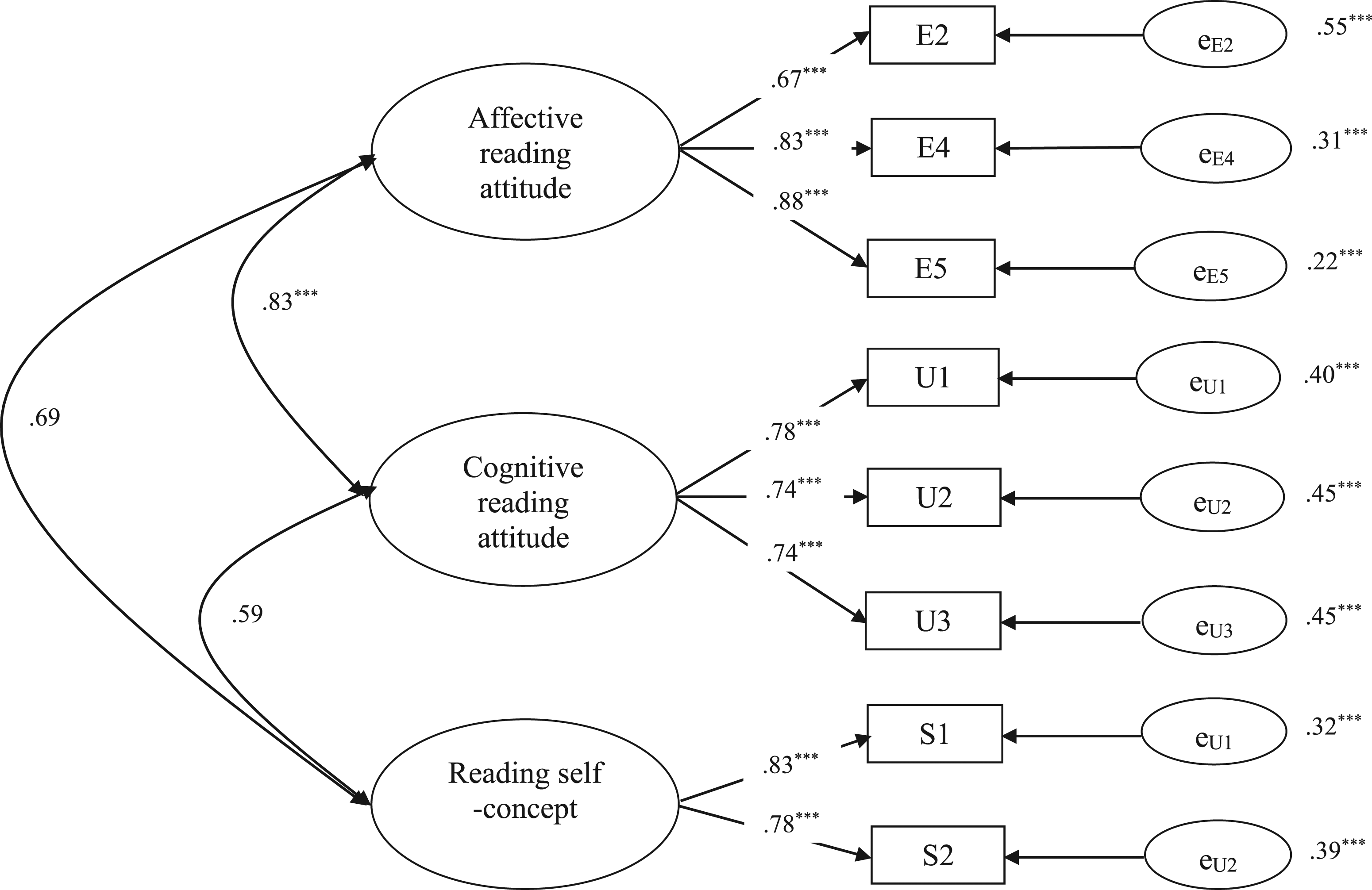
To address the major research aims, path analysis was performed to examine the relationship among the affective and cognitive components of reading attitude, reading self-concept, amount of reading for fun and for learning, and reading achievement. In this model (see Figure 2), affective reading attitude, cognitive reading attitude, and reading self-concept were assumed to have direct and indirect relations to reading achievement via amount of reading for fun and for learning, and they also had direct relations to both types of reading amounts. Standardized and unstandardized estimates of the model relating the affective and cognitive components of reading attitude and reading self-concept to reading amount and reading achievement. Note. STDYX standardized results were reported here. Significance test was only available for unstandardized estimates from path analysis with ML in conjunction with bootstrapping procedure in Mplus.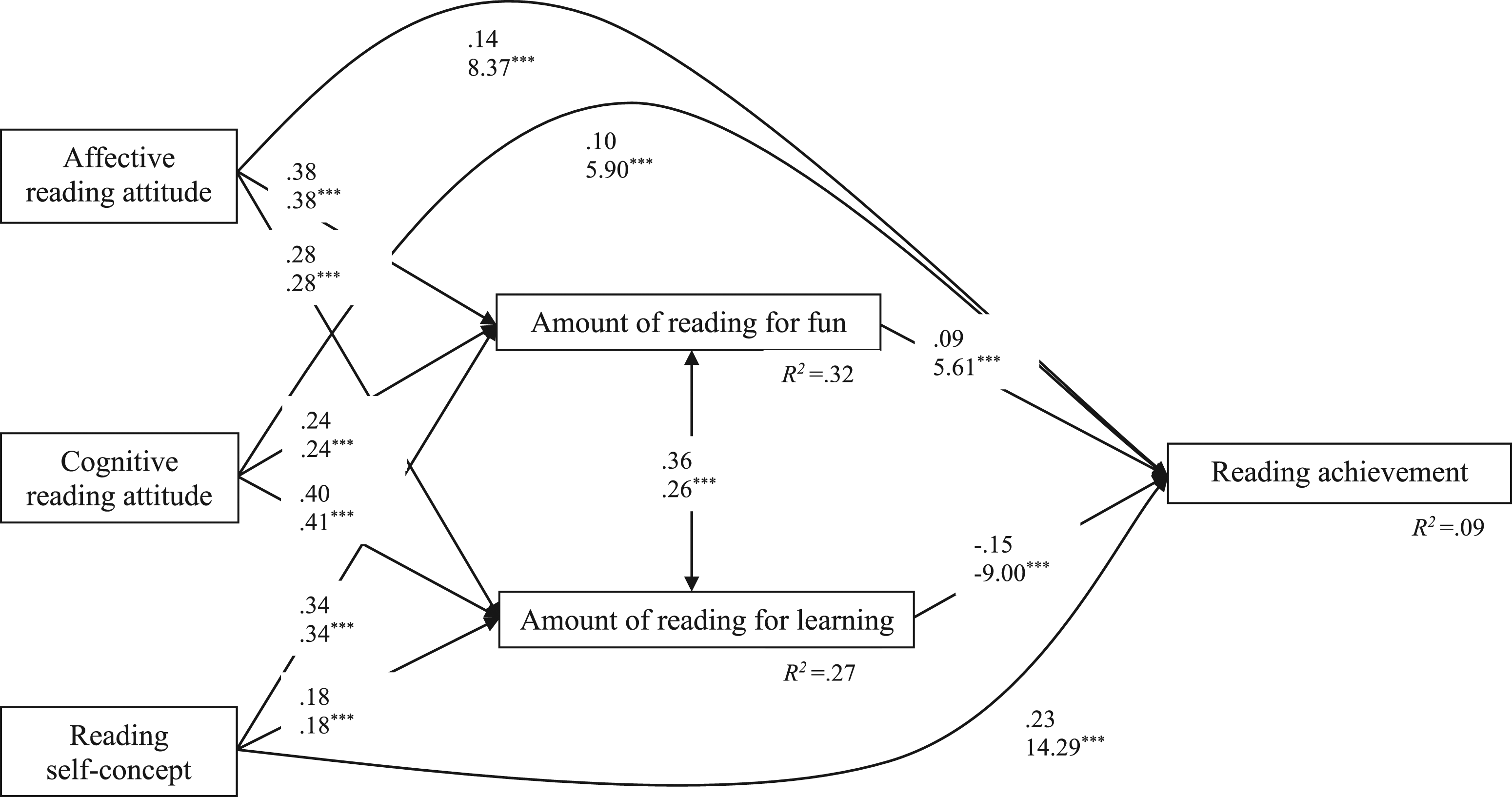
Goodness fit of the models was evaluated with the chi-square test statistics, the comparative fit index (CFI), the Tucker–Lewis index (TLI), the root mean square error of approximation (RMSEA), and the Akaike’s information criterion (AIC), as available in Mplus for ML estimation (Muthén and Muthén, 2014). Comparative fit index and Tucker–Lewis indices equal to or above 0.95 indicate a good fit, and RMSEA equals to or below 0.06 is good (Bentler and Bonnet, 1980; Hu and Bentler, 1999; Marsh et al., 2004). Akaike’s information criterion values indicate a better fit when it is smaller (Browne and Cudeck, 1992). It should be pointed out that model fit statistics should be interpreted with a detailed examination of theoretical adequacy in complement with the rough guidelines.
Results
Development and validation of the scales of reading attitude and reading self-concept
Exploratory factor analysis
Exploratory factor analysis was performed to explore the underlying structure of reading motivation and reading self-concept. The Bartlett’s test of sphericity and the Kaiser–Meyer–Olkin (KMO) measure of sampling adequacy were adopted to guarantee the appropriateness of EFA for the data. According to Lee et al., (2005), a statistically significant result for the Bartlett’s test and a KMO measure greater than 0.50 suggest that variables are correlated highly enough for factor analysis. The Bartlett test was significant (χ2 = 20,190.57, df = 91, p < 0.001) and the KMO measure was 0.90 in the present study, both of which satisfy the assumptions for EFA.
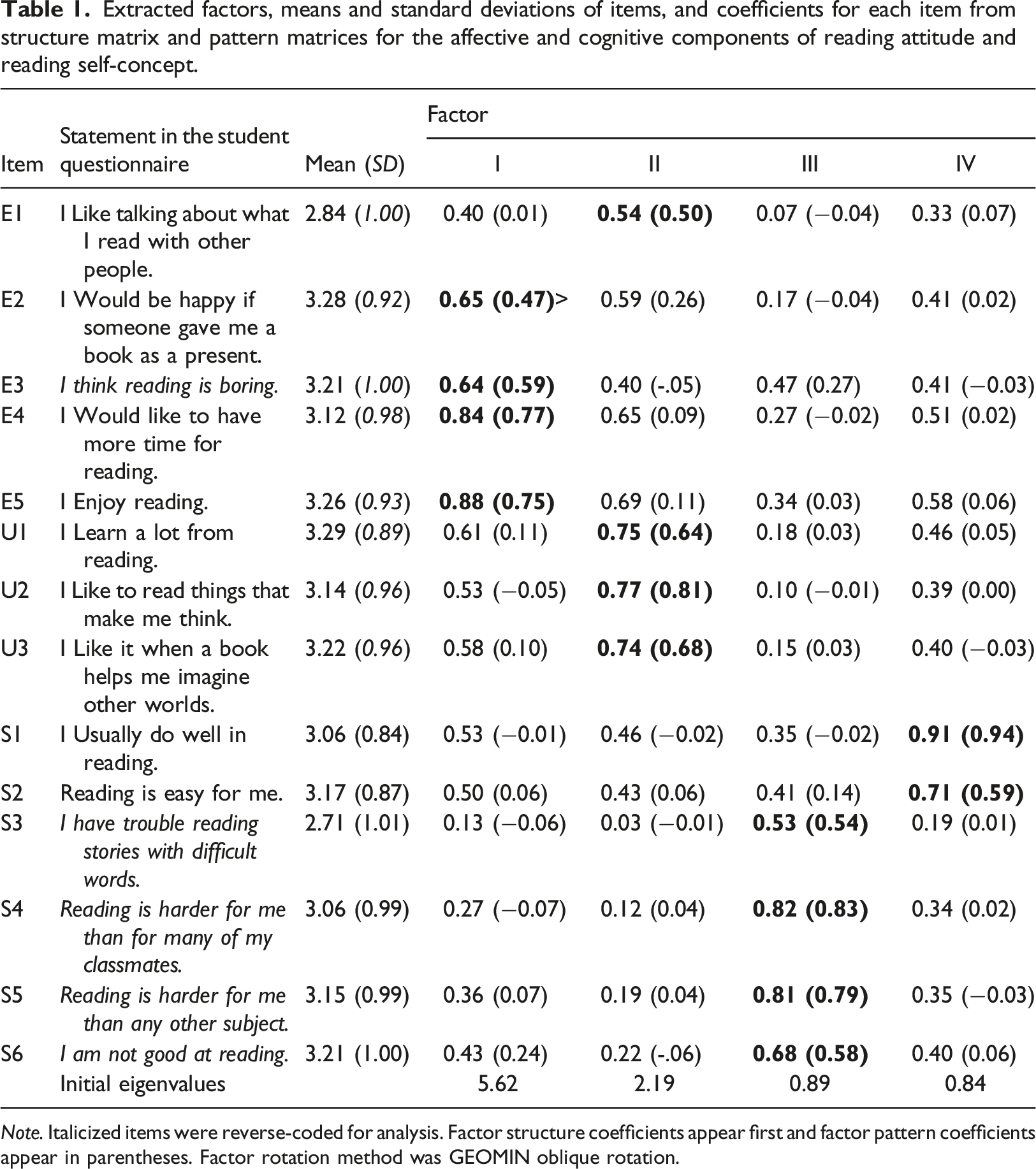
Extracted factors, means and standard deviations of items, and coefficients for each item from structure matrix and pattern matrices for the affective and cognitive components of reading attitude and reading self-concept.
Note. Italicized items were reverse-coded for analysis. Factor structure coefficients appear first and factor pattern coefficients appear in parentheses. Factor rotation method was GEOMIN oblique rotation.
The correlation coefficients among the four factors were all significant (0.15 ≤ r ≤ 0.72). Table 1 presents the extracted four factors as well as the structure coefficients and pattern coefficients for each item. The structure coefficients representing the correlations between the extracted factors and items ranged from 0.53 to 0.91. According to the pattern coefficients representing the linear combinations of observed variables or items that make up factors, all the items could be grouped into four factors. The first factor was composed of four items in the first column: E2 (“I would be happy if someone gave me a book as a present”), E3 (“I think reading is boring”), E4 (“I would like to have more time for reading”), and E5 (“I enjoy reading”). The second factor was composed of four items in the second column: E1 (“I like talking about what I read with other people”), U1 (“I learn a lot from reading”), U2 (“I like to read things that make me think”), and U3 (“I like it when a book helps me imagine other worlds”). The third factor was composed of four items in the third column: S3 (“I have trouble reading stories with difficult words”), S4 (“Reading is harder for me than for many of my classmates”), S5 (“Reading is harder for me than any other subject”), and S6 (“I am not good at reading”). The fourth factor was composed of two items in the fourth column: S1 (“I usually do well in reading”) and S2 (“Reading is easy for me”).
Inspection of the items under each factor showed that most of the negatively worded items loaded on one factor (i.e., the third factor), and most of the positively worded items loaded on the other three factors (i.e., affective reading attitude, cognitive reading attitude, and reading self-assessment), respectively. These results might suggest negative item bias in the scales of reading attitude and reading self-concept, as reported in previous studies (Marsh, 1986a, 1990b). Deleting negatively worded items has been suggested by some researchers as preadolescents are not able to respond adequately to negative items (Arens et al., 2011; Marsh, 1990b). Therefore, only the positively worded items were included to calculate the scales of reading attitude and reading self-concept. For the second factor, E1 (“I like talking about what I read with other people”) was also deleted as it loaded on cognitive rather on affective reading attitude.
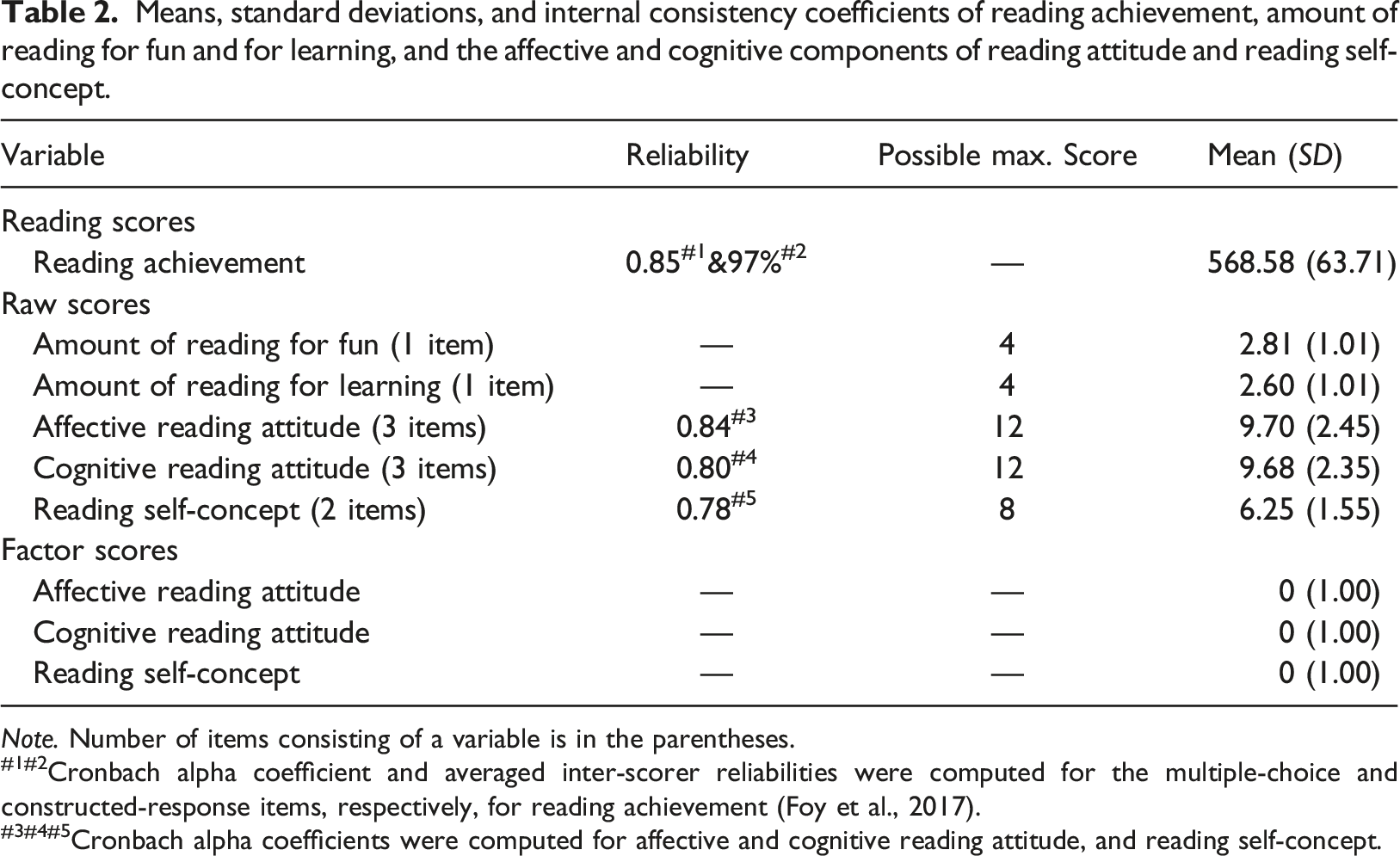
Means, standard deviations, and internal consistency coefficients of reading achievement, amount of reading for fun and for learning, and the affective and cognitive components of reading attitude and reading self-concept.
Note. Number of items consisting of a variable is in the parentheses.
#1#2Cronbach alpha coefficient and averaged inter-scorer reliabilities were computed for the multiple-choice and constructed-response items, respectively, for reading achievement (Foy et al., 2017).
#3#4#5Cronbach alpha coefficients were computed for affective and cognitive reading attitude, and reading self-concept.
Factor score estimates of these three scales were derived using the Bartlett method for path analysis. The Bartlett method was used here as it generates unbiased factor score estimates (Bartlett, 1937) which has been recommended by other researchers (e.g., Marsh, 1986b; Park, 2011).
Confirmatory factor analysis
Confirmatory factor analysis was performed to examine the adequacy of the new factors constructed from EFA. The hypothesized three-factor model for the constructs of the affective and cognitive components of reading attitude and reading self-concept (Figure 2) showed a good model fit, χ2 (17, N = 3349) = 81.15, p = 0, CFI = 0.99, TLI = 0.98, and RMSEA = 0.03. All parameters were significant at the 0.001 level. The results proved sufficient construct validity of the proposed three factors.
Descriptive statistics
As shown in Table 2, the mean scores of the three scales of reading attitude ranged from 6.25 to 9.70, indicating that readers with higher scores have more positive attitudes toward reading and higher self-concept in reading.
Correlations between derived factors and other variables
Correlations among reading achievement, amount of reading for fun and for learning, and the affective and cognitive components of reading attitude.
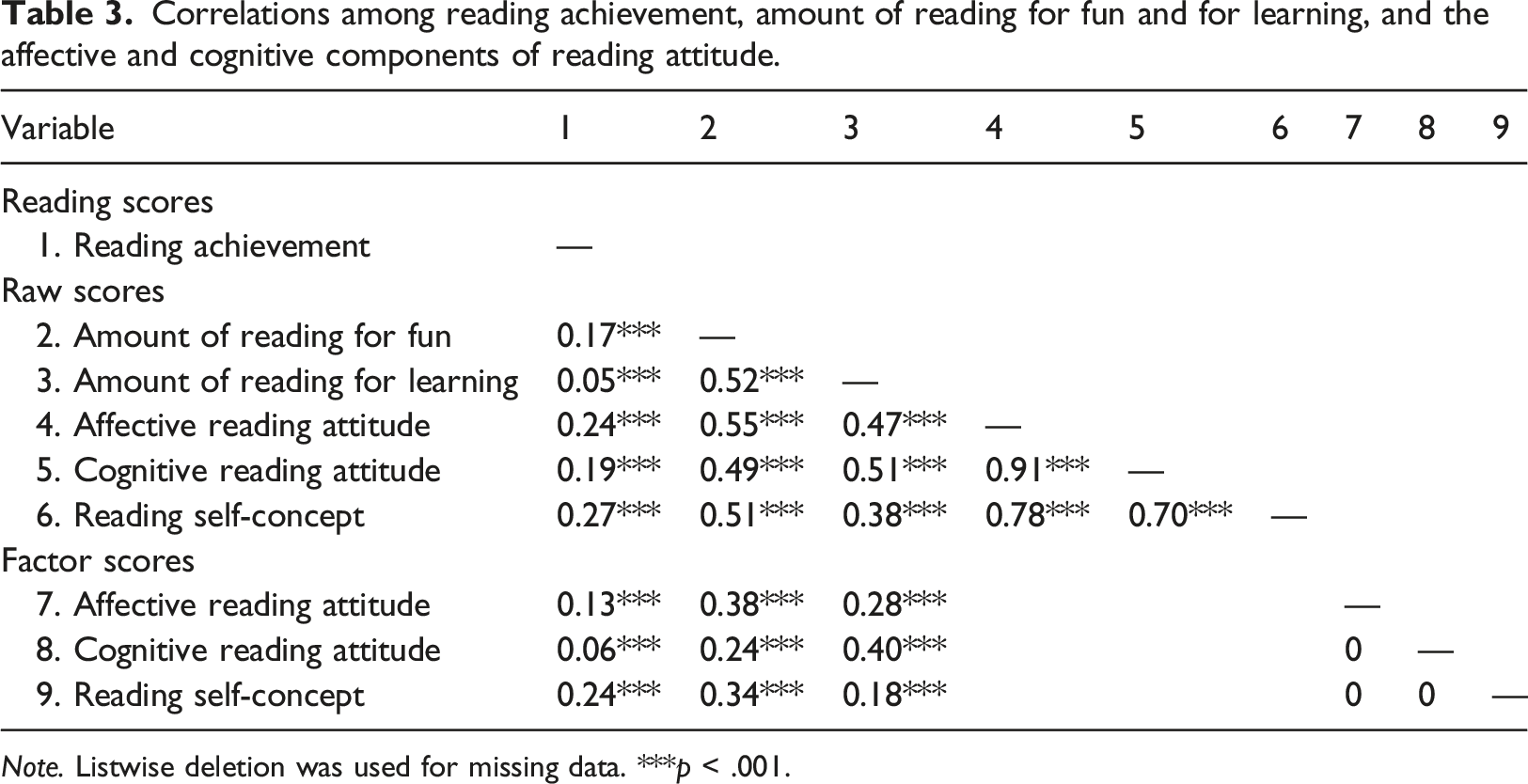
Note. Listwise deletion was used for missing data. ***p < .001.
Testing the hypothesized model of the relationship among the affective and cognitive components of reading attitude, reading self-concept, amount of reading for fun and for learning, and reading achievement
Path analysis was conducted to test the hypothesized mediation model relating the affective and cognitive components of reading attitude, and reading self-concept to reading achievement via the effects of amount of reading for fun and for learning (Figure 2). The model provided a satisfactory level of fit to the data (χ2 (0, N = 3349) = 0, p = 1, CFI = 1, TLI = 1, and RMSEA = 0.
Figure 2 presents the unstandardized and standardized parameter estimates of the Model. The model accounted for 32%, 27%, and 9% of the variance in amount of reading for fun, amount of reading for learning, and reading achievement, respectively. Affective reading attitude, cognitive reading attitude, and reading self-concept made direct contributions to reading achievement significantly (t = 7.04, p < .001; t = 4.79, p < .001; and t = 12.32, p < .001, respectively). Amount of reading for fun was positively associated with reading achievement (t = 4.10, p < .001), whereas surprisingly, amount of reading for learning was negatively associated with reading achievement (t = −5.29, p < .001). Moreover, affective reading attitude, cognitive reading attitude, and reading self-concept were positively related to amount of reading for fun (t = 23.80, p < .001; t = 15.77, p < .001; and t = 21.24, p < .001, respectively), and to amount of reading for learning (t = 17.58, p < .001; t = 25.99, p < .001; and t = 10.78, p < .001, respectively). Notably, the relation of affective reading attitude with amount of reading for fun was stronger than that with amount of reading for learning, and the same pattern of results was also found for the relations of reading self-concept with amount of reading for different purposes, while the relation of cognitive reading attitude with amount of reading for learning was stronger than that with amount of reading for fun (see the standardized path coefficients in Figure 2). The different patterns of associations of affective reading attitude, cognitive reading attitude, and reading self-concept with amount of reading for fun and for learning and with reading achievement revealed a complex relationship among these constructs.
As for the mediation effects, the indirect effects of affective reading attitude on reading achievement via amount of reading for fun and for learning were significant (coefficients for the indirect effects = 0.04 & −0.04, respectively, p < .001). Likewise, the indirect effects of cognitive reading attitude on reading achievement via amount of reading for fun and for learning were also significant (coefficients for the indirect effects = 0.02 & −0.06, respectively, p < 0.001). Reading self-concept contributed to reading achievement via the effects of amount of reading for fun and for learning (coefficients for the indirect effects = 0.03 & −0.03, respectively, p < .001). Of special concern is the negative indirect effect of the three scales on reading achievement via amount of reading for learning, which indicates that students with stronger reading attitudes toward reading tended to initiate more reading behavior for learning objectives which negatively predicted their reading achievement. These results will be discussed in more detail later.
Discussion
The present study examined the multidimensional structure of reading motivation, using the measures of reading attitude and self-concept from PIRLS 2016. It also tested the contributions of the cognitive and affective components of reading attitude as well as reading self-concept to reading achievement, and examined how these constructs alongside with reading amount predicted reading performance, to further our understanding of reading attitude and self-concept and their importance. The main findings were discussed as follows.
Understanding the multidimensional nature of reading motivation
This study found that the two constructs hypothesized by PIRLS 2016, reading attitude and self-concept, could be restructured to be further distinguishable into the cognitive and affective components. Such separation of reading attitude into cognition and affect is consistent with the multicomponent view in attitude research (Ajzen, 1989; Mathewson, 1994; McKenna, 1994; Mizokawa and Hansen-Krening, 2000; Ruddell and Unrau, 1994).
Result of the CFA validated the fit of this restructured construct of reading motivation (see Figure 1). Therefore, the three motivational scales should be treated as conceptually independent components of reading motivation. The findings from this study provide compelling empirical evidence in support of the distinctiveness of the cognitive and affective components of reading attitude. Moreover, the current investigation extends previous findings that it corroborated reliable indicators of the affective and cognitive components of reading motivation. In this study, the affective component of the reading attitude construct was indicative of enjoyment and the cognitive component was operationalized as utility. Hedonic and utilitarian experiences are very influential in forming students’ reading attitudes (Broeder and Stokmans, 2013; Stokmans, 1999). In addition, self-perception of reading performance often provides new information that may change existing beliefs and hence have an impact on building subsequent attitudes toward reading. Therefore, the present findings provide substantial evidence to include enjoyment, utility, and self-concept into the reading motivation construct.
Although the present study is in line with the finding from previous studies which showed that reading attitude and reading self-concept are distinguished motivational constructs (Möller and Bonerad, 2007; Park, 2011; Wigfield and Guthrie, 1997), this issue remains inconclusive. Schiefele et al. (2012) proposed that reading attitude belongs to the category of genuine reading motivational constructs, similar to the concepts of intrinsic and extrinsic reading motivation which appear as subjective reasons for reading. In contrast, reading self-concept could be classified into the category of antecedents of reading motivation as it is the precondition of reading motivation and it reflects the expectation of successful reading. Therefore, the appropriateness of reading self-concept as a differentiable motivational construct should be subject to more in-depth research.
Understanding the relationship among reading attitude, reading self-concept, reading amount, and reading achievement
Results of the path analysis confirmed the expectation that the three components of reading motivation have differential relations to reading achievement, which have been reported in previous studies (Park, 2011; Retelsdorf et al., 2011), suggesting that reading motivation is a multidimensional construct and hence it is not always appropriately to be measured with a composite score for different dimensions or facets of motivation (Schiefele et al., 2012).
The positive relation between reading self-concept and reading achievement found in this study provides support for the self-enhancement approach which posits that academic self-concept is primarily a determinant of academic achievement (Calsyn and Kenny, 1977). Additionally, stronger association was found between the enjoyment factor (indicative of affective reading attitude) and achievement rather than between the utility factor (indicative of cognitive reading attitude) and achievement (see the standardized path coefficients in Figure 2). This finding is in accordance with the findings from previous research that intrinsic reading motivation positively and significantly contributes to reading competence, but extrinsic reading motivation either negatively or not significantly contributes to reading competence (Andreassen and Braten, 2010; Becker et al., 2010; Law, 2008; Retelsdorf et al., 2011). Although intrinsic reading motivation (i.e., the enjoyment factor in this study) tackles the incentives involving the reading process, extrinsic reading motivation is more related to the consequences of reading (Schiefele et al., 2012).
Regarding the contributions of the motivational constructs to reading behavior, the relation between affective reading attitude (i.e., enjoyment) and amount of reading for fun was more strongly visible as compared to amount of reading for learning. In other words, students are more motivated to use more of their leisure time to engage in reading activities when they feel joyful than when they feel stressed to read something (e.g., school work). In contrast, cognitive reading attitude (i.e., utility) had a stronger relation with amount of reading for learning than that with amount of reading for fun, indicating that students are more inclined to read something useful when they are aware of the relevance of the materials to academic success. Despite the consensus among researchers that both intrinsic and extrinsic are closely related to amount of out-of-school reading (Cox and Guthrie, 2001; Guthrie et al., 1999; Wang and Guthrie, 2004), only some studies reported that intrinsic motivation was more related to amount of reading for enjoyment than was extrinsic motivation while extrinsic motivation was more related to amount of reading for school (Baker and Wigfield, 1999; Becker et al., 2010; Wang and Guthrie, 2004). These findings were replicated in this study, suggesting that whereas intrinsic motivation (e.g., enjoyment) plays a significant role in increasing enjoyment-reading amount, extrinsic motivation (e.g., utility) positively and significantly contributes to amount of reading for school/learning.
For reading self-concept, the present result confirmed the concurrent positive correlation between reading self-concept and amount of reading for enjoyment in previous studies (Durik et al., 2006; Möller and Bonerad, 2007) and extends the previous finding that such correlation was also strong even when the relation between reading self-concept and amount of reading for learning was taken into account.
With respect to the mediation of effects of reading attitude on reading achievement through amount of reading for fun, both the affective and cognitive components were found to have significant and positive indirect effects on reading achievement via the influence of amount of reading for fun. The current data are in line with the previous evidence that reading attitude has impact on students’ levels of reading ability mainly by means of its influence on reading behavior (McKenna et al., 2012). Favorable attitudes toward reading such as thoughts of the positive emotional consequences of reading and utilitarian consequences of a reading behavior examined here increase frequent reading activities, which increases reading effectiveness by means of enhancing the automatization of reading processes to free up resources for text comprehension (Guthrie et al., 1999). This explanation also applies to the indirect association between reading self-concept and reading achievement mediated by amount of reading for fun given that reading-related competence beliefs enhance reading frequency, which in turn promotes students’ abilities of reading comprehension (Guthrie et al., 1999).
The affective and cognitive reading attitudes were measured with the indicators of enjoyment and utility, respectively, which are analogous to the subscales of the MRQ: involvement and grades accordingly (Schiefele et al., 2012; Wigfield and Guthrie, 1997). The examination of similar motivational dimensions in the MRQ makes the present results comparable to previous findings from research on reading motivation. Although reading amount is the most important potential mediator proposed in literature, there is scarce evidence for its mediating role in the association between reading motivation and reading competence. Convincing evidence was provided by McElvany et al. (2008) and Becker et al. (2010) who used a same data set in their longitudinal studies in which a significant indirect effect of Grade 3 or 4 intrinsic motivation on Grade 6 competence mediated by reading amount was obtained and no substantial indirect effect of extrinsic motivation was observed. However, there was no indirect effect of Grade 4 intrinsic or extrinsic motivation on Grade 6 competence mediated by reading amount when both Grade 4 intrinsic and extrinsic motivation as well as Grade 3 competence were added to the structural equation model (Becker et al., 2010). Moreover, Grade 6 competence was significantly and negatively predicted by Grade 4 extrinsic motivation and significantly and was significantly and positively predicted by Grade 3 competence (Becker et al., 2010). It seems that the failure to demonstrate a significant mediation effect of intrinsic motivation on competence through reading amount is most likely due to the addition of extrinsic motivation or other reading-related variables (e.g., reading competence) in the analyses.
As intrinsic and extrinsic reading motivation were found to be highly correlated to each other or with other relevant constructs (e.g., reading self-concept) in previous studies, the inclusion of measures of intrinsic and extrinsic motivation as well as other highly correlated constructs in a model may yield nonsignificant or even negative relations between intrinsic or extrinsic motivation on one hand, and reading amount and performance on the other hand, and thus no mediation effects were induced (De Naeghel et al., 2012; Wang and Guthrie, 2004). Therefore, it could be expected that there would be substantial significant relations between intrinsic or extrinsic motivation on one hand, and reading amount and performance on the other hand, or even a significant indirect effect of intrinsic or extrinsic motivation on performance via reading amount when there was no or low correlations among the predictors in a model. This expectation was evidenced by the present findings that reading achievement was predicted significantly and positively by enjoyment (i.e., the indicator of affective reading attitude representing intrinsic motivation) and utility (i.e., the indicator of cognitive reading attitude representing extrinsic motivation), and reading self-concept directly and indirectly via the effect of amount of reading for fun. It should be noted that no suppression effect among the predictors in the model was observed in this study as there were no correlations among affective and cognitive reading attitude, and reading self-concept (see the factor correlation coefficients among the variables in Table 3).
Interestingly, affective and cognitive reading attitude, and reading self-concept were also found to have significant and negative indirect effects on reading achievement through the influence of amount of reading for learning. These results may suggest that when students feel internally or externally pressed to read for their learning during their leisure time (e.g., to read for home assignments), the pressure experienced by students might result in their poor reading performance. This is in line with the result of De Naeghel et al.’s study (2012) that recreational controlled reading motivation was reported to have a significantly negative relation with reading comprehension. The negative associations observed in this study are subject to further investigation in future studies.
Research and educational implications
First, the present study supported the multidimensional and multifaceted nature of reading motivation. This highlights the importance for our understanding the nature of reading motivation. To improve theoretical models of reading motivation, this construct should be understood as a complex system in which various motivational dimensions have differential relations with reading behavior and performance.
Second, the present study also supported the important role of reading attitude and reading self-concept in relation to reading behavior and performance. This particularly highlights the importance of parents’ and teachers’ attitudes towards reading in fostering children’s reading performance. Community context for learning to read in Hong Kong, Confucian ideas form the basis of the attitudes and principles held by Chinese educators, families, and children. “Respect for examinations and competition, which are commonly seen as characteristic of the East Asian education systems, are inherited from very ancient practice” (Cheng and Wong, 1996, p. 42). Therefore, Chinese parents and teachers invariably have high expectations of children’s academic success and encourage them to read a lot. Chinese students themselves tend to have positive attitudes towards the value of being able to read well and are willing to work hard to achieve academic success (i.e., utility motivation). However, affective reading attitude (e.g., reading for enjoyment) had a stronger association than cognitive reading attitude (i.e., reading for learning) with reading performance in this study. This finding may suggest that reading as a way of developing literacy skills as well as demonstrating parents’ and teachers’ valuing of reading should be both emphasized in the community. The results of this study also offered some new lights into how to design tailor-made intervention programmes for Chinese students with learning difficulties such as Chinese dyslexic students. Given the stronger link of reading achievement with affective reading attitude than with reading for learning, we need to consider ways to extend students’ experience in reading for enjoyment (e.g., selecting appropriate books and engaging them into reading interactive activities).
Finally, results from the present study demonstrated a positive relation between reading self-concept and reading for fun but a negative association with reading for learning. One practical implication of these findings may be that reading programmes should be designed and delivered in a more enjoyable way. Students could view themselves as competent readers through those instructional activities with both on enhance their reading skills and stimulate their reading interests.
Footnotes
Declaration of conflicting interests
The author(s) declared no potential conflicts of interest with respect to the research, authorship, and/or publication of this article.
Funding
The author(s) received no financial support for the research, authorship, and/or publication of this article.
