




Abstract
Introduction
Pakistan inherits a legacy of more than seventy (#70) vernaculars spoken (Abbas et al., 2017). The 1973 Constitution officially recognizes Urdu as Pakistan’s only national language (Kamran, 2019). Urdu being adopted as a national language has a wider range of applicability and transmissibility across several countries in Asia and South Asia (Maqbool et al., 2018). Urdu is among the top 25 languages spoken in the world. A population of over 100 million speaks Urdu in different countries (Muzaffar et al., 2019).
Adoption of Urdu as national language by a multi lingo-racially mosaic country, Pakistan, has the religio-historical and cultural inspiration of the nation (Datla, 2013). Moreover, teaching-learning objectives framed for the interest of the country stem from the socio-cultural learning theory of Vygotsky (Maqbool et al., 2018). Furthermore, Vygotsky's theory also spotlights critically on lingo-cultural interference in learning (Maqbool et al., 2018). It significantly connects with culture, society, and environment enabling them to obtain new information. Language aptitudes are especially basic for making meaning and connecting new thoughts to past encounters and earlier information (Hamilton & Ghalala, 1994); Dahms et al., 2007). Vygotsky claimed that language is considered a basic principle component in subjective improvement (Maqbool et al., 2018). Pakistan being a Muslim-majority country people and thinkers also believe that the Holy Quran also highlights the importance of mother tongue (Parveen et al., 2007).
The need to connect with students is necessary to successfully transfer learning (Launio, R. M. 2015). Inherently Pakistan carries diverse lingo-racial populations. However, weak policy for the medium of instruction and its implementation lead to several difficulties and differences (Akinnaso, 1993). Children raised with mother tongue (vernacular), spoken in Urdu, and taught in English (Mills, 2004). Many schools in Pakistan follow English as a medium of instruction (Rashid et al., 2016). This is difficult to understand for learners (Tehseen, 2013). This dilemma creates a teaching-learning gap between students and teachers. Hence, there is a barrier between education and the environment (Rashid et al., 2016). Pakistan has four provinces, and every province has its language. Inside schools’ different languages for communication are used in the country.
Similarly, research has revealed that the use of Urdu in teaching Mathematics to primary school students had a positive impact (Maqbool et al., 2018). This impact was observed significantly in Urdu medium classes rather than in English medium (Mahmood and Gondal, 2017). Building on the importance and utility, Khalique (2007) claimed that Urdu should also become the main language of academic discourse nationally for humanities, physical, and social science subjects. The use of Urdu infuses a high level of aspiration and self-efficacy compared to English at schools (Shakoor et al., 2007).
In South Asia and outside, it is the most frequently spoken and understood by more than 100 million people. Since colonial times, Urdu has remained influential across a range of portfolios including the court of law, official documentation, religiopolitical presentation, and transmission. Moreover, it has been born in the region with a synergistic exhibit with its culture, tradition, and values and their transformation.
An acute controversy and confusion exist among the policymakers, academic planners, and managers regarding the selection and adoption of any language for medium of academic instructions in the country (Kanu, 2005). The current investigation was aimed to reach a tangible conclusion that would reflect the utility and role of Urdu as a medium of instruction. Findings will help to broaden understanding of the role and utility of national language, that is, Urdu, in Pakistan particularly and the rest of the world in general. Moreover, it will also have an impact on the development of the nation.
Material and method
A total of hundred (N = 100) university teachers in Pakistan were interviewed randomly using a standard data tool. Responses were recorded using the Likert Psychometric Summative Ranking Scale (1: Strongly Disagree to 5: Strongly Agreed). A quantitative–qualitative mixed method was used. Following the Pre-test and dry run, the data tool was optimized, and then actual data was gathered. Almost 30% of data was collected through personal/official emails from different universities in different provinces.
Before export to SPSS, data was digitized in MS Excel (365). Data cleaning was made and exported to SPSS v.16 for further process. After testing data normality, descriptive (mean, standard deviation, standard error, ranges, frequencies, percentages, percentile, and cross tabs) and inferential statistics (Regression) were applied for analysis.
The Likert Summative Ranking Scale was applied to the given questions for data gathering:
Q1: Does Urdu promote unity in society?
Q2: Does Urdu enhance brother and sisterhood in society?
Q3: Does Urdu can help the realization of the national development dream?
Q4: Does Urdu will bring harmony to society?
Q5: Does Urdu will make educational development possible?
Q6: Does advanced research will only be possible with using Urdu?
Q7: Does Urdu can fulfill the needs of the nation?
Q8: Does the effective transmission of social and cultural heritage will be possible only using Urdu?
Q9: Does effective teaching-learning will be possible using Urdu?
Q10: Do academic and professional advancement possible with using Urdu?
Q11: Does the adoption of Urdu can satisfy the objective of creating Pakistan?
Q12: Does adoption of Urdu can help civilizational evaluation of nation?
Q13: Does Urdu can realize social stability?
Q14: Does the adoption of Urdu will improve the national Identity?
Q15: Does Urdu would be effective in creating social relations and networking?
Results
Investigation revealed that on an average (mean), 58.0% respondents “strongly agreed” to all 15 questions followed by 9.6% “agree,” 10.7% “neither agree nor disagree,” 12% “disagree,” and 9.6% “strongly disagree”. Around 68% (Sum 67.6 = 58.0% strongly agreed + 9.6% agreed) respondents collectively showed confirmed agrees with the overall questions positively. Similarly, around 22% (21.6 = 12% strongly disagree + 9.6% disagree) did not favor in the whole (Figure 1). Response distribution of Likert psychometric summative ranking scale.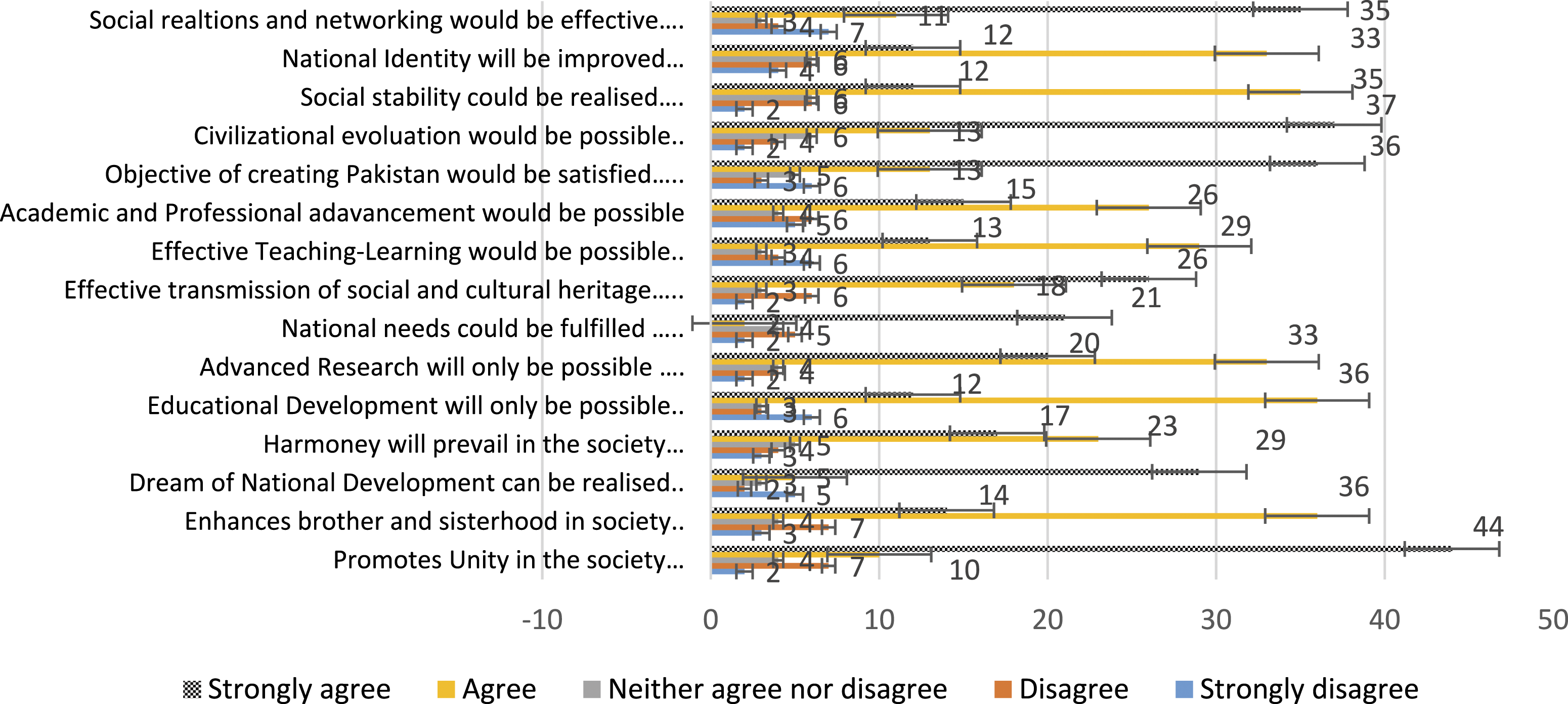
ANOVA b .
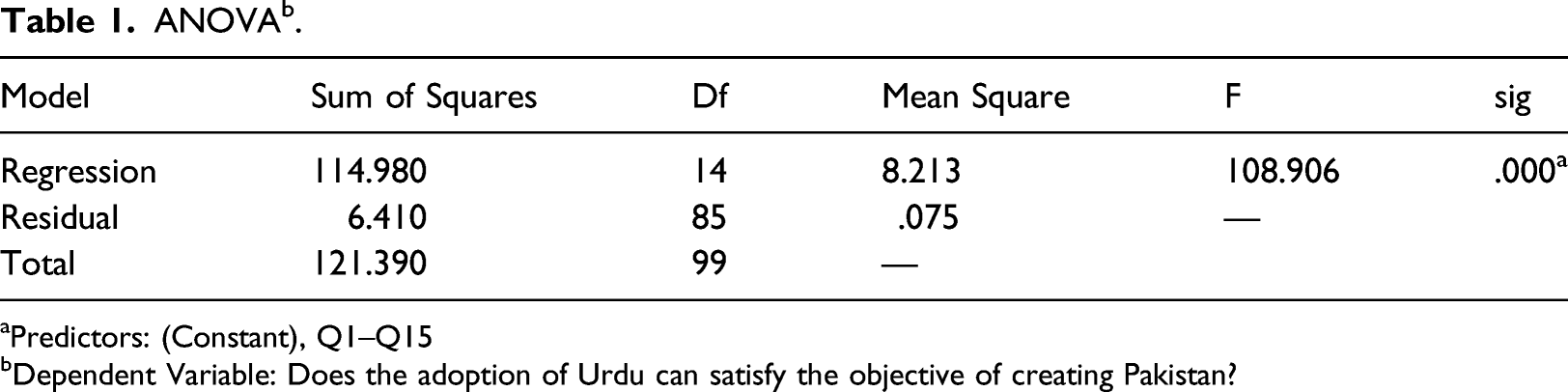
aPredictors: (Constant), Q1–Q15
bDependent Variable: Does the adoption of Urdu can satisfy the objective of creating Pakistan?
Model Summary d .

cPredictors: (Constant), Q1–Q15.
dDependent Variable: Does the adoption of Urdu can satisfy the objective of creating Pakistan?
Statistics.

This means that teachers and academicians across Pakistani universities believe that the use of Urdu as a medium of instruction and its utility across all walks of life is critically important to realize the dream of creating Pakistan. There is no question recorded that has strong negative feedback from the respondents.
Discussion
Controversy over the adoption of a language as a medium of academic instruction has been an ongoing problem for several nation-states in general and Pakistan particularly. Several studies are in favor of English as a medium of academic instruction (Mehboob, A, 2017; Nisar and Ahmad, 2011). The medium of instruction is crucial in transforming education and making it easier or difficult for a student. In Pakistan, there is a considerable gap in the attitudes of the students getting the education in English, Urdu, and regional languages (Tahir, 2019; The Dawn, 28 July 2019).
Moreover, this problem becomes a dilemma when different power players sitting in the bureaucracy, parliament, and judiciary (Amir, 2008; Manan et al., 2015). Bureaucracy favors English to be the medium of instruction in academic institutions, parliamentarians try to be the voice of the public favor Urdu, and the apex court in Pakistan also has a ruling to make Urdu as not only the medium of educational instruction but also to be part of all public interest publication in Pakistan (The Dawn, 28 July 2019). Academicians have never been a strong voice to contribute into this power play. Due to such confusion, there is no uniform curriculum in the country (The News, Sept. 9, 2020).
Present investigation brings forward the voice of academicians as they are the true implementers, managers, and promoters. Current research does not support Mehboob, A. (2017) and Nisar and Ahmed (2011). Present research supports the use of the Urdu as a medium of academic instruction (Farouqui, 1994). The use of Urdu will contribute to economic growth development in the region. Moreover, the adoption of Urdu will help students to understand and digest more as compared to the use of English. Academicians in the country strongly believe that Urdu will help to synchronize teaching-learning with culture and environment making people connected with their heritage and history at large. This will fruit as fast development and promotion of harmony across communities living in the country.
Conclusion
The conclusion of this investigation comprising upon analytical and standardized scientific opinion taken from 100 university teachers and academicians across Pakistan showed that the national language can play a critical role and of highly important when it comes to its utility. It plays a role in social stability, fostering harmony across different lingo-racial diversity, improves humanistic approaches through establishing brother and sisterhood among the population, and paves the path to ownership of the country, its heritage, culture, development, and strategic drive. Moreover, it plays a vital role in fulfilling the objective of creating a country and its identity among other nations of the world.
This research summarizes and recommends that the use of national language in all walks of the nation’s life is important to achieve social, cultural, developmental, strategic, academic, and scientific and identity goals amicably.
Footnotes
Acknowledgments
We gratefully acknowledge The Federal Urdu University of Arts, Sciences & Technology, Karachi, Pakistan, for providing inputs in this study. Acknowledgment is also made to the supervisor Prof. Dr. Muhammad Ashraf Khuram for his moral support. I acknowledge faculty of the department of Education for helping with this research.
Declaration of conflicting interests
The author(s) declared no potential conflicts of interest with respect to the research, authorship, and/or publication of this article.
Funding
The author(s) received no financial support for the research, authorship, and/or publication of this article.