




Abstract
The last two decades have seen the emergence of a global education paradigm that has reimagined education through the lens of neo-liberal ideology. Education policy agendas and discourses in current times are globally governed through transnational networks, which have increased the opaqueness of education policymaking. For critical policy researchers, the challenge is to respond with new methodologies that can capture and critique the increasingly diffuse, fractured nature of contemporary policy processes. This article presents one such methodology, where Foucauldian genealogy is used to construct a history of the discourse of ‘quality’ in early childhood reform policy in Australia. The genealogical approach is combined with ‘network ethnography’, which uses interviews with policy actors and the construction of policy network and mobility maps to undertake a governmentality analysis of discourse production. The preliminary findings emphasize the global spread of a positivist discourse of quality, and discuss its neo-liberal ideological ties and policy uses in Australian early childhood policy. The tactical use of human capital theory in the Australian Early Years Learning Framework is uncovered, wherein government discourse control resulted in the creation of learning outcomes for children, intended for use as a performativity structure.
Introduction
The emergence of a global policyscape has had major implications for education, with the last two decades determining ‘major shifts in the ways in which education policies are developed, implemented and evaluated’ (Rizvi and Lingard, 2010: 22). There is now a type of globalized education policy paradigm (Ball, 2003, 2012b: Rizvi and Lingard, 2010) that has been taken on by developed and developing countries alike, due to sponsorship by powerful international organizations (Olssen et al., 2004). This represents a policy shift from ‘government to governance’ (Rizvi and Lingard, 2010: 117), with an increasing number of non-government agents participating in education policymaking due to the advancement and motives of neo-liberal globalization. Education policy reform and discourse production in current times takes into consideration world ideologies and happenings, such as the global economy, migration and national security. As Rizvi and Lingard (2010) point out, the concern is that the global governance of education represents an ideological shift, from governments attempting to make policy for people, to governments making people for policy.
Through the processes of global governance, education policy reform and discourse is understood to be uniquely mobile through complex policy networks, within which state action is ‘framed and conditioned by a dense web of international legal and political obligations’ (Verger et al., 2012: 10). The term ‘mobility’ is consciously applied here because it distinguishes the flow of policy through governance processes from the pre-existing practices of policy transfer or policy borrowing between countries (Peck and Theodore, 2010). These tend to favour existing ideological lines, meaning that the balance of power lies not only with those who have input into education policy, but also with those who work towards reimaging education and what it is for (Moutsios, 2010).
Global governance has been particularly problematic for education, whereby sanctioned policy agenda and discourse has created an increasingly hegemonic neo-liberal policyscape by ‘standardizing the flow of educational ideas internationally and changing fundamentally what education is and can be’ (Carney, 2009: 68). For education policy, this standardization has presented as the key policy priorities of privatization, accountability and competition (Clarke, 2012: 175), typically executed from the 1990s through ‘modern’ governance strategies called new public management (NPM). Championed by international organizations such as the World Bank, the European Union and the Organisation for Economic Co-operation and Development (McNutt and Pal, 2011; Mahon, 2010), NPM involves stimulating and monitoring markets through accountability measures (outputs), distancing government involvement (Irvine and Farrell, 2013).
This ‘neo-liberalisation of education’ (Ball, 2012b: 18; original emphasis) can be considered problematic in that it limits the choices available for education provision, and does so based on economic and political dogma, rather than research-based evidence (Moss, 2009). Difficulty resisting the neo-liberalization of education is increasing, due to the restriction of viable alternatives through the marketing and circulation of desirable education packages worldwide (Ball, 2012b; Verger et al., 2012). The result is that similar policy packages are being applied in many parts of the world, based on shared reform discourses and ambitions (Verger et al., 2012).
The doctoral study reported in this article sought to investigate one such dominant education reform discourse: quality reform, which rapidly took hold of the Australian early childhood education and care (ECEC) sector after a change of federal government in 2007, ending decades of relative policy obscurity (Cheeseman and Torr, 2009). The positivist assumption of a universal, measureable state of ‘quality’ will be problematized, and its use within neo-liberal-inspired policies in ECEC in Australia will be discussed.
The complexities of the global education policyscape mean that while ‘all policy is local’ insofar as the development and implementation is contextually specific, the discourse on which it ‘hangs’ rarely is (Peck and Theodore, 2010). Taking this into consideration, the study deployed neo-Foucauldian genealogy as an approach through which to create a history of discourse that considered local and global contexts. This was supported by ‘network ethnography’ (Ball, 2012b), a qualitative method that uses insider accounts and visual mapping to further insights into policy and discourse governance and the ambitions that underpin it. The first section of this article further outlines the methodology, and the second section demonstrates its application by reporting some preliminary findings in two parts: a genealogy of the discourse of quality in ECEC policy in Australia prior to reform (1980s–2006), followed by a genealogy of the discourse of quality during reform, with network ethnography. The goal is to disrupt the taken-for-granted assumptions inherent in the policy constructions of quality over time, in order to view their tactical uses in the present day and the theoretical and non-theoretical implications (Doherty, 2007).
Conceptual framing and methodology
Genealogy is a research approach or intent to create a history for that which is considered without history, such as truth, knowledge or discourse, and to determine how these understandings become an ‘item of popular imaginary [enshrined] within the true’ (Foucault, 1971: 16). Here, the definition of discourse is particularly important because it denotes the subject of inquiry, which within Foucauldian historiography is the conditions in which we consider certain statements to be the ‘truth’ (Ball, 2012a). In Foucault’s analytics of discourse, statements are a central concept because discourse is defined as groups of statements occurring from within a system (Doherty, 2007). Statements are ordered and patterned according to the rules-based systems within discourse, meaning that they create a type of border through which to locate discourse (Foucault, 1970) . Foucault (1991b) called this the ‘discursive field’. Statements and groups of statements contribute to discourse but do not define it, because they often overlap, contradict and complement each other in their plurality. The goal of genealogy, therefore, is to disrupt the taken-for-granted continuity of the system, uncovering the patterns and ordering of statements, or the statements themselves (Doherty, 2007). This is not to say that genealogy constructs the actual truth, or reality, but simply that it offers another account, another way of seeing or ‘reading’ the present.
Genealogical approaches tend to be concerned with how power inscribes itself at the site of the individual, or ‘on the body’; therefore, this study employed Foucault’s later work on governmentality as a theoretical framework that could broaden the power analytics to an institutional level that would be more explanatory for policy analysis (Doherty, 2007; Foucault, 1991a). In governmentality, Foucault’s theories of power, knowledge and discourse come together as a lens for analysis that aims to uncover and understand ‘truth politics’, or how governments attempt to create power mechanisms that govern populations: ‘It captures the way that governments and other actors draw on knowledge to make policies that regulate and create subjectivities’ (Bevir, 2010: 423). This emphasizes the changing political rationalities and ambitions that drive how the government governs, and who or what is governed (Tikly, 2010). The governmentality lens is a historical one, and the emphasis that it places on the consequences of discourse is uniquely productive for policy analysis (Doherty, 2007). I take on Doherty’s (2007) suggestion of conceptualizing governmentality as a ‘prism’, through which we aim to see and construct an account of government reasoning.
In practice, genealogy is ‘grey, meticulous and patiently documentary’ (Foucault, 1998: 369) – a process that involves the critical analysis of historical documents and related texts. In this study, historical and research literature, policy documents and statements, and political documents (including speeches) from governments and organizations worldwide were considered within the scope of analysis.
Genealogy with network ethnography
The study assumed that more than documentary analysis was needed to uncover in policy discourse the power/knowledge struggles that Foucault (1998) considered vital to genealogy. This argument has been made elsewhere with regard to integrating critical policy analysis with interviews with policy actors (Bown, 2014; Logan et al., 2015), and deploying genealogy for critical policy analysis with interviews with policy subjects (Hill, 2009; Middleton, 2003; Pillow, 2003). However, capturing the mobility of education discourse remains a challenge, which I addressed through an application of Ball’s (2012b) ‘network ethnography’ method.
Network ethnography, as presented by Ball (2012b), is a qualitative method that involves the use of interviews with policy actors and the development of visuals or charts to inductively map policy networks and policy mobility. This is carried out through the identification of the social relations, histories, ideologies, and so on that impact policy governance in the local and/or global context (also see Howard, 2002). Ball (2012b) calls this a mapping of the ‘how’ of neo-liberalism: how policy is deployed and how that deployment interacts with culture, identity and subjectivity.
In the second part of the findings presented in this article, the network ethnography appears qualitatively through quotations and discussion, and as ‘maps’, layered within the genealogy to expand and guide the enquiry and critical narrative. Personal accounts from policy actors are used to gain insight into the conditions of policy reform, policy processes and discourse production, as reflected in their own experiences, agendas, restraints and impressions (Christopoulos, 2008). Policy maps are used to show policy networks, policy mobility, and discourse production and control. These maps are not intended to present a definitive view of power relations or to imply an interpretation of power as static, but rather to create relational profiles of power that deepen our understanding of how power was deployed.
Five high-profile policy actors participated in this study, who were invited due to their involvement in the consultation and/or writing stages of Australia’s first Early Years Learning Framework (EYLF) (DEEWR, 2009), the first policy product of the ECEC ‘quality’ reform agenda. As this article only presents some aspects of the findings, only accounts from four of the participants are discussed, and three in depth. 1 The participants were recruited using the ‘snowball’ technique (Micekz, 2012) and took part in one semi-structured interview of approximately one hour. 2 The participants reviewed the discussion topics prior to the interview and were able to member-check (Creswell, 2009) their transcripts. Informed consent addressed anonymity and the use of data in publications. The interview material has been interpreted through a post-structural lens, which means that my role in selecting, interpreting and constructing the material was foregrounded, with the analysis ‘speaking to’ the interviewees rather than for them (Alcoff, 2009: 128).
Findings, part one: the genealogy of the discourse of quality in Australian early childhood policy prior to reform (1980s–2006)
ECEC in Australia encompasses a variety of prior-to-school settings, including child day care, preschool (for three- and four-year-old children), family day care, and after-school care across all states and territories. These services have a philanthropic history, as the plans for Australian settlement did not include provisions for children under five (Clyde, 2000), leaving the establishment of child day care and kindergarten (now known as preschool) to philanthropists and charities (Brennan, 1998). The introduction of the Child Care Act in 1972 (Commonwealth of Australia, 1972) finally legislated state and federal responsibilities for childcare, establishing a universal community model. However, since the 1990s, Australian governments have increasingly turned to neo-liberal market principles and policy tools to expand the supply of childcare through private sector provision (Newberry and Brennan, 2013), within which ‘quality’ has become a key trope for accountability and reform structures.
Quality, markets and performativity
The marketization of Australian childcare began in 1991, after the social democrat Hawke Labor government twice attempted to expand childcare through the existing government-funded community services model (1983, 1988), and twice found the expansion insufficient to meet need. Childcare at this point was a labour-force issue in Australia, conceptualized as a means for increasing productivity through an expanded (female) workforce (Cheeseman and Torr, 2009). The Labor Party was reluctant to turn to market solutions to expand childcare services, as it ‘adhered to the principle that non-profit was the best vehicle through which to deliver high quality services’ (Brennan, 2010: 45). However, the National Treasury was increasingly influenced by NPM principles in the global policyscape (Newberry and Brennan, 2013), as well as pressure from the private sector and media (Brennan, 1998). In 1991, the existing funding model was revised, with the Commonwealth extending childcare subsidies to families accessing for-profit services for the first time. This required an amendment to the Child Care Act of 1972 (Logan et al., 2012).
Here, the genealogical lens highlights the global systems of influence that oriented this decision, as the marketization of public care sectors (care of the elderly, childcare, health care) took on a global or ‘continental spread’ (Moss, 2009; see also Brennan et al., 2012) from the 1990s – part of a broader neo-liberal globalization agenda that was vigorously promoted by world superpowers such as the World Bank, the United Nations, the Organisation for Economic Co-operation and Development, and related supranational policy networks (McNutt and Pal, 2011; Mahon, 2010; Rizvi and Lingard, 2010). The anglophone countries were the first to adopt market models for childcare, as the sector in those countries had typically developed more slowly due to conservative governments, and rapid expansion of the sector was required (Moss, 2009; Penn, 2012).
At the same time as the commencement of private sector funding was announced, the Hawke Labor federal government announced its intention to introduce a national ‘quality’ accreditation system. Here, the governmentality prism offers a means for gaining insight into the ‘state rationality’ and the ‘understanding of governing’ inherent in this decision (Doherty, 2007: 199). Research findings promoting the social, emotional and developmental benefits of ‘high-quality’ ECEC environments came to prominence globally within the same time frame as the anglophone governments were developing markets for childcare (Brennan et al., 2012). Researchers identified environmental factors that comprised ‘quality’ settings in ECEC and used these as the basis for developing quality ‘rating scales’, which are still in use today (see Harms and Clifford, 1980; Harms et al., 1990; Pianta et al., 2008; Sylva et al., 2006). This research was oriented in a positivist view of reality, through which it was assumed that the elements of quality were, for all children, salient, identifiable and measureable (Fenech, 2011; Moss, 2014).
As Brennan et al. (2012: 382) point out, the Australian government intercepted the ‘high-quality’ imperative without considering the inherent (in)compatibility with marketized care. For example, private providers rely on the economics of scale for profitability, ‘by spreading costs over a large number of centres’ (Sumsion, 2012: 216). However, this principle does not hold with some important indicators of quality, such as staff–child ratios and staff qualifications. This prompts further consideration of the government’s ambitions for the discourse of quality.
In 1994, Australia introduced the world’s first Quality Improvement and Accreditation System (QIAS; National Childcare Accreditation Council, 2001). As a NPM technique, accreditation systems are a means for regulating how a marketized sector functions, whilst also shaping consumer behaviour by restricting subsidies to accredited services (Brennan et al., 2012). According to the government, the QIAS would prevent potentially exploitative for-profit services from proliferating, which shows how accreditation was intended to quell fears about a childcare market (Brennan, 1998: 202).
Through the genealogical lens, it can be seen that the existing positivist discourse of quality played favourably to the government’s NPM ambitions by providing the basis for, and legitimizing the establishment of, accreditation structures for the new childcare market. In addition, assuming quality to comprise salient environmental factors placed the onus for executing quality on the ECEC sites; this discursively confirms the neo-liberal government as a regulator, rather than supporter of or co-contributor to quality. Last, discursively linking quality to accreditation allows the government to prevent market failure by shaping consumer behaviour, for example, as only accredited centres would be subsidized by the Commonwealth.
Ball (2003: 215) wrote that the global neo-liberal agenda for education from the 1990s included a ‘package’ of three interrelated policy techniques: markets, managerialism and performativity. Through the governmentality prism (Doherty, 2007), it can be seen that accreditation completed this ‘package’ in the Australian ECEC policyscape by acting as a performativity policy technology. Performativity refers to a ‘technology, a culture and a mode of regulation’ (Ball, 2003: 216) in which sanctioned ideas and judgments are used to control and/or change the behaviour of a population, often in conjunction with rewards (subsidies). Through the QIAS (National Childcare Accreditation Council, 2001), the discourse of quality provided the truth assumptions on the basis of which these sanctions and judgments were made. Thus, we see that the discourse of quality in ECEC policy in Australia has always been highly politicized, due to its entwinement with performativity structures through accreditation. In addition, as a population group are required to ‘perform’ quality, when used as the basis of a performativity structure, assumptions about ‘quality’ also become entwined with neo-liberal accountability discourse (Kilderry, 2015).
This use of the discourse of quality to meet neo-liberal policy ambitions intensified under the succeeding Howard Liberal government (1996–2007), in tandem with the intensification of the marketization of childcare. The conservative government introduced market-friendly family subsidies and rebates that enabled the for-profit provision of childcare to jump from 67% in 2001 (Press and Woodrow, 2005: 280) to 88% by 2008 (Brennan, 2014), 25% of which was owned by one company, ABC Learning (Wannan, 2007). In 2001, ABC Learning entered the Australian stock exchange, increasing discomfort around the (in)ability of private and corporate companies to provide quality childcare (Bown, 2014). The Howard Liberal government responded in 2006 by updating the QIAS (National Childcare Accreditation Council, 2001) process, introducing a ‘quality rating’ for each service: ‘unsatisfactory’, ‘satisfactory’, ‘good quality’ and ‘high quality’ ratings were attributed to each of the 10 quality areas (Rowe et al., 2006). The accreditation visits were no longer scheduled, in addition to which unscheduled ‘spot visits’ were introduced (Brough, 2006). This demonstrates an intensification of performativity and accountability policy structures over time (Kilderry, 2015) . This tactical use of the discourse of quality for NPM was similarly taken up by the developed world governments from the 1990s, which used quality rating scales to guide state regulations and licensing, and often accreditation structures (Dalli et al., 2011).
The uptake of the positivist discourse of quality as a means of accreditation (quality control) can be considered problematic insofar as it relies on the notion of objectivity. The professional beliefs, experiences and decision-making of ECEC professionals can be marginalized (Kilderry, 2015) because notions of what ‘quality’ in ECEC is or might be, and for whom, are delimited. As Dahlberg et al. explain: Not only does the discourse assume a reality, a thing called quality, it assumes that this reality can be perfectly captured, given adequate and carefully controlled means. The overriding aim is to reduce the complexity and diversity of the products measured and the contexts within which they exist and operate to a limited number of basic measureable criteria which can then be encapsulated in a series of numerical ratings. (Dahlberg et al., 2007: 94)
There is a contradiction, therefore, between the complexity of early childhood teaching and learning and the discourse of quality when used for regulation and control. This is because performing ‘quality’ actually involves the homogenization of settings towards common ‘outcomes’ or quality indicators (Dahlberg et al., 2007). For example, in its first iteration, the QIAS (National Childcare Accreditation Council, 2001) encompassed 52 quality principles, which were later refined to 10 overarching quality areas.
Having established a history of the discourse of quality in ECEC policy in Australia up until the reform era (2007–2009), the article now shifts its focus to the discourse of quality as it was constructed for/during reform, using the network ethnography data. In order to do this, the development of the first policy product of the reform era, the EYLF (DEEWR, 2009), is in focus, as I look for insights into discourse production and control.
Findings, part two: the genealogy of the discourse of quality during reform policy production (2007–2009), with network ethnography
Despite the commitment to market principles on a federal level, the influence of social investment discourse globally began to show in the Australian policyscape from 2005. Globally, scholars had begun to call into question the neo-liberal reverence for markets in public policy. By the mid 1990s, it was a common concern in Latin America and Europe that neo-liberalism had reached the limits of its social, economic and political usefulness (Jenson, 2010), with influential thinkers such as Giddens (1998) and Esping-Anderson (2002), and international organizations such as the World Bank and the Organisation for Economic Co-operation and Development, converging around a new paradigm for public services called ‘social investment’ (Mahon, 2010). Central to the social investment agenda in Australia, was the reinvigoration of human capital theory by the Victorian state government – the assumption that some government spending could prevent the depreciation of human capital and was therefore recouped (Adamson and Brennan, 2014). Victoria’s human capital reform strategy was approved by the Council of Australian Governments (COAG) in 2005. 3 As a result, the COAG expanded its economic agenda from a rigid focus on deregulation and privatization, assuming that ‘investment in human capital’ was the best way to boost productivity and workplace participation (Adamson and Brennan, 2014). By the 2007 federal election, this had yet to be translated into policy (Dawkins, 2010).
In 2007, the Rudd Labor government won the federal election on a platform that proposed an ‘education revolution’ – a renewed investment in all education sectors based on human capital truths, including cost–benefit economic models from neuroscience and economics researchers such as John Shonkoff and Nobel Prize Laureate James Heckman (Bown, 2014). Early on, the ‘education revolution’ sought to discursively align ‘revolution’ and ‘quality’ (Clarke, 2012), wherein ‘quality’ continued to be expressed through neo-liberal assumptions about increasing choice and the accountability of schools and teachers (Hattam et al., 2009). For ECEC, the revolution involved the development of the first national EYLF (DEEWR, 2009); a revived accreditation and ratings system based on new National Quality Standards (replacing the QIAS); changes to the National Law and Regulation; and a commitment to 15 hours of funded universal access to preschool (previously 10 hours) (Brennan, 2014). The ECEC reform would take place alongside other health and indigenous reform initiatives for young children (Adamson and Brennan, 2014). This suite of reforms was called the National Quality Framework.
Producing policy (discourse)
For the five participants of this study, who represent government bureaucrats and sector advocates, the quality agenda represented a long-awaited acknowledgement of the importance of ECEC (Fenech et al., 2012) . An independent education consultant, Emily, who was active on the board of the advocacy group Early Childhood Australia at the time of the reform, reflects as follows: It was a bit of a feeling of the day in the sun, you know? … It just felt like all the moons were in alignment and I think we felt that we’d finally got this big message across in terms of the understanding of the importance of early childhood education.
This sentiment was echoed by Judy, from her perspective as a government bureaucrat working in curriculum governance. Judy reflects: ‘[the government] got early childhood up on the COAG agenda. I mean, how amazing is that? I mean, I’m still amazed’.
From the participants’ choice of language, an almost mystical quality is attributed retrospectively to the reform agenda. Without attempting to generalize these impressions, we can layer them onto the genealogy to create a ‘union of erudite knowledge and local memories which allows us to establish a historical knowledge of struggles’ (Foucault, 1980: 83). Or, in this instance, we observe an asymmetry of power through the apparent lack of struggle, for the reform agenda in ECEC marked the end of a ‘long period of indifference and neglect under the previous Australian Government’ (Cheeseman and Torr, 2009: 61). The personal accounts suggest a relational profile of power in which the marginalized ECEC sector was more incentivized to capitalize on – not contest – government reform discourse. For example, Sharon, a high-level department bureaucrat, reflects on the departmental mentality as follows: [There was] really considerable alignment … and you need that to make the sort of change we’ve made. It rarely happens. And so the [workforce] sector at times would push back and say, ‘This is all far too fast’, but all of us as bureaucrats knew that this was a once in a lifetime opportunity, a window that rarely opens, and that it was worth trying to meet the timelines that were pretty difficult.
Here, the impact of the 18-month timeline for the development of the EYLF (DEEWR, 2009) is raised, along with its impact on the power relations that oriented policy and discourse production. For example, in her capacity as a curriculum-governance bureaucrat, Judy reflects: Politically, this is the date that was said and that you had to get onboard and do it by then and there was a strong view in early childhood at that point … [that] we don’t miss opportunities. This is the political opportunity, you go with it now and we’ll do it. And I think that’s actually, it’s almost the personality of early childhood people. You roll up your sleeves and say, ‘Yep, I’m up for it’.
The enthusiasm for reform that Judy perceived was also expressed by Emily, who states: ‘Everybody was going, “Yeah, great! That will be fantastic for early childhood”. Yeah [laughs]. So I think perhaps we were a little bit naive because it’s never really happened before in the political landscape for early childhood’. Here, Emily’s impression of a ‘naive’ sector, which had not previously undertaken a reform of this nature, contributes to the overall impression of an uncontested reform discourse and agenda. This is significant because it suggests that the dominant positivist discourse of quality, previously identified, endured, despite the introduction of social-investment truths in the policyscape. For example, based on her work on the national board of Early Childhood Australia and, later, as a consultant contracted to deliver professional development and training for the ECEC workforce around implementing the EYLF, Emily further reflects that: From a sector point of view, I think we thought … [quality], that’s the rationale. But understanding what quality means? I think that is completely up for grabs. It was in name only I think, in that national quality reform was a name attached to it.
In this way, layering the network ethnography data onto the genealogy, we start to develop ‘thick descriptions’ (Rappleye et al., 2011) of the power relations embedding policy, based on the accounts of those who were there. Looking outward, Australia’s growing reconceptualization of ECEC as a form of social investment took place at a time when transnational policy networks were promoting cost–benefit studies of early childhood investment (Moss, 2014). Drawing on human capital theory, it became ‘commonplace for governments to see ECEC as a prescription for ameliorating social and educational problems’ (Sumsion et al., 2009: 5). In Australia, this ‘prescription’ manifested in ECEC reform policy being situated as part of the Rudd Labor government’s broader productivity reform agenda, as shown in Figure 1.
COAG ECEC working group structure (adapted from Productivity Agenda Working Group, 2008).
By placing ECEC reform under the auspices of the COAG and a productivity agenda, the quality ‘policy problem’ was confirmed as an economic one. This shows a continuation of neo-liberal governance because human capital theory interpreted in this way positions the individual as the ‘actor’ of human capital, bringing greater dividends to the economy by maximizing their capacities and potential: ‘we become entrepreneurs of the self, seeking to enhance and invest our “human capital” for best return’ (Moss, 2014: 57). Funding agreements were linked to intergovernmental agreements on policies and initiatives (Sumsion et al., 2009), as the Australian governments pledged AU$970 million to fund the implementation of the productivity agenda initiatives over five years. For ECEC, the first policy enactments were the changes to the National Law and Regulation and the development of the EYLF, both delegated to Victoria (Productivity Agenda Working Group, 2008).
From this point, the policymaking process becomes increasingly opaque, and we turn to the personal accounts for otherwise unknowable insights into the EYLF policy networking and mobility. Judy explains that the Victorian Curriculum and Assessment Authority (VCAA) formed a ‘national steering committee with Department [of Education and Early Childhood Development] colleagues to develop the Early Years Learning Framework for Australia’. Sharon, a high-level department bureaucrat, details the next steps: The first step was … to get a literature review, which [University 1] did, and we thought we were getting someone to write the curriculum. [University 2] did quite a bit of work and came up with an initial draft, but generally it wasn’t considered by all jurisdictions to be in the right place/state. It became a three-stage process, so it was decided to go out again for the third stage rather than just allow University 2 to keep going, and the third stage was won by a consortium led by [University 3].
The work undertaken by University 2 was utilized as a background discussion paper, and an additional discussion paper was produced by the Early Childhood Development Sub Group (Productivity Agenda Working Group, 2008), outlining key tenets around which applicants for the Stage 3 (the drafting of the EYLF) tender were expected to base their work (Sumsion et al., 2009: 6). Here, the governmentality prism (Doherty, 2007) highlights the role of these processes in controlling discourse through tactical knowledge production, employing a mechanism that Foucault (1971: 18) calls the ‘rarefaction’ of discourse – creating ritual that ‘defines the qualifications required of the speaker’. Whilst government cannot prevent statements from being contributed to discourse, it can marginalize unwanted statements by situating them outside the ‘true’ (the rules of discourse), preventing repetition (Zittoun, 2014).
Despite the rarefaction processes, space was created for broad consultation during the drafting of the EYLF by the Stage 3 tender awardees – the ‘consortium’ led by University 3. The consortium comprised 29 members and included academics from seven universities, as well as service providers, early childhood advocate group representatives and practitioners from all states and territories (Sumsion et al., 2009). This was intended to allow for broad national intergenerational perspectives, and to make the nine-month drafting deadline manageable – in comparison, New Zealand’s early years framework was written over six years (Sumsion et al., 2009). Judy reflects: ‘There were groups of researchers working to develop the framework in a series of hubs … I was at national meetings which included all of those researchers coming in, plus the bureaucrats and the policymakers’. In addition, under the auspices of the consortium, a Stage 4 period of consultation was undertaken, which included a six-week trial of the EYLF in 28 centres across Australia, focus groups, a symposium and an online forum (Sumsion et al., 2009). Australian Education Union officer Marie reflects on her experience of this ‘broad consultation’: I recall that I went to one consultation around the Early Years Learning Framework up in Sydney, which was obviously a national consultation and there were, you know, you name it, they were there in terms of representing different interest groups in early childhood.
Taking a broader view using the policy mobility map shown in Figure 2, we can observe the rarefaction of discourse through the selection and reselection of those who could contribute. However, it can also be seen that, within Stages 3 and 4, the EYLF was highly mobile due to the large national policy network, instigated by the consortium led by University 3 in partnership with the National Steering Committee. These processes of discourse production have not been documented elsewhere, demonstrating how the methodology allows for new insights into the policymaking process, including the constraints and networks that formed.
The EYLF stages of discourse rarefaction.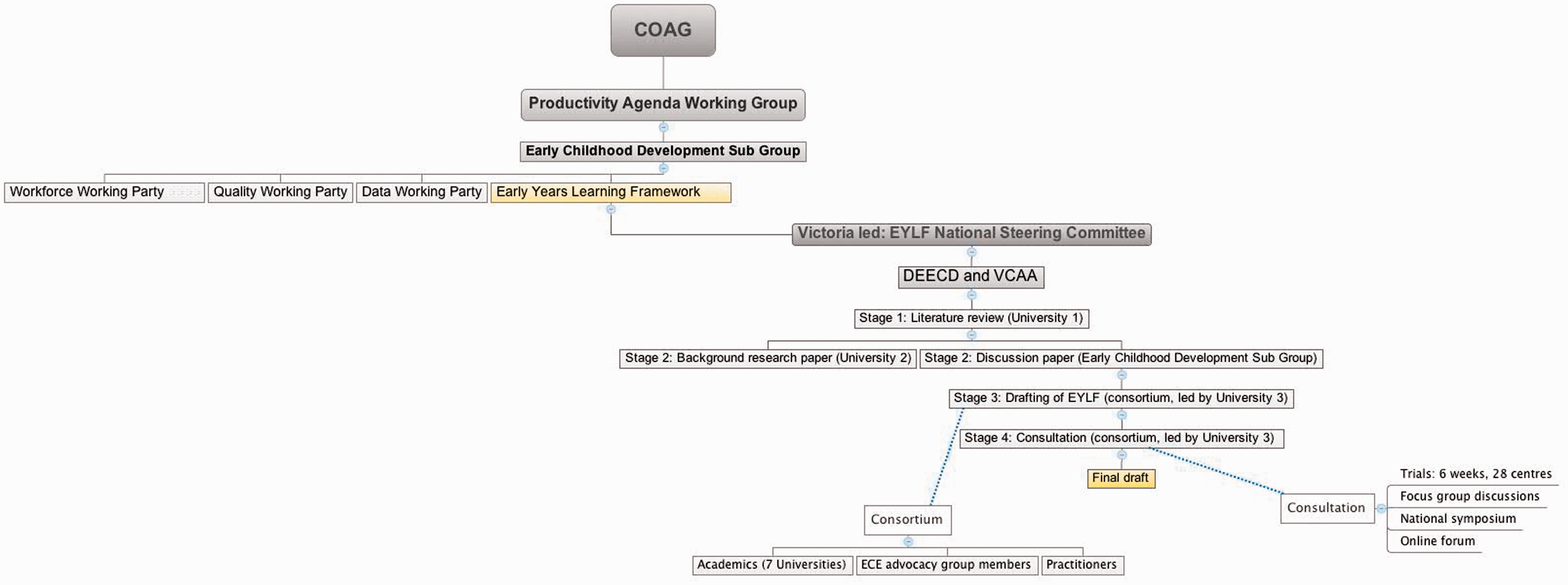
Discourse control
As a COAG policy responsibility, the EYLF needed to be approved by all of the COAG ministers to proceed. For the National Steering Committee, this meant balancing the agendas of all jurisdictions, which manifested in a ‘very direct line’ of accountability to those ministers, as Judy describes: ‘In being accountable to the minister, you have a project board and you provide reports on that and you meet … in order for the policy to be developed, that’s a very direct line’. Here, the network ethnography method makes it possible to observe the otherwise unknowable tensions that arose due to the National Steering Committee’s need to acquiesce to the productivity agenda of the COAG ministers. Sharon, a high-level department bureaucrat, explains: In actually doing the draft, you will see there are some published articles written by [some members of the consortium] … about how challenging it is to work with government. It would be fair to say the government found it as challenging to work with academics … Basically the first draft [of the EYLF] was not acceptable to government and basically because the academics wanted to continue to focus on processes, you know the pedagogy, the practice, play, but of course the productivity agenda was about outcomes for children, so all jurisdictions wanted the framework to have a focus on outcomes for children.
As the timeline did not allow for an extended period of discussion, Sharon explains how the consortium was given the option of withdrawing its draft or agreeing to a redraft: [By] the end of 2008, we had a solid meeting with the consortium in Sydney and said we weren’t happy and asked them would they like to continue to work with us and so we then offered … [to do] a bit of a redraft with the focus on outcomes.
The redraft was completed by a ‘small working group’, comprising DEECD and VCAA bureaucrats, with some early childhood consultants from different backgrounds, who had been invited to assist. As Sharon explains, the redrafting process focused on establishing the outcomes that the government felt were essential to an EYLF, after which the small working group met with the consortium to negotiate the additional content: So the small working group worked pretty quickly and turned around something that focused on outcomes. And then, when the consortium received it, they did have some concerns about it and didn’t want to put their names to it, but I think they understood that we were saying we needed outcomes. There were things that they wanted to make sure were still there which were around professional judgment and agency of children, which we saw no problem with. So then we went into a smaller working party with them and us, the sort of writing team they had and our three or four in the writing team, and bedded it down. And you’d be safe to say our approach was to ensure that … we got to the best product, one that suited government and could be signed off by the academics using their knowledge.
Observing these processes in Figure 3, a policy mobility map, we can see that government control of the discourse of quality was absolute, insofar as the processes put in place ensured that the statements made about ‘high-quality’ learning and development represented the government’s interpretation.
The EYLF mobility map showing the governance of discourse.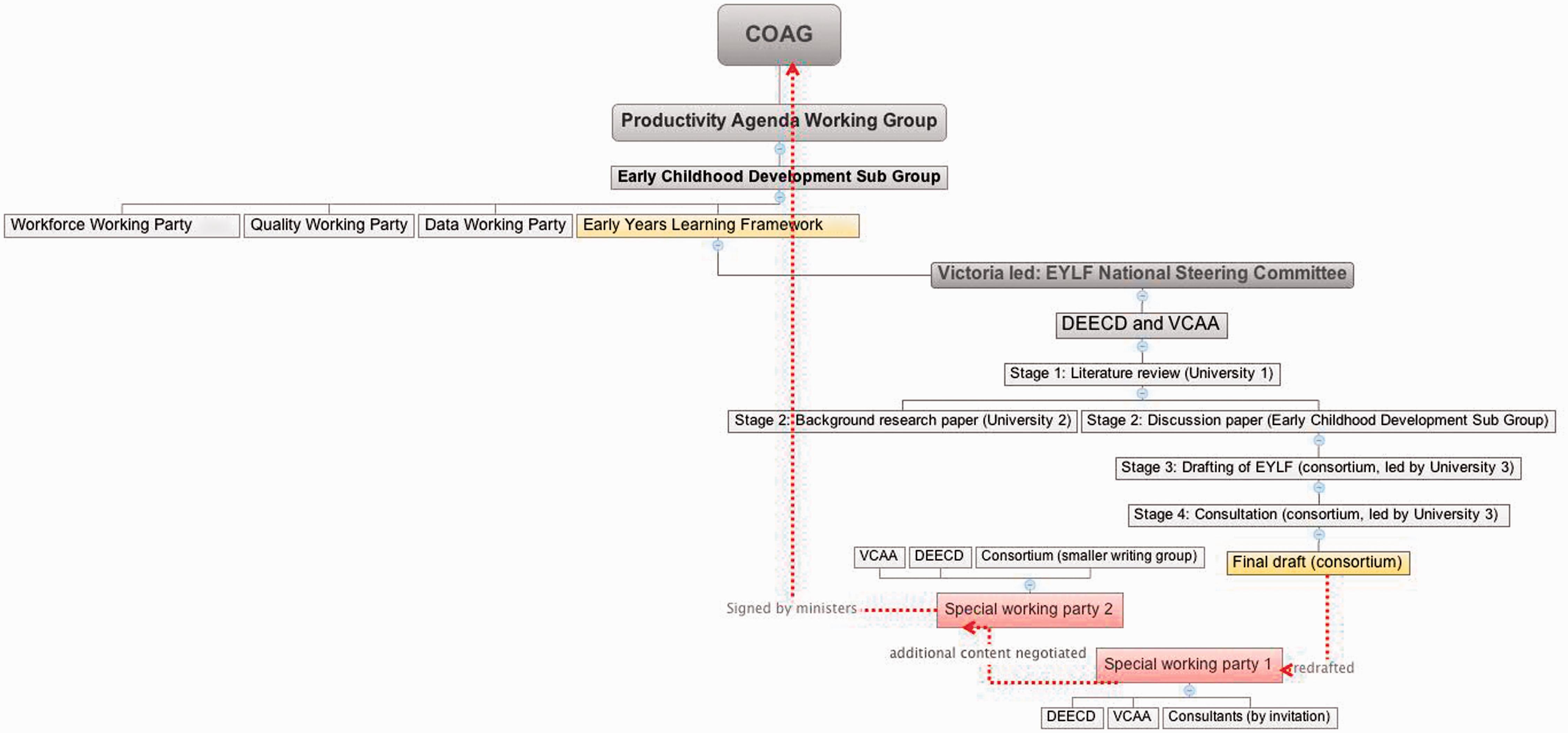
In this way, we are reminded that, despite a high level of mobility during the drafting process, the EYLF, like other government policy documents, is not a neutral document and is tactically imbued with government ambition and ideology (Taylor, 1997). As Sharon explains, there was a clear assumption that ‘high-quality education’ can produce certain ‘outcomes’: Interviewer: So, from your perspective, government needed outcomes. Sharon: Mainly because of the productivity agenda … I mean, you can’t really go out anymore and say, ‘Well, we’d like to focus on process and we don’t know if anything is going to come of it’ … We’re still struggling to measure in the early childhood space. We’re not going to ask children to sit [standardized] tests – they can’t write for a start. But the agenda going forward will be to be able to demonstrate that government’s investment is effective … I mean, every other area of government has to do it, so there’s no reason why early childhood shouldn’t have to do it.
Thus, we see that the EYLF (DEEWR, 2009) extends the positivist discourse of quality by assuming that the observable, objective and quantifiable ‘quality’ is also productive. Through the EYLF, learning ‘outcomes’ introduce a currency of measurement to the discursive field of quality in ECEC, reflecting the government’s need for mechanisms through which to quantify the benefits of its human capital investment. As Sharon explains: It’s really important that we are listening to the accountability requirements for government. I mean investment – every dollar is scrutinized centrally by Premier and Cabinet and Treasury, and they are the ones who decide what’s the priority to fund. If we’re not in there showing improved outcomes, there’ll be no extra investment in early childhood, so we need to understand that is the way government works, if governments have to make decisions about where they prioritize spending and there are a lot of people asking for that money, you know.
Sharon’s reflection shows us how the logic of human capital investment in ‘quality’ ECEC by government presupposes a measureable outcome or product of that investment. This logic necessitates and legitimizes the introduction of new means through which to measure the performance of the sector via its output (children). This tactical use of discourse and policy for intensifying performativity and accountability structures is described by Mahon (2010) as ‘neoliberalism plus’ – social investment paradigms interpreted through neo-liberal truth regimes and executed through investment in human capital via the existing private sector and NPM structures. This approach to the human capital reform was championed by the World Bank and its transnational networks, based predominantly on cost–benefit research from the USA (Mahon, 2010). In Australian ECEC policy, the ‘neoliberalism plus’ approach to quality reform is further evidenced by the continuation of pre-existing subsidy and funding structures known to favour the private sector by the Rudd Labor government after the reform (Adamson and Brennan, 2014), and the allocation of reform spending, which was funnelled into strengthening NPM structures (accreditation, performativity techniques) rather than into the ECEC centres themselves (Bown, 2014).
Concluding comments
As Foucault (1972: 54) theorizes, the use and repetition of words will ‘systematically form the objects of which they speak’. It is significant, therefore, that the positivist discourse of quality has a long history of government endorsement in Australian ECEC policy, prior to the national quality reforms (2007–2009) that are under investigation in this study. The genealogy shows how the discourse of quality in ECEC policy in Australia has been made meaningful by the neo-liberal ideology from which it emerged, enshrined in policy as a way of regulating the market by shaping consumer and workforce behaviour. It is entwined with performativity and accountability structures and discourse. To assume that this discourse can be extended to accommodate new perspectives without first disrupting these taken-for-granted groupings is problematic (Dahlberg et al., 2007). Methodologies such as I have shown in this article can provide one such avenue for expanding policy conversations in this way.
Considering the implications of these findings through a governmentality lens (Doherty, 2007), we can see that social investment reform in ECEC in Australia has been used to progress neo-liberal policy ambitions and techniques, not to challenge or shift their policy wisdom. The innovative methodology – genealogy deployed with network ethnography (Ball, 2012b) – has illustrated how the discourse of quality in ECEC was highly controlled by the government during the production of the EYLF (DEEWR, 2009). It has been shown that government sought to produce a discursive field that could facilitate performativity structures for quantifying human capital (child) outputs. Here, I return to Rizvi and Lingard’s (2010) concern that governments are now making people for policy, and note the need for further research that problematizes human capital investment and how its logic and policies of investment in ECEC subjectify children.
These preliminary findings will be expanded as my doctoral study progresses. Currently, ECEC investment in Australia is under threat as some of the National Quality Framework reform targets have been revised or unrealized – for example, the federal government has only recommitted to funding 15 hours of preschool until 2017. My interest is in applying the methodology to better understand how and why the view of ECEC as a worthwhile social investment has changed/eroded over time, and how this might be related to the increasingly delimited assumptions about quality ECEC settings, and the costs and benefits (what type, whose) of ECEC, in the Australian policyscape.