




Abstract
In the Canadian province of Ontario, the early childhood education and care workforce continues to be undervalued, underpaid and burdened with challenging working conditions. Drawing on Fairclough and Lazar, this study employed a feminist critical discourse analysis to explore the discourses of care work present in the 2018 childcare platforms of three major parties: the Liberal Party, the New Democratic Party and the Progressive Conservative Party. This critical discourse analysis provided an opportunity to consider the absence and presence of early childhood education and care discourses in the election platforms, and the consequences this has for the advancement of the workforce. The findings indicate that the early childhood education and care workforce remained largely invisible in the 2018 childcare platforms. When present, educators were often constructed as components of the early childhood education and care system’s stability. In addition, a discourse of ‘maternal care burden’ emerged in some platforms, which initially suggested progressive recognition of the gendered reality of care and care work for women in Ontario. However, the critical discourse analysis illuminates that the maternal-care-burden discourse, while suggesting that mothers are freed to enter the paid workforce, actually reinforces notions of care as women’s work. As well, this discourse further marginalizes the early childhood education and care workforce by downloading one group’s caring responsibilities to a new group of invisible carers – early childhood educators. In light of these findings, the need to disrupt discourses that continue to devalue the early childhood education and care workforce is considered as researchers and advocates seek to assert care labour as an essential public responsibility and a critical concern in political dialogue.
In the Canadian province of Ontario, the early childhood education and care (ECEC) workforce continues to be undervalued, underpaid and burdened with demanding working conditions. Like many ECEC service systems in Canada and internationally, Ontario early years services are delivered through a market-model approach. As Penn (2012: 1) concludes: ‘the childcare market is a way of describing a situation where the state has relatively little influence on – or interest in – how services for young children are set up, maintained and delivered’. Therefore, despite some recent policy and funding initiatives at both the provincial and federal levels, a universal (i.e. publicly funded and accessible for all who seek it) service system continues to be outside the scope and vision of all Canadian jurisdictions. 1 Consequently, the market-model approach, which inherently focuses on competition and creating scarcity (Tronto, 2013), continues to diminish the availability, affordability and quality of ECEC services, as well as the experiences of early childhood educators in the sector.
Who are the carers?
In Ontario, the ECEC workforce comprises early childhood educators and other staff (some with few formal credentials and some holding one-year assistant certificates). Early childhood educators work in a variety of settings. Some are legislated co-educators alongside Ontario certified teachers in the kindergarten programme (four- and five-year-old children) in public elementary schools across the province. In these cases, they are required members of a staff team in early childhood programmes (children under four). Early childhood educators are educated professionals, holding a minimum of a two-year post-secondary diploma, with increasing numbers holding a four-year degree. Early childhood educators in Ontario engage with a code of ethics and standards of practice, and must demonstrate continuous professional learning to maintain membership with their regulatory body, the College of Early Childhood Educators.
In this article, we refer to the ECEC workforce broadly to be inclusive of both early childhood educators and other early years staff, as both educators and carers, and specifically discuss early childhood educators where relevant. Our preferred terms to describe the issue and group that we are focusing on are ‘early childhood education’ and ‘early childhood educator’, with an implicit understanding that care is integral to everything the educator does (Dahlberg and Moss, 2005). However, given the chronic downplaying of care in early childhood practice and policy, we have intentionally inserted the term ‘care’ into our language for this article, thus purposely referring to ‘early childhood education and care’ (ECEC). We assert that care is fundamental to ECEC services; indeed, we argue that good education cannot exist without care. In addition, we view early childhood educators as carers who are engaged in complex and simultaneous caring and educational practices. As Ailwood (2017: 305) states: ‘it is dangerous to assume that we understand a concept as complex and value laden as care without also engaging in reflection and analysis about the singularity, complexity and the multiplicity of care in ECEC environments’.
Why do we care?
Over the past decade, educators have experienced a rapid increase in their professionalization, creating what the Association of Early Childhood Educators Ontario (2017) has coined as the ‘professionalization gap’. The professionalization gap refers to increasing responsibilities with few improvements in wages and work conditions. This has resulted from the creation of a self-regulating body, the College of Early Childhood Educators, with more regulation and assessments, and the introduction of more pedagogical initiatives at the provincial level, including an early learning curriculum framework, while few improvements in the wages and working conditions of the ECEC workforce have been achieved. This situation – of increasing professional demands without commensurate improvements in working conditions – is also evident in other Canadian provinces and territories, and, more broadly, in other countries. A Canada-wide study of the ECEC workforce (Flanagan et al., 2013) found that the mean gross hourly wage for qualified early childhood educators was CAN$16.50 – not far from the minimum wage across the provinces and territories. Wages are even lower for early childhood educators who are immigrants to Canada, who have been found to have the lowest wages of any occupational group in the country (Flanagan et al., 2013).
For immigrant and non-immigrant early childhood educators alike, this deficit is a result of a number of intersecting factors, including, but not limited to, the market approach to ECEC services, the devaluation of care labour, and the growth of precarious, part-time employment, which disproportionately impacts racialized women. This is the reality for early childhood educators in Ontario and Canada, and internationally as well. Across 19 different countries, ‘the wages of the ECEC practitioners [are] amongst the lowest in the teaching profession’ (Phillipson et al., 2018: 244). This indicates that, like in Ontario, a significant number of countries are pushing for greater qualifications for the ECEC workforce, yet material compensation and working conditions have not kept pace with professionalization.
Early childhood educators are typically sidelined in political dialogue and debate, despite the volume of national and international research establishing clear connections between the quality of care in ECEC and a well-educated, well-compensated and well-supported workforce (Halfon and Langford, 2015; Moss, 2006; Urban, 2008). In 2018, however, the Ontario Liberal government launched Growing Together: Ontario’s Early Years and Child Care Workforce Strategy (Ontario Ministry of Education, 2018), in which it explicitly acknowledged the challenging working conditions and wages for early childhood educators. This was a significant shift at the provincial level – the level of government charged with overseeing ECEC services. Yet during the provincial election, and despite two political parties’ promises to move towards a universal ECEC system in Ontario, ECEC workforce issues were muted in political discourse. No provincial party acknowledged the ECEC workforce as a political or policy issue. As researchers, we were interested in the rationale for this exclusion, particularly given the progressive ECEC policy framing by the incumbent federal Liberal government. This progressive framing suggested that real change for the ECEC workforce was possible, both in terms of wages and working conditions, and also a possible increased awareness in public discourse of the care and care labour done by early childhood educators. Therefore, the invisibility of ECEC workers, their remuneration and working conditions in political platforms merited greater examination.
Theoretical perspective and methodology
Drawing on Fairclough’s (2003, 2013) theoretical approach and analytical tools for critical discourse analysis, we undertook an interdiscursive analysis to consider what language and texts were used to produce and reproduce ideas, practices, meaning and ideologies about care in ECEC in Ontario. In our analysis of the 2018 election platforms, the Ontario budget and advocate responses, we explored textual decisions and strategies, including the absence and presence of discourses used in describing and conceptualizing early childhood educators, and the consequences this has for the social and material advancement of the ECEC workforce.
We also used a feminist lens in our critical discourse analysis to explore ‘the interconnections between and the particularities of discursive strategies employed in various forms of social inequality and oppression’ (Lazar, 2007: 144), which we believe can inform the development of the strategies needed for social change. In our interdiscursive analysis, particular attention was paid to the implication of textual decisions and different discourses for women, gender inequality and the public–private divide. In so doing, we intentionally worked against universalizing ‘women’, and strove to reflect on the intersecting identities embedded in caring relations. This was achieved through ‘analytical activism’, wherein we contested ‘the workings of power that sustain oppressive social structures/relations’ by engaging in feminist praxis as researchers (Lazar, 2007: 146).
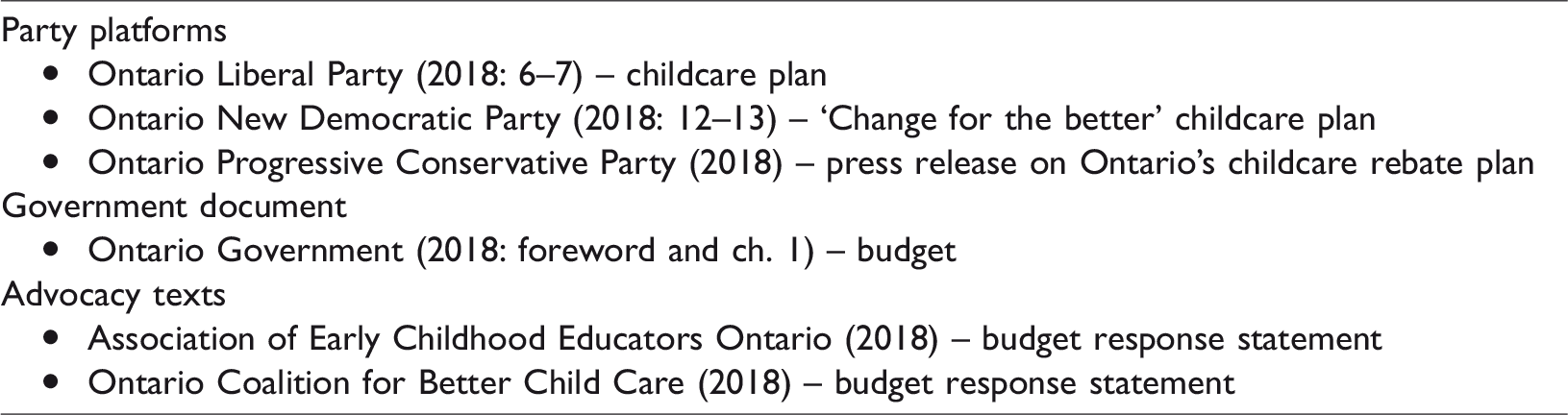
We analysed the discourses of ECEC in the 2018 childcare platforms of the three major provincial parties – the Liberal Party, the New Democratic Party and the Progressive Conservative Party – as well as the budget of the incumbent Liberal Party. 2 We also analysed how two provincial advocacy groups – the Association of Early Childhood Educators Ontario and the Ontario Coalition for Better Child Care – responded to the political party platforms (see Table 1). We acknowledge that political party platforms are a distinct genre of text, with a particular audience in mind: voters. Notwithstanding, an analysis of political platforms can identify which issues, ideas and practices political parties and campaign teams understand to be salient and appealing to the voting public. Investigating which messages are included or excluded, and how they are conceptualized, informs researchers and advocates as to how the messages are produced and reproduced through widely distributed political texts.
Documents analyzed.
We utilized interdiscursive analysis to uncover discourses embedded in relations with social structures, social events and social practices (Fairclough, 2003: 23). Fairclough (2003: 124) conceptualizes discourses as ‘ways of representing aspects of the world’, which can be exposed and analysed in texts, alongside their conjectures with issues of power, hegemony and ideology. Beginning with a structural analysis, discourses drawn on in relation to the social practice of caring for young children were located in the texts and a coding scheme was developed to organize the discourses that emerged. Utilizing Fairclough’s (2003) modes of textual analysis, the following questions were then asked of the texts and used as analytical tools:
What is the activity of the different genres? What value assumptions are made? What discourses are drawn on? How are social actors represented? What is the role of intertextuality in the texts? Is nominalization present in the texts? What elements of the social practice (caring for young children) are included or excluded? (adapted from Fairclough, 2003: 192–193)
Fairclough (2003) articulates relationships between texts and social events by describing ‘orders of discourse’, indicating how genres (the type of text), discourse and style work to create and transfer meaning in the material and non-material world. Following Fairclough’s (2003) methodology, in analysing intertextuality, we identified what voices (other than the authors’) were included and advanced in the texts, and the implications of this for the social world. As well, in exploring occurrences of nominalization in the texts, we analysed how complex and ethical concepts and social practices (i.e. caring for young children) were reduced to simple, abstract concepts (Fairclough, 2003). We considered the implications of these textual decisions for those embedded in caring relations, and for the conceptualization of caring for others as a public good.
Why care for carers?
Following the ‘ethics of care’ framework (Barnes, 2012; Held, 2006; Sevenhuijsen, 2003; Tronto, 1993, 2013), we posit and seek to assert that care work – which is a public good – should be central to political dialogue and public policy. Tronto and Fisher (1990) describe care as ‘a species activity that includes everything that we do to maintain, continue, and repair our “world” so that we can live in it as well as possible’ (quoted in Tronto, 1993: 103). As a complex social practice and value, care involves responsiveness, attentiveness, trust, responsibility and competence (Tronto, 1993), which is not limited to interactions between individuals but can occur within systems, such as governance and institutions (Tronto, 2013). Barnes (2012) suggests that in understanding the ethics of care and deliberating publicly about care lies the power to disrupt deeply entrenched binaries of public–private, economy–care and production–social reproduction. This is important in liberal welfare states (like Ontario and Canada), where social reproduction generally, and childcare specifically, is largely left to private individuals. This continues to impact the ECEC workforce negatively, as the absence of consistent public (government) funding and a well-planned and competent system for ECEC services means that the wages of early childhood educators are sacrificed to market forces and the need to keep parents’ fees low.
We propose that a key responsibility of public policy in advanced liberal welfare states is to ensure that the approach and funding adequately supply the resources needed for all citizens to care well, and addresses the inequality experienced by those who assume caring responsibilities in both the private and public realms. Therefore, it is important to consider how the ECEC workforce is discursively positioned in party platforms and government documents, in order to understand the extent to which they are (or are not) central to a government’s understanding of ECEC services. Additionally, by considering the discursive positioning of early childhood educators in Ontario’s party platforms, researchers and advocates are better able to articulate the centrality of care and care labour in political dialogue and debate, and its implications for the material conditions experienced by the ECEC workforce.
Who cares for carers?
Prior to the 2018 Ontario election, the conditions affecting the ECEC workforce were formally acknowledged in the (outgoing) Liberal government’s Growing Together document (Ontario Ministry of Education, 2018). Growing Together was an immensely significant policy document for the ECEC workforce. For the first time in early years policy, the Ontario Ministry of Education publicly acknowledged and committed to address the inequities and challenges facing the workforce, including improving wages through the implementation of a provincial wage grid. Further, childcare was a central election issue; the Liberal Party, New Democratic Party and Progressive Conservative Party all addressed it in their platforms (contrary to past elections, where some parties – namely, the Progressive Conservative Party – made no mention of childcare in their platform).
(In)visibility of the ECEC workforce
Our findings show that the ECEC workforce remained largely invisible in the 2018 childcare platforms and was discursively addressed only as a component of system stability, with the value of care (and education) in early childhood and care labour marginalized and excluded from political discourse. This exclusion and abstraction reinforces the devaluation of care labour and obscures the complex ethical work of early childhood educators. This, in turn, has deep implications for policy, funding and, ultimately, compensation and working conditions in the sector.
The Progressive Conservative Party’s platform contained no mention of the ECEC workforce. It presents care as the responsibility and ‘choice’ of parents. While the text lists the many care options available to families, the Ontario Progressive Conservative Party (2018) is explicit in its exclusion of early childhood educators, naming instead ‘licensed care’, ‘independent care’, ‘babysitters’ and ‘nannies’. As Fairclough (2003) suggests, these textual decisions are purposeful and carry social implications. In this case, the complete absence of early childhood educators undermines the current efforts of early childhood educators, advocates and labour groups to improve wages and working conditions for the ECEC workforce in Ontario and Canada, and reinforces a market approach – cheap, easy and natural work that does not require professional education – as being in parents’ best interests.
While the ECEC workforce is marginally present in the Liberal Party and New Democratic Party platforms, educators are usually represented as components of the stability of the ECEC system. For example, the Ontario New Democratic Party’s (2018: 12) platform explains that ‘[a]ffordable child care will create significant new demand’, which will ‘requir[e] more Early Childhood Educators … and high-quality, licensed, not-for-profit spaces’. In so doing, the texts suggest that early childhood educators and childcare spaces are both necessary components for the stability of the childcare system. This nominalization of early childhood educators positions them as the system’s structure. What also stands out in the text is the explicit mention of the quality of the spaces (i.e. ‘high-quality’), while the ECEC workforce is mentioned without any qualifiers (e.g. well paid, well educated, respected, etc.). In this conceptualization, the ethical and complex elements of caring for others are not highlighted or central to a vision of ECEC services. The New Democratic Party’s platform does acknowledge the ‘vital work they [early childhood educators] do’ and recognizes the need to ‘increas[e] the wages for [early childhood educators]’, but only in order to encourage more early childhood educator workforce participation – to ‘ensure people see this as a career that can support a family’ (Ontario New Democratic Party, 2018: 12–13).
The Liberal Party’s platform points to their previous actions to ‘build Ontario up’ by ‘invest[ing] in people’, including ‘Early Childhood Educators’, and also positions early childhood educators as a mere component of Ontario’s infrastructure (Ontario Liberal Party, 2018: 5). In addition, the Liberal Party’s platform makes a promise to ‘support child care professionals through higher wages’ (7), although when linked to the previous textual example, the purpose of this promise is investment in human capital. These textual decisions, while demonstrating some attention to the ECEC workforce as an election issue, still overlook the ethical value and complexity of the work undertaken by educators, and continue to position early childhood educators as a mere variable of system stability.
Political documents, such as party platforms, provide an opportunity for public dialogue and to position the ECEC workforce as engaged in ethical caring practice, which is central to quality ECEC services. The textual responses of the Association of Early Childhood Educators Ontario and the Ontario Coalition for Better Child Care to the (outgoing) Liberal government’s position (via the Growing Together document) immediately before the election demonstrated that advocates present a more complex conceptualization of early childhood educators’ work. The Association of Early Childhood Educators Ontario (2018) describes early childhood educators as ‘well-educated … passionate … professionals who play a valuable and important role in our communities’. Nevertheless, descriptions such as these could be more nuanced. When obscured, the critical components of the work of early childhood professionals continue to be abstracted in political discourse, devaluing and making invisible the significance of this work.
The maternal care burden becomes the early childhood educator’s
Our analysis illuminated the prevalence of discourse on or about the maternal care burden, linked to the promise of free preschool in both the 2018 Liberal Party platform and provincial budget. The maternal-care-burden discourse was visible in statements such as: ‘often, it is particularly stressful for women and mothers who carry the burden disproportionately’ and ‘child care is an integral part of women’s economic empowerment’ (Ontario Government, 2018: iii). At first sight, this seems to be a progressive recognition of the gendered reality of care and care work. This discourse implies a shift towards a more public recognition and dialogue about care and gender inequality, as it identifies and labels the (often invisible) inequity in who is primarily undertaking care responsibilities. As suggested by Tronto (2013), recognizing inequitable access to care and social inequality is necessary if we wish to promote a more democratic form of care and challenge and disrupt hegemonic discourses. These discourses position care work, or early childhood educators, outside of the public realm, contributing to their ongoing marginalization. The Liberal Party’s attempts to articulate the gendered inequality of care are noteworthy, particularly as no other major party makes such claims. However, there remain notable concerns that arise from closer analysis of this discourse.
The maternal-care-burden discourse acknowledges that the economic empowerment and workforce participation of women is linked to the availability of care services, yet the gendered nature of the ECEC workforce remains invisible. As has been noted by others (Fraser, 2016; Tronto, 2013), many countries currently have a care deficit, as mothers enter the workforce without an ECEC system that is sufficient to support caring responsibilities. It is, then, expected that the ECEC workforce will fill this care deficit. Relying on hegemonic discourses of individual responsibility, the care deficit continues to position the ethical work of caring for others as a private matter. In so doing, it obfuscates the particular and nuanced experiences of those entangled in the caring relationship, and allows governments to escape their responsibility to ensure that society can care well (Tronto, 2013). Missing from the maternal-care-burden discourse is critical reflection and consideration of the material realities and intersecting identities (some as unpaid mothers and paid caregivers themselves) of the ECEC workforce. In its current neo-liberal simplicity, with a central focus on women who are able to be ‘freed’, the maternal-care-burden discourse reinforces what Tronto (1993) cautioned against – the creation of a group of caregivers who ultimately become responsible for the burden of care while other women are then able to participate in the labour market. Further, the outsourcing of the maternal care burden to early childhood educators positions them as ‘substitute mothers’ (Moss, 2006), rather than professionals in their own right. As Moss (2006) describes, this view draws on a gendered understanding of care, wherein care comes naturally to women and requires no education or formal training. This discourse obfuscates the value of the work of early childhood educators and compounds their marginalization.
Universalizing the care burden
While the Liberal Party recognized that ECEC services are necessary for women’s empowerment, the discourse relied on a homogenized and universal notion of what women’s issues are. This notion inevitably reflects the needs of white, middle-class women at the expense of all other intersections of difference (Lazar, 2007). The neo-liberal notion of the maternal care burden, then, is built on the backs of a devalued and invisible ECEC workforce that inherits the burden of care without recognition of the complex realities those workers experience when taking on the ethical responsibility of caring for others.
While data on the intersecting identities of the early childhood workforce in Ontario is significantly lacking, national and international data suggests that care responsibilities increasingly fall to racialized women, who are often underpaid for the care work that they do, further contributing to their marginalization and oppression (McCuaig and McWhinney, 2017; Whitebook et al., 2018). As noted above, Fairclough (2003) and Lazar (2007) suggest that textual decisions are powerful and persuasive, informing our understanding of, and interactions with, the social world. In this way, through the strategic decision to rely on the neo-liberal maternal-care-burden discourse, political parties are reinforcing a market approach (cheap labour, individual responsibility) and the ongoing devaluation of care labour.
The consequences of the political neglect of ECEC workforce issues are national and international. As Tronto (2013) states, governments have failed to take responsibility for the care deficit and failed to elevate the significance of caring responsibilities in democratic deliberations. This is evident in Canada, which has historically relied on the migration of temporary foreign workers – primarily women from the Philippines – to take on caring responsibilities (Brickner and Straehle, 2010). This immigration programme reinforces and reiterates a neo-liberal maternal-care-burden discourse as it seeks to address the caring needs of some (middle-class) Canadian mothers who wish to re-enter the workforce. However, it does so to the explicit disadvantage of the women who are exploited as care labourers and of mothers who cannot afford this type of care (i.e. childcare). As well, this labour strategy has significant implications for professionalized early childhood educators, who continue to exist on the margins in this market approach, and whose ethical and complex care labour is devalued as ‘the natural work of women’.
For a brief moment before the 2018 provincial election campaign, it appeared that the material conditions and inequities of the ECEC workforce would become part of political discussions about a universal ECEC system for Ontario. However, our research shows that early childhood educators were largely invisible or discursively devalued in political party childcare platforms. The conceptualizations of early childhood educators’ work in these platforms were hollow and problematic for advancing the profession. In fact, beyond the election, the dominance of the market approach, assumptions about the innate nature of care labour and the simplistic abstraction of the gendered realities of care continue to negatively affect the ECEC workforce, whose ethical value and complex practice are ignored by the current Progressive Conservative government.
Caring through discursive resistance
Unsurprisingly, the abstractions and problematic discursive constructions of care that we found in Ontario also exist outside of Ontario, and contribute to the marginalization of the care workforce and the invisibility of the complexity of care work at the national and international levels. For example, reflecting on care work in the USA, Duffy (2015) argues that simply focusing on the outsourcing of childcare from the working mother to the early childhood educator misses the ways in which the care of children in out-of-home settings is different from care in the home and, therefore, has changed and become more complex. In addition, Robinson (2011), using a critical feminist ethics-of-care approach, considers how the relationships involved in transnational care work (e.g. a nanny from the Philippines and working mother in Canada, as previously mentioned) affect the security of the carer. What Robinson (2011) illuminates is the complexity of the caring relationship, and the often ignored international implications of the market-model childcare system. The dominance of the maternal-care-burden discourse in Ontario therefore reinforces and contributes to the international care deficit – a complex web in which care work is marginalized and devalued.
What is necessary, then, from our perspective, is discursive resistance. As we found through this critical discourse analysis, advocates have begun to work on shifting discourses to keep the value of ECEC services and the workforce central to public responsibility and on the public’s radar. Yet, more is required. Researchers and advocates are in a position to challenge dominant discourses and use communication platforms to disseminate these alternative messages to the public. Bown et al. (2011: 278) conclude from their study of influences (maternalist discourses) on Australian politicians’ decision-making for ECEC that activists have opportunities ‘to disrupt [these] discourses and transform the way educators, politicians and the broader community conceptualises ECEC’. Moss (2019: 30) also argues that alternative visions of early childhood education, made tangible by policy proposals, have the potential to shift activism from a resistance movement to a social movement. In the Canadian context, Langford et al. (2016) have urged advocates to make strategic use of cooperative relationships with progressive governments, where they can directly assert their positions on ECEC services and the workforce. Important to advocacy efforts will be pressing the implementation and funding of progressive policies (like Growing Together) early in a governmental term, thereby decreasing the chances that, as experienced in Ontario, a change of government will disrupt the realization of progressive policy promises.
Advocates can help position care as central to the public good, discursively (re)construct the value of the care workforce, and engage governments in fulfilling their responsibilities to both citizens and workers. It is imperative to think critically about how, and the extent to which, the value and purpose of ECEC services and the workforce are discursively constructed and articulated to politicians and policymakers in order to make visible that every citizen is implicated in the web of care.
Footnotes
Declaration of conflicting interests
The authors declared no potential conflicts of interest with respect to the research, authorship and/or publication of this article.
Funding
The authors disclosed receipt of the following financial support for the research, authorship, and/or publication of this article: This research was supported in part by funding from the Social Sciences and Humanities Research Council of Canada.
