



Abstract
The early phases of teachers’ professional careers are multi-layered and informed by many factors, including teachers’ values, their own experiences in schools, and the nested contexts of their professional employment. While in teachers’ everyday lives government policies sometimes operate beneath the surface rather than overtly, these policies influence many teachers’ experiences, contributing significantly to what critical discourse analysis scholars call the ‘issue’ of teachers’ available subjectivities being influenced by prevailing ideologies as they are newly entering the profession. In this analysis, we activate critical discourse analysis in order to offer new understandings about policies and contexts associated with new teachers entering the profession. Our analysis is significant in its co-consideration of policies from contexts that we see as experiencing the influence of neoliberal ideologies in different ways. As critical discourse analysis is transdisciplinary, it also offers chances to transcend boundaries of politics and culture to inquire into social wrongs as we actually experience them in a world that is globally connected and globally influenced. The significance of this analysis, then, lies with the continued questioning we hope that it, and others like it, make possible.
Keywords
The early phases of teachers’ professional careers are layered and informed by many factors, including teachers’ values, their experiences in schools, and the nested contexts (Lubeck, 1985) of their professional employment (e.g. Feiman-Nemser, 2003). While in teachers’ everyday lives government policies sometimes operate beneath the surface rather than overtly, these policies influence many teachers’ experiences, contributing significantly to what critical discourse analysis (CDA) scholars call the ‘issue’ of teachers’ subjectivities as they are becoming certified (Chouliaraki and Fairclough, 1999). In this analysis, we activated a four-stage critical discourse analysis to illustrate how policy documents contribute to and circulate neoliberal discourses that promote certain subjectivities for newly certified teachers in the early childhood (EC) sector. Alongside a wider-ranging analysis, we engaged with six focal documents to better understand this social problem in its semiotic aspect. While we engaged Fairclough’s (2012) call to examine the context of the problem and think towards possible ways to ameliorate it, this analysis is also an invitation for further critique and continued study.
While analysing documents and policies about teachers becoming certified, we consider Bacchi’s (2000) assertion that the framing of ‘problems’ within policies is ‘non-innocent’, therefore impacting what can be thought about a problem and what can be thought about possibilities for action (50). In order to trouble this non-innocent framing, we analysed documents from two contexts with notable differences in how they policize teachers advancing or beginning their careers, hoping to produce new questions and otherwise-unthinkable problems about the other. Using policy documents from Aotearoa New Zealand (NZ) and Texas, 1 USA, we engage CDA to inquire into how these documents, and the policies they are co-constituted with, contribute to the subjectivities promoted for beginning teachers.
In our analysis, we draw from Fairclough’s (2012) applied framework for using CDA to do what Luke (2002) described as ‘a principled and transparent shunting back and forth’ between micro-analysis of text and ‘macro-analysis of social formations, institutions, and power relations that these texts index and construct’ (100). In doing so, we regard language as an aspect of social practice able to illuminate wider ideologies and able to draw us towards ‘empowering those who are disadvantaged by those ideologies’ (Uzuner-Smith and Englander, 2015: 65). We see the empowerment of newly certified teachers as central to our purpose, and the potential for their empowerment as entangled with priorities of systemic change and social justice in education.
Subjectivity, the process of being made a subject, is a process always in motion and in relation to the shifting and intersecting contexts we are part of. St Pierre (2000) recognizes the double move in the construction of subjectivity (502) – as we construct Ourselves as a subject, we are being simultaneously constructed as subjects by elements circulating around us, including through discourses and trajectories of power. So, policies contributing to subjectivities are not necessarily a social wrong; we are all made subjects by many layers of social life, including laws, policies, education, cultural expectations, etc. But, as a prevailing ideology in early childhood education (ECE) in the US and NZ (Arndt et al., 2018; Brown, 2015; Brown et al., 2015), neoliberalism functions surreptitiously (Geerts, 2019). The ways in which the subjectivities of beginning teachers may be influenced by documents and policies (that are produced by and help reproduce neoliberal priorities) need to be illuminated in order to expand possibility for choice and the potential for social change (Weedon, 1997).
Baltodano’s (2012) analysis of how neoliberalism has taken root in various educational structures in the US explains the key goals, including: reducing the individual to principles of production and efficiency; manipulating discourses, social institutions and the state; protecting capital; and reducing citizenship to passivity and subservience. Neoliberalism circulates through policy in different ways. According to Baltodano (2012) and relevant to our work is the positioning of ‘No Child Left Behind’ (NCLB) legislation as ‘one of the most important achievements of neoliberalism’ (495) due to its de-professionalization of teachers, obliteration of local control for schools, and shift towards defining high-stakes testing as accountability, and students as data. Scholars have noted the impact of neoliberal discourses on education policies and practices around the world, including in NZ’s EC sector (Duhn, 2012; Sims, 2017; Smith et al., 2016). These ideas permeate all aspects of our lives, often undetected since they ‘have become social common sense’ (Kleinman et al., 2013: 2398). However, we agree with scholars like Geerts (2019) who believe that neoliberal priorities are particularly damaging to education. The documents and policies we focus on here represent a point where cycles of formal education end, begin, and overlap.
Context
In the last 20 years, CDA has been established as a useful method of analysis in education practice and policy (e.g. Rogers et al., 2016; Taylor, 2004; Uzuner-Smith and Englander, 2015). For example, studies have activated CDA to illuminate definitions and perceptions of teacher quality and accountability (Berkovich and Benoliel, 2018; Kilderry, 2014; Ryan and Bourke, 2013; Thomas, 2005a, 2005b, 2011), and of teachers’ identities and sense of professionalism (Hill, 2004; Larsen, 2010; McIntyre et al., 2019; Mooney et al., 2019; Osgood, 2009; Sachs, 2001; Sisson and Iverson, 2014). Joining these studies, our analysis uses CDA to examine education documents and policies from two contexts to better understand a social phenomenon, and encourage new questions about the policies themselves. Several recent studies have used CDA in this way to examine: the role of democracy in teacher education in Sweden and Ireland (Mooney et al., 2019); the belief in the centrality of the teacher in Australasia, Europe, Great Britain and North America (Larsen, 2010); and the exclusion of teachers’ reflexivity in policy in Australia and the UK (Ryan and Bourke, 2013). While there are important distinctions, we drew from Uzuner-Smith and Englander’s (2015) work with university policy documents in Turkey and Mexico, and their call to use CDA as a potentially ‘revelatory’ practice that serves to ‘identify, challenge, and resist ideologies that disempower major actors’ in educational systems (Uzuner-Smith and Englander, 2015: 82), like teachers who are entering or advancing their professional careers in the EC sector, a space of shifting subjectivities and socio-economic conditions that ‘often undermine rather than support professionalism’ (Arndt et al., 2018: 97).
We, the authors, are both former teachers and current teacher educators with an interest in teachers’ professional transitions, and in how attention to complexities of teachers’ material-discursive subjectivities might open up the possibility for individual and political change (see Weedon, 1997). We are both usually read as white North American women, and we both speak English as our first language. When selecting contexts from which to choose policy documents for analysis, Texas and NZ arose as generative possibilities for several reasons. We have 20 years combined experience teaching in different US states outside Texas, and over 10 years combined experience within the state of Texas. Currently, we are learning about NZ from both inside and outside this context. So, we have a general working knowledge of the processes by which teachers interact with policies around certification, early career opportunities, and induction and mentoring in these contexts, and we have some familiarity with what information and documents are immediately available to those interested in earning their teaching certification. In our considerations of neoliberal ideologies and how those pervade education policy in the US (which has, essentially, 50 different systems), it made sense to focus on Texas since it is the state whose legislation provided the blueprint for nationwide neoliberal policies (which the state of Texas proudly advertises by saying they have a ‘well regarded accountability system’ that then was the ‘model for No Child Left Behind’) (Texas Education Agency (TEA), 2020a: 3). Since education researchers caution about the proliferation of neoliberal education policies in NZ (Duhn, 2010, 2012; Sims, 2017; Smith et al., 2016), we saw this point of overlap as generative for this analysis.
We see both of these contexts as foundationally multicultural and multilingual, though geographically quite different. A border state with Mexico that occupies territory once controlled by Mexico, Texas’s population is largely bilingual, with 34.5% of people speaking a language other than English at home, the majority of those (83.3%) speaking Spanish. An island nation in the Pacific, NZ’s biculturalism is officially encoded in Te Tiriti o Waitangi, the Treaty of Waitangi, a political document produced in 1840 by representatives of the British Crown and representatives of Māori iwi and hapū. Neither NZ nor the US has English as an official language; however, in both contexts, in practice and in policy, English is positioned as the dominant language and the main mode of communication in academic and political spaces. We also were intrigued by current shifts in education and teacher certification policy in both contexts as the respective governments respond to (and create) changes in the teaching force. In Texas, the passage of House Bill 3 (HB-3) has far-reaching impacts on education programming, including mentoring for new teachers and funding for EC (TEA, 2020f). And in NZ, the EC sector is one of several areas affected by an ongoing teacher shortage (Collins, 2019; Feigen, 2019) and has recently been impacted by the government’s 10-year plan for expanding access and increasing quality of early childhood education and care (ECEC), ‘He taonga te tamaiti/Every child a taonga: Early learning action plan 2019–2029’, published in draft form in November 2018 and in its current version in December 2019 (MOE, 2019b).
Methodology
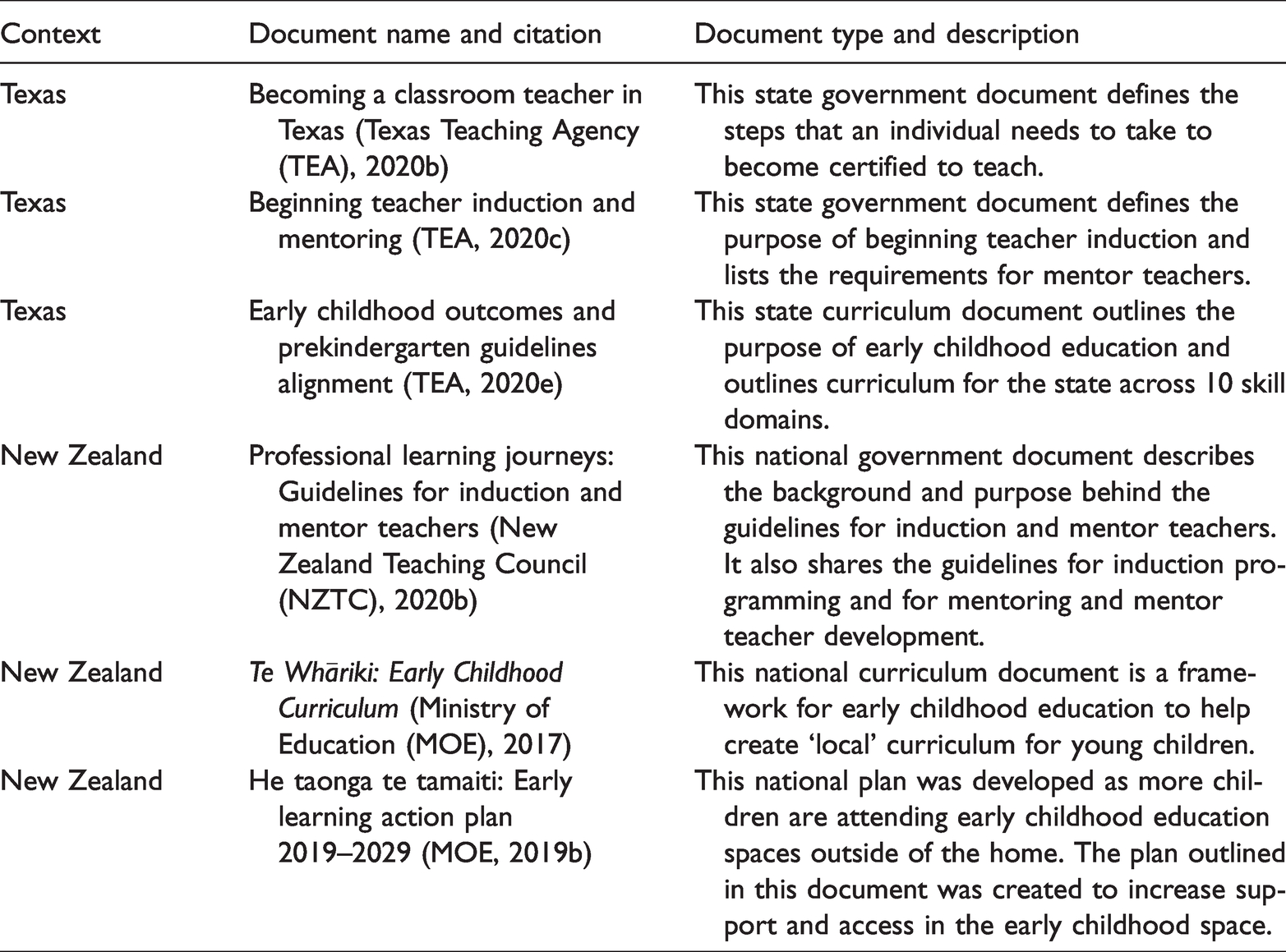
Using policy documents from NZ and Texas, we engaged CDA to inquire into the ‘issue’ (Fairclough, 2012: 14) of how policy documents contribute to and circulate neoliberal discourses that promote certain subjectivities for newly certified/qualified teachers, particularly in the EC sector. In order to establish understanding of these social contexts, we analysed over 250 pages of policy documents related to teachers seeking certification in the EC sector and the experience of teaching in the EC sector in Texas and NZ. Our aim was to enter the broad space of available information and focus on those documents that are readily available to the public, including and especially members of the public who might be considering seeking certification in this field. All reviewed documents were available online through the main authoritative body for the teaching profession in each context: the TEA in Texas at tea.texas.gov; and the New Zealand Teaching Council (NZTC) in NZ at teachingcouncil.co.nz. A summary of our insights from this phase of analysis is provided in Table 1, and a full list of the documents we reviewed is available in Appendix A.
Our initial interest led us to focus on the certification processes and induction opportunities for newly certified teachers in the US and NZ. However, a focus on ECE developed due to the recent passing of HB-3 in Texas (TEA, 2020f) which newly policizes the sector in this context. ECE had already been policized in New Zealand (e.g. Ministry of Education (MOE), 1996), though the policies and documents are not static nor immune to shifts, and the sector was attracting increased attention due to the developments stated above. In order to develop understandings of the contexts and focal documents for the more specific task of critical discourse analysis (Fairclough, 2012), we conducted a broad search of the websites and publicly available documents for or about those teachers looking to become certificated in the ECE sector. We searched and catalogued available documents and developed a comprehensive data set for preliminary analysis. Then, we produced analytical memos in a shared online folder. We aimed to understand the social practice of defining ECE and a teacher entering the profession 2 in Texas and NZ, and identify the most relevant document(s) with which to engage in a micro-analysis to produce new understandings.
Documents selected for critical discourse analysis
To form the basis of our CDA analysis, we selected six policy documents (see Table 2) as most relevant to our topic about policy in ECE influencing the available subjectivities of newly certified teachers. These documents contribute to the ‘culturally available meanings’ of beginning/continuing work as an ECE teacher and the ‘open-ended, power-laden enactments of those meanings’ (Kondo, 1990, p. 24).
Early childhood education (ECE) in Texas, USA, and New Zealand.

Documents selected for critical discourse analysis.
Stages of critical discourse analysis of focal documents
We employed a methodology described by Fairclough (2012) and used in a similarly cross-cultural policy document analysis by Uzuner-Smith and Englander (2015). While cautioning against the uptake of this methodology as a linear series of discrete steps, Fairclough describes four stages, which we employed in a repeated, informative and recursive analytical procedure: (1) focus upon a social wrong, in its semiotic aspect; (2) identify obstacles to addressing the social wrong; (3) consider whether the social order needs the social wrong; (4) identify possible ways past the obstacles.
According to Fairclough (2012: 13), ‘(s)ocial wrongs’ can be understood in broad terms as aspects of social systems, forms or orders that are detrimental to human well-being and could in principle be ameliorated if not eliminated, though perhaps only through major changes in these systems, forms or orders.
After identifying obstacles to addressing the social wrong in Stage 2, Fairclough (2012) then invites us to consider ‘whether the social wrong in focus is inherent to the social order, whether it can be addressed within it, or only by changing it’ (15). While we do see a need to shift away from neoliberal discourses and late capitalist structures, we also hope that this particular social wrong might be addressed, in the meantime, from within the system, hopefully unsettling the cross-generational hold of these ideals. In the final stage, we endeavoured to move ‘from negative to positive critique’ (Fairclough, 2012: 15), finding spaces and possibilities for the nurturing of alternative discourses that might nurture an expanded sense of possible subjectivities for teachers earning certification.
Citing Bourdieu and Wacquant (1992), Fairclough (2012) described this methodology as ‘a transdisciplinary process of theoretically constructing the object of research’ (13, emphasis in original), thus acknowledging the interwovenness of theory and method. This application of Fairclough’s method is one pathway by which the main goals of CDA might be realized, including attempting to ‘capture the dynamic relations between discourse and society’ (Luke, 2002: 100) through pivoting ‘between a normative reading of texts and a normative reading of the social world’ (Luke, 2002: 103).The stages of Fairclough’s suggested analysis, along with our ongoing broader topic research, required continued consideration of how the documents produced and were produced by the social world they are part of; in other words, continually asking of the documents and ourselves why this analysis matters.
As mentioned, the stages were ongoing and overlapping. Throughout the process, we read and annotated the documents individually and then met regularly to discuss insights, pose new questions and discuss our ongoing reading of peripheral documents and published literature in this field. At several points, we returned to unmarked copies of the focal documents to re-read them in a different order or after having read other texts that might influence our thinking. This ongoing and iterative process meant that we were producing insights while constructing the object of research, as Fairclough (2012) suggests, rather than coming to the documents with a pre-formed hypothesis.
Findings and discussion
The ‘social wrong’ we investigated was the way policy documents promote or persuade subjectivities available to ECE teachers seeking certification. The documents we analysed support that while the neoliberal priorities of Texas’s many interlocking systems are foundational to their state education ethos, and to the prevailing national system for education regulation in the US, neoliberal education reform in NZ has looked different. Scholars have previously noted that in the EC sector, neoliberal priorities circulate in discourses of professionalism (Osgood, 2009) and the marketization of the sector (May and Mitchell, 2009; Nxumalo et al., 2011), and influence teachers’ identity construction (Kamenarac, 2019).
Policy documents’ contributions to the social wrong
Overall, the focal documents narrow opportunities for teacher agency and de-professionalize the work of teaching, promoting subjectivities that favour compliance and view teaching as a profession where success is measured quantitatively. The documents define the work of teaching and what could be acceptable support for beginning teachers. For teachers in ECE settings in Texas, curriculum documents create a set of prescriptive curricula that teachers should follow, based on a linear continuum of development based on age specific milestones (TEA, 2020e). In NZ, ‘He taonga te tamaiti’ (MOE, 2019b) states the purpose of the action plan is to raise the quality of EC teachers and ECEC experience. While it is important to have competent individuals working with children, the call to increase certification requirements also subjects people to government-regulated systems. As defined in these policies, ECE teaching focuses on encouraging teachers to follow the prescribed guidelines instead of allowing teachers to draw from their own professional knowledge and the connections they build to meet and respond to individual student needs.
Texas presents steps towards becoming a certified teacher; however, the documents obfuscate where to look for clarification or additional information if the provided steps do not match an individual’s situation (TEA, 2020b); there is effectively no flexibility visible in the focal documents. NZ’s Guidelines for Induction and Mentoring and Mentor Teachers created the guidelines to ‘acknowledge (that) a teacher’s work is highly complex and demanding’ (NZTC, 2020b: 4). Their mentoring and induction support is designed to be ‘high-quality’ and ‘well-structured’ (4). While this creates space for beginning teachers to take multiple lenses to their work, the highly structured nature of the guidelines defines what counts as teaching and support for new teachers through the existing systems and structures. While teachers will find ways to access individual choice and agency, these documents draw newly certified teachers into existing systems, leaving little space for teachers to reimagine possibility within the profession.
The focal documents reflect neoliberal priorities in the ways they commodify the activities of teaching. For example, in NZ, ‘He taonga te tamaiti’ aims to ‘develop an early learning teacher supply strategy that aligns with the wider education workforce system’ (MOE, 2019b: 24). Aligning with the wider education workforce system ignores the unique needs of beginning EC teachers and merges their context into larger, sweeping systems. Beginning teacher induction and mentoring support in Texas has the stated purpose of ‘increas(ing) retention of beginning teachers’ (TEA, 2020c: 1). Increasing teacher retention is important for a variety of reasons, one of them largely economical as it is cheaper to keep teachers in their current teaching positions than to train new teachers (Ingersoll, 2007). Also, both the steps to becoming a teacher, and the beginning teacher induction and mentoring programming in Texas are series of quantifiable steps (TEA, 2020b). Each of the steps is something that an individual must pay for in order to complete and gain admission to the profession. With requirements such as length of time teaching or completed mentor teacher training programming, it assumes that any teacher who has done those things and has ‘a superior history of improving student performance’ (TEA, 2020c: 1) can be a mentor. Only those who have produced high student performance on standardized tests can serve as a mentor, linking what counts as good teaching back to neoliberal agendas of sorting and control that have permeated schools and systems. In Texas, ECE becomes ‘Pre-K’ (pre-kindergarten) and education for these young learners is defined and described as being designed for ‘future success’ and ‘foundation for success in kindergarten and the early school years’ (TEA, 2020d: 4–5). For some beginning teachers, their understandings of ECE may be shaped by documents highlighting the importance of ‘success’ and ‘achievement’ in future academic spaces, rather than any qualities of the space of ECE itself.
Finally, the documents also fail to fully humanize the young children who should be at their centre, potentially impacting the perspectives that the teachers bring to their work.
Rather than centering children, the documents centre guidelines and requirements. As previously mentioned, ECE curriculum documents in Texas define the purpose of ECE as preparing students to be successful in kindergarten and future schooling and pre-professional spaces. In Texas’s ECE curriculum, when a student is not meeting standards described by the curriculum as ‘appropriate’ for age or social norms the teachers are directed to approximate diagnosis and provide immediate interventions. Often, the labels given to students at young ages such as ‘at-risk’ tend to locate the ‘risk’ within the child (rather than the system), potentially pulling the student into a web of deficit perceptions leading to limited curriculum and opportunities (Brown, 2016). The ECE curriculum for Domain II, the Language and Communication Domain, links a quantifiable developmental continuum to ‘foundational skills’ and then provides a set of ‘differentiation of instruction for children with learning differences’ (TEA, 2020d: 29). In NZ, the early learning action plan states that NZ is increasing in diversity and it is striving to create ‘equity from the start’ to ‘reduce disparity’ for children in ‘adverse circumstances’ (MOE, 2019b: 13). Students are categorized by ability and teaching is positioned as transferring measurable skills and increasing ‘intensity’ of the ECE experience (MOE, 2019b: 13).
The policies and documents attempt to create alignment in ideas and space to build common understandings about becoming a teacher and supporting beginning teachers. However, quoting Derrida, Luke (2002) reminds us that ‘the absent signifier, the “unsaid” and the “unwritten,” can be as significant as what is said’ (104). Absent from the documents are mention of systemic inequities and acknowledgement of individual strengths and differences, as well as the idea that school could be a space for exploration rather than a space to be trained. These absences create ‘powerful political effects’ (Luke, 2002: 104) promoting the possibility that good teachers can do good work without acknowledging them, amplifying an agenda where schools are sites of social reproduction (Bennett DeMarrais and LeCompte, 1999) that uphold societal neoliberal structures. It becomes up to individual teachers, then, to assert their own understandings of how inequities are echoed over time, and how differences among members of a classroom community might contribute to rich ideas about what it means to be a learner and a teacher.
Looking closely at meaning: the social wrong at the semiotic level
At the formal level, we noted that most documents utilized tables and bulleted lists to define requirements and skills necessary for completion of various tasks. Mentor teacher requirements for teachers in Texas are bulleted lists of requirements, all quantifiable or measurable attributes (TEA, 2002c). NZ’s more expansive mentoring document (NZTC, 2020b) acknowledges potential complexities in teaching; however, the document focuses on defining explicit roles and expectations for EC teachers and their mentors with lists. The lists often shorten a major role or idea into seemingly discrete but necessary tasks without acknowledgement of the varying contexts where EC teachers may be working. The tables and bulleted lists often began with subjectless action verbs, suggesting anyone could or should be capable of completing the task. Bulleted lists work to commodify teaching into something that might be a simple series of steps. Or, that there is a prescribed series of steps that can move teachers and students from one level to the next. The bulleted lists and tables may limit teachers’ agency by suggesting they should act within the strict confines set by the lists themselves. The lists authorize what counts as teaching or as mentoring support within the school systems.
Relatedly, throughout the documents we noticed the use of imperative statements, implying a power relationship wherein the documents, as representative of the State, should be followed explicitly. With shortened phrases and no active subject, teaching becomes about performing specific actions. Lists also imply a series of items that can be ticked off individually. Teaching is presented as a mechanic, replicable act. We noted, embedded in the commands, the use of words such as ‘required’ or ‘must’ (TEA, 2020b: 1; 2020c: 1). When listing the process to become a classroom teacher, TEA has five steps, each with five or fewer words in bold text. There are six phrases using the word ‘must’. These directives guard little space for individual manoeuvrings. Instead, in Texas, to become a certified member of the profession or to be qualified to support EC teachers, one must adhere to quantifiable guidelines not related to the humanistic qualities that one might need to be a teacher. Instead, they focus on being ‘qualified’ or ‘hav(ing) completed’ specific steps that appear to be achievable by any individual who desires work in a classroom (TEA, 2020b: 1).
We became interested in the words used in each document to refer to teachers, starting with a perceived contrast in the use of the word ‘educator’ and ‘teacher’ in the Texas ECE curriculum document. ‘Teacher’ is not used until page 7 (of 156) in the document; ‘educator’ was used early in the document and seemed to refer to an administrator or curriculum coach who would be engaged in the more complex task of writing and organizing curriculum. The word ‘teacher’ was used to say ‘effective teachers recognize’ and ‘when teachers integrate the guidelines and outcomes in their instructional approach’ (TEA, 2020d: 7). In addition, each section of the table for differentiation of instruction starts with the phrase ‘the teacher’ (29) and lists strategies that the teacher should then teach or try. The word ‘educator’ is used in conjunction with more complex work, while the word ‘teacher’ is linked with following a predetermined curriculum roadmap. In other words, the ‘teacher’ is positioned as somehow less autonomous than the ‘educator’, one tasked with enacting decisions made by the other. This subtle yet complex hierarchy positions teachers as technicians (Giroux, 1985) rather than intellectual professionals in charge of their own decisions, thus narrowing the definition of what it means to be a teacher.
In NZ documents, ‘teacher’ and ‘educator’ are also both used, often together, implying a difference between these roles that is not fully explained. In addition, the NZ documents use the Māori word ‘kaiako’, though this word is used much more in the curriculum document than the policy document: 230 times in Te Whāriki (MOE, 2017) and twice in ‘He taonga te tamaiti’ (MOE, 2019b). ‘He taonga te tamaiti’ (MOE, 2019b), a 158-page document, uses the word ‘teacher’ 109 times, ‘educator’ 16 times and ‘kaiako’ only twice, once in a photo caption and once to include them alongside ‘teachers’ and ‘educators’ who will all take part in a national programme to ‘grow leadership capability’ (26). In the 72-page curriculum document, Te Whāriki (MOE, 2017), ‘educator’ and ‘teacher’ are used only 5 and 16 times, respectively and ‘kaiako’ appears 230 times. The different degrees of prevalence of ‘kaiako’ between the two documents highlights a tension between what and who policy can control. In definition, ‘kaiako’ invokes a reciprocal relationship between teaching and learning and generally includes everyone who teaches the children, not only those defined as a ‘teacher’ by employment, certification or policy. In ‘He taonga te tamaiti’ (MOE, 2019b), many uses of the word ‘teacher’ are in bulleted commands that define a task they are required to complete or a policy that shapes their position using phrases such as ‘require teachers’ and ‘develop policies about how teacher’s responsibilities for children are organized’ (17). Teachers may construct their subjectivities as drawing from understandings of ‘kaiako’, but cannot become fully qualified without also adhering to the policies that define ‘teacher’.
Both contexts serve learners who speak multiple languages, though the way multilingualism is addressed varies greatly. Despite serving a large population of emerging bilinguals and Spanish-speakers, all of the documents from Texas were written only in English and refer to multilingual students as ‘English Language Learners’. In NZ, both te reo Māori and English are used throughout the mentoring documents; however, English is still positioned as the privileged language of communication and instruction. To differing degrees, this positions EC teachers as responsible not only for supporting students’ communication and development of oral communication, but for brokering relationships between home and school languages. In Texas, the wording of the documents encourages the pathologization of young children who use or come from homes that use languages other than English; what can this mean for those EC teachers who are multilingual or who grew up in multilingual homes? They are implicitly positioned by this policy language as well.
Obstacles to addressing the social wrong; determining if the social wrong is needed
The obstacles to addressing this wrong are the cultural value placed on ECE and the socio-economic value placed on neoliberal priorities like efficiency and market success. There are several important obstacles to addressing the social wrong of EC teachers’ subjectivities being defined in neoliberal contexts. Significantly, part of neoliberalism’s power is its invisibility (e.g. Kleinman et al., 2013); so, an obstacle to addressing any social wrong threaded through with neoliberal ideologies is making them plain. But a related obstacle is the cultural dominance and social value placed on these ideologies.
While teachers in general are often undervalued and over-regulated (Berkovich and Benoliel, 2018; Larsen, 2010), the positioning of EC teachers as technical workers rather than highly skilled professionals positions them as needing increased guidance and control by others, like ‘educators’, who make decisions about their daily work. In NZ, EC teachers are positioned alongside teachers in other sectors, and required to be mentored into the field similarly even though many EC teachers have experience working in EC settings prior to their certification. In Texas, HB-3 and other recent legislation to ‘increase standards’ for those entering ECE also increase surveillance on them and demand specific measurements of their performance. For many years, child care was positioned as a market need rather than an education sector, watching children to free up parents to participate as members of the workforce rather than primarily focusing on supporting children’s learning and development (Ball and Vincent, 2005). Now, ECE serves as both a market need and an education sector; in Texas, the EC care sector remains separate from Pre-K education in policy and funding support. Additionally, while parents are being freed up to participate in the workforce, there is an additional emphasis on beginning even earlier to prepare students to enter the workforce.
The ‘instrumentalizing claws of neoliberal reason’ (Geerts, 2019: 124) are so inescapable in these cultures that it can be difficult to highlight them as obstacles to a different way of thinking about EC education and early career teachers. We see inherent value in positioning teachers as agents of their own learning and practices, and believe that this approach can coexist with guidelines for the profession that safeguard children and families and help them know what to expect (Polakow, 1993). The same tendency towards binary thinking that pervades the teaching policies leads readers to think that ‘good’ teaching can only be achieved through top-down regulation, and that, without control, teachers will be free to be ‘bad’ (Berkovich and Benoliel, 2018). NZ’s action plan acknowledges the importance of the local context and what that means for teachers and their work (Arndt et al., 2018); however, at the same time, it also undermines the importance of the local by increasing regulation for teachers becoming certified in ECEC contexts. The document lists ‘rais(ing) the levels of home-based educators’ qualifications’ as part of the outcome (MOE, 2019b: 24), which pulls EC teachers into existing certification systems. In addition, the plan calls for ‘develop(ing) a sustained and planned approach to professional learning and development where the Ministry will design a ‘planned and coherent national programme’ (MOE, 2019b: 25). The documents promote certain subjectivities without leaving space for the varying perspectives and experiences that teachers bring to their work. In teacher education programmes, teachers are often presented with different pedagogies that can be used to facilitate learning, and teachers have agency to make choices grounded in what they know about their students. Policy and curriculum documents steer the work of teaching in singular directions and provide little space for newly certified teachers to maintain confidence while breaking away from the promoted actions.
To address Fairclough’s (2012) most straightforward question: yes, the social order, of neoliberalism, does need to promote and persuade certain available subjectivities for all workers, including teachers of young children. But could the system itself continue to function if this particular group of workers was valued differently and offered more space to elevate the collective over the individual? Yes. So, we believe that this particular social wrong might be movable from within the confines of the social order, perhaps in part because this group of workers is so drastically undervalued and underestimated. By subjecting EC teachers to demands of performance culture, their jobs become marketized and positioned as deserving of better rewards like salary, but also positioned as needing mechanisms for quality control and accountability. The policy-promoted subjectivity for EC teachers is a technician who follows all government guidelines, checks boxes in order, controls and diagnoses differences in children and works under a mentor to learn the methods and traditions of a specific school, juxtaposed with the available binary of being a bad teacher who does not do those things.
Further discussion and conclusions
For this analysis, we sought certification, mentoring/induction, and curriculum documents from two contexts, but found that the EC curriculum document from NZ, Te Whāriki, did not contribute in the same way as the other documents to our analysis of the social wrong in focus. However, it is important to note that the most recent update to Te Whāriki (MOE, 2017) has been critiqued and contrasted with the original document (MOE, 1996), which was praised for its celebration of Māori culture and worldview, and affirmation of the rights of children (Rau and Ritchie, 2011). Scholars have also raised important questions about the ways that these policies are put into practice (Arndt and Tesar, 2015; Duhn, 2006; Press et al., 2018; Tesar, 2015). Within the bounds of this analysis, for which we focused on the most readily available (and recent) documents to teachers seeking certification, we cannot meaningfully comment on the changes to the document, but we do see the newer version of Te Whāriki as a meaningful point of discussion in its own right.
In Te Whāriki, the first points of focus are on the ‘immense potential’ of children (MOE, 2017) and the multicultural priorities of NZ’s earliest political documents. In its introduction, Te Whāriki draws from Māori traditions that position children as valued members of the world, to be ‘nurtured like a precious seed’ (6). By founding these policies on Māori traditions, and specifically those traditions that acknowledge the inherent and unique value of each child, the roots of the policy feel far removed from neoliberal ideals, but, as policies circulate, the intrusion of such ideals and limitations is never impossible. Teachers, parents and other readers of this policy are reminded that ‘each child is on a unique journey’ (6) and that the role of teachers is to empower them for this lifelong journey. As professionals tasked with supporting and empowering diverse individuals, teachers have space to navigate diverse subjectivities within this sphere, though that space can be constricted by the enactment of regulation and measurement.
Named after a woven mat (whāriki), the curriculum is conceived as non-linear and non-hierarchical, acknowledging the metaphorical and literal interwovenness of its principles and strands. Whereas the Texas documents position languages other than English as impediments to correctness, Te Whāriki pays attention to English, te reo Māori, and New Zealand Sign Language as languages of NZ, and emphasises that environments for infants, toddlers and young children should have access and exposure to their own languages and other languages in their daily lives. However, scholars like Mika and Stewart (2017) caution that Indigenous knowledges can be selectively co-opted by dominant discourses in documents like this, and we regard the use of te reo Māori and te ao Māori with this critique in mind.
Still, this suggests that ECE is not by nature a space that must constrict the available subjectivities of early career teachers; the obstacles to addressing this social wrong have been constructed in service of broader neoliberal goals and priorities. The positioning of EC teachers as professionals in charge of the complex, nuanced work of empowering young children for their life’s journey through this curriculum document suggests that there are ways past the obstacles to addressing the problem. Purposefully and authentically grounding policies that define EC and beginning teachers in ways of thinking that exist outside of neoliberal structures, like Indigenous perspectives, might be one path.
Considering how policy documents contribute to persuading subjectivities is a significant interruption to the influences of these policies. Beginning teachers in EC encounter tensions as they navigate their first years of teaching (e.g. Mahmood, 2013) and feel pressure to design a learning space where students can meet the increasing demands of curriculum (Brashier and Norris, 2008). The tension and pressure are largely shaped by the policy documents defining their roles in the classroom. In fields that directly impact the learning of young children, we must see their well-being as already entangled with that of the people who teach and care for them every day.
Footnotes
Declaration of conflicting interests
The author(s) declared no potential conflicts of interest with respect to the research, authorship, and/or publication of this article.
Funding
The author(s) received no financial support for the research, authorship and/or publication of this article.
