




Abstract
The early childhood workforce in England has experienced periods of policy attention and more recently policy neglect. During the past two decades (2000–2022) the extent of interest in workforce policy has fluctuated with episodes of investment followed by phases of disinvestment. Throughout this period, early childhood educators have been subjected to multiple, often conflicting and shifting demands upon them, which have evolved with varying political priorities.
This paper builds on earlier analyses and exposes how neoliberal logic has been advanced in the intervening years and continues to permeate the terrain. Through a Critical Discourse Analysis (CDA) of nine English early childhood workforce policies numerous, dominant, institutional discourses and reciprocal obligation are discerned. This analysis uncovers how policies of standard setting, credentialising and surveillance create discursive borders which are established and maintained to create the ‘ideal’ professional identities of early educators.
It is contended that these conceptual and discursive borders delimit versions of professional identities and thereby curtail capacity to imagine and act beyond such boundaries. The paper concludes that identifying and naming these borders are important prerequisites for contestation of such institutional discourses and for asserting alternative subject positions.
Keywords
Introduction
Early childhood education and care (ECEC) has been the subject of substantial policy attention both nationally and internationally during the past 20 years (OECD 2017). Significant financial investment, numerous policy directives and extensive research have resulted in far-reaching developments in practice and provision of early childhood education. In England, over the past two decades, political motivations and priorities for involvement in ECEC have evolved (Archer and Oppenheim 2021). Across and within different political administrations prevailing political agendas have steered these trajectories.
Following the critical juncture of the first Childcare Act (Great Britain 2006) in England, a raft of policies, including those on workforce reform, have reshaped, and continue to reshape, the early childhood education landscape. In the intervening years, the ECEC community has seen significant policy advance in qualifications and professional development followed by neglect; unprecedented investment and then disinvestment (Pascal et al., 2020; Nutbrown 2021). This flux has been accompanied by ideological shifts in how children, early childhood education and the ECEC workforce are framed, with the discernible intensification of neo-liberal logic. Roberts-Holmes and Moss (2021) describe how the contemporary early childhood worker is viewed as compliant technician, one ‘tasked with pursuing outcomes to ensure investment pays off, [and] is increasingly brought under management control’. (p.109)
Many changes to qualifications criteria, competency frameworks and occupational standards over this period have created and inculcated numerous power discourses that have framed early childhood educators in multiple, conflicting and shifting ways (Archer 2020). It is these discourses, which, I argue, seek to bound particular versions of the professional identities of early childhood educators.
In this paper, I aim to explore the policy constructions of professional identities of early childhood educators. I do this by critically analysing recent early childhood workforce reform policies to identify the discursive positioning of early educators within policy texts. Through adopting a critical orientation, I illuminate issues of dominance and oppressive structures. Drawing on the reconceptualised critical theory work of Kincheloe and McLaren (2000) who explore hegemony, ideology, and importantly for this study, discursive power, I note: criticalists begin to study the way that language in the form of discourses serves as a form of regulation and domination…in this context power discourses undermine the multiple meanings of language establishing one correct reading that implants a particular hegemonic/ideological message…This is a process often referred to as discursive closure. (p.284)
It is this risk of discursive closure that shapes the policy analysis. Such a critical perspective enables a critique of the ideology of policy texts in terms of relations of power. This affords opportunities to identify and name dominant institutional discourses which seek to create discursive closure around the ‘ideal’ early educator professional identity.
Plurality and diversity in the workforce
In comparison to the school system, provision of ECEC services in England is a complex landscape which has evolved into publicly funded part time early education and privately purchased childcare. Publicly funded entitlements are offered by a ‘mixed market’ of settings: state maintained, private and voluntary organisations including local authorities, schools, charities, social enterprises and limited companies and self-employed childminders. These settings are broadly divided into the maintained sector (nursery classes in schools and standalone nursery schools), and the Private, Voluntary and Independent (PVI) sector (including pre-schools, day nurseries and childminders). The majority of places are provided by the private sector with fewer places provided by the voluntary, maintained sector and childminders (Archer and Oppenheim 2021).
Early childhood policy texts analysed.
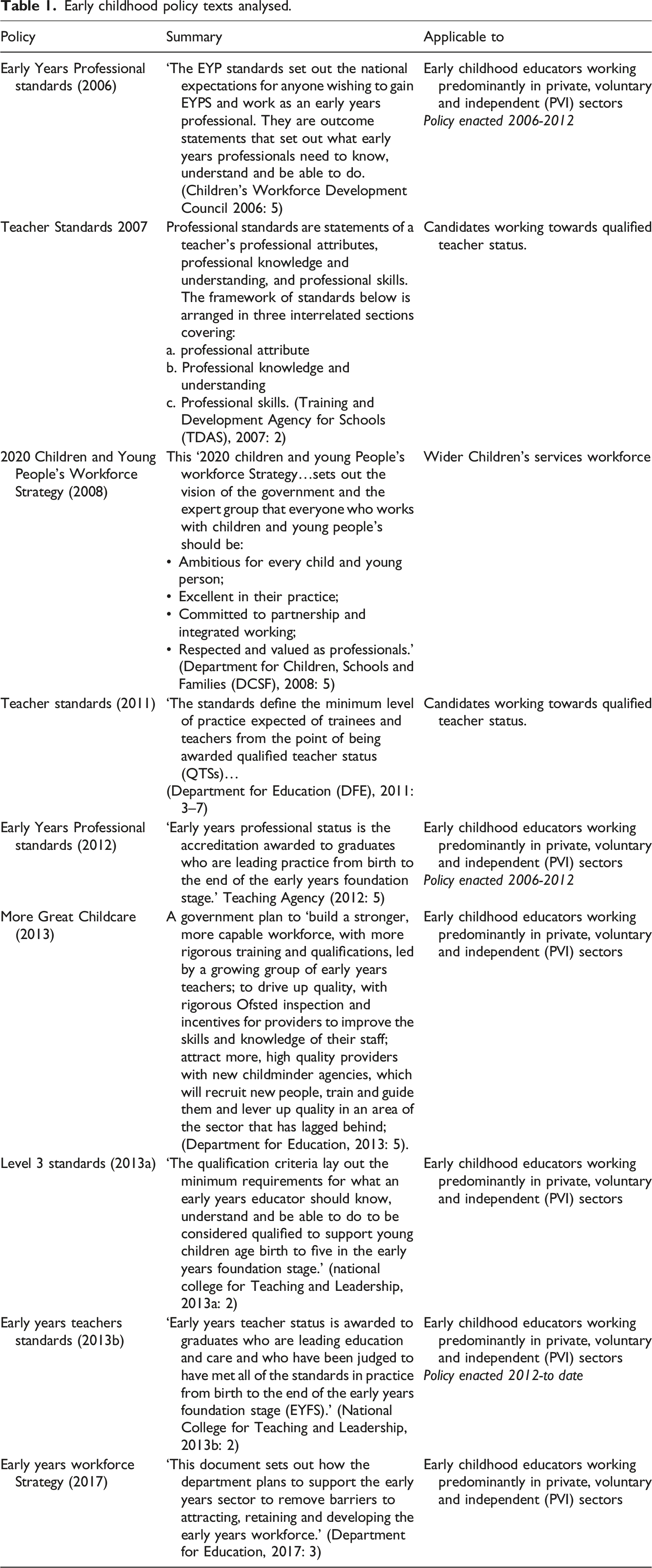
Given the multiplicity of professional roles and titles in the sector, and in order to adopt an inclusive term, I have chosen ‘early childhood educator’ to refer to all professionals working in ECEC, and where appropriate I have differentiated analysis by specific professional role, for example, Early Years Teacher.
Professional identities
From a critical perspective, I draw on the concept of subjectivities which Ball (2016) describes as ‘the point of contact between self and power…the subject is then governed by others and at the same time governor of him/herself’. (p.1131). In this way, I understand subjectivities to be influenced by cultural forces determining individuals’ actions and the ways they are not only situated and situate themselves but are ‘subjected’ to external forces of societies, economies and histories. In policy critique, professional identity formation has been seen as a set of centrally defined competencies and attributes that are imposed upon educators (Sachs 2010: 4).
A body of research exists which acknowledges the influence of institutional discourses on the professional identity construction of early childhood educators (Osgood 2009, 2012; Arndt et al., 2018). In addition, a growing corpus of international research critiques the ways in which early childhood educators have been positioned in relation to the dominance of a neoliberal paradigm (Dahlberg and Moss 2005; Moss 2014; Wood 2017; Roberts-Holmes 2019; Roberts-Holmes and Moss 2021; Kamenarac 2022)
Neoliberal thinking has been described as focussing on marketisation, efficiency, increased accountability and globalisation (Baltodana 2012; Waugh 2014) privileging the power of the market over issues of citizenship, equity and social justice. In such a regime, early childhood education is framed by an investment narrative (Heckman, 2011) and as an economic imperative as the ‘foundation for tomorrow’s workforce’ (World Bank 2017) with resulting implications for both professional identities and pedagogy (Roberts-Holmes and Moss 2021). In order to understand the extent to which these discourses permeate recent English early childhood workforce policy, and thereby influence the professional identities of early childhood educators, I offer a critical analysis.
Methodology
Policy texts as data
The data set is made up of nine key English government policy texts on early childhood workforce reform in the period 2006–2017, an era which saw significant evolution of broader early childhood policy in England. This starting date was selected as The Childcare Act (Great Britain 2006), was watershed legislation, which overhauled the legislative and operational landscape of early education and childcare. At a critical juncture in policy development this was the first ever Act to be exclusively concerned with early childhood services in England.
This analysis utilises policies developed in an era of austerity (2007–2019) (Institute of Fiscal Studies, 2019). The challenges of offering early childhood education in a neoliberal context have been exacerbated by recent economic conditions and political developments in the UK and globally. Most notably this has been the case following the financial crisis of 2007/8, the subsequent recession, and the election of a Conservative-Liberal Democrat administration in 2010 focussed on deficit reduction. Following a decade (1997–2007) dominated by Labour governments’ investment in infrastructure services for young children and their families, economic policy changes resulted in significant cuts to local government, welfare and social services, including early childhood services post-2010 (Lloyd 2015). Such developments escalated following the election of majority Conservative governments in 2015, and again in 2017 and 2019, during which this fiscal retrenchment continued. The UK has endured several years of economic downturn, and associated austerity policies. The detrimental impact of these decisions on children’s services is well documented (Torjesen 2016; Lewis and West 2017) and forms a sobering backdrop to this study. In particular, the impact of investment followed by disinvestment between 2007 and 2019 is noted in early childhood workforce policy (Education Policy Institute 2020).
I established criteria of analysing only government-produced workforce reform policies (2007–2019) as sites of institutional/structural discourses (however, they may have been shaped, influenced or originated). Workforce reform policies are the most explicit examples of government-constructed frameworks on professional standards and qualifications. I perceived these to be the clearest and most instrumental policy vehicles for discerning institutional discourses of professional identity. Given the aforementioned diversity of the workforce, policies analysed included those pertaining to those employed in the maintained and PVI sectors.
Critical discourse analysis
Critical Discourse Analysis (CDA) serves as both method and analytical framework. Critical Discourse Analysis is an approach to the analysis of discourse, through talk and text, that views language as a mode of social practice. Various iterations are united by the intention to investigate the ways in which societal power relations are formed, circulated and reinforced through language.
Fairclough and Wodak (1997) offer an interpretation of discourse from one school of CDA, which sees discourse as a form of social practice. As such, the authors propose a relationship between the discourse and the social structures and situations that frame it. This suggests that such discursive practices have ideological effects in creating and sustaining unequal power relations (p.258). Critical Discourse Analysis is a valuable means to uncover dominant and naturalised structural discourses, and thereby ideology. As a method, it has notably been applied in critical policy analysis, of which Kiersey (2009) notes its affordances in exposing political agendas, loci of power and the expression of particular values.
Critical Discourse Analysis has been utilised to undertake analysis of early childhood policy including Osgood (2009), Wild et al. (2015) and Kay et al. (2019). This paper builds on this work deploying CDA to a recent and broader corpus of workforce policy texts.
The analysis for this study was undertaken using Hyatt’s (2013) analytical frame which was developed to support the CDA of policy texts. Hyatt (2013) details the framework of analysis thus: ‘A Contextualising the text 1. Considering policy levers and drivers 2. Considering warrant (justification or authority for an action) i. Evidentiary (credibility established by empirical evidence) ii. Accountability (grounds for actions based on outcomes) ii. Political (justification in the public/national interest) B. Deconstructing the text 1. Modes of legitimation (justification of policy through authorisation, rationalisation, moral evaluation and/or myth creation) 2. Interdiscursivity and intertextuality (relationships between discourses and texts) 3. Evaluation (inscribed with attitudinal judgement of text producer and/or evoked leaving the judgement to the reader) 4. Presupposition/implication (lexical devices such as closed questions, factive verbs) 5. Lexico-grammatical construction (e.g. pronouns to include or exclude)’ (p.839)
Hyatt (2013) proposes that this CDA frame is not intended to be an ‘all encompassing, universal tool’, and that users should select ‘aspects of the frame that are useful’ (p. 837). Consequently, I utilise this flexibility to meet the needs of this research project.
Application of Hyatt’s CDA doctoral frame to chosen policies.
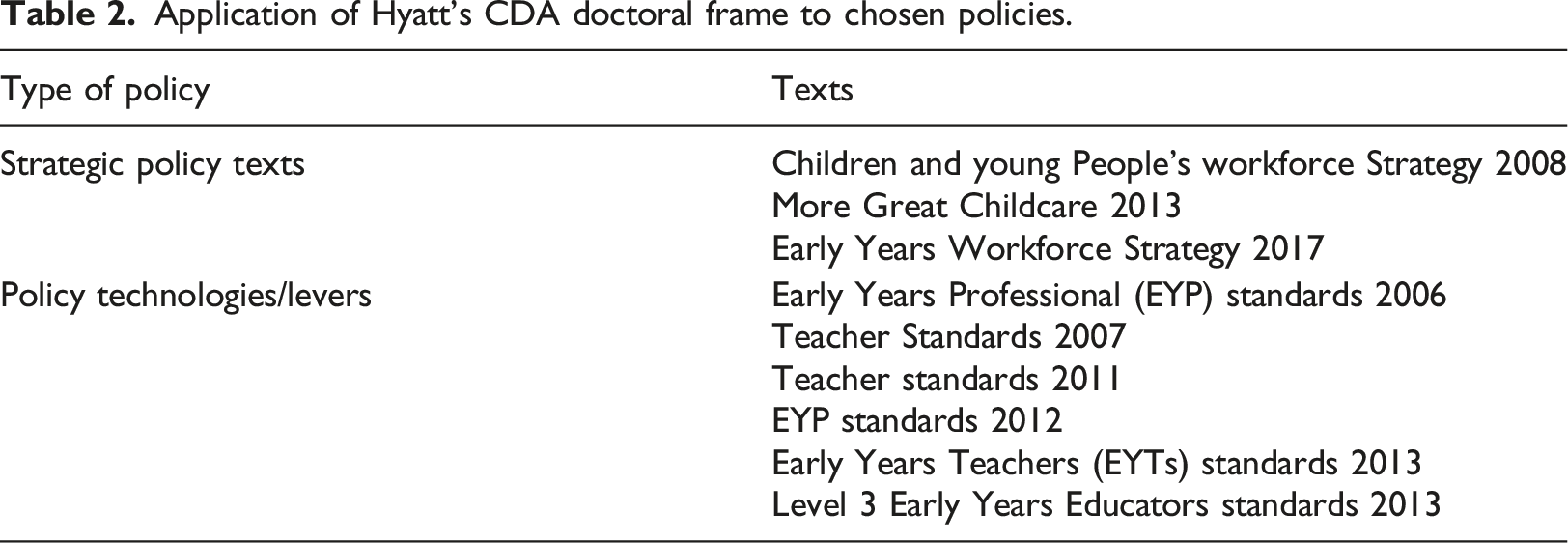
In particular, I considered that the policy drivers, warrant, legitimation and evaluation elements of the tool would enable me to consider motivations, rationale and attitudinal judgements in policy which discursively created professional identities of early educators.
Findings
These analyses have been synthesised under the following discourses identified across the data set: • governmentality • responsibilisation • performativity and accountability • surveillance • marketisation and commodification
These discourses are discussed, in turn, below.
Governmentality
Analysing the context of these policies highlighted discourses of governmentality across a number of the texts. I understand this notion of governmentality in a Foucauldian sense as methods attempting to ‘shape human conduct by calculated means’ (Li, 2007: 275). In particular, I draw on Foucault’s notion of disciplinary power as it is exerted in a neoliberal education context. Such disciplinary power concerns the circulation of desires by authorities to individuals through techniques of the self, in this case, engendering certain expectations in educators. In the strategic policies, such governmentality is expressed through policy levers and drivers to justify the policy: The affordability and availability of childcare are growing concerns…the quality of provision could be improved (Department for Education, 2013: 4) Settings which gained [an optional] graduate leader with Early Years Professional Status (EYP) (the precursor to Early Years Teacher status) made significant improvements in quality for pre-school children compared with settings which did not. (Department for Education, 2017: 15)
These quotes position the possibility of quality improvement and links between Early Years Professional Status (EYP) status and quality as decisions to be taken by schools or settings. The fear of ‘growing concerns’ and appealing to local leaders on EYP deployment for ‘significant improvements’ inculcates government expectations through moral evaluation and persuasion. Akin to Osgood’s (2012) work, which identifies discourses of educators defined both by their deficit and as potential saviours, these texts discursively construct the early educator as both cause for unease and as a redemptive force. A notable discursive absence is the role of government in enabling such quality improvement through mechanisms of funding or support. Thus, modes of governmentality are discernible and frame the early childhood educator as both ‘in need of improvement’ and the Early Years Professional as a driver of quality improvement but with limited government support to do so.
Governmentality discourses intended to shape, guide and influence the conduct of early childhood educators are further evidenced in the occupational standards texts. These texts attempt to discursively frame and discipline educators in acquiring the skills and habits to perform in ‘appropriate’ ways, thereby reducing the need for regulatory power to ensure this. In deconstructing these texts, I identify modes of authorisation deployed to present these standards as non-negotiable. In Teacher Standards, pertaining to statutory Qualified Teacher Status in maintained schools (2007): Professional standards are statements of a teacher’s professional attributes, professional knowledge and understanding and professional skills. (Training and Development Agency for Schools, 2007: 2)
Such standard setting of required attributes, knowledge, understanding and skills creates detailed and instrumental ‘ways of being’ and acts to shape desirable conduct. Notably, in a further evolution of Teacher Standards (2011): The following statements define the behaviour and attitudes [my emphasis] … Teachers must have an understanding of and always act within, the statutory frameworks which set out their professional duties and responsibilities (Department for Education, 2011: 1)
These standards move beyond knowledge and skills, and further define and inscribe in detail the behaviours and attitudes required of a teacher. Given the complex, situated nature of education, attempts to prescribe such attitudes and behaviours reflect a disciplinary power and a reductionist perspective in attempts at centralised control.
Discourses of governmentality are also deployed through authorisation to guide operational decisions on staffing ratios (through the suggestion to reduce the number of adults to children despite well documented resistance to this): Settings that employ an early years teacher can choose to operate a 1:13 staff: child ratio for three and four year olds in recognition of the additional training and expertise these graduates have in leading the learning and development of young children. (Department for Education, 2017: 14)
The government-sanctioned ‘choice’ to deploy the qualified early years teacher working with more children, which is ‘in recognition’ of their qualification is, I suggest, a cost saving measure steering the conduct of setting leaders to reduce staffing costs whilst adding to the day-to-day responsibilities and workload of early childhood educators. This seemingly benevolent ‘choice’ acts as a form of governmentality through both disciplinary power and operational demands of cost-savings in an era of austerity. Within this policy, the educator is positioned as someone able to provide care and education for more children as a result of their qualification (i.e. they were previously underutilised) and simultaneously the source of cost savings for the early years setting.
Governmentality as a discourse pervades these texts. Various mechanisms are at work which seek to frame the educator in particular ways and steer their conduct. Both strategic level documents and professional standards are used to detail desirable attitudes and behaviours and to shape decisions on staff deployment for greater efficiency. In deconstructing these texts, particularly analysing modes of legitimation and evaluation of text producers, I discern attempts to secure the willing participation of early educators and their active consent to adopt the sanctioned, ideal version of their professional identities. Additional modes of governmentality are discerned in these policies.
Responsibilisation
One technology of governmentality which was notable in the analysis was the discourse of responsibilisation. This concept is perceived as the shifting of responsibility from higher authorities to individuals in order that they take responsibility for their own problems or issues. As MacfarLane and Likhani (2015) attest: mutual responsibility and reciprocal obligation [are] crucial to civil societies. Consequently, the civic minded citizen self regulates and becomes responsibilised, that is, comes to understand this process as the proper way to function. (p.184)
Such a concept of responsibilisation was particularly evident in policy texts from 2013 onwards. Most significantly, in More Great Childcare (Department for Education 2013), a number of modes of legitimation for the policy (authorisation, rationalisation and moral evaluation through inscribed or evoked attitudinal judgement) are deployed: Increasing the freedom for professionals to exercise their judgement…it is right to place more power in the hands of professionals to do what is best… (Department for Education, 2013, p. 34) Despite some recent improvements, the early years profession has not broken out of the cycle of low pay and perceived low status relative to other professions. Although the evidence suggests that the best outcomes are achieved by high quality staff, current regulations limit the number of children each member of staff can look after constraining salary levels. Moreover, many providers often fail to use this flexibility… (Department for Education, 2013: 17) The government’s role is that of facilitator…(Department for Education, 2017: 27)
I contend that these proposed freedoms (p.34) frame the ideal early childhood professional as autonomous and self-improving. However, such aspirations, when placed alongside numerous occupational standards and regulatory frameworks are contestable, given the extent of prescription in the standards. Additionally, the ‘power in the hands of professionals’ (p.34) is, I suggest, curtailed through parallel policy technologies including a highly regulated system of standards. The idea that such standards will ‘increasingly shift to providers’ has not materialised in the intervening period.
The second paragraph cited offers an example of moral evaluation and, I argue, myth creation in the construction of the early childhood professional. By conflating research on the impact of higher staff qualifications (used as a proxy for ‘high quality staff’) with regulations around staffing ratios, this policy text has created an alternative conception of the early educator as insufficiently entrepreneurial. Despite government interventions (such as changes to staff: child ratios), it is, according to the text, the early years profession which has not ‘broken out of the cycle of low pay and perceived low status’ [my emphasis] (p17). I propose that this acts to alleviate authorities of responsibility and responsibilise a profession into reducing staffing ratios with the aim of reducing costs for parents.
The text seemingly absolves government and policy makers of any responsibility for structural constraints (such as limited funding) and proposes that the profession itself is responsible for low pay and fails to take advantage of a process of deregulation. The policy text frames the early childhood profession by utilising deficit and failure discourses which attempt to further responsibilise the workforce. In an era of austerity and reduced investment from government, this text positions the early childhood educator as responsible for their own diminished salary.
Coupled with this, the lack of educator appetite for deregulation is seen as a cause of inefficiency. This is read as a myth creation that the early childhood sector is being responsibilised for its own development and efficiency, but is choosing not to, or is incapable of using this responsibility ‘correctly’.
Performativity and accountability
A further tool of governmentality can be seen in discourses of performativity and intensified accountability across the policy texts. In considering the context of these texts, whilst examples of these discourses are not large in number, they do pervade the texts in terms of the policy levers, drivers and warrants for the policies.
More Great Childcare (Department for Education 2013) refers to bringing in ‘tougher entry requirements’ (p.6) which will ‘raise the quality of the workforce’ (p.6). This text frames educators as needing further scrutiny or benchmarks to improve performance.
Further, teacher standards deploy discourses of performativity through modes of evaluation (attitudinal judgement in the text) and presupposition. Evaluation is evident in the text: The framework of standards is progressive, reflecting the progression expected of teachers as their professional attributes, knowledge and understanding and skills develop, and they demonstrate increasing effectiveness in their roles. (Training and Development Agency, 2007: 4) [my emphasis]
Such performativity is linked to credentialising so that eligibility for progression within the profession is demonstrated through the performance of approved attributes, knowledge and skills.
Embedded within policy texts throughout the era, various modes of intensified accountability and measurement of performativity are analysed. Through these discourses I perceive early childhood educator professional identities increasingly constructed by policy expectations. As a result of this, educator autonomy and decision making are subservient to standards compliance and increased accountability for performance.
Surveillance
I also argue that such performativity and accountability are policed through surveillance, itself made explicit in these texts. The justification of policies through authorisation is a mode of legitimation in Hyatt’s frame and can be evidenced in the text below. Drawing on Page’s (2017) conceptualisation of surveillance, I identify both vertical (by regulators) and horizontal (by peers) modes of surveillance: The framework of professional standards will provide a backdrop to discussions about how a teacher’s performance should be viewed in relation to their current career stage. (Teacher Standards, 2007: 2)
This text makes explicit the notion of teacher performance. Through a process of authorisation, these standards normalise horizontal surveillance by peers/managers. A result of such a performativity regime, according to Ball (2003) is that It requires individual practitioners to organize themselves as a response to targets, indicators and evaluations. To set aside personal beliefs and commitments and live an existence of calculation. (p. 215)
Lash and Castner (2018) concisely critique how such ‘…hegemonic monologues of reductionist evaluative frameworks routinely appraise and manage the daily lives of practitioners’. (p.93)
In terms of vertical surveillance, policy texts make it explicit that regulation is a key apparatus both for ‘delivery’ of childcare and oversight of educators: Key to delivering great childcare is a rigorous regulatory and inspection regime…[with] Ofsted as the sole arbiter of quality. (Department for Education, 2013: 10)
Through these policies, the notion of quality is centrally defined and regulated, with Ofsted framed as the ultimate authority on the matter. Quality of early education or childcare is reduced to surveillance by inspection and a resultant grading. There is an absence of educator conceptualisations and interpretations of quality and a dearth of discussion about the contextual nature of quality provision and practice. As such, a regulator-sanctioned version of quality is the only version presented. Educators are surveilled as to their performance of quality according to centrally constructed and applied frameworks.
In summary, these discourses of surveillance are woven through workforce reform policy texts. Directives in the form of professional standards are enacted through both regulatory regimes and the required horizontal scrutiny of peers and managers. As a result, spaces for trust, autonomy and agency are diminished and the early educator performance is observed, assessed and monitored through various policy technologies. The interdiscursivity between performance, accountability and surveillance is discernible, and I suggest, also nested in a marketised system.
Marketisation and commodification
Marketisation is an additional dominant discourse in the policy texts and a further governmentality technology. Through explicit reference to competition between ‘providers’ of early education and care and the prevalence of a choice agenda for parents in accessing such provision, marketisation becomes normalised. Whilst such a discourse is predominantly found in policies pertaining to the private, voluntary, and independent sectors of early childhood provision, increasingly colleagues in maintained sector provision are expected to operate within this diverse market. Marketisation is prevalent as a discourse in the policy drivers and levers for the More Great Childcare (2013) policy: More great childcare is vital to ensuring that we can compete in the global race …by helping parents back to work and readying children for school…(Department for Education, 2013: 6)
This policy positions the early educator as enabler of parental employment and preparer of children for primary school. In this scenario, the childcare offered to the parent-consumer is purchased as a commodity and the school readiness agenda defines early education by its preparatory nature for the next phase of learning. By consequence, the early educator is positioned and responsibilised as needing to enable UK competition ‘in the global race’, both through the childcare which enables parents to work and the foundational learning for children (as future workers).
In order to undertake this with maximum efficiency, a form of deregulation attempts to shift market conditions. This discourse plays out in the More Great Childcare text with the proposal to change staffing ratios of adults to children, affording the flexibility for educators to care for more children and thereby to reduce costs to parents: [current staffing ratios] means providers employ staff in numbers which force a choice between paying low wages and charging parents excessively high fees. (Department for Education, 2013: 19)
The deregulation through proposed changes to staffing ratios is shaped by a desire for greater economic efficiency. This policy thus positions the early educator as accountable either for accepting low wages or working within an organisation charging ‘excessively high fees’. The discourse of marketisation in which the frame of wages and fees is used to warrant the policy proposal, is explicit.
Notably, the political justification for the policy is offered as the need for childcare to enable economic development: Delivering more for the investment currently made by tax-payers …more great childcare is vital to ensuring we can compete…our reforms seek to benefit both society and the economy by delivering high quality early education and at the same time helping parents back to work. (Department for Education, 2013: 13)
I suggest that a discourse of commodification is present in this policy text, normalised both through the rationalisation of the policy and the attitudinal judgement of the text producers. The justification for the policy and the perspectives of the policy authors is made explicit in discourses commodifying children, the provision of childcare and early years educators as professionals.
Discussion
This discussion builds on the critical analysis of discourses within policy texts and considers this in light of theory of discursive closure. This discussion utilises the concept of borders to further develop the analysis of the purposes of and effects of policy on professional identity construction. I read the neoliberal discourses of governmentality, responsibilisation, performativity and accountability, surveillance, marketisation and commodification as discursive borders attempting to shape the identities and conduct of the ‘ideal’ early childhood educator. Although this manifests in different ways across policies aimed at early childhood educators in the maintained and private and voluntary sectors, the prevalence of neoliberal logic is discernible.
Through these policies, concepts about ideal professional identity, through desirable knowledges, skills, behaviours and attitudes, become normalised. As Laliberte-Rudman (2015) asserts, such ‘dominant discourses progressively come to be viewed as normal, natural, ethical, and ideal, thereby bounding identity’. (p.29). I contend that, based on this CDA, one of the ways in which such neoliberal forms of governmentality and responsibilisation are formalised, engendered and inculcated is through setting standards. The strategic workforce policies coupled with associated qualifications criteria, competency frameworks and occupational standards serve as policy technologies and act as a form of hegemony; ‘the discursive face of power’ (Fraser 1992).
Standards setting
These standards are presented as logical and desirable and are deployed (through credentialising, incentivising and surveillance) to manufacture the acceptance and consent of an early childhood workforce. The standards are discursively coercive and through their establishment, maintenance and regulation, ‘inhibit professional autonomy and promote a model of technical practice’ (Miller, 2008: 260).
What is evident from this policy analysis is that over the last 20 years, English early childhood workforce reform policy has sought a specific form of professionalism (and thereby professional identity) shaped by neoliberal thought, which is centrally prescribed and leaves little space for diversity or experimentalism. This underscores Osgood’s (2006) work in that regulatory frameworks can result in practitioners who ‘conform to dominant constructions of professionalism’ and that the ‘regulatory gaze’ inhibits agency (p.7).
Credentialising across professional roles (and different political administrations)
The CDA of policy suggests the essentialist nature of workforce reform policy and the ways in which qualifications and associated technologies act as processes of credentialising across professional roles. Although these reforms and qualifications shifted according to ideologies of different political administrations in the period considered, such credentialism is presented as a solution to a deficit workforce. Notably, dominant discourses analysed in these policy texts positioned educators through multiple and often conflicting discourses. As I have attested, these workforce policies and external accountability demands reflected in the policies require that early childhood educators ‘face’ different directions at the same time: • Early Years Educators are ‘enablers of school readiness' (National College of Teaching and Leadership, 2013b: 2) • The early years workforce are carers to enable parental employment (Department for Education, 2013: 3) • The early years workforce needs to ‘deliver more for taxpayer investment’ (Department for Education, 2013: 13)
In addition to these numerous and disparate discursive demands, policy discourses changed over time. Constructions of the early childhood workforce are discerned as shifting with political priorities and different political administrations during this period. The language of ‘agent of change’ (Children’s Workforce Development Council, 2006: (5) ‘narrowing the gap’ (Department for Education, 2013), ‘accountable for achieving the highest possible standards’ (Department for Education, 2013: (2) illustrate these ever-changing emphases and ideologies which, I argue, seek to shape professional identities. Notably such shifting demands become embedded (albeit for the short term) within qualifications standards indicating the ideologically constructed nature of the ideal professional identity for early childhood educators.
Such policy ‘layering’ and the resulting redefinitions of purpose of early childhood educators, is reflected by Goouch and Powell (2017): ‘politicians and policy makers [are] constantly… treating the practitioners as “palimpsests” inscribing, cleaning, and re-inscribing those who work with babies and young children.’ (p.2) This notion of a palimpsest is a powerful heuristic and brings a sharp focus to the way in which educators are subject to and accountable for the expectations of ever-evolving policy priorities. As Roberts-Holmes and Moss assert: Professional identity is corroded by this performative culture, steering practitioners away from pedagogical values and principles that may have brought them into the work in the first place…’ (2021: 144)
Ideal subject positions formed within professional roles
Through the analysis of policy levers and drivers, warrant and modes of legitimation, I have identified a series of discursively constructed ‘ideal’ (although often multiple and conflicting) subject positions in the policy texts. The discursive construction of categories including ‘early years teacher’, ‘early years educator’, defined by prescriptive standards, presents particular versions of who early childhood educators should strive to become, and ‘what occupations they view as possible and not possible’ (Laliberte-Rudman, 2015: 55). I propose that institutional discourses are mobilized to align early childhood educators’ thinking and acting with the values and intentions of dominant ideology, thereby delineating what is, and is not, socially, politically and economically acceptable action. This results in ‘transmitting favoured assumptions and values whilst obscuring vested interests and constraining opportunities for contestation’. (Wiggan, 2012: 384).
Demarcation as an act of bordering
Through workforce reform policy asserting ideal subject positions, I contend that this process constitutes an act of demarcation. That is to say, instrumental and essentialist discourses in policy texts act to delineate professional identity ‘territory’. I read this demarcation as an attempt at prescriptive professional identity bordering through the identification of desirable or ideal subject positions. Beyond the identification of skills, such policies stray into explicating desired behaviours.
Through the policies analysed (and associated policy technologies) ideal subjects are discursively constructed, regulated and bordered. As Green (2012) states ‘borders always involve a form of classification and categorization of the world, because otherwise, they would not be recognized as borders’ (p.575). I contend that such bordering results in forms of complexity reduction and diversity reduction thereby opening a space for some professional identities and closing down others.
Conclusion
This CDA of workforce reform policies and qualification standards has illuminated the dominant discourses prevalent in policy texts. Building on work by Osgood (2009, 2012); Arndt et al. (2018); Roberts-Holmes and Moss (2021), the institutional discourses analysed in policy texts point to the pervasiveness of a neoliberal regime.
The prevalence of discourses of governmentality, responsibilisation, marketisation, performativity and surveillance within these texts leads me to conclude that neoliberal ideas are reaching into early childhood policy in attempts to shape notions of the ‘ideal’ early childhood educator’s professional identity. Although the manifestation of these discourses differs between professional roles detailed in policies (e.g. horizontal surveillance of teachers and vertical surveillance of private and voluntary early childhood educators) nonetheless the pervasiveness of neoliberal discourses is discerned across the workforce policies.
I have argued that policies, particularly post-2013, frame the ideal early childhood educator (regardless of their professional role and title) as autonomous and self-improving. This is set within the neoliberal frame of significant regulation, accountability and surveillance, and that educator autonomy is curtailed by compliance with these standards.
Further, I argue that these tenets of neoliberalism are explicit in workforce reform policy, evident through the bordering processes which seek to demarcate and delimit prescriptive professional identities and create ideal subject positions. Normative professional standards and regulatory technologies are attempts at a disciplinary and repressive process of bordering. In so doing, this bordering through setting standards opens spaces for certain compliant identities and closes down others. This analysis echoes work by Roberts-Holmes and Moss (2021) who highlight how neoliberalism offers an understanding of professionalism which is ‘narrow and instrumental, viewing it as something that is measurable, manageable and standardisable’ (p.111). The study which informed this paper has further interrogated workforce policies to evidence the extent of this reach.
I also contend that such discourses are contestable. However, in order for these dominant discourses to be challenged, they must first be uncovered. I conclude that identifying and naming these borders are important prerequisites for contestation of such institutional discourses and asserting alternative subject positions.
Footnotes
Acknowledgements
With thanks to the anonymous reviewers whose comments were formative in improving the paper.
Declaration of conflicting interests
The author(s) declared no potential conflicts of interest with respect to the research, authorship, and/or publication of this article.
Funding
The author(s) received no financial support for the research, authorship, and/or publication of this article.

Author Biography
Appendix
Adapted from Hevey. D. (2017) ‘United Kingdom – ECEC Workforce Profile.’ In Workforce Profiles in Systems of Early Childhood Education and Care in Europe, edited by P. Oberhuemer and I. Schreyer. www.seepro.eu/English/Country_Reports.htm.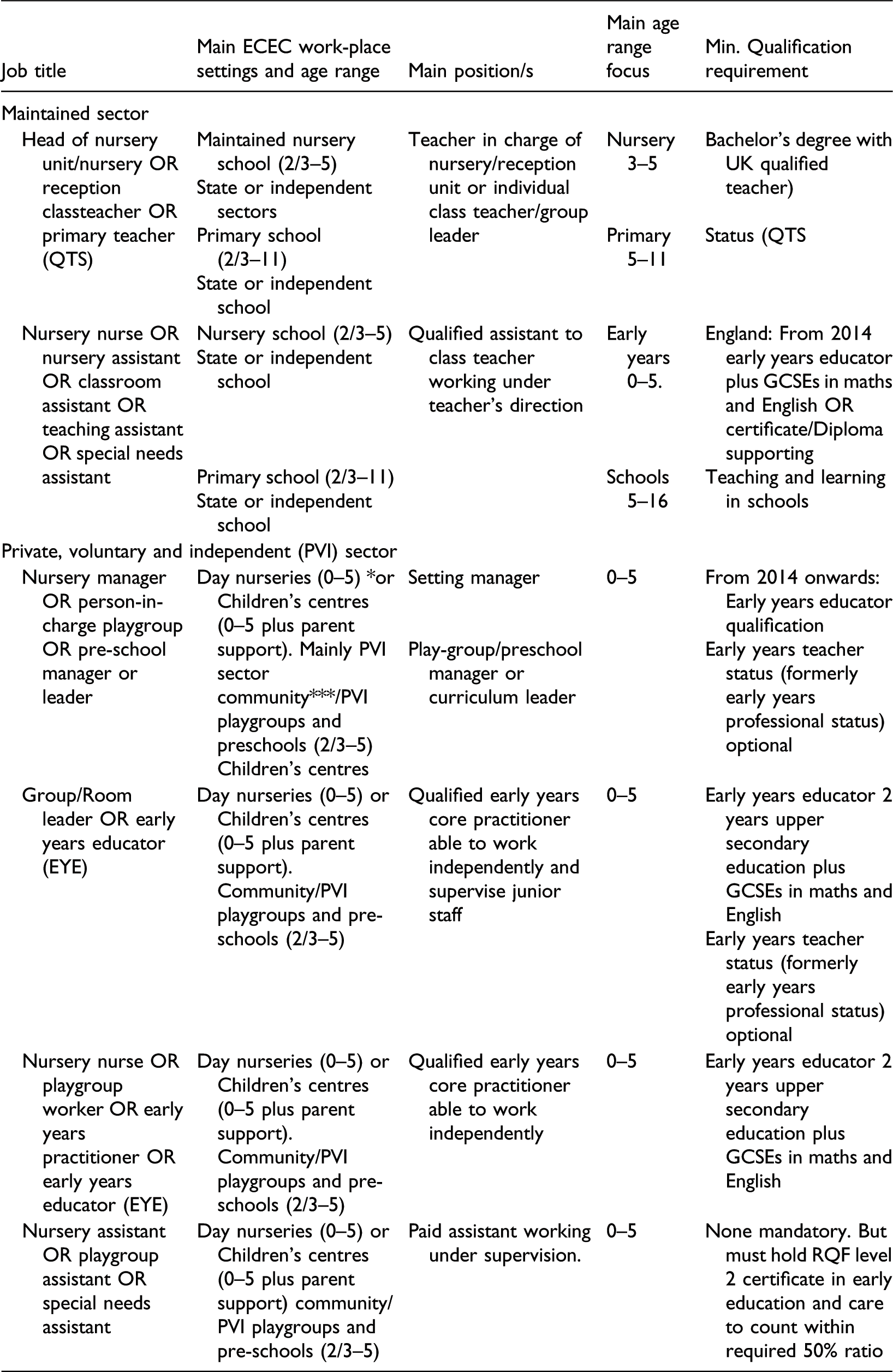
Job title
Main ECEC work-place settings and age range
Main position/s
Main age range focus
Min. Qualification requirement
Maintained sector
Head of nursery unit/nursery OR reception classteacher OR primary teacher (QTS)
Maintained nursery school (2/3–5)
Teacher in charge of nursery/reception unit or individual class teacher/group leader
Nursery 3–5
Bachelor’s degree with UK qualified teacher)
State or independent sectors
Primary school (2/3–11)
Primary 5–11
Status (QTS
State or independent school
Nursery nurse OR nursery assistant OR classroom assistant OR teaching assistant OR special needs assistant
Nursery school (2/3–5)
Qualified assistant to class teacher working under teacher’s direction
Early years 0–5.
England: From 2014 early years educator plus GCSEs in maths and English OR certificate/Diploma supporting
State or independent school
Primary school (2/3–11)
Schools 5–16
Teaching and learning in schools
State or independent school
Private, voluntary and independent (PVI) sector
Nursery manager OR person-in-charge playgroup OR pre-school manager or leader
Day nurseries (0–5) *or Children’s centres (0–5 plus parent support). Mainly PVI sector community***/PVI playgroups and preschools (2/3–5) Children’s centres
Setting manager
0–5
From 2014 onwards: Early years educator qualification
Play-group/preschool manager or curriculum leader
Early years teacher status (formerly early years professional status) optional
Group/Room leader OR early years educator (EYE)
Day nurseries (0–5) or Children’s centres (0–5 plus parent support). Community/PVI playgroups and pre-schools (2/3–5)
Qualified early years core practitioner able to work independently and supervise junior staff
0–5
Early years educator 2 years upper secondary education plus GCSEs in maths and English
Early years teacher status (formerly early years professional status) optional
Nursery nurse OR playgroup worker OR early years practitioner OR early years educator (EYE)
Day nurseries (0–5) or Children’s centres (0–5 plus parent support). Community/PVI playgroups and pre-schools (2/3–5)
Qualified early years core practitioner able to work independently
0–5
Early years educator 2 years upper secondary education plus GCSEs in maths and English
Nursery assistant OR playgroup assistant OR special needs assistant
Day nurseries (0–5) or Children’s centres (0–5 plus parent support) community/PVI playgroups and pre-schools (2/3–5)
Paid assistant working under supervision.
0–5
None mandatory. But must hold RQF level 2 certificate in early education and care to count within required 50% ratio