




Abstract
This analysis examines the roots of clinical practice regarding oxygen therapy and finds that some aspects have changed very little over the past 200 years. Oxygen is commonly prescribed and administered as a therapy across all healthcare settings, particularly for the treatment and management of respiratory conditions, both acute and chronic. Yet despite its widespread use and recent advances in understanding and guidance, poor practice and controversies regarding its use persist. This historical analysis highlights origins in practice that may suggest where the roots of these fallacies lie, highlighting potential ambiguities and myths that have permeated clinical and social contexts. It can be considered that based on clinical presumptions and speculation the prolific and injudicious use of oxygen was encouraged and the legacy for today’s practice seeded. The conjectures proposed here may enable modern day erroneous beliefs to be confronted and clinical practice to move on.
Introduction
Oxygen therapy is one of the commonest interventions in modern day healthcare worldwide. Yet, despite universal use, it is evident through poor practice that oxygen is often prescribed and administered injudiciously [O’Driscoll et al. 2011; Wallace et al. 2010; Pilcher et al. 2013], potentially resulting in worse outcomes for patients with respiratory conditions, including increased mortality particularly in the prehospital setting [Austin et al. 2010; Perrin et al. 2011; Wijesinghe et al. 2012]. Similarly, a report on domiciliary oxygen in the UK [Royal College of Physicians, 1999] demonstrated costly poor prescribing practices, leading to major changes in home oxygen services in England and Wales [British Thoracic Society (BTS), 2006].
The issue of problematic prescribing in the UK has heralded directives from the National Patient Safety Agency [NPSA, 2009] which received 281 reports of serious incidents related to oxygen, of which poor oxygen management appears to have both caused and contributed to patient deaths. The number of unreported incidents cannot be assessed and the problem could be greater in the community. The use of oxygen in both acute and chronic settings is now recognized as a major area for improvement in England [Department of Health, 2011].
When administered as a therapeutic intervention, oxygen is regarded as a drug [British National Formulary (BNF), 2014]. In the UK contemporary guidelines offer criteria and directives for administration and prescription of oxygen, dependant on the patient’s condition, acuity and care setting [BTS, 2006, 2008; Joint Royal Colleges Ambulances Liaison Committee (JRCALC), 2013]. In the context of respiratory care, oxygen is generally prescribed for hypoxaemia, as either an acute or chronic therapy; the condition being treated would normally determine the concentration and duration of oxygen administered. Despite these widely accepted guidelines, however, it is unclear why poor practice persists [BTS, 2008].
It has been proposed that possibly an influencing culture presides, whereby oxygen is often poorly understood and uncertainty regarding its use exists [BTS, 2008], leading, at times, to inappropriate use and prescription. Yet it is unclear where the origins of this existing culture lie. The problem may self-perpetuate as erroneous beliefs impact upon patients’, carers’ and the general public’s perceptions. Thus this analysis seeks to explore historical perspectives of oxygen in order to consider origins of practice that may influence and permeate contemporary healthcare. Highlighting these issues could help identify misplaced beliefs and allow healthcare practitioners to confront poor practice that is continuing to harm patients.
The context
In order to contextualize the problem it is worth first considering the evolutionary nature of living organisms which adapted not only to utilize oxygen, but also to tolerate and provide protection against it. Oxygen, absent from the Earth’s atmosphere during its formation, latterly became abundant, rising to levels of approximately 35% about 300 million years ago, before falling and stabilizing to today’s 20.8%; the reason is attributed to photosynthesis. It is regarded that the evolutionary development of mitochondria, an inherited legacy from photosynthetic ancestors, that then enabled oxygen to be harnessed as an economic fuel, allowing the evolution of complex organisms with high energy demands [Lane, 2002].
Paradoxically adaptation to aerobic respiration required additional adjustment to protect against oxygen’s toxic effects - namely reactive oxygen species (ROS). ROS are unstable molecules produced during normal metabolism. An excess of ROS results in oxidative stress which can be damaging to the body’s cells and has been associated with aging [Dowling and Simmons, 2009]. The structure of the mitochondria themselves seems central to this protection: mitochondria have their own DNA and reproduce independently of the host cell. It is thought that this primary evolutionary function of the compartmentalization protects the cells’ nuclei from damaging toxic side effects of oxygen metabolism [Abele, 2002]. The sensitive equilibrium that mitochondria therefore aim to achieve is to keep cellular oxygen concentration high enough to meet the tissue’s demands but low enough to minimize or control ROS formation. Seemingly the evolutionary irony of oxygen is that in addition to sustaining life it is also what limits lifespan and ultimately kills.
With increasing knowledge and understanding of these processes, a growing body of evidence is now highlighting the potential iatrogenic effects of oxygen, for example worsening hypercapnia, in certain clinical conditions [Austin et al. 2010; Singhal, 2006; Shuvy et al. 2013], often adding to healthcare professionals’ uncertainties and clinical quandaries. Uprooting the origins of these current beliefs and overthrowing the enigma that oxygen is the panacea of contemporary clinical practice will be an important step in confronting existing beliefs and myths. The history of oxygen may enlighten this challenge.
Early discoveries
Early founders recognized that air was made up of various components. In 1674 Mayow termed ‘aerial nitre’ (oxygen) as a normal constituent of air, yet despite this seemingly accurate concept it took a further century to isolate oxygen. One of the key reasons for this delay was persistent belief in the ‘phlogiston theory’. In 1771 Scheele and in 1775 Priestley both discovered oxygen independently, though Priestley was the first to publish. Both appreciated that burning (of candles) was more vigorous in the presence of oxygen and Scheele termed ‘fire-air’ to depict the gas [Scheele, 1777]. Priestley, however, named the gas ‘dephlogisticated air’ [Priestley, 1775]. The term originating from the accepted purporting that phlogiston, a contaminant, was released in combustion, therefore dephlogisticated air represented pure air. This theory dogma probably blinded both Scheele and Priestley to the true meaning of their discoveries and it was not until 1777 that Antoine Lavoisier cast off the flawed theory and named oxygen as the reactive constituent of air [Grainge, 2004].
Despite the fetters that beliefs of the day imposed on Priestley, he recognized potential benefits of oxygen. In his words ‘… it may be conjectured, that it might be peculiarly salutary to the lungs in certain morbid cases’ [Priestley, 1775]. He also recognized collateral merits of oxygen as a placebo: ‘… I fancied my breast felt peculiarly light and easy for some time afterwards. Who can tell that, in time, this pure air may become a fashionable article in luxury’ [Priestley, 1775]. This insight into the use of oxygen as a commodity is unprecedented in contemporaneous and subsequent literature, but clearly parallel to today’s commercial oxygen industry.
In addition to beneficial effects Priestley pondered the potential that oxygen may accelerate aging and death, not dissimilar to today’s free radical theory of aging:
[oxygen] might not be so proper for us in the usual healthy state of the body; for, as a candle burns out much faster in [oxygen] than in common air, so we might, as may be said, live out too fast … A moralist, at least, may say, that the air which nature has provided for us is as good as we deserve [Priestley, 1775].
Priestley alludes to the toxicity of oxygen but although it was embraced as medical therapy by Priestley’s contemporaries, its potentially noxious qualities were not documented further until 1849 when Lorrain Smith reported high oxygen tensions acting as an irritant, inflaming lung tissue [Smith, 1849]. Based on animal studies, however, these latter findings were slow to be adopted.
The first publication reporting oxygen as a medical therapy was in 1783; a French physician treating a young woman with tuberculosis claimed that she ‘very much benefitted’ [Grainge, 2004]. Soon after in 1798 the Pneumatic Institute opened in Bristol to investigate the efficacy of oxygen to treat disease. Thomas Beddoes, the founder of the institute, was joined by Humphrey Davy and James Watt [Leigh, 1974]. These early experiments however proved unsuccessful, probably because of the ambitious choice of intractable diseases (including dropsy and venereal disease). Beddoes favoured the notion that in some cases oxygen did good, and in others it could do no harm [Leigh, 1974]. This philosophy of oxygen as harmless has followed practice over the next 200 years.
Quacks and charlatans
Throughout the nineteenth century problems with oxygen therapy persisted, probably due to impurities, lack of scientific knowledge and diverse delivery methods; for example, bubbling oxygen through water and wafting it towards the patient [Grainge, 2004]. Additionally, a lack of understanding of physiology often led to hyperbolic claims, further impeding scientific advancement.
Much literature of the time purported virtues of oxygen therapy; the principle ethos being that oxygen is essential for life so it should be a treatment for all diseases. Birch in 1857 heralds the case of a 33 year old with syphilitic ulcerated legs exemplifying the curative nature of oxygen. The ‘largest quantity that could be borne’ was administered every evening and in 3 months his ulcerated legs were cured [Birch, 1857]. In 1869 Birch further wrote about oxygen ‘in connexion [sic] with a new, agreeable, and easy form of administration by the stomach’ [Birch, 1869]. What Birch was referring to was ‘oxygenated bread’. Heralding its merits he advocated ‘a surprisingly small bit of this oxygenated bread proves its special influences in suitable cases’ [Blodgett, 1890]. Similar abundant claims for oxygen products can be found on the internet today. Preservation of the bread was problematic but Birch suggested using paper soaked in phenic acid to keep mould at bay: ‘… will prove a positive advantage to some patients who desire medical flavor’ [Birch, 1869]. Analogies with the placebo effect are apparent.
Mixed messages
Claims to success with specific diseases, for example pneumonia, appeared more trustworthy. In 1890 Albert Blodgett used oxygen to treat a 46-year-old woman with pneumonia, quoting ‘… the patient was irrevocably doomed, and the best result that I looked for was simply relief to the sensation of suffocation …’ [Blodgett, 1890]. But she recovered with continuous administration of oxygen. Blodgett correctly identified oxygen as ‘tiding the system over’ rather than curing disease [Blodgett, 1890]. Importantly he acknowledged the potential toxicity of oxygen: ‘Pure oxygen I believe to be too powerful an oxidizing agent when used alone, especially when there exists inflammation of the air passages’. ‘Judicious employment’ and stopping oxygen as soon as possible were advocated [Blodgett, 1890]. Unfortunately this early insight went unheeded and the toxicity of oxygen was, and often still is, overlooked.
At the same time oxygen to treat dyspnoea was common. Dyspnoea can be defined as the subjective experience of discomfort in breathing. It is a complex symptom and a distressing sensation of both body and mind [Booth, 2013]. A common presentation of a wide range of diseases, it has been identified as a potent predictor of mortality and hospitalization [Parshall et al. 2012]. It is now recognized that an array of physiological mechanisms in addition to psychological, social and environmental factors contribute to dyspnoea and the complexity itself adds to its often intractable nature. However, given the limited knowledge of physiology in the nineteenth century it was hardly surprising that the sensation of breathlessness and lack of oxygen were often considered synonymous. An example published in 1891 by Robert Reed: ‘In general terms one may say any disease which gives rise to dyspnoea will be benefitted by oxygen, and the greater the dyspnoea the greater the need of oxygen’ [King Oxygen Works, 1901]. A philosophy that appears to have traversed decades with little modification as many clinicians often believe that, with regards oxygen therapy, ‘more is better’. Additionally, given the complex psychological dimensions of dyspnoea, it is hardly surprising that if a medication is prescribed and administered it may have additional placebo effects. Recent evidence concludes that, although oxygen may alleviate breathlessness to some extent, the use of air provides similar relief [Abernethy et al. 2010; Cranston et al. 2008].
Fick and Bert advanced understanding of related physiology further, describing oxygen tension in terms of partial pressure [Haldane, 1917]. Building further on this work John Scott Haldane published ‘The therapeutic administration of oxygen’ in 1917 [Haldane, 1917]. This landmark paper represents the origin of rational use of oxygen, outlining regulation of respiratory drive by carbon dioxide and its effects on blood hydrogen concentrations and pH.
Haldane’s legacy to respiratory medicine was prolific. Amongst his attributed discoveries he explained the physiology of carbon monoxide poisoning; proposed the need to know the percentage of oxygen administered, and the concept of ventilation perfusion matching. Haldane also alluded to the toxicity of oxygen, citing the work of Lorrain Smith [Haldane, 1919]. Haldane’s cautious advice was to give only as much oxygen as would ‘suffice to relieve anoxaemia’ [Haldane, 1919]. This is a further recognition of the judicious employment of oxygen, a key message in today’s guidelines [BTS, 2008] that is still often not heeded.
Enlightenment
Throughout the twentieth century use of oxygen as a therapy progressed, in part due to advances in science and medicine, but most profoundly experiences of gas poisoning in the First World War (1914–18). Phosgene was used commonly in the trenches and principally caused pulmonary oedema; oxygen therapy became the primary treatment.
Empirical knowledge followed with single-blind experiments showing oxygen improved survival and reduced morbidity. However, intermittent use of oxygen, for example 5 min in each hour, was still common practice, although condemned as ‘useless’ [Royal Society of Medicine, 1920]. It seems that ambiguity regarding the clinical use of pro re nata (PRN) oxygen was established.
Still, physiological understanding progressed. In 1920 Meakins published experimental work in the BMJ outlining methods for calculating the percentage of oxygen saturation of haemoglobin and its relationship with the patient’s condition. Meakins, a physiologist, however, neglected clinical outcomes of treatment and robust studies failed to materialize [Meakins, 1920].
The sound scientific basis for oxygen therapy was definitively proposed in 1922 by Haldane in Respiration. Haldane highlighted the principles of knowing the percentage of oxygen breathed, keeping it as low as possible, and balancing the risks of hypoxia and hyperoxia [Haldane, 1922]; the same key principles that guide oxygen administration today [BTS, 2008] but which are seldom heeded [Austin et al. 2010].
Reluctance to use continuous oxygen however still pervaded practice. In an attempt to confront this poor practice, Haldane reportedly summarized intermittent use as ‘… bringing a drowning man to the surface of the water – occasionally’ [Campbell, 1965]. Campbell in 1965 offered a contrary perspective: ‘it is like pushing him down between times’. Campbell went on to describe use of intermittent oxygen as ‘… bad practice which I think and hope is disappearing’. Almost 50 years on Campbell would surely be disappointed with common clinical practice of PRN oxygen.
Cautionary tales
Simultaneously, as the issue of controlling oxygen doses was debated, the widespread use of 100% oxygen was endorsed. Boothby and colleagues in 1939 reported ‘The ability to administer practically 100 per cent oxygen … economically, efficiently and comfortably, has opened a new field’ [Boothby et al. 1939]. Based on preventative principles, 100% oxygen was administered to all patients following extensive surgery. Additionally, relief of headaches, seasickness, acute pulmonary oedema and angina were indicated, ‘…without the slightest evidence of pulmonary irritation’ [Boothby et al. 1939]. Although claims were cautioned by those aware of oxygen toxicity, current practice suggests this caveat was seldom heeded and the practice of administrating high-flow oxygen to treat most clinical presentations was established and persists today.
It has been recognized for several decades that oxygen administration can cause carbon dioxide levels to increase significantly and that inappropriate use of oxygen in some patients can be harmful [Donald, 1949]. The importance of titrating oxygen to achieve target saturation ranges has become increasingly apparent, with a number of randomized, controlled trials indicating that failure to do so in patients presenting with respiratory conditions can lead to life-threatening, if not fatal, respiratory acidosis [Austin et al. 2010; Perrin et al. 2011; Wijesinghe et al. 2012].
This injudicious use of oxygen, often in the prehospital setting, has been attributed to a number of mechanisms [New, 2006; BTS, 2008], arguably one of the most important being release of hypoxic pulmonary vasoconstriction. When ‘at risk’ individuals, namely those with type II hypercapnic respiratory failure, are administered high-flow oxygen this vasoconstriction is released and ventilation perfusion matching worsened creating a mismatch and resulting in increased dead space, further exacerbating hypercapnia and respiratory acidosis. Other risks to patients receiving excessive oxygen include absorption atelectasis, reduced cardiac output, damage from oxygen free radicals and increased systemic vascular resistance [BTS, 2008]. Increasing awareness of these detrimental effects of oxygen [Singhal, 2006; Shuvy et al. 2013] have also heralded recent changes in the UK for first response management of other clinical conditions, such as stroke and cardiac ischaemia [JRCALC, 2013].
To address the risk of worsening hypercapnia, in 1960 Campbell advocated small increments of oxygen to correct hypoxaemia. Campbell’s main argument was not about limiting the dose but rather ‘advocating care and precision’ in contrast to ‘haphazard and imprecise dosage’, claiming controlled evidence should not be required to prove this [Campbell, 1963]. But this lack of empirical evidence regarding low-dose oxygen has potentially contributed to the perpetuation and continuation of uncontrolled administration of oxygen to the present day.
In 1962 it was recognized that hypoxaemia, for patients with respiratory acidosis, is more profound following treatment with intermittent oxygen, with accompanying hypercapnia and lowering of pH [Massaro et al. 1962]. This finding supported agreement that continuous administration using low flow rates with graded increases avoids serious worsening of hypercapnia while maintaining acceptable oxygen tensions. A philosophy echoed today in emergency oxygen guidelines [BTS, 2008; JRCALC, 2013].
Further evidence supporting the judicious use of oxygen therapy was advocated by Hutchinson and colleagues in 1964, suggesting that an arterial oxygen tension of 50 mmHg (7 kPa) would prevent death from hypoxia in patients with respiratory failure [Hutchinson et al. 1964]. The use of blood gases was advocated to distinguish respiratory failure from breathlessness per se, and, identifying the dangers of withdrawing oxygen suddenly from patients with hypercapnia, recognized today as rebound hypoxaemia [Kane et al. 2011], advice was given never to stop oxygen suddenly. Despite revised guidance [BTS, 2008; JRCALC, 2013], abrupt removal of oxygen when hypercapnia is suspected is a practice that persists today.
From these early discoveries regarding the utility and futility of oxygen the need for evidence-based clinical trials emerged. In particular two landmark trials, the Nocturnal Oxygen Therapy Trial [Nocturnal Oxygen Therapy Trial Group, 1980] and the Medical Research Council trial [MRC, 1981], confirmed that survival in chronic hypoxic chronic obstructive pulmonary disease (COPD) is increased with oxygen compared with no oxygen, survival is better at 15 h than 12 h, but maximum survival benefit was achieved at 24 h per day. This evidence provided the contemporary guidance and criteria for the prescription of long-term oxygen therapy (LTOT) used today [BNF, 2014].
Whether these early trials in fact hindered clinical progress with oxygen as a therapeutic intervention remains debatable. Many questions remained unanswered following these trials and it is likely that controversies regarding the use of LTOT permeated clinical practice [Heffner, 2013]. Additionally the findings are often extrapolated to other disease areas, such as heart failure, when LTOT is often prescribed to correct chronic hypoxia. Nonetheless LTOT remains one of only two proven interventions that prolong survival in COPD (smoking cessation being the other). An ongoing multicentre longitudinal trial by the National Heart, Lung, and Blood Institute (NHLBI), the Long-Term Oxygen Treatment Trial, is due to complete in December 2015 [NHLBI, 2013]. This should answer some outstanding questions, such as effect on exacerbation frequency, impact on exercise tolerance, enhancing quality of life and impact on mortality.
Time to move on
Oxygen as a cornerstone to medical therapy is now long established. With this integration into mainstream medicine, many fixed beliefs, myths and entrenched practice have evolved and become embedded. However, it is evident from emerging clinical trials that some of these practices are at best of no benefit and at worst detrimental to the patient’s clinical outcome. In order to address these issues, practice must change. This will require a paradigm shift for healthcare professionals across clinical settings and clearly education will be crucial to initiating this change. It has been proposed that as part of this educational strategy healthcare professionals need to have a greater understanding of the dangers and mechanisms that underlie hypercapnia [New, 2006]. Beasley and colleagues suggest that this might be achieved by a change in emphasis in teaching the physiology of the carriage of oxygen, and rather than focusing on the ‘slippery slope’ the emphasis should be on how oxygen tensions can remain relatively stable despite the decline of oxyhaemoglobin saturation [Beasley et al. 2006]. It is further argued that clinical teaching should present not only the adverse physiological effects of hyperoxia but also the potential risks of high-flow oxygen, masking deterioration in a patient’s clinical condition [Beasley et al. 2007].
In addition to changing the mindset of healthcare professionals, expectations of patients, carers and the general public also need to be modified in order to change the automatic ‘want’ for oxygen. The influence of the media will be important in altering perceptions but by far the most influential catalyst will be the actions and responses of healthcare professionals. In order to achieve this, clinicians will need to think more carefully about how they use oxygen and follow disease and situation-specific guidelines. Of particular importance is the overarching message that oxygen should be titrated to haemoglobin saturation, giving enough but not too much, thus avoiding the deleterious effects of both hypoxaemia and hyperoxaemia. Education of clinicians will be the fulcrum to initiate these changes.
Summary
Oxygen can be considered an effective therapeutic intervention in many clinical situations [Cranston et al. 2005; BTS, 2008; JRCALC, 2013], but also one of the most misused and abused remedies in medicine. Although it has been inferred that evolution has, over several millions of years, evolved to protect us from the toxic effects of oxygen, there has been an assumption that oxygen was the panacea for numerous clinical presentations. This historical overview outlines potential ambiguities and myths that have permeated clinical and social contexts. Boxes 1 and 2 summarize these key assertions and contentions of dogma versus science within oxygen doctrine.
Dates of key assertions: the dogma.

Dates of key assertions: the science.
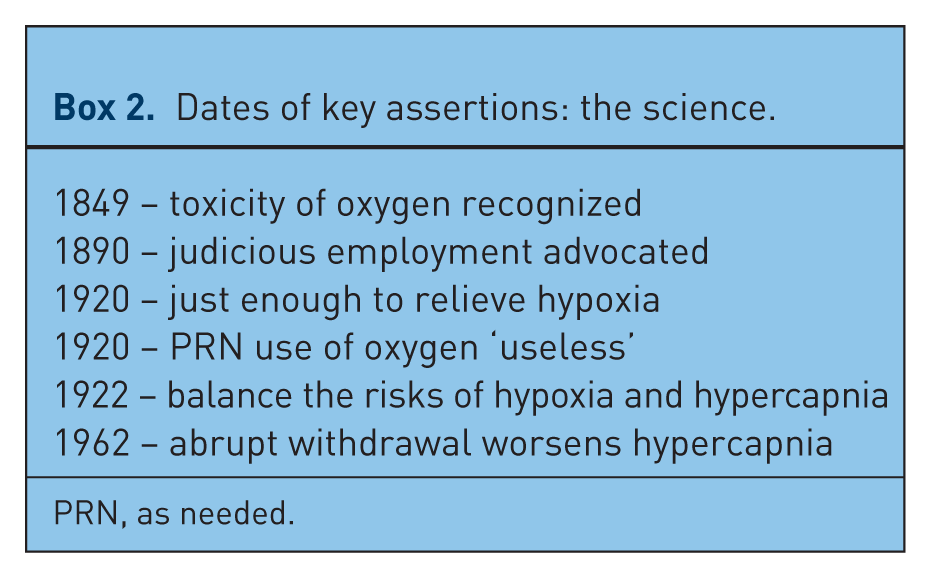
PRN, as needed.
Oxygen as a therapy evolved based on individual cases rather than sound experimental research. This often led to a priori knowledge being adopted and the need for controlled trials diminished. The contribution that the early scientists of the eighteenth, nineteenth and twentieth centuries made to establishing oxygen as a medical therapy is undisputed. Whether they unwittingly made additional contributions by establishing widely held beliefs that oxygen can treat disease and improve health far beyond scientific evidence remains an enigma.
Perhaps it was the insidious nature of the emergence of oxygen as a therapy that led to an eagerness to embrace comparatively unsound evidence. Based on presumptions that hypoxia is harmful and that prevention is better than cure, the widespread use of oxygen was encouraged and the legacy for today’s practice established, some aspects of which have changed very little over the past 200 years. New research in this area, both physiological and clinical, will further understanding of the safe use of oxygen, underpinning the futility and potential dangers of widespread injudicious use.
Meanwhile it is important that clinicians reconsider their practice to reflect current guidelines. Important messages have emerged from this historical analysis, suggesting that the common culture that exists with regards to oxygen is grounded in history. As advancements are made regarding emerging therapies for respiratory disease it is also an opportunity to reflect and learn from the past. With an emerging new evidence base it is time to realign beliefs and alter common practices concerning oxygen as a therapeutic intervention in order to ensure patient safety. It is time to move on.
Footnotes
Acknowledgements
I would like to thank Dr Mary O’Brien, Reader in Health Research, Edge Hill University and Professor Ben Shaw, Consultant in Neonatal and Respiratory Paediatrics at Liverpool Women’s Hospital and the Royal Liverpool Children’s Hospital for their guidance in reviewing the historical literature.
Funding
This research received no specific grant from any funding agency in the public, commercial, or not-for-profit sectors.
Conflict of interest statement
The author declares no conflicts of interest in preparing this article.