




Abstract
Internal medicine trainees (IMTs) comprise a significant portion of rotational junior doctors in intensive care units (ICUs) in the UK. Provision of formal training for this role is highly variable, delivered by only 67% of units responding to our UK-wide survey. Topics most often covered in formal training include renal medicine, airway management, pharmacology, ventilators, vascular access and assessing the critically unwell patient. The results of the survey have been used to design a follow-up national survey of IMTs to elicit their perceived training needs when undertaking their intensive care medicine rotation.
Keywords
Introduction
In the UK, internal medicine trainees (IMTs) now spend a minimum of 10 weeks in intensive care as part of their training programme. There is scant discussion in the literature on how the different background and learning needs of trainees rotating through ICU impacts on their experience. The experience of IMTs is likely to be far more varied than trainees from anaesthetics or acute care common stem (ACCS) background and some may have never had a placement previously in an acute specialty. One small survey of medical trainees in London showed that while intensive care medicine placements are perceived to be useful and enjoyable, better formal training at the outset may be beneficial in helping them to achieve their learning goals. 1
A new regional course is currently under development within the North East, for rotational trainees new to intensive care medicine. To ensure that the course is inclusive for all trainees, a better understanding of the learning needs for IMTs was needed. The first part of this work was based on a survey which was undertaken to identify what training is currently offered elsewhere to IMTs on rotating to intensive care.
Methods
An anonymous eight-item online survey was distributed to adult general intensive care units in the UK via the listed Faculty of Intensive Care Medicine (FICM) college tutor (Supplemental Appendix 1). In total, contacts were identified for 135 general intensive care units. Follow-up emails were sent after a further 2 weeks. The survey remained open for 4 weeks.
Results
Fifty-one responses to the survey were received, although 16 respondents indicated that they were involved in training within more than one unit. Responses were received from across all but one UK deanery and represented a range of different sized units. Forty-nine respondents indicated that their units did take IMTs on rotation and 85% of units responding to the survey included IMTs on their unit’s intensive care rota.
Only 67% of units responding provide any type of formal teaching to IMTs new to ICU when they commence this role. Thirty-four percent of respondents indicated that their trainees had access to regional teaching for new starters to intensive care. The topics which units reported covering in their own teaching are detailed in Figure 1.
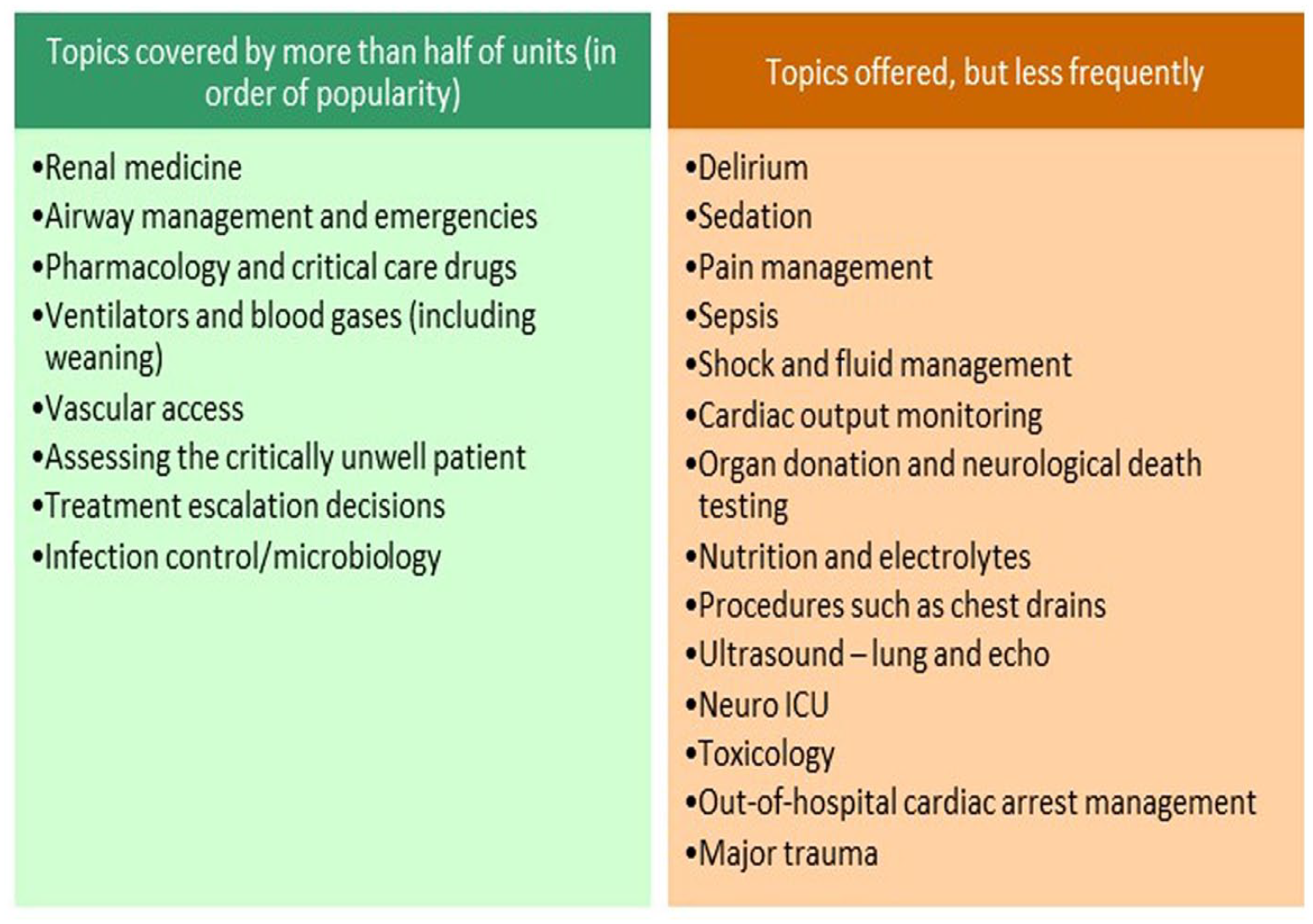
Topics which were reported to be covered by formal teaching for IMTs new to intensive care.
There were no questions included in the survey relating to how long the teaching programme offered lasted, nor the format which it took. Some respondents provided this information in the free text at the end of the survey. A small number of respondents reported offering the Basic Assessment and Support in Intensive Care (BASIC) course. Others specified a 2- or 3-day course, using a mixture of lectures and skills workshops. Some identified that simulation teaching was used. A small number of respondents identified that rather than having a course at the outset of the placement, a rolling series of tutorials was offered across the rotation.
Discussion
Overall, the results of the survey demonstrate that IMT preparation for intensive care placements is highly variable across different units and regions, with one third of trainees from responding units receiving no formal training on commencing the rotation. Where training was offered, the content was highly variable. The key topics covered by most units would account for much of the daily work of a rotational trainee in intensive care. Other commonly encountered problems may be formally taught less often, although it is difficult to be certain as these were not specifically included within the question but were given as free-text responses.
The second part of this project is currently underway, using a survey distributed to IMTs nationally, to gather information on their identified learning needs and experiences of undertaking their first posts in intensive care. The information gained from the survey described here was used in the design of this survey, and it is hoped that the results will allow the design of teaching within the Northern Deanery which is inclusive to this group.
Supplemental Material
sj-docx-1-inc-10.1177_17511437231163694 – Supplemental material for Preparing internal medicine trainees for their intensive care rotations: What are we doing across the UK?
Supplemental material, sj-docx-1-inc-10.1177_17511437231163694 for Preparing internal medicine trainees for their intensive care rotations: What are we doing across the UK? by Amy Fox in Journal of the Intensive Care Society
Footnotes
Declaration of conflicting interests
The author declared no potential conflicts of interest with respect to the research, authorship, and/or publication of this article.
Funding
The author received no financial support for the research, authorship, and/or publication of this article.

Supplemental material
Supplemental material for this article is available online.
References
Supplementary Material
Please find the following supplemental material available below.
For Open Access articles published under a Creative Commons License, all supplemental material carries the same license as the article it is associated with.
For non-Open Access articles published, all supplemental material carries a non-exclusive license, and permission requests for re-use of supplemental material or any part of supplemental material shall be sent directly to the copyright owner as specified in the copyright notice associated with the article.
