




Abstract
In 2021 NHS England commissioned regional Adult Critical Care Transfer Services. These services will replace a historically predominant ad hoc approach to adult critical care transfers nationally. It is anticipated that these new formal services will provide a system of robust regional & national governance previously acknowledged to be deficient. As part of this process, it is important that an agreed set of transfer service quality indicators are developed to drive equitable improvement in patient care. We used a Delphi technique to develop a set of key performance indicators through consensus for a recently established London critical care transfer service. We believe this may be the first-time key performance indicators have been developed for adult critical care transfer services using a consensus method. We hope services will consider tracking similar measures to enable benchmarking and drive improvements in patient care.
Introduction
In 2021 NHS England commissioned dedicated, nationwide, Adult Critical Care Transfer Services (ACCTS). A significant development, in part triggered by the surge in inter-hospital critical care transfers experienced during the COVID-19 pandemic. 1 The provision of formal ACCTS will enable improvements in the safety and efficiency of adult critical care transfer which have long been recognised as deficient in England’s historical ad-hoc approach to adult critical care transfers.2–6 Quality metrics, developed through consensus methods, have been published for paediatric and neonatal critical care transfer services in both Europe and the USA.7,8 In adult services, however, whilst many likely use quality metrics, or have specified contractual obligations, a set of quality metrics specifically designed for adult services through consensus methods have not been published. Agreement about these metrics or key performance indicators are essential as part of any continuous quality and safety monitoring system. The North East London Critical Care Transfer And Retrieval (NECCTAR) service, a recently established ACCTS, sought to develop KPIs through consensus using a Delphi process.
Methods
Potential KPIs were identified from a scoping review (Supplementary Material) alongside consultation within the service, referring hospitals, and a commissioner. The authors reviewed the final list by removing duplicates, and those identified from the literature not relevant to an ACCTS (e.g. ‘bystander CPR time’). These were evaluated in an e-Delphi process with three rounds of questionnaires before being discussed at a consensus meeting among NECCTAR’s working group. Online questionnaires were created and distributed using Google Forms (Google LLC, Mountain View, CA, USA). The first questionnaire asked respondents to suggest ‘the most optimal’ KPIs. The following rounds asked panel members to rate each KPI using a seven-point Likert scale. Anonymity was maintained throughout, and the composition of the panel unknown to its members. Consensus was defined a priori as a minimum of 70% agreement associated with a Likert scale score above four. The Delphi process was stopped when at least 50 KPIs reached consensus. An a priori agreed threshold.
Results
Figure 1 summaries the Delphi process. The Delphi panel consisted of a wide range of individuals including NECCTAR clinicians, managers & service users; the London Ambulance Service; a patient representative; and representation from NHS England & NHS Improvement London (see Supplemental Table for detailed description of the Delphi panel). Following independent screening by the authors (NH & SF) for duplicates or similar KPIs a total of 76 KPIs were formulated from the initial Delphi Round. 26/37 (70%) responded to the second-round invitation and 24/37 (65%) responded to the third-round invitation. The Delphi process was completed at this stage as over 50 KPIs had reached consensus.
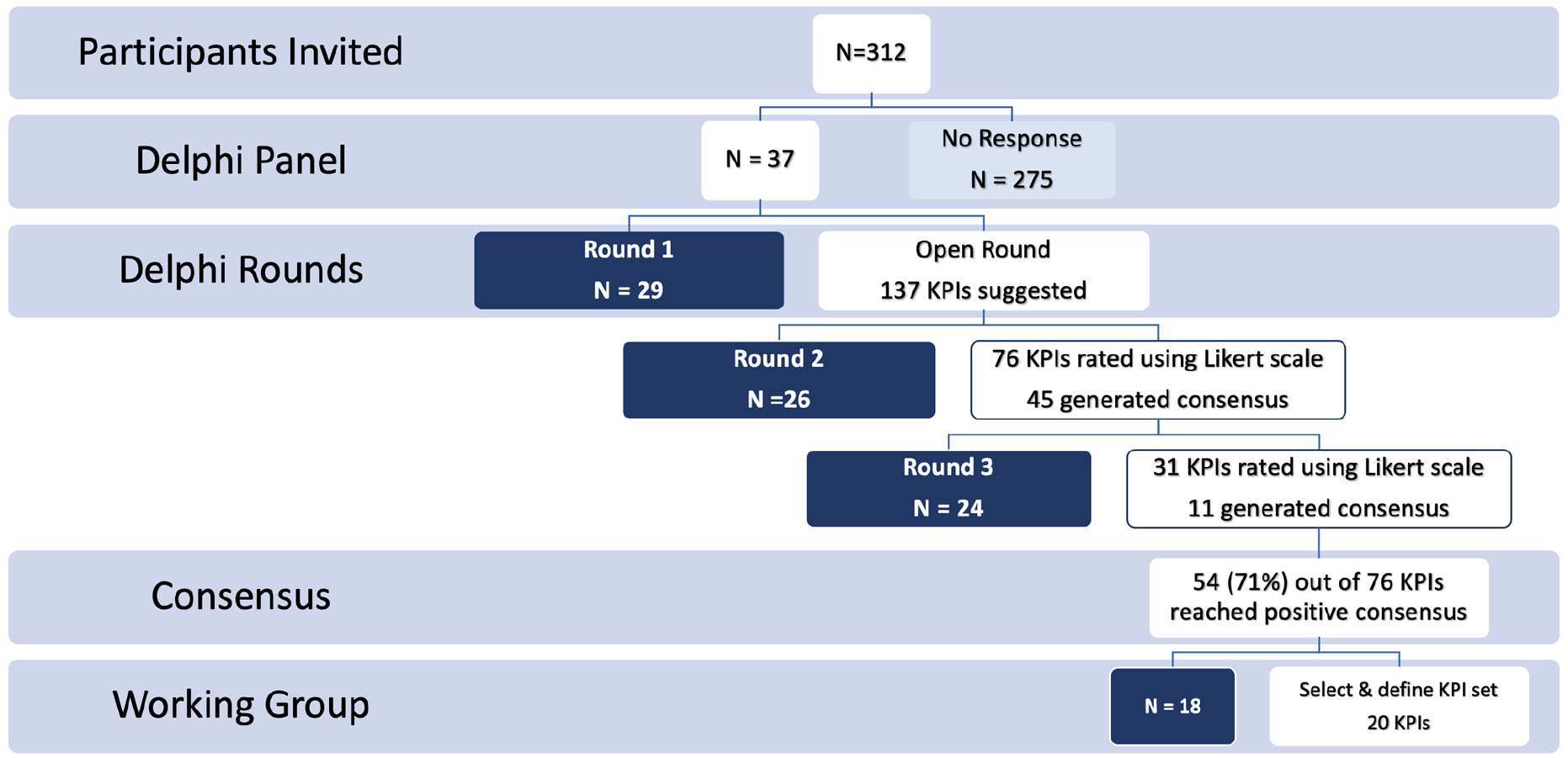
Flowchart detailing the Delphi process and selection of KPIs for adult critical care transfer services.
The final 54 KPIs that reached positive consensus were reviewed by the authors and NECCTAR working group to produce a balanced scorecard (Table 1). For practical application full definitions and specifications of each KPI from the final scorecard are presented (Supplemental Material).
Final scorecard.
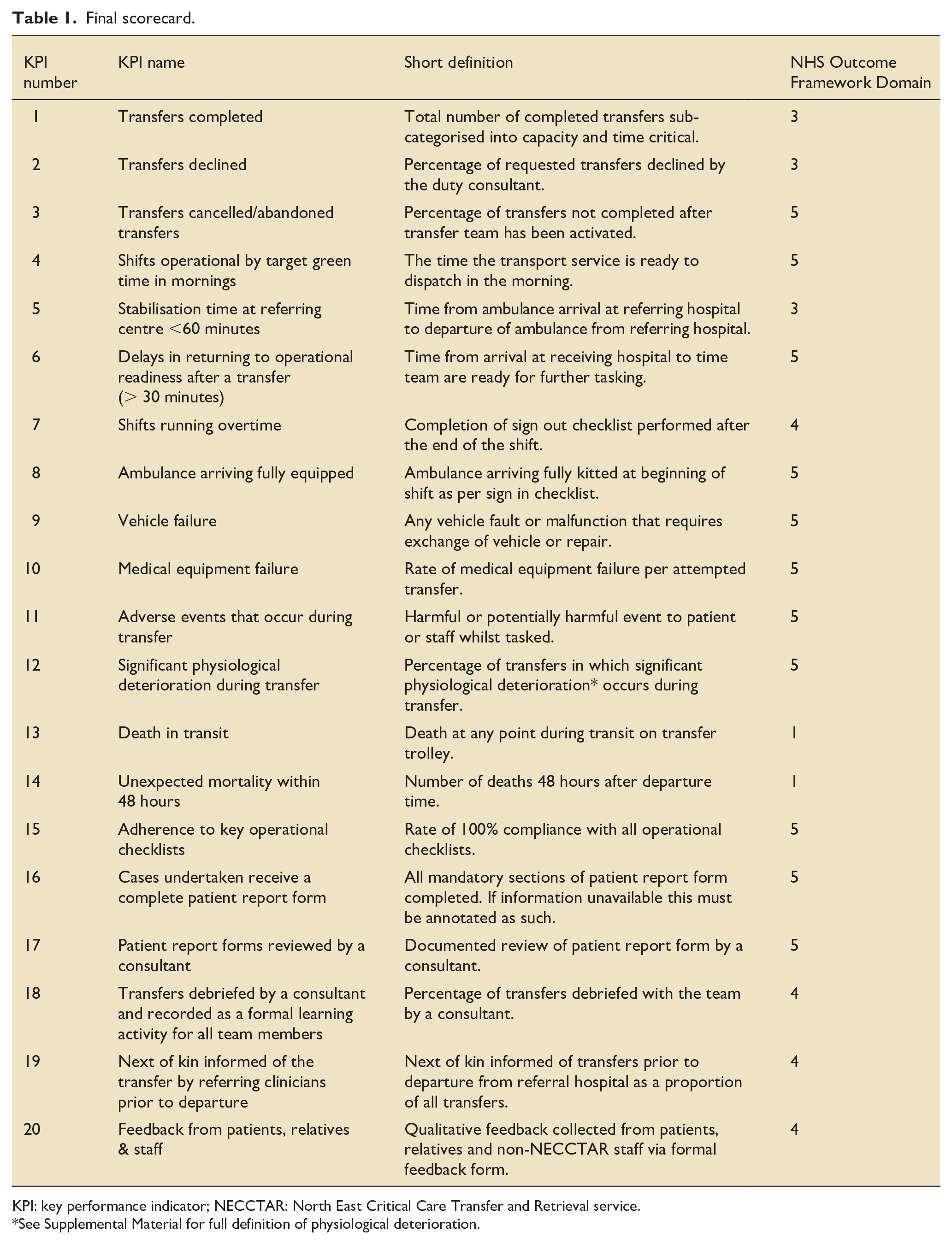
KPI: key performance indicator; NECCTAR: North East Critical Care Transfer and Retrieval service.
See Supplemental Material for full definition of physiological deterioration.
Discussion
We have developed a balanced set of KPIs for a newly established ACCTS in England following a Delphi process. To the authors’ knowledge this is the first published set of KPIs developed through consensus for an ACCTS. The final scorecard emphasises a number of important areas in critical care transfer that have previously been identified in the literature as requiring improvement. 9 Namely – safety; efficiency and timeliness; and senior leadership presence. As well as embracing broader aspects of a quality service including education; focus on communication with relatives; and feedback from patients.
Concerns regarding the safety of adult critical care transfer have been consistently voiced2–5 and re-emphasised in recent guidelines. 6 A recurring theme, however, has been a lack of adherence to published national guidelines despite their existence. 3 Continual monitoring of the proposed KPIs will provide some assurance that these aspects are being monitored; drive quality improvement; and afford the opportunity for services to benchmark themselves against one another.
Delays in transfers are also common.4,9 A national target of less than 4 hours from acceptance of referral to delivery of the patient to the destination hospital for time-critical transfers has been suggested. 10 This timeline, however, will be dictated by numerous factors outside the control of an ACCTS. To mitigate this our KPIs focus on time periods specifically influenced by the performance of the transfer team. We feel these are fair across services with different geography and regional setup.
NHS England has specified that all ACCTS should be consultant led. 10 Our scorecard includes metrics monitoring consultant involvement in clinical and non-clinical roles. Including consultant led multidisciplinary learning, debriefing and case review.
Our final scorecard has some similarities to previously published quality indicators developed for paediatric and neonatal transport7,8 including emphasis on process safety (e.g. adverse event rate); efficiency/timeliness (e.g. time to mobilisation); and physiological changes (e.g. cardiovascular, temperature). There are, however, important differences as our scorecard aims to capture the quality of a transfer service rather than just the transport process itself. For example, our scorecard, incorporates feedback from relatives, patients and staff; documented communication with the next of kin; and formal consultant led debrief and learning. This reflects our broader stakeholder representation and is a strength of our study.
The development of formal ACCTS throughout England represents a paradigm shift in the approach to adult critical care transfer nationally. We will use this scorecard and monitor the KPIs over time to ascertain their ability to highlight areas for improvement and to assure our users about quality within the service. In the future, we hope other services will use the scorecard to facilitate benchmarking across transport providers.
Supplemental Material
sj-docx-2-inc-10.1177_17511437231153049 – Supplemental material for Developing key performance indicators for adult critical care transfer services: Scoping review and Delphi technique
Supplemental material, sj-docx-2-inc-10.1177_17511437231153049 for Developing key performance indicators for adult critical care transfer services: Scoping review and Delphi technique by Nick Haslam, Aurelien Giouse, Jonathon Dean, Mamoun Abu-Habsa and Simon J Finney in Journal of the Intensive Care Society
Supplemental Material
sj-docx-3-inc-10.1177_17511437231153049 – Supplemental material for Developing key performance indicators for adult critical care transfer services: Scoping review and Delphi technique
Supplemental material, sj-docx-3-inc-10.1177_17511437231153049 for Developing key performance indicators for adult critical care transfer services: Scoping review and Delphi technique by Nick Haslam, Aurelien Giouse, Jonathon Dean, Mamoun Abu-Habsa and Simon J Finney in Journal of the Intensive Care Society
Supplemental Material
sj-docx-4-inc-10.1177_17511437231153049 – Supplemental material for Developing key performance indicators for adult critical care transfer services: Scoping review and Delphi technique
Supplemental material, sj-docx-4-inc-10.1177_17511437231153049 for Developing key performance indicators for adult critical care transfer services: Scoping review and Delphi technique by Nick Haslam, Aurelien Giouse, Jonathon Dean, Mamoun Abu-Habsa and Simon J Finney in Journal of the Intensive Care Society
Supplemental Material
sj-docx-5-inc-10.1177_17511437231153049 – Supplemental material for Developing key performance indicators for adult critical care transfer services: Scoping review and Delphi technique
Supplemental material, sj-docx-5-inc-10.1177_17511437231153049 for Developing key performance indicators for adult critical care transfer services: Scoping review and Delphi technique by Nick Haslam, Aurelien Giouse, Jonathon Dean, Mamoun Abu-Habsa and Simon J Finney in Journal of the Intensive Care Society
Supplemental Material
sj-docx-6-inc-10.1177_17511437231153049 – Supplemental material for Developing key performance indicators for adult critical care transfer services: Scoping review and Delphi technique
Supplemental material, sj-docx-6-inc-10.1177_17511437231153049 for Developing key performance indicators for adult critical care transfer services: Scoping review and Delphi technique by Nick Haslam, Aurelien Giouse, Jonathon Dean, Mamoun Abu-Habsa and Simon J Finney in Journal of the Intensive Care Society
Supplemental Material
sj-jpg-1-inc-10.1177_17511437231153049 – Supplemental material for Developing key performance indicators for adult critical care transfer services: Scoping review and Delphi technique
Supplemental material, sj-jpg-1-inc-10.1177_17511437231153049 for Developing key performance indicators for adult critical care transfer services: Scoping review and Delphi technique by Nick Haslam, Aurelien Giouse, Jonathon Dean, Mamoun Abu-Habsa and Simon J Finney in Journal of the Intensive Care Society
Footnotes
Acknowledgements
Sincere thanks to all members of the Delphi panel and NECCTAR Working Group: Abhishek Chitnis, Andrew Leitch, Andrew Rhodes, Arun Sahni, Ben Singer, Ben Roberts, Catherine White, Charlotte Trainer, Elinor Chloe Baker, Emma Collins, Flavio Severgnini, Hannah Ward, Ismail Tariq, James Stevenson, James Waiting, Jeremy Cordingley, John Comerford, John McKenna, Jonathan Stokel, Karin Schoeman, Lucy Jenkins, Margherita Moro, Musarat Hussain, Nicole Tribe, Nancy Faulkner, Peter Shirley, Phillipa Hartridge, Philip Leadbeater, Sara Davenport, Shah M. Rahman, Shane Wilde, Stephanie Kwok, Stephen Shepherd, Timothy Kuhn, Tom Abbott, Victoria Jenkins, Zudin Puthucheary.
Declaration of conflicting interests
The author(s) declared no potential conflicts of interest with respect to the research, authorship, and/or publication of this article.
Funding
The author(s) received no financial support for the research, authorship, and/or publication of this article.

Supplemental material
Supplemental material for this article is available online.
References
Supplementary Material
Please find the following supplemental material available below.
For Open Access articles published under a Creative Commons License, all supplemental material carries the same license as the article it is associated with.
For non-Open Access articles published, all supplemental material carries a non-exclusive license, and permission requests for re-use of supplemental material or any part of supplemental material shall be sent directly to the copyright owner as specified in the copyright notice associated with the article.

