



Abstract
Using a vernacular approach to security, this article examines what ordinary people narrate about the insecurities they experience in their information landscape in a time of remote war and the practices they employ in response. Based on the narrative analysis of semi-structured interviews with Finnish nationals in spring 2022, after the outbreak of war in Ukraine, the article identifies two main narratives and three sub-narratives of informational insecurity. The first narrative portrays information as reassuring to the individual experiencing war at a distance, and the second depicts information as a source of insecurity. In a war context, feelings of insecurity arise because information is perceived as uncertain, malevolent, and contradictory to one’s prior understanding of the reality. The vernacular security approach is applied because participants’ experiences are complex, and they cannot be confined within one concept of security. Participants draw on influences from diverse scholarly and media discourses of security.
Introduction
My sense of security improves when I seek information . . . The more I know, the calmer I am. If, for some reason, I start to freak out, I often go back to facts. (Sari, female)
Drawing on semi-structured interviews with Finnish nationals conducted after the outbreak of war in Ukraine in 2022, this article examines what drives the participants’ need to seek information during a war they experience remotely, and how this relates to scholarly and participant-driven concepts of information and (in)security. Taking a lead from the narratives of participants like Sari, I explore how ordinary Finnish citizens describe the wartime information environment, and how they construct understandings of the role of information in coping with the shock and fear of the war. I argue that a vernacular security approach, which pinpoints how lay citizens construct and describe their experiences of (in)security ‘in their own vocabularies’ (Croft and Vaughan-Williams, 2017: 22), is useful for gaining a comprehensive view of what is at stake in the informational context of the Russia–Ukraine war.
The growth of social media platforms and the convergence of digital technologies have prompted a rise in research into how people navigate these developments across various domains of life (Krotz, 2017). This includes studies exploring strategies of media use and the ways in which they intersect with feelings of being overwhelmed and emotional insecurity, especially in times of crisis (Ytre-Arne and Moe, 2021). The majority of this research has focused on mediated channels of communication, and many have concentrated exclusively on social media (Corbu et al., 2024). Furthermore, scholars often work with a single concept of security, such as ontological security, to argue that people turn to media to gain basic trust in the continued existence of themselves, others, and the world in order to function in crisis (Moe et al., 2023). A small but growing body of research examines ordinary people’s information-related anxieties and threat perceptions, typically focusing on malign informational influence or conspiracy thinking (Harambam et al., 2022; Wagnsson, 2020). Additionally, there are psychological surveys providing insight into the transnational psychological impacts of war (Kalaitzaki et al., 2024; Scharbert et al., 2024). Based on the analysis of a longitudinal experience-sampling study in 17 European countries, Scharbert et al. demonstrate that the wellbeing of Europeans declined significantly on the day of the Russian invasion and was lower when the war was salient on social media. Their research argues for a correlation between media use and a sense of psychological wellbeing in the context of the Russia–Ukraine war.
These studies shed light on the perceptions and experiences of ordinary citizens while also highlighting the need for more qualitative research, for example, on how war news or malign informational influence are received and processed in different national contexts (Corbu et al., 2024; Wagnsson, 2020). Such a broadening of research is important for foregrounding both the diversity of experiences of informational (in)security and the heterogeneity of security discourse, and to identify intersections between the two. The longstanding information warfare and its escalation into full-scale war in Ukraine have impacted both security and information environments in several ways (Asmolov, 2021; Gehle et al., 2024). Research needs to keep pace with these developments that are encountered and partly generated by ordinary citizens.
To grasp how Finnish people understand the relationship between information and security in a time of remote war, this article addresses the following research questions: What kinds of narratives do Finnish citizens use and produce when describing their experiences of navigating the information landscape after the outbreak of war in Ukraine? How is the relationship between information and security, and the role for citizens, articulated within these narratives? By information landscape, I refer to the contexts of the analysed information practices, which can also be approached as constituent of a broader context, that is, information environment (Savolainen, 2021: 8). As vernacular narratives of (in)security, individuals’ stories of their lives and experiences are seen as unique, diverse and bound up with their personal circumstances, which also makes knowledge about war personal and rooted in specific places, communities and subject positions (Jarvis et al., 2025: 508). Simultaneously, the interviews are analysed as temporally evolving narratives that, owing to their linguistic nature, are intertwined with the shared notions and concepts, and therefore do not merely represent the contents of an individual’s consciousness (Tökkäri, 2018). For instance, academic and media discourses of security serve as building blocks for the narratives participants engage in when narrating their views and experiences of the war.
The analysis of the interviews identified a set of narratives that portrayed information about the war in Ukraine as uncertain, malevolent and irrational, while also revealing strategies proposed by participants for navigating the insecure information environment. Before exploring each of these narratives in turn, I will outline the article’s theoretical underpinnings, in particular the vernacular security approach, and the ways in which these relate to different scholarly understandings of the relationship between information and security. The methodological section provides an overview of the participants and methods of this study.
Grasping the relationship between information and security during crisis
Key to the research project on which this article is based is the idea of exploring Finnish nationals’ experiences and perceptions of war during the aftermath of the full-scale invasion of Ukraine by the Russian Federation. The project’s overarching aim is to move beyond top-down and state-centred conceptualizations of war and draw on more vernacular and experiential interpretations. Sylvester (2012) importantly posits that there are many locations and types of war experience. Individuals, such as medics, family members, or civilians, may be physically close to war yet experience it at a distance, near but not within active war zones. Conversely, people may be geographically distant but actively engaged in war through material or symbolic means, such as donating to war efforts or participating in anti-war demonstrations. The participants of this study experienced war from the safe distance of their homes but were often tightly connected to it through media and emotional attachment.
The lay understandings and experiences of security have been studied, among other approaches, under the concept of vernacular security (Bubandt, 2005; Jarvis, 2019; Vaughan-Williams and Stevens, 2016). In this tradition, researchers have acknowledged the importance of speaking with (rather than speaking for) ‘ordinary’ people about the conditions of (in)security they experience (Jarvis and Lister, 2013: 158). Jarvis and Lister define vernacular securities as socially specific articulations of security that are contextually and historically situated (p.159). Their analysis seeks to broaden the conceptual work on (in)security with an empirically detailed account of the ways in which different publics understand, experience and articulate this condition in their everyday lives.
Recently, Jarvis et al. (2025) have noted that the specificity of vernacular security studies concerns the conceptual emptiness of its core term, security, suggesting that in every circumstance its meaning must be discovered, or (even) invented, rather than assumed (see also Jarvis, 2019: 118). They distinctively argue that scholarship within the vernacular tradition could benefit from a corresponding methodological openness regarding its appropriate level of analysis. Rather than maintaining a neat separation between elite and non-elite discourses, and advocating the primacy of the latter, Jarvis et al. (2025: 511) suggest focusing on specific rhetorics that seek to unsettle established security narratives regardless of their source. For this purpose, my study has adopted a narrative–analytical approach, which facilitates the exploration of intertextualities and relational dynamics between the security discourses of lay people and security experts. Arising from the analysis, the focus is placed on the intersections between lay and scholarly concepts of security, which ordinary people both come across and produce themselves as they follow war news and other war-related media content.
In seeking to understand how Finnish people narrate the relationship between information and security, I have mostly engaged with the Media Studies literature on news monitoring and news avoidance in times of crisis (Ytre-Arne and Moe, 2021). Here, Moe et al. (2023) have argued that, as the world appears insecure, practices of news use can be interpreted as attempts to re-affirm one’s sense of security and encourage further attention to both news use and news avoidance as coping strategies during crises. Moe et al. (2023) have specifically explored the relationship between media use and ontological security, which is conventionally defined as ‘security as/of being’ (Kinnvall, 2017: 97) or ‘security not of the body but of the self, the subjective sense of who one is’ (Mitzen, 2006: 344). In recent years, the definitions of ontological security have been both challenged and broadened to include various applications of the concept (for discussion, see Krickel-Choi, 2022).
Other related concepts include, for example, cognitive security, which is defined by Grahn and Taipalus (2025) as ‘a state and process in which malign influence or manipulation is unable to alter human cognition, and which can be achieved through a combination of knowledge and situational awareness with purposeful actions’. Related research focuses on the practices of disinformation, antagonistic strategic narratives, propaganda and hybrid warfare (Baumann, 2020; Jonsson and Seely, 2015; Mejias and Vokuev, 2017; Renz, 2016). Similarly, the concept of epistemic security has been proposed by Seger et al. (2020: 11–12) to investigate the processes by which societies produce, distribute, evaluate, and assimilate information, and to examine threats that restrict access to information or undermine the ability to evaluate the veracity of information or the reliability of its sources. Their focus is at the systemic level and centres on the analysis of how threats to epistemic security undermine a society’s ability to make well-informed and timely decisions and to coordinate action in response to crises. Adler and Drieschova (2021: 359), on the other hand, apply the concept of epistemological security to denote ‘the experience of orderliness and safety that results from people’s and institutions’ shared understandings of their common-sense reality’. They argue that, while ontological security refers to the stability of an individual’s and a state’s identity, epistemological security refers to trust in collectively shared knowledge. In their work, epistemological security is presented as a condition for rational truth-finding and warranted knowledge production in liberal societies and the International Liberal Order more broadly.
Each of these concepts bears relevance to my research context. They also contain far more nuance than I can express in this article, which places greater emphasis on empirical analysis of the interview data. In contrast to mundane and routine experiences, captured in the notion of everyday security (Jarvis, 2019), at the time of the interviews, participants in Finland, which is this relatively peaceful part of the world, were describing the exceptionalities of war and insecurity. Alongside and in interaction with narrative analysis, vernacular approach is helpful in identifying meanings that participants attributed to information in construction of their sense of security, which is understood here as the positive feeling of being safe and free from war-related anxiety and fear.
Data and methods
To understand how Finnish people experience and reflect on the outbreak of war in Ukraine, semi-structured interviews were conducted in April–May 2022 with 29 adults (18 female and 11 male) who live in Finland. The call for participation was distributed on social media and specifically invited participants who considered that talking to a researcher would support their wellbeing by giving them an opportunity to reflect on the war in a structured interview. The group of interviewees was diverse in terms of gender, age and education, and included students, working-age participants, and pensioners. Most of the participants were from the southern parts of Finland and lived in and near the capital region of Helsinki, where most of the population in Finland live. However, there were participants from cities, towns, and rural areas across the country, including the regions of Central Finland, Kainuu, Kymenlaakso North Karelia, North Savo, Pirkanmaa, South Ostrobothnia, Southwest Finland, and Uusimaa.
The interviews were conducted in Finnish, audio-recorded, and transcribed by a professional. I conducted all but one interview myself, which was carried out by Dr Yasemin Kontkanen. The citations were translated into English by the author. The research was conducted in accordance with the Guidelines for Ethical Review in Human Sciences of the Finnish National Board on Research Integrity (2020). The details of the research process are outlined underneath in the statement about research ethics. For example, to ensure that the study did not risk causing mental harm that exceeds the limits of normal daily life, a decision was made to wait until the initial shock of the war had subsided and the security situation in Finland was considered stable (for advice on timing research interviews, see Cramer, 2020).
As the participants were primarily recruited through different social media channels, my sample is skewed towards active media users who work in middle-class professions. Participants also largely perceived themselves as having above-average levels of competence in information processing. Class background, alongside gender and generational differences, influences a person’s media use (Hovden and Roselund, 2021). It is therefore highly likely that answers to my questions would have been different if I had interviewed, for example, more people with a working-class background, or those who do not use much media or follow news. This said, the high level of media use can partly be explained by the timing of the interviews. Most interviewees explained that they had increased their media consumption after the outbreak of the war and adopted new platforms and tools for better situation awareness, which is typical of crisis (Ytre-Arne and Moe, 2021). Therefore, the predominance of active media users among the participants may not represent a sampling weakness, but is rather a contextually relevant feature of the study. Furthermore, qualitative research does not aim at generalizability in the statistical–probabilistic sense (Smith, 2018). It aims to produce analytical generalization and create new knowledge for making sense of the world and people’s lives (Atkinson, 2017).
Given that terms such as cognitive security, epistemic security and so forth are not commonly used and participants were unlikely to be familiar with them, I refrained from explicitly asking about their views of a particular concept of (in)security during the interviews. Instead, I sought to elicit participants’ definitions and experiences of security relating to information in the research context. My first question to participants was about when and where they had learnt the news about Russia’s invasion of Ukraine, which provided me with valuable insights into their media use and information landscape. I also asked which sources they relied on in their information needs about the war, including what sources of information they considered reliable. Furthermore, I inquired into their experiences of conflicting opinions they had encountered about the war, which often led to stories about confrontations on social media and in personal relationships and related insecurities.
The dataset was pseudonymized and analysed using thematic coding. Then the chosen sections of the data were analysed around a set of themes, many of which are discussed in other papers currently in progress. For this article, the focus was placed on participants’ perceptions and experiences of operating within the wartime information environment. The first step in the narrative analytical process involved identifying the segments of text that captured participants’ responses to the research questions about information seeking and security in their own words. The second step entailed the development of narrative categories whereby the meaning units with related content were grouped together. Through close reading of the interviews, I identified two foundational narratives in the data, each driven by opposing motives. In the first, information and knowledge related to the war were portrayed as important and reassuring. In contrast, the second narrative depicted information as a source of insecurity. In these latter accounts, feelings of insecurity arose because wartime information was perceived as uncertain, malevolent and contradictory to one’s prior understanding of the situation, making the integration of new war-related information into existing knowledge particularly demanding. Furthermore, every narrative produced during interviews constructed particular positions for lay citizens and specific kinds of relationships between information and security.
The narrative duality concerning the relationship between information and the sense of security
Pertaining to the relationship between information and security, the analysis revealed that the participants narrated information in the research context as necessary and important, but also threatening in a number of ways. This duality implied that participants regarded access to information as fundamental to their sense of security, while simultaneously experiencing the war-time information environment as deeply unsettling. Tilda is a pensioner living on the west coast of Finland, while Mikko is a middle-aged civil servant who lives in the southern part of the country. Like many other participants, they narrated contrary experiences:
It hit me the first night, the fear of war, like what will happen to Finland. And from the next morning onwards I have all day, possibly 15 hours a day, all the waking hours, watched TV, listened, searched online for all the information that is available . . . I noticed that during the first days, information helped. It felt like the more I know, the safer I feel . . . Afterwards I have understood that this gave me a feeling of being in control . . . But then I realized that the information load is too much . . . There was this news image of a 4-year-old girl, whose mother had written her name and a phone number on her back, so that you can call someone if she dies and the child is found on her own somewhere.
I am a bit of a newshawk, so I regularly followed four sources: two Finnish, two British, and the Washington Post on top of that. The Finnish Broadcasting Company YLE, and Hesari [the colloquial term for the major national newspaper Helsingin Sanomat], BBC, The Guardian, and Washington Post, and occasionally Huvudstadsbladet and Swedish TV news. I could take it for two days. Then I switched off all the newsfeeds on my phone because I realized my nerves couldn’t handle it full-time. I withdrew myself into a complete news blackout for three, maybe four, weeks. Although it wasn’t complete, because I kept using Facebook.
Both participants spoke about their desire to acquire information about the war, but also addressed the point at which their information-seeking began to work against its intended purpose. Tilda, realizing that ‘the information load is too much’, felt overwhelmed by what she witnessed on television, yet continued her immersive information gathering. Mikko, on the other hand, explained that he had restricted his media intake to maintain a calmer mind. Their accounts exemplify a combination of two key narratives identified in the data: first, one that highlights the importance of information for a sense of security, and second, one describes the distressing nature of the wartime information environment. Such analysis resonates with previous research (Scharbert et al., 2024), with the nuance that, in this research context, information not only played a significant role in managing war-related fears but was also in itself imbued with meanings that evoke uncertainty and insecurity. In what follows, informational insecurities prevailing in the data are analysed through three narratives, which portray wartime information as uncertain, malevolent, and irrational.
The sub-narrative of uncertainty
In the narrative of uncertainty, information about war was constructed as uncertain or ‘foggy’. Three participants, namely Jaakko, Sini and Timo, used the term ‘fog of war’, which they had adopted from military language, where it describes the uncertainty of information in combat and military decision-making (Von Clausewitz, 1976). In vernacular use, the concept was linked with the uncertainty of information in military crises, where there is plenty of unverified information available, and when all parties are likely to produce misinformation and some actively spread disinformation, with the intention of deceiving their audiences.
Rauni is a pensioner who lives in Eastern Finland. During her interview, she expressed deep concern about the escalation of the war. In relation to this, she had, for example, phoned the pharmacist to enquire about the availability of iodine tablets, which are recommended in the case of a nuclear emergency, and contacted the office of the Minister of Defence regarding the purchase of F-35 fighter planes. In Rauni’s opinion, the fighter planes are crucial for Finland’s military capability. Rauni had also called the head of the local fire department to find out where her nearest civil defence shelter was. During the call, she asked how and where she would be evacuated in case Russia attacked Finland: I asked what will happen, whether they will pick me up or whether I should drive by my car to the town square and leave it there so the parking officer will write me a ticket, or how does this go? They couldn’t answer. Well, they finally confirmed that if there is a need for evacuation, people will be taken to some distance, but this was all they told me.
Rauni narrated her extensive information-seeking in a humorous tone, but there was a real concern identifiable in her voice. When her questions were not fully answered, she felt let down by the authorities and politicians, and expressed frustration with the vagueness of the information given. Her narrative illustrates the intertwining of insecurities, as her worry about missing or uncertain information reinforced physical insecurity related to the fear of war and vice versa. Ultimately, for Rauni, information seeking, which included reminding decision-makers of their duties, was a matter of making sure citizens are adequately protected by the Finnish government and local authorities.
Important elements of the narrative of uncertainty were descriptions that stressed the availability and veracity of information about war. Often the emphasis was placed on seeking information through reliable sources. One of the participants suggesting such an approach was Jaakko, a retiree of the Finnish Defence Forces. Jaakko noted that his own sense of security was strong, primarily owing to his extensive professional knowledge of military affairs, which he used to interpret news from the battles in Ukraine. However, he was concerned that not everyone had the same ability to seek and process information. Jaakko criticized the commercialization of media and the prevalence of ‘clickbait headlines of tabloids, which are so full of crap that it is sure to shatter one’s peace of mind’. Like many others, he emphasized the importance of identifying ‘news sources that offer reasonably neutral and factual coverage’. His advice to those feeling insecure was to listen to ‘those who have correct information’ and explained that he is one of those people who provides reliable information for his friends and family members. Jaakko also recommended ‘dosing’ one’s media consumption ‘just right’ to maintain a balanced mind, advocating for both time- and content-based regulation of media use (Ytre-Arne and Moe, 2021).
Another common but more controversial suggestion was to utilize diverse information sources, including those deemed unreliable. For example, Ilkka emphasized the importance of the information processing skills he had gained through his employment in data management. He explained that he did not categorize information sources as reliable or unreliable because ‘they each have their own needs and purposes’. During the interview, he elaborated on the various types of data circulating, such as personal opinions and scientific and historical facts, and concluded: These are all very different things, but for someone like me, who works in data management, the key is the integrity of the data, where it came from, who discovered it, what the time stamp is – this is more relevant. If you want to understand the situation in Russia, perhaps the most reliable source is Russian TV and Channel 1’s main evening news broadcast.
Both Jaakko and Ilkka emphasized the professional and civic roles they played in dealing with uncertain information. Jaakko constructed himself as a military expert, capable of leading his peers to reliable and evidence-based information. Ilkka, on the other hand, advocated for acquiring information processing skills. Interestingly, they both presented themselves as having better knowledge about the war than the general public. Their concerns were thus centred on the fear that other people did not possess the means to deal with the uncertain information environment. Their interviews also contained elements of the narrative of malevolence, as they argued that navigating the information environment involved monitoring state and non-state actors, which distribute mis- and disinformation for commercial, military and propaganda purposes.
To conclude, the narrative of uncertainty concerns the quality of information available in times of war, when there are, in participants’ opinion, legitimate reasons for withholding information or twisting narratives for one’s own military advantage. Participants either focused on seeking reliable information or they consulted a wide range of sources to gather diverse perspectives and develop their awareness of the situation. A key informational practice described was learning to come to terms with informational uncertainty through extensive and skilful information processing. The term ‘situational awareness’, which originates from aviation and military discourse (Salas and Dietz, 2011), was frequently mentioned to describe the ideal of awareness about the war that encompasses a wide range of considerations and relevant information. In the narrative of uncertainty, concerns about the availability and veracity of information, which are central to the notion of epistemic security, were intertwined with aspects of physical, national, and cognitive security.
The sub-narrative of malevolence
The participants engaged with and reproduced the narrative of malevolence when describing information as harmful and damaging, both at individual and societal levels. The participants argued that the hybrid warfare regarding Ukraine started around the annexation of Crimea in 2014 and had escalated since. This narrative, which centred on the negative impacts of disinformation and malign informational influence, was usually constructed in relation to the Russian Federation, arguing that Russian state television had brainwashed their audience to the extent that they could no longer be trusted as a nation to make sensible and rational choices about their lives, which had direct and dire consequences for neighbouring countries. This concern was exemplified by Jouko, who reflected on how deeply propaganda can influence individual behaviour: ‘If they know how to sell things and seeds fall on fertile ground, then anything can be justified, and individual people can do horrible things.’ Here, Jouko was referring to the power of Russian state media to influence opinions and sow seeds of disinformation, shaping minds to favour war and destruction over peace and neighbourly relations. He believed that, in comparison to other countries, Finland however experiences less of a threat because ‘we are better educated, and we have free media and press.’
At the societal level, participants argued that the spread of disinformation not only distracts in the moment but more fundamentally erodes trust in state government and destabilizes Western states. It may even lead to disorder and violence (see Wagnsson et al., 2024). Tilda, who was quoted above, reflected on her concerns: The problem is mistrust. In my view mistrust is poison. Surely decision-makers have made bad decisions, poor choices and media has been too one-sided, sided with decision-makers. This has given root for poison that is spreading here . . . It sucks away the trust in state leadership, institutions, decision-making bodies . . . During the war I have done some reading and research and started to understand that, hang on, we may be dealing with Russia’s information operations. The aim has been to divide Finns and Western countries and convince us that our leaders are evil, corrupt, which leads to us seeing Russia as a Saviour, kind of. This is scary.
Mari, an experienced journalist, expanded on these predictions by highlighting the subtle and indirect methods through which malign informational influence can operate. She perceived it as likely that Russia sought to divide Finns on various value-related issues with the aim of influencing decision-making processes essential for national security, explaining that it would be foolish to think that malign informational influence ‘does not threaten Finland because we Finns have such good media literacy skills’. She referred to the outcomes of the Brexit referendum, the US elections, and the January 6 US Capitol attack to argue that people across the world are prone to disinformation and that Finnish people should not be considered any different. Mari further warned about the consequences of information campaigns that are difficult to detect: I have heard examples from the defence forces that influence can operate through completely different routes. They can, for example, shatter the reliability of an expert or politician who portrays Russia in a negative light. Or they can drive Finnish people into opposing camps using, for example, trans issues, even if this is not related to our defence policy in any way. They attempt to sow confrontation in society, and we need to talk about this more.
A key element of this narrative is the attention given to measures to counteract disinformation and malign informational operations. Kaisa, a 43-year-old communication manager, highlighted her interest in the activities of Bellingcat, which is an investigative journalism group specializing in fact-checking and open-source intelligence to counter false information. Bellingcat’s related activities include, for example, building a database of social media content exposing war crimes in Ukraine. In Kaisa’s words: I have followed Bellingcat and other fact-checking websites but there is also a lot of information that cannot be verified. I find it important to also follow unverified information. You just need the right attitude. Perhaps you start recognizing yourself, whose information is verified and whose is not. You create your own filtering system.
The practice of engaging in information verification or ‘filtering’ highlights a growing trend of non-professional media users assuming roles traditionally performed by professional journalists. These strategies, which participants perceived as crucial in the wartime information landscape, embody what Golovchenko et al. (2018) describe as the work of ‘citizen curators’, who process information on social media to shape the competing narratives of war. While only a few participants stated that they had taken part in curation on a large scale, many among them claimed they had engaged in this to improve awareness of the situation or circulated information in their immediate social circles.
To conclude, the narrative of malevolence connects with fears about the impacts of disinformation and malign informational influence. At the subjective level, participants are concerned about the possibility of malign informational influence altering the processes through which citizens acquire knowledge and understanding of the events of war and related political developments. In lay vocabulary, they express concern that malevolent actors lead ordinary people to do ‘horrible things’ that go against their own interests and the interests of those around them. At the societal level, concerns are expressed regarding widespread distrust in democratic decision-making and the erosion of a commonsense shared reality. The key informational practices include the identification of malevolent information producers, fact-checking and participation in open-source intelligence through the curation of available information. The narrative of malevolence particularly reflects concerns related to cognitive and epistemological security.
The sub-narrative of irrationality
The narrative of irrationality includes interview excerpts in which the participants described immersing themselves more deeply in the information environment to understand not only what was happening in Ukraine, but also why. The participants talked about trying to make sense of the war, which appeared incomprehensible and lacking rational reason. Several participants talked about the common media narrative that the invasion was the result of long-standing war propaganda (Oleinik and Paniotto, 2024). However, they were not content with this explanation alone but actively sought to grasp the facts and causalities that could provide a more comprehensive understanding of the war.
In 2018, Finnish scholar and former intelligence colonel Martti J. Kari gave a lecture at Jyväskylä University entitled Russian strategic culture: Why does Russia act the way it does? The lecture was recorded and one of Kari’s students uploaded the video online, where it became viral at the start of the war in 2022. In the video, Kari reflects on the history of Russia to explain why the Russian leadership and Russians today perceive their actions, including the war in Ukraine, as justified. Within a week, the video gained 450,000 views, which is a substantial number for a Finnish-language video (Hujanen and Toivanen, 2022). During the interviews, 9 out of 29 participants talked about Kari’s video and mentioned its importance to their understanding of the war. The video was praised because it provided participants with a historical framework for comprehending Russia’s activities in Ukraine and helped restore meaning to events that at first seemed irrational. Rauni, who was quoted above, described the experience of watching the video as feeling like her brain had been ‘brushed clean’. With this metaphor of cleanliness, she conveyed the sense of clarity she felt when finally comprehending the situation after grappling with profound confusion about Russia’s intentions today and historically.
In the narrative of irrationality, the participants described the destabilization of their familiar ways of perceiving the world and a desire for coherent interpretive frameworks that would help them make sense of the war. At the same time, they disclosed concern about the lack of shared understandings of the reality of the war. Several participants stated that they were reading books, both fiction and non-fiction, to create meaning from events that seemed irrational and inhuman to the extent of being incomprehensible. The popularity of Kari’s lecture among the participants and wider online audience speaks to the difficulty of making connections between what people had known about Russia prior to the war and what they now encountered in the news and through social media. It also illustrates that seeking a sense of informational security extends beyond the gathering of facts. Facilitating security at personal and societal levels involves constructing broader epistemic frameworks that synthesize the multitude of epistemic and evaluative claims in circulation, which is what Kari did, from an historical perspective, on the video.
To conclude, the narrative of irrationality connects with the difficulty of integrating new information about the war into existing epistemic frameworks. It also entails personal fears and anxiety about the transforming security environment and the social imaginaries of where the war will lead humanity. The struggle to grasp the motives and consequences of war has led participants to either seek expert knowledge or construct their own epistemic frames, often through historical narratives or literary references, to build a more logical understanding of the situation at hand. The narrative of irrationality relates to the notions of ontological and epistemological security, which entail a feeling that the world of war is both navigable and understandable to ordinary citizens.
Concluding discussion
This article’s contribution lies in the combination of a vernacular security approach and narrative analysis to shed new light on lay perceptions of the relationship between information and security after the outbreak of war in Ukraine. The interviews with Finnish participants revealed narrative duality, in which information was portrayed as both challenging and contributing to their sense of security. When describing the wartime information environment, the participants adopted different narratives, depicting information about the war as uncertain, malevolent, and irrational (see Table 1).
The relationship between information and insecurity.
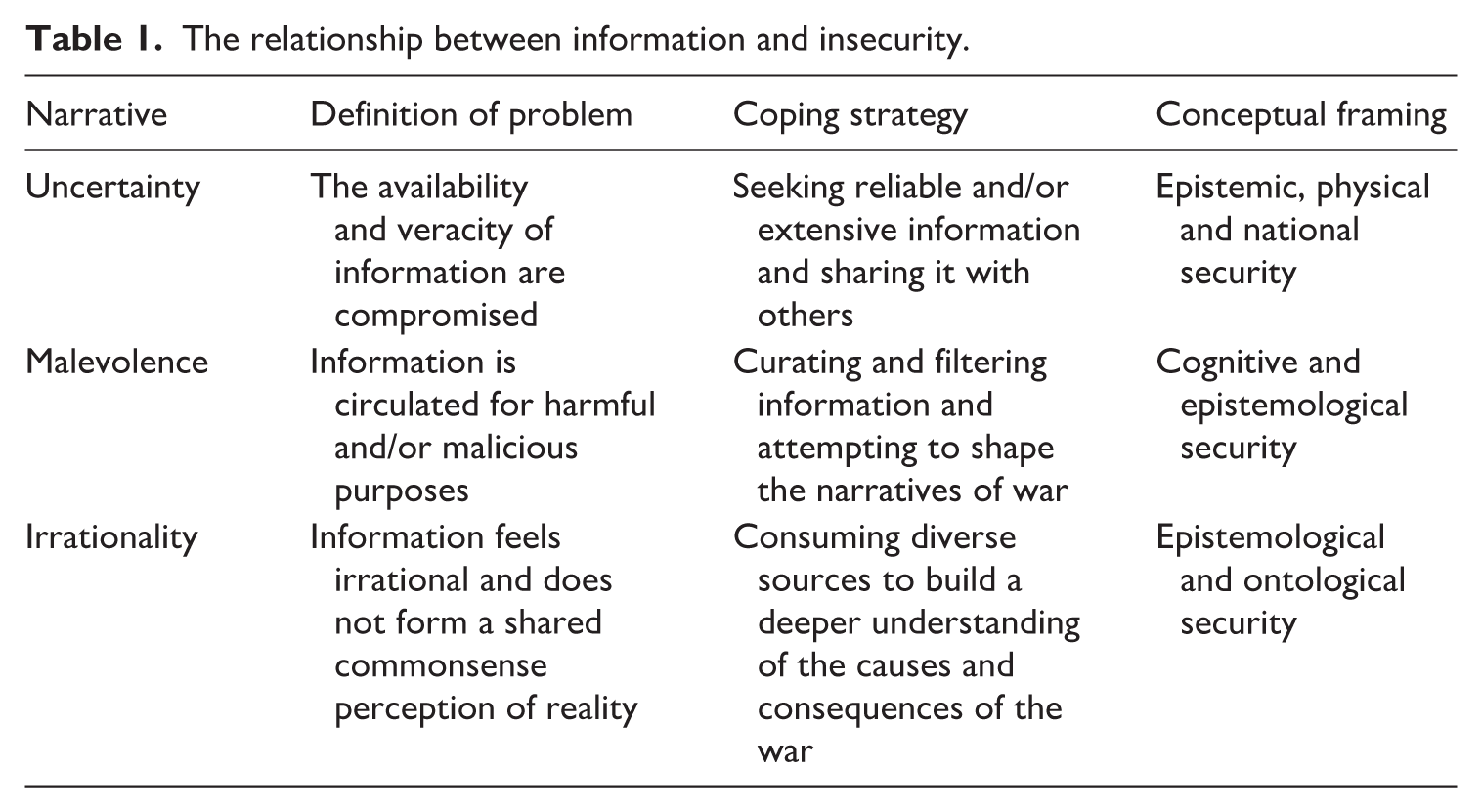
The key finding of the article is the narrative variation it reveals. Even within a single narrative of information-related (in)security, an encounter in the context of the wartime information landscape was narrated through a combination of conceptual reference points. Thus, while the identified vernacular narratives of insecurity share similarities with many scholarly concepts, important differences also remain. In academic research, various forms of informational (in)security are usually examined in isolation from one another. In everyday life, by contrast, individuals experience multiple threats (and securities) simultaneously. People do not encounter cognitive, ontological, or epistemic insecurity as discrete entities. Rather, they face a complex and multifaceted information landscape, which is simultaneously generative of security and, in many respects, deeply unsettling. Operating within a wartime information environment requires constant navigation between diverse and interconnected risks and opportunities.
Exploring the experiences of relatively resourceful Finnish citizens and emphasizing the interlinkages between their views and scholarly concepts brings a critical insight to research in the field, which has more commonly discussed ordinary media users as targets (or even victims) of informational insecurity and malign information influence. While such threats are perceived as real and serious, many participants also demonstrate high levels of knowledge and skills in mitigating them. This multiplicity of experiences and perceptions has both theoretical and practical relevance. From the perspective of vernacular security studies, this finding speaks to the importance of reconsidering the relationship between elite/expert and non-elite/non-expert knowledge. While some Finnish participants feel relatively insecure and articulate a need for top-down guidance, there clearly are numerous ordinary people, such as skilled enthusiasts and retirees from military or data professions, with significant knowledge of the issues at hand. Indeed, several Finnish participants showed eagerness to contribute to societal security through their extensive informational competences. This aligns with the argument by Jarvis et al. (2025) that vernacular security studies should reconsider the inherent assumption underpinning the distinction between the elite/non-elite binary. In their view, this binary oversimplifies social relations and positions because positions of power fluctuate across time and space. The interviews with Finnish people not only foreground the many similarities between scholarly, military and lay conceptions of informational (in)security but also bring to the fore the expertise that lay people have about this topic.
In terms of practical outcome of the analysis, I propose that multi-purpose and multi-level actions are needed to improve the security of war-time information landscapes (see Saurwein and Spencer-Smith, 2020). Societal campaigns for countering informational threats are often based on the idea of influencing citizens through information. An example of such a campaign in Finland is at Aalto University, where a study was conducted on how citizens in different European countries are taught basic cyber security skills, and the results were used to develop guidelines for better ‘cyber citizen skills’ (Limnéll et al., 2023). However, the dissemination of the results and best practices of such projects are hindered by various obstacles. If people are afraid of information and do not trust its accuracy to begin with, they are unlikely to follow information campaigns or consider their messages to be trustworthy. Alongside projects teaching the technical use of digital and smart devices, there is a need for guidance and practice in proactive measures, as well as learning emotional regulation related to the handling of information (Lewandowsky and Van der Linden, 2021). Information reaches citizens only if they have the means to cope with the fears and insecurities that it rouses. However, although emotional regulation may assist media users in coping with media content, it does not necessarily help them in distinguishing false from true information (Bago et al., 2022). As the need for such knowledge is immense both in academia and in practitioner communities, more consideration should be given to the competences of ordinary citizens and how they can be used to tackle informational insecurities. The key question is how to systematically identify competent ordinary citizens and involve them in designing and executing measures to combat the identified insecurities.
To tackle such questions requires further work into citizens’ vernacular perceptions and practices of security. This article has argued that the available concepts only partially capture citizens’ perceptions of the insecurities they encounter when navigating the wartime information landscape. The benefit of the vernacular, participant-led approach is that it captures both subtle and explicit security concerns, both in mediated and non-mediated communication channels, which the participants highlight. Most importantly, it captures the intersections between lay and expert discourses of (in)security, and the encounters in which information acts as a source of relief and distress.
Footnotes
Acknowledgements
I thank Dr Yasemin Kontkanen for conducting one of the interviews for this study and Rubrica Services for copyediting a version of this paper. I am grateful to all participants for sharing their experiences and insights with me.

Ethical considerations
This study was conducted in accordance with the Guidelines for Ethical Review in Human Sciences of the Finnish National Board on research Integrity TENK. The study did not contain any of the elements that these guidelines regard as situations in which the researcher should request an ethical review statement for their work. The participants were adults over the age of 18 and they each provided a recorded verbal informed consent at the start of the interview. All research material has been carefully stored and pseudonymized. The university’s AI-powered assistant has been used to check the grammatical structure of certain sentences in the article, but only anonymized text has been fed to the AI. The text has been copyedited by a professional during the writing process.
Consent to participate
All participants were informed verbally and in writing of the aims of the research and the topics covered in the interview. A specific website was published to explain the research and management of the data. Furthermore, at the start of the interview, the participants were asked about their reasons for participating in the study. In addition to stating personal reasons, they claimed they felt it important to contribute to scientific research on this topic, which speaks to the informed consent. In all research encounters, participants were reminded of the right to withdraw from the study at any moment.
Funding
This work was funded by the University of Eastern Finland.
Declaration of conflicting interests
The author declared no potential conflicts of interest with respect to the research, authorship, and publication of this article.
Data availability statement
All but one participant gave their oral consent for their anonymized data to be shared publicly. However, the data are not publicly available as they contain information that could compromise the privacy of research participants.