




Abstract
A close reading of Ukrainian President Volodymyr Zelensky’s self-produced social media content alongside Western news outlets’ profiles of Zelensky from the first months of the Russian invasion of Ukraine in 2022 illuminates a symbiotic relationship of drama-making that is mutually beneficial for Zelensky’s military and the West’s journalistic interests. Performing as a scrappy underdog turned brilliant military mind, Zelensky provides the Western press with an authentic protagonist figure who makes ideal fodder for a Western news style steeped in drama-making and a natural fit for the individualized storytelling core to the genre of the profile piece. While genre is an aesthetic categorizing tool, it is also a signal of the sociohistorical conditions of texts’ production and circulation. Thus, taken as products of their moment, the profile pieces and their interplay with Zelensky’s short form, seemingly grassroots social media videos are revealing of the value system underpinning journalism in the West, and the society it reflects.
Introduction: Zelensky, capturing (journalists’) hearts and minds
With Ukraine an increasingly partisan issue for the US, and a significantly less visible one, taking a backseat against the unfolding crisis in the Middle East, it might be hard to remember back to the early days of Russia’s invasion in spring 2022 when the country was ubiquitous in mainstream Western news. In those months, it was nearly impossible to follow the news without seeing similar stories across outlets: ‘How Zelensky Found His Roar’ (The Economist Staff, 2022) or ‘How Volodymyr Zelensky Defended Ukraine and United the World’ (Shuster, 2022), detailing Ukrainian President Volodymyr Zelensky’s response to Russia’s invasion of Ukraine. A major shift in the global order, in which war came to Europe’s doorstep for the first time in decades, it makes sense that the invasion of Ukraine made headline news in Western markets. However, the sheer volume of coverage trained on not just the country but specifically its leader raises questions about what makes Zelensky – the man, the leader and the citizen – such a keen object of interest for journalists and why Western news outlets thoroughly strapped for resources and time would cover the same man, in the same way, so many times.
The genre of the ‘profile piece’ emerges as a meaningful site of inquiry for understanding what it is about Zelensky that captured the hearts and minds of Western journalists (and publics) in those early days. By ‘profile piece’, I mean the kind of narrative non-fiction reporting that details a person’s life or experiences (Joseph and Keeble, 2016), in this case, Zelensky’s. The profile piece is unique in the world of journalism: it plays within a news ecosystem that lays claim to a notion of ‘truth’ and ‘authority’ from its role as ‘witness’ (Zelizer, 2007), but it takes a narrative approach to its subject, providing a closer, more personal perspective than its breaking news counterparts (Joseph and Keeble, 2016). It also exists within a news ecosystem that is woefully limited in resources and time (Reid and Ghaedipour, 2021), yet it often takes up more space than other kinds of news stories – prime real estate for a news ecosystem increasingly reliant on fast-paced ‘clickbait’ (Petre, 2021). Following the logic of journalistic ‘scoop’, profiles are often proprietary; in other words, while celebrities and politicians might receive profiles in different outlets throughout their lifetimes, it is rare to see the same person profiled simultaneously across outlets. However, breaking this norm, Zelensky enjoyed appearances in profile stories in nearly every major Western media outlet since rising to global consciousness in February 2022. The omnipresence of these pieces warrants close attention, standing separate and apart from the (albeit widespread) breaking news/political coverage of the events in Ukraine.
That Zelensky managed to both capture this genre and break certain of its norms – appearing consistently in profiles across outlets for a sustained period of months – is thanks in part to his self-made social media content released in the days and weeks following the invasion, which quickly went viral online. Just weeks after the invasion began, TikTok hashtags related to Zelensky already had over 350 million combined views, and one of his own videos, posted to Telegram, garnered over 5 million views in the span of one week (Press-Reynolds, 2022). Almost unanimously, the profile pieces in mainstream news outlets cite Zelensky’s own self-produced content – not just the journalists’ observations and reporting – from the time immediately following Russia’s invasion as evidence for the (laudatory) story they tell. Emphasizing Zelensky’s savvy leadership and strong resolve as key reasons why Ukraine remains standing despite expert estimations that the Ukrainian capital Kyiv would fall immediately upon Russia’s invasion (O’Grady et al., 2022), the profiles act not as a check to his online virality, but as fuel for its fire. While genre is an aesthetic categorizing tool (Ritzer, 2022), it is also a signal of the sociohistorical conditions of the production and circulation of texts (Levine, 2015). Thus, I argue, paying attention to the profile genre and its interplay with Zelensky’s short form, seemingly grassroots social media videos is essential to understanding the broader Ukraine war coverage in 2022. Taken as products of their moment, I further argue that these pieces are revealing of the value system underpinning journalism in the West, and by extension the society it reflects.
Theoretical framework and methodological approach
I understand the relationship between Zelensky, his content and Western news through the lens of performance studies, where Zelensky and his self-produced content provide fodder for profile news, in exchange for visibility of Ukraine’s cause. Richard Schechner (1985) argues that news should be understood as ‘not art-not journalism’, as ‘facticity’ that ‘needs a push from drama’ to ‘make it in the marketplace’ (p. 319). News, according to Schechner, is as constructed and scripted as a play or movie – and Zelensky’s persona as president-turned-everyman provides Western news with exactly the kind of drama on which it thrives. Zelensky’s self-produced content engages, strategically, in ‘impression management’ 1 (Goffman, 1959) to craft the persona that has afforded him and his country a measure of legibility in Western media, so crucial in the early days of the invasion. Zelensky and Western media should be understood, then, as engaged in a symbiotic relationship of drama-making that is mutually beneficial for their respective military and journalistic interests.
Goffman (1959) notes that attending to ‘performance’ is less about pinpointing someone’s true character and more about understanding someone’s motivations at a particular point in time. Goffman contends that, when in the presence of others, we always have motives for how we behave, ‘try[ing] to control the impression [others] receive of the situation’ (p. 15). These efforts at impression management; however, are not so much about deceit or self-interest, but more about the ways in which ‘appearance and manner can do something for a scene of a wider scope’ (p. 77). In other words, performance is ‘concerned with the structures of social encounters – the structure of those entities in social life that come into being whenever persons enter one another’s immediate physical presence’ (p. 254). Thus, the lens of performance allows us to think through the structure of social life that gives rise to Zelensky’s ‘presentation of self’ 2 and the widespread interest in this performance in mainstream Western news. Performance allows us to see that as much as Western news has made a drama of President Zelensky, Zelensky, too, has made a drama of Western news.
I attend to the social work of Zelensky’s performances in relation to a Western news landscape that relies on logics of performativity to secure and maintain its audience (Schechner, 1985). At stake here is not whether it is ‘true’ that Zelensky is a formidable leader – or even what makes him so – but rather the kinds of values and norms Western journalism is uncritically privileging by identifying Zelensky – over and over again – as the intrepid leader and fighter he claims to be. Paired with an attention to performance, an economy of visibility lens helps to explain the sweet spot Zelensky occupies in Western news, positing that ideas, people and practices are made visible in mainstream discourses because they reflect and reify deeply held norms and values (Banet-Weiser, 2018). At the core of the economy of visibility privileging Zelensky, I contend, is a performance of authenticity that sutures the mutually beneficial relationship between Ukraine’s leader and Western news. Authenticity works on both ends, for Zelensky’s interests and for those of the Western news system, because it ‘sells’ – both figuratively and literally (Banet-Weiser, 2012). Banet-Weiser argues that Western, particularly US, publics ‘crave’ authenticity in our commodified world, so much so that authenticity itself has been ‘trademarked’ (p. 3). For Zelensky, authenticity is key to gaining both the internal and international support needed for Ukraine to succeed in its fight against Russia. Meanwhile, highlighting Zelensky’s authenticity allows mainstream news to give its readers the story it presumes they crave – potentially gaining eyeballs and dollars. In short, through a performance of authenticity, Zelensky enacts the exact story Western news wants to tell, the sheer number of profile pieces emerging in such a truncated period suggesting the story Zelensky provides is a marketable one.
Performing as a scrappy underdog turned brilliant military mind, Zelensky provides the Western press with a bildungsroman-style protagonist figure who makes ideal fodder for a Western news style steeped in drama-making (Schechner, 1985) and a natural fit for the individualized storytelling core to the genre of the profile piece (Joseph and Keeble, 2016). Zelensky is not a ‘traditional’ Western leader: his country has long existed on the margins of the West, as its struggle to join NATO, especially since the invasion, has made clear (Wong and Jakes, 2022). Zelensky is also in an unusual position as a Jewish leader of a majority Christian country; he is from a working-class family – several members of which tragically died in the Holocaust (Horovitz, 2020). And his background as a comedian and actor is atypical (though perhaps not to the US, which has seen the likes of Ronald Reagan, Arnold Schwarzenegger and Donald Trump rise to the highest offices in the land). However, far from disqualifying, the factors that distinguish Zelensky are also part of what make him so enticing to Western news – unusual enough to be eye-catching, but proximate enough to Western myths of bootstraps social climbing and intrepid male heroism to be extraordinarily digestible. Zelensky’s authenticity is complex, yet nearly perfectly suited (or intentionally tailored) to Western news audiences for the way it engages Western society’s deepest held myths.
In what follows, I close read two sets of media texts alongside one another: Zelensky’s self-produced social media content detailing the early moments of the war – including posts on Telegram, Instagram, X (still ‘Twitter’ at the time of the invasion) and YouTube – and the profile pieces that feature him in mainstream Western news outlets, from the period of February through May 2022 immediately following Russia’s invasion of Ukraine’s borders. I maintain emphasis on this period because it marks the most prolific moment yet in the war, where these texts emerged rapidly and in tandem with one another in a way not replicated in the months and years since. The sheer speed with which these media texts emerged – and the volume in which they proliferated – is key to the narrative work they perform. Any reporting, print or audio, from a mainstream news outlet that focuses specifically on Zelensky and his navigation of the war with a narrative, individually focused style fits within my parameters of ‘profile’. According to Joseph and Keeble (2016), the profile is a nebulous genre, describing more a human-interest emphasis than a concrete genre of reporting. Unlike opinion pieces, letters to the editor, or live breaking news, which are typically labelled explicitly by outlets, the contours of profiles are soft. Existing somewhere between interview, feature, biography and portrait, the profile is far from a settled genre. Thus, my close reading practice must be understood as mine alone, based on what I understand to be profile writing in some of the most widely circulated newspapers and magazines at this moment in time.
I situate my close reading practice within ‘critical discourse analysis’, where I see discourse as ‘text’, both written and social, that makes knowledge about our world possible, attuned specifically to relations of power (Van Dijk, 1993; Wodak, 2014). Thus, while I am interested in the language and form of the texts I review, I embed my observations in ‘broader social, political or cultural theory . . . of the power relations that enable or result from such “symbolic structures”’ (Van Dijk, 1993: 258–259). Critical discourse analysis allows me to see journalism, in this case profiles, and the other texts it engages, in this case Zelensky’s content, as part of a system of language inextricable from social structures and relations of power, that allows for certain kinds of knowledge to emerge as truth in the world. Bringing together notions of ‘discourse’ as both a narrative structuring of events (Barthes and Duisit, 1975; Culler, 2002; Puckett, 2016; White, 1987, 2001) and as an ordering principle of modern life (Foucault, 1969; see also Hall, 1992; Said, 1978; Wagner-Pacifici, 1994; Wodak, 2014), this approach is uniquely suited to the study of social media performance and journalistic uptake as symbolic systems by which we make and know reality.
Throughout, I use the terms ‘mainstream’ and ‘Western’ to describe the profile pieces I engage. Here, I am referring to journalism in longstanding highly circulated public and commercial news outlets in the US, the UK and Europe (accommodating my choice to look at The Washington Post, headquartered in the US, along with The Economist, which is based in London, UK, for example). While I situate these texts geographically, I see ‘the West’ as both delineating (artificial) national borders and describing a discursive formation turned mythology and ideology that allows the societies it encompasses to represent modernity, democracy and commerce, and those it does not as ‘lesser’. Following Hall (1992) and Said (1978), ‘West’ and ‘East’ are as much ‘systems of knowledge’ as they are geographic orientations. Similarly, while ‘mainstream’ refers to the relative popularity and generally (but not always) top-down, commercial funding structure of the media outlets I engage, I also see it as bearing an ontological orientation toward the dominant forces in society – particularly whiteness as an ideological construct. Ahmed (2007) describes the ways in which whiteness is not simply a racial category, but an analytic that brings to light institutional habits, or the institutionalization of a certain ‘likeness’ such that ‘non-white bodies feel uncomfortable, exposed, visible, different, when they take up this space’ (p. 157). This institutionalization allows certain experiences, bodies, language and ways of thinking/knowing the world to emerge as dominant, and it is through this default, or unmarked, state that I understand ‘mainstream’. It is to Zelensky’s performances that serve as fodder for these mainstream Western media texts that I turn below.
Zelensky’s content: A masterful performance of authenticity
When Russia invaded Ukraine on 24 February 2022, experts in the region gave Kyiv only a matter of hours before falling to Putin’s troops (Drozdiak and Champion, 2022). While Ukraine’s forces were far stronger than expected, it was clear in the early days of the attack that they would not be able to sustain their hold on the country without outside support – Ukraine being a small country about the size of the US state of Texas and Russia a powerhouse. To put a finer point on the kind of support Ukraine requires, since the invasion, the US has appropriated more than $175 billion in aid to the country – the large majority of which supports military efforts (Masters and Merrow, 2024). This context helps to explain Zelensky’s instantaneous transformation into character, what we might also think of as the launch of his ‘charm offensive’ (Sonnevend, 2024), as Ukraine’s rugged, tireless, and fearless leader. ‘Instantaneous’ is not an exaggeration; in fact, as of early February 2022, Zelensky presented as one would expect the leader of a country to look, his X profile picturing him in a sharp pressed suit, shaking hands with other world leaders, and attending ‘official’ events. However, as soon as the invasion began, Zelensky’s posts shifted in tone, picturing him in his now infamous green t-shirt, seated behind his desk poring over his computer or bundled in rugged outerwear surveying the state of Ukraine’s capital, Kyiv (Zelensky, 2022a, 2022b, 2022c).
At a moment when the fate of his country was hanging in the balance, Zelensky’s rapid transformation can be understood as an attempt to secure the support of the Western world in Ukraine’s favor. As Goffman (1959: 6) notes, at stake in any individual’s performance is how one’s actions will influence the definition of the situation . . . sometimes the individual will act in a thoroughly calculating manner, expressing himself in a given way solely in order to give the kind of impression to others that is likely to evoke from them a specific response he is concerned to obtain.
Ju Yon Kim’s (2015: 7) interpretation of Goffman’s dramaturgy allows us to see Zelensky’s behavior as a ‘site of struggle’ to ‘control meaning’, his impression management an attempt to wrangle possible understandings of the major events in Ukraine in a way that supports his country’s needs. Zelensky’s rapid change into character can be read as impression management – in this case rooted in an attempt to secure international financial, military, and moral support for Ukraine’s fight against Russia. The logic might go: if Zelensky appears disheveled but dogged in his commitment to fight Russia, dressing in military attire and staying alongside his countrymen, perhaps global leaders would take the situation as seriously as he does.
Kim suggests that at the core of dramaturgy is not only meaning making and maintaining, but also believability, defining dramaturgy as the process by which an individual asks those around them to ‘believe her or his presentation’ (p. 6). Crucially, for Zelensky, this process is negotiated publicly, his believability hinging on widespread and culturally accepted notions of authenticity and trustworthiness (Banet-Weiser and Higgins, 2023). Thus, it is no surprise that Zelensky, in the immediate days following Russia’s invasion, engaged in an effort at self-branding that centered a performance of authenticity distinctly suited to a Western audience: a Marlboro-esque masculinity defined by patriarchal defense of country, complete with a rugged look of t-shirts and fatigues, regular engagement with everyday people in Kyiv and solidarity with Ukrainian troops, all captured in low-quality self-made videos. In a video from the day after the invasion began, Zelensky now-famously addressed Ukrainians and the world in a quick announcement recorded from his cellphone: ‘Good morning to all Ukrainians! There are a lot of fakes out there . . . [but] I am here’ (Zelensky, 2022c; see Figure 1). From his (purposefully) disheveled look to his scorn for those who are ‘fake’, Zelensky tells his viewers that he is to be believed because he is ‘real’ while others are not. ‘Unshaven, wearing a khaki jacket and flashing a smile’ (Williams, 2022), the video performs authenticity through and through: ‘a reminder of Mr. Zelensky’s origins as a regular guy’ (Friedman, 2022).
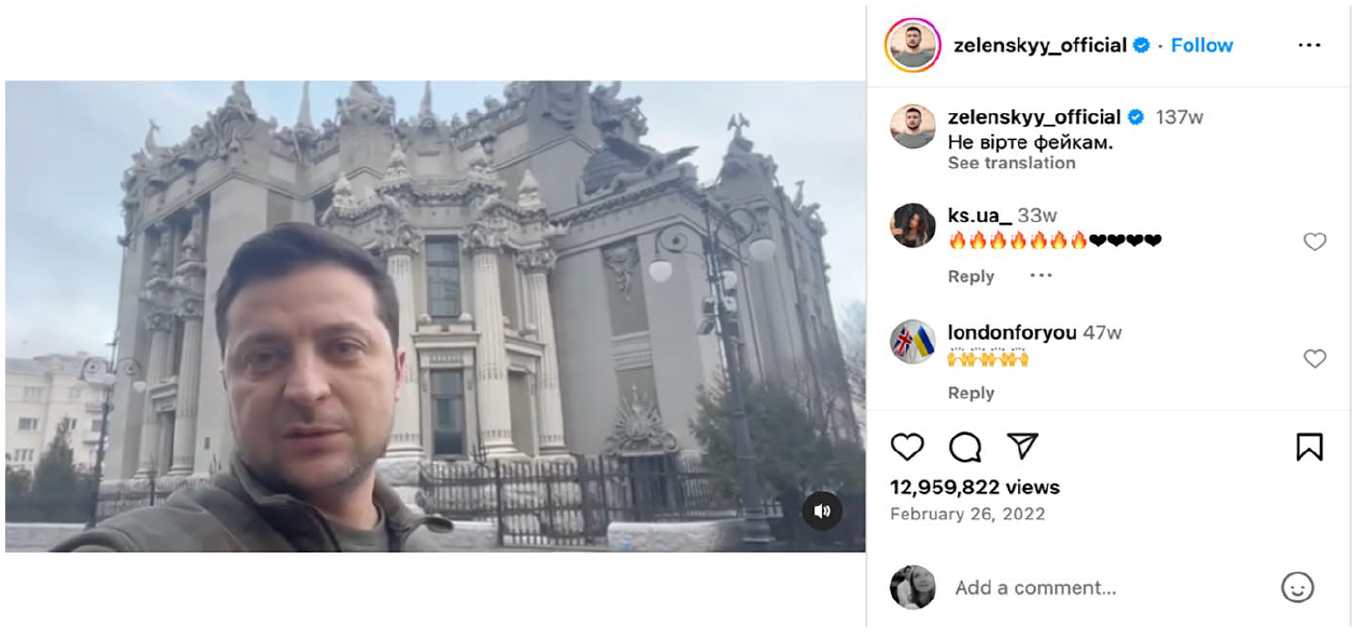
Screenshot of Zelensky video from Instagram: ‘Good morning to all Ukrainians’.
Core to Zelensky’s performance of authenticity is not only his self-made claims to truth and realness, but also a mastery of the ‘front stage’ vs ‘backstage’ (Goffman, 1959) dynamic that allows anyone viewing his videos to feel as if they are seeing his inner world. Internet influencers are a helpful comparison here, fostering a sense of intimacy that creates (artificial) closeness with their followers (Abidin, 2015). For Zelensky, the cultivation of this closeness started immediately when the invasion began. On the night of Russia’s advance, President Zelensky and members of his cabinet posted a video from the governmental district of Kyiv, in which Zelensky repeatedly named members of his cabinet followed by the declaration ‘here’ (0:03–0:22) (Zelensky, 2022b; see Figure 2), confirming that the Ukrainian government remained standing. In the video, Zelensky appears to hold his cell phone out in front of him to record the video, the other government officials gathered closely around him. They are all wearing rugged cold-weather gear. His colleagues appear serious, but Zelensky is smirking slightly, appearing proud and defiant. Standing in sharp contrast to highly polished, public relations-approved materials one is used to seeing from a politician, the shaky-cam quality of the video, the leaders’ casual dress, and the fact that Zelensky was clearly filming the video as a ‘selfie’ gives viewers the impression of a backstage moment.
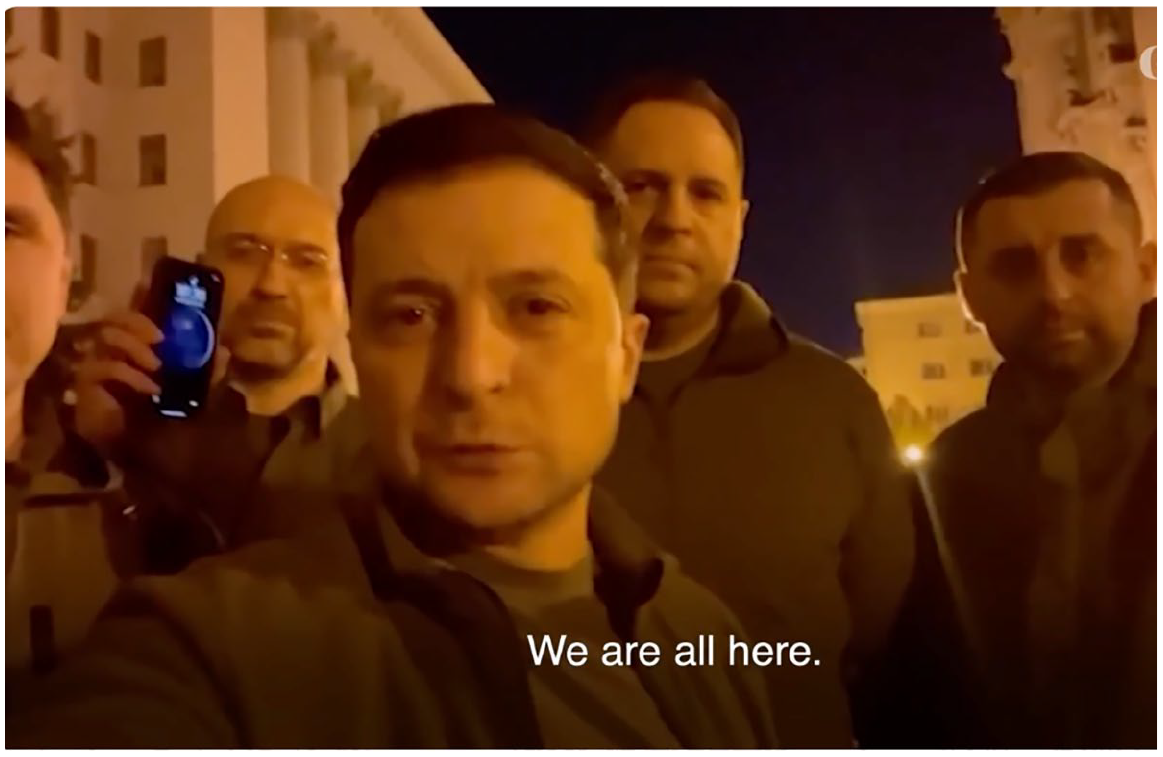
Screenshot of Zelensky video from YouTube: ‘We are all here.’
This video is just one example of how Zelensky seemed to completely embrace the backstage from the moment war began, no longer attempting to put forward a front stage façade in his public communications. Hogan (2010: 378) writes of dramaturgy that the backstage is ‘where we do much of the real work necessary to keep up appearances’. However, ‘keeping up appearances’ is exactly what Zelensky’s performance seems to signal he cannot be bothered to do – instead forgetting appearances entirely. Washington Post critic Robin Givhan (2022) documents the curtain lifting, so to speak: ‘Over the days, the tie vanishes. The suit is stripped away. The glow of a rested, well-fed man dulls. The personal trappings of hierarchical authority have been cast aside’; she continues: He doesn’t look disheveled as much as he looks like a man who has shed all the layers of pretense, decorum and diplomatic obtuseness until what remains is an open wound of dire truth. Zelensky’s vulnerability is evident; he’s not struggling to conceal it.
Of course, we know that there is a backstage. There is a home where Zelensky goes to see his family, there are moments that are not captured on camera and expanses of time where he is not filming himself – even if he remains in his green t-shirt. However, Zelensky’s rapid but careful public transformation from polished president to ‘man of the people’ stands in for the backstage, doing a convincing job of fostering the kind of ‘perceived interconnection’ (Abidin, 2015) that feels like true personal closeness – with the audiences he most crucially needs to reach.
No doubt familiar with the dynamics of front and backstage, it matters that Zelensky is a professionally trained and experienced actor, in addition to President of Ukraine, not because it explains why he is so adept at performing this particular authenticity, but because it lends credence to others’ interpretations of his behavior as authentic. Schechner (1985: 311) describes this phenomenon – in which theater and life appear indistinguishable, arguing: So there is theater in the theater; theater in ordinary life; events in ordinary life that can be interpreted as theater; events from ordinary life that can be brought into the theater where they exist both as theater and as continuations of ordinary life . . . For some, drama is the motor underlying social processes and crisis management. For others, like Goffman, all human behavior has a strong performative quality.
For Schechner (1985:312) (and Goffman, 1959) there is not an important distinction between ‘theater’ and ‘life’; what separates them, rather, is how behavior is framed, or understood, as either theater or life. Thus, Zelensky’s skillset as an actor is not important for how it might influence his behavior, but rather for how his behavior is understood. Kim (2015) argues that it is a racialized gaze that allows behavior to be understood as performative or not, where racialized bodies are often seen as ‘acting’ even when they are completing mundane tasks (i.e. eating, studying, greeting one another), perpetually marked as different. What does it mean, then, when journalists, those endowed with a certain (if misplaced) cultural authority (Zelizer, 1990), interpret Zelensky as authentic, natural despite his decidedly unusual social position and life experience as an actor? It is to journalists’ authentication of Zelensky’s performance via the profile piece that I turn to address this question.
Zelensky profiles: Authenticating authenticity
Zelensky’s widespread uptake across profiles in Western outlets can be explained in part by the relevance of his social media performance to the narrative and formal demands of the genre. The focus on the individual, promise of a personal perspective and engaging novelistic style of the profile map naturally onto Zelensky’s own efforts at self-branding in the immediate period following Russia’s invasion. Like profiles, brands locate meaning in the individual, privileging ‘individual relationships over collective ones’ and seeing ‘the individual, rather than the social, as a site for political action (or inaction) and cultural change (or merely exchange)’ (Banet-Weiser, 2012: 10). The individual, for both the brand and the profile, is where we can find answers regarding larger social phenomena. Thus, that the Zelensky profiles routinely repeat the biography of Zelensky’s life as the locus for his authenticity, suggests that Zelensky, the individual, is a central node for understanding Ukraine. As The Economist Staff (2022) writes: Mr. Zelensky was born in 1978 in Kryvyi Rih, a Soviet-looking, industrial city in the south-east of Ukraine, a centre of iron mining and metallurgy. His favourite film was ‘Once Upon a Time in America’. To survive among the town’s knife-wielding gangs, you had to have a sense of humour, chutzpah and a posse that had your back. Mr. Zelensky had all of these things, in abundance. (np)
The piece highlights the aspects of Zelensky’s biography that ring true to its audiences: a humble, working-class background, a pull towards the aspiration of the West and a charisma that allowed him to overcome life’s challenges. Explicitly encouraging us to understand Zelensky’s biography as a metonym for the crisis in Ukraine, the piece continues: ‘Like the country he leads, Mr. Zelensky is far from perfect and he is often frustrating.’ The representation of his strong but struggling country, Zelensky’s individuality becomes the lens through which the profile explains Ukraine’s existential battle – an explanation made all the more convincing with the help of authenticity.
While providing a deep dive into the individual, profiles also promise a ‘peek behind the curtain’ (Joseph and Keeble, 2016) that allows audiences a seemingly novel look at its subject. This promise is also reflected in the intimacy required of successful branding, which thrives on the notion of access. Brands are ‘the essence of what will be experienced; the brand is a promise as much as a practicality’ (Banet-Weiser, 2012: 4, emphases added), their orientation toward the future providing consumers with the sense that they are privy to a secret. Thus, the ways in which Zelensky profiles engage Zelensky’s own content as the key to making sense of the Ukraine crisis suggests (successful) branding is at work. Citing Zelensky’s ‘Good morning to all Ukrainians’ video, The Economist Staff (2022) locates the potential success of the war – its future outcome – in Zelensky himself: Standing outside the House with Chimaeras on that bright morning, with the blue sky behind him, Mr. Zelensky again sounded a defiant note: ‘We will be defending our country, because our weapon is truth, and our truth is that this is our land, our country, our children, and we will defend all of this.’ If fortune favours Mr. Zelensky, it is because he carries the virtue that Mr. Putin lacks: he speaks the truth for his people. (np)
Here, Zelensky’s prediction for the future – that Ukraine successfully defends its land – is not definite, but the piece argues that if it comes to pass, it will be thanks to Zelensky. Here, Zelensky’s own prediction for the future becomes that of the profile – the logic of the brand linking the video and the piece in a symbiotic relationship of meaning making. Zelensky is touted, ‘not as idealised myth but as reality’ (The Economist Staff, 2022), suggesting that the video, like the profile, has managed to look ‘behind the curtain’ – to identify something true about Zelensky, and by extension the war itself.
The profile genre invites a narrative journalism that feels more like storytelling than traditional reportage, lending a logic of narrative authority to the story it tells about Zelensky. Sidestepping the standard ‘lede’, which answers the classic journalistic questions of who, what, when and where, profile journalists set the scene with their own impressions and situate their subject within a character arc that allows for a coherent, logical narrative. Journalism studies scholars have argued that narrativity imbues journalists with a certain level of cultural authority (Zelizer, 1990) – but, in the case of the Zelensky profiles, narrativity also lends credence to Zelensky’s authority, allowing him to emerge as a believable, authentic subject. Following a pattern of skepticism that gives way to belief and admiration, Zelensky profile writers seem to downplay their own expertise, while emphasizing his. TIME’s Simon Shuster (2022), for example, ‘proves’ Zelensky’s performance of authenticity is genuine by taking an apprehensive stance early in the profile, before revealing his ultimate belief in Zelensky’s claims. He writes, ‘this trip to the front lines last April was the first time I’d seen him [Zelensky] with his troops – the former actor playing the part of the generalissimo. It was not entirely convincing.’ He even reports that his closest aides recognize an actor’s ‘malady’ in Zelensky, trying to keep him away from social media because he becomes ‘depressed’ when he sees negative comments. Goffman (1959: 59) explains that, when we hold this kind of skepticism towards someone else, in which we ‘ask whether a fostered impression is true or false’, what we are actually asking is whether ‘the performer is authorized to give the performance in question’. But, by the end of the piece, Shuster’s tone shifts and he testifies, ‘Before our eyes he came to embody a struggle that most Western statesmen had long forgotten how to fight, the one that is sometimes required to keep tyranny from killing off democracy.’ Admitting that he was at first ‘unconvinced’ by Zelensky’s performance of comradery and leadership with his soldiers, before ending with an about-face, Shuster’s narrative lends credence to the conclusion that this actor-turned-president is ‘authorized’ to play the role of soldier. The profile confirms: Zelensky is the real deal.
This story arc, from doubt to belief, echoes throughout the Zelensky profiles, a repeated narrative that sutures Zelensky’s authenticity as ‘true’. Echoing Shuster’s display of distant skeptic turned believer, Robin Givhan (2022) begins her column for the Washington Post by signaling that she sees Zelensky’s performance as exactly that: a highly honed skillset from a man who has ‘mastered’ the art of the ‘direct appeal’. However, by the end of her piece, she is receptive to the appeal. Her analysis becomes enmeshed with Zelensky’s own performance, her final paragraph invoking Zelensky’s words from an earlier video: ‘The president was here. And he was still working.’ The line quotes Zelensky’s videos from the first night of the war, in which he repeatedly assured civilians – and the world – that he was staying to fight, that the Ukrainian government hadn’t fallen, and that he was in it for the long-haul. Concluding Zelensky is just who he claims to be, Givhan determines his performance as ‘everyman’ is real. The Atlantic’s Megan Garber, too, takes a tentative tone at first, categorizing Zelensky’s (2022b, 2022c) selfie videos as ‘grim stagecraft’. But Garber’s interpretation of Zelensky’s performances ends up collapsing the roles of actor and politician into authentic leader, determining Zelensky’s skillset in acting makes not for a disingenuousness but rather a powerful form of leadership. She writes: Statecraft, often, is stagecraft; Zelensky, who rose to prominence as an actor, comedian, and producer, understands that better than most. But Russia’s invasion of Ukraine has turned the president into a performer of a different kind. Zelensky has been using videos, brief and self-shot, not only to document his continued presence in Kyiv, but also to rally his constituents to stay with him, and to fight . . . In war’s chaos, after all, few statements are as powerful as the one Zelensky has been delivering, to his people and to the world: I’m still here’. (original emphasis)
Crosschecking Zelensky’s video performances against journalistic impressions, the Zelensky profiles amplify Zelensky’s own message: he is here, he is real, he is true.
While Zelensky’s self-branding matches the logic of the profile in terms of the focus on the individual, the promise of an inside perspective, and the narrative structure, the repetition of the Zelensky profiles breaks with convention, forcing a typically proprietary genre into a repetitive onslaught. Although profiles are often singular, the Zelensky profiles fit within the broader performative logic of news, which Schechner (1985) argues lends itself to repetition, eventually amounting to ritual. James Carey’s (1975) understanding of ritual helps explain the stakes of Schechner’s observation, arguing that the ritual nature of news allows for the ‘construction and maintenance of an ordered, meaningful cultural world that can serve as a container for human action’ (pp. 18–19). What kind of order and meaning is created from the repeated Zelensky character sketches? According to the logics of branding and visibility, Zelensky’s repetition throughout profile news suggests there is something deeply resonant about the version of authenticity Zelensky offers as profile subject. If visibility lends itself to those subjects that reinforce the status quo (Banet-Weiser, 2018), then successful ‘brands’, defined by ‘the perception –the series of images, themes, morals, values, feelings, and sense of authenticity conjured by the product itself’ (Banet-Weiser, 2012: 4), must also tap into a mainstream affective consciousness. The profiles reveal that Zelensky’s performance of authenticity is more than just relevant, it is reflective, mirroring the myths, desires, and values most ingrained in Western society.
Zelensky’s authenticity as brand lies in his affective resonance with his audience, a ‘charm’ that enables proximity (Sonnevend, 2024) by connecting on a core level with the largely Eurocentric, anti-Russian (anti-communist more broadly), ruggedly individualistic, patriarchal society of the West. Zelensky’s embrace of the ‘dirty work’ of war signals a conventional masculinity that Western culture has long privileged – one, again, that the West’s arch enemy Vladimir Putin has eschewed (Litvinova, 2022). In fact, much about Zelensky’s authenticity operates as a direct foil to Vladimir Putin’s perceived elitism and inaccessibility. While Zelensky embodies the traditional nuclear family model, with a (conventionally attractive) wife and children – the couple was even featured in Vogue (Donadio, 2022) – Putin is a notorious ‘playboy’ (Breslow, 2022). Zelensky’s home is in the middle of a war-torn city, whereas Putin’s permanent residence remains a mystery, while rumors have swirled about numerous homes, including one that’s allegedly worth US$1 billion (Impelli, 2022). Zelensky is regularly pictured in his signature green t-shirt alongside scrappy Ukrainian troops fighting for the country’s freedom, meanwhile the image arguably most associated with Putin is a caricature of macho masculinity: Putin horseback-riding shirtless through the mountains of the Siberian Tyva region of Russia (Druzhinin, 2009). The comparison has been acknowledged directly in Zelensky profile news coverage, Atlantic staff writer Megan Garber (2022) noting, ‘Zelensky’s latest videos frame him in stark contrast to Ukraine’s aggressor: Here is Zelensky, on the streets and in danger; there is Vladimir Putin, pulling history’s levers from afar, removed from the violence and unaccountable for it.’ Zelensky’s authenticity capitalizes on a West united in anti-Russia sentiment, against a common enemy in Putin (Landler et al., 2022). A Western news narrative that has identified Zelensky as authentic, then, is evidence of his success in self-branding, proof that he has tapped into the kinds of core affective mythologies required of a consumer relationship (Banet-Weiser, 2012). Thus, symbiosis between Zelensky and Western news is enabled via a logic of branding that has both formal and affective resonances with the profile genre – and its Western audience.
Conclusion: The stakes of symbiosis
If authenticity as ‘symbolic construct’ has ‘cultural value in how we understand our moral frameworks and ourselves, and more generally how we make decisions about how to live our lives’ (Banet-Weiser, 2012: 5), what does it mean for Western profile news to authorize and amplify Zelensky’s performance of authenticity? For whom, if anyone, is this kind of authenticity – and the visibility it accrued – also accessible? Who else can perform it, and who cannot, and at what cost? Against a glut of existential crises for self-determination and democracy across the globe, Zelensky’s emergence as a singular protagonist figure in Western news suggests that it is not simply his dogged determination on behalf of his country, but his particular brand of dogged determination that has won the hearts and minds of Western journalists. His ubiquity in Western news profile pieces cannot be disentangled from his mastery of self-branding via social media, nor from the logics of the profile genre, which rely on the kind of personal, individually focused narrative storytelling that his social media performance provides. A confluence of form and subjecthood help to explain Zelensky’s resonant authenticity; the symbiosis of Zelensky’s performance on social media and the Western profiles is rooted in Zelensky’s believability as an authentic storyteller.
Zelensky is a case in point that believability functions according to performance and subjecthood, where one’s performance as a truth-telling subject is rooted in the relative marginality or dominance of one’s subject positions (Higgins and Banet-Weiser, 2023). Thus, the seemingly natural symbiosis between Zelensky’s self-presentation and Western news profiles relies on a performance of authenticity that cannot be separated from logics of whiteness, maleness, and aspirational Westernness. The story Zelensky has succeeded in telling about himself, repeated and validated through mainstream media discourse, is evidence that ‘whiteness is secured through its habitual performance’ (Shome, 2014: 12) – where whiteness is not a natural property of the body, but an orientation towards certain stories, myths, images and narratives (Ahmed, 2007; Shome, 2014). Thus, just as whiteness can help to explain Zelensky’s stardom in Western news, it can also help to explain Putin’s villain character. In both cases, the men are afforded a measure of visibility because of the myths they clearly tap: underdog versus tyrant, and the subconscious associations of each of these main characters in Western society with a dominant white male lead.
Whiteness becomes an analytic that allows us to parse the unique brand of authenticity that Zelensky mastered in the immediate period following Russia’s invasion, and by extension the commitments of the journalistic form – the profile – that afforded it a significant measure of visibility. Together, understandings of performance and authenticity allow us to see that the broad swath of similarly narrated Zelensky profiles are not a fluke, nor are they indicative of truth, but are rather the natural extension of a media institution habituated toward certain stories, which certain subjects are particularly authorized to tell. Understanding how whiteness as ideological power locates itself in certain bodies rather than others (Shome, 2014), reveals how ‘beliefs about the body are crucial to structuring the world’ (Kim, 2015: 5). If the formal structure of the profile reflects larger structuring logics of the sociohistorical conditions in which it is produced, then it is meaningful to question who receives profiles, under what conditions, and with what consequences.
Telling deeply individualized stories that satisfy audiences’ curiosity with people as news – allowing audiences to ‘peak behind the curtain’ so to speak at the seemingly private, full lives of those profiled (Joseph and Keeble, 2016), profiles do more than provide an insider view, they authenticate their subject as legible, believable, and proximate. The Zelensky profile, which authenticates Zelensky according to narratives steeped in resonant Western mythologies, runs parallel to strong (if contested) support from the mightiest military power in the world, a near universal welcome to Ukraine’s refugees and a relative dearth of attention to other people, places and conflicts. Western news’ validation of Zelensky as a ‘man of the people’ is premised on a recognition of Zelensky as ‘one of us’ – the profile coverage reflecting a Western worldview that sees Zelensky, and Ukrainians by extension, as ‘close’ (Edwards, 2022), in part due to the ideological pull of whiteness as affective attachment that reflects deeply rooted values of Western society. In a news economy in which what is seen and heard cannot be disentangled from what is felt and acted upon, the Zelensky profile encourages us to think critically about how news genres enable proximity with certain conflicts (and the individuals who represent them) – and whether this proximity might come at the expense of others.
Footnotes
Acknowledgements
The author would like to thank Sarah Banet-Weiser, Guobin Yang, Robin Wagner-Pacifici, Barbie Zelizer and Emilie Grybos for graciously reviewing early drafts of this article. The author would also like to thank the reviewers for their time and feedback, and Katy Parry for shepherding this project to the finish line.
Funding
The author received no financial support for the research, authorship, and publication of this article and there are no competing interests.

Data availability
The social media and news data for this article were collected from publicly available resources.