



Abstract
Political backlash against liberal democracy and ubiquitous clashes between different versions of identity politics in recent years evoked a heightened awareness of political polarization. Rather than examining the mechanics of this process, social science predominantly conceives political polarization in a rather static manner and measures its prevalence and causes within and between societies. This article views political polarization as taking shape in the experience of political conflict. It proposes a cultural performance framework suitable to examine the social drama of political conflict and its connections to interpersonal political dispute. Performative polarization is premised upon antagonizing one public in order to win over and energize another public. It views political antagonism as constituted by (1) powerful performers and performances that provide the preparatory symbolic work and scripts and (2) divided publics who arbitrate their dramatic acts in ensuing performances and who collectively generate political divisions. The anti-Critical Race Theory campaign in the USA serves as a case study to work through the elements of this theoretical framework.
Keywords
Political commentary of the past 10 years has mulled over political polarization as one of the central problems of the US-American polity (Ornstein, 2014; Talisse, 2019), with headlines such as ‘Polarization: It’s everywhere’ (Cohn, 2014) or ‘In the Trump era, America is racing toward peak polarization’ (Kilgore, 2017). Though perhaps most pronounced in the United States (Boxell et al., 2020), there is a strong sense in many liberal democracies that its publics are drifting apart. In the United States, political polarization is nothing new. It turned into violence and civil war in the mid-19th century and was evident following political realignments of 1894–1896 (Jenkins et al., 2004) and the Civil Rights era (Rosenfeld, 2018), the latter of which particularly reverberates in political divisions today. The current moment is distinctive, however, in how political polarization is generated and perceived.
As the following section details, there has been surprisingly little effort to theorize and qualitatively examine the process of political polarization, especially accounting for both mediated and face-to-face social interaction. This is in stark contrast to the burgeoning empirical research on the subject, in which polarization is largely examined in statistical aggregates and conceived as a state. Recently, research attention turned towards the affective dimension of polarization, and inter-group resentments came into focus (Iyengar et al., 2019). This article calls for research on how antagonism-inducing political emotions (like resentment, hostility and outrage) arise, evolve and are nurtured in order to be in a better position to dismantle them. It uses the anti-critical race theory (CRT) campaign to argue that examining political antagonism from a performance perspective helps address unresolved questions and underexplored areas of affective polarization research.
Premised on inter-group hostility, affective polarization must be conceived as the experience of dividedness, which originates in the meanings and emotions generated in the social drama of political conflict that members of the public engage in, witness or have at least awareness of. It turns the initial focus on the moral claims and divisions and political emotions that emanate from this social drama. The claims of political performances, conventionally understood, are universal; the effectiveness of performers rests on their ability to generate wide-ranging belief and identification with the encoded meanings of the dramatic act and approving responses from the audience. Polarizing performances, on the other hand, are anti-universalist. Their initial objective is disapproval from an adversarial audience, which provides the emotional energy to address, attract and empower the audience that polarizers seek approval from. Performative polarization follows a logic of escalation: dramatic acts and responses widen in scope and intensity, which involves enhancing (not only maintaining) divisions through interlinking new issues and symbols with existing concerns and sentiments. Symbolic entrepreneurship refers to this embedding of new elements in extant group antagonisms and conflicts by skilled performers. Performative polarization today, finally, requires considering the historical backdrop of political backlash and the confluent practices of political provocation and trolling. Examining the gestures, symbols and emotions generated in polarizing performances enables us to discern their expression in everyday social interaction and better understand the origins of political divisions.
The following section will point to some of the shortcomings in polarization research and map out a course for a processual and cultural theoretical framework. Subsequent sections will develop this framework by conceptualizing political conflict, publics, backlash and provocation from a cultural performance perspective and then deploy this framework to the anti-CRT campaign.
Political Polarization as a State and as a Process
Two main conceptions of political polarization are used in the social sciences: elite and mass polarization. Whereas elite polarization focuses on divisions within political institutions, mass polarization deals with public cleavages, whether conceived in terms of divergence of attitudes (ideological polarization) or inter-group hostility and resentment (affective polarization). Linking the two dimensions, scholars have demonstrated that political parties became increasingly effective in sorting voters to ensure alignment between party identification and political views (Baldassarri and Gelman, 2008; Fiorina and Abrams, 2008; Levendusky, 2010). This issue has been viewed in terms of a top-down process in US politics, where ‘voters use elite cues to sort’ (Levendusky, 2010: 15) – cues they learn from leading politicians in political campaign messages, the news, through activists, interest groups and social movements. Following the argument developed in this article, cues are not only about establishing cognitive links between positions and party but about reinforcing ideological identity and affective appeals. One research implication of this argument is to trace back and examine the relevance of these cues in day-to-day social interaction.
Affective polarization (Iyengar et al., 2012) became the dominant focus of research over the last decade, which explains cross-party resentment by partisan sorting, differentiation of news media ecosystems, proliferation of partisan media, expansion of internet access, the professionalization and increasing negativity of political campaigns and homogenization of social networks offline and online (Iyengar et al., 2019). Standard survey measures of affective polarization are ‘thermometer ratings’ of parties/partisans and tolerance of inter-party marriage. From this aggregate data we can learn about how affective divisions evolve over time within and between societies. We do not learn much about the emergence and experience of antagonism, the implications of feeling resented by others (Hochschild, 2016; Polletta and Callahan, 2017) for relating to these others, or the mechanisms of strategic evocation of affects by political actors and activists. Efforts to reconceptualize the phenomenon as political sectarianism (Finkel et al., 2020), which arises as mutual othering, aversion and moralization between partisan groups, points in the right conceptual direction and calls for more meaning-centered approaches.
Beyond the USA, research recognized that political identities do not only form around parties but specific issues which cut across party lines, such as Brexit (Hobolt et al., 2020; Norris and Inglehart, 2018; Sobolewska and Ford, 2020). Though the case study in this article is set in the USA where most political divisions sort neatly into the two main parties, the performance framework is suitable for affective polarization in the broader inter-group hostility conception. It recognizes that, apart from organizational structures which seize and fuel antagonisms, each side of the divide is fundamentally a discursive construction (Anderson, 1983) and an outcome of polarizing performances themselves. Material categories of similarity and difference, such as voting preferences, income, abilities, phenotypical features, are symbolic devices for these constructions. Research following a performative polarization approach needs to investigate how hostility is generated at various intersections of political conflict and its actualization in social interaction.
Similar to Braunstein’s (2018) perspective on incivility as a subject of ongoing contestation rather than a predefined category, the active creation of antagonism between friend and enemy characters and attributes in mediated and interpersonal relations are the focus of performative polarization research. It thus follows a developmental understanding of polarization, which has evolved in historical comparative research and focuses on the divisive effects of institutional changes in politics (Pierson and Schickler, 2020). Among other insights, research in this area discovered feedback loops between changes of media ecologies, relationships between federal and state politics, interest groups and parties as boosters of polarization.
Survey-driven polarization research’s removal from experience and practice has been partly corrected by advances in computational analysis of digital trace data of online behavior (Bakshy et al., 2015; Faris et al., 2017; Flaxman et al., 2016). But this research has been dominated by concerns over filter bubbles, which adopts a model of publics as information-processing citizens, to use Jacobs and Townsley’s (2011) terminology, and tends to disregard the importance of media for identity formation (Kreiss, 2017). One of the key studies in recent years, which used digital trace and experimental data, ultimately fell back on qualitative interviews to better understand why preexistent political beliefs were strengthened rather than attenuated through exposure to oppositional views (Bail, 2021).
Performative polarization contends that political antagonism and public divisions are constituted and sustained through performance. Its effects must be traced in everyday life and this article provides conceptual tools and anchor points for such an investigation.
The Case Study: The Anti-Critical Race Theory (CRT) Campaign
The anti-CRT campaign was chosen as a case of a successful performance with wide-reaching (and lasting) effects to illustrate the various aspects of this analytical framework. It was selected because of its clear and singular origin moment, which was when activist Christopher Rufo appeared on Fox News on 1 September 2020 and introduced the term to a conservative audience, including then-president Donald Trump. Most divisive debates are entanglements of performances and counter-performances without such a clear initiating moment and act of symbolic entrepreneurship. But even Rufo’s performance built on sentiments and cues that have evolved in conservative media, including and especially in the context of Black Lives Matter (BLM) protests in 2020.
In the initial broadcast (Carlson, 2020), Rufo claimed that CRT was used to indoctrinate the federal administration through anti-bias and diversity trainings and called on Trump to shut them down. The White House responded immediately with a memorandum and an executive order to defund diversity trainings in federal agencies a few weeks later, which would restrict how racism and sexism could be addressed in such programs. It was followed by liberal outrage and pushback and though Joe Biden rescinded the executive order on his first day in office, it served as a template for state-level legislations which specifically censored racism-related teaching in the education systems of US states dominated by the Republican Party, including Texas, Florida, Idaho, Iowa and Georgia.
I analyzed this debate by an unstructured but focused approach, more akin to an ethnographer than a content analyst (Altheide, 1987) but with a clear theoretical agenda. I mainly focused on anti-CRT discourse from the perspective of the political right and not the reaction on the left. I followed news coverage in major news publications with distinct editorial positions and alternative news websites such as Breitbart, around key moments of the debate. I read user discussions in comment sections of the articles and on the Twitter feeds of these news publications as well as of key figures, such as Chris Rufo, leading politicians and Donald Trump himself (using www.thetrumparchive.com). I reference public figures’ Twitter posts in this article and not those of regular users as it would be unethical to single out individuals among thousands of comments.
The Cultural Pragmatics of Political Polarization
Turning our attention to the characters and gestures of the social drama of political conflict enables us to better understand the symbolic grammar of the lived experience of polarization and the relationship between structural and interpersonal political divisions. Inevitable and not per se a social problem (Simmel, 1992), political conflict is integrative as long as conflicting parties encounter each other ‘as sharing a common symbolic space within which the conflict takes place’ (Mouffe, 2005: 20) while acknowledging the insurmountability of some, if not all, of their differences. In a polarized political culture, however, these differences amount to divisive antagonisms and opponents who encounter each other as friends and enemies.
Political disputes are part of civic socialization, for better and for worse. As much as we would like to claim our own political positions to be rooted in information and studiously acquired knowledge, they are in large parts generated through the moral oppositions arising from political conflict. Political disputes that we become aware of, witness, and conflictual interactions we participate in ourselves – face-to-face and in mediated encounters – generate meanings and emotions of political affinity and liking as well as opposition and antipathy. It is thus important to not only assess the substantive dimension of arguments, according to their truth value or under which conditions people believe in or trust them. They are generative acts with possible wider consequences or performativity (Austin, 1962) and thus have to be appraised in terms of their efficaciousness, as Isaac Reed (2013a) puts it. Theories of performance and ritual enlighten this set of problems, which comprises cultural performance theory.
Goffman’s dramaturgical sociology conceived social interaction as performance and generated forensic and microscopic examinations of social interaction from this perspective. Though he never denied the structuredness of performance, and in fact explored it in specific institutional orders (Goffman, 1961), he merely related dramaturgical action back to social structures (Goffman, 1983) and overlooked how culture structures not only shape the style of presentation but also constitute the very foundation of performative power (Alexander et al., 2006; Reed, 2013b). Conceived as the ability to assert one’s will against the will of others without force, power (Reed, 2013b), as well as counter-power (Morgan and Baert, 2018), must be conceived as performative, though it is aided by material resources and capacities.
Among other resources, cultural pragmatics (Alexander, 2004) incorporates ritual theory (Durkheim, 1995; Geertz, 1973; Turner, 1977) to emphasize that emotional investment and meaningful import of ideas in a performance are contingent on reference to significant discourses, symbols and belief systems, such as religious dogmas, cultural traditions or constitutional principles. It accounts for the structuredness of dramatic action by these symbolic underpinnings, the role of power and its unequal distribution over the means of symbolic production, as well as the agency in asserting symbolic meanings in specific contexts and tailoring them according to situational requirements. Thus, cultural pragmatics points to extra-situational dimensions shaping performance and determining performative success.
As with all public performative acts, polarizing performances are partly retrograde, marking well-trodden paths of political dispute. The performative moves of an effective polarizer are thus immediately recognizable, following scripts which effectively evoke and condense complex meanings in morally unambiguous ways, pitting good against evil and ‘performing the binaries,’ as Alexander (2004: 552) put it. Audiences of divisive performances will feel unambiguously addressed as friends or enemies. This is why the empirical analysis of cultural performance must be historical, at least to the degree of understanding their historical backdrop, if not comparing performative acts over time. Though this article cannot fulfill the latter requirement, the next section will point in the right direction in arguing that performative polarization is conditioned by political backlash. Understanding the successful anti-CRT campaign in conservative US states involves understanding previous conservative responses to anti-racist advancements, which inevitably leads into the Civil Rights era, in the first instance.
As much as performances are referential, however, they are immediate and to some extent innovative arrangements of meanings. It is in this symbolic innovativeness in which performances are also prospective: They serve as foundations and inspiration for subsequent innovative dramatic acts, including and importantly in this context antagonistic ones. Rather than mere articulations of social positions (Bourdieu, 1991), this iterative understanding of performance is more akin to Butler (1997: 127–163): as much as performativity enacts established systems of domination – making patriarchy seem natural and inescapable, for instance – the actual contingency of performance bears possibilities of resignifying and thereby transforming social order.
The concept performative polarization has been used by Morgan and Baert (2018) to circumscribe one way in which the Black Consciousness Movement performed counter-power, namely fighting racist structures in apartheid South Africa through embracing the racial category Black – radically collapsing various racial categories of discrimination like ‘Coloured’ or ‘Indian’ – and dramatically emphasizing opposition to the morally corrupt White antagonists. The theoretical argument developed in this article uses performative polarization to point to political emotions produced by divisive dramaturgical acts. Identification and resentment materialize, solidify, and occasionally shift during continuous cycles of performances and counter-performances, whether at rallies, protests, or online discussions about the social drama of politics. Political emotions certainly facilitate but cannot be reduced to power and must be considered in their own terms in the first instance, especially when the ultimate object of research should be the everyday experience of political conflict.
Enhancing antagonism, not only refueling it – though both are important moves in performative polarization – involves symbolic entrepreneurship. I draw here from the notion of institutional entrepreneurship (Battilana et al., 2009), which highlights possibilities of agency for restructuring institutions, despite their general inertia to change. Fligstein and McAdam (2012) discuss this ability in terms of social skill, or actors’ ability of motivating others to cooperate. Socially skilled actors do this by appealing to shared interests, meanings and identities while also reconstructing these to bring about institutional change. It goes without saying that forging relationships and motivating others is all about performance. Symbolic entrepreneurs meet their audience at its shared commitments and link them to new ideas and issues of concern. Figuratively speaking, they sew in new patterns into their cultural fabric. This is critical for transformative polarizing performances, including the outset of the anti-CRT campaign.
The Connected and Antagonistic Audience-Performers of Performative Polarization
The strong program tradition is concerned with ritual-like performances in highly differentiated modern societies in which projected and interpreted meanings align and the audience ‘fuses’ with the performer. Oppositional decoding (Hall, 1973) of performed meanings, averse responses from audiences or particularistic performances for specific communities entail de-fusion and are deemed ineffective (Alexander, 2004: 562–565). Though some de-fusion is expected, the main question is whether fusion by-and-large carries the day. Active involvement and plurality of audiences as the ultimate arbiters of performative success and failure has long been neglected. Building on Reed’s (2013a) notion of charismatic performance, premised on resonant interactions between leaders and followers, recent cultural performance work devises agency to audiences who have to perform fusion for it to take effect (Taylor, 2022). Taylor argues that fusion does not ‘just happen’ in terms of passive resonance but as an audience’s expressed ‘arbitration’ of performative success. This is what emboldens the performer to subsequent dramatic acts and what moves performative success forward. The same is true for performative failure, which is a result of an audience’s negative arbitration. Taylor envisions the performative back-and-forth between performer and audience as a spiral in which audiences perform fusion or de-fusion and thereby bolster or weaken a performer’s subsequent acts and their impact. The arcs in this spiral indicate the audience’s varying contributions to performative success and failure (see Figure 1).
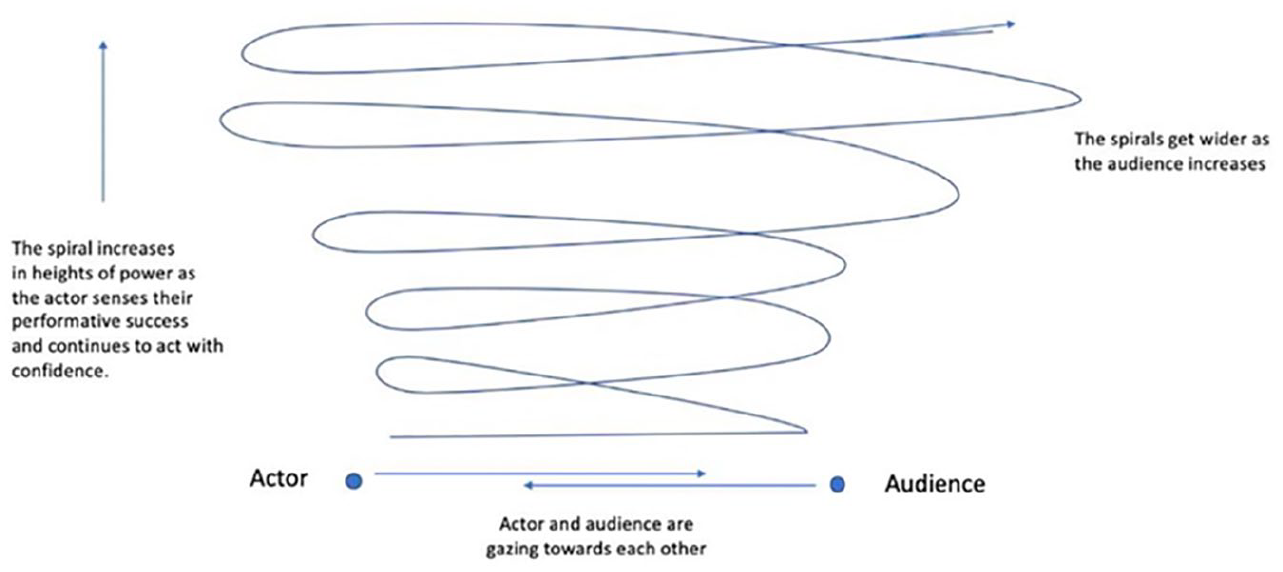
Spiral of performative success (Taylor, 2022: 72).
For the rise and performative success of politicians like Trump and populist leaders in European and Latin American countries, however, de-fusion seemed instrumental. With enhanced possibilities of mediated communication and the rise of social media in particular, different audiences witness each other’s arbitrations and respond to them in turn. This has led Malacarne (2021) to differentiate between target and secondary audience, whose respective responses are shaped by the others’ response to the same performance. Though there are certainly more intricate links between audiences, in situations preconfigured by past political conflict, in cases of open political dispute or explicitly divisive dramatic acts, inversely related responses occur: if one approves, the other disapproves, with the corresponding and mutually reinforcing emotional intensity.
Adversarial audience B’s negative response may be exactly what evokes or intensifies a positive response from target audience A. In fact, disapproval is the initial objective of a polarizing performance and the emotional means to performative success. The performance is staged in awareness of audience B and crafted to evoke and make visible their oppositional responses to appeal to and consolidate audience A, often through shared counter-outrage against audience B. This visibility – connecting divided audiences to each other – is mostly mediated visibility and enabled through what Malacarne (2021) calls linking mechanisms: the means through which audiences become aware of one another’s response to the performance. This includes physical co-presence, for instance, at political rallies in which supporters encounter protesters and are explicitly pitted against one another from the campaign stage. Linking also happens through symbolic representation, for instance, when public figures incorporate imagined responses of adversarial audiences into their performance. Of course, linking is most prevalent through means of cross-linking and association on social media platforms.
In order to adapt the widening spiral, which indicates an increase in performative power (Figure 1), a dynamic of political backlash as Braunstein (2021) points out is critical: backlash leads radicals to double-down and further radicalize and also leads outsiders to join them in support of the lager political project they are engaged with. This counter-backlash then evokes further backlash, and so on. Doubling down is a performative move; radicalizing and joining forces involves performance. The emotionally intensifying back-and-forth of performances and counter-performances lies at the heart of the experience of political polarization, which captures and morally codes more issues, terms, gestures and actors in its orbit, partly by symbolic entrepreneurs sewing them in strategically.
The model in Figure 1 can now be usefully adapted for polarizing performances where acts aim to appeal through aggravation. The adapted model accounts for connections between affirmative and oppositional counter-performances of polarized audiences and can be envisioned as inverse spirals whose arcs are linked to one another (see Figure 2) – representing the negatively associated but connected audiences who perceive and respond to one another (Malacarne, 2021).
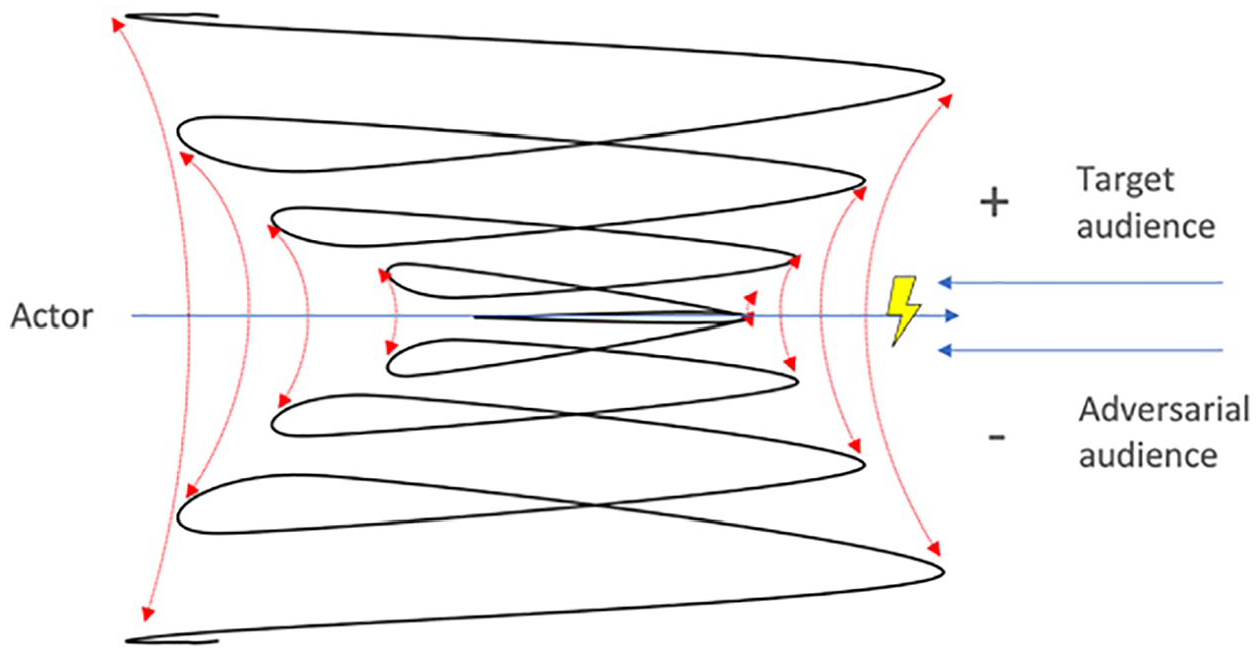
Spirals of performative polarization.
The Terrain of Performative Polarization: Political Backlash
While polarizing performances are ubiquitous, their centrality in political culture varies. Comprehensive political backlash is the historical condition for performative polarization in which political conflict permeates so many discursive arenas that it becomes difficult to escape. Many contemporary concepts of political backlash, though imaginable in liberal form after extended periods of democratic backsliding, essentially deal with conservative backlash. In a recent special issue, for instance, Alter and Zürn (2020) define backlash politics as retrograde, attempting to reshape politics through specific visions of the past, either based on real, imagined or glossed-over earlier conditions. Similarly, Alexander’s (2019) theory of democratic progress conceives political avantgardes to push new visions forward (frontlash) to successively incorporate marginalized groups and rectify social injustices committed against them, on the one hand, and political reactionaries seeking to revert changes and return to earlier states of affairs (backlash), on the other.
Norris and Inglehart (2018) lead the current cultural backlash in many post-industrial societies back to a shift in balance between socially liberal and conservative values since the post-war era, following structural changes in education, urbanization and intergenerational relations. The main reference point and articulation of this backlash is nationalistic populism (Mudde and Kaltwasser, 2018), which pits a homogenous notion of ‘the people’ simultaneously against ‘elites’ and ‘outsiders’ (immigrants, minorities) (Brubaker, 2017; Jagers and Walgrave, 2007). While Müller (2016) considers anti-pluralism its most important feature and greatest danger to liberal democracy, populism’s lack of a comprehensive political worldview or vision (Rensmann, 2006; Stanley, 2008) and indeterminacy of its targets – elites and outsiders – makes it so appealing and well-suited for the conditions of digital mobilization and what Bennett and Segerberg (2012) call connective action.
Aside from the specific ideological slant of backlash today, which also pertains to the case study of the anti-Critical Race Theory (CRT) campaign, a broader, less specific and at the same time more interactional conceptualization guiding this article views backlash against a political group or movement as initially prompted by and as a response to the actions of its more radical elements (Braunstein, 2021). This backlash can be more or less sweeping: It may be, to use Braunstein’s distinction, narrow and only targets radicals or it may be broad backlash directed against the group as a whole, including its moderate elements subsumed through ‘guilt by association.’ The current political divisions in the USA may have evolved from and still partly involve narrow backlash. However, broad backlash clearly dominates US politics, which is manifest in the perceived expansionism of divisions (‘everything becomes polarized’) and legislative gridlock. What makes it so broad is in large part the asymmetrical and politically orchestrated far-right disinformation order (Benkler et al., 2018; Bennett and Livingston, 2020) as well as the algorithmic infrastructure of social media, which makes extreme voices dominate the perception of political life (Bail, 2021).
Backlash, furthermore, has a specific political emotional flavor: It refers back to, amplifies and generates indignation – a complex of shame, anger and contempt (Petersen, 2020) – as well as resentment and ressentiment (resentment’s ‘passive and helpless shadow’ (Salmela and Capelos, 2021: 193)), which are products of structural differences between privilege and unprivilege (Turner, 2014). Building on Nietzsche and Weber, Turner viewed resentment as a pronounced modern sentiment linked to urbanization and the greater visibility and awareness between social groups it brought with it. This is a precondition insofar as one can only resent what one notices. Social media, as the McLuhanian technological extension of urban visibility, have further enhanced inter-group awareness and are thus breeding grounds for societal resentment (cf. Buck and Powers, 2010), irrespective of algorithm-induced emotions.
In addition, a typical (but not exclusive) feature of US politics, including backlash politics, is its paranoid style. Following Hofstadter (1996: 3), this involves ‘heated exaggeration, suspiciousness, and conspiratorial fantasy.’ Though this style is not ideologically specific, Hofstadter detected it among leading figures of the political right in the mid-20th century, such as Joseph McCarthy and Barry Goldwater. Such figures typically create a sense of dispossession, construct threats of state infiltration by unwanted beliefs and elements and sketch an apocalypse of a declining country and its values – features which also characterize the anti-CRT campaign.
The Art of Political Provocation and Political Trolling
A critical performative move for the purpose of creating, maintaining and intensifying antagonisms is provocation, on the part of the performer as well as the responding audience. Polarizing performances aim for provocation and/or provoke in effect. Figuratively speaking, provocation is the wedge which keeps the antagonistic spirals of performative polarization apart. The divisive emotional energy is partly provided by provocateurs becoming sacred objects themselves, as much for their provoked opponents as for their supporters.
Provocation as a rhetorical strategy has a long and illustrious history in the USA, especially on the political right. William F. Buckley Jr.’s combative rhetorical style, for instance, was about creating ‘inflammatory drama,’ as Lee (2010) argued. Buckley’s standing among conservatives was partly advanced by successfully antagonizing political opponents. Provocation from the far right, furthermore, has been understood as a metacommunicative frame which signals affective investment rather than furthering truth claims (Kølvraa, 2015). The provocation is only successful when the frame becomes contagious and responses against it are primarily affective rather than substantive.
Particularly right-wing digital politics has been captured by trolling on platforms such as 4chan and 8chan (Lewis and Marwick, 2017). A troll seeks to expose the irrationality and emotional-moral infatuation of their targets through indignant reactions (Phillips, 2015), 1 often with the sinister objective to embarrass or ruin their reputation (Coleman, 2014). Trolling primarily relies on responses of those who object. Trolls’ symbolic weaponry, lulz as the bait of provocation, are always jokes of an ‘us’ at the expense of a certain ‘them.’ 2 The self-replicating and memetic character of lulz and the shared amusement emanating from them make up their socially cohesive character. A troll largely performs for their own community, where having successfully trolled someone is rewarded with recognition, irrespective of the message. Trolls share a general cynical-ironic stance on any belief, conviction or shared sentiment.
Though trolls are different from most political provocateurs, the cultural practice of trolling has seeped into politics. During the political rise of Trump, the embodiment of the hybridization of trolling and strategic provocation was the alt-right influencer Milo Yiannopolous who has since been deplatformed. Many political provocateurs either act as trolls themselves or rely on them to support their provocations online. In both instances, political provocation uses the performance scripts of trolling, taking their point of departure from but further extending beyond online discussion spaces. The very notion of ‘owning the libs’, which involves humiliating and dominating the opposition on the basis of violating liberal sentiments and norms of civility, is a manifestation of this. There is overlap in the subject matter – all us/them divisions are about the assertion of power and thus political. Professional political provocateurs, like politicians, commentators and activists, however, do not provoke for sheer amusement and address the voting public with the strategic objective to morally outrage the opposition and to appeal to and evoke affirmation by supporters.
Performative Polarization and the Anti-CRT Campaign
The critical race theory (CRT) controversy is part of a lineage of conservative backlash against racial de-segregation and inclusion since at least the Civil Rights era. George Wallace’s open segregationism or Richard Nixon and Barry Goldwater’s ‘Southern Strategy’ to appeal to White voters’ racial resentments are some of the most infamous immediate reactions to the Civil Rights Movement which paved the way for an emergent racial conservatism that helped realign the parties in the US-American South. Comparative analysis of key performative interventions, including those by supporting conservative intellectuals during this era (such as William F. Buckley) would be expedient to trace the derivation of the anti-antiracism scripts during Trump’s 2020 reelection campaign. At that moment, a conservative backlash formed against the initiatives that sought to call attention to and push back against systemic racism and other forms of structural discrimination, which were all folded into and coded as representations of CRT.
It is worth emphasizing here that the following analysis deals with the evolvement of the CRT debate from the perspective of the political right. As soon as the conservative campaign started, of course, it immediately induced counter-backlash on the political left which no doubt contributed to the antagonism and deserve its own analysis whose demands cannot be met by the oppositional interjections of Twitter users refer red to in what follows.
The initial and critical performative move in the CRT debate was Christopher Rufo’s appearance on Tucker Carlson Tonight on 1 September 2020. Rufo began his prepared statement by sharing the main conclusion from his examination of diversity and anti-bias trainings, which was that ‘critical race theory has pervaded every institution in the Federal government’ (Carlson, 2020). He thought of CRT as a ‘cult indoctrination,’ as undermining ‘traditional American values’ and therefore as posing an ‘existential threat to the United States.’ Tucker Carlson, a seasoned polarizer, rhetorically pre-escalated this threat in the introduction of the segment, referring to the programs in a remarkable attempt of resignification as ‘openly racist’ and claimed they would lead to ‘violence and permanent division.’
This critique met open ears of the Fox News audience, who were primed by their host Carlson to be hostile towards any effort to combat systemic racism in the wake of the George Floyd murder more than three months earlier and ensuing protests across America. Rufo’s performance also tapped into a trope constructed in right-wing media for years, which is that American institutions have been infiltrated by ‘Cultural Marxism.’ 3 Against this discursive backdrop, Rufo’s performance was not only successful in reinforcing political divisions over questions of race but also in terms of symbolic entrepreneurship: Repeating ‘critical race theory’ six times in his three-minute opening statement, it started implanting the concept 4 in the consciousness of the Fox News audience and conservative politics. By way of persistent reiteration through various communication channels and voices, CRT stuck as a label for anti-racist positions and practices deemed problematic on the political right. With its weaponization in subsequent debates and regulatory interventions against various anti-discriminatory practices and teachings, CRT became a dominant symbol of contention of identity politics in the USA. CRT will probably never be understood in the same way, either by its opponents, or by those who believe in the need to combat systemic racism, for whom the meaning of CRT is now shaped by opposition to anti-CRT. One powerful audience member who was directly addressed by Rufo’s performance on Carlson on 1 September 2020 was then-President of the United States. In the first critical arc of fusion, the White House informed Fox News the following day that it heard the call (Dorman, 2020) and, as was later revealed, got in touch with Rufo and flew him to Washington to help draft the Executive Order to be released three weeks later (Wallace-Wells, 2021), which would essentially ban any anti-bias and diversity trainings in federal agencies. 5 The first official public response and next critical arc followed on 4 September when the Director of the Office of Management and Budget, Russ Vought, announced a memo on Twitter which called on federal agencies to identify ‘un-American propaganda training sessions,’ including on CRT, White privilege and any trainings suggesting the US as a country or any race or ethnicity was ‘inherently racist or evil’ (United States, Office of Management and Budget, 2020). In reporting this announcement, Breitbart suggested CRT was a ‘leftist, racist doctrine that forms the intellectual underpinnings of Black Lives Matter, Antifa, and other radical organizations currently engaged in unrest on America’s streets’ (Bokhari, 2020). Linking to this article in a tweet, Trump added that ‘[t]his is a sickness that cannot be allowed to continue. Please report any sightings so we can quickly extinguish!’ (Trump, 2020 (Trump @realdonaldtrump)).
Another key moment in the lead up to the Executive Order was Trump’s speech at the National Archives Museum on 17 September 2020, in which he reiterated the critique against CRT and announced the 1776 commission as a counter-initiative to the New York Times’ 1619 project: ‘Critical race theory is being forced into our children’s schools, it’s being imposed into workplace trainings, and it’s being deployed to rip apart friends, neighbors, and families’ (C-SPAN, 2020). After disparaging CRT and the 1619 project as the main purveyor of this ‘ideological poison that, if not removed, will dissolve the civic bonds that tie us together,’ he announced the 1776 commission in the hope to ‘restore patriotic education to our schools.’
A new target of CRT insinuated in this speech is school education. It marks the first widening of the spirals of performative polarization, continuing to resignify anti-bias trainings and now race-conscious education in schools informed by CRT as racist, as obsessed with (racial) hierarchy, oppression and positive discrimination rather than equality and inclusivity. This makes anti-CRT discourse appealing to a wider audience, who could thereby simultaneously support censorship of anti-racist educational content while perceiving themselves as opposed to racism, as twisted as this may sound.
Trump’s attacks against CRT outraged his opponents, which had the side-effect (and to Trump the main effect) of confirming his supporters in their rejection of anti-racism as understood through the code CRT. It also emboldened conservative politicians and activists to enact follow-up anti-CRT performances, which would eventually culminate in effective censorship of teaching about discrimination in educational curricula in various US states, most pronouncedly in Florida. The shared negative sentiment towards the performance and ensuing counter-performances by extension fuses the adversarial audience with their preferred performers. There is no doubt, for instance, that the disdain of Trump unified his opponents and in part supported the rise of politicians such as Alexandria Ocasio-Cortez who rose to the occasion in performing in many ways as the anti-Trump during his presidency.
Oppositions between performers and between target and adversarial audience are generated in polarizing performances themselves, including through the aforementioned linking mechanisms of social media. Since the start of the campaign, Rufo’s Twitter feed mainly consisted of anti-CRT rallying cries and pronouncements next to occasional exposure of counter-performances by influential opponents, like Ibram X. Kendi: an adversarial audience member in one sense, a public intellectual with a platform who continuously responded to these performances in another sense, including in an essay in the Atlantic later on in the debate, which refuted the argument that anti-racism is merely a cipher for anti-White sentiments (Kendi, 2021). In a Twitter thread about this essay, Rufo started by characterizing his reading: ‘Ibram X. Kendi: Critical race theory is not anti-white. Critical race theorists: Yes, it is.’ He then juxtaposed a screenshot of the essay’s headline with a screenshot of five quotations from critical race theorists who, in his mind, exemplified anti-White animus: ‘All white people are racist.’ – Barbara Applebaum ‘White identity is inherently racist; white people do not exist outside the system of white supremacy.’ – Robin DiAngelo ‘Whites spend a lot of time trying to convince ourselves and each other that we are not racist. A big step would be for whites to admit that we are racist and then to consider what to do about it.’ – Stephanie Wildman and Adrienne Davis ‘Whiteness is an invisible veil that cloaks its racist deleterious effects through individuals, organizations, and society.’ – Derald Sue ‘We believe that so long as the white race exists, all movements against what is called racism’ will fail. Therefore, our aim is to abolish the white race.’ – Noel Ignatiev
What CRT theorists like Kendi were now doing in the Atlantic essay was ‘damage control,’ Rufo argued, before referring to Kendi as a ‘one-trick magician’ for ‘call[ing] everything “racist” and “White supremacist’’’ (Christopher F. Rufo [@realchrisrufo], 2021d). Next to relatively measured disagreements that these quotations were taken out of context and explanations of what DiAngelo is really trying to argue, Rufo’s tweets were mostly followed by affirmative responses by his followers. They questioned Kendi’s intellect, called him and/or CRT racist or insinuated that ‘they REALLY hate us’ suggested by ‘genocidal language’ in those quotations. One mentioned a Twitter conversation the day before in which a person ‘advocated for white genocide’ as further proof of CRT extremism.
In another thread, Rufo responded to New York Times columnist David French who just tweeted a link to a piece titled ‘Structural racism isn’t wokeness, it’s reality,’ pointing out a perceived contradiction to a 2017 piece French published in the National Review in which ‘you said critical race theory was “racial poison” that “leads to sheer cruelty and malice,” describing it as a cult-like movement that uses bullying, intimidation, and harassment to enforce its orthodoxy. Now you want to institutionalize it in schools and churches’ (Christopher F. Rufo [@realchrisrufo], 2021c). French did not respond himself. A few users engaged in rational objections to that characterization but most affirmed Rufo’s criticism, thanked him for his activism, ridiculed French for having ‘converted,’ having undergone an ‘indoctrination camp’ and joked that the 2017 piece was published before he was ‘trapped in an elevator with Robin DiAngelo.’
Rufo’s direct opponents, that is, influential voices he criticized and represented as voices of CRT hardly engage on his feed. But they were a strong presence in his performances where they served as foils for CRT extremists, propagators or converts. Regular members of the adversarial audience were a minority and a mostly ignored opposition in the discussion threads. In response to a tweet with a clip from the initial interview with Tucker Carlson (Christopher F. Rufo [@realchrisrufo], 2020), one referred to the premise that anti-diversity trainings draw from CRT as ‘dumb and desperate,’ another suggested that Rufo ‘might be a little bit racist’ and another told him and his supporters: ‘welcome everyone, to the wrong side of history.’ While Rufo’s critics were met with a domineering majority of supporters, my probes of Twitter feeds of defenders of anti-racism revealed the opposite picture. For example, when legal scholar Kimberlé Crenshaw listed CRT among concepts like intersectionality and structural racism as ‘ideas [that] help many people understand social injustice’ (Crenshaw [@sandylocks], 2020) and argued that this was the very reasons why they are under attack, this was mostly met by disagreement, dismissal and ridicule. I did not do a systematic comparison but at least in the beginning of the anti-CRT campaign, its supporters appear to dominate the Twitter discussion in intensity.
Both supporters and opponents of anti-CRT discourse were activated by indignation. This was a strategy, as Rufo explained in later profiles and pronouncements, to evoke reactions against preferably clumsy or crude instances of anti-racism practices and to code them as manifestations of CRT. Eventually, this coding would ensure consistent and autonomous drawing of moral boundaries around anti-racism. As he put it: ‘I basically took that body of criticism [of issues associated with CRT], I paired it with breaking news stories that were shocking and explicit and horrifying, and made it political . . . [I] turned it into a salient political issue with a clear villain’ (Meckler and Dawsey 2021). Rufo further explained his strategy in a Twitter thread in March 2021: We have successfully frozen their brand—‘critical race theory’—into the public conversation and are steadily driving up negative perceptions. We will eventually turn it toxic, as we put all of the various cultural insanities under that brand category . . . The goal is to have the public read something crazy in the newspaper and immediately think ‘critical race theory.’ We have decodified the term and will recodify it to annex the entire range of cultural constructions that are unpopular with Americans. (Christopher F. Rufo [@realchrisrufo], 2021a, 2021b)
Rufo’s first appearance on Fox News itself – in line with the channel’s agitated coverage of anti-racism measures after the George Floyd murder – itself would not have been a successful provocation were it not for the aid of two seasoned provocateurs who generated attention (Tucker Carlson) and took action (Donald Trump) in response to Rufo’s call. However, Rufo was the precursor who provided the symbolic weaponry for these two performers and many others, like Ron DeSantis, to spin the spirals of performative polarization forward.
Conclusion
To understand the cultural and emotional mechanisms of affective polarization, I have argued for the centrality of strategically and inadvertently divisive performances by political actors and the ways in which publics are exposed to them. Antagonizing political opponents is a key to political success under conditions of sociotechnically magnified conflict and a political culture wrought by backlash. Performative polarization is best imagined as inversely opposed spirals which continue and widen through rhetorical escalation, provocation and symbolic entrepreneurship, folding in more issues and characters in their orbit. Obviously, this process cannot go on forever and it is here that a crucial relationship between performative politics and realpolitik is important: once enough political and public support is generated and legislative processes are set in motion, performative intensity is no longer required. The spirals of performative polarization served their political purpose, they linger as symbolic and emotional triggers if needed while the focus of indignant attention turns elsewhere.
I have argued that the predominant understanding of political polarization in terms of statistical distributions of survey measurements (attitudes, positions and party identification/animosity) or aggregated data of online interactions is limited. We can only really understand how polarization evolves and manifests by focusing on experiences of political antagonism in people’s lives and how they suppress, implement and reassemble cues, gestures and symbols of the social drama of political conflict in offline and online interaction. What this also implies is that the power of performative polarization can only be determined by investigating polarized interactions, which goes beyond the scope of this article. Drawing from Collins’ (2004) notion of interaction ritual chains, such investigations have to be attentive to the political emotional and symbolic points of reference of the social drama, which are motives and means of communication in interpersonal conflict. The ability to steer meanings and emotions into social interaction is the true power of successful polarizers and this article has provided a conceptual framework to make these connections.
We also need to realize that polarization is not the only effect of political conflict but in fact the opposite, namely a desire for de-polarization, exemplified by experiments of convivial politics (Parry, 2020) and reverence for cultural figures like Dolly Parton, who serve as projection screens for a more United States. Furthermore, Butler’s (1999) emphasis of the iterative quality of performative power, which points to its tenuousness and instability, provides some hope for the future: as inexorable as political divisions appear to be, they can be as easily subverted, resignified and reassembled through performative action. It may require the political equivalent of drag (Butler, 2003) – subversive acts to expose the impersonating, imitative and overall constructed nature of political identity – to counter political polarization. As opposed to the satirical punditry of the anchorman in Colbert Report on US television, such acts should hold the mirror to both sides of political conflicts, however.
Footnotes
Acknowledgements
I would like to thank Stephen Coleman, Ron Jacobs, Tom Tyler, the Political Communication Research Group at Leeds and participants at the New Frontiers in Journalism, Communication and Media Research Colloquium at the University of Hamburg, two anonymous reviewers and the editor, Bernadette Nadya Jaworsky, for helpful comments and conversations about earlier drafts of this article. Any errors and shortcomings are entirely my fault.
Funding
The author received no financial support for the research, authorship, and/or publication of this article.
