




Abstract
The contemporary communication ecology contributes to affective polarization by presenting us with extreme exemplars of disliked groups. News exposure that is associated with political discussion networks is related to greater political knowledge, yet unlike previous eras where political knowledge and tolerance went hand in hand, this is no longer the case. We employ a comparative design to examine this idea among two democracies with differing levels of journalistic professionalism and political system: Mexico and the United States. Results show that greater political knowledge is associated with affective polarization, especially for the United States. Furthermore, there was a significant indirect path between media use and affective polarization, mediated through homogeneous political talk and political knowledge, but not in Mexico.
Normative views of deliberative democracy suggest that through political conversation, people come to be more informed about the polity and become better to understand the reasons underlying political differences, thus promoting social tolerance, and, in some instances, reach agreements regarding collective problems (Rojas et al., 2005). Nevertheless, with growing concerns over the deeply confrontational and divisive global media environment (Waisbord, 2013), it seems critical to examine whether, in the contemporary communication ecology, news exposure and conversation may instead be associated with political intolerance in the form of political polarization.
While there is still some academic debate on whether the public is becoming politically polarized in terms of specific issues (Abrams & Fiorina, 2012), overall, the literature suggests that issue alignment among partisans (Abramowitz & Saunders, 2008) and affective political polarization (Iyengar et al., 2012) are on the rise. The latter seems particularly deleterious for democracy. If people increasingly dislike those with different ideas or political identifications, democracy itself is at risk since compromise and interactions become problematic. In this study, we seek to test whether news consumption and different forms of political conversation—with like-minded or non-like-minded individuals—continue to strengthen democratic practices or, on the contrary, they are associated with increased affective political polarization.
Research on political tolerance has consistently linked education, knowledge, and cognitive sophistication with the increased toleration of those who do not think like us or belong to groups that we are predisposed to dislike (see, for example, Bobo & Licari, 1989). However, in a fragmented media environment, it can well be that these relations have dissipated.
To answer this question, we rely on a comparative design that lets us test these relationships in two quite different democracies, establishing the relationships in a contextualized matter (Rojas & Valenzuela, 2019). On one hand, we have the United States with comparatively higher levels of journalistic professionalism (rank 45 out of 180 countries, according to the 2018 Press Freedom Index), historically higher levels of political knowledge, and affective political polarization on the rise (Iyengar et al., 2012). On the other hand, we have Mexico with lower media professionalization (rank 147 out of 180, according to the 2018 Press Freedom Index), historically lower levels of political knowledge, and also high levels of affective polarization (Inglehart et al., 2014; Lugo-Ocando & Garcia Santamaria, 2015). Relying on representative samples of these countries, we model how news media use is associated with different types of conversations, political knowledge, and, ultimately, affective political polarization.
Affective polarization
The United States has observed an increasing gap among partisans regarding political values, policies, and issues (Pew, 2019). Beyond differences in policies and issues, however, recent work supports a tendency that “a partisan behaves more like a sports fan than like a banker choosing an investment,” viewing each party as two “teams” of partisans led more by “team spirit” (Mason, 2018). With this team identity, partisans see the others as rivals and threatening objects, and they prefer the own party simply because it is their home team, not necessarily because of the party’s issue positions or policies.
Partisan actions based on motivational underpinnings of social identity or psychological attachments (A. Campbell et al., 1980) have received scholarly attention in understanding mass publics. Relatedly, Iyengar et al. (2012) suggest that the traditional notion of political polarization, which has mostly relied on the policy or ideology differences, does not capture mass polarization in today’s society and alternatively argue that affective polarization is a more appropriate way to view public polarization, defining it as a phenomenon in which partisans increasingly view each other as a “disliked out-group” (p. 406).
Much of the recent literature on affective polarization documents a tendency of partisans to dislike the out-group. Iyengar et al. (2012) provide evidence that between 1976 and 2008, both Democrats and Republicans remained stable on the evaluation of their own party, while the evaluations of the opposite party declined significantly. In a follow-up series of experiments, Iyengar and Westwood (2015) demonstrate that the tendency of partisans eliciting extreme negative evaluations toward the out-party members is robust and persistent both for implicit and explicit measures and for non-partisan settings. Huddy et al. (2015) provide additional empirical evidence of the greater power of partisanship based on social identity and psychological attachments in driving political actions, rather than one based on instrumental issue positions or policies. It suggests the importance of partisan affect independent of partisan cognitions. In a sense, affective polarization may have important implications for political tolerance and social interactions among citizens; if negative feelings toward the out-group party are strong, explicit or implicit discriminations toward members of the opposing party may become more common.
While affective polarization has mostly been studied in the American context, studies also suggest evidence of affective polarization outside of the United States. For example, Westwood et al. (2018) examined the levels of trust among partisans in the United States, the United Kingdom, Belgium, and Spain and found the consistent importance of affective polarization in those countries. Reiljan (2020) also documented the widespread out-party hostility across 22 European democracies, with some nations experiencing an even higher level of affective polarization than the United States.
Affective polarization in the United States and Mexico
While studies on affective polarization show its widespread prevalence in different parts of the world, few comparative studies have examined affective polarization in emerging democracies like Latin American countries. Extending the comparative framework to developing democracies is important to understand how mass partisanship and polarization operate to institutionalize party systems and consolidate new democracies (Lupu, 2015). Interestingly, recent evidence shows a resemblance of Latin American countries with the United States regarding the recent rise in polarization among mass publics (Bruhn & Greene, 2007) and increasing populist appeals in contentious elections (Brasilia & Lima, 2019; Lugo-Ocando & Garcia Santamaria, 2015). In particular, Mexico is a country with low levels of political cohesion and is one of the most polarized countries in Latin America (Cardenas, 2009). The Mexico’s electoral system that selects the President based on plurality voting where multiple parties compete in a single round also solidifies the dislike of opposing parties, contentiousness in campaigns, and perceptions of electoral manipulation (Simpser, 2012).
Despite certain similarities in the recent political climate with the rise of populist appeals and polarized publics in both the United States and Mexico, we expect the case of Mexico provides two important contrasting points with its party system and media landscape. First, Mexico is an emerging democracy that has transitioned to a multiparty system after a long authoritarian legacy. Mexico has three large parties, including National Action Party (Partido Acción Nacional (PAN))—a right-to-center party, Institu-tional Revolutionary Party (Partido Revolucionario Institucional (PRI))—a centrist party, and National Regeneration Movement (Movimiento de Regeneración Nacional (MORENA))—a left-wing nationalist party, along with other smaller parties. This contrasts with the United States with a long-standing party system of two dominant parties—the Republican Party and Democratic Party. The processes to affective polarization in multiparty systems likely differ from that in the two-party system. In the two-party system, the competition is one-dimensional as there are only two parties to choose from. However, in a multiparty system, the dynamics between parties are more complicated not only because there is more number of parties but also because often relations between parties are multidimensional; sometimes proximate parties cooperate during elections, and voters feel strong positive affect toward more than one party (Wagner, 2020). As a result, information channels and attitude formation processes are not as simple as in the two-party system.
Second, Mexico has a deeply divided media landscape, especially between governmentally controlled official media and oppositional private media (Lugo-Ocando & Garcia Santamaria, 2015; Weiss, 2015). Unlike the United States with a market-dominated “liberal media system” (Hallin & Mancini, 2004) and the rise of partisan media along political ideologies, Guerrero and Márquez-Ramírez (2014) describe the Mexican media system as a “captured liberal model.” This media system combines characteristics of a traditional liberal media system, for example, the rise of private media ownership and the commercialization of journalism, with features similar to the polarized pluralistic model prevalent in Southern European countries, such as a strong government role in regulating mass media. This landscape in Mexico has limited the freedom of journalists to embrace certain viewpoints, resulting in lower levels of media freedom compared to those of the United States (according to the 2019 Press Freedom Index by Reporters without Borders, Mexico ranked 147 out of 180 countries and the United States ranked 45), as well as lower levels of political trust (Morris & Klesner, 2010).
Taken together, partisanship and polarization appear to be widespread in both countries, yet little is known about how they are functioning either similarly or differently and what the roles of media consumption and political talk are; using a comparative design, this study attempts to provide a holistic understanding of how people in different media systems within different political contexts may experience affective polarization through mechanisms such as communication and political knowledge.
Antecedents to affective polarization
Mass media have been criticized for describing the public as deeply divided and polarized (Fiorina et al., 2005). Journalistic reports tend to highlight the extreme and unrepresentative examples of the opposite side (Fiorina et al., 2005). Especially in the United States, unlike the previous era with a limited number of legacy news institutions, content diversification and channel proliferation have put legacy news media in the competition, therefore shifting their attention more to providing strongly opinionated views instead of conveying information (Garces-Conejos Blitvich, 2009). Evidence also confirms that American media’s coverage of political divides and uncivil discourse between political parties has consistently increased in the last decade, contributing to affective polarization (Levendusky & Malhotra, 2016). Such contentious rhetoric is also prevalent in the Latin American media environment, where pro-government and anti-government narratives are saturated. Public media transfer governments’ populist messages, stigmatizing criticisms toward the government with the “us” versus “them” logic (Kitzberger, 2012; Lugo-Ocando & Garcia Santamaria, 2015) while the private media are voicing anti-government, citizen-oriented messages. Mexico has especially grown in a media system where journalists facilitate political conflicts with blatant partisanship and activate polarization (Márquez-Ramírez, 2010). Across sociopolitical contexts, media coverage emphasizing “in-your-face” politics (Mutz, 2007) or “us” versus “them” logic (Lugo-Ocando & Garcia Santamaria, 2015) likely results in negative emotional arousals and potentially more polarized affect against disliked parties. Given the literature on the role of news media and affective polarization, we hypothesize the following:
H1. Traditional news media use will be directly associated with affective polarization in both the United States and Mexico.
We propose to investigate further the mechanisms by which mass media may be related to affective polarization in two countries. As the communication mediation model suggests, political communication scholars have stressed the role of mental reflection or orientation to learning after message exposure (Cho et al., 2009). This reflection after news content exposure, however, is not limited to the psychological or mental processes, but often takes a variety of forms, including interpersonal discussion. In other words, news contents, especially when they are personally motivating, likely stimulate an individual to process or elaborate upon received information, gratifying the need to reassure their attitudes or beliefs. Much of the literature on political campaigning (Cho et al., 2009) and collective action (Bimber, 2017) emphasizes the role of cognitive processes through political expression and deliberation to reflect on the acquired news content. While the current media ecology has allowed individuals to consume online information easily and at the same time be exposed to various discussion networks in social media, traditional, legacy news media continues to be a crucial determinant for spurring political discussion (Shah et al., 2017).
Political talk and affective polarization
Political talk refers to informal political interactions that take place outside of formal deliberative structures and rather occur in daily life (Barnidge & Rojas, 2014). Studies have suggested that the act of reasoning, or mental reflection, especially through discussion, is related to more extreme attitudes. At an individual level, the act of expression itself, which includes increased attention to the issue and cognitive processing to articulate a position, has an effect on the expresser that hardens preexisting attitudes (Pingree, 2007). Social comparison with others through discussion (Sanders & Baron, 1977) and making persuasive arguments (Burnstein & Vinokur, 1977) determine the polarization of attitudes. In other words, repeated acts of opinion expressions, combined with repeated exposure to others’ opinions, contribute to increased polarization.
However, the acts of expression and the reasoning that goes with it may have a different influence on polarization depending on the nature of the discussion network. Much of the literature has looked at the consequences of political conversation, especially how certain types of political conversations (e.g. talk with like-minded people or with non-like-minded people) affect attitude formation and, further, polarization. People tend to cluster along with homogeneous networks (McPherson et al., 2001), and the positive receptions from like-minded others after expressing opinions likely reinforce one’s belief. As D. Campbell (2013) stated, the strength of political preferences “does not exist in a vacuum; it is reinforced by a social network of like-minded politicos” (p. 41). From a social identity perspective, repeated exposure to like-minded information in homophily leads to the increased salience of partisan identities (Parsons, 2015), which in turn results in more extremity and isolation from different views. This can be deeply related to increased partisan hatred or polarization in the in-party and out-party affect, as political talk is often heated and emotional, which is likely to shape negative affect toward the out-group. Some comparative studies demonstrate that exposure to like-minded information sources leads to greater attitudes or affective polarization in other political settings beyond the United States, such as South Korea (Kim, 2015) and Israel (Garrett et al., 2014), providing compelling evidence for the role of homophily in inducing the divergence of party attitudes.
On the contrary, previous research over whether heterogeneous talk affects polarization has provided inconsistent and conflicting results. It should be noted about different conceptualizations of “heterogeneity” in prior research; the concept of heterogeneity is generally understood as having “(a) difference in kind; unlike; incongruous; (b) composed of parts of different kinds; having widely dissimilar elements or constituents” (Eveland & Hively, 2009). The first component of the concept corresponds to the diversity of personal background. Individuals in a network of peers with different demographic backgrounds have a higher likelihood of encountering a diversity of political viewpoints. The second component of heterogeneity gives more emphasis to the dissimilarity of views rather than differences in demographics. Most studies on the heterogeneity of networks and discussions regard it as exposure to cross-cutting (Mutz, 2006), diverse (Huckfeldt et al., 2004), competitive (Kim & Chen, 2015), and even dangerous information (Eveland & Hively, 2009). While both components of the concept are important in understanding heterogeneity, having a different background may not necessarily refer to having heterogeneous viewpoints. The current study conceptualizes heterogeneity more as involving dissimilar and diverse viewpoints than as having merely different backgrounds.
From a deliberative democracy perspective, understanding the role of heterogeneity in social networks is crucial for maintaining the democratic ideal, as heterogeneous communication may lead to rational compromise and have depolarizing effects. Exposure to heterogeneous and dissonant viewpoints can spur reflection of information (McLeod et al., 1999) and increase cognitive elaboration (Eveland, 2004), all of which would stimulate a better understanding of different perspectives of an issue and increase political tolerance (Mutz, 2006). The evidence further suggests that political disagreement can depolarize emotional reactions by reducing positive emotions toward the in-party candidate and developing positive emotions toward the opposition (Parsons, 2010).
However, enhanced reasoning does not always produce positive consequences. The presence of disagreement can trigger motivated reasoning; accordingly, exposure to disagreeable information can motivate people to counter-argue and end up supporting their original position even further (Taber & Lodge, 2006). This would happen because people weigh pro-attitudinal information more heavily than counter-attitudinal information, meaning they experience biased information processing, especially when they have a goal to draw a conclusion in a predetermined way. In an attempt to protect their identities, partisans are likely to selectively process information consistent with partisan identity while dismissing that which does not align with said identity (Bolsen et al., 2014). In other words, while exposure to political disagreement ideally leads to a better understanding of the opposite side, at the same time, it is costly to change one’s preexisting beliefs as it requires much cognitive effort. Empirical evidence has shown that those who frequently discuss within an online heterogeneous network tend to show stronger partisanship and higher ideological polarization (Lee et al., 2014).
Given the rationale and previous findings discussed, we expect such theoretical explanations would hold for both the United States and Mexico. Taken together, we propose a positive association between homogeneous talk and polarized affect toward the out-party. The literature is less clear, however, regarding the relationship between heterogeneous talk and affective polarization. Therefore, the following hypothesis and research question are proposed:
H2. Homogeneous talk will be positively related to affective polarization in the United States and Mexico.
RQ1. Will heterogeneous talk be related to affective polarization in the United States and Mexico?
Political knowledge as a mediating mechanism
While we expect a significant relationship between discussion networks and affective polarization, the question of the possible mechanisms remains. In this study, we suggest that political knowledge can mediate the link between political talk and affective polarization.
Scholars have documented the effects of political talk in the process of political learning. A long tradition of research supports the notion that those who discuss political information are more likely to learn about politics, and in a sense, factual knowledge best represents the level of political sophistication and expertise (Delli Carpini & Keeter, 1996). Within this line of research, it is well established that news exposure is beneficial for political talk, which in turn helps acquire more political knowledge.
Different dimensions of talk, including homogeneity and heterogeneity, have also been considered as antecedents of political learning. From a social utility perspective, conversations with like-minded people will result in increased political learning because the information that appears consistent with one’s viewpoints is perceived as having greater utility (Stroud, 2011). On the contrary, the empirical evidence on heterogeneous conversation and political knowledge is fraught with inconsistencies. While heterogeneous political talk has shown to be related to greater ambivalence about political options that may lead to retreating from political activity (Mutz, 2006), scholars argue that it is deemed critical in knowledge acquisition (Feldman & Price, 2008). Exposure to different perspectives can stimulate a better understanding of different perspectives of an issue (Eveland, 2004); for example, heterogeneous political talk helps individuals become better at giving reasons for both liking and disliking a candidate, implying an enhanced deliberation (Huckfeldt et al., 2004). Social network literature also suggests that more heterogeneous, weakly tied networks help disseminate information (Bakshy et al., 2012) because they are more likely to expose individuals to new information.
It is worth examining how different types of political talk—homogeneous and heterogeneous—relate to political knowledge, but more importantly, for our purposes, whether greater political knowledge would be related to affective polarization. Traditionally, political knowledge is considered to promote core democratic values, including tolerance (Delli Carpini & Keeter, 2000) and reduced fear of minorities (Popkin & Dimock, 2000). However, recent scholarship on partisanship in the United States suggests that those clustered at the extremes of the political spectrum are active in politics and have high levels of political interest and high levels of information (Abramowitz & Saunders, 2008). In the American context, according to the “Hidden Tribes” report, the two most politically active groups among seven clusters of American voters were the most highly educated but most polarized groups: “Progressive Activists on the Left” and “Devoted Conservatives on the Right” (Hawkins et al., 2018). Similarly, evidence on attitude polarization also shows such tendency in a range of sociopolitical issues, such as climate change, abortion, and racial and social welfare policies, in which highly educated and well-informed individuals are highly polarized (Drummond & Fischhoff, 2017). The concept of partisanship theorized in advanced democracies is related to the psychological attachment to parties and group identities (Huddy et al., 2015) and social sorting (Mason, 2018), developed over a long time in history passing generations. In other words, those who are the most informed in developed democracies are capable of forming psychological bonds to the relevant party. Building upon the current literature, we expect that in the United States, the most informed are also more likely to be affectively polarized, forming discrepant affect toward parties.
On the contrary, whether political knowledge would operate similarly in other political contexts beyond the United States remains an open question. Political knowledge is also associated with contextual political factors, such as the fluidity of party systems, beyond individual-level factors such as education. For example, in emerging democracies with relatively newer and less stable party systems, it is hard for citizens to develop well-established political knowledge along the party lines (Vegetti et al., 2017), whereas citizens in advanced democracies with long-standing party systems are likely to have developed consistent assessments about their parties, often attached with psychological bonds and group identities (Green et al., 2002). Similarly, a simulation study notes that political knowledge has a greater impact on vote choice as the number of competing parties increases (Hansen, 2009). Taken together, the ability to understand complex political system in a developing democracy might require much information, suggesting a different functioning of political knowledge in varying levels of political contexts. Given the rationale, we form the following hypotheses and research questions:
H3. In the United States, political knowledge will positively mediate the relationship between political talk—(a) homogeneous talk and (b) heterogeneous talk—and affective polarization.
RQ2. In Mexico, will political knowledge positively mediate the relationship between political talk—(a) homogeneous talk and (b) heterogeneous talk—and affective polarization?
H4. In the United States, there will be a mediation relationship between news use, political talk, political knowledge, and affective polarization.
RQ3. In Mexico, is there a mediation relationship between news use, political talk, political knowledge, and affective polarization?
Figure 1 illustrates the proposed model of the relationships among mediated and interpersonal communication, political knowledge, and affective polarization.
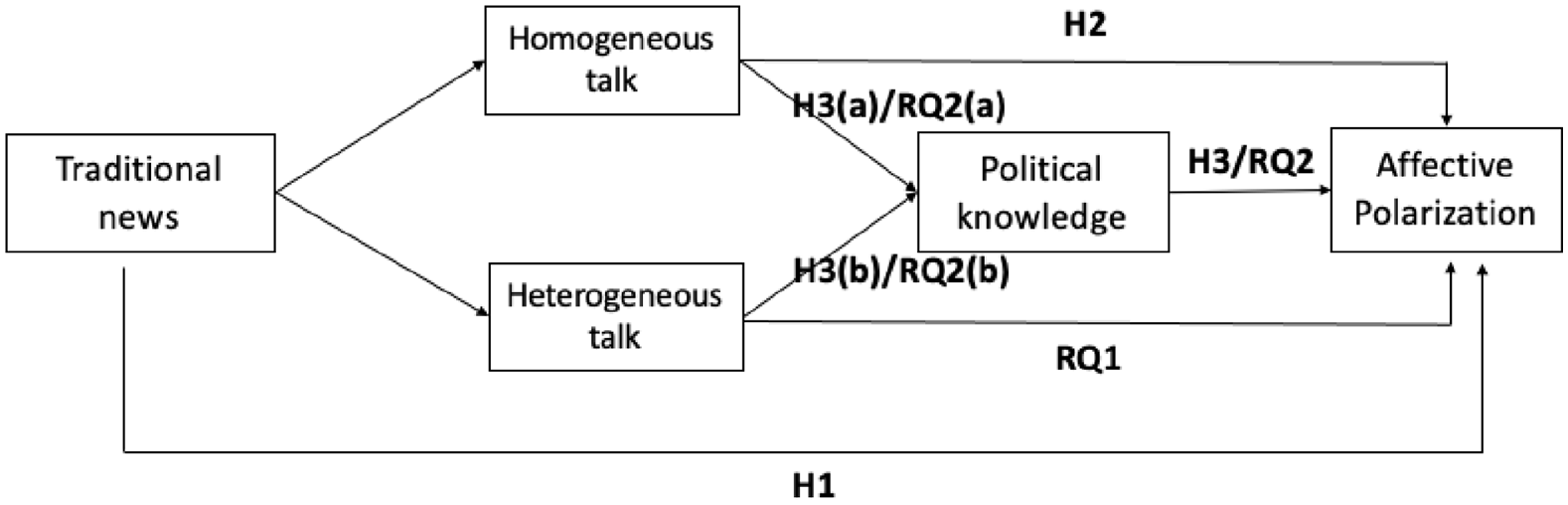
The hypothesized model: RQ3, which is not included in the model, asks the serial mediation between the news media use, political talk, political knowledge, and affective polarization.
Methods
To test our ideas, we used data collected in April 2016 using online survey panels administered by Survey Sampling International (SSI). The samples were designed to reflect the population of adults (age 18+) in Mexico and the United States. SSI uses a two-stage sampling process. First, subjects are randomly selected from each country’s online panel constructed along with geographic and demographic parameters. Next, subjects are presented with profiling questions to create a final sample that is balanced regarding certain demographics: age, gender, and education.
The US dataset was completed between 5 and 10 April 2016, and contains 514 complete responses; 10 responses were discarded due to excessive missing responses. The sample reflects well the US adult population in terms of gender (sample: 48% males; census 49% males), age (sample: 18–44 years old 46%, 45–64 years old 38%, and 65 and over 16%; census 18–44 years old 48%, 45–64 years old 35%, 65 and over 17%), educational level (sample: did not complete high school 10%, high school and/or some college 53%, college 37%; census: did not complete high school 11.6%, high school and/or some college 55.9%, completed college 32.5%), and race (sample: white 78%; census 77%).
The Mexican dataset was completed between 11 and 15 April 2016, and contains 511 complete responses; 17 responses were discarded due to excessive missing responses. The sample reflects well the Mexican adult population in terms of gender (sample: 47% males; census 49% males). In terms of age, our sample is slightly younger than the census (sample: 18–39 years old 56%, 40–59 years old 32%, and 60 and over 13%; census 18–39 years old 51%, 40–59 years old 33%, 60 and over 16%); in terms of race, our sample is less White than the census (sample: White 13%; census 17%); and in terms of educational level, our sample is significantly more educated than the census (sample: did not complete high school 2%, high school and/or some college 37%, completed college 61%; census: did not complete high school 44%, high school and/or some college 47%, completed college 9%).
Measures
Affective polarization, our core criterion variable, was measured following Almond and Verba’s (1963) conceptualization that partisan polarization is feelings that can be measured by a comparison of attributes between parties. We constructed this variable using four items that asked whether they would describe people who vote for a political party as “intelligent,” “ignorant and misguided,” “intolerant,” and interested in “the welfare of humanity” (1 = yes, 0 = no). Subsequently, survey respondents had to answer parallel questions for major political parties in their country—for Mexico, PRI, PAN, and MORENA; for the United States, Democratic Party and Republican Party. For each dimension of polarization, discrepancies among parties were coded as one, and lack of discrepancy (e.g. everyone is intelligent or no one is intelligent) was coded as zero. To illustrate, affective polarization in the United States was constructed by, first, separately adding up responses of each trait question for both Democratic and Republican Party supporters, and then converting zeros and twos, which indicate consistent attitudes toward both party supporters, to zeros, while ones, which show discrepant attitudes toward partisans, were kept as one. The same approach was used for Mexico but with three parties; for each trait, records with consistent answers (either 0 or 1) among the three parties were recoded as zero, and those with inconsistent answers to any party were retained as one. The resulting variable for each individual then ranged from zero (no discrepancies) to four (a discrepancy on every characteristic; the United States: M = 1.71, SD = 1.43; Mexico: M = 1.76, SD = 1.18). Other research using similar measures of polarization includes Garrett et al. (2014) and Gentzkow (2016).
News media use was measured by averaging the frequency of consuming the following news media on a scale of 0 to 5: national TV news, local TV news, national newspapers, and local newspapers (the United States: α = .78, M = 2.85, SD = 1.37; Mexico: α = .82, M = 3.01, SD = 1.30).
For homogeneous political talk, respondents assessed how often they commented on the news or talked about politics with people who have similar ideas to their own, on a 0 to 5 scale (the United States: M = 3.14, SD = 1.38; Mexico: M = 3.52, SD = 1.33). For heterogeneous political talk, respondents reported how often they commented on the news or talked about politics with people who have very different ideas from their own, on a 0 to 5 scale (the United States: M = 2.80, SD = 1.40; Mexico: M = 3.07, SD = 1.41).
To assess the level of political knowledge, respondents were asked to identify leaders from major political parties in each country. For example, the US respondents were asked to name three leaders from the Democratic and Republican Parties, and for Mexican respondents, they named two leaders from PRI, PAN, and MORENA. Correct answers were coded as 1 and incorrect answers as 0, and were summed to create an index of political knowledge, ranging from 0 to 6 (the United States: M = 3.10, SD = 2.45; Mexico: M = 3.11, SD = 2.03).
Demographics, including age (the United States: M = 45.94, SD = 16.07; Mexico: M = 40.00, SD = 14.62), gender (the United States: 48% males; Mexico: 47% males), education level (the United States: Mdn = incomplete college; Mexico: Mdn = complete college), and monthly household income (the United States: Mdn = between $2001 and $5000; Mexico: Mdn = between $5001 and $8000), were measured. Respondents also reported their level of interest in (a) local and (b) national politics, using a scale of 0 to 5 (the United States: α = .86, M = 2.89, SD = 1.54; Mexico: α = .93, M = 2.81, SD = 1.56). Partisanship was dichotomized, with 1 indicating supporting or leaning toward any particular political party and 0 indicating not affiliating with any party (the United States: M = 0.68, SD = 0.47; Mexico: M = 0.37, SD = 0.48). In addition, we added the frequency of social media news use as a control (a 5-point scale; the United States: M = 2.83, SD = 1.87; Mexico: M = 3.86, SD = 1.4) given the increasing hybrid nature of the media system as well as a potential association with affective polarization. Correlations of all study variables used in this study are available in Supplementary File.
Statistical analysis
To simultaneously examine the relationships among study variables across countries, we conducted multiple-group path analysis with the full sample of 1025 observations (the United States: N = 514; Mexico: N = 511) using an R package, lavaan. Overall, the dataset contained less than 1% of missing information, and we used robust maximum likelihood (MLR) to handle the non-normality of data. To test whether path coefficients differ significantly across countries, we used the global estimation by comparing two nested models (Kaplan, 2008; Molina et al., 2013): (a) a baseline model with no constraints across countries and (b) a second model with all paths constrained to be invariant across countries. A comparison of the nested models was followed using a chi-square test for nested models based on log likelihood values. It is noteworthy that this comparison informs the rejection of the null hypothesis that the paths as a whole are the same across the two countries. The significant p value in the comparison test indicates that the baseline (fully unconstrained) model and constrained model are significantly different, implying that some paths vary while others do not. Therefore, this global estimation is for the exploratory purpose of examining whether the coefficients as a whole would not vary by the country so that a pooled analysis of both countries would be more appropriate or not. Throughout the analyses, multiple goodness-of-fit indices were used to determine the overall model fit, with the following cutoff values: CFI (comparative fit index) above .95, RMSEA (root mean square error of approximation) lower than .05, and SRMR (standardized root mean square residual) of .08 or lower as indicative of good fit (Kaplan, 2008).
Results
The proposed multiple-group path model was first fitted, allowing the structural coefficients to vary across the countries. In the model, significantly correlated covariates (demographics, political interest, partisanship, and social media use) for each endogenous variable were added. This unconstrained model had a great fit to the data, as indicated by χ2(8) = 22.38, p < .001, CFI = .983, SRMR = .012, RMSEA = .060, and 90% confidence interval (CI) = [.031, .090]. The model was compared to a model with only the coefficients constrained to be equal across groups, which showed an adequate fit to the data, as χ2(41) = 84.95, p < .001, CFI = .947, SRMR = .033, RMSEA = .046, and 90% CI = [.032, .060]. According to the robust nested chi-square test, the constrained model significantly worsened the overall model fit compared to the fully unconstrained model, as suggested by Δχ2(33) = 62.68, p < .001. In other words, the result provides evidence that the coefficients of relationships vary by country; thus, we opted to vary the parameters for the hypothesis testing of two countries. Table 1 describes the findings of the path analysis for each country.
Path analysis predicting affective polarization in (a) the United States and (b) Mexico.
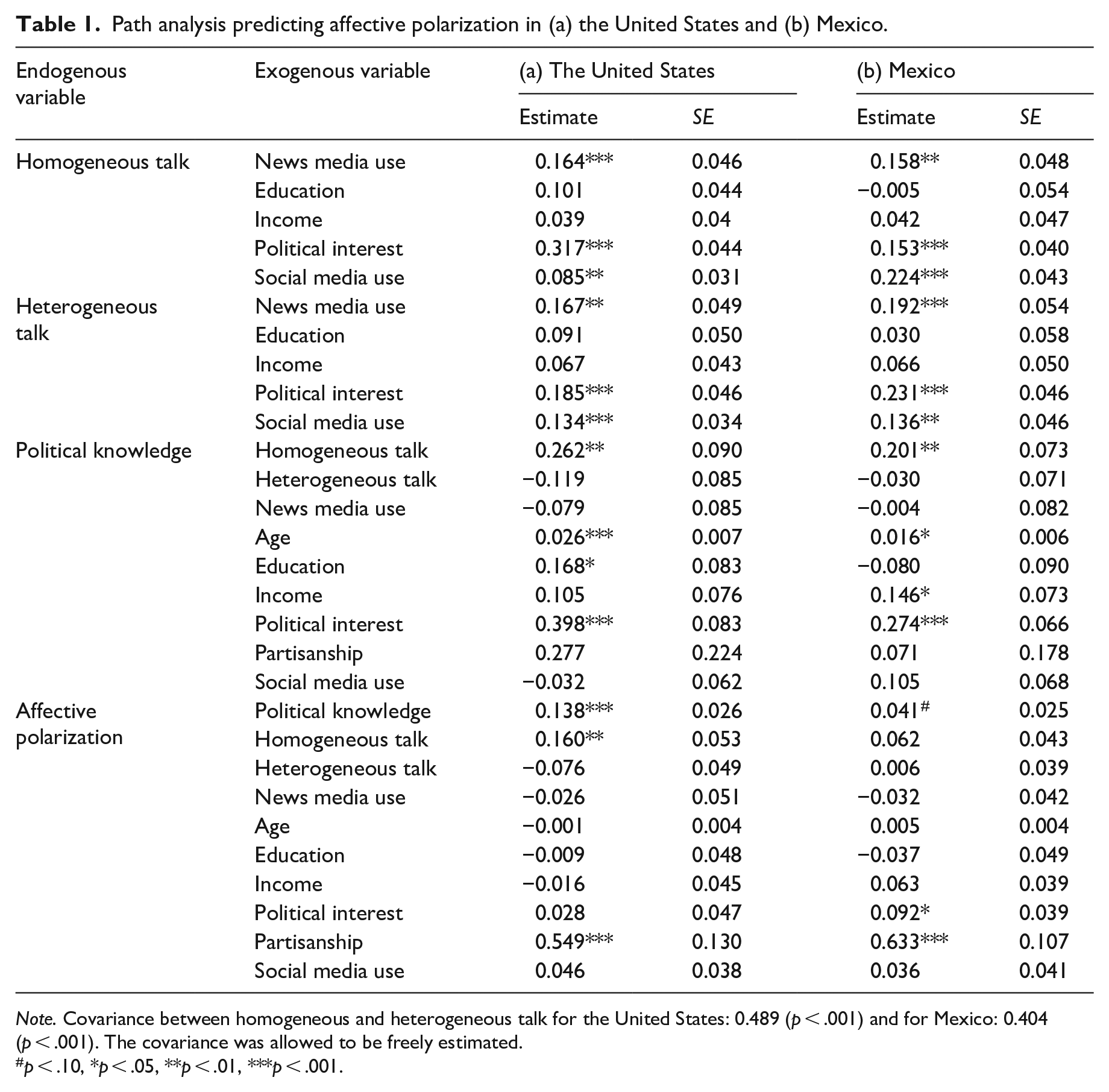
Note. Covariance between homogeneous and heterogeneous talk for the United States: 0.489 (p < .001) and for Mexico: 0.404 (p < .001). The covariance was allowed to be freely estimated.
p < .10, *p < .05, **p < .01, ***p < .001.
H1 suggested that news media use would be associated with affective polarization. According to our findings, while news media use was positively associated with more political talk, including homogeneous and heterogeneous talk, higher news use did not directly associate with affective polarization, consistent in both the United States and Mexico. H2 and RQ1 asked about the relationship between different types of political talk and affective polarization in both the United States and Mexico. For the United States, more engagement in homogeneous political talk had a direct association with a higher level of affective polarization, controlling for other covariates, but it was not the case in Mexico, thus supporting H2 only for the United States. Heterogeneous political talk had no direct association with affective polarization for both countries (RQ1).
H3 proposed the role of political knowledge as a mediator between political talk—(a) homogeneous and (b) heterogeneous talk—and affective polarization in the United States. Our findings show that homogeneous talk had a direct association with a greater level of political knowledge, and greater political knowledge was directly linked to an increased level of affective polarization in the United States. For the US sample, there was a significant indirect association between the homogeneous political talk and affective polarization, mediated through political knowledge (b = .035, p < .05), suggesting that when Americans engage in more political conversations with like-minded others, they are more likely to acquire political knowledge, which is ultimately associated with more polarized affect toward partisans. Furthermore, the coefficient for the effect of homogeneous talk on affective polarization decreased with the inclusion of political knowledge as a mediator (b = .160, p < .01; see Table 1), compared to without the inclusion of political knowledge (b = .196, p < .001). The Sobel test shows that the reduction in the coefficient is significant (t = .255, SE = .014, p < .05), confirming the significant mediation effect of political knowledge. For heterogeneous talk, it was not directly associated with political knowledge, and the mediation path between heterogeneous talk and affective polarization through political knowledge was not significant (b = –.017, p > .05). Taken together, this supports H3a but not H3b.
RQ2 asked the same relationship in the Mexican context. Consistent with the United States, our findings show that homogeneous talk was directly associated with political knowledge, but political knowledge did not directly associate with affective polarization (with only marginal significance). The indirect path between homogeneous political talk and affective polarization through political knowledge was not significant for Mexico (b = .010, p > .05). The indirect path for the heterogeneous talk was also not significant (b = –.001, p > .05).
RQ3 asked the serial mediation analysis between news use, political talk, political knowledge, and affective polarization. Our findings show that the United States exhibited a significant indirect path from media use to affective polarization through homogeneous political talk and political knowledge (b = .007, p < .05). In other words, Americans who consume news media more frequently tend to have more political conversations with like-minded others, which is linked to greater political knowledge acquisition and further higher affective polarization. For Mexico, this indirect path was not significant, b = .002, p > .05. A total effect on affective polarization, combining both direct and indirect effects, was significant for both countries (b = .889, p < .001, for the United States; b = .856, p < .001, for Mexico).
Discussion
Scholars have long posited that informed, knowledgeable citizens are critical for a democracy to function. As Delli Carpini and Keeter (1996: 3) put it, “factual knowledge about politics is a critical component of citizenship, one that is essential if citizens are to discern their real interests and take effective advantage of the civic opportunities afforded them.” While this view still holds as an important political principle, the current study shows that being more knowledgeable is associated with a larger discrepancy in the affect toward opposing political parties, at least in the US context. Factual knowledge provides citizens with accessible information to evaluate partisans, yet our findings suggest that such accessible information is possibly interpreted in a way that favors one’s partisanship while forming more extreme negative affect toward other parties.
In our study, the relationship between political knowledge and affective polarization is especially pronounced in the United States, compared to Mexico (where significance is marginal). Also, the notable indirect path from news media use to affective polarization, mediated through homogeneous political talk and political knowledge, was found among Americans. Having “safe” conversations with similar or like-minded others has been demonstrated to contribute to greater gaining in factual political knowledge (Eveland & Hively, 2009). If knowledge is positively related to homogeneous talk, even factual knowledge can carry contexts more aligned with one’s political views, making people more polarized (Stroud, 2011).
While our research generally suggests that knowledge as a mediator can also link to a greater discrepancy in partisan affect, this finding is absent in Mexico due to the weaker relationship between knowledge and affective polarization compared to the United States. Our observations provide evidence that political knowledge plays different roles across different systems. As in line with previous literature, the required political knowledge in a multiparty context to understand politics more accurately is higher (Vegetti et al., 2017). In particular, a more polarized political system makes it easier for citizens to sort out the characteristics of different parties. If the required knowledge is higher for individuals in a young multiparty system to accurately understand politics, US citizens, who are able to obtain relevant political information more easily, might be more prone to forming related emotions. As an emerging democracy with a relatively less stable and fragmented party system, political knowledge in Mexico does not operate as polarized as in the case of the United States and likely carry less established partisan cues. Our results further show that affective polarization in Mexico is positively related to the level of partisanship and, more interestingly, political interest, which is contrary to the case of the United States. This suggests that for Mexico, the level of political engagement is likely to be a significant contributor, rather than political knowledge. Future studies should examine how mass polarization and partisanship develop over time, resembling patterns in advanced democracies.
Our findings also reveal several consistent patterns both in the United States and Mexico, especially in the relationships among news media, political talk, and political knowledge, expanding the robustness of the relationship across different political contexts and media systems. First, media use was positively associated with both homogeneous and heterogeneous talk, suggesting the potential of news media to expand political discussion partners and stimulate civic motivations (Gil de Zúñiga et al., 2016). The findings further note that homogeneous political talk was positively linked to a higher level of political knowledge in both countries, indicating that it was supportive and encouraging networks with like-minded others that were more related to political learning. At the same time, heterogeneous political talk was not associated with political knowledge in both countries. This is consistent with prior evidence that discussions with non-like-minded others did not help increase factual knowledge, such as candidate issue stances (e.g. Eveland & Hively, 2009). Contrary to homogeneous political talk, lack of support in heterogeneous conversations likely provided less favorable conditions for knowledge acquisition. It is possible that counter-attitudinal political talk increased complexities of thinking and understanding of the other side (e.g. Mutz, 2006; Price et al., 2002), but our evidence corroborates that it is not related to factual political learning. We encourage future studies to seek to understand different dimensions of political learning that can be related to heterogeneous political talk that go beyond factual information.
In terms of the relationship between political talk and affective polarization, while both countries showed that heterogeneous political talk was not directly related to partisan hatred, we observed a significant association between homogeneous political talk and greater affective polarization, especially in the United States, consistent with the previous studies on attitude polarization. This finding is meaningful in that it shows that engagement in political conversations with those who are more like-minded and similar to oneself, indeed, predicts extremity in affect, beyond political attitudes. This has important implications for our understanding of the role of interpersonal communications in shaping polarized affect toward the parties in deliberative democracy. Passionate political conversations often carry argumentative, emotional posturing (Feldman & Price, 2008), and especially when talking with like-minded others, similar emotions can be shared. This is in line with a recent finding on valence-based homophily on Twitter (Himelboim et al., 2016), which suggests that individuals with different ideologies share similar valence (positive and negative), forming “affective echo chambers.” It is also notable that the link between like-minded political talk and affective polarization in Mexico was insignificant, only suggesting a positive direction. The weaker level of the partisan divide in Mexico, compared to the United States, likely conditioned the relationship of how homogeneous conversation networks be linked to the extremity in affect.
The study’s findings also show that media use did not have a direct effect on affective polarization across both countries. This is contrary to our expectation as well as prior evidence that the mainstream media’s emphasis on conflicts and social divides contributes to polarization (Levendusky & Malhotra, 2016). However, our study does not distinguish specific media use repertoires across outlet types and the political spectrum. Given the rise of partisan media in the United States and the divided media landscape in Mexico, perhaps what is more important than mere news media consumption would be which news media one consumes, as the selective exposure literature (Garrett et al., 2014; Stroud, 2011) suggests. Further research should investigate the direct influence of different types of media, such as partisan news media or digital media, on affective polarization as well as the mediated influence identified here.
Our work contains several limitations. First, the current study did not distinguish different types of political knowledge. We focused on factual political knowledge, but prior research has incorporated different dimensions of knowledge, such as structural knowledge (Eveland & Hively, 2009) or misinformed knowledge (Vosoughi et al., 2018). Future studies should explore beyond general political knowledge, testing whether people holding different dimensions of knowledge are also more prone to polarization. Second, our affective polarization variable is dichotomous, as each item was not asked on a scale. Although our measure provided a comparable way of constructing affective polarization in both two-party and multiparty contexts, this likely removed some variation of traits for each party group. Relatedly, we acknowledge that our trait measure is one way of measuring affective polarization, among others, including feeling thermometer ratings (e.g. Garrett et al., 2014). Future studies with both trait ratings and feeling thermometer measures should be conducted to better assess various aspects of polarization. Third, the cross-sectional nature of our study design does not allow us to establish causation among the study variables. Future research with panel data may be needed to address issues of endogeneity among variables. Fourth, we acknowledge that different political contexts in the two countries at the time of the survey likely played a role in our findings. To be specific, given the contentious presidential election in the United States in 2016, it is likely that the general political attention was more heightened among Americans than Mexicans, resulting in the difference in the paths to affective polarization in the two countries. We hope future studies expand the context, beyond the electoral settings, to document the generalized patterns of communication, knowledge, and affective polarization. Finally, our comparative context only examines two countries, the United States and Mexico, and it is clear that having only two countries to examine is a limitation. However, the comparison is still meaningful, given the contrast in political and media systems between the two countries and the fact that the Mexican media system does not fall squarely under Hallin and Mancini’s (2004) original media system classification. While the two countries are interesting comparison cases in terms of the media and political systems, extending the context to multiple countries to investigate the relationships among communication, knowledge, and polarization will be a fruitful avenue for future research for a fuller picture of the global political phenomenon.
In conclusion, using a comparative design, our study examined the underlying functioning of affective polarization in two countries with different political and media systems—the United States and Mexico. The study offers several important theoretical implications. First, adding to the growing line of research on affective polarization, we expand our observations to Mexico, one of the politically contentious countries in Latin America, demonstrating the prevalence of affective polarization beyond the United States and Western European countries. Second, we offer interesting insights into how knowledgeable citizenry can be linked to partisan hostility and democratic discord, in contrast to the traditional notion that political knowledge is a core principle for deliberative democracy. In a sense, finally, our study underscores the importance of comparative design in understanding the mass public and political phenomenon, contextualizing the relationships (Rojas & Valenzuela, 2019). While we demonstrated the consistent partisan discord in both countries, the more pronounced link between political knowledge and affective polarization in the United States suggests that similar political phenomenon can behave differently across nations with different political and social contexts.
Supplemental Material
sj-docx-1-ctp-10.1177_20570473211063237 – Supplemental material for The more you know, the less you like: A comparative study of how news and political conversation shape political knowledge and affective polarization
Supplemental material, sj-docx-1-ctp-10.1177_20570473211063237 for The more you know, the less you like: A comparative study of how news and political conversation shape political knowledge and affective polarization by Jiyoun Suk, David Coppini, Carlos Muñiz and Hernando Rojas in Communication and the Public
Footnotes
Author note
Jiyoun Suk is now affiliated to University of Connecticut, USA.

Supplemental material
Supplemental material for this article is available online.
Author biographies
References
Supplementary Material
Please find the following supplemental material available below.
For Open Access articles published under a Creative Commons License, all supplemental material carries the same license as the article it is associated with.
For non-Open Access articles published, all supplemental material carries a non-exclusive license, and permission requests for re-use of supplemental material or any part of supplemental material shall be sent directly to the copyright owner as specified in the copyright notice associated with the article.
