



Abstract
Reintegrating ex-offenders into society poses a significant global challenge, yet, it is fundamental to reducing recidivism. Nevertheless, there is research paucity exploring public perceptions and attitudes towards ex-offenders and their reintegration in Nigeria. This study makes an original contribution, drawing on a mixed-method approach underpinned by positivist and interpretivist epistemology to understand attitudes towards ex-offenders’ reintegration and whether there is a positive association between the level of education and the likelihood of accepting ex-offenders into society. In total, 1187 respondents completed survey questionnaires from states representing Nigeria’s main geopolitical zones affected by conflict. Quantitative data were analysed using descriptive statistics and Spearman’s rank correlation coefficient. The qualitative analysis involved a unique combination of social identity and boundary theories. The quantitative ambit reveals a correlation coefficient of r = .025, denoting a negative association between the level of education and reintegration. The qualitative analysis further finds a lack of confidence in ex-offenders’ genuine reintegration coupled with the perceived role of community trauma, which collectively fuels a negative social identity against the ex-offenders. Collectively, insight gained from the findings advances our knowledge on improving reintegration in countries affected through addressing trauma and stigma to encourage the successful reintegration of ex-offenders and avoid recidivism.
Introduction
Reintegrating ex-offenders into society is an issue of global concern, given its likelihood of increasing recidivism if unsuccessful and its enormous strain on the criminal justice system and society. For example, in the United Kingdom, the Ministry of Justice (2021) data suggest that adults released for less than 12 months of custodial sentence had a proven reoffending rate of 59.7%. Those released from 6 months or less sentences had a proven 62.0% reoffending rate (Ministry of Justice, 2021). In the United States, a similar trend is present. The US National Institute of Justice suggests that almost 44% of released offenders return to prison within a year (World Population Review, 2021). As reported by the Alaska Department of Corrections, two-thirds of those released are reincarcerated within 6 months in Alaska. Such statistics in the United States have a long trend, as seen in 2005, where within a 3-year period, 68% of 405,000 released prisoners were arrested for a new offence and 77% were arrested within 5 years (World Population Review, 2021). In Nigeria, the trend is not different, given its high recidivism rate, estimated at 52.4% (Abrifor et al., 2012). The rate sharply increased from 37.3% in 2005 (Soyombo, 2009). This is further compounded by the fact that Nigeria is experiencing prison overcrowding issues, with reoffending as a contributory factor. According to the Nigerian Correctional Service (2023) data, the country currently has an inmate population of 76,239, which surpasses its capacity of 50,083 (Mbah, 2021), thus denoting over 50% more inmates than it is designed to hold. This is coupled with the fact that Nigeria is Africa’s most populous black country with an estimated 200 million people which, according to the Global organised crime index (2021), has a criminality score of 7.15 out of 10, collectively making it an important case study to examine in terms of public attitude towards the reintegration of ex-offenders to avoid increased recidivism.
A growing body of literature attempts to proffer several arguments to partly explain the increasing rate of recidivism. This spans from harsh prison conditions (Igbo and Ugwuoke, 2003), to substance abuse (Chenube et al., 2011), employment discrimination (Ismail, 2022) and the limited emphasis accorded to communities in the reintegration process (Ike et al., 2021). Previous research on the reintegration of ex-offenders has also tended to focus on prisoners, ex-offenders and programmes designed to foster their reintegration (Salaam, 2013; Stephen and Dudafa, 2016; Uggen et al., 2006; Ugwueze et al., 2022; Visher and Travis, 2003). Such programmes include the evaluation of prison-based deradicalisation programmes (Barkindo and Bryans, 2016), context-specific operation safe corridor intervention for former terrorists (Felbab-Brown, 2018; Ugwueze et al., 2022), rehabilitating former terrorists (Horgan and Braddock, 2010), career placement and basic educational training of prisoners (Salaam, 2013), democratic and civic reintegration of offenders (Uggen et al., 2006), amnesty intervention to aid reintegration of former militants (Adebayo and Matsilele, 2019; Ike et al., 2022b) and inmates perception of prison rehabilitation programmes in Nigeria (Stephen and Dudafa, 2016).
Even when it focuses on the community, the emphasis seems directed at how the community perceives the reintegration of a specific group of ex-offenders based on the type of crime committed (Abrifor et al., 2012; Ike et al., 2021, 2022b; Hassan and Tyvoll, 2018). This strand of literature emphasises that a negative disposition towards the type of crime or groups the ex-offenders were once affiliated with (e.g. terrorism) could limit reintegration (Ike et al., 2022b; Owonikoko, 2022). For instance, Ike et al. (2022b) study suggests that the community resisted the reintegration of ex-Boko Haram offenders due to a negative disposition towards the Boko Haram group and the emphasis accorded to the former Boko Haram members with limited focus on the community. A limitation with differentiating crime committed as a basis for predicting reintegration is that the law and society frown against all crimes regardless of the type due to the social harm it could cause society.
Another strand of literature also tends to focus on issues such as stigma, discrimination and the indirect impact the label of being a prisoner or ex-offenders plays in serving as barriers to reintegration and growing recidivism (Ahmed, 2015; Moran, 2012; Schneider and Weber, 2020). Drawing on extensive research with women prisoners and former prisoners from the Russian federation, Moran (2012) argues that embodied experiences of release and reintegration, including prison time being ‘inscribed’ on the body, prove problematic for ex-offenders’ re-entry into society. Ahmed’s (2015) study further finds that criminal records and racial and social discrimination predict criminal recidivism.
While the preceding literature adds to our understanding of factors limiting ex-offenders’ reintegration into society, these are limited in that while crime types may lead to different attitudes towards reintegration, the fact remains that crime is frowned upon by the criminal justice system and punishment is meted out proportional to the crime regardless of the gravity. Thus, highlighting a significant gap in the literature on public attitude towards ex-offenders’ reintegration regardless of the crime committed. The gap also relates to whether there is a positive association between public education level and the likelihood of accepting ex-offenders into society. Previous literature on education and ex-offenders’ reintegration often focuses on the offenders themselves (Easton, 2022; Jengeleski, 1984; O’Reilly, 2014; Salaam, 2013). Even within the context of Nigeria, this remains a gap, as highlighted in Salaam’s (2013) study.
Against the preceding backdrop, this study contributes to the literature from two main perspectives delineating its originality and significance. The study’s originality lies in its adoption of empirical data underpinned by a mixed-method approach that draws on theoretical and methodological innovation to understand public attitudes towards reintegration. This is demonstrated in adopting social identity theory and boundary theory, including Spearman’s rank correlation coefficient, to understand perceptions and attitudes towards ex-offenders’ reintegration. The significance relates to the contribution to the literature in better-understanding barriers to reintegration as reoffending is a global problem regardless of geographical location or advancement of countries which, as denoted in the introductory part, remain a challenge to developed countries such as the United States, the United Kingdom and even developing countries such as Nigeria. In essence, our study’s significance lies in its ability to inform the improvement of policies aimed at reducing recidivism and encouraging prosocial reintegration. This is especially given the enormous budget allocated to the criminal justice system and the military at the expense of other sectors, such as education and health, due to growing crime, terrorism and insecurity in Nigeria (Ike et al., 2022a). For example, in Nigeria, under the administration of President Muhammadu Buhari, the defence budget for the military was estimated at N878.4 billion and N840.56 billion in 2020 and 2021, respectively (Ayitogo, 2021, as cited in Odalonu, 2022). The World Bank data also show Nigeria’s defence budget has risen by 262% in the past 5 years, from US$1.72 billion in 2017 to US$4.5 billion in 2021 (Babatunde-Lawal, 2022). The Nigerian Federal authorities also allocated 15% of their 2022 budget to defence (Tayo, 2022). This supersedes the combined budget allocations to health (7%) and education (5%) (Tayo, 2022).
It is against this backdrop that our study seeks to investigate:
What are public perceptions and attitudes towards the reintegration of ex-offenders in Nigeria?
Our study hypothesis is that:
There is a positive association between a higher level of education and favourable attitudes towards the reintegration of ex-offenders in Nigeria.
For this study, ex-offenders are defined to include those having completed custodial or non-custodial sentences regardless of the type of offences committed. It also includes those who might have engaged in terrorism, theft, burglary or other activities broadly defined by law as crimes and those who might have undergone programmes designed to change (e.g. deradicalisation programmes) and reintegrate them into society. The study commences with an engagement with the literature on attitudes towards reintegration and reintegration programmes in Nigeria. This is followed by a report on the study’s methodology, results, findings and discussion in light of the literature. The study concludes with recommendations.
Background
Crime is an issue of crucial concern. The fact that those convicted will, at some point, complete their sentence and ultimately need reintegration into society represents a crucial challenge in any criminal justice system. However, the focus has consistently been accorded the ex-offenders with limited emphasis on the community, the trauma suffered or the social context in which reintegration occurs. This is regardless of the crime committed, as studies have shown that there is a pattern of extensive focus on the ex-offender whether it relates to terrorism (Ike et al., 2022b; Owonikoko, 2022), militancy (Adebayo and Matsilele, 2019), theft or murder (Uggen et al., 2013). For instance, within the Nigerian context, Ike et al. (2021) systematic review highlights a perceived focus on ex-offenders, such as militants and terrorists, with limited emphasis on the community.
Even when previous research includes communities, it often tends to focus on their perceptions of reintegration programmes (Felbab-Brown, 2018) or specific group of ex-offenders (Ike et al., 2021; Owonikoko, 2022). For instance, Felbab-Brown’s (2018) study found that the community was sceptical about the genuine repentance of ex-Boko Haram members and their families. Felbab-Brown’s (2018) study also found, among others, that the community resent the support accorded to ex-Boko Haram members through job provisions and start-up funds with little focus on the community. Similarly, the study conducted by Adebayo and Matsilele (2019) relating to the reintegration of ex-militants in the Nigeria Niger Delta region found that community participants expressed a lack of confidence in the amnesty programme the moment monetary compensation was introduced to the ex-militants. The implication of over-emphasising the ex-offenders is that it risks undermining the social context in which reintegration occurs. Several studies have emphasised community importance by drawing on its ability to predict reoffending through assessing the neglected role of neighbourhood in recidivism (Kubrin and Stewarts). The effect of undermining the community’s attitude towards ex-offenders is that it could lead to an increased reoffending rate. As Clubb and Tapley (2018) argue concerning the importance of community in the reintegration process: The ability of former combatants to be accepted by family and the community is shaped by the community’s ideational relation to the state and to the radical sections of society (the ideational context) [. . .] which encompasses the relationship between the former combatant and the community they are re-integrated into (Clubb and Tapley, 2018: 5–6).
While this points to the integral role communities play in ensuring the successful reintegration of ex-offenders, little seems to be done to involve the community as part of the reintegration process or assess whether any association exist between community level of education and positive acceptance of ex-offenders into society. Several factors have been proffered to explain why this is the case. Osayi (2015), for example, argues that the global shift in prison management and penal philosophy plays a role. This is because it emphasises the need to assess why individuals engage in anti-social behaviour and treatment that could help the offender return to society as a ‘transformed productive person’. Osayi (2015) argues that such an approach poses a significant challenge in Nigerian prisons. Ugwuoke (2010) contends that in Nigeria, the prison system, while preaching rehabilitation and reformation, adopts a practice that runs contrary to what is being preached, given its retributive approach. Ugwuoke (2010) further argues that this is partly because the ex-offender punishment continues after discharge from prison due to public attitudes that brand, treat and stigmatise them as ‘ex-convicts’. These actions, including stigma collectively, serve as the greatest obstacle to the ex-offenders’ reintegration. The role of stigma arguably explains the country’s growing recidivism rate and the government programmes aimed at reintegration appear to downplay community stigma through much emphasis on ex-prisoners. For example, programmes such as Operation Safe Corridor have often tended to focus on the repentant Boko Haram members while also facing criticism due to being shrouded in secrecy and not made open to the community. Even the amnesty programme designed to encourage ex-militants’ reintegration has also suffered similar criticism of its being one-sided.
Concerning education, research on the positive association between the public level of education and their attitude towards ex-offender reintegration appears limited. Previous studies on the role of education often focus on its use as an intervention for prisoners and ex-offenders to enable them to gain vocational skills for an easy transition into society (Alvarez et al., 2018; Huaiquián-Billeke et al., 2021; Leone and Wruble, 2017). For example, Leone and Wruble’s (2017) study emphasises the use of prison education in maximising potential employment opportunities for ex-offenders and aiding successful community reintegration. Alvarez et al.’s (2018) study stresses the social reintegration of prisoners and ex-offenders through the dialogic reading of classic literature in prisons. In the Chilean context, Huaiquián-Billeke et al.’s (2021) study draws on the social reintegration process of young people after secondary education in custody. Even within the Nigerian context, similar trends exist. Previous literature in Nigeria has investigated education from its use in prison to aid potential tools for rehabilitation and reintegration (Adekanmbi and Ezikpe, 2021; Salaam, 2013). Salaam’s (2013) study also highlights the need to focus on basic educational training as a tool for rehabilitating and reintegrating ex-offenders in Nigeria. While this literature provides relevant insight into the role of education in reintegration from the ex-offenders’ and prisoners’ perspectives, it still leaves a gap on whether a higher level of education has a positive association with the successful reintegration of ex-offenders. This is especially considering the need to foster positive social identity, which, if undermined, could create the ‘us and them’ mentality, further exacerbating the divide and scepticism between the community and those reintegrated.
Social identity theory, boundary theory and ex-offenders’ reintegration
Tajfel and Turner’s (1985) social identity theory argues that people’s self-esteem and concepts are based on their membership in social groups. The group that people belong to, which may include families, communities, nationalities, religions and so on, forms an integral part of self-esteem, and social identities could affect people’s attitudes towards others not perceived to be in their group. As such, social identity creates an ingroup versus outgroup identity where those not perceived as part of the ingroup are viewed as outsiders. This is given that individuals in the ingroup possess strong emotional ties to its members, and it also confers a source of self-esteem.
As an extension of social identity theory, boundary theory could be further used to understand the symbolic and social boundaries made by social actors to create, maintain, contest or even dissolve institutionalised differences, including ingroup versus outgroup identity (Lamont and Molnár, 2002). Symbolic boundaries represent conceptual distinctions social actors make to categorise people, practices and objects. It allows for capturing dynamic dimensions of social relations as groups tend to compete in producing, diffusing and institutionalising alternative systems and principles of classification. Symbolic boundaries also lead to the separation of people into groups (e.g. law-abiding citizens vs ex-offenders) and could generate the feeling of similarity and group membership (Epstein, 1992). Social boundaries stress objectified forms of social differences manifested in unequal access to and unequal distribution of resources (nonmaterial and material) and social opportunities. They also unveil stable behavioural patterns of association as manifested in connubiality (Lamont and Molnár, 2002). A growing body of literature suggests that only when symbolic boundaries are commonly agreed upon can they translate to social boundaries in the form of an identifiable pattern of social exclusion or segregation (Logan 1996; Stinchcombe, 1995).
More specifically, social identity theory (SIT) links implicitly with symbolic boundaries, as it suggests that ‘the pressure to evaluate one’s group positively through in-group/out-group comparison lead social groups to attempt to differentiate themselves from each other’ (Tajfel and Turner, 1985: 16–17). Such a differentiation process aims ‘to maintain and achieve superiority over an out-group on some dimension’ (Tajfel and Turner, 1985: 16–17).
Social identity theory and boundary theory are particularly relevant to understanding community (public) perceptions and attitudes towards ex-offenders and their reintegration in that it helps provide a motivational explanation for perceived community in-built bias (Ike et al., 2021). SIT and Boundary theory also provide a strong foundation from which to analyse how people establish boundaries of group membership, the divisions between ‘us vs them’, collective identity and (de)valorisation of particular bodies and behaviours. Boundary theory could also aid in understanding public attitudes towards and perceptions towards ex-offenders’ reintegration by analysing ‘the lines that include and define some people, groups, and things while excluding others’ (Lamont et al., 2015: 850). Boundary theory, as an extension of social identity theory, would provide a framework for understanding how people participate in processes of social differentiation of groups, but also how those processes shape ‘their understanding of responsibilities towards such groups’ (Lamont and Molnár, 2002: 187). Such is partly because positive self-evaluation of a group is achieved by ensuring the group (Community) is shaped in a distinctive possible light from the perceived outgroup (ex-offenders). The process of shaping attitude is regulated by three cognitive processes: social categorisation, social identification and social comparison (Tajfel and Turner, 1979). Social categorisation involves categorising individuals into certain social groups to inform a definition of the group to which we and others belong. For instance, social categorisation partly explains the label ascribed to those that offend as ‘offenders or ex-offender’, ‘male or female’, ‘old and young’ and so on. The difference and similarities among groups are identified through social categorisation and inform the second stage, social identification.
Social identification entails the process in which an individual identifies as a group member (Tajfel and Turner, 1985). By socially identifying with a group, individuals are led to behave in ways that conform to how other group members ought to behave. Within the context of our study, social identification explains the prejudice, stigma and stereotype directed towards ex-offenders given the perceived non-conformation with the norms and behaviours expected of society. It also explains the ingroup and outgroup identity that appears to inform community attitude towards the ex-offenders’ reintegration through the process of social comparison. By social comparison, people tend to compare their group with other groups by drawing on social standing and prestige. To maintain self-esteem, the ingroup could arguably tend to portray themselves as having higher social standing and being more advantageous than the outgroup (Brewer and Brown, 1998). Social comparison partly explains community attitude towards what counts as acceptable behaviour and what conforms to the ingroup identity, especially related to the ex-offenders’ reintegration.
Methodology
The study adopted a mixed-method approach to data collection and analysis. The convergent parallel design was adopted and involved using quantitative and qualitative data with equal priority (Bryman, 2016). The findings from the analyses are then combined and compared to form an integrated whole. The purpose of adopting the convergent parallel design is to allow for triangulation exercises in which the researchers can compare the set of findings from both data collection methods while offsetting the weaknesses of both qualitative and quantitative research by dwelling on both strengths (Bregoli, 2013).
Given its mixed-method design, the study draws on positivism and interpretivism epistemology. Positivism argues that science can be conducted in ways that allow for a value-free approach to research (Bryman, 2016). It also stresses the importance of being able to test hypotheses using statistical theories. The rationale for adopting a mixed-method approach is to explore attitudes towards prisoners and ex-offenders using the quantitative approach while exploring perceptions concerning the transitional identity from being prisoners to ex-offenders and their reintegration in Nigeria. The qualitative ambit is important to provide depth, given the difficulty in subjecting participant perspectives to measurement (Bryman, 2016). Hence, adopting interpretivism epistemology aims to explore the socially constructed shared meanings ascribed to perceptions concerning ex-offenders reintegration.
Our study received ethical approval from the first author’s University. The study also adheres to the University’s ethical guidelines, including confidentiality, participant anonymity and the safe use of participants’ data. In terms of recruitment, participants were recruited using the JISC online survey. The JISC online survey (formerly Bristol Online Survey – BOS) is a tool designed for education and academic research. The JISC is secure and GDPR compliant, conforming to the General Data Protection Regulation. JISC online surveys are used by over 300 organisations in the United Kingdom and internationally. Participants were eligible for inclusion if there were 18 years of age, based in Nigeria, and could give informed consent by ticking the box acknowledging having read the study’s purpose and being happy to proceed. A total of 1187 respondents completed the survey, of which 598 identified as males and 588 as females, with only one indicating others as gender. The participants’ ages range from 18 to 60 years and over. The participants’ educational background was diverse, with 197 (16.6%) having attended primary school and 285 (24.1%) secondary. The other 437 respondents (36.9%) indicated having attended tertiary education (e.g. University), and 265 (22.4%) respondents decided not to indicate their level of education. Regarding occupation, 699 (59.4%) of respondents indicated being unemployed, while 477 (40.6%) indicated being employed. In terms of religious denomination, 545 (46%) indicated being Christians, while 565 (47.6%) indicated being Muslims and 73 (6.2%) of respondents indicated being traditional worshippers, with only 3 (0.3%) of respondents indicating others. The survey was also completed by respondents across Nigeria, including states such as Adamawa, Borno, Delta, Plateau, Anambra, Lagos and Edo.
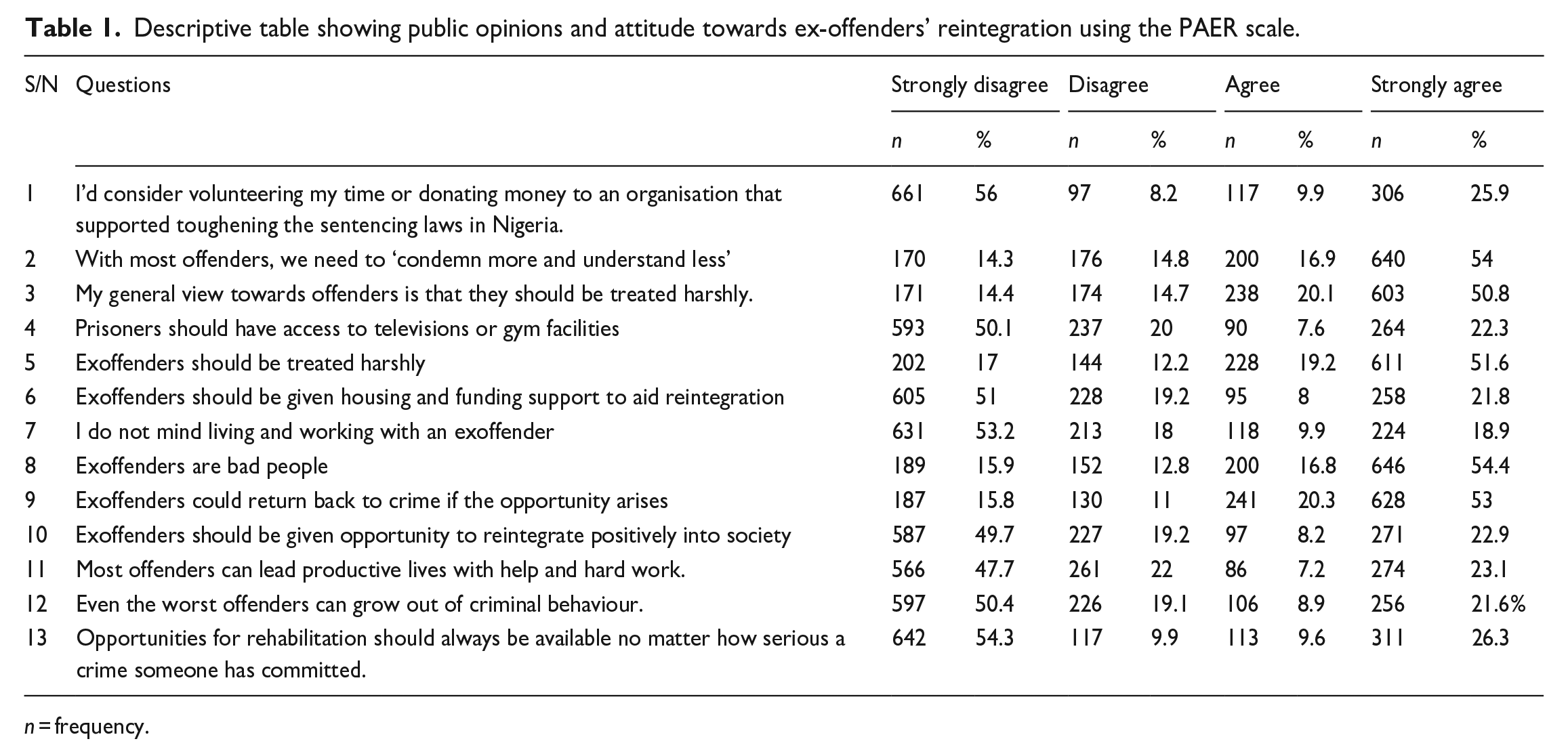
The Public Attitude towards Ex-offenders and their Reintegration (PAER) scale informed by the Melvin et al. (1985). Attitude towards prisoners scale was developed, tested and adopted for the quantitative data collection. The PAER scale is a 13-item and 4-point Likert-type scale rating with responses ranging from strongly disagree, disagree, agree and strongly agree to explore public attitude towards ex-offenders’ reintegration as it relates to punitive attitude and opportunity to reintegrate positively into society. It also explores their attitude towards living and working with ex-offenders. Some of the statements asked in the PAER include, Ex-offenders should be treated harshly, Ex-offenders should be given housing and funding support to aid reintegration, I do not mind living and working with an ex-offender, Ex-offenders are bad people, Ex-offenders could return to crime if the opportunity arises, Ex-offenders should be given the opportunity to reintegrate positively into society and Opportunities for rehabilitation should always be available no matter how serious a crime someone has committed (see Table 1 for the full survey). In addition to the scale, the survey also includes components for respondents to include qualitative comments to questions such as
Descriptive table showing public opinions and attitude towards ex-offenders’ reintegration using the PAER scale.
n = frequency.
What are your views concerning the reintegration of ex-offenders in Nigeria?, What are your views concerning government approaches aimed at encouraging the reintegration of exoffenders?, What are your views of the perceived effectiveness or otherwise of the approaches aimed at the reintegration of exoffenders? What are your thoughts concerning ways to improve the reintegration of ex-offenders?
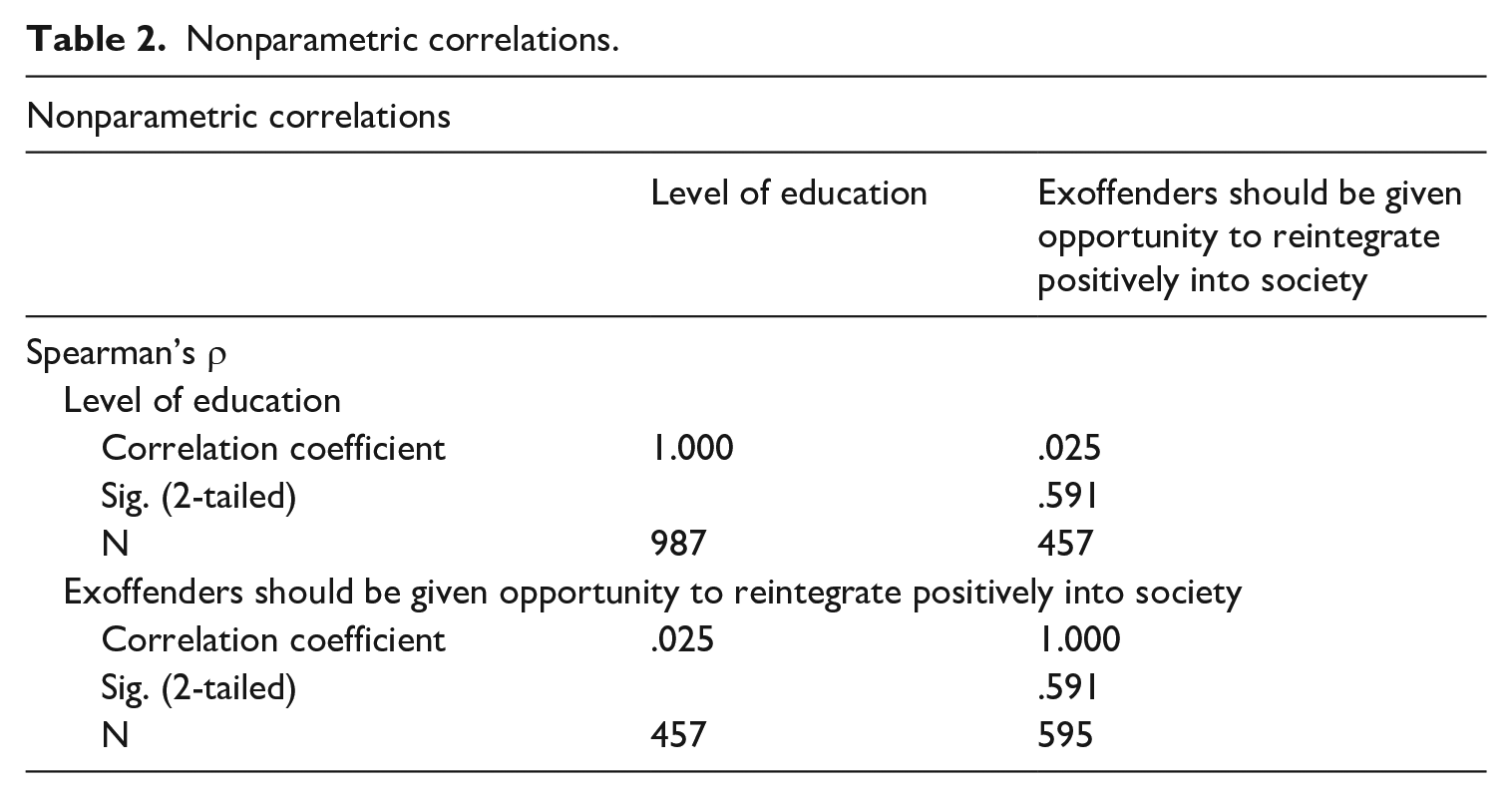
A total of 1188 respondents took part in the survey, with 1187 duly completed responses and one excluded due to no response entered by the respondent. The response from the PAER was analysed using descriptive statistics. Spearman’s rank correlation coefficient (Spearman’s p) (Table 2) was also used to analyse the measures of association that exist between variables (e.g. level of education and attitudes towards ex-offenders’ reintegration). It was also used to assess if there is an association between the variables and, if yes, then what the strength of such an association is. The rationale for using Spearman’s ρ is that it analyses nonparametric measures of association using two sets of ranked scores of two variables. It is appropriate for ordinal data as our scale is ordinal, given its Likert-type-style rating. Spearman’s ρ does not require that the two variables be linearly related and does not assume that the variables are measured on interval or ratio scales (Choi et al., 2010).
Nonparametric correlations.
Below is the formula we adopted to compute the associations using Spearman’s ρ.
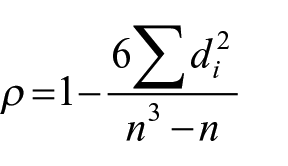
where di is the difference between each rank of corresponding values of X and Y, and n is the number of pairs of values, when tied ranks do not exist (Chen and Popovich, 2002; Kendall and Gibbons, 1990).
The survey indicates responses across Nigeria and states representing the main geopolitical zones affected by conflict. Thus, suggesting that the results from the data are cut across the country. The states included Delta (South-South), Lagos (South-West), Borno (North-East), Plateau (North-Central) and Anambra (South-East). These states were also peculiar for issues relating to crime and reoffending. For instance, Borno (Maiduguri) is peculiar for terrorism and issues relating to the reintegration of ex-Boko Haram terrorist members (Ike et al., 2022b). Plateau is well known for a series of ethno-religious crises between Christians and Muslims and increased prison statistics due to the conflict (Varin, 2016). Anambra is also known for agitation from The Indigenous People of Biafra (IPOB) – a separatist organisation in Nigeria (IBE, 2021). IPOB aims to achieve an independent state of Biafra in the Old Eastern Region of Nigeria, and in recent times, the state has experienced backlash and prison breaks due to the growing crime rate. Delta state is also peculiar for issues relating to militancy and resistance towards ex-offenders (Onuoha et al., 2021).
For the qualitative ambit, thematic analysis is underpinned by the unique fusion of social identity theory and boundary theory to analyse the qualitative data. The six-step process enunciated by Braun and Clarke (2013), which first involves familiarisation with the dataset, was adopted. In this stage, we engage in an in-depth immersion with the dataset contained in the survey questionnaire. During this stage, we also note down preliminary points. The second stage involves the generation of initial codes. We adopted coding that captures both the semantic and latent levels of meanings while staying close to the participants’ meanings. In the third stage, we engage in generating themes from the coded dataset. This is followed by the fourth stage involving a review of the themes in line with the coded dataset. The stage was important to ensure quality and to check the themes against collated extracts to explore and identify that the themes work closely with the data. In the fifth stage, all themes were defined and named by clearly stating what is specific and unique about the themes. In the sixth stage, a write-up of the themes in line with their link to existing literature was done. In summary, the following main themes emerged that are reported in the findings section: Lack of trust in the genuine repentance of ex-offenders, trauma and focus on ex-offenders as barriers to reintegration, and limited education on legal avenues of support.
Results
Based on descriptive statistics, a punitive attitude towards offenders appears prevalent in the quantitative dataset, as illustrated in Table 1.
Based on the analysed data, a negative attitude towards ex-offenders’ reintegration appears apparent. As illustrated in the table, 605 respondents making up 51%, strongly disagree with the statement that ex-offenders should be given housing and funding support to aid reintegration when compared with 258 making 21.8% that agreed to them being supported. The finding resonates with previous literature, which finds, among others, that community members resented the offering of support in the form of incentives and housing to ex-offenders, including former Boko haram terrorist members (Felbab-Brown, 2018; Ike et al., 2022a, 2022b; Owonikoko, 2022). A similar finding was also reported regarding former militants being offered amnesty and monetary incentives to return to society in Nigeria’s Niger Delta region (Adebayo and Matsilele, 2019). There was also a high level of lack of trust regarding the genuine reform of ex-offenders. As illustrated in the dataset, 628 respondents made up 53%, indicating that they strongly agreed that ex-offenders could return to crime if the opportunity arises, while only 187 respondents (15.8%) disagreed, suggesting their unlikelihood to return to crime. Again, the dataset resonates with previous literature, which highlights community scepticism behind ex-offenders’ genuine repentance (Ugwueze et al., 2022). Even when a more positive statement was utilised in the survey, we also found a similar result of negative attitude and lack of trust in their reform. For example, the statement ‘most offenders can lead productive lives with help and hard work’ highlight the result that 566 respondent (47.7%) strongly disagreed, while 274 (23.1%) strongly agreed that they could live productive lives. A possible explanation could be because of how crime is socially constructed as abhorrent to society and the negative label and stigma ascribed to an ex-offender.
Even when we controlled whether the level of education predicts a positive association towards attitude concerning the reintegration of ex-offenders into society, we found no positive association. This implies that regardless of the level of education, ex-offenders are construed from a negative perspective. Data from the qualitative ambit illustrate why this is; hence there is a need to address these issues to improve reintegration positively.
Based on the analysed data using Spearman’s rank correlation coefficient and interpreted using (Hinkle et al., 2003). Rule of thumb for interpreting the size of a correlation coefficient (r), we found r = .025, representing little, if any, correlation. In essence, the level of education appears to denote little association or correlation to public attitude towards the reintegration of ex-offenders into society by ensuring opportunity for such reintegration. The qualitative findings shed more light on why the result highlights such trends.
Findings: qualitative data
Theme 1: lack of trust in the genuine repentance of ex-offenders
As found in the quantitative data set, where 53% of respondents strongly and 20.3% agreed that ex-offenders could return to crime if the opportunity arises, a common theme in the qualitative dataset was the perceived lack of trust in ex-offenders’ genuine repentance. In further explaining the quantitative findings using the qualitative data, participants expressed distrust concerning the genuine reformation of the ex-offenders. As one participant commented: ‘I feel it is a terrible line of action. For the most part, we are not sure if these “ex” offenders are truly repentant’. (p5). Another male participant educated up to a tertiary degree from Delta State also noted that: Ex-offenders are unlikely to change, and I will tell the reason why. A saying goes that ‘a leopard cannot change its spot’. We, as a community, are law-abiding citizens that make sure we adhere to the law. However, the ex-offenders were once people who had been found legally guilty of committing a crime against society. Their unlikelihood to change is also coupled with our poor prison conditions, which rather than rehabilitating them, worsen them more. So, for me, especially being a victim of theft crimes and having suffered trauma; as a result, I do not believe in ex-offender repentance. I think they are pretending so the government will give them support in the form of amnesty or even stipends and jobs.
Here, the participant extract highlights a negative attitude towards ex-offenders drawing on symbolic boundaries and social boundaries that highlight an ‘us vs them’ stance. Being a law-abiding citizen creates a sense of social categorisation and labelling where those not fitting within this label are considered outgroup, as illustrated in the participant extract using terms such as ‘we, as a community, are law-abiding citizens’. Being law-abiding thus conjures positive social identity and categorisation, while terms such as the ‘ex-offenders were once people who have been found legally guilty for committing a crime against the society’ connote negative outgroup identity. The implication of such categorisation is that it could create a sense of stereotype and stigma towards ex-offenders’ reintegration regardless of whether they have completed their sentences (Ike et al., 2022b). Another important point is that the participant’s level of education does little to shape his thoughts and attitude towards ex-offender. A possible explanation that might have informed the participant’s perception could relate to his being a crime victim and his lack of trust in the criminal justice system. For instance, the participant’s reference to terms such as ‘poor prison conditions’ highlights a negative view concerning its ability to effectively reform ex-offenders. Similarly, another male participant from Plateau state, educated to the tertiary (university) level, expressed concern when he commented that ‘the correctional facility needs rehabilitation’. This finding appears congruent with previous studies that highlight the poor state of Nigerian prisons partly due to limited funding, overcrowding and poor prison experience (Osayi, 2015; Ugwuoke, 2010). The participants’ perceptions imply that it risks undermining the successful reintegration of ex-offenders into society.
Concerning reintegration, another female participant from Borno state, which is one of the states severely affected by terrorism, commented that: Regardless of the crime committed, I see all ex-offenders as the same because the law itself does not discriminate against crime. Once the law has been broken, punishment follows because that is the norm in our society! Having personally experienced the kidnapping of one of my parents and the trauma, I do not believe in the genuine reform of those ex-offenders.
Again, the sense of social boundaries, which impliedly highlights what is acceptable behaviour, resonates in the participant extract. Terms such as ‘that is the norm in our society’ highlight a collective social identity of a law-abiding ingroup society which contrasts against the outgroup perceived as those violating the law. The extract also seems to deviate from previous studies, which suggest that the type of crime committed (e.g. terrorism) will determine negative perceptions towards ex-offenders (Owonikoko, 2022). The participant’s extract denotes a negative attitude and stereotype towards ex-offender irrespective of the crime committed. The product of which might lead to stigma and reoffending. Another implication relates to the negative social identity which being an ex-offender conjures.
Theme 2: trauma and focus on ex-offenders as barriers to reintegration
A recurrent theme in the dataset was the perceived impact of trauma as a significant inhibitor to reintegration. Previous experiences of crime were often referred to when describing perceptions concerning ex-offenders’ reintegration. This was regardless of the participants’ level of education or gender. As one female participant from Delta State, while recounting her experience, commented: I think exoffenders need to be scrutinised really hard. I experienced the robbery of our property and how the robbers mercilessly injured my father with their guns. It will be very hard for me to accept such robbers once they have undergone their time in prison and now labelled an ex-offender. The reason is because the Nigerian criminal justice system appears not to have the requisite programme to aid ex-offender reintegration. In addition, the trauma from the offence still lingers in my memory and it feels as if it happens yesterday. In the absence of addressing trauma and good reintegration programme involving the community, I do not think I will want to accept ex-offenders back because I will always see them as threat and not trust them.
Here, the participant recounts her experience, which conjures negative and sad memories, given that injuries were inflicted on a close family member. This finding explains the quantitative data where 631 (53.2%) strongly disagree with living and working with an ex-offender while only 224 (18.9%) agreed. Even when the perceived ex-offender appears to have undergone a prison sentence for the crime committed, the participant appears not to consider such appropriate to justify reintegration. The extract thus draws on a punitive attitude towards ex-offenders such that completion of prison sentence does not appear to change the perception of their genuine repentance. As highlighted in the participant extract, a possible explanation is the State’s response to crime, which appears inadequate. The relinquishment of the victim’s identity to the state when the offenders are prosecuted in that once a crime is committed, it is perceived to be committed against the State does little to assuage the victim’s needs. In this sense, the dataset appears to suggest that the victim’s trauma left unaddressed could play a significant role in fuelling resentment towards ex-offenders. Such is especially when emphasis seems accorded the repentant ex-offenders with limited emphasis on the victims. The findings appear in line with those relating to perceptions concerning the reintegration of ex-Boko Haram members, where the extensive focus on the latter was perceived to further lead to community resistance towards their reintegration in Nigeria (Felbab-Brown, 2018). It also resonates with the views of other participants in the study who felt the Nigerian government’s approach to reintegration was one-sided. As one female participant who is a Muslim from Edo commented: The government approach seems to be one sided. For example, in the North a lot is being done for repentant Boko Haram who are provided with housing, money, jobs. But look at the victims, many of them are in Internally Displaced Person’s Camps. The victims lost their livelihood, identity and even loved ones. So, I think more needs to be done to help the victims and the community so we can have positive reintegration.
Again, the extract draws on the victims and community agonies as mobilising forces for resenting those who are ex-offenders and affiliated with Boko Haram. Positive reintegration is seen as one that considers the community’s needs, without which reintegration might be limited. The findings thus emphasise the importance of the social context in which reintegration takes place, as echoed by Clubb and Tapley (2018) within the context of former Boko Haram members. Our qualitative finding also explains the quantitative finding, which showed a strong negative attitude where 605 (51%) of respondents strongly disagreed while 228 (19.2%) disagreed that ex-offenders should be given housing and funding support to aid reintegration. The qualitative finding also explains why 611 (51.6%) respondents strongly agreed that ex-offenders should be treated harshly.
The emphasis on community role in reintegration is further emphasised by another male participant from Maiduguri who commented that: Ex-offenders are people who might have engage in crime in one form or the other. However, the crime committe[d] affected a victim and the larger community. For example, I have experienced a crime when I was working in a clothing shop . . . a woman can under the pretence of wanting to buy clothes and while I was bringing the clothes the woman stole my phone and other clothing items. In this situation, if such a woman is caught and then subsequently become an ex-offender it still has not erase the fear, anxiety and trauma I experienced. So if the criminal justice system takes a more victim focused approach to encouraging reintegration then that way I can overcome the fear and past negative memories. Reintegration can then be a positive experience for both the victim, the community and the ex-offender.
Here, the participant extract highlights a shared sense of community and social identity where the crime committed by an offender is perceived to extend beyond the immediate victim. The extract also highlights a sense of ‘us and them’ where addressing the victims and community needs are considered paramount instead of much emphasis on the offender. The study thus makes an important contribution concerning trauma, as previous studies tend to construe trauma from an individual perspective as opposed to a communal aspect (Lyon et al., 2021). The implication is that, in improving programmes aimed at reintegration, more needs to be done to address the victims’ and community’s needs in addition to addressing the ex-offender’s needs. As succinctly captured by another female participant from Delta State: To improve ex-offender reintegration, first of all the trauma the victim suffered needs to be addressed and based on my experience as a victim of crime, I believe the community and victims needs to be involved in the reintegration process. [. . .] This will also include the avoidance of the current top-down approach which appears to downplay victims and community role in the positive reintegration of ex-offender. Thus, a bottom-up victims/community informed approach that addresses trauma and heal the community is encouraged for positive reintegration of ex-offenders.
Another participant also added that: To improve the reintegration of ex-offenders, the government should engage communities and heal the pain, suffering and trauma they suffered from the crime committed. By such, it becomes easy to trust and accept ex-offenders back. The government should also provide jobs, security and accommodation for victims who are displaced as a result of crime and terrorism as we see here in Maiduguri and not just focus on enriching the ex-offenders.
The preceding extracts highlight the importance of the community in the reintegration process. It also reinforces a sense of collectivism and social identity where addressing the community’s needs has a ripple effect in creating a positive social identity. The finding appears to reinforce the need to create a balanced approach to reintegration where both the communities and victims are considered as opposed to too much ex-offenders emphasis, as highlighted in previous studies (Barkindo and Bryans, 2016).
Theme 3: limited education on legal avenues of support
A recurrent pattern in the dataset was the perceived sense that limited awareness of avenues for legal support and means of securely reporting ex-offenders in the event of perceived relapse limit their reintegration. As one female participant from Adamawa educated to tertiary level commented: To improve reintegration of ex-offenders we also need to be made aware of access to legal support and channels for redress in the event of the ex-offender relapse. That way one can trust ex-offenders reintegration in Nigeria.
On a slightly similar vein, another male participant from Anambra educated to secondary level commented that: In foreign countries in the west, they have databases you can request to check and verify whether a person is an ex-offender. If we are made aware of legal avenue, then that will instil confidence that once an ex-offender re-offends, we have where to go to confidentially to report while also having our legal rights protected.
The preceding extracts highlight a significant role of legal awareness in instilling confidence and trust in ex-offenders’ reintegration. Here, being made aware of legal platforms in the event of perceived relapse of ex-offenders is considered important in the reintegration process. A possible explanation that might inform the participants’ perception might be based on their location. For example, the second extract was from a participant from Anambra state – a state faced with a high level of crime, secessionist agitations and issues relating to ex-offenders’ reintegration. Such factors could impact their perception of ex-offenders and the need for awareness of available channels to bolster confidence in their reintegration further. The findings also represent an important contribution that differs from previous studies that highlight the extensive focus on ex-offenders as one of the limitations to reintegration (Felbab-Brown, 2018).
Discussion and conclusion
The study’s main aim was to explore community perceptions and attitudes towards the reintegration of ex-offenders in Nigeria and whether there is an association between the level of education and the positive reintegration of ex-offenders using a mixed-method approach. In the quantitative ambit, findings on whether there is a positive association between the level of education and ex-offenders’ reintegration found a poor association. We found a correlation coefficient of r = .025, denoting little if any correlation or association between level of education and attitude towards reintegration, including opportunities for ex-offenders’ reintegration. The descriptive findings of the dataset also indicated a highly negative perception of ex-offenders’ reintegration. The results indicate a perceived lack of trust towards the genuine repentance of ex-offenders. For example, data from the survey highlight that 628 (53%) of the respondents strongly agree that ex-offenders could return to crime if the opportunity occurs, while only 187 (15.8%) strongly disagree with their likelihood to return to crime. Our findings are congruent with previous literature, which stresses the stigma towards ex-offenders’ reintegration (Felbab-Brown, 2018; Ike et al., 2022b) and the public lack of trust in their reform (Owonikoko, 2022).
Findings from the qualitative ambit highlight three major themes, including lack of trust in the genuine repentance of ex-offenders, trauma and focus on ex-offenders as barriers to reintegration, and limited education on legal avenues of support. First, concerning lack of trust, the data highlight that it appears to stem from the symbolic and social boundaries of what constitutes right or wrong and ‘us vs them’ as constructed in everyday society. Terms such as the public being ‘law-abiding’ capture a dynamic separation of the public as the ‘good one’, while ex-offenders are perceived as the ‘bad other’ subject to de-valorisation and negative social identity. Our findings are interesting in that no distinction was made in terms of the crime committed. Thus, highlighting a shift in previous studies that emphasises that reintegration is influenced by the gravity of the type of crime (Kubrin and Stewart, 2006; Owonikoko, 2022). Our study also found that education level had no association with shaping the provision of support to encourage positive ex-offenders’ reintegration. However, our findings highlight factors such as poor prison conditions as a contributory factor to public lack of trust, and this is congruent with previous research that highlights poor conditions in Nigeria correctional facilities as significant impediments to reintegration (Ike et al., 2021; Osayi, 2015; Ugwuoke, 2010).
Second, another key finding was the significant role trauma plays in inhibiting reintegration and how it was socially construed as impacting beyond the victim to the community. Thus, it does not resonate with previous studies that stress the impact of trauma only at the individual level (Lyon et al., 2021). The criminal justice system’s approach, which appears to focus on the offender’s rehabilitation, also seems problematic, especially as it relates to the needs of the victims and communities’ trauma, which are perceived to be given less attention. The findings resonate with previous studies that highlight the extensive focus on ex-offenders with limited attention to the community (Adebayo and Matsilele, 2019; Felbab-Brown, 2018; Hassan and Tyvoll, 2018). The implication of our study’s findings is that regardless of the level of education, the perceived impact of trauma suffered by the victims highlights the contesting and reinforcing of a negative outgroup social identity towards exoffender’s and their positive reintegration. This appears to constitute a taken-for-granted role of the community and victims in reintegration (Ike et al., 2021). In essence, any policy that seeks to improve reintegration is encouraged to involve the community and address the trauma suffered. This is because the extensive focus on ex-offenders devoid of the victims’ needs appears to fuel resentment.
Our qualitative findings also explain why there was a high level of negative perceptions and attitudes towards ex-offenders’ reintegration, with 605 (52%) strongly disagreeing with the provision of housing and funding to support ex-offenders reintegration. A plausible explanation could partly relate to the respondents’ level of employment, where of the 1187 respondents, 59.4% (699) indicated being unemployed, while 40.6% (477) are employed. This figure seems congruent with the National Bureau of Statistics (2021), data which suggest in the Q4 of 2020, the unemployment rate was 33.3% which increased from 27.1% in Q2 of 2020. The implication of our findings is that providing jobs, stipends and accommodation to ex-offenders is often perceived as unfair if victims do not receive similar attention. Our findings resonate with previous studies relating to Boko Haram and former militants, where the community expressed scepticism behind the government’s provision of support to these categories of persons with limited emphasis on the community (Centre for Democracy and Development, 2017; Felbab-Brown, 2018; Ike et al., 2021). Such an uneven level of support is frowned upon and appears to create a negative social identity highlighting an ‘us vs them’ (see also Baron and Byrne, 2000) perspective where the ex-offenders are perceived from a negative lens and as one reaping from their wrongdoing while those who live by the law are given less attention.
Third, our study also highlights limited education on legal avenues of support as factors inhibiting trust in ex-offenders’ reintegration. This finding appears contrary to previous studies, which often emphasise focus on ex-offenders as a major barrier to reintegration (Felbab-Brown, 2018). Legal awareness of avenues for reporting ex-offenders in the event of a perceived breach was considered useful to instil public confidence in their reintegration. Such usefulness was further emphasised while comparing Nigeria with other Western countries perceived to have a database of ex-offenders’ that could be easily verifiable. As such, programmes aimed at reintegration are also encouraged to include legal awareness for the community to improve confidence in the reintegration process.
Collectively, the study highlights the significance of understanding community perceptions and attitudes towards ex-offenders as important factors in encouraging positive reintegration. Social identity is presumed to constitute an essential aspect of reintegration due to the ‘us and them’ identity, which, if not adequately addressed, could lead to stigma and stereotypes for the ex-offender – the product of which might impact reoffending. In essence, it is encouraged to build trust in the institutional setting, such as the prisons that carry out punishment and reintegration to improve reintegration. This way, the communities may have genuine confidence in ex-offenders’ reformation. Another recommendation relates to the need to address the trauma suffered by the victims and communities as emphasis seems to focus on the ex-offenders’ reintegration in the form of provision of jobs, accommodation and other levels of support. While these supports are important for the successful reintegration of the ex-offenders, adopting a balanced approach that also takes on board the community’s needs could help improve positive social identity and reintegration.
Our study acknowledges some limitations, including not assessing variables such as age and its impact on reintegration. It did not also adopt an experimental design. As such, it can only highlight association and cannot infer causality as it only explores perceptions and attitudes towards ex-offenders’ reintegration. In essence, future studies could adopt experimental designs to check if a community-informed intervention could help improve the positive reintegration of ex-offenders in Nigeria.
Despite these few shortfalls, our study makes an original contribution to the growing body of literature on community perspectives and attitudes towards the ex-offenders’ reintegration in Nigeria from the following main perspectives delineating its originality and rigour. Our study’s originality is delineated in its empirical approach to exploring perceptions and attitudes towards ex-offenders reintegration using a hybrid combination of social identity theory and boundaries theory in deeper insight into understanding perceptions towards ex-offender reintegration. The study’s findings are also significant and relevant in contributing to extending existing literature and informing government agencies’ approach to reintegration as it highlights the importance of social identity and community in the design of successful reintegration programmes. It also highlights the need to address trauma at both individual and community levels to aid ex-offenders’ reintegration. Finally, our study’s adoption of a mixed-method approach using descriptive and Spearman’s rank correlation for the quantitative data and thematic analysis from social identity and boundary theoretical lens demonstrates its methodological rigour in highlighting the significant impact of community trauma and lack of confidence in ex-offenders’ genuine repentance as factors likely to limit positive social reintegration. Against these backdrops, the study advocates the need for trauma-informed interpersonal group therapy that is community-focused and designed to change the negative stereotype against those perceived as ex-offenders to aid successful reintegration.
Footnotes
Declaration of Conflicting Interests
The author(s) declared no potential conflicts of interest with respect to the research, authorship and/or publication of this article.
Funding
The author(s) received no financial support for the research, authorship and/or publication of this article.
