




Abstract
Terrorism and insecurity pose significant global concern and Nigeria has been bedevilled by Boko Haram – a terrorist group deemed one of the deadliest terrorist groups in the world. While the Nigerian government have adopted concerted counterterrorism approaches to tackle terrorism, very limited success seems to have been achieved and the synthesis of community perspectives of government interventions appears lacking. This study makes an original and significant contribution by adopting a systematic review approach to synthesise existing studies on community perspective on the drivers of involvement in terrorism and on Nigerian government’s responses. Six databases were searched, and 21 studies met the review criteria. Informed by thematic analysis principles and the conceptual framework of synthesis, the study finds a sense of disconnect between the government approach to counterterrorism and community perspectives. The study recommends a context-specific community informed response to insecurity towards improving existing counterterrorism measures.
Introduction
Over the last decade, Nigeria has experienced high level of insecurity and terrorism from Boko Haram. The Institute for Economics and Peace (IEP) Global Terrorism Index (IEP, 2020) report ranks Boko Haram among the three deadliest terrorist groups in the world (IEP, 2020). The IEP (2022) report also suggests that in Nigeria, terrorist attacks increased by 49% between the period of 2020 and 2021. According to the United Nations High Commissioner for Refugees (UNHCR, 2020), the terrorist attacks of Boko Haram have also been instrumental to the displacement of approximately 2.4 million people in the Lake Chad Basin, while over 2 million people are internally displaced in Nigeria because of the conflict. Central to these concerns are the country’s economic loss and increased budget accrued to the security forces, with little evidence suggesting its effectiveness at quelling the conflict.
The Nigerian government has commissioned several military counterinsurgency operations with different code names, including Operation Last Hold, Operation Lafiya Dole, Operation Zaman Lafiya, Operation Boyona and Operation Restore Order (Omeni, 2017). In addition to these operations, the Multinational Joint Task Force by neighbouring countries in the Lake Chad region and the voluntary Civilian Joint Task Force (CJTF) in Nigeria alongside the Vigilante Groups are also instrumental in augmenting the military counterinsurgency efforts (Onuoha et al., 2020). However, the concerted effort’s efficacy remains questionable despite claims by the Nigerian government under President Muhammadu Buhari to have ‘technically’ defeated Boko Haram (Clubb and Tapley, 2018).
The increasing military spending to combat Boko Haram highlights a significant concern. For instance, between 2009 and 2018, Nigeria’s total military spending accrued to US$1.9 billion (Onuoha et al., 2020: 7). The amount far surpasses the expenditure of neighbouring countries, including Niger, Cameroon and Chad, making Nigeria, the largest financier of the counterinsurgency war against Boko Haram (Onuoha et al., 2020). Existing statistics also suggest that between 2014 and 2018, Nigeria spent approximately US$3.9 billion to procure arms (Oriola, 2018). Ukpong (2017) argues that over US$2 billion of the said amount was allegedly embezzled by some politicians in the Dasukigate inquiry for corruption.
Despite Nigeria’s increase of the military budget in the fight against Boko Haram, Onuoha et al. (2020) argue that there seems to be a disconnection between this increased military funding and the effectiveness of the government’s counterinsurgency efforts in Nigeria. Bappah (2016) further contends that in the last decade, the military has seen an exponential increase in its funding to combat Boko Haram; however, the security agencies’ effectiveness, including public confidence in the military, has continued to see a decline. Onuoha et al. (2020) also argue that institutional corruption issues partly explain the shortcomings of the Nigerian military. Omeni (2017) contends that corruption plays a limited role in explaining the limitations of the military; rather, institutional isomorphism and practices adopted from its British colonialist could partly explain why they engage in the type of military counterinsurgency they adopt.
Notwithstanding, existing studies tend to focus on the military counterinsurgency issues with little emphasis accorded to community perspectives of the intervention. Previous literature has also shown that minimal attention is accorded to community members in counterinsurgency or even reintegration of repentant terrorists (Felbab-Brown, 2018; Ike et al., 2021, 2022). Such limited attention implies that it tends to downplay the communities’ role in support of counterinsurgency in the form of information sharing, trust and confidence in the security agencies.
In addition, how states respond to crimes such as terrorism will determine support or resistance towards such efforts. Several approaches have been adopted to combat crime within the criminal justice system, including the police, public prosecutors, the courts and prisons (Ajah et al., 2022). In a complex scenario, the security forces, including the army, could be deployed to combat crime and terrorism, as seen in the case of Nigeria (Thurston, 2017). In criminology, several pieces of work have argued that the public perceptions of the criminal justice system could determine whether it improves or hinders confidence in such agencies (Bottoms and Tankebe, 2012; Hough and Roberts, 2005). For example, the police represent an avenue often subjected to public scrutiny globally. In the United States, indiscriminate use of force in conducting arrests against black and minority ethnic groups has been instrumental to the widespread dissatisfaction against the police and the emergence of movements such as the #Black Lives Matter (Phelps et al., 2021). In the United Kingdom, the disproportionate use of stop and search where a person of colour is more likely to be stopped and searched than their white counterpart has led to scepticism and limited confidence in the police (Minhas and Walsh, 2021). In Nigeria, the police, as a source of crime reduction and countering violent extremism alongside other security agencies, have also been faced with public criticism on the grounds of torture, arbitrary arrest, corruption, and lack of accountability. Incidents such as the #End SARS protest of 2020 (Ike et al., 2021) and the confrontation between the police and Muhammad Yusuf, the demised leader of Boko Haram (Varin, 2016), highlight moments where police practice triggers resentment towards the police, thus underscoring the importance of community perspectives on government approach to counterterrorism.
Against the preceding backdrop, this study makes an original contribution by synthesising community perspectives on the motivations for involvement in terrorism and the government counterterrorism interventions in Nigeria. The study is important and significant for informing existing policies on improving counterterrorism strategies to achieve optimal success. The adoption of a rigorous systematic review approach allows for a less biased synthesis of existing studies informing findings that are useful for improving the deteriorating security situation in Nigeria. The rationale for focusing on Nigeria is that the counterterrorism strategies are often context-specific. For instance, what motivates drivers of terrorism in countries like the United Kingdom might be significantly different from those in Nigeria. In light of this, scholars such as Sarah Marsden (2016) have argued on the need for intervention to be context-specific to achieve the desired aims.
The study commenced with a background overview of Boko Haram and the conflict. This is followed by an in-depth analysis of the Nigerian government’s counterterrorism strategies to combat the terrorist threat. Intervention within this review context is defined as any approach, including military, sensitisation, law enforcement and non-military approach used to combat Boko Haram. The study also reports the methods adopted to conduct the systematic literature search. A detailed report of the review’s findings is presented alongside a discussion of the implications for relevant research and policy.
Background
Terrorism is an issue of major concern, and in the wake of the 9/11 attack in the United States, there has been a renewed vigour to addressing terrorism and state response to terrorists. Countries such as the United Kingdom have adopted several counterterrorism strategies, including CONTEST, while Nigeria has promulgated laws, including the Terrorism (Prevention) (Amendment) Act 2013, to curb terrorism. Despite these measures aimed at tackling terrorism, it is a well-established fact that there seems to be a lack of agreed definition of what is meant by ‘terrorism’ (Crenshaw, 1992; Richards, 2014). Some of the notable explanations allude to the fact that one-man ‘terrorist’ is another man’s ‘freedom fighter’. While the definition of terrorism is beyond the scope of this review, for the systematic review, it suffices to adopt the definition by the United State US Joint Publications Department of Defense (US Joint Publication 3-26, 2016: 241): ‘[terrorism is] the unlawful use of violence or threat of violence, often motivated by religious, political, or other ideological beliefs, to instil fear and coerce governments or societies in pursuit of goals that are usually political’. The definition is instrumental as it covers important features peculiar to the Nigerian context, namely the use of unlawful forces for political or religious purposes (US Joint Publication 3-26, 2016).
Nigeria’s experience of terrorism over the last decade has spurred significant concerns. Existing systematic reviews tend to be dominated by Western studies. Although the review conducted by Grip and Kotajoki (2019) attempted to include two studies from Nigeria, their review focuses on disengagement, rehabilitation and reintegration of violent extremists. Their review also fails to explore or synthesise the Nigerian community’s perspective on the interventions/approaches adopted to combat terrorism. This is a significant gap concerning the Nigerian context. While there exists limited research in this context, most studies tend to be qualitative. Schuurman’s (2020) review of 2552 articles between 2007 and 2016 found that qualitative studies tend to dominate research on terrorism. According to Schuurman’s (2020) review, 78.1% of the articles studied were devoid of any statistical analysis, and only two studies (that amounted to 0.08% of the sampled articles) adopt methodologies aimed at clinical assessment (Schuurman, 2020). Informed by an initial scoping exercise conducted before the present systematic review, a similar trend seems apparent within the Nigerian context. The studies identified tend to be qualitative, and there seem to be limited quantitative studies or even experimental studies assessing the effectiveness of the Nigerian counterterrorism approach, hence the rationale for more qualitative studies being included in the review. Our study thus aims to adopt a systematic review approach to address the research question: What are community perspectives of the drivers of involvement in terrorism and of the counterterrorism interventions adopted to address Boko Haram terrorism in Nigeria? It is important to describe how insecurity is construed within this review. Insecurity refers to the state of being open to threat, danger, lack of protection or being exposed to attack from crimes such as terrorism and the fear of recruitment into terrorism.
Boko Haram: An overview
Conflict is not a new phenomenon in Nigeria. Spanning from the Civil War to the Maitatsine movement of the 1980s and the Niger Delta militants, insecurity and dissent issues have often faced the Nigerian polity. However, none of these conflicts has raised significant concerns, as the Boko Haram insurgency. Boko Haram’s official name is Jama’tu Ahlis Sunna Lidda’awati wal-Jihad which translates to ‘People propagated to the prophet teaching and jihad’ (Ike, 2018). Originally formed by Mohammed Yusuf, Boko Haram advocates a Salafist-jihadist ideology that seeks to abolish Western influences and Islamicise Nigeria by establishing an Islamic caliphate. Maher (2016) argues that Salafism is a philosophical standpoint that seeks to return Islam to those practised by its pious predecessors. While Salafism advocates Islam’s purity, it is worth acknowledging that not all Salafists resort to violence as a means of achieving their goals. It is against such a backdrop that Maher (2016) argues on the need to highlight the characteristics and typologies of Salafist-jihadist, which include Hakimmiya, Albara alwara (friends and foes), tawhid, jihad and rissalah (belief in the Prophet). Wiktorowicz (2006) further contends that jihad forms the typologies of Salafists. While the typologies are beyond the scope of this article, it suffices to add that Hakimmiya (seeking political sovereignty for Allah), tawhid (oneness of Allah) and jihad all highlight some of the major characteristics which define Boko Haram ideologies and the use of jihad against Nigeria.
A plethora of arguments have been put forth to explain the drivers of Boko Haram’s involvement in terrorism. It spans from the religious fundamentalism debate to relative deprivation and perceived harsh use of force by the security agencies. Concerning Boko Haram’s link to religious fundamentalism, Adesoji (2011) argues that Nigerians are highly sensitive to religion, and apart from religion being seen as the lifeblood of the Nigerian people, it often constitutes the basis for justifying mundane and politically motivated situations. Adesoji (2011) further adds that Boko Haram advocates and embraces the propagation and strict adherence to Islam by everyone regardless of whether they want to adopt it as their religion. Bumah and Adelakun (2009) further contend that the religious motivation of Boko Haram explains the group’s quest to impose Sharia across all states in Nigeria.
Agbiboa (2015) and Adesoji (2011) argue that relative deprivation issues also play a role in informing Boko Haram’s emergence and even those involved in the terrorist movement. Elegbe contends that ‘unemployment is higher in the north than in the south. Mix this situation with radical Islam, which promises a better life for martyrs, and you can understand the growing violence in the north’ (cited in Agbiboa, 2013: 52). Onuoha (2014), drawing from empirical data on why youths join Boko Haram, finds that widespread unemployment and poverty are instrumental to northern vulnerability towards radicalisation. Such findings are further corroborated with the data from the National Bureau of Statistics (NBS, 2019) report, which noted that not only over 100 million Nigerians lived in absolute poverty in 2011, while a further 12.6 million were classed as ‘moderately poor’ but also that Nigeria’s northern region is worse hit by poverty than the southern region (NBS, 2013; see also NBS, 2019). The population worse hit by the high poverty rate were young people, mainly from Nigeria’s northern region (Onuoha, 2014).
Boko Haram has caused havoc in Nigeria, ranging from kidnapping to suicide bombing and even human trafficking. For instance, the IEP ‘Global Terrorism Index’ report (IEP, 2019) suggests that in 2019 alone, Boko Haram was responsible for the death of 2040 persons, which accounts for 13% of the deaths from terrorism globally. However, it is worth noting that the group initially was not predisposed toward the use of violence. The transformation of Boko Haram from a radical preaching group to one that evokes terrorism as a tactic seems informed by how the security agencies, including the police and the army, handled the violent uprising (Ike et al., 2021).
Nigeria’s counterterrorism response
Historically, the stick and carrot approach characterises the Nigerian government’s responses to insecurity and dissent. Conflict such as the Civil War, the Maitatsine movement of the 1980s and the Niger Delta militants highlight situations where repression was seen as the optimal response to dissent. Before the demise of Mohammed Yusuf, the leader of Boko Haram, the security forces (including the police) response to the initial conflict was criticised. The criticism spanned from the conflict’s poor handling to the arbitrary use of force (Varin, 2016). The subsequent crackdown in 2009, which eventually led to Muhammad Yusuf’s demise, exacerbated the situation and changed the conflict’s dynamism. Yusuf was used as a mobilising force and martyr to highlight long-standing brutality from the security forces.
Despite support from the international community, including the United States, the Nigerian military experience minimal success in entirely eradicating the terrorist threat. For instance, the United States alone donates US$3 million annually to Nigeria as security assistance in addition to other logistical and technical support (LeVan, 2013). There is no doubt that recent years have also seen the country’s increased security budget, which seems not to reflect the military’s ability to counterterrorism effectively. The military counterinsurgency in Nigeria has been subject to various criticism. Onuoha et al. (2020) argue that the criticism spans three main perspectives: the political, the strategic and the tactical. At the political level, Onuoha et al. (2020) and the International Crisis Group (2016) contend that lawmakers extort money from commanders and service chiefs under the auspices or pretext of approving their budgetary allocation. At the strategic level encompassing military leadership and oversight, the procurement of relevant weapons and ammunition has been criticised because it is shrouded in secrecy (International Crisis Group, 2016). Onuoha et al. (2020) further argue that the military-led counterinsurgency is undermined by political leaders’ failure, compromised legislative oversight, obsolete equipment and inadequate arms, the poor welfare system and sabotage and misuse of budgetary allocation. Another issue that further compounds the communities’ perceived limitations of the military to combat Boko Haram effectively is human rights abuses (Amnesty International, 2014; Human Rights Watch, 2012).
While concerted efforts have been made at deploying the security forces, successive government administrations have also engaged in dialogue and negotiation, which seems to have limited success. For instance, the administration of President Jonathan has engaged in negotiations to curtail the conflict. In 2012, the Jonathan government attempted to broker a deal with Boko Haram through Datti Ahmad, the then President of the National Supreme Council on Sharia, to no avail. Similarly, on 2 May 2014, President Goodluck Jonathan announced that his administration made concerted efforts to rescue the kidnapped Chibok girls (Osasumwen et al., 2017). However, the assurance uttered by Jonathan was countered by a video released on 12 May 2014 by Boko Haram in which Abubakar Shekau was shown in the midst of over 130 of the girls, demanding a prisoner exchange (Osasumwen et al., 2017). Even in the current administration under Muhammadu Buhari, efforts at negotiation have seen the release of the Kidnap Dapchi girls and even a series of kidnappings in early 2021, including the hundreds of girls abducted from Government Girls Secondary School, a boarding school in Jangebe in Zamfara state in March 2021 (Alfa and Ives, 2021).
While negotiation seems to achieve a quick fix to issues such as kidnapping, Kaplan (1983) argues that states should not concede to negotiating with the terrorists as it rewards terrorism as a tactic. However, this argument has been criticised both from tactical and strategic perspectives. At the tactical level, the plight of hostages and the government’s duty to protect them is the ultimate goal (Richards, 2015). In contrast, at the strategic level, non-concession could lead to further terrorist activities, which might affect the State’s reputation, tourism and economy (Richards, 2015). Despite these criticisms, the adverse impact of negotiation in Nigeria highlights Kaplan’s (1983) concerns, as seen in the widespread use of kidnapping as a Boko Haram tactic. Based on the preceding literature, there remains a gap in the literature that aims to synthesise community perspectives of interventions aimed at countering Boko Haram. The next section addresses the methods relied on for the review.
Method
Protocol/search strategy
The Preferred Reporting Items for Systematic Reviews and Meta-Analyses (PRISMA) informs the review protocol. The PRISMA guidelines were adopted to ensure rigour and transparent reporting of the systematic review approach in line with the global best practice for conducting the systematic review (Sideri et al., 2018). Informed by Boland et al.’s (2017) model, a protocol including the study’s inclusion and exclusion criteria and the proposed method of analyses were predesigned before undertaking the review. All records of studies were collated in Mendeley, a bibliographic referencing tool used to develop the study’s personalised databases.
Study’s inclusion and exclusion criteria
The following studies were eligible for inclusion: (1) studies including members of the Nigerian public, victims or former Boko Haram members; (2) studies including community members’ perspectives of interventions such as military, educational programmes or orientations aimed at countering terrorism; (3) studies addressing community perspectives of the drivers of terrorism; (4) studies using either qualitative or quantitative methods with pre- or post-intervention methods evaluating public perspectives of the effectiveness of counterterrorism interventions.
The review excluded studies if (1) the study’s population were non-Nigerian, (2) the studies addressed interventions that were not related to counterterrorism, (3) the studies did not report community perspective of interventions, (4) the studies did not report community perspectives of the causes of terrorism in Nigeria, (5) the studies are not reported in English language or where no English language translation was provided if written in any other language(s). The review acknowledges that a major issue associated with English language sources is that it might risk missing important studies that are relevant to the research. We also acknowledge that the linguistic limitation of our methodology, which adopts only the English Language, might exclude the views of a proportion of the population who are unable to communicate in English. Our searches were also restricted to search terms in the English language using the following database: Web of Science, Scopus, Proquest, Ebsco, International Bibliography of the Social Sciences, the Applied Social Science Index and Abstracts and hand-searching of the reference list of included paper. Notwithstanding, previous systematic reviews on the effect of English-language restriction on a systematic review of empirical studies find, among others, that there was no evidence of a systematic bias from the use of language restrictions in a systematic review (Morrison et al., 2012).
Search strategy
The review adopted the PICo model (Population (Nigerian and members of the public), the phenomenon of interest (terrorism and counterterrorism interventions), context (insecurity due to terrorism and the link between counterterrorism interventions in reducing insecurity) (Stern et al., 2014). The Boolean operators (AND/OR/NOT) were also adopted to design strategic search terms (Abdulla and Krishnamurthy, 2016). The search terms adopted for conducting searches in the databases included ‘Community perspective’ AND ‘counterterrorism’ AND ‘Nigeria’, ‘Public perspective AND root causes AND terrorism AND Nigeria’, ‘Community perspective AND Poverty in Nigeria’, ‘Community attitudes AND Counterterrorism in Nigeria’, Community AND Government AND approach AND insurgency AND Nigeria’. ‘Public perspectives’ NOT ‘government’, OR ‘Security’ OR ‘Political leaders’ AND ‘views of Boko Haram’. The aforementioned search terms were used to search six databases, including Web of Science, Scopus, Proquest, Ebsco, International Bibliography of the Social Sciences and the Applied Social Science Index and Abstracts. Database searches were further supplemented with manual searching of the included papers’ reference list. The review synthesises studies between the periods of 2009 and March 2021 to aid relevance.
Included studies screening and selection
The searches yielded 1208 records. Of 1208 studies, duplicates were removed (n = 829). The remaining studies’ titles and abstracts were screened by two reviewers by applying the review’s inclusion and exclusion criteria. As a result, studies not including empirical data were removed, and a subtotal of 21 studies met the review inclusion criteria (see Table 1 in Appendix 1). In evaluating the paper-meeting criteria, two reviewers took part in the process, and any discrepancies were resolved through consultation and discussion among the reviewers.
Assessment of risk of bias
The qualitative study was assessed using the Critical Appraisal Skills Programme (CASP, 2018). The CASP is a 10-question quality criteria sheet that helps in the systematic evaluation of each article. The CASP also include three broad questions addressing issues relating to each article. The questions include (1) ‘Are the results of the study valid?’ (Section A), (2) ‘What are the results?’ (Section B) and (3) ‘Will the results help locally?’ The first two questions are intended as screening questions and can be answered quickly. If the answer to both is ‘yes’, the review proceeded with the remaining questions. There is some degree of overlap between the questions, and the CASP tool allows for the recording of a ‘yes’, ‘no’, or ‘can’t tell’ to most of the questions. It also allows for the record of reasons for the answers in the spaces provided. The majority of the studies adopted qualitative methods; however, very few adopted a quantitative approach. The CASP could also be used to assess the risk of bias on the qualitative ambit of studies adopting a mixed-methods approach. The majority of the studies also provided information on the process of data collection and analysis. In essence, the studies included in the review highlighted a low risk of bias (see Table 2 in Appendix 1 for studies assessed using CASP).
Data synthesis
The key findings from the included studies were synthesised thematically to address the review’s research question. The conceptual framework also informed the adoption of the thematic analysis of synthesis (Torraco, 2005). The synthesis matrix was used to critically evaluate and analyse each of the included studies relating to their strengths, weakness and major gaps. A four-stage approach was adopted to conduct the synthesis. This includes (1) implementation of the relevant literature search, (2) identification of the key elements and ideas, (3) organisation of the key elements and ideas, (4) synthesis of existing data and development of a case for a new research intervention. In the fourth stage, an ‘index card method’ was also used to identify and organise the key elements and ideas from stages 2 and 3.
Results
The result from the syntheses yielded 21 eligible studies (see Figure 1). Of the 21 studies, 12 focussed on public perceptions of the drivers of terrorism, while the other nine explored perceptions of the intervention aimed at addressing counterterrorism in Nigeria. The review also highlights three main themes that emerged from the synthesis. These include socioeconomic deprivation spurring terrorism, religious divide and scepticism towards Islam, and military intervention and perceived abuse by the security forces.
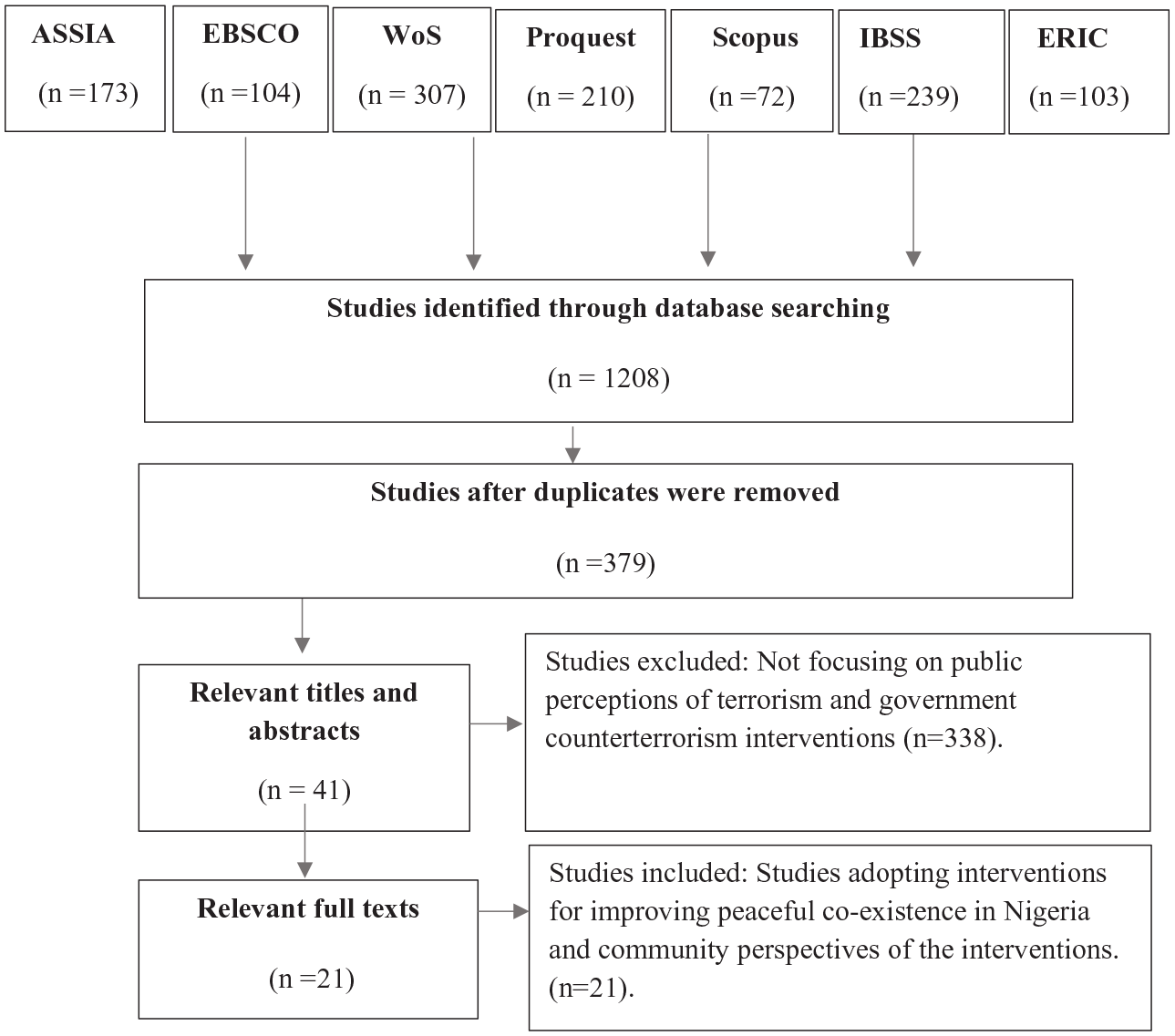
PRISMA flow diagram.
Theme 1 – Socioeconomic deprivation spurring terrorism
A notable pattern among the reviewed studies was the perceived sense that socioeconomic factors, including poverty and unemployment, constitute major drivers of terrorism and radicalisation into terrorism (Adelaja et al., 2018; Akinyemi, 2018; Botha and Abdile, 2019; Brisibe, 2018; Ikezue and Ezeah, 2015; Kamta et al., 2020; Kumo, 2020; Mercy Corps, 2016; Olofinbiyi and Steyn, 2018; Onuoha, 2014). For instance, Onuoha (2014) conducted a study based on interviews, focus groups and surveys conducted in six states across Nigeria, highlighting socioeconomic factors. The study includes data from traditional leaders, women leaders, religious leaders and focus group discussions with youth, women, faith groups and interviews with civil society organisations drawn from Bornu, Gombe, Kaduna, Kano Sokoto and Yobe states of Nigeria. Onuoha’s (2014) study found, among others, that issues of unemployment, poverty and weak family structure were instrumental to the drivers of radicalisation into terrorism. In Kano state, 92% of the participants cited poverty and unemployment as key drivers of radicalisation, while 83% of surveyed respondents in Kaduna consider them as important (Onuoha, 2014).
Existing studies that include former Boko Haram members also highlight the role of poverty in driving radicalisation (Adelaja et al., 2018; Botha and Abdile, 2019). For instance, Botha and Abdile (2019), on the basis of 50 quantitative structured interviews with civil societies and 10 interviews with peacebuilders and Boko Haram fighters, report a pattern concerning the role of poverty. This is exemplified in the excerpt from an interview with one of the former fighters: First of all, we were carried away by the name of Islam, we were told to go and do jihad (Holy war) after that, we came to discover that it was a deceitful way of introducing us into another part of the world. Poverty, lack of money is what induces us to join Boko Haram. (Botha and Abdile, 2019: 8)
The implication of these findings is that poverty left unaddressed tends to breed frustration, leading to aggression. Within the synthesised studies, such aggression is manifested in a diverse format, including joining terrorism. While poverty is construed as a breeding ground for terrorism, the government are perceived to have failed in their duties to provide the requisite basic welfare and living conditions for its populace. Such failure was identified in another study conducted by the Mercy Corps (2016) as a condition exploited towards recruiting youth desperate for business support: A male youth is running his business – struggling, perhaps and he is approached by a generous benefactor. Maybe he has seen this person around the community, or he has a mutual friend. The benefactor offers a business loan to the youth. Later, he comes back demanding repayment. If there is no money, the youth is forced to join Boko Haram or be killed. (Mercy Corps, 2016: 13)
The extract highlights a perceived sense of initially positioning Boko Haram as the ‘good other’ that provides opportunities otherwise not easily obtained from the government. The quest for sustenance amid the ‘struggle’ to remain afloat in business seems central to the decision to accept loans from perceived benefactors regardless of the consequences of non-repayment. The implication of such findings is that access to required financial support perceived not to be readily available by the government could trigger easy recruitment into terrorism. Such recruitment is made easy due to the exploitation of the needs of those struggling to survive.
Theme 2 – Religious divide and scepticism towards Islam
The data set revealed a sense of scepticism towards Islam. Boko Haram was construed as a religiously-motivated group, and religion was also perceived to constitute one of its key drivers and source for recruitment (Adelaja et al., 2018; Akinyemi, 2018; Botha and Abdile, 2019; Granville, 2020; Ikezue and Ezeah, 2015; Kumo, 2020; Mang, 2014; Mercy Corps, 2016; Olofinbiyi and Steyn, 2018). The study conducted by Mercy Corps in 2016 made some useful findings that suggest religion as a source of recruitment. The study recruited 47 people who previously took part in Boko Haram as youths (Mercy Corps, 2016). It also recruited 46 friends and family members of former and active members of Boko Haram (Mercy Corps, 2016). Twenty-six youths, who resisted voluntary participation alongside 26 community leaders, were also interviewed from Borno, Gombe and Yobe states (Mercy Corps, 2016). Concerning religion, one of the participants, who was a male youth from Yobe state and a member of Boko Haram at the time of the study, noted that ‘They were preaching for jihad and faith. Their words are strong and convincing. They will attract you with rewards of jihad, which, according to them, is paradise’ (Mercy Corps, 2016: 14). Another male youth also commented that ‘I joined in the name of protecting the religion of Allah [. . .] they convince me through exposing the injustice of the government’ (Amnesty International, 2014: 15). Here religion is positioned as both a source for mobilisation and a unifying goal in spurring radicalisation into Boko Haram. While the perceived external gains for engaging in jihad trigger radicalisation, a notable point of attention is the problematisation of the Nigerian government as the reason why religion is seen as the panacea for addressing the limitations of the government. The implication of the findings is that the perceived inability of the Nigerian government to address injustice constitutes a major limitation exploited for recruitment. A possible explanation as to why such perceived injustice could fuel radicalisation may include the fact that the participants may have experienced such injustice in the form of high-level deprivations, extreme poverty and the heavy-handedness of the security forces.
Concerning scepticism towards Islam, Boko Haram was also construed as a central driver of the religious divide. While Boko Haram conjures negativity, it was also construed to pose fear and lack of trust for the Islamic religion’s adherents (Adelaja et al., 2018; Granville, 2020; Ikezue and Ezeah, 2015; Mang, 2014). A study conducted by Granville (2020) with 10 participants recruited from Bornu state who had experienced Boko Haram terrorist acts found a perceived severed relationship characterised by a lack of trust of the Muslims. This is also exemplified by the account of one of these participants in Granville (2020) study: My sad experience with insurgency had made me wary of Muslims, and I am not sure I will be able to trust any Muslim again, particularly those fundamentalists. Boko Haram wiped out my village and my people because we were predominantly Christians. Why should I trust any Muslim again? I am really disheartened and very frustrated that all my relations and friends were killed, maimed, raped, or kidnapped by the insurgents. It will take the grace of God for me to have any endearing relationship with Muslims. It is a pity, but that’s the reality for me. (Granville, 2020: 105)
The excerpt highlights a perceived scepticism towards the Muslim communities. The extract also demonstrates a perceived sense of generalisation of the Muslims, which resonates with Mang’s (2014) study. A notable implication of Boko Haram acts, and insurgency is the perceived divide created as a result. Such divides are highlighted via the construction of identities, which creates a perceived ‘us and them’ stance where the Muslims appear construed as the ‘feared other’ not worthy of trust. Thus, the ‘othering’ could hamper peaceful co-existence among both religious adherents, especially considering the generalisation of other Muslims regardless of whether they hold a liberalist view, which distances them from the appalling acts of Boko Haram.
While the group’s religious underpinnings appear central, some studies indicate that community perceptions concern its use for underlying political purposes, a tool used by politicians for their gain which sometime result in bad governance (Adelaja et al., 2018; Akinyemi, 2018; Alimba and Salihu, 2020; Ikezue and Ezeah, 2015; Olofinbiyi and Steyn, 2018). For instance, in the study by Ikezue and Ezeah (2015) conducted with 500 survey respondents and 10 interviews with key informants, the account of a 60-year-old male participant who was a key informant highlighted that Boko Haram was motivated by the extreme form of religious beliefs at the early stage of its formation. However, they later became political and started fighting government and security officials when their members were killed. After sometimes, there started killing non-Muslims [. . .] They started as religious group. They were later hijacked by politicians for political killings. (Ikezue and Ezeah, 2015: 10)
The excerpt highlights the multifaceted dynamism associated with community perceptions of the group. Religion is seen as an avenue for exploitation. The extract problematises the politicians whose role is to uphold the rule of law rather than use the terrorist group for their political objectives and private gains.
Theme 3 – Military intervention and perceived abuse by the security forces
A common finding from the synthesised studies was that military intervention formed the bulk of the government response. Perceptions on the use of military interventions were particularly negative and span from the community’s perceived abuses meted by the security forces to informing resentment leading to radicalisation into Boko Haram and ultimately lack of confidence in the security forces’ ability to defeat Boko Haram. Members of the community perceive abuse by the security forces as a further basis for alienating the public from the security forces (Agbiboa, 2018; Amnesty International, 2014; Botha and Abdile, 2019; Brechenmacher, 2019; Granville, 2020; HRW, 2012; Mercy Corps, 2016; Saheed and Onuoha, 2019; United Nations High Commissioner for Human Rights, 2015). A female participant in Granville (2020) study who had experienced insecurity because of Boko Haram attacks commented: I see myself much more vulnerable as a woman [. . .] Because of Boko Haram terrorists and their inflated ego, women have been further relegated and dehumanised even here in this camp where officials and security personnel who should ordinarily protect vulnerable women and girls are the ones abusing them sexually, demanding sex as gratifications from girls and women in exchange for basic relief products. I am pained and embittered that women are now the scourge of the Borno society, particularly widows, orphans, and young girls. Women had always been treated as inconsequential, even before the insurgency started and grew, but now, my opinion is that the sad situation has become worse. (Granville, 2020: 102)
The security forces are problematised and seem construed negatively. The perceived gender-based marginalisation appears construed from a historical context where those meant to ensure safety are viewed as condoling violent acts against women. The implication of such perceptions is the perceived lack of confidence in the security agencies (Granville, 2020). Such a finding is congruent with studies conducted by Amnesty International (2014) and the HRW (2012). The HRW (2012) study comprising 135 interviews with 91 witnesses and victims of Boko Haram attacks or security forces abuses, as well as with journalists, lawyers, religious leaders, civil society activists, military, police officials, senior officials of justice and foreign aid workers, is instrumental in eliciting views concerning human rights abuses. Based on interviews with participants resident in Maiduguri, the HRW (2012: 59) report recurrent findings are summarised by a participant who is a civil activist that: ‘The abuses by the JTF have created more distance between the people and the government’. The HRW (2012: 58) further report that: During raids in communities, often in the aftermath of Boko Haram attacks, members of the security forces have executed men in front of their families; arbitrarily arrested or beaten members of the community; burn houses shop and cars; stolen money while searching homes, and in at least one case raped a woman. Government security routinely hold suspects incommunicado without charge all trial in secret detention facilities and have subject detainees to torture or other physical abuse.
The heavy-handed approach of the security forces highlights a sense of division in the populace who, seems alienated and unwilling to cooperate. The perceived lack of confidence in the security forces as an intervention has consequences such as the reluctance on the part of the public to divulge critical information to the security forces that may help counterterrorism and insecurity in Nigeria. In its extreme form, the public seems more likely to support vigilantes whom they believe are better alternatives to the security forces (including the Nigerian police and army) (Agbiboa, 2018). A possible explanation of why vigilantes are considered in a positive light might be because of the vigilantes’ shared identity with the local community. The perceived ‘empathy’ and ‘being part and parcel’ of the community represent features perceived to be lacking in Nigerian security agencies.
Security forces’ abuses further trigger radicalisation
Another notable subtheme that emanates from the synthesis was a sense that the heavy-handed approach of the security forces spurs radicalisation into Boko Haram (Amnesty International, 2014; Botha and Abdile, 2019; Mercy Corps, 2016). The study conducted by Botha and Abdile (2019), for example, found that the security forces’ heavy-handedness partly informed why some community members join Boko Haram. In particular, Botha and Abdile (2019: 18) note that ‘placing revenge in context, 42.86 per cent of male Boko Haram respondents of male Boko Haram respondents versus 30.16 per cent of female Boko Haram respondents referred to military action as making recruitment “more likely”’. Succinctly put in the word of a former Boko Haram fighter, ‘they [security forces] kill innocent people that are not members, mistakenly so. So [people] join the group to fight the military’ (Botha and Abdile, 2019: 17). A peacebuilding participant in Botha and Abdile’s (2019) study further adds that ‘[t]he military can kill indiscriminately; it makes people angry, and they join to get back and government’ (p. 18). The implications of these perceptions are that states could invariably unintentionally play a part in fuelling the drivers of terrorism or radicalisation into terrorism. The perceived disconnect in the relationship between the security forces and the populace fuels resentment towards the former. The implication of which the quest for ‘revenge’ drives some aggrieved community members into Boko Haram.
While resentment towards the security forces contributes to radicalisation, the study conducted by Mercy Corps (2016) also finds that some people join Boko Haram due to the perceived quest for identity and protection. A participant from the Mercy Corps (2016) study commented that: I officially joined them [Boko Haram] when they started killing indiscriminately in Bama [local Government Area]. Because I needed an identity to remain safe, I decided to pledge my allegiance to them. At that time, I needed protection and immunity from persecution by them so I could continue with my business. When they attacked Bama. . . and burned all the houses in our community, my family’s house was spared. (p. 12)
The extract highlights a critical point where ‘protection’ against attack from Boko Haram is construed as a basis for joining the group. While reflecting on the important role of identity, the participant’s view also reflects the perceived weakness of the State, which seems limited in providing the required security for the public. Such a limitation seems to play into the hands of the terrorist group that is able to exploit the fears of the populace and failing security forces as a basis for recruitment.
Scepticism towards the ability of the security forces to end Boko Haram
The last point is further supported by community members’ scepticism towards the ability of the Nigerian security forces. In fact, a common pattern among the synthesised studies was the lack of confidence in the Nigerian security forces to effectively combat Boko Haram (Amnesty International, 2014; Botha and Abdile, 2019; Granville, 2020; Ike et al., 2021; Mercy Corps, 2016; Onuoha et al., 2020). As one participant in Granville’s (2020) study recounts, The State of economic, political and social circumstances in Borno is appalling, chaotic and discouraging. Borno is in a deep slumber and may not awake unless Boko Haram insurgents are defeated and flushed out. However, I am afraid, and in light of what is going on, I doubt if the Nigerian military has the capacity to defeat the Boko Haram terrorists. (Granville, 2020: 109)
Here, Boko Haram is construed from a position of strength, while the Nigerian military appears as one already beaten in their efforts. A possible explanation for the participants’ perceptions may be the general fear evoked by Boko Haram. Such perceptions relate to and reinforce the lack of trust in the government’s ability to protect the populace. Similar findings were reported in the study conducted by Ike et al. (2021), where participants expressed scepticism about the government’s ability to even reform repentant Boko Haram members before integrating them back into society. Some of the reasons were the perceived lack of adequate infrastructure or database to capture repentant combatants (Ike et al., 2021).
Discussion, conclusion and implications of the study
The rationale for this review is to synthesise community perspectives on terrorism and the Nigerian government’s response to addressing terrorism. The review highlights three main themes: (1) socioeconomic deprivation spurring terrorism, (2) religious divide and scepticism towards Islam and (3) military intervention and perceived abuse by the security forces. The themes will be discussed in relation to existing literature. The implication of the review for policy will also be addressed.
First, it was found that socioeconomic deprivation is perceived as one of the main drivers of terrorism in Nigeria (Adelaja et al., 2018; Akinyemi, 2018; Botha and Abdile, 2019; Brisibe, 2018; Ikezue and Ezeah, 2015; Kamta et al., 2020; Kumo, 2020; Mercy Corps, 2016; Olofinbiyi and Steyn, 2018; Onuoha, 2014). Socioeconomic factors such as unemployment and poverty are construed as fuelling a sense of deprivation among the population. The feeling of lack is construed to trigger resentment, making some people likely to be radicalised into Boko Haram. The findings of the review are congruent with Ted Robert Gurr’s (2012) theory concerning relative deprivation. However, it seems not to be congruent with Krueger and Malečková’s (2003) study, which argues that there appears to be no connection between poverty or low education and terrorism.
While education has often been perceived as having a limited impact on radicalisation and recruitment into terrorism (Krueger and Malečková, 2003), in Nigeria, recent studies on the drivers of radicalisation found, among others, that Boko Haram terrorists benefit from sympathy from some Northern citizens due to indoctrination (Enweonwu et al., 2022). The study also suggests that indoctrination remains an effective tool for breeding the growth of Boko Haram terrorism in Nigeria (Enweonwu et al., 2022). It stresses the need to re-examine the type of education available to youths and children in Northern Nigeria, including the redesign of the alamjiri system of education to limit room for indoctrination (Enweonwu et al., 2022). In essence, the geographical and temporal variation in the northern region of Nigeria makes it a dynamic region for potential recruitment into terrorism. As previous studies suggest, in terms of education, the northern region geographically scores lower when compared to other regions of the country (Adejoh et al., 2022). This arguably makes it a potentially volatile ground for radicalisation into terrorism as it was in 2009, with little changes in 2022. The implication of this finding is that the context- and country-specific dynamics might inform how the root causes of terrorism are construed. Consequently, socioeconomic factors in Nigeria are seen to influence the prevalence of terrorism.
Another implication is that while socioeconomic factors such as poverty are seen as drivers of terrorism, the government appears to be problematised by the failure to resolve the country’s socio-economic hardship. In essence, it poses a risk of potential recruitment pool into terrorism, especially as it relates to the northern Nigeria region, worse hit by poverty and limited level of education. As data from the Nigerian National Bureau of Statistics (NBS) suggest, that between September 2018 and October 2019 alone, 40% or 83 million Nigerian lives in poverty (NBS, 2019). The national poverty rate of Nigeria is also forecasted to experience an increase from 40.1% in 2019 to 45.2% in 2022, suggesting that approximately 100.9 million Nigerians will be living in poverty in 2022 (Irwin et al., 2021). The northeast of Nigeria also has a significantly higher poverty level when compared to its southern counterpart. A study by Ewi and Salifu (2017) found that in Nigeria, unemployment and poverty were construed as the main reasons to join extremist groups in the region – thus making the northern region a potential target for terrorist exploitation and recruitment, and less changes seen on the driver of radicalisation from temporal and geographical perspectives.
Second, the review found a perceived sense of religious divide and scepticism towards Islam (Adelaja et al., 2018; Akinyemi, 2018; Botha and Abdile, 2019; Granville, 2020; Ikezue and Ezeah, 2015; Kumo, 2020; Mang, 2014; Mercy Corps, 2016; Olofinbiyi and Steyn, 2018). Boko Haram conjures negativity, and the killings of non-Muslims (and moderate Muslims) by Boko Haram have heightened existing tensions between the Christian and the Muslim communities. The finding resonates with some of the concerns expressed in previous literature, highlighting the perceived fear of Christian of possible subjugation by the Muslims (Onapajo and Usman, 2015). These findings appear to imply that Boko Haram is construed as part of a broader political strategy to Islamise the country. Even the fact that Boko Haram also kill other moderate Muslims not supporting its radical ideologies, it does little to put members of the Christian community at ease in relation to a ‘conspiracy of the Muslim north’ in the conflict.
A third major finding from the data set was that Military intervention represents a dominant intervention perceived to be abused by the security forces. The review highlights that the community perceives the heavy-handedness of the security forces as something that fuels a sense of public resentment (Agbiboa, 2018; Amnesty International, 2014; Botha and Abdile, 2019; Brechenmacher, 2019; Granville, 2020; HRW, 2012; Mercy Corps, 2016; Saheed and Onuoha, 2019; United Nations High Commissioner for Human Rights, 2015). The security forces are perceived from a negative perspective. The security forces are also construed to use their power as a platform for abuse and domination. Females were also considered as those more likely to be affected within the context of the conflict. This review’s findings resonate with other literature concerning the widespread resentment towards the Nigerian security forces, including the police (Ike et al., 2021). For instance, the massive #EndSars protest in October 2020 highlights public frustration with members of the Special Anti-Robbery Squad of the Nigerian police force. The implication of the findings is that public alienation and resentment limit support by providing relevant intelligence to prevent and combat acts of terrorism. Such implication resonates with the finding of Omeni’s (2017) study, which highlights the lack of intelligence from the public as some of the factors limiting Nigerian counterterrorism insurgency using the military.
A further finding from the synthesised studies was the sense that the harsh use of repressive measure drives radicalisation rather than prevent it (HRW, 2012; Mercy Corps, 2016). The findings are congruent with existing literature that argues that intensive military actions increase rather than decrease terrorism (Brophy-Baermann and Conybeare, 1994; Enders and Sandler, 1993). For instance, Enders and Sandler (1993) found that the Reagan administration’s ‘get tough’ policy on terrorism, which included a retaliatory raid on Libya in 1986, did not have any noticeable long-term effect on curbing terrorist attacks directly against US interests. Moreover, the study conducted by Jones and Libicki (2008) on how terrorist groups end found that military force had rarely been the primary reason for the end of any terrorist group. The implication of such a finding – in conjunction with those highlighted in the synthesised studies – is that extensive reliance on the security forces and a military approach (and especially without the assistance and support of the community) is limited in its ability to combat terrorism. It might also imply an approach that treats the symptom and not the ailment, leading to even greater alienation between the public and the security forces and a further lack of public confidence in the security forces.
Our review also highlights perceived scepticism towards the Nigerian security forces’ ability to effectively deal with and end Boko Haram (Botha and Abdile, 2019; Granville, 2020; Ike et al., 2021; Mercy Corps, 2016). The implication of lack of confidence in the security forces is the fact that it might boost the morale of the terrorists who are positioned as ‘strong’, the Nigerian security forces are portrayed as ‘weak’ and unable to suppress Boko Haram. A possible explanation for this might be related to alleged poor weaponry issues, institutional isomorphism and heavy-handedness, all of which limit the efficacy of the security forces (Omeni, 2018).
It is worth addressing some of the limitations of our review. First, our review is confined to the Nigerian context, and although we consider this to be an important context due to the involvement of an impactful terrorist, that is, Boko Haram, and might not be a basis for generalisation to other contexts unless there are similar characteristics and features to that of Nigeria. Second, a limitation relates to contacting authors whose papers could not be obtained during the searches but yielded limited success.
Nevertheless, our review’s strengths lie in its originality in synthesising existing empirical studies on community perspectives of terrorism and the Nigerian government’s counterterrorism approaches. The review is particularly important and significant in informing existing counterterrorism strategies, which seems limited by the disconnect between how the communities, including victims and former Boko Haram combatants, perceive the root causes of terrorism and how the State responds to it. Adopting a systematic approach in selecting the studies included in the review highlights rigour devoid of bias, thus strengthening the basis for the review. It is against the preceding backdrops that the review highlights the need for policies aimed at addressing counterterrorism to work closely with the community through trust-building, accountability for perceived acts of human rights abuses by security agencies and addressing the perceived root causes of terrorism. Such approaches appear more likely to gain public confidence and support for counterterrorism by being willing to divulge relevant information that could help the security forces in their counterterrorism interventions. It might also prove cost-effective as less radicalisation into terrorism due to public trust for the Nigerian government and its security agencies might mean a weakened terrorist group likely to be surmounted by the security forces.
Footnotes
Appendix 1
CASP quality and risk of bias assessment of included studies.
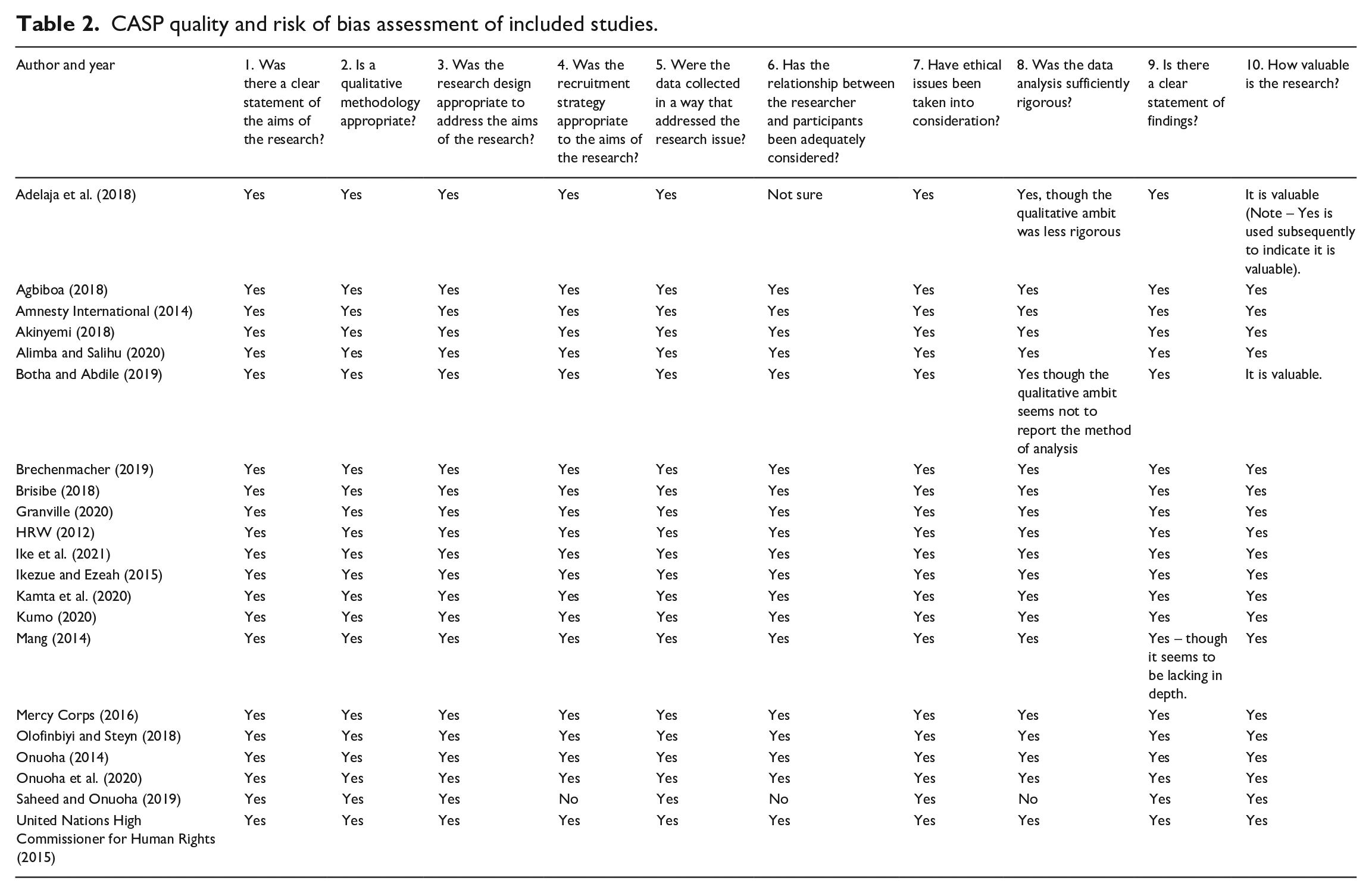
| Author and year | 1. Was there a clear statement of the aims of the research? | 2. Is a qualitative methodology appropriate? | 3. Was the research design appropriate to address the aims of the research? | 4. Was the recruitment strategy appropriate to the aims of the research? | 5. Were the data collected in a way that addressed the research issue? | 6. Has the relationship between the researcher and participants been adequately considered? | 7. Have ethical issues been taken into consideration? | 8. Was the data analysis sufficiently rigorous? | 9. Is there a clear statement of findings? | 10. How valuable is the research? |
|---|---|---|---|---|---|---|---|---|---|---|
| Adelaja et al. (2018) | Yes | Yes | Yes | Yes | Yes | Not sure | Yes | Yes, though the qualitative ambit was less rigorous | Yes | It is valuable (Note – Yes is used subsequently to indicate it is valuable). |
| Agbiboa (2018) | Yes | Yes | Yes | Yes | Yes | Yes | Yes | Yes | Yes | Yes |
| Amnesty International (2014) | Yes | Yes | Yes | Yes | Yes | Yes | Yes | Yes | Yes | Yes |
| Akinyemi (2018) | Yes | Yes | Yes | Yes | Yes | Yes | Yes | Yes | Yes | Yes |
| Alimba and Salihu (2020) | Yes | Yes | Yes | Yes | Yes | Yes | Yes | Yes | Yes | Yes |
| Botha and Abdile (2019) | Yes | Yes | Yes | Yes | Yes | Yes | Yes | Yes though the qualitative ambit seems not to report the method of analysis | Yes | It is valuable. |
| Brechenmacher (2019) | Yes | Yes | Yes | Yes | Yes | Yes | Yes | Yes | Yes | Yes |
| Brisibe (2018) | Yes | Yes | Yes | Yes | Yes | Yes | Yes | Yes | Yes | Yes |
| Granville (2020) | Yes | Yes | Yes | Yes | Yes | Yes | Yes | Yes | Yes | Yes |
| HRW (2012) | Yes | Yes | Yes | Yes | Yes | Yes | Yes | Yes | Yes | Yes |
| Ike et al. (2021) | Yes | Yes | Yes | Yes | Yes | Yes | Yes | Yes | Yes | Yes |
| Ikezue and Ezeah (2015) | Yes | Yes | Yes | Yes | Yes | Yes | Yes | Yes | Yes | Yes |
| Kamta et al. (2020) | Yes | Yes | Yes | Yes | Yes | Yes | Yes | Yes | Yes | Yes |
| Kumo (2020) | Yes | Yes | Yes | Yes | Yes | Yes | Yes | Yes | Yes | Yes |
| Mang (2014) | Yes | Yes | Yes | Yes | Yes | Yes | Yes | Yes | Yes – though it seems to be lacking in depth. | Yes |
| Mercy Corps (2016) | Yes | Yes | Yes | Yes | Yes | Yes | Yes | Yes | Yes | Yes |
| Olofinbiyi and Steyn (2018) | Yes | Yes | Yes | Yes | Yes | Yes | Yes | Yes | Yes | Yes |
| Onuoha (2014) | Yes | Yes | Yes | Yes | Yes | Yes | Yes | Yes | Yes | Yes |
| Onuoha et al. (2020) | Yes | Yes | Yes | Yes | Yes | Yes | Yes | Yes | Yes | Yes |
| Saheed and Onuoha (2019) | Yes | Yes | Yes | No | Yes | No | Yes | No | Yes | Yes |
| United Nations High Commissioner for Human Rights (2015) | Yes | Yes | Yes | Yes | Yes | Yes | Yes | Yes | Yes | Yes |
Declaration of Conflicting Interests
The author(s) declared no potential conflicts of interest with respect to the research, authorship and/or publication of this article.
Funding
The author(s) received no financial support for the research, authorship and/or publication of this article.
