



Abstract
We present a numerical method for approximating the two-dimensional surface quasi-geostrophic equation. We first reformulate the equation into an equivalent system by using the scalar auxiliary variable approach. Then we propose first-order and second-order discretization schemes for solving the new surface quasi-geostrophic system in time. Furthermore, we prove that both of these schemes based on the scalar auxiliary variable approach satisfy an unconditionally energy stability property. Since the method gives two linear equations with constant coefficients in each time step. We have an efficient approach and accurate for solving these spacial fractional diffusion equations. Ample numerical experiments are carried out to validate the correctness of these schemes and their accuracy for inviscid problems and the problems with small viscosity.
Introduction
In this article, we consider a numerical approximation of the two-dimensional (2D) surface quasi-geostrophic (SQG) equation. The numerical schemes are based on a modified SQG equations by using the scalar auxiliary variable (SAV) approach. The general three-dimensional (3D) quasi-geostrophic equation, first derived by Charney in 1940s,
1
have been very successful in describing major features of large-scale motions in the atmosphere and the oceans in the mid-latitudes.2,3 These 3D equations can be reduced to the SQG equation with uniform potential, modeling the potential temperature on the 2D boundaries4,5 as




When the fractional order
Quasi-geostrophic equation has been intensively investigated because of both its mathematical importance and its potential for applications in meteorology and oceanography. On application, 2D and 3D quasi-geostrophic equations are important mathematical models for simplifying 2D and 3D atmospheres and oceans. These models focus on highlighting certain features of the atmospheric and ocean. Theoretically, the existence of weak and strong solutions of subcritical quasi-geographic equations has been solved, but the uniqueness of weak solutions is still an open problem. Constantin et al.
4
demonstrated the smooth solution of the SQG equation is unique but, if
In this work, we present numerical schemes for the SQG equation. The significant feature of these schemes is an auxiliary variable is introduced into the SQG equation as a scalar number. This idea is inspired by Shen et al.,17–19 working for gradient-type dynamical systems or a general dissipative system and has also been used for solving incompressible Navier-Stokes flow.20,21 Since its introduction, the SAV approach has received much attention due to its efficiency and flexibility. The original SAV approach 17 has been expanded numerous forms, including the Runge-Kutta SAV (RK-SAV) method 22 in which it is shown that the SAV approach coupled with diagonally implicit high-order Runge-Kutta method is unconditionally energy stable, generalized SAV (G-SAV) 23 allow a range of functions in the definition of the SAV variable, relaxed-SAV (RSAV) 24 method penalizes the numerical errors of the auxiliary variables by a relaxation technique, and the Lagrange multiplier approach 25 which can conserve the original energy instead of a modified energy in the SAV approach. The SQG equation is reformulated into an equivalent system employing the auxiliary energy variable, and numerical schemes are devised to discrete the reformulated system. The algorithm requires only solving two linear equations with constant coefficients in each time step. In addition, these schemes satisfy discrete energy stability properties and accuracy.
The remainder of this article is organized as follows. In the “Numerical methods and stability analysis” section, we introduce an auxiliary energy variable and reformulate the SQG equation into a new system based on this variable. First-order and second-order numerical schemes are presented for approximating the reformulated equivalent system. We then prove the unconditional stability property of the proposed schemes and show the implementation details of the schemes. In the “Numerical results” section, we present the numerical results. We consider the inviscid and viscous SQG equation with smooth initial conditions, and investigate the effectiveness and accuracy of the SAV method. Finally, we provide a short summary in the “Summary” section. In Appendix A, we provide the details for the artificial term (fSVV term) of the schemes.
Numerical methods and stability analysis
In this section, we present the SAV approach for the SQG equation, and prove the first-order and second-order schemes based on the SAV approach are both unconditional stable. In addition, we also show that the algorithm can be implemented efficiently and easily.
Auxiliary variable approach
The schemes are based on an auxiliary variable approach for the SQG equation system. To this end, we first reformulate the equation into the equivalent system by introducing the following auxiliary variable


From the new reformulation equation (5), we are able to construct various time discretization schemes for equations (1) and (2), and analyze the stability of the schemes. Let
Time discretization schemes and their stability analysis
In this subsection, we will propose two time discretization schemes for the new SQG system. We will also prove that both of these two schemes follow the discrete energy law.
The first-order backward differentiation scheme for equations (2) and (5) can be written as follows: Find
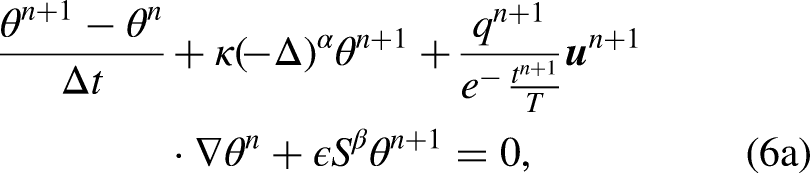


The extra term
Now we consider the stability of the above time scheme with periodic boundary conditions. The discrete energy law of the first-order scheme is then given in the following theorem.
The scheme (6) with periodic boundary conditions is unconditionally stable in the sense that the following discrete energy law holds


Now we present the details for solving the time discretization scheme (7). Firstly, we denote


Once

It is clear that scheme (7) is only of first-order. Moreover, we can also construct a second-order SAV Crank–Nicolson scheme as follows.
The second-order semi-implicit Crank–Nicolson scheme of equation (2) and (5) can be written as follows: Find



The solution of scheme (15) satisfies the following energy law:


The numerical procedure for the second-order scheme (15) is exactly the same for the first-order scheme (6). We denote


Plugging (2.2), we find that

We have shown that the first-order and second-order schemes based on the SAV approach satisfy an unconditionally energy stability. Furthermore, the total computational cost of the first-order and second-order schemes is equal to solving two linear equations with constant coefficients in each time step, which can be implemented in a very efficient way.
Numerical results
In this section, we present some computational experiments using the numerical schemes constructed in the last section to demonstrate their accuracy and efficiency. In the first example, we verify the convergence rates of the first-order and second-order schemes in time. We then test the accuracy and efficiency for the inviscid SQG equation (i.e.
Accuracy test
In order to test the convergence rates in time, we consider the inviscid SQG equation (i.e.



In Figure 1, we plot the convergence rate of the

Convergence test for the inviscid SQG equation using the SAV-BDF and SAV-CN schemes. (a) and (b) Plot
The inviscid SQG equation
Next, we consider another inviscid SQG equation with streamwise velocity in the square domain

In Figure 2, we present the evolution of the numerical solutions from the SAV-BDF, SAV-CN schemes, and fSVV method,
26
respectively. The time step is set

The dynamic evolution of vortex growth driven by the SQG equation by using SAV-BDF, SAV-CN schemes, and fSVV method. Contours of the numerical solutions
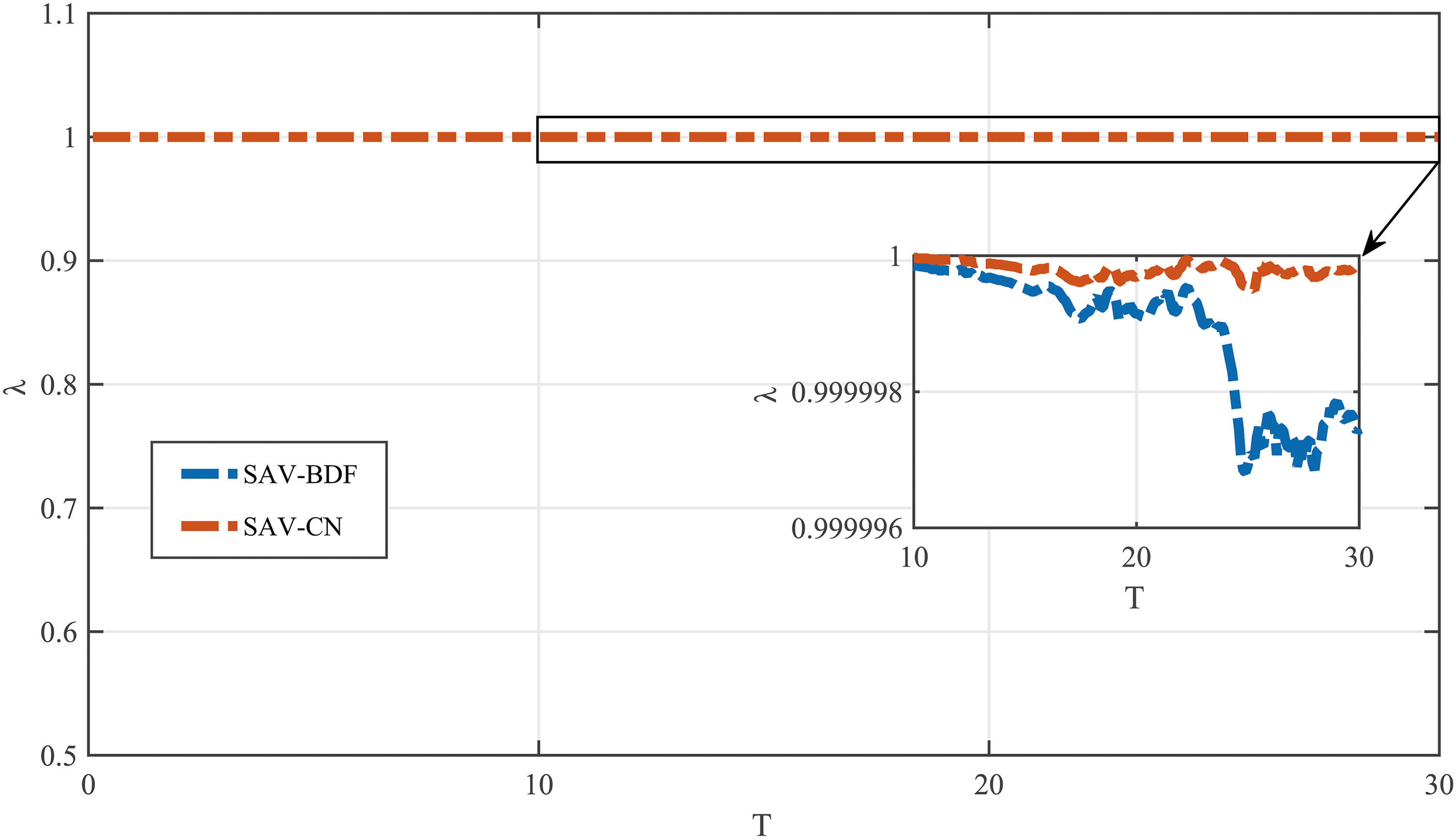
Numerical result of
The dissipative SQG equation
In this subsection, we consider the dissipative SQG equation which the solution corresponding to the initial condition given as

In Figure 4, we plot the evolution of the contours of

Evolution comparison of dissipative SQG equation by using the SAV-CN and fSVV schemes at
Summary
We have presented an algorithm for approximating the 2D SQG equation based on the SAV approach. By introducing a scalar equation as a variable, we reformulated this equation into an equivalent system. Further, we constructed first-order and second-order schemes for the reformulation system. We carried out the stability analysis for these schemes. We show that the methods are unconditionally energy stable. Such that, the schemes allow an efficiently implemented for solving the SQG equation system. In each time step, the algorithm only requires solving two linear equations with constant coefficient, and there is no need to solve nonlinear algebraic equation when we compute the parameter
Supplemental Material
sj-cls-1-act-10.1177_17483026231176203 - Supplemental material for Scalar auxiliary variable approache for the surface quasi-geostrophic equation
Supplemental material, sj-cls-1-act-10.1177_17483026231176203 for Scalar auxiliary variable approache for the surface quasi-geostrophic equation by Shengtao Shi and Fangying Song in Journal of Algorithms & Computational Technology
Supplemental Material
sj-ins-2-act-10.1177_17483026231176203 - Supplemental material for Scalar auxiliary variable approache for the surface quasi-geostrophic equation
Supplemental material, sj-ins-2-act-10.1177_17483026231176203 for Scalar auxiliary variable approache for the surface quasi-geostrophic equation by Shengtao Shi and Fangying Song in Journal of Algorithms & Computational Technology
Supplemental Material
sj-dtx-3-act-10.1177_17483026231176203 - Supplemental material for Scalar auxiliary variable approache for the surface quasi-geostrophic equation
Supplemental material, sj-dtx-3-act-10.1177_17483026231176203 for Scalar auxiliary variable approache for the surface quasi-geostrophic equation by Shengtao Shi and Fangying Song in Journal of Algorithms & Computational Technology
Supplemental Material
sj-bst-4-act-10.1177_17483026231176203 - Supplemental material for Scalar auxiliary variable approache for the surface quasi-geostrophic equation
Supplemental material, sj-bst-4-act-10.1177_17483026231176203 for Scalar auxiliary variable approache for the surface quasi-geostrophic equation by Shengtao Shi and Fangying Song in Journal of Algorithms & Computational Technology
Supplemental Material
sj-cls-5-act-10.1177_17483026231176203 - Supplemental material for Scalar auxiliary variable approache for the surface quasi-geostrophic equation
Supplemental material, sj-cls-5-act-10.1177_17483026231176203 for Scalar auxiliary variable approache for the surface quasi-geostrophic equation by Shengtao Shi and Fangying Song in Journal of Algorithms & Computational Technology
Footnotes
Declaration of conflicting interests
The author(s) declared no potential conflicts of interest with respect to the research, authorship, and/or publication of this article.
Funding
The author(s) received no financial support for the research, authorship and/or publication of this article: This work was supported by the NSF of China (Grant No. 11901100) and the Natural Science Foundation of Fujian Province of China (Grant No. 2020J05111).

Supplemental material
Supplemental material for this article is available online.
Appendix
Artificial term
In the following reference,
27
authors have developed a numerical method for computing fractional Laplacians on complex-geometry domains, by considering the following eigenvalue problem (EVP) for the Laplacian: .0Δ028
References
Supplementary Material
Please find the following supplemental material available below.
For Open Access articles published under a Creative Commons License, all supplemental material carries the same license as the article it is associated with.
For non-Open Access articles published, all supplemental material carries a non-exclusive license, and permission requests for re-use of supplemental material or any part of supplemental material shall be sent directly to the copyright owner as specified in the copyright notice associated with the article.
