In this paper, we propose a second-order operator splitting spectral element method for solving fractional reaction-diffusion equations. In order to achieve a fast second-order scheme in time, we decompose the original equation into linear and nonlinear sub-equations, and combine a quarter-time nonlinear solver and a half-time linear solver followed by final quarter-time nonlinear solver. The spatial discretization is eigen-decomposition based on spectral element method. Since this method gives a full diagonal representation of the fractional operator and gets an exponential convergence in space. We have an accurate and efficient approach for solving spacial fractional reaction-diffusion equations. Some numerical experiments are carried out to demonstrate the accuracy and efficiency of this method. Finally, we apply the proposed method to investigate the effect of the fractional order in the fractional reaction-diffusion equations.
In recent years, the fractional partial differential equations are wining more and more scientific applications across a variety of fields including control theory,1 biology,2,3 electrochemical processes,4 finance,5 etc. There have been many numerical methods for discretizing fractional operators and resolving fractional differential equations6–11 etc. Splitting methods have been fruitfully used to solve large systems of partial differential equations.12–14 Usually, it is very difficult to find the exact (analytical) solution of a given problem in practice. Thus, we can use numerical methods to obtain an approximate solution of the equations. There are many major benefits of operator splitting, including dimension reduction, problem simplification, preservation of any order accuracy in time, and computational speed-up for some complex problems (cf.15–17 and the references therein). In this paper, we try to extend the splitting method for spacial fractional reaction-diffusion equations as follows
with , where Ω is a bounded domain in , μ is viscosity coefficient, the fractional operator is defined as and the nonlinear term (e.g. in the Fisher-Kolmogorov equation18, here r and K > 0 are variable coefficients depending on the space). The initial condition is given as .
The fractional Laplacian in this paper is defined as follows
where are the eigenpairs of the standard Laplacian with certainty boundary conditions and u has the expansion . Alternatively, the fractional operator can be defined19 through the Fourier transform
The remainder of this paper is organized as follows. In next section, we describe the numerical method for the fractional reaction-diffusion equations, and provide the error estimation for the splitting scheme. Several numerical examples are given in ‘Numerical results’ section. We will apply our method to solve the fractional Allen-Cahn, Fisher-Kolmogorov, Gray-Scott and FitzHugh–Nagumo equations.2,11,21 The numerical results show that our method is both efficient and highly accurate for solving fractional reaction-diffusion equations. We provide a short summary in the final section.
Numerical method
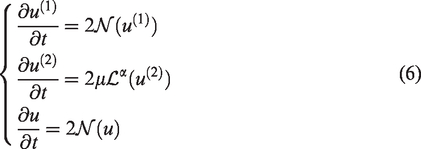
We introduce a second-order splitting scheme for solving the above reaction-diffusion equation (1) and derive the error estimation for the scheme in this section. Let L be the number of the time step to integrate up to final time T, then the time step and for . We denote the time levels by superscripts and set initial condition . We look for solution of
with the initial conditions in each sub-step and respectively.
Remark 1. In particular case we can find the analytic solutions of the initial value problem with a given nonlinear term f(u), since the ordinary differential equations in the first sub-step and the third sub-step of the above scheme (5) are solvable. Alternatively, we solve a diffusion equation for the second sub-step with an efficiency way since the fractional operator is defined as (3).
Next, we will derive the error estimation for the above scheme (5). Here we have second-order convergence in time which is the same as the splitting method used for standard reaction-diffusion equation (i.e. α = 1) in Harwood.22
Theorem 1. Given a semi-linear parabolic PDE, which can be written aswhereandare linear and nonlinear operator upon u, respectively, the solutions to the set of split equations
provide ansplitting accuracy when solved sequentially over the set of subintervals
Proof. Using Taylor expansion at time step , the solution to the full problem (1)
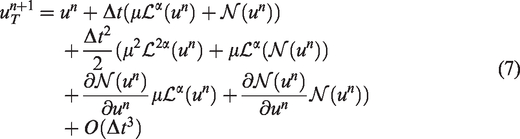
Combining the splitting equations (19) we have the following approximation, here we denote and I represents the identity operator for convenience. By using Taylor expansion
Where is derived from the second sub-step of the scheme (6). The splitting error can be obtained by computing the solution difference from this ordering as
Thus, the symmetric splitting scheme results in second-order accuracy in time. The proof is complete. □
In previous work, we have developed a numerical method for computing fractional Laplacians on complex-geometry domains.23 By using the numerical eigenpairs of the Laplace operator from the SEM solution, we can approximate the fractional Laplace operator as
where represents inner product and denotes the degree of freedom (DoF) which depends on the element number El and the polynomial degree N of the problem. The variational statement for the second sub-step of the scheme (5) reads as: Find so that
where the time interval is and and in equation (5) is replaced by u(t) for convenience. The numerical solution is expanded as and the fractional operator is defined as follows
By the orthogonality of the eigenfunctions we obtain
The solution of the above equations with initial condition is given as follows
where . Thus we obtain the analytic solution of (9)
Numerical results
Fractional Allen-Cahn equation (verification of convergence results)
In order to test the convergence rates of the splitting scheme (5) for reaction-diffusion equations, we consider the fractional Allen-Cahn equation
with the Neumann boundary condition
where the bounded domain and μ is the viscosity. The initial condition is given as
The corresponding nonlinear initial value problem for the Allen-Cahn equation is given as follows
here the initial condition is given as , here ξ is equal to n or at the n-th time step. The equation (15) can be integrated to obtain24,25
We set , the element number El = 64 and the polynomial degree N = 20 in each element such that the spatial discretization errors are negligible compared to the time discretization errors. Since the analytical solution is not available in this test, we choose the result obtained from the finest time step as our reference solution and compute the L2 errors between the reference and the numerical solutions from several time steps , denote . We also use the numerical solution as another reference solution, where is computed by using the method we developed in Song et al.,23 and denote . In Figure 1, we plot the L2 errors e1 and e2 with different time steps for several fractional orders α. It is clear from Figure 1 that the scheme is second-order accurate method in time for any α. Moreover, the splitting scheme (5) is more accuracy than the scheme in Song et al.23 for , since we solve the nonlinear equation (15) exactly in each time step. In Figure 2, we also show the spatial errors in semi-log scale for several α. The time step is and final time T = 1 in this test. It is observed that this method has exponential convergence rate for all α. Since the analytical solutions are not available in this test either, we choose the result obtained from the finest mesh N = 25 in each element as the reference solution and compute the L2 errors between the reference and the numerical solutions from several polynomial degree N, denote .
L2 error as a function of in log-log scale with different fractional order α of the Allen-Cahn equation (13).
L2 error as a function of the polynomial degree N in semi-log scale with different fractional order α of the Allen-Cahn equation (13).
Fisher-Kolmogorov model
In this subsection, we consider the Fisher-Kolmogorov equation
with the Dirichlet boundary condition
where the bounded domain , K(x, y) is a variable coefficient
In applications to biology, Ωb represents a region where populations cannot grow, due to unfavorable environmental conditions. The geometry is a slitted barrier, through which the solution will eventually penetrate. K smoothly interpolate on the interface between Ωb and outside region for our simulation. The initial condition is given as
We consider the corresponding nonlinear initial value problem for the Fisher-Kolmogorov model as follows
here the initial condition is given as . The equation (20) can be integrated to obtain
We set , the element number El = 117 and the polynomial degree N = 8 in each element to this simulation. Figure 3 shows the evolution of the solution for different fractional order . These results conform to the results presented in Baeumer et al.26Figure 3(a) shows the solution in the case of α = 1 (i.e. the classical reaction-diffusion equation) at t = 50, 70, 90. We can observe that the solution is very slow to penetrate the barrier. Next we change to represent anomalous diffusion, and repeat the numerical simulation. Figure 3(b) shows the solution has penetrated significantly at time t = 70. Due to the strongly non-local character of the fractional operator, it is much easier for members of the population to cross (jump) over the barrier. Figure 4 shows the population masses versus time t for the cases in two different regions and . The population mass of the fractional case (i.e. ) in grows significantly faster than the classical case (i.e. α = 1) after time t = 40.
Evolution of the solution corresponding to Fisher-Kolmogorov model. u contours are shown at times t = 50, 70, 90 from top to bottom. (a) , (b) .
Population masses of the Fisher-Kolmogorov model versus t: , here and .
Gray-Scott model
In this subsection, we consider the Gray-Scott model. The Gray-Scott equations describe an autocatalytic reaction-diffusion process between two chemical constituents with concentrations u and v
with periodic boundary condition, the corresponding chemical reaction is as follows
where the bounded domain and P are chemical species, u and v represent their concentrations, μu and μv are the diffusion rates, k represents the rate of conversion of V to P and c represents the rate of the process that feeds U and drains and P.
By splitting the linear terms of the reactive contribution into the linear system
the corresponding nonlinear system for
which has the conservation relation , where u0 and v0 are initial conditions. This allows the nonlinear system to be uncoupled to obtain , which can be integrated to obtain
where W0 is the principal branch of the Lambert W function.27,28 Writing equation (26) in terms of W0 is only possible when . In this simulation, the initial condition in the some regions of the domain. The Lambert W function can not be used in this case. Alternatively, we use fix-point iteration method for solving the nonlinear equation as follows
from the conservation relation .
We set the element number El = 1600 and the polynomial degree N = 8 in each element to this simulation. The coefficients are given as , c = 0.03 and , where . For the ratio of diffusion coefficients , the model is known to generate different mechanisms of pattern formation depending on the values of the feed c and depletion k rates. We select k in a range in which the standard diffusion model is known to exhibit interesting dynamics.3 The initial condition of the entire system is placed in the state , and the center plate of the domain is perturbed to . Figure 5 shows the evolutions of the numerical solution v and summarizes the effects of the super-diffusion for the fractional Gray-Scott model. Since the evolutions of the numerical solution u is similar to that the v, we will not elaborate it in this paper. In Figure 5(a) to (c) with , under the influence of the standard diffusion (α = 1), the Gray-Scott model exhibits patterns of mitosis.3 However, in the super-diffusion case , the way of the replication has a slight change and the dissociated spots become smaller. In Figure 5(d) to (f) with , the Gray-Scott model with the normal diffusion () produces a circular wave propagating outward and forms a structured pattern shown in picture (d). Moreover, the reduction of the fractional order effects the size of patterns with smaller spots. For smaller values of the fractional order , a new process of nucleation of structures in the center and in the boundaries of the domain is observed, that then grow outward until the entire domain reaches its final steady state configuration. These results show the same phenomenon as the results in literature.2,29
Evolution of the solution v in Gray-Scott equation (22): (a)-(c) v contours are shown at times t = 2000, 4600, 5200, 6200, 7200, 9200, 12000, 18000 from top to bottom for three fractional orders with k = 0.063; (d)-(f) v contours are shown at times t = 2000, 4600, 5200, 6200, 7200, 9200, 12000, 18000 from top to bottom for three fractional orders with k = 0.055. (a) , (b) , (c) , (d) , (e) , (f) .
FitzHugh–Nagumo model
In the last subsection, we consider the fractional FitzHugh-Nagumo model as follows
with homogeneous Neumann boundary condition on the bounded domain , where u is a normalized trans-membrane potential and v is a dimensionless time-dependent recovery variable, Ku is the diffusion coefficient. We set the parameters of the model: and δ = 0, which is known to generate stable patterns in a system in the form of reentrant spiral waves. In order to illustrate the effect of varying fractional order α in the FitzHugh–Nagumo model, we take an initial condition as
The time step in the numerical experiments is .
Figure 6 presents the stable rotation solutions of the FitzHugh-Nagumo model at t = 2000 for . We find that as expected, the wave travels more slowly as fractional order decreases. The width of the excitation wavefront is markedly reduced for decreasing α, as is the wavelength of the system, with the domain being able to accommodate a larger number of wavefronts for smaller fractional order α. These visualizations are consistent with results presented in Bueno-Orovio et al.2 (Figure 3) for time up to t = 2000 for all α.
Spiral waves in the FitzHugh-Nagumo model for varying α. (a) a = 1.0, (b) a = 0.85, (c) a = 0.75.
Summary
We develop a second-order operator splitting algorithm for solving reaction-diffusion equations with fractional operator. We analyze the discretization errors with benchmark solutions that show second-order convergence in time. We employ the spectral element method in space to solve the fractional diffusion equation. And we observe an exponential convergence in space. We investigate the effect of the fractional order for the different models, including the Allen-Cahn, Fisher-Kolmogorov, Gray-Scott and FitzHugh–Nagumo equations. Moreover, our method can be applied to the fractional reaction-diffusion models on complex-geometry domains, since the fractional Laplacian is defined as (8). We can use the spectral element method for solving the integer-order eigenvalue problem on complex-geometry domains. After we obtain the numerical eigenpairs of the eigenvalue problem, we can approach the fractional Laplace based on the eigenvalue decomposition on these domains. The approach is efficient as it does not require the solution of any linear systems since the eigenfunction decomposition leads naturally to a system of ODEs, which can be readily solved with standard methods.
Footnotes
Declaration of conflicting interests
The author(s) declared no potential conflicts of interest with respect to the research, authorship, and/or publication of this article.
Funding
The author(s) disclosed receipt of the following financial support for the research, authorship, and/or publication of this article: This work was supported by the NSF of China (Grant No. 11901100), the Natural Science Foundation of Fujian Province of China (Grant No. 2020J02001) and Funds of Education Department of Fujian Province (Grant No. 510881/GXRC-20046).
ORCID iD
Fangying Song
References
1.
YeXXuC.A space-time spectral method for the time fractional diffusion optimal control problems. Adv Differ Equ2015;
2015: 156.
2.
Bueno-OrovioAKayDBurrageK.Fourier spectral methods for fractional-in-space reaction-diffusion equations. BIT Numer Math2014;
54: 937–954.
3.
PearsonJE.Complex patterns in a simple system. Science1993;
261: 189–192.
4.
YusteSBAcedoLLindenbergK.Reaction front in an a+B →C reaction-subdiffusion process. Phys Rev E2004;
69: 36126.
5.
ScalasEGorenfloRMainardiF.Fractional calculus and continuous-time finance. Phys A – Stat Mech Appl2000;
284: 376–384.
6.
LinYXuC.Finite difference/spectral approximations for the time-fractional diffusion equation. J Comput Phys2007;
225: 1533–1552.
7.
ZhangYMeerschaertMMBaeumerB.Particle tracking for time-fractional diffusion. Phys. Rev. E2008;
78: 036705.
8.
WangHTianH.A fast and faithful collocation method with efficient matrix assembly for a two-dimensional nonlocal diffusion model. Comput Meth Appl Mech Eng2014;
273: 19–36.
9.
LiuFZhuangPAnhV, et al.
Stability and convergence of the difference methods for the space–time fractional advection–diffusion equation. Appl Math Comput2007;
191: 12–20.
10.
DengW.Finite element method for the space and time fractional Fokker–Planck equation. SIAM J Numer Anal2009;
47: 204–226.
11.
ZengFLiuFLiC, et al.
Crank–Nicolson ADI spectral method for a two-dimensional Riesz space fractional nonlinear reaction-diffusion equation. SIAM J Numer Anal2014;
52: 2599–2622.
12.
LadicsT.Application of operator splitting to solve reaction-diffusion equations. Proc 9th Coll QTDE2012;
9: 1–20.
13.
FengN-NZhouG-RHuangW-P.An efficient split-step time-domain beam-propagation method for modeling of optical waveguide devices. J Lightwave Technol2005;
23: 2186.
14.
ChenLShenJXuC.Spectral direction splitting schemes for the incompressible Navier-Stokes equations. E Asian J Appl Math2011;
1: 215–234.
15.
GuermondJ-LMinevPSalgadoA.Convergence analysis of a class of massively parallel direction splitting algorithms for the Navier-Stokes equations in simple domains. Math Comp2012;
81: 1951–1977.
PeacemanDWRachfordHHJr.The numerical solution of parabolic and elliptic differential equations. J Soc Ind Appl Math1955;
3: 28–41.
18.
AdomianG.Fisher-Kolmogorov equation. Appl Math Lett1995;
8: 51–52.
19.
ConstantinPWuJ.Behavior of solutions of 2D quasi-geostrophic equations. SIAM J Math Anal1999;
30: 937–948.
20.
TaylorME.Tools for PDE: pseudo-differential operators, paradifferential operators, and layer potentials.
Volume 81.
Cambridge:
Cambridge Univ Press, 2000.
21.
LiuFZhuangPTurnerI, et al.
A semi-alternating direction method for a 2-D fractional FitzHugh–Nagumo monodomain model on an approximate irregular domain. J Comput Phys2015;
293: 252–263.
22.
HarwoodRC.Operator splitting method and applications for semilinear parabolic partial differential equations. PhD thesis, Washington State University, USA, 2011.
23.
SongFXuCKarniadakisGE.Computing fractional laplacians on complex-geometry domains: algorithms and simulations. SIAM J Sci Comput2017;
39: A1320–A1344.
24.
LiYLeeHGJeongD, et al.
An unconditionally stable hybrid numerical method for solving the allen–cahn equation. Comput Math Appl2010;
60: 1591–1606.
25.
LiYLeeHGKimJ.A fast, robust, and accurate operator splitting method for phase-field simulations of crystal growth. J Crystal Growth2011;
321: 176–182.
26.
BaeumerBKovácsMMeerschaertMM.Numerical solutions for fractional reaction–diffusion equations. Comput Math Appl2008;
55: 2212–2226.
27.
CorlessRMGonnetGHHareDE, et al.
On the lambert W function. Adv Comput Math1996;
5: 329–359.
28.
VeberičD.Lambert W function for applications in physics. Comput Phys Commun2012;
183: 2622–2628.
29.
WangTSongFWangH, et al.
Fractional Gray–Scott model: well-posedness, discretization, and simulations. Comput Meth Appl Mech Eng2019;
347: 1030–1049.