




Abstract
In this article, the residual power series method for solving nonlinear time fractional reaction–diffusion equations is introduced. Residual power series algorithm gets Maclaurin expansion of the solution. The algorithm is tested on Fitzhugh–Nagumo and generalized Fisher equations with nonlinearity ranging. The solutions of our equation are computed in the form of rapidly convergent series with easily calculable components using Mathematica software package. Reliability of the method is given by graphical consequences, and series solutions are used to illustrate the solution. The found consequences show that the method is a powerful and efficient method in determination of solution of the time fractional reaction–diffusion equations.
Keywords
Introduction
In the last few years, there has been considerable interest in fractional calculus used in many fields, such as regular variation in thermodynamics, biophysics, blood flow phenomena, aerodynamics, viscoelasticity, electrical circuits, electro-analytical chemistry, biology, and control theory.1–4 Besides, there has been a significant theoretical development in fractional differential equations and its applications.5–10 However, fractional derivatives supply an important implement for the definition of hereditary characteristics of different necessaries and treatments. This is the fundamental advantage of fractional differential equations in return to classical integer-order problems.
In this article, we apply the residual power series method (RPSM) to find series solution for nonlinear time fractional reaction–diffusion equations. The RPSM was developed as an efficient method for fuzzy differential equations. 11 The RPSM is constituted with a repeated algorithm. It has been successfully put into practice to handle the approximate solution of the generalized Lane-Emden equation, 12 the solution of composite and non-composite fractional differential equations, 13 predicting and representing the multiplicity of solutions to boundary value problems of fractional order, 14 constructing and predicting the solitary pattern solutions for nonlinear time fractional dispersive partial differential equations, 15 the approximate solution of the nonlinear fractional KdV–Burgers equation, 16 the approximate solutions of fractional population diffusion model, 17 and the numerical solutions of linear non-homogeneous partial differential equations of fractional order. 18 In addition, K Moaddy et al. 19 used this method to obtain analytical approximate solution for different types of differential algebraic equations system. The proposed method is an alternative process for getting analytic Maclaurin series solution of problems.
In this article, we consider the following one- and two-dimensional fractional nonlinear reaction–diffusion equations of the form


where

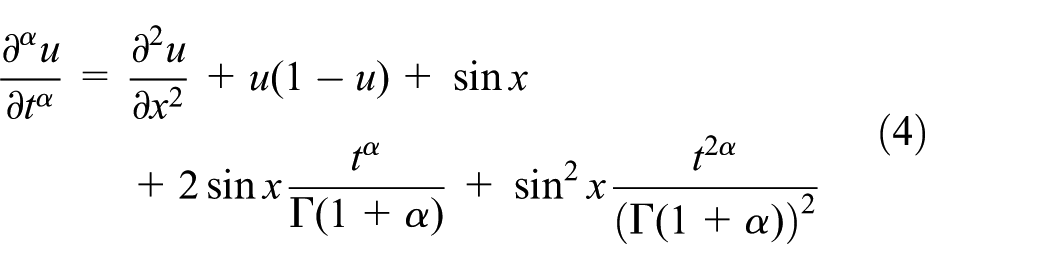

In Baranwal et al., 22 an analytic algorithm for time fractional nonlinear reaction–diffusion equations (3),(4) and (5) based on a new iterative method (NIM). In Bhrawy, 20 the authors used Jacobi collocation method in order to find the approximate solutions of equation (3). SZ Rida et al. 21 used generalized differential transform method for numerical solutions of equation (3). Khan et al. 23 applied homotopy analysis method (HAM) and Merdan 24 applied fractional variational iteration method (FVIM) for series solutions of equation (3).
In these equations, the function
In section “Basic definitions of fractional calculus theory” of this work, some preliminary results related to the Caputo derivative and the fractional power series (PS) are described. In section “Applications for RPSM algorithm and graphical results,” the base opinion of the RPSM is constituted to construct the solution of the time fractional nonlinear reaction–diffusion equations and some graphical consequences are included to demonstrate the reliability and efficiency of the method. Finally, consequences are introduced in section “Conclusion.”
Basic definitions of fractional calculus theory
We first illustrate the main descriptions and various features of the fractional calculus theory 2 in this section.
Definition 1
The Riemann–Liouville fractional integral operator of order


Definition 2
The Caputo fractional derivatives of order

where
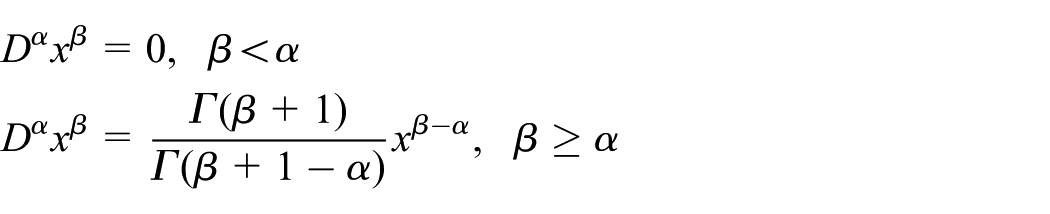
For the Caputo derivative we have
Definition 3
For

and the space fractional derivative of order

Definition 4
A PS expansion of the form

is named fractional PS at
Definition 5
A PS of the form
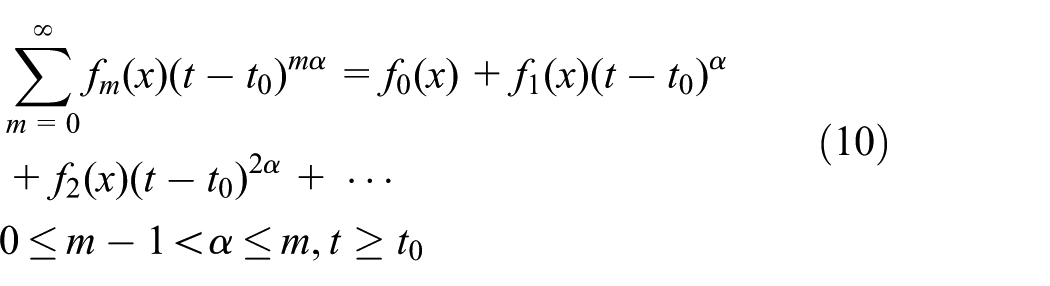
is named fractional PS at
Theorem 1. (see El-Ajou et al. 16 for proof)
Only if

If

where
Result 1
The fractional PS expansion of

which is a generalized Taylor’s series formula. To specify, if one set

is obtained. 16
Applications for RPSM algorithm and graphical results
Example 1
First, we consider time fractional Fitzhugh–Nagumo equation.21,23

by the initial condition

The exact solution for equation (13) for
We apply the RPSM to find out series solution for the time fractional Fitzhugh–Nagumo equation subject to given initial conditions by replacing its fractional PS expansion with its truncated residual function. From this equation, a repetition formula for the calculation of coefficients is supplied, while coefficients in fractional PS expansion can be calculated repeatedly by repeated fractional differentiation of the truncated residual function.13,26
The RPSM propose the solution for equations (13) and (14) with a fractional PS at

Then, we let

where
Also, equation (16) can be written as

At first, to find the value of coefficients

and the kth residual function,

As in the literature,11–14 it is clear that

to get the required coefficients
Hence, to determine

where

for

Therefore

From equation (19) we deduce that

Therefore, the first residual power series (RPS) approximate solutions are

Similarly, to find out the form of the second unknown coefficient

where

Therefore

From equation (19), we deduce that

Therefore, the second RPS approximate solutions are

Similarly, to determine

where

Therefore

From equation (19), we deduce that

Therefore, the third RPS approximate solutions are

Similarly, applying the same procedure for

Therefore, the fourth RPS approximate solutions are (Figure 1)
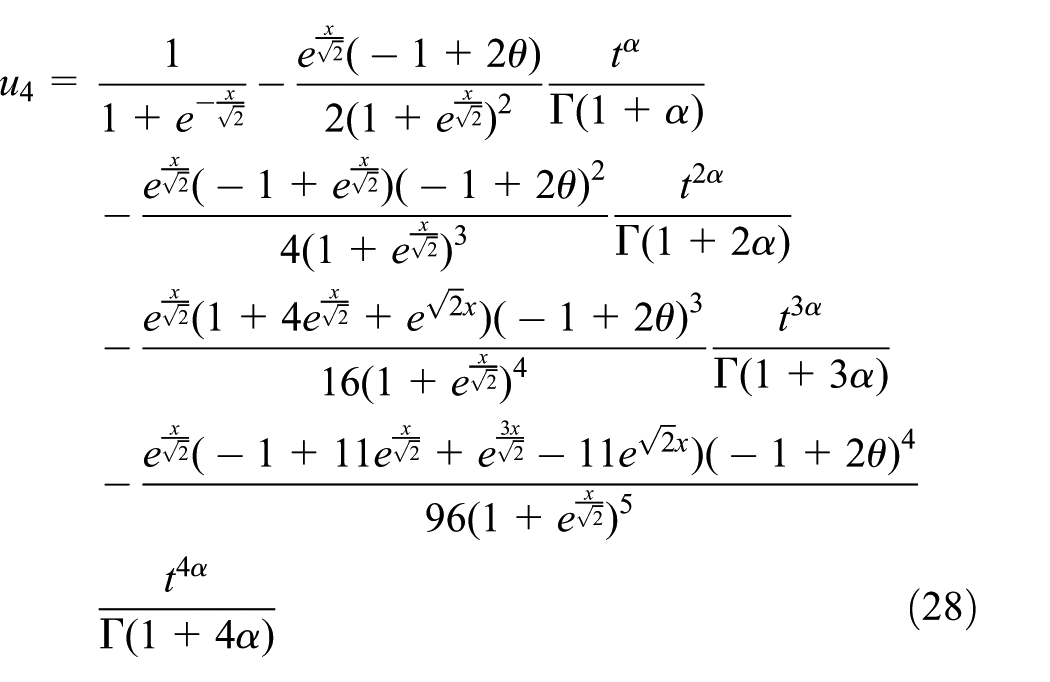
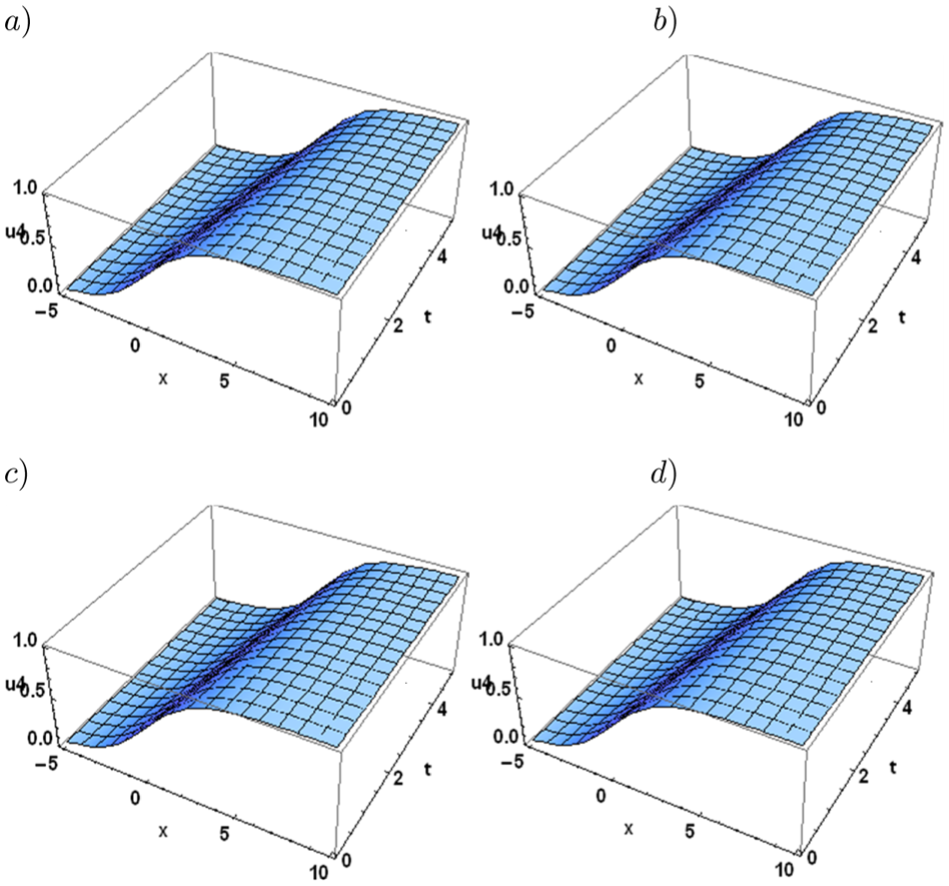
The surface graph of the exact solution
In where, we plot the RPS approximate solution

Figure 3 clears that

In Table 1, comparison among approximate solutions with known results is made. These results are obtained using RPSM, HAM, 21 FVIM, 24 and an NIM. 22
Comparison between approximate solutions

These table clarify the exact error is being smallest in the value of the
Example 2
We consider time fractional non-homogeneous reaction–diffusion equation

by the initial condition

For equation (29), the kth residual function,

We apply repeating process as in the former application

Therefore, the first RPS approximate solutions are

which, in fact, is the exact solution of equation (29) (Figures 4 and 5).

The surface graph of the exact solution

Example 3
We study two-dimensional time fractional Fisher equation

by the initial condition

The exact solution for equation (35) for
For equation (35), the kth residual function,

We apply repeating process as in the former application


Therefore, the fourth RPS approximate solutions are

Figures 6 and 7 clear that the exact error is being smaller as the number of
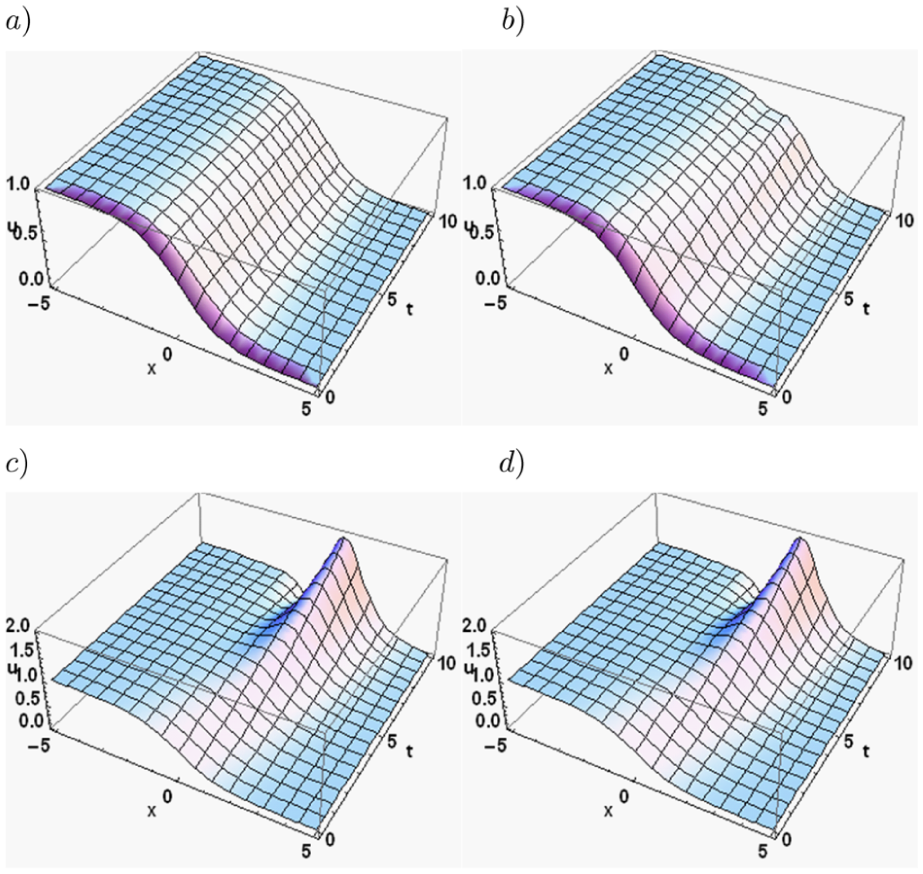
The surface graph of the exact solution
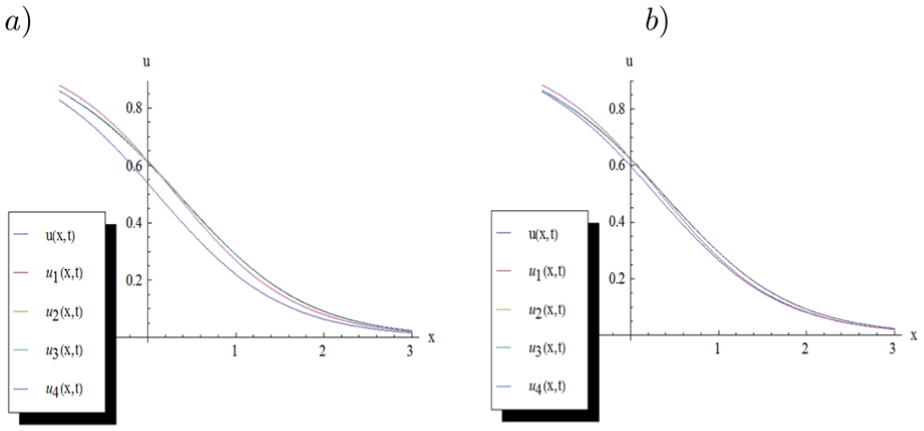
In Figure 8, we plot the RPS approximate solution

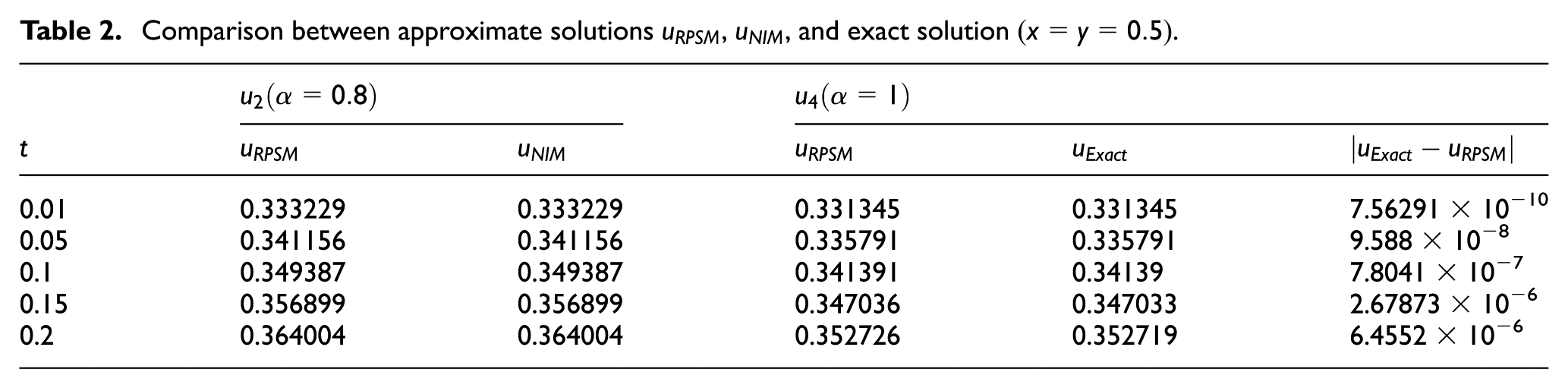
In Table 2, comparison among approximate solutions with known results is made. These results are obtained using RPSM and an NIM.
22
This table clarifies the convergence of the approximate solutions to the exact solution, and exact error is being smaller as the value of the
Comparison between approximate solutions
Conclusion
The RPSM is applied successfully for solving the nonlinear fractional differential equations. The fundamental objective of this article is to introduce an algorithmic form and implement a new analytical repeated algorithm derived from the RPS to find numerical solutions for the time fractional reaction–diffusion equation. Graphical and numerical consequences are introduced to illustrate the solutions. Thus, it is concluded that the RPSM becomes powerful and efficient in finding numerical solutions for a wide class of linear and nonlinear fractional differential equations. From the results, it is clear that the RPSM yields very accurate and convergent approximate solutions using only a few iterates in fractional problems. The work emphasized our belief that the present method can be applied as an alternative to get analytic solutions for different kinds of fractional linear and nonlinear partial differential equations applied in mathematics, physics, and engineering.
Footnotes
Academic Editor: Mohana Muthuvalu
Declaration of conflicting interests
The author(s) declared no potential conflicts of interest with respect to the research, authorship, and/or publication of this article.
Funding
The author(s) disclosed receipt of the following financial support for the research, authorship, and/or publication of this article: This research project was supported by a grant from the “Research Center of the Center for Female Scientific and Medical Colleges,” Deanship of Scientific Research, King Saud University.