



Abstract
The fractional reaction diffusion equation is one of the popularly used fractional partial differential equations in recent years. The fast Adomian decomposition method is used to obtain the solution of the Cauchy problem. Also, the analytical scheme is extended to the fractional one where the Taylor series is employed. In comparison with the classical Adomian decomposition method, the ratio of the convergence is increased. The method is more reliable for the fractional partial differential equations.
Keywords
Introduction
The fractional calculus has been extensively used in nonlinear sciences and has become an increased topic of interest in recent years. The fractional differential or partial differential equations have been proposed in the fractional modeling. Many analytical methods have been developed, such as the Adomian decomposition method (ADM),1,2 the variational iteration method,3–6 the reproduce kernel method,7,8 and so on. We just list few here.
The famous ADM is named after G Adomian9,10 who first proposed it in 1989 for solving the nonlinear differential equation. The idea is simple and nice. For a linear differential equation, one can use Laplace transform to solve the initial value problem. But for the nonlinear ones, since there are nonlinear terms resulting in difficulty in the analytical calculation, one cannot solve the equation exactly. The ADM can linearize the term and can play a crucial role in speeding the convergence of the approximate methods. However, the classical Adomian series calculation, one of the important steps in the method, is not so easy. Particularly for the fractional calculus, since there is the memory effect of the fractional derivative operator, the computation becomes more complicated and costs much time.
Very recently, Duan and colleagues11–14 proposed an alternative way to calculate the Adomian polynomials. Within the same iteration step or the truncated order, one can quickly obtain the approximate solutions. For example, the method together with the Taylor series is used for the chaotic differential systems. 13 For the fractional differential equation, it shows a very efficient tool to find the analytical approximate solutions. 14 The calculation has been done using the Runge–Kutta method. The result shows a great perspective over other analytical methods.
In this article, the method is used to solve the Cauchy problem of the fractional reaction diffusion equation. We first give the iterative scheme for the reaction diffusion equation of the integer order. Then together with the fractional Taylor series, we investigate the model of the fractional case. Finally, we conclude our work.
Some basics
Let us first revisit the fractional calculus and some other basic properties.
Definition 2.1. The Caputo derivative 15 is defined as

where
Definition 2.2. The Riemann-Liouville (R-L) integration
15
of

We also need the following integral transform so that the fractional differential equation can be reduced to an integral one and the ADM can be applied.
Properties 2.3. The Leibniz integral law 15 holds

Properties 2.4. Let

Algorithm for the reaction diffusion equation of fractional order
In this section, we investigate the reaction diffusion equation fractional order. 16 Let us first consider the one in ordinary calculus.
Reaction diffusion equation of integer order
The famous reaction diffusion equation reads

subjected to the Cauchy condition

According to the basic idea of the ADM, we give the scheme as follows:
Step I. Taking the integral on both sides, one has

Step II. Considering the solution in the Taylor series

one can have the following iteration formula

where
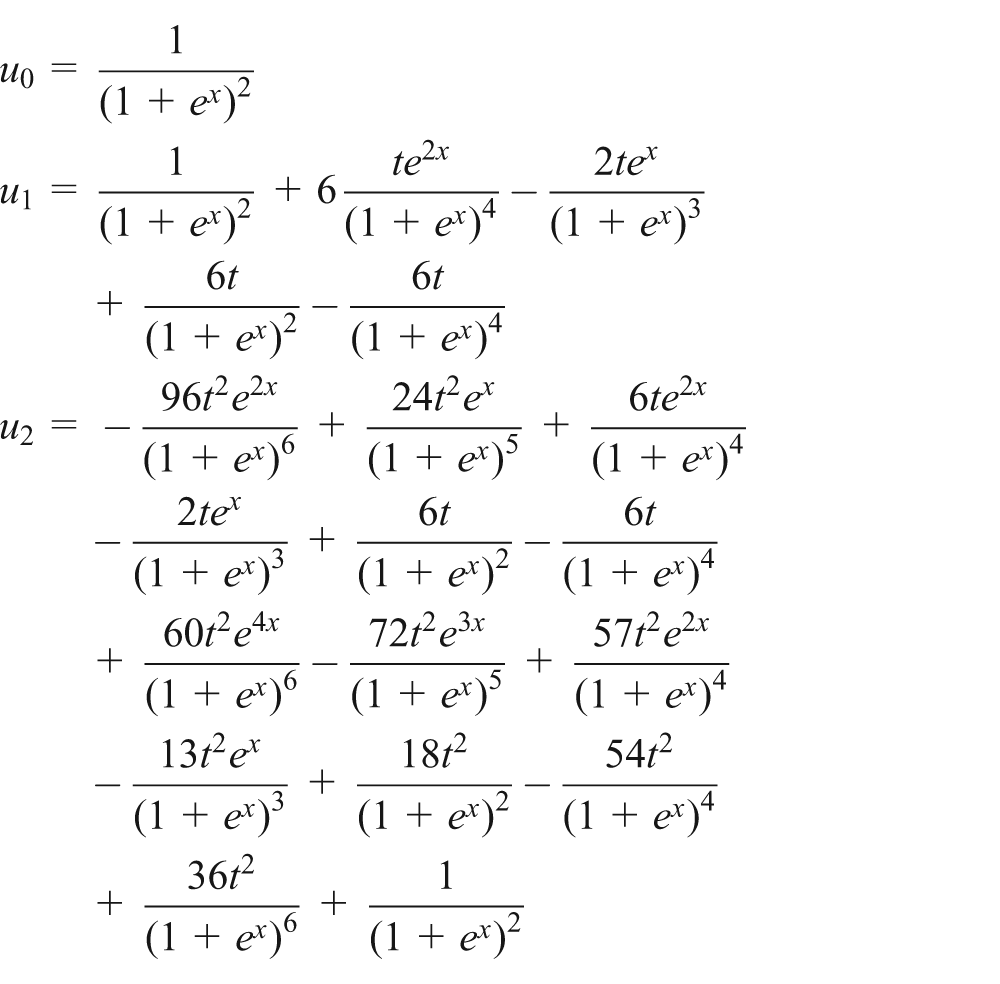
Together with the following given exact solution

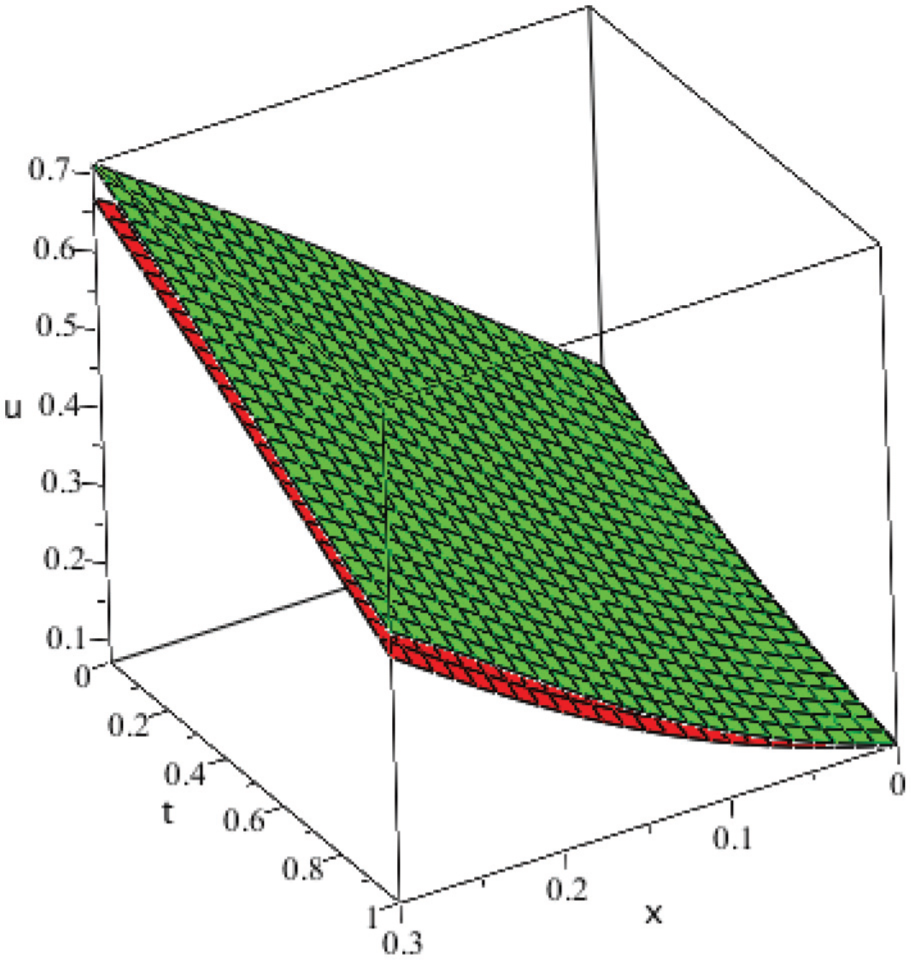
We plot

Approximate solution (green surface) versus exact solution (red surface).
We can see the approximate solution has a good agreement with the exact one (equation (9)) which shows the algorithm’s validness. For the other recent development, readers are referred to other works, for example, the applications to fractional differential equations,17–20 integral solutions, 21 and transformations of the series. 22
Now let us consider the fractional case.
Reaction diffusion equation of fractional order
The time-fractional reaction diffusion equation is given in Podlubny 15 as

subjected to the same Cauchy condition (6).
We present the steps as follows. We only need to make some changes according to section “Reaction diffusion equation of integer order.”
Step I*. Taking the fractional integral (1) on both sides, one has

Step II**. According to the idea, 14 we assume that

One can have the following iteration formula

We now discuss the effects resulting from the fractional order. We vary
Reaction diffusion behaviors for

Reaction diffusion for

Reaction diffusion for

Reaction diffusion for
Conclusion
This article applies the fast ADM to investigate the Cauchy problem of the fractional reaction diffusion equation. Then we extend the method to the time-fractional equation. We compare the approximate solution with the exact one and discuss the diffusion behaviors for various fractional orders. The fast ADM is suitable for solving the Cauchy problem of the fractional partial differential equations. We will further consider the various boundary value problems such as the initial boundary value condition, the Robin condition, and so on in the nearest future.
Footnotes
Academic Editor: António Mendes Lopes
Declaration of conflicting interests
The author(s) declared no potential conflicts of interest with respect to the research, authorship, and/or publication of this article.
Funding
The author(s) disclosed receipt of the following financial support for the research, authorship, and/or publication of this article: This work was financially supported by National Natural Science Funds of China (No. 51504208), the Open Fund of the State Key Laboratory of Oil and Gas Reservoir Geology and Exploitation (Southwest Petroleum University; No. PLN1421), the SWPU Science & Technology Fund (No. 2013XJZ029), and the Scientific Fund of the Sichuan Provincial Education Department (No. 14ZB0060).