




Abstract
Russia's invasion of Ukraine in February 2022 caused ideological confusion in South Africa, which holds Russia in high esteem as a Brazil, Russia, India, China, and South Africa (BRICS) partner and a major player in Africa's political economy since 2000s. Against this background, this article examines the coverage of the Russia–Ukraine war on selected days from the start of the war to April 2022 on the South African Broadcasting Corporation (SABC). Through content analysis, the study concludes that war-related topics that received the most coverage were security, peace, United Nations, and civilians. War-related topics that received least coverage on SABC News were sanctions, battlefield, EU policies, nuclear, U.S. policies, justification, and disinformation. The article argues that SABC News coverage was largely objective.
Introduction
The South African Broadcasting Corporation's (SABC) coverage of the Russia–Ukraine war is examined in this article in the context of South Africa's ideological position(s) on the conflict, more especially as a Brazil, Russia, India, China, and South Africa (BRICS) member. Adopting this approach assists in evaluating if the SABC covered the Russia–Ukraine war from its own independent point of view or represented the South Africa government position(s), or if it framed the war through BRICS or Western lenses.
South Africa joined the Brazil, Russia, India, and China (BRIC) coalition of emerging economies in 2010, extending it to BRICS. Ideologically, this aligned with the country's foreign policy of strengthening South–South relations. By late 2010, BRICS was already a powerful economic bloc, with the International Monetary Fund projecting its growth soon to be 61%; South Africa itself was growing economically. The 2010–2011 Global Competitiveness Report by World Economic Forum ranked the country favourably in relation to other BRICS members. The 2010 UN Conference on Trade and Development put South Africa in the top 20 of priority economies for foreign direct investment in its World Investment Report (South African Government, 2022).
The Russia–Ukraine war obviously raised issues of solidarity with Russia by other BRICS members, although different views on this exist. Western analysts, for example, have described the Russia–Ukraine war as the post-Cold War turning point for the emergence of a new world order. In the global South, on the other hand, the war has resuscitated ideas of foreign policy autonomy and non-alignment (Sidiropoulos, 2022). South Africa, in this context, has vacillated between its strongly worded statement from the Department of International Relations and Cooperation (DIRCO) on the opening day of the war calling on Russia to withdraw from Ukraine and DIRCO's Deputy Minister, Candith Mashego-Dlamini going as far as to urge South African citizens not to take sides (Comins, 2022) and to Defence Minister Thandi Modise's defence of South Africa's neutrality (Stoltz, 2022).
Since South Africa backtracked on its early call for Russia to withdraw from Ukraine, officials have avoided using the words ‘war’ and ‘invasion’ with reference to Ukraine and have at least in part blamed the North Atlantic Treaty Organization (NATO) alliance for the ‘conflict’, while acknowledging what they described as legitimate Russian security concerns. Against South Africa's BRICS membership and accusation that it supports Russia in the ongoing Russia–Ukraine war (even being accused later by the United States of selling arms to Russia), it becomes important to examine how South Africa's largest news media producer, the SABC, covered the Russia–Ukraine war.
The SABC
The SABC, although not a State, but a Public Service Broadcaster (PSB), is closer to state power than any other media organisation in South Africa and it has historically proven to be open to political manipulation. Furthermore, the SABC is the country's largest transmitter of audio–visual news, reaching a broader citizenry through radio, TV and online digital platforms. For most South Africans watching broadcast news, the SABC was the window through which they saw the Russia–Ukraine war. Of its six nationwide TV channels, the three generalists SABC1, SABC2 and SABC3 are legally mandated to carry conventional news bulletins in their daily programming. Its 19 radio stations too, broadcasting in country's all 11 official languages, must provide hourly news. All these news platforms receive and transmit news from the SABC News, a national news department, which collects, produces and distributes local, national, regional (Africa) and global news for all the SABC channels, including the growing online/digital news platforms. Of the TV channels, the sixth one, the focus of this study and sharing the same name as the national news department, is a satellite and subscription-based news channel called SABC News.
SABC NEWS
The Russia–Ukraine war coverage analysed in this study is drawn from the SABC News, the 24-h news channel with a regional and global reach. Enabling its ability to reach 50 of 54 African countries is its association with South Africa's DStv/Multichoice, a dominant direct broadcast satellite service in Africa. Its regional and global reach is also enabled by its integration of digital multi-media platforms into its broadcasting.
Under the 24-h SABC News banner, there are various news and current affairs programmes, which air throughout the day, that have covered the Russia–Ukraine war. ‘Morning Live’ (06:00) is the country's leading news and current affairs morning show: ‘The Agenda’ (09:00) is a news and current affairs show; ‘On Point’ (12:00) is a business news bulletin with interviews and insights from around the world; ‘SA Today’ (15:00) brings the latest news and current affairs issues from around the country and the world; ‘Full View’ (17:00) ‘breaking news happens throughout the day; we wrap it all together to bring you the #FullView of what's happening in your world’; ‘The Watchdog’ (20:00) calls itself a hard-hitting news and current affairs show, and ‘The Globe’ (21:00) moves beyond the country's borders and offers an in-depth look at global news through a network of international correspondents. Depending on how the news stories of the day develop, these news programmes present almost the same news content, all produced by the SABC news department. Thus, the Russia–Ukraine war stories analysed were the same across SABC TV channels, just presented in different news programmes at different times. These were analysed through the following method.
Methodology
This study followed the content analysis guidelines of the international study ‘Coverage of the Russia–Ukraine war by television news in nine countries’, edited by Nordenstreng (2022). News programmes for the content analysis were selected from 24 and 28 February, 3, 7, 10, 17, 24 and 31 March, 7 and 14 April, constituting a 10-day sample. The content analysis was conducted by examining items directly focused on the war; here also referred to as ‘stories’. For SABC News, these varied from 1 to 30-min presentations containing material from the studio or from outdoors. Each news item was then attributed to one of the 13 pre-identified topics. These were battlefield, civilians, disinformation, EU policies, justification, nuclear hazard, peace, refugees, sanctions, security, United Nations (UN), U.S. policies, and other war-related. Items were also classified according to the national perspectives or angles which they represented. The quantitative analysis was complemented by a qualitative analysis, identifying specific narratives in the coverage.
These news programmes were acquired from SABC for analysis in this study. The SABC downloaded its archived Russia–Ukraine war news stories as they were presented on the sample days, on different news bulletins. Accordingly, the object of this country report is not a single news programme but a whole channel. The SABC News covered the following topics.
Topics
Table 1 below gives the figures of the number of war-related news items and their accumulated duration on the 10 sample days for the 13 topics included in this study. The total number of items discovered in the SABC News Channel was 100 and their total duration was over 153 min. The figures show that SABC News covered all the 13 topics. Of these, the top five, measured by number of news items, were security (14%), peace (14%), other war-related stories (12%), UN (11%) and Civilians (11%). The top five topics, in terms of duration by minutes, were security (18%), refugees (15%), UN (14%), civilians (14%) and peace (12%).
Topics by number of war-related news items and coverage duration in minutes on SABC news channel.
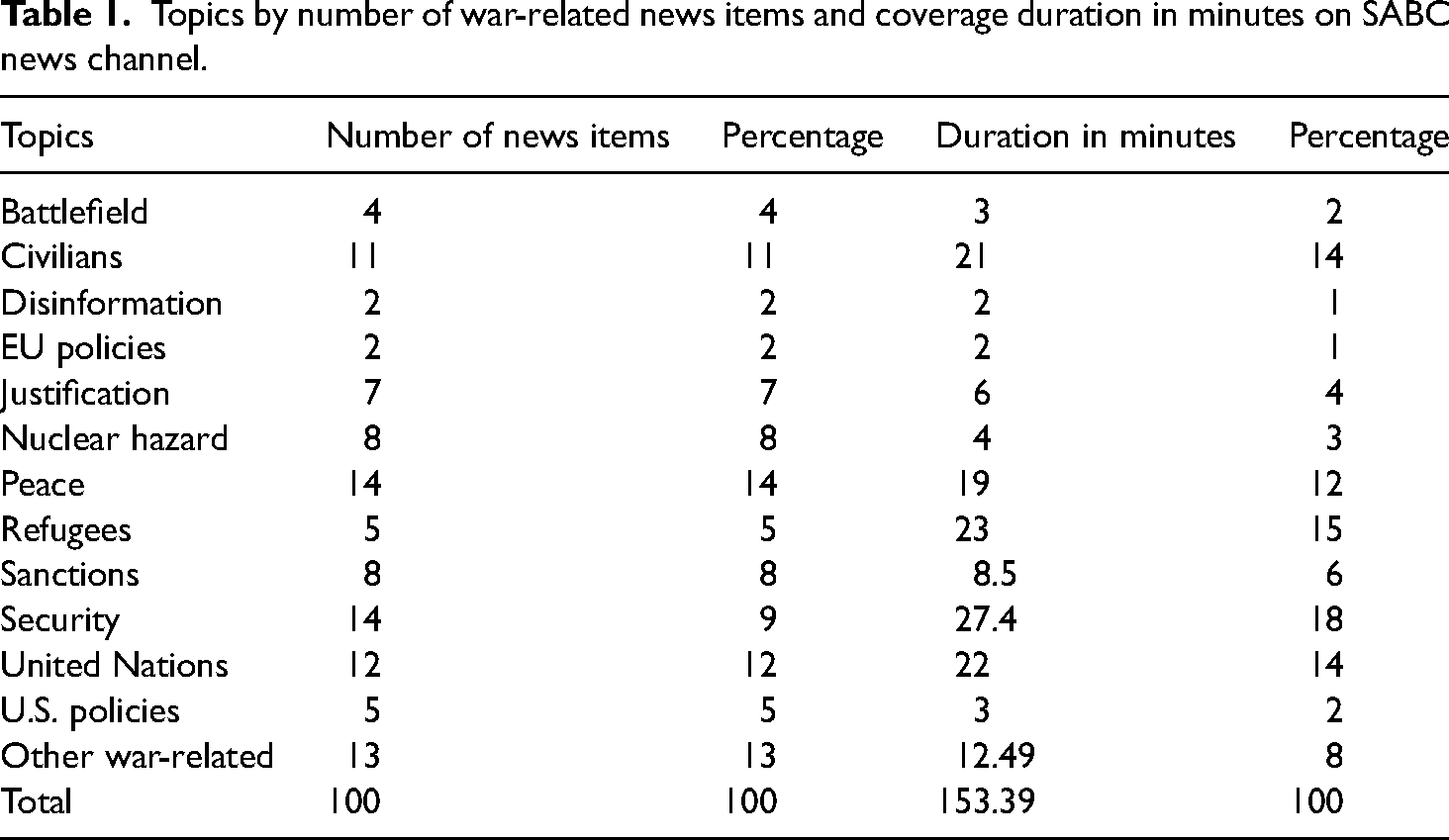
Table 2 lists the duration of SABC News items on each sample day from 24 February to 14 April.
Sample days by topics of duration of war-related news in percentages on SABC news channel.
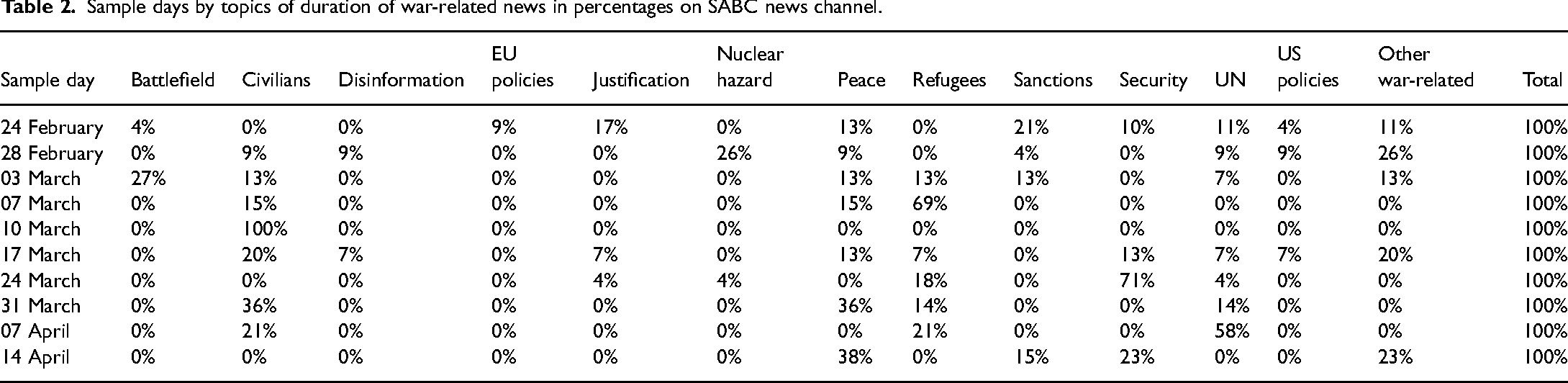
On 24 February, the first day of Russia's invasion, the coverage on SABC News was dominated by the sanctions topic (21%). It was covered on only the first three and the last of the 10 sample days but not at all on the other sample days. The second leading topic on 24 February was Justification, which was subsequently to be sparsely addressed.
On 28 February the nuclear hazard topic dominated (26%), matched by other war-related topic. Interestingly, although other war-related topic was later to occupy a central space in the news treatment, nuclear hazard was to henceforth feature only peripherally, on 24 March at 4%.
On 3 March the battlefield topic dominated. Having been covered already on 24 February (4%), it was never covered on other days after that, making it, in the end, the third least frequently covered topic.
On 7 March the topic of Refugees was the leading one. Not only was it covered substantially (69%), but it was also reported on six of the 10 sample days. To this extent, the issue of refugees received regular and substantial attention from SABC, as will be shown below.
The civilians topic was the only war-related topic covered on its own (100%) on 10 March. In addition, it was covered less on six of the 10 sample days. Apart from covering civilians in-depth and regularly, this was one of the leading topics on 17 March (20%) and 31 March (36%). Matching the civilians topic on 17 March was the topic of other war-related stories.
The security topic received serious attention on 24 March. Although it was reported in detail (71%) on this day, it was covered on four of the 10 sample days. This topic had the most news items on the channel.
The peace topic was one of the two dominant topics, along with civilians, on 31 March, amounting to 36%. This topic once again dominated on the last sample day 14 April (38%). It was covered on seven of the 10 sample days.
The UN topic, although mentioned regularly, on seven of the 10 sample days, dominated only on 7 April (58%).
The EU policies featured only on the first day of the invasion and not prominently (9%).
The U.S. policies were reported on three of the 10 days and with quite short duration (49%).
The disinformation topic appeared only on two of the sample days and with fairly low attention (7–9%).
The other war-related news topic dominated on 28 February and 17 March. It was present in half of the sample days.
Angles
Table 3 shows the angles represented by the coverage on SABC News measured by the time devoted to the five angles applied in this study.
Angles by duration of all war-related news on SABC news channel.
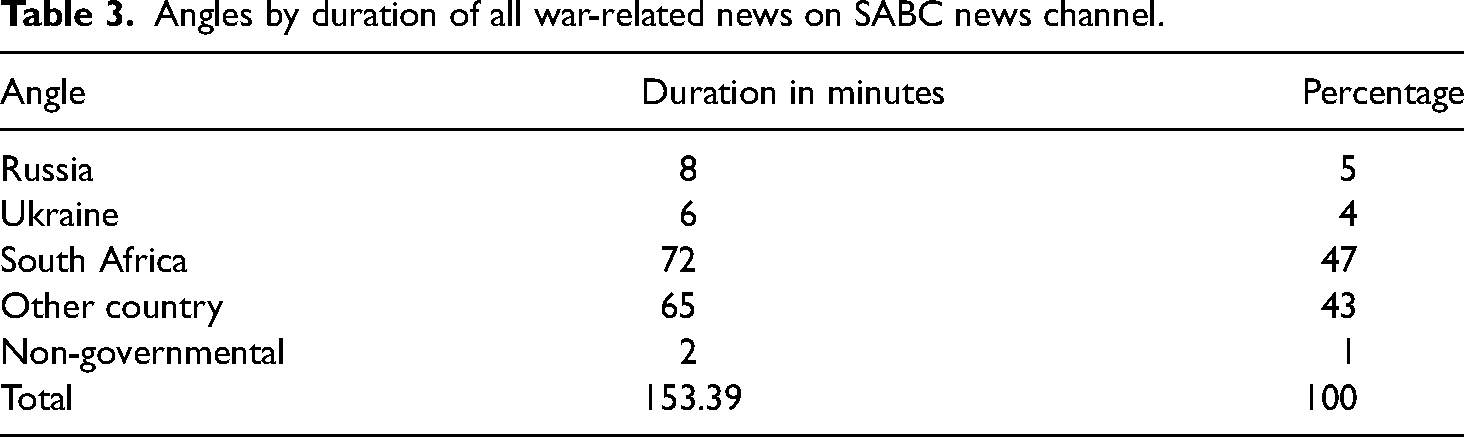
Table 3 reveals that most of the war-related stories on SABC News in the sample period were covered from the home country South African angle (47%), followed by other country angle (43%). The Russia angle was 5%–1% above Ukraine. Only 1% of stories were covered from the non-governmental angle. The topics and angles represented in them are reviewed below in the order of frequency.
Security
Fourteen news items constituted the security topic. They had the longest duration of 27.4 min and accounted for 18% of the total news coverage in the period under review. The topic was covered on four of the 10 days of the sample period. Crucially, when it was focused for some days, as was the case on 24 March 2022, the security topic was covered in greater detail (71%) and covered largely from the South African angle (74%).
Peace
This topic had an equal number of news items as security, accounting for 14%. The combined duration of these was 19 min, accounting for 12% of the total duration of all news items studied. Peace was covered on seven of the 10 days of the sampling period. The peace topic was covered mostly from the South African angle (87%).
Other war-related topics
Twelve news items came under the other war-related topic, accounting for 12% of the number of news items. Combined, their duration accounted for 8% of the total coverage. The other topic appeared on five of the 10 sample days, presented largely from the South African angle (53%).
UN
The UN topic featured prominently on the SABC News coverage of the war. There were 11 UN-related news items in the sample period, 11% of all stories. The UN-related news items had one of the longest duration coverages (14%). The UN topic was covered mostly from the other country angle (91%).
Civilians
The topic of civilians was crucial to the SABC News treatment of the war. It had 11 news items (11%) and it had the fourth longest coverage duration of 21 min, after Security, Refugees and the UN, accounting, as such, for 14% of the total duration of news items. The Civilians topic was covered largely from the other country angle (52%) and then from the South Africa angle (40%).
Sanctions
Eight news items constituted the Sanctions topic in the 10-day sample period (8%). Their combined duration accounted for 6% of the total time. Half of this topic was reported from the other country angle, effectively from the perspective of Western institutions and countries. One-fourth was covered from the Russian angle and slightly less from the South African angle.
Justification
Seven news items addressed the Justification topic (7%). These were reported on three of the 10 days of the sample period. The duration was 6 min, accounting for 4% of the total time. Half of the stories under this topic were reported from the Russian angle, one-fourth from the South African angle and the rest from the other country angle.
Refugees
Six items focused on the refugees topic (6%). Of these stories, two-thirds were reported from the other country angle and the UN angle. These stories, although few in number, were reported in greater depth, with a combined duration of 15%. One-third was reported from the South African angle.
U.S. policies
Five items were on U.S. policies in relation to the war (5%). They were 3 min long in duration, accounting for 2% of the total coverage. All of these stories were reported from the other country (United States) angle.
Nuclear hazard
The nuclear hazard topic had four news items (4%). They had a duration of 4 min and accounted for 3% of total coverage. The topic was presented mostly from the South African angle and marginally from the other country angle.
Battlefield
Four news items throughout the 10-day sample period were about the Battlefield topic (4%). They had a combined duration of 3 min and accounted for 2% of news coverage time. Two-thirds were from the South African angle and one-third from the Ukraine angle.
Disinformation
There were only two news items on Disinformation topic (2%). They were 2 min in duration, accounting for 1% of the coverage. Both were from the South African angle.
EU policies
There were only two news items on the EU policies (2%). Their combined duration was 2 min, which was 1% of the overall duration of all news items. Both were reported from the other country angle.
Key narratives
Like other countries, South Africa also identified specific narratives in the news stories, including their tones in a positive, negative or neutral direction relating to the main parties to the conflict: Russia, Ukraine and the West. The following section is a review of how the key narratives as well as domain angles were presented in each of the 13 topics, ranked in the order of frequency as in Table 1.
Security
The security topic had a high level of coverage throughout the sample period as documented in Table 1. One news item on this topic was related to the security of other Eastern European countries, with a negative tone. The other focused specifically on Africa and in terms of a different kind of security, that is, food and economic security – also negatively.
Two news items related to Ukraine's insecurity as consequence of the Russian invasion, with neutral tone: Ukraine has responded to Russia's invasion by closing its airspace to civilian flights. But the Eastern European nation has also stopped the movement of commercial vessels in the Azov Sea. It says there is a high risk to safety due to the military activities.
The Russia angle on security matters in this context was not covered much or it mattered less. The SABC News, however, did have an analyst who presented the following: And these are some of the concerns that you know, Russia has raised in terms of the potential that, you know, this could get to its borders with Ukraine and hence, the reason why we are where we are in the first place.
NATO received more attention here, specifically in terms of security preparations. There were four news items, neutral in tone, in this regard: NATO has ordered its military commanders to intensify preparations to defend allied territory after Russia invaded Ukraine and it has put hundreds of war planes and ships on alert.
The UN's reaction to Russia's security threats had three news items, neutral in tone: The Security Council meeting follows a ruling yesterday by the International Court of Justice by 13 votes to two that the Russian Federation shall immediately suspend the military operations that it commenced on 24 February 2022 in the territory of Ukraine by 13 votes to two: the Russian Federation shall ensure that any military or irregular armed units which may be directed or supported by it, as well as any organizations and persons which may be subject to its control or direction, take no steps in furtherance of the military operations referred to in point one above.
It is plausible to argue that the SABC News positioned Russia as presenting a security threat to the other countries concerned.
Peace
The Peace topic had the equally highest number of news items on SABC News coverage as the Security topic. Two primary themes typified the reporting on the Peace topic. The first theme centred on different countries’ and/or international institutions appeals for peaceful and diplomatic solutions to the war, revolving around calls for the Russia–Ukraine war to end, a proposal that was weighted heavily against Russia. The second theme rested on the reporting that fighting countries themselves were planning to negotiate and/or there were already ongoing talks of one form or the other, about the war, some aspects of it, or humanitarian aspects of it.
Six of the 14 news items constitutive of the Peace topic were connected to the first theme, that is, propositions by different countries and international organizations for peaceful and diplomatic solutions to the Russia–Ukraine war, as well as for the war to end. On the very first day of Russia's invasion of Ukraine, for example, the SABC News reported, in reasonable detail, on the South African government's response/reaction to the Russia's invasion. South Africa's DIRCO had issued a statement, which at this stage was characteristically blunt, calling for a peaceful resolution to the escalating conflict.
South Africa had, in a straightforward manner, called on Russia to immediately withdraw its forces from Ukraine in line with the UN Charter, and to settle any disputes by peaceful means. South Africa's call for peace and SABC's heightened focus on it, by default or design, endured. Coincidentally, for example, as SABC News had ‘opened’ with South Africa calling for peace on the first day of this study's sample, it also ‘closed’ with South Africa calling for peace on 14 April 2022. On the same last day of the sample period the SABC News reported on the decision by the South African National Assembly to appoint its Speaker, Nosiviwe Mapisa-Nqakula, to mediate on the Russia–Ukraine conflict.
Furthermore, SABC News granted space to both Russian and non-Russian supporters to air their perspectives in relation to peace. The SABC News reported, for example, that the United States – Russia's arch-rival – remained really committed to diplomacy being given a chance. Iran too, Russia's strong supporter, was covered saying dialogue should be given an opportunity. France and Mexico's draft humanitarian resolutions were also mentioned by the SABC News as part of the peace efforts by third parties. Efforts by the Turkish President regarding the possible outcome of negotiations being finalized in Turkey were reported on, likewise those by Belarus, Russia's ally in this conflict.
Regarding the second theme on this topic and with eight news items, the SABC News repeatedly reported on diplomatic efforts by the Russians and Ukrainians to find solution to their conflict. The channel reported on video conferences taking place where the two parties were still talking to each other, and where military, political and humanitarian issues were being discussed.
SABC News's substantial focus on the Peace topic, by default or design, was congruent with South Africa's ideological stance on the Russia–Ukraine issue. South Africa consistently called for a peaceful resolution to the conflict and for diplomacy to prevail. The DIRCO statement on the very first day on the invasion centred on Peace and on the consequences of not pursuing it. That said, South Africa's stance of not openly condemning Russia and its voting posture in the UN through abstaining on Russia–Ukraine matters is viewed not only as sitting on the fence, but as supportive of Russia, its BRICS partner.
Other war-related topics
Naturally, the 12 news items classified under this topic could not fit perfectly within the specific topics of included in this study. There were items in this category that related to the reaction and shock of what SABC News described as world leaders because of Russia's invasion of Ukraine; pressure on BRICS members to take an ideological stand on the war; the ideological ambiguity of South Africa; the unequal power relations in the UN Security Council; the activities of the International Criminal Court were focused on; the reaction of the Russian representatives to Putin having been called a war criminal; and South Africa accusing the Ukrainian Ambassador to the country of using undiplomatic ways to seek an audience with President Cyril Ramaphosa.
Thus, under this topic, the SABC News covered a wide range of matters and gave diverse voices room for articulating their perspectives. Part of this was achieved by SABC's emphasis on the UN.
UN
The UN activities, as they related specifically to the Russia–Ukraine war, featured prominently on SABC News, as shown above. The UN topics developed along three themes: UN condemnation of Russia/speeches by UN representatives in a negative tone; UN reports on the civilian crisis, also in a negative tone; and South Africa's position on UN matters with a neutral tone.
Where SABC News focused on the UN topic, it focused on the UN's Security Council and the General Assembly. For the Security Council, the reporting would focus on the veto powers of certain member countries, for example, Russia blocking resolutions, and South Africa calling for the democratization of the UN Security Council. The voting of various countries in the UN General Assembly was another dimension focused on by the SABC News. The SABC would report, for example: The resolution received 141 votes in favour and 35 abstentions while four countries joined Russia in voting No – Belarus, Syria, North Korea, and Eritrea.
Furthermore, the SABC News concentrated on the UN in terms of the speeches of its senior representatives, more specifically its Secretary General, Antonio Gutierrez. The SABC reported, for example: ‘Antonio Gutierrez urges Russian President Vladimir Putin to recall his troops and says Putin needs to put a stop to what could be the worst war since the beginning of the century’.
In most cases, if not all, and as can be inferred from the above quotation, the speeches and resolutions were very critical of Russia's invasion of Ukraine, as the following report attests: ‘[UN] condemned in the strongest terms the Russian Federation's aggression against Ukraine and decided that the Russian Federation shall immediately cease its use of force against Ukraine and shall refrain from any further unlawful threat or use of force. It also decides that the Russian Federation shall immediately, completely, and unconditionally withdraw all its military forces from the territories of Ukraine within its internationally recognized borders’.
SABC News also reported in detail on the UNs’ humanitarian concerns, giving space for long interviews to the UN and its agencies, especially in relation to explaining the civilian and refugee situations. For example: ‘We go live now to Ukraine, and we’re joined by UNICEF's spokesperson … A lot of families are on the streets cooking food for people who are coming through the city. It's about 600 kilometres from Livia here, and only 80 kilometres from the Polish border’.
Also, the SABC News reported as follows: ‘The UN reported that more than 1.5 million refugees have crossed from Ukraine into neighbouring countries in just the past 11 days amid bitter urban fighting and Russian bombing campaigns against major cities’.
Civilians
Civilians as a distinct topic for analysis in this study were crucial to the SABC News’ treatment of the Russia–Ukraine war. Fundamentally, anguish and trauma were the overriding narrative of the topic on civilians. The only other theme that developed in relation to civilians regarded them as people imbued with fortitude. The idea of anguish in relation to reporting on civilians began on 24 February, when the SABC News featured Ukrainian civilians withdrawing money in panic, while sirens summoned them to places of safety. Two reports, henceforth, progressed into focusing on the number of civilians killed and injured. Naturally, this was reported in a negative tone, as the following quotation signals: ‘Officials from there say the Russian forces have killed more than 2000 civilians and destroyed hospitals, schools, and homes … At least 352 people have been killed in Ukraine following Russia’s invasion and 14 of those killed are children. A further 1684 people, including 116 children, have been injured’.
Staying with theme of anguish, five news items on the topic of civilians on SABC News focused on civilians in various forms of social distress. The report made references to the suffering of civilians and the humanitarian crisis. In many areas across the country, people urgently needed medical supplies food, water, shelter, and basic household items.
Mass exodus and displacement was also one of the news items focused on. The depth of focus on civilians by the SABC News extended to covering specific categories of civilians such as children, girls, and women, especially the number of women who had given birth during the war, as shown here: ‘Since the war in Ukraine started just over two weeks ago, more than 4300 women have given birth in the country as the UN's Population Fund highlights that it is women and girls that are disproportionately affected by war’.
If the broader narrative of the topic Civilians was of pain and suffering, only once did the SABC News report on Ukrainian civilians being praised by their President for resilience and resolve. This, too, was the only news item that was positive in tone under this topic.
Sanctions
The topic developed along two broad narratives. The first narrative here concerned Western countries’ and institutions’ plans to impose or having already imposed sanctions on Russia, other Russian people and institutions. Under this narrative, there were six news stories, reported neutrally. One of the news items, typically, reported that the EU had sanctioned several members of the Russian government and the Editor-in-Chief of Russia Today (RT). The other reported that the European Commission was considering instituting a raft of sanctions against Russia. These sanctions were to target banks, military generals and members of the Duma (the Russian Parliament): ‘What the EU unveiled yesterday was sanctions against several members of the Russian government against the Editor-in-Chief of the broadcaster RT that, of course, seems not to have deterred Russia in any sense’.
The second narrative, made up of two news items, pertained to Putin's reaction to Western-imposed sanctions. Putin was reported to be preparing nuclear arms in response to Western sanctions.
Justification
The topic developed alongside two narratives. The first narrative considered Russia’s rationale for executing the ‘special military operation’, reported neutrally. The second narrative considered the West's reaction to Putin's rationale for his special military operation, reported neutrally. There was one news item that related to the West's reaction to Russia's rationale for the invasion of Ukraine.
Regarding the first narrative, the SABC News reported that Russia had finally invaded Ukraine ‘to protect Russians who, Russia said, were vulnerable in the face of genocide, with even Vladimir Putin using that word’. SABC granted the West space to react to this view saying Putin's views were an ‘absurd pretext for war’. Furthermore, it was reported that Putin talked about the demilitarisation, denazification and de-escalation of Ukraine as a justification for the military operation: ‘So, we are still back to basics whereby Russia is invading Ukraine, because he feels that NATO is getting too close to Ukraine. It requests for demilitarization, denazification and Ukraine remaining a neutral member of NATO and of course you know, this is where we are. So, nowhere close to any form of resolution to this’.
Refugees
These stories, though six in number, were reported in greater depth, with a combined duration of 15%. The tone was negative throughout. They produced one main narrative: the number of refugees who had left Ukraine since Russia's invasion or those had been internally displaced: ‘As the war enters a third week there are more than 3 million refugees and over 2 million internally displaced ….’; ‘The 1.8 million children who’ve made it to neighbouring countries enjoy relative safety, but none of their family surroundings’; ‘UNICEF added that there were two and a half million displaced inside Ukraine’.
The SABC News reported that the UN had said a million refugees had left Ukraine since Russia's invasion began, mostly to neighbouring EU countries. At the top of this narrative of displacement were issues of safety, including that of children: ‘It's now officially Europe's largest refugee crisis since World War Two: 10% of the population has now fled the country, as the scale of this disaster continues to grow by the second’. ‘As of 27 |March, 1119 people have died, including 99 innocent children’.
U.S. policies
The SABC News had five stories focusing on the U.S. policy in relation to the war. In the main, news items on this topic concerned the U.S. attitude towards Russia and the war in Ukraine.
On the very first day of the war, the SABC News reiterated to its viewers that ‘we are going to hear from U.S. President Joe Biden shortly’. This was done throughout the whole news bulletin on 24 February. The U.S. position in the UN was also reported with the draft resolution that the U.S. ambassador was to table at the UN. The other news items revolved around President Biden's strong views on Putin and Russia.
One of the news items was about Biden calling his Russian counterpart a war criminal in relation to the Russia–Ukraine war. The SABC News gave Russia's response airtime, with Moscow slamming Biden and calling his utterances totally unacceptable. In another news item the U.S. leader referred to Russia's activities as ‘very unprecedented aggression’. Biden also dismissed Putin's comments on nuclear weapons as attempts to escalate.
Nuclear hazard
Narratives on this topic developed along two themes: the possibility of Russia using nuclear weapons and Russia using nuclear talk simply as a threat, an act of desperation, or to create a stalemate. All stories were framed in a manner that put Russia in a bad light. The SABC News reported, for example, that ‘negotiations were happening at a time when Russia put nuclear weapons on high alert. We know that in 2020 Putin approved so-called basic principles that would justify Moscow releasing nuclear weapons’.
Russia was framed in relation to nuclear weapons as an immediate threat to Ukraine and the whole world, while Germany and France considered Putin's mention of nuclear weapons as a sign that his campaign in Ukraine was not going as well as he wanted and this was an escalation to try to scare off any further Western intervention, for example, by providing more weapons or providing intelligence to Ukraine. NATO Secretary General Jens Stoltenberg also raised the concern that Russia might be trying to create a pretext for the use of chemical weapons in Ukraine.
Battlefield
There were two reports about military activities in the battlefield. On the first day SABC reported that the first explosions sounded before dawn as Putin launched his long-anticipated military operation in the Ukraine. The other news item was about the conquering of Ukrainian territories by Russian troops: ‘It's been a week since Russia invaded Ukraine. And since then, Russian troops have taken over the southern Port of Kherson. There has also been heavy shelling in Kharkiv in the east’. All these were reported in a negative tone. The only positive item here was about President Volodymyr Zelensky praising the courage of the Ukrainians in defending their country.
Disinformation
The Disinformation topic, an expanding field of study in both the media industry and scholarship, received very limited attention on the SABC News, at least in the sample period here. It was reported from the South African angle and negative in tone. One news item pointed out that ‘we are in an information war right now. It's not just about the weapons and the boots on the ground’. The other item related to the need for proper verification of evidence: ‘You should start with the evidence. And one needs to collect the evidence and separate truth from falsehood’.
EU policies
The SABC News paid EU policies minimum attention in its reporting of the war. The EU policies topic developed along the lines of sanctions: ‘That's something the European Union will be doing. It already has done, and we are expecting more sanctions to be unveiled in the next hour as the EU says those will be massive in nature’.
Conclusion
The SABC News coverage of the Russia–Ukraine war was cautious balancing between the West and BRICS. First, the coverage presented, intentionally or unintentionally, a predominantly Western world view. Most contents, although viewed from the South African angle, represented typically Western concerns, however legitimate or illegitimate.
The SABC News covered the war primarily from the South African angle (47%) and primarily also from the other country angle (43%), representing mainly the U.S. and the UN perspectives. Stories covered from the Russian angle occupied 8 min, accounting for only 5% of the coverage time; it was mainly on the Justification topic that Russia was given more airtime than other parties. Accordingly, contrary to many concerns in South Africa that the SABC News was supporting South Africa's ideological position that favours Russia, this study shows that the SABC favoured Russia only on rare occasions.
Second, the SABC News relied heavily on multilateral institutions such as the UN and the International Criminal Court, as its sources of news. These institutions were critical of Russia and shared the same world view as Western institutions and the political elites. Stories on civilians and refugees in particular came largely from the UN.
Third, the SABC News coverage of the war was not uniform but reflected the ideological schisms currently existing in South Africa in relation to this war. Despite the prominence accorded to the Western view, the SABC was conscious of its position in the south and respected sovereignty and institutions such as BRICS. The pervasive theme of peace in the coverage is in line with the position of South Africa and other African countries as well as among the BRICS members.
The SABC News concentrated largely on the security topic, as shown above. Although the coverage was mainly from the South Africa angle (74%), the actual news content focused on the lack of security in Ukraine, other Eastern European countries and Africa in terms of food and economy. Furthermore, the focus was on Ukraine's military defence against Russia and NATO's support for this. This growing lack of security was not just attributed to NATO, U.S. policies, EU policies or even to Ukraine. According to the framing of these news items, it was so because Russia had invaded Ukraine, a term SABC News used repeatedly in its reporting.
Furthermore, SABC News consistently framed Russia as the source of others’ misery. This was also clear in the presentation of UN, United Nations International Children's Emergency Fund (UNICEF) and International Criminal Court (ICC). The UN and ICC speeches, reports and resolutions were disproportionately critical of Russia. It is not an argument here that the SABC was biased against Russia per se. It was the number of news items and their duration that gave more space to other parties than Russia. To the extent that Russia may have had security concerns, legitimate or illegitimate, they either received less coverage or they mattered less. On this basis, it is hardly plausible to argue that just because South Africa has close historical ties with Russia and BRICS, these were extended to the way the Russia and the war was framed, at least on security issues. The same applies to peace issues, the other main topic of the coverage as shown above.
The SABC News gave all sides, supportive of either Russia or Ukraine, space to present their views on the possibility of peace and how it could be achieved. The focus on the Peace topic was congruent with South Africa's ideological stance on the Russia–Ukraine issue, consistently calling for a peaceful resolution to the conflict and for diplomacy to prevail.
Overall, despite the dominance of the views of the West in the SABC News, the coverage shows a certain South African impartiality and a BRICS perspective on the global scene. This is evident in the priority of the theme of peace over the theme of war and South Africa's attempt to promote peace from the first day of the invasion. This was far from the Western approach, which immediately responded to Russia's invasion by defending Ukraine and opposing Russia ideologically and concretely – entering into a hybrid war with Russia on the political, economic and informational–emotional fronts. The SABC News, reflecting South African government's viewpoint, reflected a moderate position in this global confrontation – neither defending Russia's invasion, nor condemning it, and keeping a distance to the Western offensive, albeit relying on Western sources of news. In some instances, the SABC censored itself: It published a Reuters wire article with the headline ‘Russia revokes registration of Amnesty and Human Rights Watch’. This headline by Reuters was edited by the SABC and in its publishing of the article the word ‘war’ was replaced by ‘conflict’ (de Wet, 2022).
The SABC News, already under financial strain, did not have the resources to send journalists to cover the war live and report from the battlefields. SABC then had to rely on its international correspondents, based in other Western countries than Ukraine, and on other international news media. Relying on Western news media sources was ideologically tricky for the SABC as Western news media are often perceived in South Africa as anti-Russian. The UN then became a safer area from which to source stories and became prominent in SABC coverage, also because it has a correspondent in New York. By focusing on the UN, the SABC reinforced its neutrality, which would have been compromised had it relied heavily on either Western or Russian sources.
Footnotes
Declaration of conflicting interests
The author declared no potential conflicts of interest with respect to the research, authorship, and/or publication of this article.
Funding
The author received no financial support for the research, authorship, and/or publication of this article.