




Abstract
This article examines the coverage of the first few weeks of the invasion of Ukraine by Russian TV in the evening news program, Vremya (Time) on the Russian prostate Channel One. The purpose of the study was to find out how Russia's main news program built its agenda and what its message was for the audience. For this, the study conducted a content analysis of the news, measuring the type, frequency and duration of topics, sources and points of view, specific narratives, and tone. The results of the analysis showed that television news was a part of the state's information policy to clarify the goals and objectives of the invasion and to promote the psychological mobilization of society around the political leadership, in the face of the West's unconditional support for Ukraine.
This study presents a detailed analysis of the evening news program Vremya (Time) on the Russian prostate Channel One, starting from the first day of the invasion on 24 February 2022 and ending seven weeks later. The purpose of the analysis was to identify and typify the key narratives of news topics, primary sources of information, different points of view in the news and the nature of the dynamics of the main news topics over time, taken to be an indicator of the state information policy in the context of public opinion in the country.
Russian society and media in the first months after the invasion
Sociological studies regularly monitor public sentiment in Russia on such important topics as the invasion of Ukraine, U.S. policies and NATO, sanctions and other issues, which are then reflected in the news agenda of Vremya. On 31 March, the Levada Center, 1 an independent polling agency, recorded popular support for the actions of the authorities in relation to these issues. An obvious reason for this was the lack of alternative sources of information in the mainstream media (Levada Center, 31 March 2022). Indeed, in March 2022, the Russian parliament passed a law introducing a punishment of up to 15 years in prison for disseminating “false information” about the Russian armed forces’ activities in Ukraine. The law required that the Russian invasion of Ukraine be described as a “special military operation” and applied equally to news media, journalists, bloggers, and private citizens. Although not technically a law regulating the media, it radically changed the country's media landscape, essentially introducing military censorship in Russia.
After the new law was passed, the Russian federal communications regulator, Roskomnadzor, began blocking independent media outlets for violations of the law, including Mediazona, The Insider, Meduza, Republic, the Silver Rain radio station and dozens of others. Several Western media outlets such as Voice of America, the BBC and Deutsche Welle, were also blocked. Some independent Russian media outlets that were not blocked informed their readers that they would no longer provide coverage of events in Ukraine, including Novaya Gazeta, and The Bell. Others, like TV Rain and Radio Ekho Moskvy, opted to shut down completely. On 5 September 2022, a court in Moscow invalidated the registration certificate for the print version of Novaya Gazeta.
Roskomnadzor also blocked the popular social networks Twitter, TikTok, Facebook, and Instagram, with the latter two labeled “extremist organizations.” Users of these platforms were encouraged to switch to domestic social networks such as Odnoklassniki and Vkontakte. As the independent online media outlet Projekt noted, many journalists from state-owned media left their jobs and that “independent journalism has gone offshore” (Projekt, 2022).
The All-Russian Center for the Study of Public Opinion (VCIOM, May-June 2022) conducted a closed poll about the attitudes of Russians to the special military operation. The result was that 57% of the population were in favor of continuing the special operation. According to the Levada Center on 30 June 2022, the number of people supporting the special operation even exceeded 75%. According to the publication, The RBC (18 May 2022), 77% of supporters of the special operation wanted to restore the borders of the former USSR.
A survey of Russians about their attitudes toward NATO recorded that the majority had a negative attitude toward NATO. The prevailing opinion was that the accession of new countries to NATO posed a threat to Russia. About half of the respondents were of the opinion that the conflict in Ukraine could escalate into a clash between Russia and NATO. A third of respondents reported that in the event of a conflict with the West, Vladimir Putin might order the first use of nuclear weapons. Only 7% of respondents were positive about NATO, 82% were negative. Compared to March, the attitude toward NATO had slightly deteriorated (Levada Center, 6 June 2022).
Summing up the perception of the invasion in the first six months, we can conclude that public sentiment in Russia approved of the actions of the authorities, perhaps reflecting the increased state censorship and a lack of alternative information in the mainstream media. Many of those who disagreed with the authorities’ decision left Russia, including journalists, scientists, information technology workers, and activists.
Research methodology
This study was part of an international television news study in nine countries initiated by the Tampere University in March 2022. The study was exploratory in nature in order to clarify the current agenda of television and understand its role at the very beginning of the military crisis in Europe. The main TV evening news program on the prime channel was identified in each country: in Russia, this was the main evening news program Vremya on TV Channel One. Channel One (until 2002 Public Russian Television/ORT) began broadcasting in 1995 and became the successor to the state television and radio company Ostankino, which was the main broadcaster in the USSR and reached 99.8% of the Russian population. Channel One quickly assumed a leading position among domestic TV channels, which it retains to this day. 2 The program has been on the air since 1968 and is nowadays produced in three daily editions of half an hour each, scheduled for transmission in Moscow at 13:00, 17:00, and 21:00, the last of these having been the program's main edition ever since its inception. In the Soviet era and also today, Vremya has a progovernment bias.
Content analysis of the news was performed according to the study's instructions for coding and recorded on the ten sample days: 24 and 28 February; 3, 7, 10, 17, 24, and 31 March; 7 and 14 April. The coding of the news included variables such as story type (war-related news and other news), duration, main topic (13 topics were identified), angles present (according to the national/government perspective), and specific narratives and their tones evaluated as positive, negative, or neutral. Only war-related news was analyzed. The news items were defined as thematically consistent units of news flow with a direct or indirect focus on the war. Items were typically 1–5 min long containing a mix of in-studio and on-location material.
At the start of the invasion, the evening program Vremya at 21:00 doubled its length from half an hour to a full hour. During the 10, sample days Vremya had altogether 204 news items with a total time of about 627 min. Of those, only one story of about 1 min duration was not related to the war—a story on 44 billion rubles being allocated by the government to construct new schools which appeared in the news bulletin of 24 February. Thus, the share of war-related news was 99.7%, leaving practically no time for other news.
Findings
Topics
Vremya covered all 13 topics, among these the top three topics, measured by a number of news items, were Sanctions (21%), Battlefield (18%), and Peace (12%) and the top three topics, measured by coverage in minutes, were Sanctions (28%), U.S. policies (13%), and Justification (13%). Table 1 lists the accumulated duration of news items on the 10 sample days from 24 February to 14 April.
Topics by duration on sample days (percent of total program time).
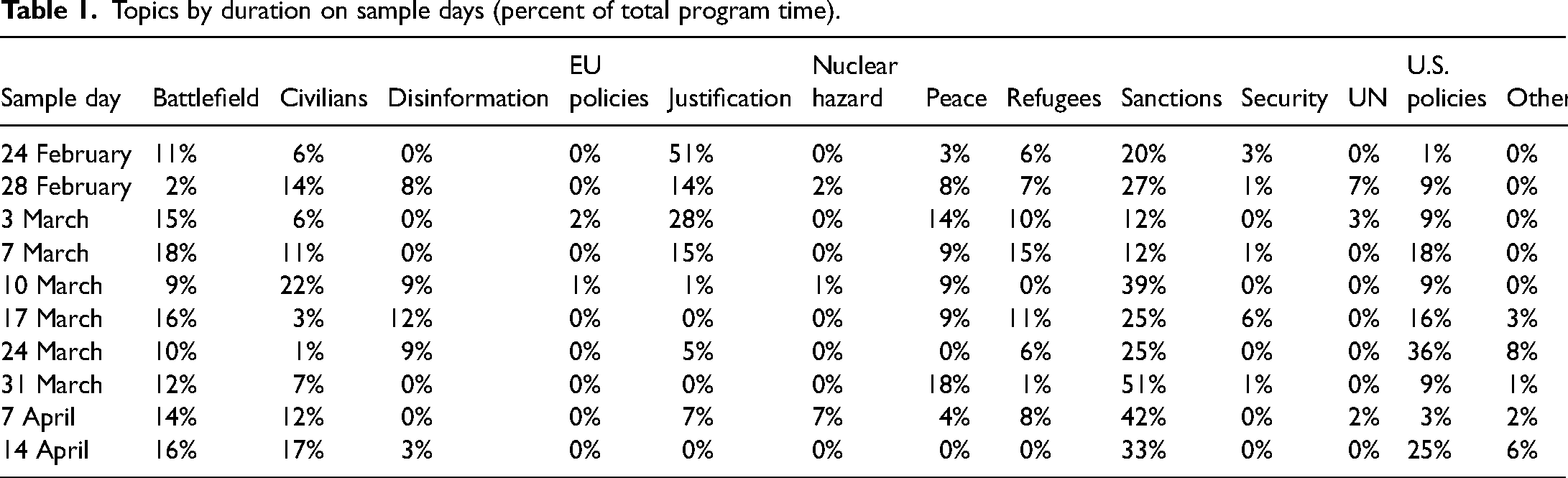
On the first day of the conflict, half of the airtime was devoted to the topic of justifying the invasion in order to protect the civilian population of Donbass in eastern Ukraine, and only 11% of the time was devoted to news from the front. The theme of Justification was the highest in terms of the duration of broadcasting until 7 March, after which it practically disappeared. The other two topics, Sanctions and U.S. policies, took the lead, and on 14 April they accounted respectively for the third and fourth largest broadcast shares. The topic Battlefield was accorded less broadcasting time, ranging from 11% to 16% during the sample period. Civilians were a growing trend in terms of length of coverage, with initially only a few percent and reaching nearly one-fifth by 14 April.
Angles
The angles representing the government interest were measured by two indicators: the number of news items on each angle and time devoted to each angle. It should be remembered that the news item could include several angles and each angle was counted, so the total number of news items regarding the presence of these angles exceeds the actual number of news items. The angles in Vremya remained more or less the same throughout the sample period, dominated by the Russian angle: 88% in terms of duration and 72% in terms of amount of news. The only notable change over time was the Ukrainian angle with its marginal visibility only during the first three weeks of the period (2% in terms of duration and 4% in terms of number of news), after which it was totally absent. The other country and nongovernmental (representing the point of view of ordinary people, including civilians and refugees as well as military prisoners) angles had a small but notable representation, being 13% and 5% and 11% and 6% correspondingly.
Key narratives
The next stage of our content analysis of Vremya was to identify the narratives under each topic, including their tones in a positive, negative, or neutral direction with their relation to the main parties to the conflict: Russia, Ukraine, and the West. The narratives and the number of items in which they appeared under each topic are listed in Table 2.
Key narratives and their tones in topics in Vremya.
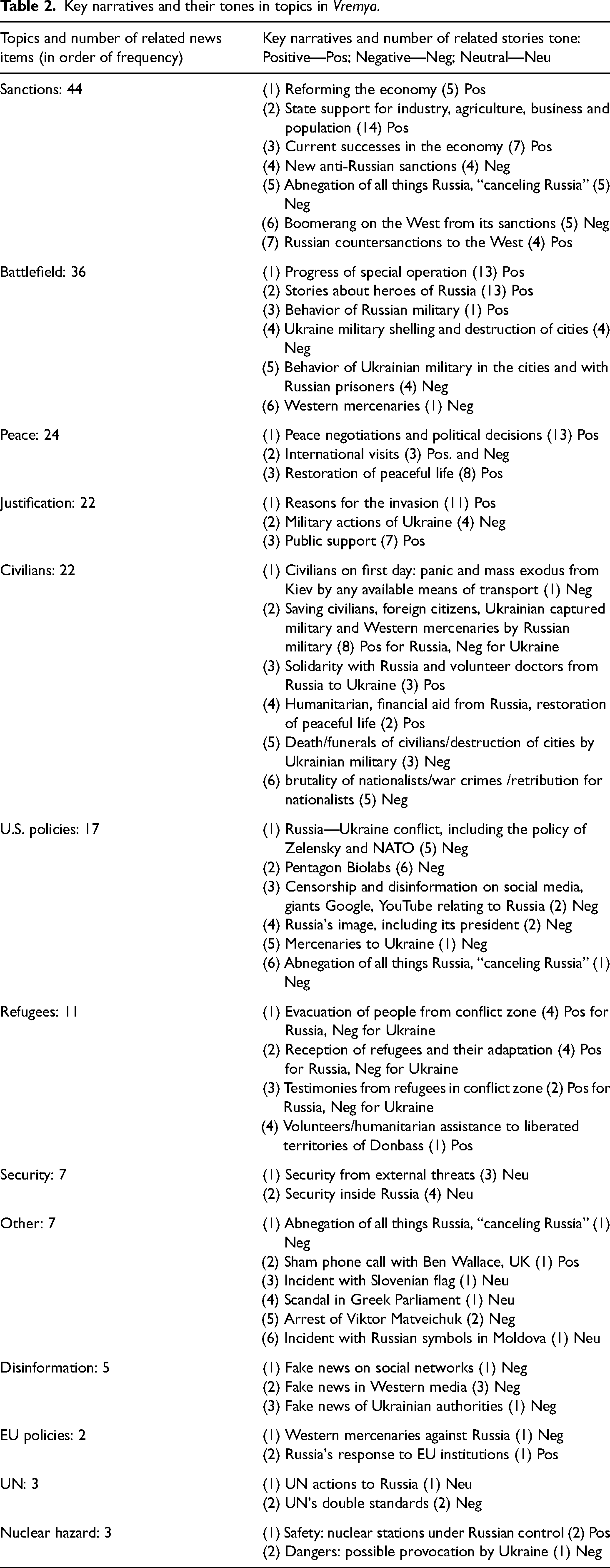
Considerations of space do not allow us to give a detailed analysis of all 13 news topics, so we focus on the six most important topics in terms of longest duration: Sanctions, Battlefield, Peace, Justification, U.S. politics, and Civilians. The following passage reviews how these key narratives as well as the angles were presented in each of these topics.
Sanctions
This topic was the leader in the news both in amount of news items (44) which was 21% of the coverage, and in duration (177.4 min) which was 28% of the coverage. The time devoted to Sanctions was over twice as much as that devoted to the topic Battlefield (12%). Sanctions were covered mainly from the Russian angle with 93% duration, but also from the angles of Other Country (10.7%), Ukraine (0.9%) and nongovernmental (0.3%). The topic was clearly identified as anti-Russian sanctions and was present every night on Vremya. Attention to it gradually increased from the first day of the invasion on 24 February. On that day, this topic occupied 20% of the broadcasting time of the program, but by the end of March, the topic had become dominant: on 31 March it occupied 51% of the broadcasting time, on 7 April 42% and on 14 April 33%.
The topic consisted of seven key narratives favorably disposed toward Russian activities and negatively disposed toward Western activities (Table 2). The main sources of news were official meetings in the Kremlin and government and the main newsmakers were the President (seven stories), the Prime Minister and ministers (seven stories), the Head of the State Duma (1), the mayor of Moscow (1), and the governor of the Moscow region (1), as well as experts, Russian journalists working in Western countries and relevant stories from Western television programs.
The topic Sanctions was already featured in the first news issue on 24 February in two stories: a report on President Putin's meeting with representatives of business circles of Russia to discuss work under anti-Russian sanctions and a little later the video news about the U.S. President Biden's speech on economic sanctions against Russia, adding a comment from the Russian Ministry of Foreign Affairs that this was already the 102nd package of sanctions against Russia over the past eight years. That is, from the first day of the invasion, a clear message was issued to the audience that it was nothing new to live and work under sanctions and thus no reason to panic.
In fact, the topic was mainly not about Western sanctions against Russia (four stories) but about Russia's successful resistance in the economic struggle with the West. News about the reform of the Russian economy, including its reorientation toward Eastern partners and Russian exports to the growing markets of the global South, successful import substitution, growing state support for industry, agriculture, business and the population, including Ukrainian refugees as well as the continued implementation of current projects in cities and regions accounted for most of the news stories (20) with these narratives. The narrative of reforming the economy emphasized the need to strengthen Russia's economic sovereignty and focused on strategic and tactical measures by Putin and the government. According to Putin, Western sanctions created many problems, but also opened up new opportunities.
The narrative of the boomerang effect on the West from its own sanctions against Russia showed viewers what losses the West was suffering due to its sanctions policy (five stories). The narrative was based on footage of speeches by ministers and leaders of Western countries, who talked about rising prices for gas, electricity, petrol, and food, with videos about empty shelves in shops, people's protests, but also comments from experts and reports from correspondents. These stories also mentioned the falling ratings of politicians due to rising prices in their countries.
The narrative “canceling Russia” or “bouts of Russophobia” as it was in the headlines appeared in five stories describing how the West's sanctions policy worked against representatives of culture, athletes, and ordinary Russians. For example, the news reported that students from Russia were debarred from studying in European universities. In Stuttgart, Germany, a restaurant announced that visitors with Russian passports were not welcome. Lithuania refused Russian citizens who wanted to come there for medical treatment and it was stated that it was not possible to meet close relatives.
The counter-sanctions narrative emerged in four news stories beginning in early March when the Russian government presented a list of states unfriendly to Russia which had imposed or supported sanctions against Russia. Countersanctions were a necessary measure aimed at protecting Russian citizens and Russia's financial sovereignty. For example, Russian citizens, on Putin's orders, could repay their debts to these countries in rubles, and all transactions with these unfriendly countries now required the permission of the Cabinet of Ministers.
Battlefield
This topic was the second most dominant topic on the agenda, included in every Vremya broadcast. In the amount of items (36), it accounted for 18% of the stories broadcast, and in duration, it accounted for 73.8 min (12%). The stories had a Russian angle in 92% of stories by duration but also included the Ukrainian angle (1%), the other country (4%) and the nongovernmental angle (4%). In some programs, it appeared in only one story, in other programs it had up to six stories. Chronologically, from the beginning of the invasion of Ukraine on 24 February until mid-April, this topic was covered regularly, ranging from 11% to 16% of the news program, but in the number of news items, Battlefield had grown from 5% on the first day of the invasion to 24% by 14 April.
The topic established six narratives and used positive and negative tones, clearly contrasting the Russian military and the militias of the People's Republic of Donbass as heroes while Ukrainian “Nazis” and Western mercenaries were fighting on the Ukraine side for money.
The positive frame of Battlefield consisted of three basic narratives. First, it described the progress of the Russian military and a chronicle of their victories including the liberation of new territories and of the civilian population, the reports of the Ministry of Defence of the Russian Federation on how many units of equipment had been destroyed and how many Ukrainian soldiers had been taken prisoner (13 stories). Secondly, it was seen in the glorification of heroes on the battlefield and their exploits, interviews with heroes, and reports from the ceremonies for awarding medals and orders on the battlefield or in hospitals. The second narrative also included 13 stories. The third narrative was about the behavior of the Russian military, who helped and rescued civilians and trapped Ukrainian soldiers (1).
The negative frame was assigned to the enemy, based on three narratives. The first was about the Ukrainian military shelling and destroying cities and towns (four stories). The second was about the behavior of the Ukrainian military, often represented as nationalists who did not let civilians out of the conflict zone, used them as human shields, put their heavy equipment in the yards of houses and on the upper floors of houses, destroyed houses, looted and tortured civilians, and Russian prisoners (four stories). The third narrative was about Western mercenaries who came to Ukraine to fight for money against Russia (one story).
Battlefield was covered by various selected sources: a reporter in the field and interviews with the military and civilians, interviews with Ukrainian soldiers who had been captured or who had surrendered voluntarily; official sources of the Ministry of Defence; foreign military experts from Fox television and from India, an article from the New York Times about the abuse and murder of Russian prisoners of war by the Ukrainian military, an Al Jazeera report about how the Ukrainian military was using ambulances for transporting their own personnel rather than for transporting the wounded.
Peace
This was one of the top six news topics, ranking third in the amount of news (24), which accounted for 12% of the coverage and sixth in duration (45.3 min) which accounted for 7% of the coverage. The topic was presented regularly, in almost every news program, but gradually lost relevance both in the amount of news from 10% to nil and in duration from 3% to nil. Peace was presented mainly from the Russian angle (90%), but also from the Ukrainian angle (5%), other country (3%), and nongovernmental angles (2%).
The topic developed along three key narratives in positive and negative tones: (1) peace negotiations and political decisions (13 stories); (2) international visits by senior officials (three stories); and (3) reports from cities and towns on the restoration of peaceful life (eight stories).
Its main newsmakers were President Putin (eight stories), Foreign Minister Sergei Lavrov (four stories), head of the Russian delegation at the talks with Ukraine Vladimir Medynsky (three stories), Prime Minister Mikhail Mishustin (one story), and Patriarch Kirill (one story).
The President was presented as the leading peacemaker, conducting all negotiations with heads of states and giving them first-hand information on Ukraine's situation and the conditions for ending the conflict. These conditions included the demilitarization of Ukraine and its neutral status, which would ensure Russia's legitimate security interests. Medynsky was the principal negotiator with Ukraine. Lavrov was responsible for negotiations with foreign ministers of other states and made official visits to Turkey, India and China. He criticized the West, NATO, and especially Washington, on sanctions, but also the situation in Afghanistan and neighboring states. Mishustin made efforts in the field of Eurasian cooperation and visited Kazakhstan.
Other news on this topic reported on the restoration of the destroyed cities of Donbass, humanitarian aid from Russia and the beginning of a peaceful life there.
Justification
This topic was fourth in the number of news items (22) accounting for 11% of the coverage and was third in duration (78.7 min) accounting for 13% of the news coverage of the sample. Justification gradually lost relevance in the amount of news items: from 45% to nil, and in duration from 51% to nil. The justification was actively introduced only in February and the first week of March, numbering three or four stories in each program, then it declined and appeared as only one story and not even in every program. It was presented mainly from the Russian angle (95%), but also from the Ukraine angle (4%), and also the other country angle (1%).
The topic established three key narratives in tones positive to Russia and negative to Ukraine. The first narrative about the reasons for the invasion was based on 11 stories. The main reasons for the invasion were: (1) to protect the civilians of Donbass from the aggression and violence of the Ukrainian military, which had continued for the last eight years, starting from 2014; (2) to demilitarize Ukraine after the West sent so many weapons there; (3) to de-Nazify Ukraine, that is, to accomplish the mission of liberating it from Nazism, which threatened not only Ukraine itself but also Europe; (4) to bring peace to Ukrainian territory; (5) to protect Russia so that no anti-Russia feeling would be created on the borders “of our homeland,” including nuclear weapons; (6) to prevent Washington from making Ukraine a springboard for a permanent threat to Russia: Britain and the U.S. built military bases and laboratories for chemical and bacteriological weapons in Ukraine, and their advisers and special services prepared Ukraine for a real war against Russia. The goal was to demonize Russia, not to make a treaty on the balance of the interests of Ukraine, the United States, and Russia. The West was using Ukraine as a pretext in the sanctions war to prevent Russia from being an independent country. Sanctions against Russia were called a Western tax on its independence (24 February).
The next narrative about Ukraine's military actions appeared in six stories. For example, this news reported on the shelling of the Belgorod region by the Ukrainian military; the distribution by the Kiev 3 authorities of weapons to anyone, as a result of which gangs of looters appeared in the city and posed a danger to civilians; the hostility of Kiev's rule toward the residents of Donbass as a result of which more than 14,000 people had died there over the past eight years; about the upcoming provocation of the Security Service of Ukraine and nationalists (Azov battalion) with possible radioactive contamination in the Kharkov region, in order to then accuse Russia of this.
The third narrative on this topic was about public support for the “special operation” in Ukraine. It appeared in seven stories, starting from the first day of the invasion, often intertwined with the narrative of the suffering of Donbass civilians over the past eight years. For example, the news of 28 February announced that the Association of Higher Educational Institutions of Culture and Art had proclaimed its support for Russia's actions in Ukraine with an open letter from universities who were teaching students what happened in Lugansk and Donetsk during these eight years as genocide.
Civilians
This topic had 22 news stories in the 10-day program sample. Measured by the number of news stories, it ranked fifth among the 13 topics with 11% of coverage. In duration, it had 67.2 min, which accounted for 11% of the news agenda. Coverage of civilians was presented from the Russian angle with 73% duration, but also from the nongovernmental angle (26%), and the Ukraine angle (1%).
The topic consisted of six narratives having a positive frame toward Russian servicemen and volunteers and a negative frame towards the Ukrainian armed forces.
This positive frame included three narratives. The first one, “rescue,” included eight different stories. Among them were stories about the rescue of civilians by the Russian military in the liberated territories and foreign citizens who found themselves in the conflict zone, for example, the story about the evacuation of Indian students from the city of Sumy thanks to the Russian military and the government. Another story was about the rescue by the Russian military of 134 Ukrainian prisoners of war as well as a British mercenary and the provision of medical care for them in a hospital. Another story was reported about a family reunion in Mariupol thanks to the Russian military and the Vremya news program.
The rescue narrative was closely related to the narrative of the solidarity of the Russian people with the civilians of Ukraine (three stories), for example, the report about volunteer doctors coming from various regions of Russia to work in the hospital and maternity hospital in Mariupol during the military conflict. The next narrative (two stories) was about the restoration of cities and communications in the liberated territories of Ukraine, the arrival of humanitarian aid from Russia, the payment of pensions and social benefits, a one-time allowance of 10,000 rubles to public sector workers, a visit to Donbass by the leader of the United Russia party, Andrei Turchak.
The negative frame of the topic was based on three narratives. The first was about the panic of civilians in Kiev and their mass exodus from the city in the absence of information from President Zelensky. It was assumed that he had left the city and the civilians did not know what to do. Another narrative was about the deaths of civilians, and the destruction of their homes and cities and settlements by the Ukrainian military in the territories of Donbass (three stories). It used eyewitness accounts, reports of funerals and interviews with victims who had lost their loved ones. For example, two teachers at a school were killed by shelling by the Ukrainian military.
The narrative about the brutality of the Ukrainian nationalists (five stories)—eyewitness accounts of rapes and murders, accounts of civilians about the excesses and torture of civilians in the concentration camp organized by the Ukrainian battalion Aidar. The narrative about the betrayal of the Ukrainian military in relation to their military (soldiers abandoned on the battlefield) and violence against the civilian population. For example, one story showed how the Ukrainian military forced a civilian in Zhytomyr under threat to the lives of his family to fulfill the role of a suicide bomber. In particular, he had to make a phone call from a certain place, and when he did, that is, he drove up to this place and made the phone call, the Ukrainian side began shelling this place and he miraculously survived and was captured by the Russians. Another news story was about the incarceration in the monastery of several hundred civilians in the Volnovakha district, who were left without medicines and water.
U.S. policies
The topic of U.S. policies was sixth on the news agenda in the amount of news items in the period analyzed (17 stories), and second in duration (80.5 min) after the topic of Sanctions, which accounted for 13% of the broadcasts. In duration (from 1% on 24 February to 25% on 14 April) and in the number of news items respectively (5% to 14%), this topic showed a significant increase. Unlike EU policies, it occurred in every newscast, along with three other topics: Sanctions, Battlefield and Civilians. Most of the news on U.S. policies was presented from the perspective of Russia (86%), but also from the perspective of other country (9%) and the nongovernmental angle (4%).
The topic established six key narratives, all represented in a negative tone. The first narrative about U.S. and NATO policy appeared on the very first day of the invasion, with the news that the Russian and Chinese foreign ministers, Sergey Lavrov and Wang Yi, had discussed the crisis in Ukraine by phone and expressed their common opinion that the crisis was caused the U.S.'s encouragement of Ukraine's noncompliance with the Minsk Agreements. In the following days, news broke that the United States was debating how to help Zelensky's government in exile in the event of a Russian victory. The United States was alleged to be planning to send more troops to the Baltic states to reinforce NATO's eastern flank. NATO was using the Ukrainian crisis to strengthen its potential.
The second narrative under the topic of U.S. policies was about the work of Pentagon biolabs in Ukraine and other states bordering on Russia. There were six stories on this at regular intervals starting on 7 March and ending on 14 April. Documentary evidence was presented each time by a representative of the Russian Ministry of Defence at their briefings, and comments on this topic were given by Putin and a Russian UN expert; the narrative was also to be seen on the American Fox News channel. For example, the news of 10 March reported on a briefing by the Russian Ministry of Defenсe where documents were shown confirming the manufacture of biological weapons in Ukraine by order of the Pentagon.
The third narrative about U.S. policy against Russia was noted in the actions of global social networks and Internet giants such as Google, Twitter, and YouTube. The news of 3 March reported that Facebook was transforming from a social network for friendship into a resource for information warfare. The number of fake videos there had grown 19 times in two months compared to the previous year. The platform for communication had turned into a place for inciting hatred and enmity. The director of the Safe Internet League, Ekaterina Mizulina, explained that the United States had invested huge amounts of money in this information war, which was being waged by more than 1500 specialists in Russia, Belarus, Ukraine, and other countries.
The fourth narrative addressed U.S. policy toward the image of Russia and its President in two news stories. For example, in the program of 28 February, under the heading “Their methods. Empire of Lies” an American documentary producer stated that Biden and British Prime Minister Boris Johnson were demonizing the Russians and that Zelensky was creating a humanitarian crisis in the country, distributing weapons to everyone, and this was dangerous for civilians. In the 17 March program, the news reported that Biden called the Russian President a war criminal, followed by detailed information about Biden with an archival video from 1999 when Biden was a senator and demanded a special operation in the former Yugoslavia to bomb Belgrade. The narrative included data on civilian deaths from bombing in Serbia and Iraq, as well as detailed information on the U.S. military operations in Libya, Syria, Afghanistan, and Vietnam.
The fifth narrative focused on U.S. military assistance to Ukraine, namely sending mercenaries to Ukraine to fight against Russia. For example, in the 7 March program, a news story reported that about 3000 mercenaries from the United States were to arrive in Ukraine. On special sites, step-by-step instructions were published on what to do to go to the front in Ukraine. In some countries, there was a voluntary collection of weapons. The Ukrainian embassies abroad were the organizers of such journeys. The news reported that the foreign legion in Ukraine would number about 20,000 mercenaries from 50 countries, according to the Minister of Foreign Affairs of Ukraine.
The sixth narrative was the spreading of the xenophobic attitude of other countries in rejecting everything Russian. The program on 14 April included a report of the speech of Foreign Minister Lavrov at a conference where he explained to future diplomats why Washington supported the Kiev nationalist regime and declared total hybrid war against Russia, including the information space.
Discussion and conclusion
With the beginning of the invasion of Ukraine, Vremya increased its airtime from half an hour to an hour, and almost all the news was devoted to this operation and its consequences for the country and the world. This study of 10 news programs confirmed that out of 204 news stories over the course of these 10 days, only one news item was not related to the military conflict and its consequences. This is probably the only case in history that TV news anywhere concentrated so intensely and for so long on a single theme. It demonstrated the totality of the psychological mobilization of society for victory on all fronts, not only on the battlefield in Ukraine, but also in the economic and, more importantly, cultural and informational confrontation with the West. Moreover, the overall editorial policy of the First Channel changed after 24 February; various programs were removed, including entertainment, with more time for documentaries and political commentaries.
The study shows that the coverage of the invasion of Ukraine has been a direct extension of the government line, not only biased in favor of official policy but an integral part of it. Accordingly, Vremya played a decisive role in generating public support for the government to continue the “special military operation” in Ukraine and to rally society around its leader. This conclusion is based on the following research findings.
The news was mainly presented from the Russian perspective (88%), and the share of other points of view was presented in the following proportions: Ukraine 2%, other country 5%, and nongovernmental 6%. Moreover, these other perspectives accounting for 12% of the coverage were included to reinforce or confirm the Russian perspective.
The news clearly adopted a tone appropriate to the Russian perspective in the presentation of information: positive for news about Russia and negative for news about its opponents. A positive tone was used in narratives about the successes of the Russian military, the defenders of the People's Republic of Donbass, its civilians and refugees, and the policies and actions of the Russian government and its allies, while opponents, including the leadership of NATO and the U.S., the Ukrainian government, its actions, as well as their military were mostly presented in a negative light.
This division into the heroes-liberators of Russia and the nationalists of Ukraine, who for the past eight years had threatened the civilian population of Donbass and were now fighting against Russia with the support of NATO countries, emotionally encouraged the viewer to justify the invasion of Ukraine. Moreover, the narrative about the captured Ukrainian military used a positive tone for them, showing them as victims of the decision of the Ukrainian authorities to fight against Russia. Putin in his speech spoke of two fraternal peoples, Russians and Ukrainians, clearly separating the Ukrainian people from the nationalists trained by NATO instructors for a real war with Russia.
Among the 13 topics on the news agenda of Vremya from 24 February to 14 April 2022, four topics showed positive dynamics in the number of news items and their duration. Their share of broadcasting in news items increased in the following proportions: Sanctions from 15% to 24%, U.S. policies from 5% to 14%, Civilians from 5% to 19% and Battlefield from 5% to 24%. In duration, the development was as follows: Sanctions from 14% to 30%, U.S. policies from 1% to 25%, Civilians from 6% to 21% and Battlefield from 11% to 15%. This distribution of topics showed that the Russian authorities were most concerned about the West's reaction to the invasion and the successes at the front.
After mid-March, Sanctions and U.S. policy became the most important topics on the news agenda, indicating that Washington, not Kiev, was perceived as the real antagonist of Russia. Thus, the news agenda shifted its focus from the battlefield to global issues, namely the opposition of Russia to the West, primarily the United States.
The sources of news on these most important topics were the president, the government and the army. Their regular participation in direct or indirect (meetings in the Kremlin and the government) transmissions to the population of the latest news and comments about events in the country, the world, and at the front were intended as a guarantee of the reliability of the information received at first hand by the viewer. It also involved the population in the daily flow of government decisions and changes.
Two topics, Justification and Peace, which had been among the top six covered topics, gradually lost their relevance after mid-March, both in the number of news items and in their duration. That is, there was no longer any need to justify the invasion as public support for the authorities was beyond question.
VCIOM (6 September 2022) monitored public opinion on the issue of a special operation for six months and found that public support for this decision remained consistently high, being in the range of 70–73%. In the August polls, on average, 70% of Russians reported that they supported this decision, 18% did not support it, and another 12% found it difficult to answer.
The opinion of Russians about the goals of the special operation also remained unchanged: in August, an average of 39% believed that the main goal of the “special military operation” was to protect Russia, disarm Ukraine and prevent the locating of NATO military bases on its territory. According to one in five (20%), it was to protect the population of Donbass. In third place was a change in the political course of Ukraine, cleansing it of the Nazis (17%).
The state media undoubtedly played an important role in the psychological mobilization of society around the leadership of the country and its opposition to Western sanctions. However, one should not underestimate the independent choice of people when using sources of information. Along with the state media, they had access to uncensored online media such as YouTube and Telegram, which, as the war progressed, increased their popularity among the population thanks to the alternative opinion. Along with patriotic military correspondents (voenkor) and progovernment channels, readers could watch numerous broadcasts by independent journalists and political shows with dissidents who had emigrated from Russia. Also, many Facebook and Instagram users learned to bypass blocking using virtual private networks (Soldatov and Borogan, 2023). That is, the hegemonic discourse of the mainstream media coexisted with alternative views on YouTube and Telegram and other sources, which the option to choose a private position toward the war, peace, and the West.
Footnotes
Declaration of conflicting interests
The author declared no potential conflicts of interest with respect to the research, authorship, and/or publication of this article.
Funding
The author received no financial support for the research, authorship, and/or publication of this article.