



Abstract
This cross-sectional, correlational study investigated the relationship between fear of swimming and psychological resilience, focusing on mental fatigue awareness as a mediator and history of non-fatal drowning incidents as a moderator. Data were collected from 624 swimmers in Turkey using the Mental Fatigue Awareness Scale in Athletes, the Brief Resilience Scale, and the Fear of Swimming Scale. Structural equation modeling indicated that fear was negatively associated with resilience through both direct and indirect pathways. Mediation analysis confirmed that mental fatigue awareness functions as an explanatory mechanism, transmitting a substantial portion of fear's impact on resilience. Furthermore, a history of non-fatal drowning demonstrated a significant moderating effect. Specifically, for athletes without such trauma, fear exerted a strong negative impact on resilience; however, for those who had survived a non-fatal drowning incident, this negative relationship was significantly attenuated. These results suggest that surviving a life-threatening aquatic event may induce a form of “psychological inoculation,” buffering the destructive effects of fear in subsequent contexts. For coaches and sport psychologists, these findings suggest that resilience-building interventions should target both the psychological sources of fear and the cognitive consequences of mental fatigue awareness to foster robust athletic performance.
Introduction
For coaches and sport scientists, understanding why athletes falter under pressure is a primary challenge. The sporting environment extends beyond a mere test of physical endurance; it constitutes a multidimensional arena where individuals contend with intense psychological pressures. Athletes perpetually navigate factors such as competitive stress, performance expectations, and injury risks.1,2 This reality underscores the extent to which athletic success is intertwined with psychological processes. Within this context, psychological resilience emerges as a pivotal construct, explicating an individual's capacity to adapt, recover, and maintain functionality amidst adversity. 3 Defined as the ability to re-establish equilibrium following stress or trauma, resilience is particularly critical for performance sustainability in domains requiring high endurance and risk management, such as aquatic sports.4,5
Swimming demands not only physical stamina but also high-level psychological competencies, including attentional control, self-efficacy, and anxiety regulation. 6 Consequently, a swimmer's level of resilience plays a decisive role in his or her performance consistency and long-term athletic adherence. One of the primary challenges to resilience is fear- and anxiety-based experiences. In swimming specifically, perceived aquatic threats and the risk of drowning bring fear of swimming to the forefront. However, the existing literature often fails to critically address the cognitive mechanisms through which these fears translate into performance decrements. According to the revised conceptualization of challenge and threat states, an athlete's appraisal of aquatic stressors as a threat (where demands exceed resources) rather than a challenge can fundamentally undermine the cognitive resources available for resilience. 7 Characterized by intense anxiety and avoidance behaviors stemming from negative beliefs about water, 6 this fear has the potential to not only reduce training efficiency but also constrain coping strategies, thereby directly eroding psychological resilience. 8
The repercussions of swimming fear extend beyond heightened threat perception; they can excessively tax an athlete's mental resources, specifically by amplifying mental fatigue awareness. At this point, it is crucial to distinguish between objective mental fatigue (the physiological state of depletion) and mental fatigue awareness (the athlete's subjective perception and monitoring of that depletion). While mental fatigue involves a decrease in executive functions,9,10 mental fatigue awareness encompasses the metacognitive process of perceiving cognitive exhaustion. 11 The broader concept of athletic mental energy emphasizes that the perception of energy and fatigue levels is as critical to performance as objective metrics. 12 According to Attention Control Theory, states of fear and anxiety demand surplus cognitive effort, thereby depleting attentional resources. 9 This continuous and escalating cognitive load leads directly to sensations of mental exhaustion and the impairment of executive functions.10,11 Mental fatigue awareness—the capacity to perceive this state of cognitive depletion 13 —may become chronic due to factors such as training intensity.14,15 Given that elevated mental fatigue is directly associated with motivational deficits and diminished resilience, 16 it is hypothesized that the relationship between fear of swimming and psychological resilience is partially shaped via the mechanism of mental fatigue awareness.
These psychological processes also engage in complex interactions with past traumatic events. 17 In the context of swimming, a serious non-fatal drowning experience—a term that more accurately encompasses drowning survival incidents involving respiratory impairment18,19—can fundamentally restructure how an individual perceives aquatic threats and manages fatigue. Despite the significance of such events, there remains a critical gap in understanding how traumatic aquatic experiences interact with emotional responses to fear-inducing situations to influence the long-term development of coping mechanisms.20,21
It is therefore plausible that such experiences assume a moderating role in the relationship between fear of swimming and psychological resilience. In other words, the direction and magnitude of this relationship are expected to diverge between athletes who have survived a non-fatal drowning incident and those who have not. According to the theory of cumulative lifetime adversity, moderate exposure to stressors can lead to “psychological inoculation” or “steeling,” where individuals develop greater resilience through successfully navigating adverse events. 22 Evidence suggesting that traumatic experiences can prompt a reconfiguration of resilience or even post-traumatic growth supports this assumption.21,23 Therefore, understanding this interaction is essential for coaches to tailor their support to athletes with different experiential backgrounds. Within this framework and also considering that coping styles manifest differently across age groups, 24 this study aims to examine the effect of fear of swimming on psychological resilience, specifically investigating the mediating role of mental fatigue awareness and the moderating role of non-fatal drowning experiences to provide an evidence-based model for coaching practice.
Hypotheses developed in accordance with the theoretical model are presented below:
Method
Research design
Data were collected in October 2025, from male and female swimmers across Turkey. This study utilized a cross-sectional, predictive correlational design to examine the structural pathways between fear, fatigue, and resilience. The proposed conceptual model, which evaluates the hypothesized mediation and moderation effects, is illustrated in Figure 1. The study employed convenience sampling, a non-probability technique often necessitated when population access is logistically constrained or when investigating specific psychological phenomena within specialized groups. 25 While commonly utilized in field-based sports psychology research, we acknowledge that this sampling approach limits external validity and the generalizability of the findings compared to randomized designs. 26
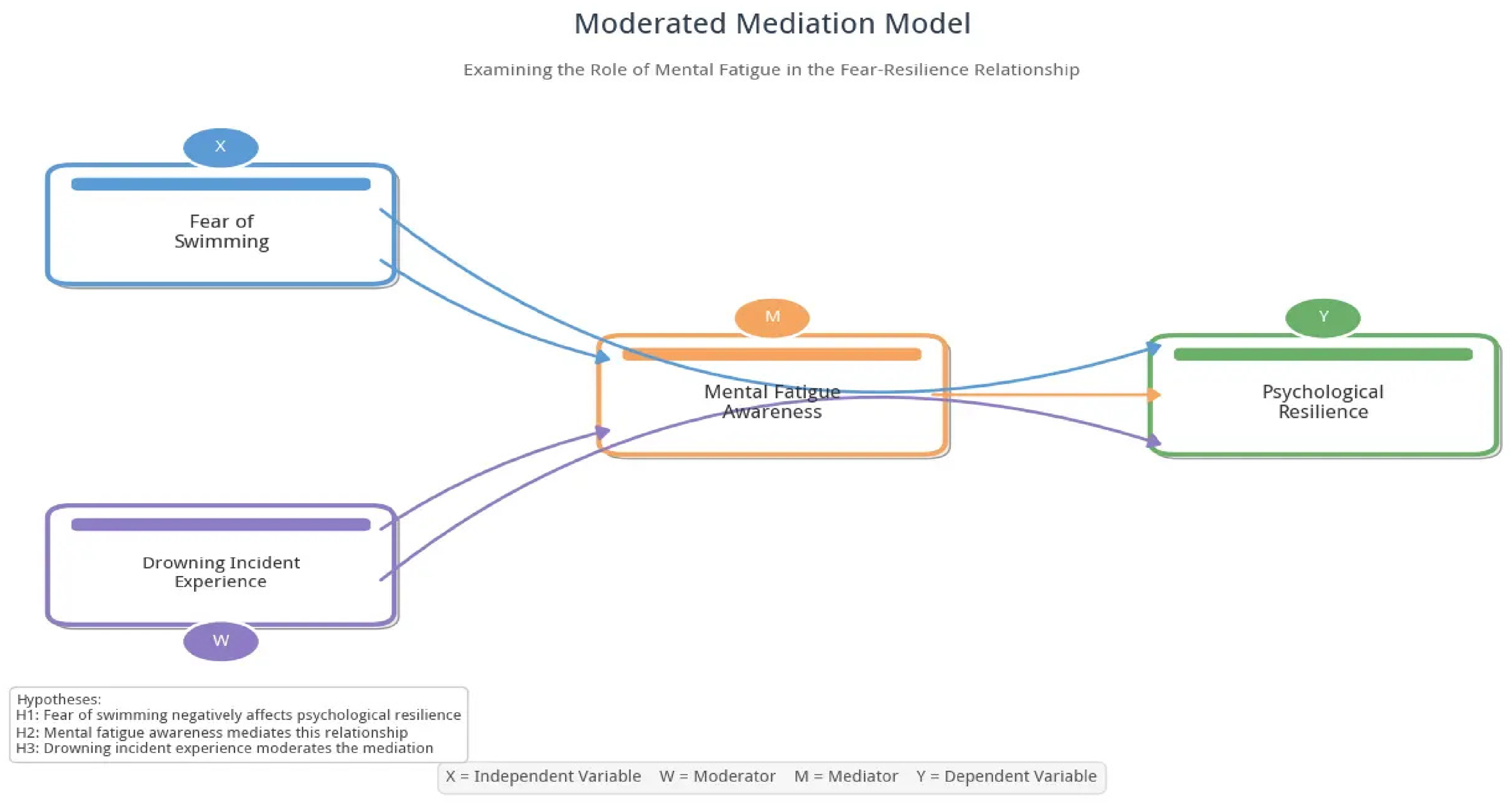
Moderated mediation model.
Ethical considerations
The study was conducted in compliance with the ethical principles and standards outlined in the 2008 Declaration of Helsinki. Ethical approval was granted by the Mersin University Sports Sciences Ethics Committee on October 6, 2025 (Decision No. 2025-076).
Participants
The initial dataset comprised 676 volunteer swimmers. Following data screening and assumption checks, the final analytical sample was established at 624 participants. Participants were stratified into three age categories: under 18, 18–25, and 26 and above. This categorization facilitated the analytical differentiation of age-related variances in motivation and mental performance.
Regarding gender distribution, the sample consisted of 57.7% female (n = 360) and 42.3% male (n = 264) swimmers. In terms of age, 20.2% were under 18 (n = 126), 27.2% fell within the 18–25 range (n = 170), and 52.6% were aged 26 or older (n = 328). Regarding swimming experience, 59% reported 1–5 years (n = 368), 21.5% reported 6–10 years (n = 134), and 19.6% possessed 11 years or more of experience (n = 122). Additionally, 42.6% of swimmers (n = 266) reported having survived at least one serious non-fatal drowning incident, while 57.4% (n = 358) reported no such history.
Data collection tools
In addition to demographic variables (age, gender, years of experience, and history of non-fatal drowning), data were acquired via three specific psychometric instruments.
Mental Fatigue Awareness Scale in Athletes: Developed by Kara et al., 13 this instrument employs a single-factor structure comprising 25 items to assess fatigue awareness. Responses are recorded on a 5-point Likert scale ranging from 1 (Never) to 5 (Always). The original internal consistency coefficient was reported as .96. In the current study, the Cronbach's alpha coefficient was calculated as .97.
Brief Resilience Scale (BRS): Developed by Smith et al. 3 to assess psychological resilience and adapted into Turkish by Doğan, 27 this scale consists of six items rated on a 5-point Likert scale. Items 2, 4, and 6 are reverse-coded. The scale possesses a unidimensional structure; Exploratory Factor Analysis (EFA) indicated that it explains 54% of the total variance, with factor loadings ranging between .63 and .79. Confirmatory Factor Analysis (CFA) further supported this single-factor structure. The scale has demonstrated high reliability (Cronbach's alpha = .83). For the present study, the Cronbach's alpha coefficient was found to be .82.
Fear of Swimming Scale (FSS): Developed by Bolat and Atasoy 6 to measure fear levels associated with swimming, the full scale comprises 20 items across four sub-dimensions: Health Fear, Apeirophobia (Fear of Infinity), Security Fear, and Hydrophobia (Fear of Water). However, to align with the specific scope of this research, only the “Security Fear” and “Hydrophobia” sub-scales were utilized. The decision to exclude “Health Fear” and “Apeirophobia” was theoretically driven, as our model focuses specifically on acute psychological responses to aquatic danger rather than broader existential or health-related anxieties. While we recognize that utilizing a partial scale structure may influence construct validity, the internal consistency for the selected dimensions remained robust (Cronbach's alpha = .78).
Data analysis
Data were collected via an online survey platform. To mitigate the inherent risks of online data collection—such as the lack of environmental control and the potential for rapid, unreflective responses—we applied stringent data cleaning protocols and monitored response timestamps to filter out automatic response patterns. Preliminary screening for missing values and outliers resulted in the removal of 52 observations based on Z-scores and Mahalanobis distance thresholds. 28 The Durbin-Watson value was 1.412, confirming the absence of autocorrelation. Multicollinearity was ruled out with VIF values below 5 and tolerance coefficients above .20.29,30 All analyses were conducted using Jamovi 2.6.2.
Normality analysis
The distributional properties of the measurement tools were first assessed using Kolmogorov-Smirnov and Shapiro-Wilk tests. As shown in Table 1, these tests indicated statistically significant deviations from normality for all variables (p < .001 for all tests).
Results of normality tests for measurement tools.
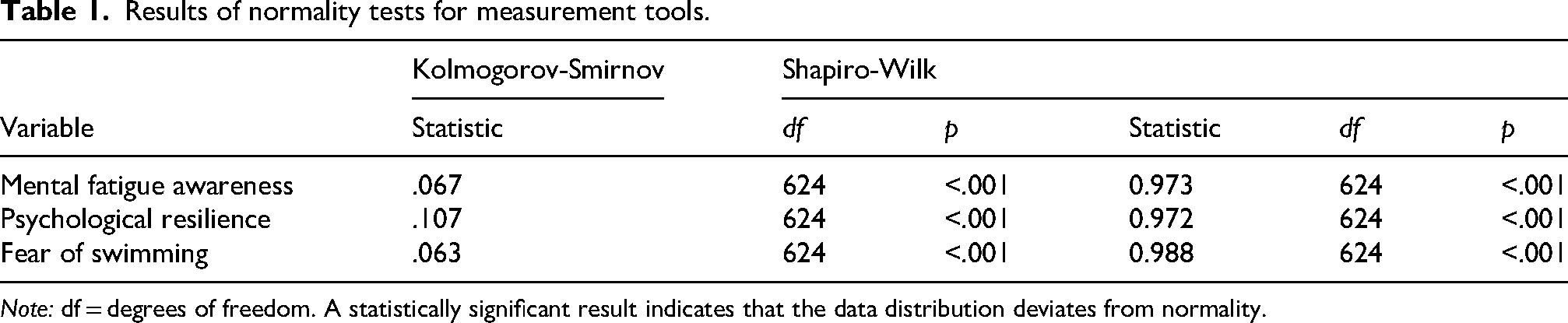
Note: df = degrees of freedom. A statistically significant result indicates that the data distribution deviates from normality.
However, it is widely acknowledged that normality tests, particularly Kolmogorov-Smirnov and Shapiro-Wilk, are overly sensitive in large samples (n > 300), often detecting statistically significant but practically negligible deviations from normality. 28 Therefore, relying solely on these tests is insufficient for robust normality assessment. To provide a more comprehensive evaluation, supplementary statistical measures reflecting the distributional shape characteristics were examined, specifically skewness and kurtosis values and their standardized z-scores. The descriptive statistics and normality distribution values are presented in Table 2.
Descriptive statistics and normality distribution of measurement tools.

Note: N = number of participants; M = mean; SE = standard error of skewness; Z = standardized z-score for skewness.
According to the findings presented in Table 2, skewness values were calculated as 0.298 for Mental Fatigue Awareness, −0.371 for Psychological Resilience, and 0.020 for Fear of Swimming. Kurtosis values were found to be −0.621, −0.022, and −0.474, respectively. The standardized z-scores derived from these values were 3.04 for Mental Fatigue Awareness, −3.78 for Psychological Resilience, and 0.20 for Fear of Swimming. Although certain z-values for skewness and kurtosis exceeded the conventional ±3 threshold, the data were deemed to satisfy the normality assumption for parametric testing because the raw skewness and kurtosis values remained within acceptable limits (typically ±2.0 or ±3.0 for smaller samples, but less stringent for large samples) and the overall distributional shape characteristics conformed to a normal structure. 31 Consequently, the distribution of the variables utilized in the analysis fulfilled the normality prerequisites for parametric testing. CFA results for the measurement tools are provided in Table 3.
Confirmatory factor analysis results for data collection tools.
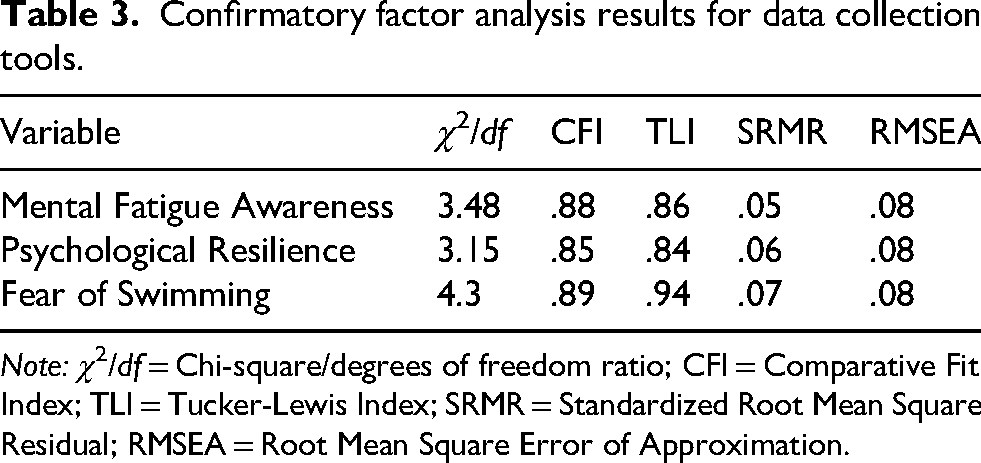
Note: χ2/df = Chi-square/degrees of freedom ratio; CFI = Comparative Fit Index; TLI = Tucker-Lewis Index; SRMR = Standardized Root Mean Square Residual; RMSEA = Root Mean Square Error of Approximation.
Measurement model fit
The construct validity of the measurement tools was evaluated via CFA. As detailed in Table 3, fit indices for the three scales remained within acceptable ranges. Specifically, while the Comparative Fit Index (CFI) and Tucker-Lewis Index (TLI) values approached or met the .90 threshold, the Root Mean Square Error of Approximation (RMSEA) values were around .08, which is at the upper limit of generally accepted criteria, indicating a tolerable level of approximation error. These indices suggest that while the measurement models are functional for structural evaluation, they may contain minor item redundancies or model specification issues. Consequently, the results derived from the structural model are interpreted with appropriate psychometric caution.32,33
Results
This section details the relationships between the variables within the research model. A fundamental assumption for mediation and moderation analyses is the existence of significant relationships among the variables.32,33 Consequently, establishing statistically significant correlations between the independent and dependent variables, the independent and mediator variables, and the mediator and dependent variables is critical for testing mediation effects. 34 In accordance with this assumption, Pearson correlation coefficients were examined. The findings revealed directional and significant relationships that support the proposed mediation model. These results are presented in Table 4.
Descriptive statistics and correlation analysis results.
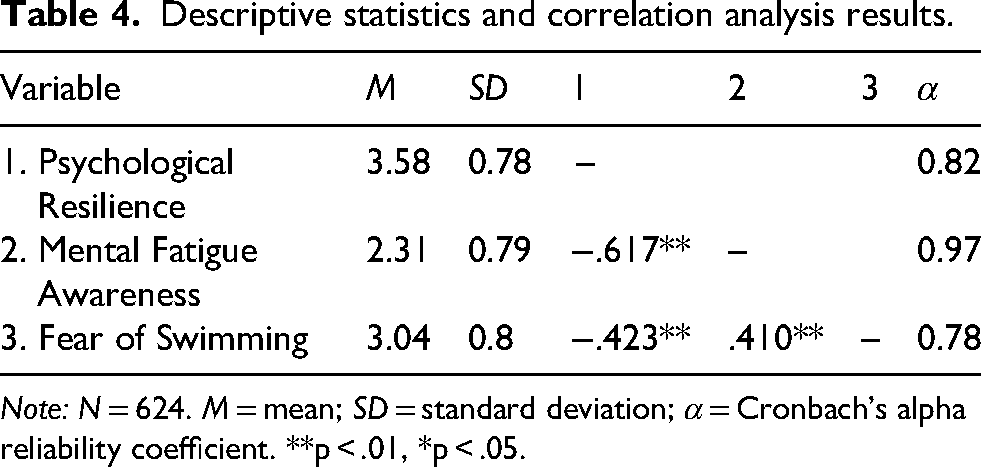
Note: N = 624. M = mean; SD = standard deviation; α = Cronbach's alpha reliability coefficient. **p < .01, *p < .05.
As demonstrated in Table 4, a strong, significant negative relationship was detected between psychological resilience and mental fatigue awareness (r = −0.617, p < .01). This finding indicates that as swimmers’ psychological resilience increases, their awareness of mental fatigue decreases. Conversely, a moderate negative correlation was identified between psychological resilience and fear of swimming (r = −0.423, p < .01), suggesting that individuals with higher psychological resilience experience lower levels of swimming-related fear. Similarly, a significant moderate positive relationship was observed between mental fatigue awareness and fear of swimming (r = 0.410, p < .01). This demonstrates that individuals with heightened awareness of mental fatigue may also exhibit elevated levels of fear. These classifications align with Cohen, 35 who categorizes correlation coefficients of .10–.29 as small, .30–.49 as moderate, and .50 and above as large.
To evaluate internal consistency, Cronbach's alpha reliability coefficients were calculated, yielding 0.82 for psychological resilience, 0.97 for mental fatigue awareness, and 0.78 for fear of swimming. These values indicate that the resilience scale possesses high reliability, the fatigue awareness scale has very high reliability, and the fear of swimming scale demonstrates acceptable reliability. 35 These interpretations are consistent with George and Mallery, 36 who classify alpha values of .70–.79 as acceptable, .80–.89 as high, and values above .90 as very high. Collectively, these findings confirm the presence of the necessary correlational relationships required to test the mediation and moderation hypotheses. Accordingly, H1, H2, and H3 are supported (all p < .01).
Findings regarding the mediation model
Figure 2 presents the structural model illustrating the indirect effect of fear of swimming (X) on psychological resilience (Y) through the mechanism of mental fatigue awareness (M).
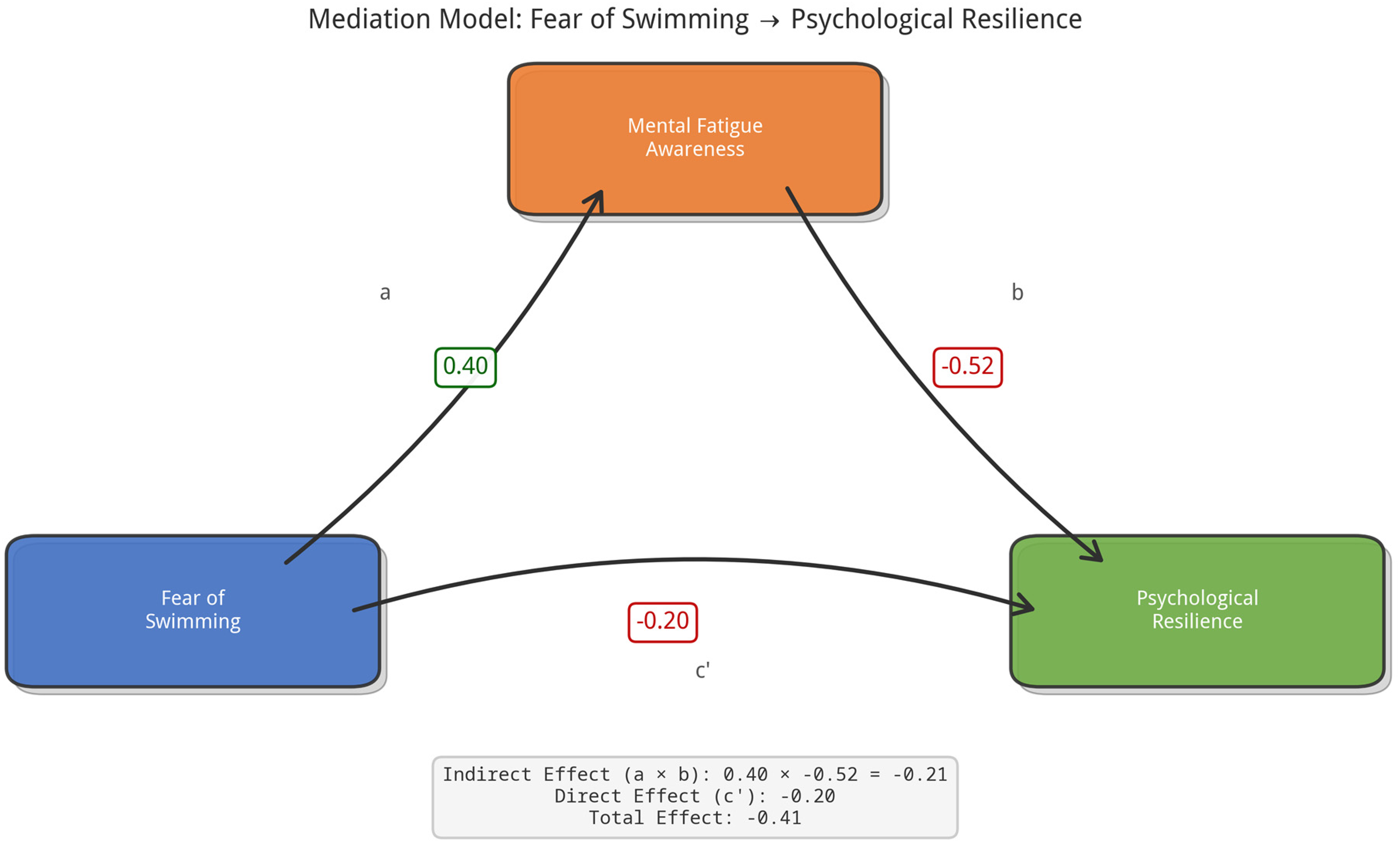
The final mediation model showing the indirect effect of fear of swimming on psychological resilience through mental fatigue awareness.
The results obtained from the mediation model analysis are presented in Table 5.
Mediation analysis of the model.
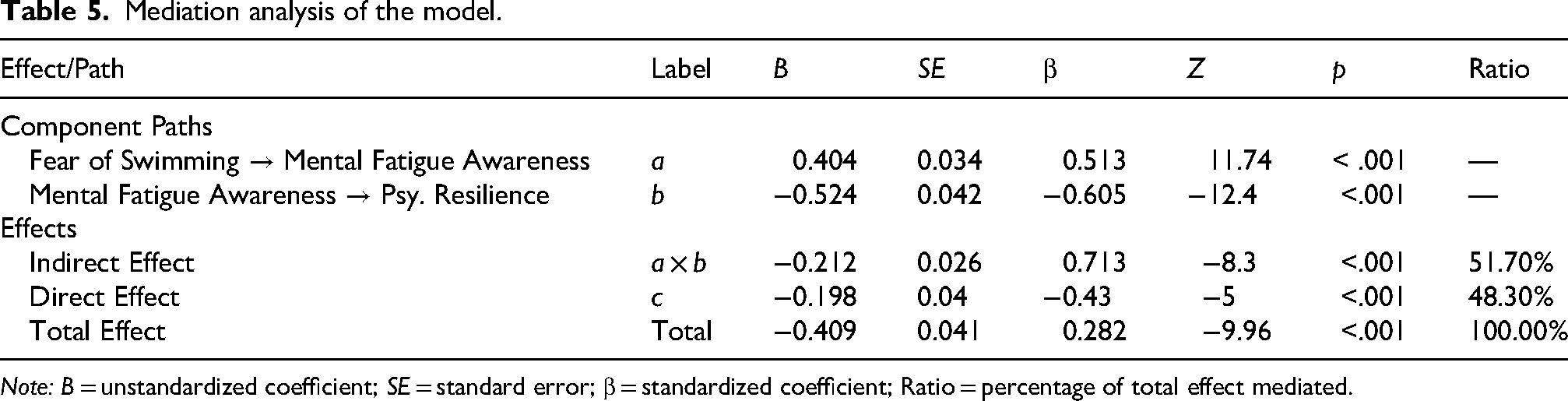
Note: B = unstandardized coefficient; SE = standard error; β = standardized coefficient; Ratio = percentage of total effect mediated.
An examination of Table 5 reveals that fear of swimming exerts a significant positive effect on mental fatigue awareness (β = 0.513, Z = 11.74, p < .001). This indicates that as the level of fear increases, swimmers’ levels of mental fatigue also rise. Similarly, mental fatigue awareness exerted a significant negative effect on psychological resilience (β = −0.605, Z = −12.40, p < .001), demonstrating that swimmers experiencing higher mental fatigue possess lower levels of resilience. Furthermore, the direct effect of fear of swimming on psychological resilience remains negative and significant (β = −0.43, Z = −5, p < .001).
Crucially, the indirect effect observed in the pathway “Fear of Swimming → Mental Fatigue Awareness → Psychological Resilience” was also determined to be significant (B = −0.212, β = −0.713, Z = −8.30, p < .001). The indirect effect accounts for 51.7% of the total effect, while the direct effect accounts for 48.3%. This suggests that the impact of fear on resilience is largely transmitted through mental fatigue awareness.
Although the relationships observed at the correlational level were consistent with theoretical expectations, the mediation model revealed that fear of swimming had both a negative direct effect and a negative indirect effect on psychological resilience. This pattern indicates a consistent partial mediation rather than an inconsistent mediation or suppression effect. In this context, the mediator variable—mental fatigue awareness—functions as an explanatory mechanism that transmits a substantial portion of the impact of fear on resilience. 37 The findings demonstrate that mental fatigue awareness assumes a partial mediating role in the relationship between fear of swimming and psychological resilience. According to Preacher and Hayes, 38 the simultaneous significance of both direct and indirect effects confirms partial mediation. Furthermore, the statistical significance of all path coefficients supports the structural validity of the model. 33 Since the indirect effect is significant and accounts for 51.7% of the total effect, H4 is supported.
Cohen's f2 coefficient serves as a measure of effect size, quantifying the proportion of explanatory variance contributed by each predictor variable within the model. Based on the data presented in Table 6, Cohen's f2 values were calculated using the explained variances associated with the fear of swimming and mental fatigue awareness variables. According to Cohen, 35 f2 values of ≥.02, ≥.15, and ≥.35 are accepted as representing small, medium, and large effect sizes, respectively.
Cohen's f2 effect size values for dependent variables in the structural model.
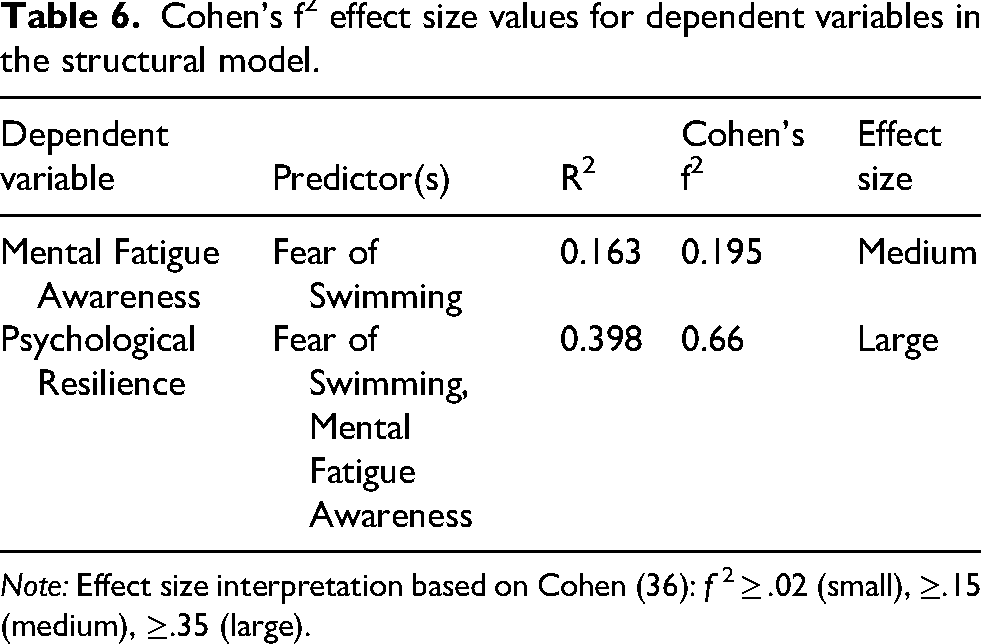
Note: Effect size interpretation based on Cohen (36): f2 ≥ .02 (small), ≥.15 (medium), ≥.35 (large).
Based on this classification, the effect of fear of swimming on mental fatigue awareness is moderate (f2 = 0.195). Conversely, the combined effect of fear of swimming and mental fatigue awareness on psychological resilience was found to be large (f2 = 0.660). These findings demonstrate that the constructs within the model act as robust predictors and that the model possesses significant explanatory power.32,39 Furthermore, these effect sizes underscore the practical significance of the relationships observed within the structural model.
Findings regarding the moderation model
Figure 3 illustrates the effects of fear of swimming on psychological resilience within the model where non-fatal drowning experience functions as the moderator variable.
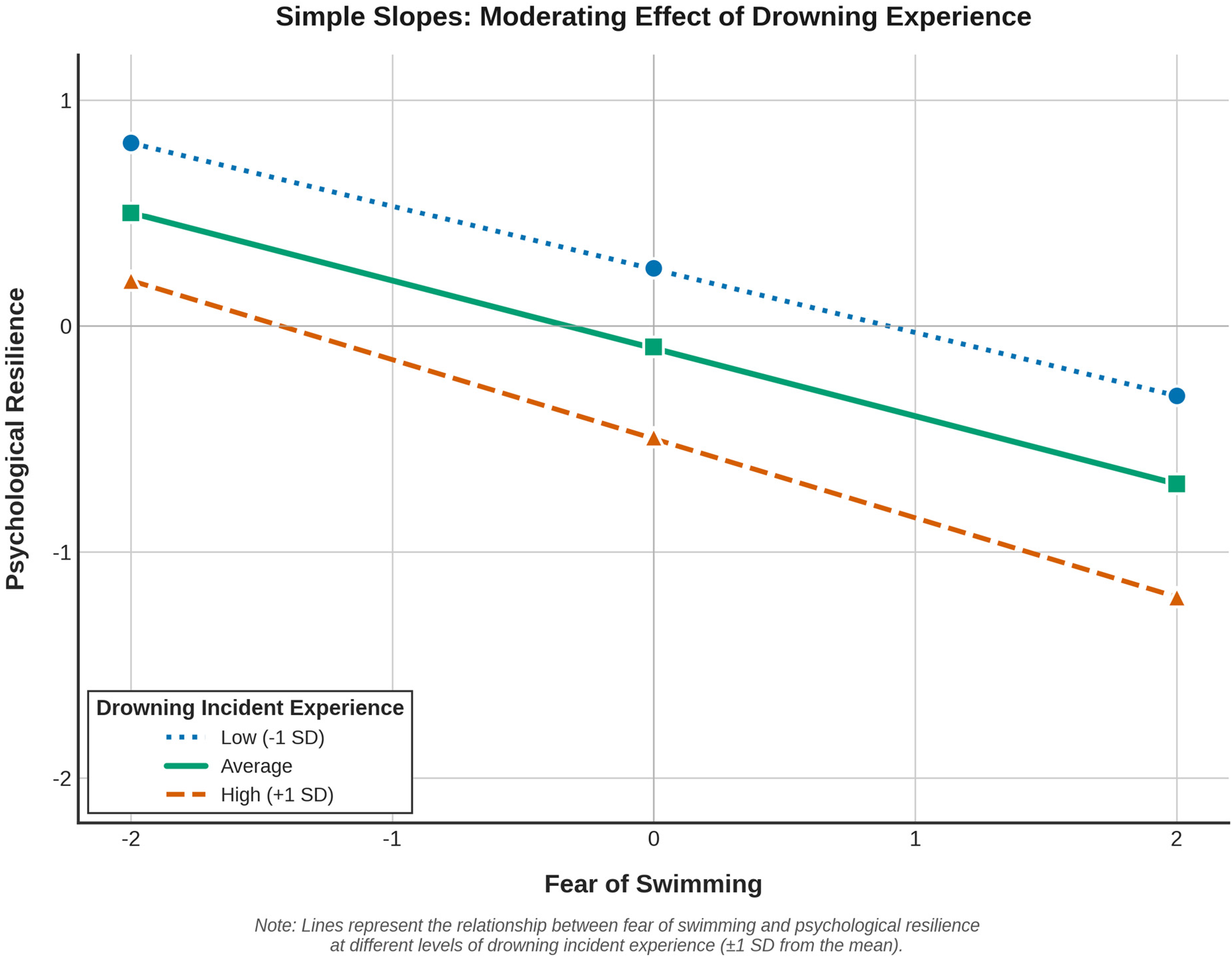
Interaction plot illustrating the moderating effect of near-drowning experience on the relationship between fear of swimming and psychological resilience.
Figure 3 visually demonstrates that the impact of fear of swimming on psychological resilience is contingent upon the history of non-fatal drowning experience. For swimmers with no prior history of a serious non-fatal drowning incident (represented by the “Low” group, β = −.530), a steep decline in psychological resilience is observed as fear of swimming escalates. Conversely, among swimmers who have survived a non-fatal drowning incident (the “High” group, β = −.210), this negative relationship is significantly attenuated; that is, an increase in fear of swimming exerts a much weaker negative impact on their psychological resilience. These results confirm that a past non-fatal drowning experience functions as a significant moderator, buffering the detrimental effect of fear on resilience, which is consistent with “steeling” or post-traumatic growth theories.20,21
According to Table 7, fear of swimming significantly predicts psychological resilience (β = −0.369, p < .001). In contrast, the non-fatal drowning experience alone does not exert a significant main effect on psychological resilience (β = 0.088, p = .129). However, the interaction term was found to be statistically significant (β = 0.323, p < .001), which confirms that the non-fatal drowning experience assumes a moderating role.
Moderating effect of near-drowning incident experience.
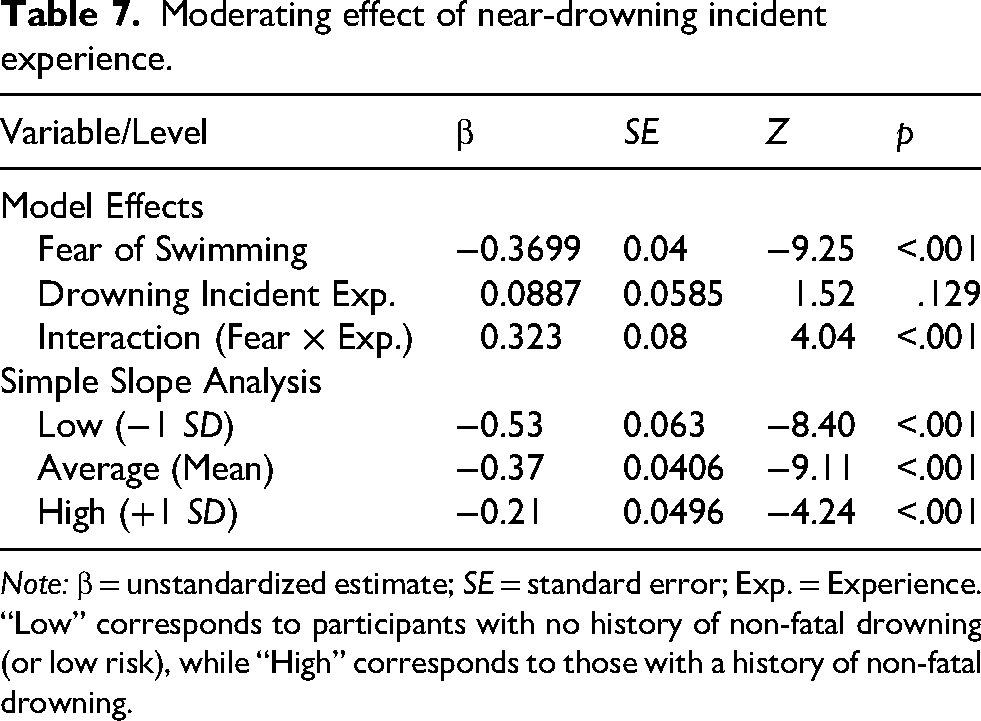
Note: β = unstandardized estimate; SE = standard error; Exp. = Experience. “Low” corresponds to participants with no history of non-fatal drowning (or low risk), while “High” corresponds to those with a history of non-fatal drowning.
Simple slope analysis suggests that the negative effect of fear of swimming on psychological resilience is strongest in the group with no non-fatal drowning experience (low group) (β = −0.530, p < .001). Conversely, in the group with a history of non-fatal drowning (high group), this relationship is relatively weaker (β = −0.210, p < .001). In the average group, the effect remains moderate (β = −0.370, p < .001).
The findings demonstrate that the detrimental effect of fear of swimming on psychological resilience differs depending on the swimmers’ prior traumatic experiences. The literature emphasizes that traumatic experiences can reshape coping styles and reconfigure levels of psychological resilience.20,21 Furthermore, following such experiences, social support, problem-solving skills, and learning from experience emerge as critical protective factors in maintaining psychological resilience. 40 The significance of the interaction term and the distinct patterns observed in the simple slopes indicate that H5 is supported.
Discussion
This study offers a distinct contribution to the literature by investigating the impact of fear of swimming on psychological resilience, framing mental fatigue awareness as a mediator and the history of serious non-fatal drowning experiences as a moderator. The findings demonstrate that the proposed conceptual model aligns with both theoretical expectations and projections from prior research. The acceptable fit indices and reliability indicators obtained for the measurement models provided a robust foundation for interpreting the results.31,32
First, regarding H1, the negative relationship between fear of swimming and psychological resilience was confirmed both at the correlational level and as a direct effect within the structural model. This pattern is consistent with theoretical explanations positing that threat- or anxiety-focused cognitive appraisals narrow coping resources and diminish resilience.1,2 According to the biopsychosocial model of challenge and threat states, when an athlete appraises a situation as a threat—where demands exceed resources—rather than a challenge, the physiological and psychological response is maladaptive, leading to performance anxiety and reduced resilience. 7 In our context, as the perception of aquatic threat increases, the swimmer's capacity for flexible adaptation appears to decline. This finding also aligns with the implications of the Broaden-and-Build Theory, which emphasizes that fear and anxiety can constrict an individual's thought-action repertoire. 8 The observed significant negative direct effect supports H1.
Second, H2 was validated; fear of swimming significantly and positively predicted mental fatigue awareness in athletes. Fear and threat-focused arousal trigger the allocation of attentional resources toward continuous vigilance and avoidance scenarios, thereby increasing cognitive load. 9 This process can result in the more frequent and intense perception of mental fatigue symptoms. 16 In a sporting context, repetitive high-effort monitoring feeds into perceived mental exhaustion, straining self-regulation. The current findings indicate that this mechanism is particularly pronounced among swimmers.
Third, in line with H3, mental fatigue awareness exhibited a strong negative relationship with psychological resilience. Mental fatigue erodes motivational drive and cognitive flexibility—such as maintaining attentional set or generating alternative solutions—thereby weakening resilience processes. 16 This provides evidence that elevated signals of mental exhaustion limit recovery capacity, a finding that overlaps with the self-regulatory energy and cognitive control components found in resilience models 2 ; thus, H3 is supported.
Regarding the mediation analysis (H4), it was observed that a significant portion (≈52%) of the total effect of fear of swimming on psychological resilience is transmitted via mental fatigue awareness. This result can be articulated as a chain: Fear → (Cognitive Load/Hypervigilance) → Fatigue Awareness → (Motivational-Cognitive Erosion) → Diminished Resilience. The retention of a significant direct effect alongside the indirect effect indicates partial mediation. 38 At this juncture, it is crucial to emphasize that the mediator variable assesses “mental fatigue awareness”—the extent to which the individual monitors and perceives this state—rather than “mental fatigue” in isolation. While high awareness may indicate actual depletion of cognitive resources, it may also reflect an enhanced ability to monitor internal somatic and mental states (interoception and metacognition).41,42 In this second scenario, continuous internal scanning creates an additional cognitive load, potentially establishing a meta-cognitive cycle that negatively impacts resilience. Consequently, the findings suggest that the act of focusing on fatigue may constitute a risk factor for psychological resilience.
Finally, the moderation analysis regarding H5 demonstrated that a history of serious non-fatal drowning experience significantly attenuates the slope of the relationship between fear of swimming and psychological resilience. Simple slope analyses reveal that for the group with no such experience, resilience declines steeply as fear increases; conversely, for the group with prior experience, this decline is far more limited. This pattern aligns with the theory of cumulative lifetime adversity, which suggests that moderate exposure to adverse events can foster “psychological inoculation” or “steeling” effects, whereby individuals develop greater adaptive capacity for future stressors. 22 It is plausible that the situational knowledge and safety strategies acquired post-experience render threat assessment more realistic, thereby blunting the destructive impact of fear on resilience. Additionally, while our data did not distinguish between pool and open water incidents, it is important to note that fear responses can be context-specific; for instance, elite swimmers may exhibit high competence in pools but significant anxiety in open water environments due to the unpredictability of the latter. Future research should parse these environmental nuances.
Implications for coaching practice
The results of this research provide several evidence-based insights that can be directly applied to coaching practice. Firstly, the significant mediating role of mental fatigue awareness offers coaches a concrete target for intervention. Rather than merely advising athletes to “toughen up” or “push through,” coaches can actively address the cognitive burden that fear creates. A practical approach would be to conduct brief “mental load assessments” before high-pressure training sessions, where athletes rate their perceived mental energy on a straightforward 1–10 scale. This information can guide adjustments to training intensity and help prevent cognitive overload, which our model indicates is a direct path to reduced resilience. To implement this effectively, coaches should consider the ‘Challenge Point Framework,’ which suggests that task difficulty must be individualized to the athlete's skill level and psychological readiness to optimize learning and minimize threat perception. 43
Secondly, the moderating effect of non-fatal drowning experiences emphasizes a crucial area for coach-athlete communication. This finding does not imply that trauma is advantageous, but rather that athletes who have overcome significant adversity may have developed unique coping strategies. Coaches, in partnership with sport psychologists, can create structured opportunities for these athletes to act as peer mentors. By sharing their coping strategies in a safe and facilitated setting, they can help transfer resilience skills to teammates who may be struggling with performance anxiety. This turns a past negative experience into a source of collective team strength.
Finally, the entire model highlights that psychological resilience is not a fixed trait but a dynamic process that can be systematically developed. Coaches can incorporate “psychological inoculation” principles into training by designing drills that intentionally and progressively increase cognitive pressure in a controlled environment. Furthermore, providing education on the physiological responses to panic, such as the ‘cold shock response’ or tachycardia, can empower swimmers to anticipate and manage these sensations rather than interpreting them as a loss of control. Understanding the neurobiology of safety is critical for regulating fear responses in aquatic environments. 44
Based on these findings, interventions should be designed with a dual-targeting approach, focusing on both fear reduction (e.g., psychoeducation, gradual exposure, and cognitive restructuring) and mental load/fatigue management (e.g., breath-relaxation techniques, attentional set-shifting, and brief mindfulness exercises). Prior to sessions, a brief “mental load screening” should be conducted to adjust training intensity, and standardized recovery rituals should be appended to the end of high-intensity sessions. Effective coping strategies from experienced athletes could be transferred via peer modeling under safety protocols. Furthermore, “mental recovery blocks” should be integrated into seasonal plans through coach–psychologist collaboration.
At an institutional level, clubs should consider implementing a “Water Competence + Mental Preparation” core protocol. We recommend shifting the focus from generic ‘water safety’ to the more comprehensive concept of ‘water competence,’ which encompasses a broader range of psychomotor, cognitive, and affective skills necessary for drowning prevention. 45 This would involve using visual marking and exposure hierarchies in high-threat training areas and ensuring that monitoring processes encompass not only physiological load but also perceived mental effort and threat perception.
Limitations and future research
While the research findings are supported by acceptable model fit, satisfaction of correlational assumptions, and consistent structural pathways, several limitations must be acknowledged. First, the cross-sectional design and reliance on self-report data limit causal inferences. Second, as noted in the methodology, the use of convenience sampling and online data collection may introduce selection bias and limits the generalizability of the findings to the broader swimming population. Third, the study did not differentiate between pool and open water environments, nor did it assess the participants’ self-perceived swimming competence, both of which could influence fear levels.
Additionally, when interpreting the moderating effect of non-fatal drowning, it is essential to consider the potential for ‘survivorship bias’. 46 The analysis encompasses only those individuals who continued swimming despite facing a serious threat. Individuals who quit the sport following a traumatic experience—and who likely possessed lower levels of psychological resilience—were excluded from the sample. Therefore, the observed buffering effect may reflect the retention of athletes who were already more resilient, rather than an increase in resilience caused by the experience itself. Future research could further illuminate the condition-dependent nature of these mechanisms by testing the model through time-series analyses (e.g., in-season vs. off-season), interventions (fatigue management, fear-reduction protocols), and multi-group comparisons (age/performance level).
Conclusion
This study tested the effect of fear of swimming on psychological resilience in athletes (within the context of aquatic sports), examining the mediation of mental fatigue awareness and the moderation of non-fatal drowning experiences, ultimately validating the model in its entirety. The findings regarding H1–H3 demonstrate that fear of swimming negatively impacts psychological resilience; fear increases mental fatigue awareness, and this heightened awareness subsequently weakens resilience. According to H4, the mediator variable provided partial mediation; the indirect effect remained significant while the direct effect persisted. Regarding H5, the experience of a serious non-fatal drowning incident buffered the negative impact by attenuating the slope of the fear–resilience relationship. Consequently, the model reveals that threat assessment and resource depletion mechanisms operate in tandem, and that experiential learning may play a protective role for certain athletes. These insights suggest that integrating fatigue management and trauma-informed coaching strategies could be vital for fostering resilience in aquatic sports.
Footnotes
Acknowledgements
Not applicable.

Ethical considerations
The study was conducted in compliance with the ethical principles and standards outlined in the 2008 Declaration of Helsinki. Ethical approval was granted by the Mersin University Sports Sciences Ethics Committee on October 6, 2025 (Decision No. 2025-076).
Consent to participate
Written informed consent to participate in this study was obtained from all participants. For participants under the age of 18, written informed consent was obtained from their legal guardian or next of kin.
Consent for publication
Not applicable.
Funding statement
No funding was received for the conduct of this study. Article processing charges (APC) were covered by Junhyoung Kim, Department of Health Behavior, School of Public Health, Texas A&M University.
Declaration of conflicting interests
The authors declared no potential conflicts of interest with respect to the research, authorship, and/or publication of this article.
Data availability
The data that support the findings of this study are available from the corresponding author upon reasonable request.
Generative AI statement
The authors used Paperpal solely for English language editing and for formatting the reference list in accordance with the journal's requirements. No generative AI tools were used for hypothesis development, data interpretation, or theoretical framing. All substantive content, analyses, and interpretations remain the original work of the authors, who take full responsibility for the integrity of the manuscript.