




Abstract
Globally, women perform the lion’s share of domestic labor. Research indicates that gender disparities in cognitive labor—the “thinking work” required to anticipate and monitor household needs—are even more pronounced than in physical household labor. Although traditional theories explain the gender division of physical household labor in terms of time, money, or gender performance, the applicability of these frameworks to the mental load is unclear. The authors address that gap using survey data from 2,133 partnered, heterosexual U.S. parents. Exposing the limits of time-availability and resource-based models, the authors find that women’s employment and earnings reduce their physical household labor, but not their cognitive burden. To explain this persistence, the authors introduce the concept of gendered cognitive stickiness: once assigned on the basis of gendered expectations (often implicitly), cognitive tasks “stick” to women and resist negotiation, regardless of their employment or resources. This concept extends doing gender theory by showing how inequality is reproduced even without visible performance and identifying a dimension of domestic labor that is less situational and more internal. This hidden constraint on domestic gender equality represents an additional measure to explain the stalled gender revolution.
Globally, women perform 76 percent of unpaid care work—three times more than men (International Labour Organization 2018). Sociological research on the gendered division of physical household labor—such as washing dishes, laundry, or childcare—is extensive (for reviews, see Coltrane 2000; Lachance-Grzela and Bouchard 2010). Less attention has been paid to domestic cognitive labor: the often unseen “thinking work” that sustains family life through planning, monitoring, coordinating, and decision making across various domains, including childcare, meals, finances, and scheduling. Research indicates the division of cognitive domestic labor is even more unequally distributed than physical household labor, with negative implications for women’s well-being (e.g., Daminger 2019, 2020; Haupt and Gelbgiser 2024; Kincaid 2021; Petts and Carlson 2023; Weeks and Ruppanner 2025).
How well do existing sociological theories explain cognitive domestic labor? We assess the explanatory power of frameworks traditionally used to explain household labor—time availability, (relative) resources, and gender specialization—to physical and cognitive labor separately. We focus on heterosexual, partnered parents living with children, who face particularly intensive household management demands (Hook, Ruppanner, and Casper 2022). We examine how gender, individual and relative resources, and time availability (measured by employment) structure physical and cognitive domestic labor, controlling for relevant demographic and family characteristics.
Our study makes two main empirical contributions. First, we draw on a large, quota-based survey of 2,133 partnered U.S. parents that approximates the demographic composition of U.S. parents living with dependent children. Existing cognitive labor research is mostly qualitative, relying on small, nonrepresentative samples, often White and college-educated (Reich-Stiebert, Froehlich, and Voltmer 2023). Although offering rich insight into the nature of household mental work, they cannot systematically assess how structural factors like time and money shape its distribution. Our approach allows for a more comprehensive and generalizable assessment of how cognitive labor is distributed and how its gendered patterns persist across social groups. Second, we contribute a novel measure of cognitive labor. Whereas previous survey-based studies typically collapse cognitive labor into one or two broad indicators (e.g., Haupt and Gelbgiser 2024; Petts and Carlson 2023), our 21-item battery captures its multidimensionality and potential variation by task type, for instance, whether women manage cleaning logistics while men handle finances.
Our findings show that although traditional theories explain the division of physical household labor reasonably well, they fall short in accounting for the gendered distribution of cognitive labor. Cognitive labor responds differently to time and resources, depending on gender. For mothers, higher earnings and employment reduce physical labor but have no effect on cognitive responsibilities. For fathers, cognitive labor is more responsive to these factors; yet even among socioeconomically advantaged parents, mothers perform most cognitive tasks. Thus, the conditions that shift physical labor do not similarly affect cognitive labor.
We conceptualize this form of household responsibility as gendered cognitive stickiness. This concept extends “doing gender” theory by positing that women do the bulk of cognitive labor not to “display” or visibly “perform” gender but as an internalized process that, distinct from physical labor, often lacks an “audience.” As such, it is harder to “undo” the gendered division of cognitive labor through negotiation or bargaining because we often can’t “see” when the labor is being done and thus have a limited understanding of its magnitude. This is where the idea of cognitive labor “stickiness” comes in: unlike physical household labor, cognitive tasks adhere to mothers and remain their responsibility net of their greater resources or employment demands. As a consequence, cognitive labor cannot be as easily outsourced or renegotiated as physical labor because it is diffuse, ongoing, and usually invisible, taking place within one’s own head.
Accordingly, our study contributes empirical evidence on gender and domestic work while advancing theoretical models of gender and care. We demonstrate that those structural factors that shift physical labor—employment and income—do not necessarily alter the distribution of cognitive tasks, particularly for mothers. Furthermore, we extend doing gender theory by showing that inequality can be reproduced even in the absence of visible gender performance. Our concept of gender cognitive stickiness captures how cognitive labor functions less as a site of active gender display –because it is not anchored in a single physical setting, and only sometimes produces a tangible outcome – and more a domain of passive gender assignment. These patterns speak directly to research on the “stalled” gender revolution (England, Levine, and Mishel 2020). Women’s increased employment and earnings have shifted some physical tasks but not responsibility for domestic cognitive labor. Managing household life—the cognitive load—remains firmly gendered. Our findings show that gender inequality at home is more entrenched than often assumed, persisting even among privileged women. Cognitive labor’s invisibility exposes a “hidden” barrier to progress, a key mechanism to help explain the stalled gender revolution.
Cognitive Labor: A Distinct Form of Domestic Labor
Sociological studies of cognitive labor have mainly focused on identifying and typifying its “doing.” Early research defined it as planning, managing, decision making, and monitoring daily life (Berk and Berk 1979; Coltrane 1989; Mederer 1993), while later work expanded this to tracking children’s vaccinations (Walzer 1996) and reminding (Zimmerman et al. 2002). A recent review classifies cognitive labor into four tasks—planning, coordinating, decision making, and monitoring (Reich-Stiebert et al. 2023)—which underpin our measurement of parents’ cognitive labor.
Most studies focus on cognitive labor related to children, housework, and household functioning to achieve shared goals (Robertson et al. 2019). Research consistently shows mothers assume a larger share in daily life management (Ahn, Haines, and Mason 2017; Haupt and Gelbgiser 2024; McLean et al. 2023; Schilperoort 2021), childcare tasks (Bass 2015; Daly 2002; Kincaid 2021; Moore 2017; Walzer 1996), and combined housework and childcare (Czymara, Langenkamp, and Cano 2021; Daminger 2019; Faircloth 2021; Luthra and Haux 2022; Petts and Carlson 2023; Robertson et al. 2019; Treas and Tai 2012; Weeks 2025).
Daminger (2019) theorized cognitive labor as scheduling, planning, and organizing across nine domains: food, childcare, logistics, cleaning, shopping, maintenance, travel, finances, and social relations. Her subsequent monograph (Daminger 2025) deepens this, emphasizing that cognitive labor is often dissociated from time and rooted in gender essentialist beliefs about men’s and women’s strengths. She thus suggests time availability arguments are weaker than doing gender perspectives. Our study advances this theorization by testing these ideas with large-scale quantitative data.
We expand upon recent scholarship that shows these activities cleave into daily and episodic tasks, with mothers assuming the bulk of the daily cognitive labor tasks and fathers the less frequent, episodic ones (Weeks and Ruppanner 2025). Thus, we follow these foundational studies to measure domestic cognitive labor using an additive scale that captures its total burden, and also allows for exploration of patterns across daily versus episodic tasks and within specific categories (care, cleaning, finances). A key contribution is linking cognitive labor to established theories of the gendered division of labor: time availability, relative resources, and gender socialization. These theories robustly explain gender gaps in physical domestic labor (Lachance-Grzela and Bouchard 2010). We test their applicability to cognitive labor through four hypotheses, outlined below.
Time and Resources
The time-availability perspective underscores that time is a finite resource; hence, time investments in one area of one’s life come at the expense of time in another. In the housework literature, this theory aids in understanding the tension between time in paid employment and time in housework: people who spend more time in paid employment will have less time available for other activities, including domestic tasks (e.g., Presser 1994). Studies analyzing time-use data show that time in paid employment has an inverse, linear association with time spent performing housework and childcare for men and women (Hook et al. 2022; Milkie et al. 2025; Sayer 2016). Studies using self-reported employment status and childcare/housework contributions identify an equivalent relationship for both men and women (Syrda 2022; Waldfogel 2002). Collectively, employment is negatively associated with domestic investments.
Another major theoretical framework for explaining domestic labor concerns resources. On the one hand, the relative-resources perspective posits that within couple-households, the partner with the relatively higher personal income (i.e., the breadwinner) can leverage their income to “bargain” out of the domestic work, leaving a larger share to the lower income partner (Blood and Wolfe 1960). Alternatively, the autonomy perspective suggests that one’s own resources matter more to their domestic labor than do their earnings compared with their partners’ (e.g., Gupta 2007; Tisch 2021). Individuals with greater resources can reduce their level of household work by outsourcing some of this labor, such as by purchasing childcare and housekeeping services or eating out (e.g., Brandon 1999; Cohen 1998).
We do not expect that time constraints or resources will influence cognitive household labor in the same way. Unlike physical household work, cognitive household work is not clearly measured in units of time. As Dean, Churchill, and Ruppanner (2022) describe, although physical household work can be conceptualized as a “second shift”—clearly demarcated from the first, paid work shift—cognitive household work is not bound by time or space in the same way. Instead, it can go on all the time, in the back of one’s mind: on the way to work, during the working day, while trying to sleep, and so on (Dean et al. 2020). The diffuse and ongoing nature of cognitive household work means that time constraints ought not to limit mental work in the same way that they structure the completion of physical tasks, in discrete units of time. This is further confirmed by Daminger (2025), who argues, “cognitive labor emerged from my research as a ubiquitous, highly feminized dimension of household labor that is poorly captured by time-based measures we normally use to measure this work” (p. 137).
Cognitive domestic labor is harder to outsource with financial resources than physical labor. Delegation is complicated by its invisibility, as anticipating and remembering typically happen inside one’s head, without others noticing. Although some elements can be outsourced (Haupt and Gelbgiser 2024), outsourcing has limited impact. Monitoring requires ongoing vigilance, which cannot be easily scheduled or transferred because it depends on constant awareness of shifting household needs and timely recognition of often subtle cues (e.g., noticing when groceries are running low before they run out). Decision making often demands specific knowledge of family preferences, histories, and routines (e.g., weighing which after-school activity best suits a child’s temperament or balancing competing needs across siblings). These tasks rely on tacit knowledge and real-time judgement, making them less transferable to paid help or technological substitutes. Cognitive labor is further harder to delimit or outsource precisely because it is not time or space bound, but can be done anytime, anywhere, and often in parallel with other activities (Daminger 2025; Weeks and Ruppanner 2025). Moreover, family life is unpredictable: a sick child or canceled daycare can instantly increase cognitive labor. These features—invisibility, personal specificity, task complexity, and life’s unpredictability—make cognitive labor especially difficult to offload. As such, we expect individual earnings to reduce physical labor more effectively than cognitive “thinking” work.
On the basis of these theoretical expectations, we offer the following hypotheses:
Hypothesis 1 (time availability): Parents who are employed will report doing fewer hours of physical household labor, but not less cognitive labor, than parents who are not employed.
Hypothesis 2 (relative resources): Breadwinners will report fewer hours of physical care and household labor, but not less cognitive labor, than parents who have lower incomes than their partners.
Hypothesis 3 (autonomy): High-income individuals will report fewer hours of physical household labor, but not less cognitive labor, than lower income individuals.
Gender
Beyond time and money, gender-based theories suggest that gender matters most. However, the applicability of these theories to cognitive labor is unclear. Gender specialization models argue that household labor is divided according to efficiency and comparative advantage, with men specializing in paid work and women in unpaid domestic tasks (e.g., Becker 1985). This framework thus assumes that specialization is a rational, negotiable choice. However, cognitive labor is often difficult to negotiate or transfer because of its invisibility. Delegating tasks may reduce the physical burden but not the mental one: a mother may delegate taking a child to a doctor’s appointment to the father, but the mother often retains responsibility for scheduling, monitoring vaccination timelines, completing forms, and coordinating with work and school commitments. Crucially, prompting or reminding a partner to take on these cognitive responsibilities often reinforces, rather than relieves, the cognitive load (Ahn et al. 2017). Expectations of “weaponized incompetence” (Miller 2018) mean mothers anticipate tasks may go undone or be done poorly if delegated, compelling them to continue monitoring. Indeed, men’s resistance can become a key barrier to genuine delegation (Daminger 2025).
“Doing gender” has more theoretical power, as it identifies that women assume the bulk of domestic labor on the basis of gendered expectations. Physical housework and childcare are often visible performances of femininity, whereas men may avoid “feminine” tasks such as cleaning to maintain a masculine identity, instead prioritizing breadwinning (West and Zimmerman 1987). Such competing expectations—“good mothering” tied to caregiving (e.g., Blair-Loy 2005; Hays 1996; Johnston and Swanson 2007) and “good fathering” linked to breadwinning (e.g., Christiansen and Palkovitz 2001; Hays 1996; Townsend 2002)—help explain why gender gaps in care and housework emerge following the transition into parenthood, and persist thereafter (e.g., Schober 2013; Yavorsky, Kamp Dush, and Schoppe-Sullivan 2015). Although these relationships are weakening, as norms of engaged fatherhood have increased (e.g., Kaufman 2013; Petts et al. 2023) and mothers’ roles have expanded to include economic responsibilities (e.g., Garey 1999), men still face “breadwinner anxiety” or a tension between workplace demands and family involvement (Shirani, Henwood, and Coltart 2012). Accordingly, we might expect that employment status may predict fathers’ physical household labor more strongly than mothers’.
However, cognitive labor typically involves “remembering to do” rather than “doing.” “Doing gender” is rooted in a social interactionist perspective that emphasizes action (e.g., doing housework or childcare) and the audience observing said action (e.g., family members). But cognitive labor is largely internal and anticipatory; it is not easily “performed” in ways that others can see. Its effects may only become visible at the point of physical tasks forgotten: a doctor’s appointment missed or a sports kit forgotten. In this sense, the audience is reactive rather than continuous: expectations are enforced only when violated. Thus, doing gender alone cannot explain why women remain responsible for household coordination.
Money complicates the relationship between gender and household labor, as the bargaining power tied to resources can differ by gender. Research documents a U-shaped pattern between women’s relative earnings and their physical housework: women earning less than their male partner perform more housework than women with similar earnings as their partner; however, when the female partner’s earnings greatly exceed that of the man’s, traditional gender roles in household labor are reinforced (Brines 1994; Schneider and Hastings 2017; Syrda 2022). These patterns reflect a form of “doing gender” through neutralizing deviance from gender roles. By performing more feminine-typed unpaid household labor tasks, high-earning women neutralize the “threat” of their breadwinner status to traditional gender roles, while their male partners reduce their household labor to reinstate their masculinity (e.g., Atkinson and Boles 1984; Bittman et al. 2003; Lyonette and Crompton 2015; Syrda 2022). In this way, resources are filtered through gender performance: relative earnings do not simply translate into bargaining power but interact with gender and its associated norms in shaping domestic labor. Whether these patterns replicate for cognitive labor remains untested.
The Gendered Stickiness of the Mental Load
Reflecting the limitations of existing gender-based theories for conceptualizing cognitive labor, we propose a new conceptual framework: gendered cognitive stickiness. We argue that, like physical household labor, cognitive labor is assigned to women by default; yet unlike physical household labor, cognitive labor’s invisibility means it often goes unacknowledged and unrecognized, and therefore is far more resistant to negotiation or bargaining between partners as resources shift. So, whereas doing gender is often theorized as contingent and responsive to context (e.g., gender deviance neutralization when women outearn men), cognitive labor is inertial or “sticky.” Gendered cognitive stickiness thus extends insights from the “doing gender” literature by highlighting how the gendered division of cognitive labor persists even without visible performance, and regardless of resources or time availability. Accordingly, we argue that gender is the strongest predictor of cognitive load among parents, transcending (relative) resources and time availability.
Prior research indicates that women, but not men, are expected to be ultimately responsible for family life and are more likely to be judged negatively by their peers if they fall short (Thébaud, Kornrich and Ruppanner 2021). This accountability explains why mothers maintain responsibility for cognitive labor regardless of their employment or financial status, because they will be the ones blamed if things go wrong. Thus, cognitive labor’s underpinnings are tied to social standards about motherhood, ranging from safeguarding children’s economic futures (Milkie and Warner 2014) to ensuring bandages have been purchased. Our concept of gendered cognitive stickiness captures how mothers assume the bulk of cognitive labor not to actively “display” or “do” motherhood and femininity, but because motherhood itself means that this labor gets stuck to women.
If gendered cognitive stickiness shapes the mental load, then we expect the gender gap in cognitive labor to be larger and more persistent than in physical housework, even when controlling for employment and income. Although time, individual resources, and relative resources are likely to narrow the gender gap in physical household work, we do not expect to observe the same for the mental dimension. Thus, we formulate the fourth and final hypothesis:
Hypothesis 4 (gendered cognitive stickiness): Women will report higher cognitive household labor than men, regardless of employment status or financial resources, with larger gender differences observed for cognitive versus physical household labor.
Data and Methods
To test our argument, we examine cognitive labor in relation to time availability, economic resources, and sociodemographic controls, comparing these patterns to physical household labor. Our data come from an original survey of U.S. parents conducted in February and March 2023. To reflect the U.S. parent population in age, race/ethnicity, gender, and education, the survey firm Dynata used quota sampling to select 3,000 parents of children younger than 18 years. The survey was administered to individuals (not couples), allowing us to assess how partnered parents individually perceive and report household labor. Table A1 in the Appendix provides summary statistics of our sample.
Given our focus on how cognitive labor is negotiated and distributed within the household, we limit our analysis to partnered, heterosexual parents (n = 2,133). 1 Although we recognize that single parents often engage in coparenting, which shapes cognitive labor, we expect different cognitive and physical labor patterns for single parents (Walper and Kreyenfeld 2022), which are beyond the scope of our analysis but a clear direction for future research.
Dependent Variables
We measure cognitive household labor using an additive scale of 21 task items, building on qualitative research outlining the cognitive labor cycle of anticipating needs, decision making, and monitoring progress (Daminger 2019). Our 21-item cognitive labor scale was developed and validated in prior work (Weeks and Ruppanner 2025). That study used exploratory and confirmatory factor analyses to test its dimensionality, demonstrating a stable two-factor structure distinguishing daily and episodic cognitive labor, with good model fit (e.g., root mean square error of approximation = 0.08, confirmatory fit index = 0.99; see Tables A8 and A9 for results of these analyses). The survey items were iteratively pilot tested for clarity and comprehension.
The questionnaire covers seven domains: scheduling, childcare, social relationships, cleaning, food, finances, and home maintenance (21 items total; see Table A2). These categories are not exhaustive but capture key cognitive labor areas. Respondents answer the question “In your family, who typically handles” each task, choosing from “Mostly me,” “Mostly my partner,” “Partner and I share equally,” “Someone else (e.g., friends, family),” or “NA” (not applicable). We construct an additive measure of cognitive labor by summing the number of tasks for which a respondent answered “Mostly me,” representing their total self-reported primary responsibility for cognitive tasks. 2
To measure physical household labor, we use two questions asking respondents to estimate weekly hours spent on (1) care: “On average, how many hours a week do you spend looking after family members (e.g., children, elderly, ill, or disabled family members)?” and (2) other household work: “On average, how many hours a week do you personally spend on household work (e.g., cooking, cleaning, yard work), excluding childcare and leisure activities?”
Explanatory Variables
Our key explanatory variables are time availability, individual resources, and relative household resources. Time availability is measured through employment status (1 = currently in paid work). Individual resources are measured by personal, individual-level annual salary, including bonuses and commissions (1 = $100,000 or more per year). 3 Relative household resources are assessed using the item “Considering all income sources, between you and your spouse/partner, who has the higher income?” (1 = higher income than their partner).
Control Variables
We control for factors that may confound relationships between gender, employment, income, and cognitive labor. These include respondents’ age, as household labor varies over the life course: men’s contributions remain low but rise slightly with age, whereas women’s housework peaks at younger ages before declining (Leopold, Skopek, and Schulz 2018). We also control for the age of the youngest child and number of children. Younger children increase time demands: parents with children aged 0 to 5 years spend 6.49 waking hours per day with them, compared with 5.05 hours for children aged 6 to 12 years and 3.43 for those aged 13 to 17 years (Bureau of Labor Statistics 2022). Meanwhile, higher order births heighten time pressure, likely because of intensified cognitive labor (Ruppanner, Perales, and Baxter 2019). We further control for education, which correlates positively with childcare (England and Srivastava 2013; Sayer, Gauthier, and Furstenberg 2004; Sullivan, Billari, and Altintas 2014) but negatively with housework (Pessin 2024; Schneider and Hastings 2017; Sullivan and Gershuny 2016). Last, we control for ethnic identity, given variations in gender divisions of labor (Kan and Laurie 2018) and parenting ideologies (Minnotte 2023).
Empirical Strategy
Our analysis proceeds in three stages. First, we describe how mental and physical household labor are divided by gender using difference-in-means tests. Second, we estimate a series of negative binomial regressions to assess the relationship between our key explanatory variables and both forms of household labor, by gender, controlling for relevant covariates. Negative binomial models are appropriate for count outcomes, i.e., number of cognitive tasks and number of hours spent on care and other household work. Because coefficients from these models are difficult to interpret, we report incidence rate ratios (exponentiated coefficients) and their transformed standard errors. These ratios indicate the multiplicative change in expected counts associated with a one-unit change in each explanatory variable, holding other variables constant. The gender-segregated models allow us to compare the key predictors of household labor for women and men. We use these models to test hypotheses 1 to 3. Third, we estimate fully interactive pooled models, including gender, explanatory variables, controls, and all gender-by-covariate interactions. These models test whether gender moderates the effects of employment and economic resources on cognitive and physical labor (hypothesis 4), specifically, whether women’s cognitive labor remains consistently high regardless of financial or employment status, while men’s cognitive labor varies more with these factors.
Results
Descriptive Overview
Table 1 provides a descriptive overview of cognitive and physical household labor for our sample by gender. Aligning with previous research, mothers report doing more physical chores than fathers: specifically, 10 more hours per week of housework and 22 more in the primary care of children. 4 Likewise, mothers hold primary responsibility for the mental load, reporting, on average, 5.54 more mental load tasks aggregated across categories than fathers (13.72 vs. 8.18), meaning mothers report primary responsibility for 68 percent more of the cognitive load than fathers.
Mean Reported Cognitive and Physical Household Labor by Gender (t Tests).
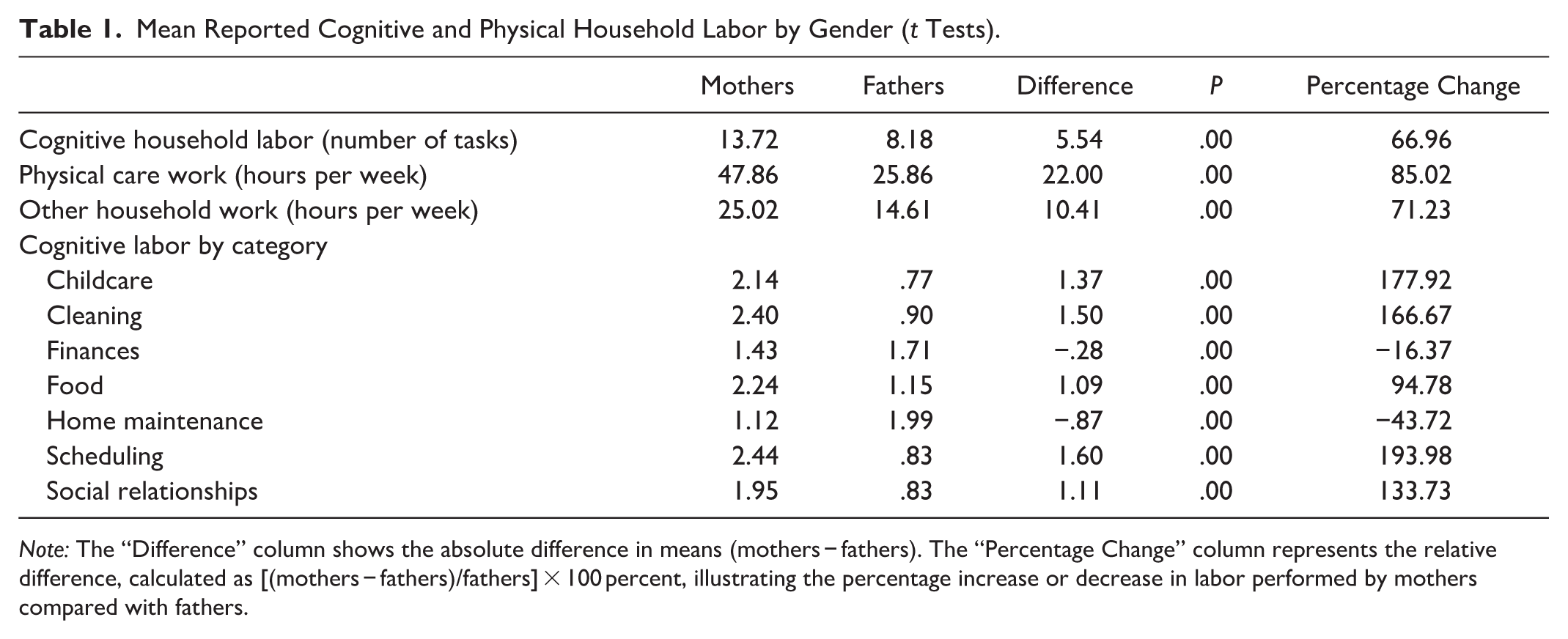
Note: The “Difference” column shows the absolute difference in means (mothers − fathers). The “Percentage Change” column represents the relative difference, calculated as [(mothers − fathers)/fathers] × 100 percent, illustrating the percentage increase or decrease in labor performed by mothers compared with fathers.
When disaggregated into the seven categories, mothers still do the bulk of mental load tasks across almost all categories. Gender gaps disadvantaging women are greatest for scheduling (2.44 for women vs. 0.83 for men), followed by cleaning (2.40 vs. 0.90), childcare (2.14 vs. 0.77), social relationships (1.95 vs. 0.83), and food (2.24 vs. 1.15). When fathers do report greater responsibility, as for household maintenance and finance, these gender gaps disadvantaging men are comparatively small. Fathers hold only 0.28 more of the finance tasks and 0.87 more of the maintenance tasks, versus mothers’ holding 1.61 more of the scheduling tasks and 1.50 of the cleaning tasks. Thus, gender gaps are 2 to 5 times greater for tasks absorbed mostly by mothers compared with those mostly done by fathers.
Within-Gender Differences: Mothers’ Cognitive and Physical Labor
Table 2 presents results for mothers’ and fathers’ physical and cognitive domestic labor in the fully controlled negative binomial regression models. Consistent with the time-availability perspective (hypothesis 1), employed mothers do less physical childcare and housework than nonemployed mothers (models 3 and 5, Table 2). Specifically, employed mothers spend 17 percent less time on caregiving and 22 percent less time on other household work compared with nonemployed mothers, controlling for other factors. Results for cognitive household labor, however, show no significant difference by employment. Employed mothers report the same total number of mental load tasks as nonemployed mothers (model 1).
Determinants of Mental and Physical Household Work, by Gender (Incident Rate Ratios).

Note: Reported coefficients are incidence rate ratios. Standard errors (in parentheses) were computed using the delta method.
p < .05. **p < .01. ***p < .001.
For physical household labor, results support the autonomy perspective (hypothesis 3) over relative-resource theory (hypothesis 2) (Gupta 2007). Mothers earning ≥$100,000 report 30 percent less childcare and 17 percent less housework than lower income mothers (models 3 and 5, Table 2). However, being the household breadwinner does not reduce women’s physical labor. In short, mothers’ physical household work is tied to their own incomes, not their partners’. Yet although employment and high personal earnings reduce women’s physical labor, they have no similar effect on cognitive labor.
Considering the controls, having more or younger children significantly increases mothers’ physical household labor (models 3 and 5, Table 2), and more children are also linked to higher cognitive labor (model 1). Black and Asian mothers report fewer hours of physical childcare than White mothers, and Asian mothers report slightly less cognitive labor. College-educated mothers spend less time on other household tasks than less educated peers but similar time on childcare and cognitive labor. Although age is unrelated to physical labor, mothers in their mid-30s to mid-50s report slightly more cognitive labor than younger or older mothers.
Within-Gender Differences: Fathers’ Cognitive and Physical Labor
As for mothers, employment reduces men’s physical household labor. Consistent with time-availability arguments (hypothesis 1), employed fathers report doing less physical childcare and housework (models 4 and 6, Table 2). Crucially, hypothesis 1 also holds for fathers’ cognitive labor. Against the null effects for mothers, being employed reduces men’s cognitive load, with employed fathers holding fewer total mental load tasks than nonemployed fathers (model 2).
Unlike time, resources function differently for men across physical versus cognitive domestic labor (hypotheses 2 and 3). Neither high income nor relative income in the household significantly determines physical household labor hours, although the correlations are negative as expected (models 4 and 6, Table 2). Thus, although individual resources are significantly associated with less physical household labor for mothers, the same is not true for fathers. Fathers’ physical household labor burden is mainly about time.
Turning to cognitive labor, results for fathers support neither resource hypotheses (2 and 3). Rather than reducing their mental loads, high absolute resources (i.e., earning ≥$100,000) and high relative resources (i.e., comparatively higher incomes than their female partners) are associated with fathers picking up more overall mental load tasks (model 2). These findings do not change when we model the determinants of the share of household mental load (number of tasks responsible for divided by number of total relevant tasks), rather than the number of tasks. They are also robust to continuous measures of absolute and relative income. 5 This unexpected result deserves further attention. To interpret these findings, we used the different dimensions of cognitive labor available in our scale in the subsequent section “Why Do Resources Matter Differently for Fathers? Core versus Episodic Domestic Mental Work.”
Results show that several controls operate differently for fathers’ physical versus cognitive labor. College-educated fathers report less physical housework than those with less education (models 4 and 6, Table 2), but education is not significantly linked to their cognitive labor (model 2). Men with children younger than five years spend more time on childcare than those with older children (model 4), and fathers with more children do more physical housework (model 6). However, unlike mothers, having multiple children does not increase fathers’ cognitive labor. In fact, coresiding with a child younger than three years is associated with lower cognitive load for fathers, compared with no effect for mothers (model 2). Together, these patterns suggest that fathers’ cognitive labor increases as children get older.
Between-Gender Differences: Marginal Effects of Gender, Conditional on Time and Resources
In the next stage of analysis, we examine the marginal effects of gender on cognitive and physical household labor, controlling for key explanatory variables. Figures 1 to 3 show predicted values by gender, conditional on employment, income, and relative income, on the basis of pooled and fully interacted models, with other covariates held at their means. These figures illustrate whether the associations in Table 2 differ significantly for mothers and fathers. Figure 1 presents weekly hours of care work, Figure 2 shows weekly hours in other household work, and Figure 3 shows the number of mental load tasks (see Table A3 for regression results).

Predicted hours per week in caring by gender, conditional on employment, income, and relative income.

Predicted hours per week in other household work by gender, conditional on employment, income, and relative income.
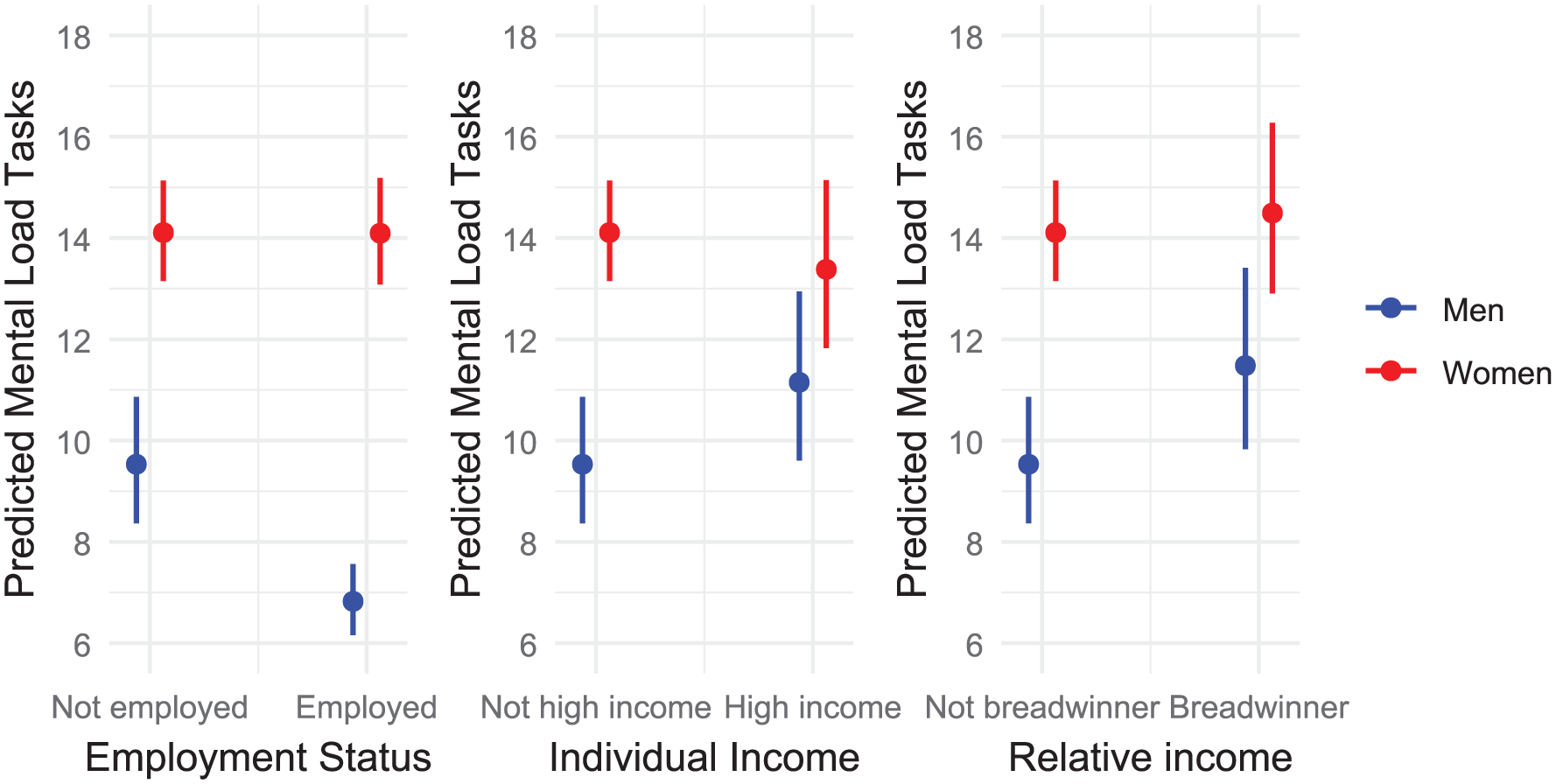
Predicted number of mental load tasks by gender, conditional on employment, income, and relative income.
Aligning with hypothesis 1 (time availability), Figures 1 and 2 show that employment reduces the number of hours men and women spend in both care and other household work (left panels). The interaction of gender and employment is not significant in either model; that is, the “effect” of employment is not different for men versus women. For mothers, employment reduces time spent in caring by 8.6 hours, similar to the reduction for employed fathers of 9.1 hours. Similarly, employment reduces time spent in other household work by 5.9 hours for mothers and 6.1 hours for fathers.
Turning to income, Figures 1 and 2 (middle panels) demonstrate that high-earning women report significantly less time in caring work than their lower earning counterparts, aligning with the autonomy perspective (hypothesis 3). All else equal, high income reduces mothers’ time in caring from 51.0 to 35.9 hours per week, comparable with that of fathers who are high earners (31.8) or who do not earn as much (34.4). Likewise, high income reduces mothers’ time in other household work from 27.3 to 22.6 hours per week, akin to high-income fathers (18.9) and lower income fathers (19.5). Although high absolute resources help narrow gender gaps in physical labor, Figures 1 and 2 indicate little evidence that high income significantly affects fathers’ care work. Instead, fathers report fewer hours in care and household work, regardless of their level of individual resources.
Against hypothesis 2 (relative income), however, we find little evidence that breadwinning reduces time spent in household work, or that it is significantly moderated by gender (right panel of Figures 1 and 2). Although breadwinning is associated with fewer hours spent in caring for fathers (30.4 vs. 34.4 for nonbreadwinners), this relationship is not significant.
Results for between-gender differences in cognitive labor contrast with those for physical labor by offering limited support for time-availability or resource perspectives (hypotheses 1–3). Rather, in line with hypothesis 4, the most striking pattern across Figure 3 is how immovable women’s mental load is across employment (left panel), absolute income (middle), and relative income in the household (right). Employed mothers do significantly more cognitive labor than employed fathers. Resources help narrow gender gaps in cognitive labor: gender gaps for high-income men versus high-income women are smaller than for lower income men and lower income women; likewise, breadwinning entails similar mental loads for men and women, whereas gaps between nonbreadwinner men and nonbreadwinner women are wide. Even so, high-income mothers and mothers who earn more than their partners tend to report more cognitive labor tasks than fathers with comparable resources; however, these gender differences are not statistically significant (Figure 3). As the panels show, women’s mental load remains static, whereas men’s mental load responds to these different factors. For the mental load, the interactions between gender and employment, gender and income, and gender and relative income are all statistically significant. This suggests that the “effects” of time and financial resources on mental load responsibility differ between women and men.
Why Do Resources Matter Differently for Fathers? Core versus Episodic Domestic Mental Work
The unexpected finding that men with higher resources pick up more cognitive labor prompts us to ask: which specific aspects of the load are they picking up? To better understand patterns in fathers’ cognitive labor, we disaggregate the overall mental load additive scale into core versus episodic components (Table 3; see Table A4 for parallel results for mothers). 6 Our approach builds on prior research showing that mothers hold the bulk of “core” mental tasks related to family well-being (cleaning, scheduling, childcare, food, social relationships), whereas fathers do more “episodic” tasks related to maintenance and finances (Weeks and Ruppanner 2025).
Determinants of Fathers’ Core and Episodic Mental Load Dimensions (Incident Rate Ratios).

Note: Reported coefficients are incidence rate ratios. Standard errors (in parentheses) were computed using the delta method.
p < .05. **p < .01. ***p < .001.
Disaggregating cognitive labor into core, routine components versus more episodic, nonroutine components reveals differences among fathers on the basis of absolute versus relative resources. Men with high absolute resources (i.e., with salaries ≥$100,000) do more core, feminine-typed mental load tasks; by contrast, men with high relative resources (i.e., who have higher personal incomes than their female partners) pick up more episodic, masculine-typed tasks. These patterns persist when further splitting the mental load into its seven distinct categories (Table A6). Specifically, high-income fathers report doing more feminine-typed tasks related to care (rate ratio = 1.4; i.e., 40 percent more likely to engage in caring mental load tasks than lower income fathers), cleaning (rate ratio = 1.2), and socializing (rate ratio = 1.5), whereas breadwinner fathers do more of the finances (rate ratio = 1.5) and maintenance (rate ratio = 1.2). Fathers with high absolute resources and high relative resources both report doing more of the scheduling mental work, too (rate ratios = 1.3 and 1.4, respectively).
What explains high-income men’s greater involvement in core mental load tasks? Several factors may be at play. A growing cultural shift toward egalitarian parenting and “involved” fatherhood emphasizes decision making and logistical planning (Gerson 2010; Lamb et al. 1985; Pedulla and Thébaud 2015). Additionally, parental investments in children’s education have become central to class reproduction (Lightman and Kevins 2021). The concept of “concerted cultivation” encourages middle- and upper-class parents to engage children in structured enrichment activities (Lareau 2000), giving high-income men greater incentives to participate in cognitive labor. Their economic resources also expand their choices, allowing them to arrange prestigious extracurriculars, such as elite camps or specialized sports training, rather than routine childcare. For example, higher income families are more likely to invest in private SAT preparation or tutoring (Buchmann, Condron, and Roscigno 2010). These types of cognitive tasks not only align with class-based parenting norms, but carry a degree of cultural prestige. Indeed, visibly participating in such domains may bring reputational benefits and praise for men, partly because their participation is less expected (Haupt and Gelbgiser 2024; Ishizuka 2025). Thus, the heightened status associated with these cognitive labor tasks may help explain why high-income men are more involved in care, scheduling, and educational decision making.
Crucially, high-income men face fewer constraints than lower income men in taking on core mental load tasks (Petts et al. 2023). Greater financial resources allow outsourcing household labor, such as cleaning services or meal preparation, thereby reducing the time spent on physical domestic work (Coltrane 2000; Dotti Sani and Treas 2016; Williams 1999). Some research has shown that high-income households perform less unpaid household labor compared with lower income households (Folbre 2012; Vagni 2020; but see Frazis and Stewart 2011), which could free up high-income men’s time for core mental load tasks, even if they crop up daily. Additionally, highly paid professional roles often entail greater job autonomy, which is positively associated with paternal involvement in childcare-related activities (Hook et al. 2022). A limitation of our analysis is that we lack a measure of these and other job characteristics; hence, future studies could build on ours by incorporating such measures.
Conversely, our results show that high relative resources (earning more than one’s female partner) lead men to take on more “episodic” mental load tasks, such as finances and home maintenance. This suggests that breadwinning men may reinforce their provider identity through financial management and traditionally masculine-typed tasks (Ishizuka 2019, 2025; Petts et al. 2023). “Strategic essentialism” may also be at play (Coltrane 2000): by emphasizing financial contributions, men may feel less obligated to engage in other, more frequent cognitive tasks, particularly if their partners work fewer hours. At the same time, breadwinner status may heighten pressure to maintain or grow earnings, in line with ideal-worker norms, reinforcing men’s focus on less time-sensitive tasks while avoiding more ongoing cognitive demands.
A final consideration is that contributing more financially may heighten investment in financial decisions. Supporting this, we find that breadwinning status is also positively associated with financial mental load for women (Table A5). For women, however, this may reflect a baseline effect: as they already shoulder most household management, the financial domain is one of the few where their load can still increase. This pattern underscores the gendered stickiness of cognitive labor: men’s contributions remain selective and domain specific, whereas women’s remain high across domains, regardless of earnings.
Discussion
Analyzing mothers’ and fathers’ domestic contributions using a survey of 2,133 heterosexual, partnered U.S. parents, we find that existing theories of the gendered division of labor remain highly predictive of physical household work. Consistent with the time-availability perspective, employed parents do less physical labor than nonemployed ones. For fathers, we find little support for relative-resource or bargaining perspectives; regardless of income or earnings relative to their partner, they report fewer hours in physical household work, reflecting persistent gender roles. For mothers, relative earnings do not reduce physical labor, but personal income does: high-income mothers do less physical housework than lower income mothers. However, they represent just 12 percent of our sample, and prior research suggests their reduced workload stems from outsourcing, not increased partner involvement. Still, our findings reinforce the role of women’s absolute resources in promoting a more equal division of physical labor (Gupta 2007; Sullivan and Gershuny 2016).
A central contribution of this study is showing how these same mechanisms – time and money – fail to alleviate mothers’ cognitive labor. We find little evidence that these factors help narrow the cognitive labor gap. Mothers carry the lion’s share of the mental load across all subgroups. Although physical labor is stratified for women, cognitive labor is not—that is, employment, (relative) income, and education make no difference. We therefore propose that cognitive labor exhibits gendered stickiness: its invisible, boundaryless, and diffuse nature makes it resistant to redistribution through employment or resource advantages. Employed and high-earning mothers report the same cognitive burdens as those with less time or income; they are “doing it all,” regardless of resources.
A further important contribution of our study is to demonstrate that, in contrast to mothers, fathers’ mental loads are shaped by resources, but in distinct ways. Fathers’ mental loads increase with income and as children age. Our multidimensional approach to measuring cognitive load reveals important nuances in how resources matter: high-income fathers engage more in core mental load tasks, likely because greater financial resources allow for outsourcing physical labor while job autonomy enables childcare planning; whereas fathers with high relative but not absolute income focus more on financial and maintenance tasks, reinforcing provider identities while avoiding frequent cognitive labor. Despite these differences, mothers shoulder larger shares of cognitive labor when employed and with young children. Given men’s tendency to overestimate domestic contributions (Carian and Abromaviciute 2023; Kan 2008), future research would benefit from innovative methods that go beyond self-report estimates, such as task-tracking apps or ecological momentary assessments, to better capture the invisible and anticipatory dimensions of mental load.
To conclude, the theory of gendered cognitive stickiness provides a critical lens for understanding persistent inequalities in household mental labor. Doing gender highlights how the gender division of (physical) household labor is reproduced through gender performance and contingent, insofar as it may be (re)negotiated on the basis of changing context (e.g., shifts in breadwinning roles). Our concept of gendered cognitive stickiness builds on this, highlighting how the gender division of cognitive household labor is less situational or changeable, in that it persistently adheres to women regardless of resources or time. In turn, our findings expose a hidden barrier to gender progress: while women’s employment and earnings reduce physical tasks, they do little to shift responsibility for ensuring household work gets done. Managing the household’s mental load remains firmly gendered, exposing yet another barrier to the unfinished gender revolution.
Our study has several limitations. First, we capture individual reports of domestic cognitive labor at a single point in time, meaning we cannot observe how the mental load evolves within households or across life stages. Understanding the distribution of cognitive labor over time would be particularly valuable during the transition into parenthood. Mothers may absorb larger childcare, housework, and cognitive labor during this transition, which may foster positive and negative emotional responses upon this transition (e.g., control, self-efficacy, stress, overwhelm). Linking these shifts in the family as well as the emotional outcomes is a fruitful area for future research.
Second, our measures cover key aspects of cognitive household labor, but not its full scope. We do not account for its emotional dimension (Dean et al. 2020). Certain tasks, such as managing school transitions or elder care, are underrepresented. This is not just a limitation of this study but rather a larger issue with this area of inquiry. We do not yet have a comprehensive measure of cognitive labor, meaning our data may be skewed in unknown ways. Although we recognize this limitation, we note that it is critical to benchmark cognitive labor against the other well-established forms of domestic labor (e.g., childcare and housework). It is for this reason that we include these measures in our analysis to validate the relationships between our estimates, theory, and existing scholarship and to identify cognitive labor as a distinct form of domestic labor. Yet more work is essential in this area.
Third, our analysis focuses on heterosexual parents with dependent children in the United States, limiting generalizability. This design allows us to study variation among parents, but it also means we cannot compare partnered parents to couples without children. Future work should examine whether the dynamics we identify differ in households without children, where parenting responsibilities are not intertwined with the division of other forms of household labor. We also lack key contextual variables such as working time, occupation, migration background, disability, or cultural norms, including those around gender and intensive parenting. Finally, we do not explore how intersecting identities may shape mental load patterns or expectations. These constraints point to important directions for future research.
Future research should examine cognitive labor across diverse employment and personal characteristics, and explore how national-level sociocultural and policy contexts might influence patterns. Investigating cognitive labor in same-gender or nontraditional households could clarify whether these inequalities stem from gender or broader caregiving norms. Couples-based or longitudinal research would also allow better insight into shared perceptions of cognitive labor, changes over time, and their implications for well-being and relationship dynamics. Overall, our findings reveal that the most deeply entrenched aspects of the gender division of labor may not be physical tasks, but rather the unseen mental scaffolding that organizes daily life.
Supplemental Material
sj-docx-1-srd-10.1177_23780231251384527 – Supplemental material for Take a Load Off? Not for Mothers: Gender, Cognitive Labor, and the Limits of Time and Money
Supplemental material, sj-docx-1-srd-10.1177_23780231251384527 for Take a Load Off? Not for Mothers: Gender, Cognitive Labor, and the Limits of Time and Money by Ana Catalano Weeks, Helen Kowalewska and Leah Ruppanner in Socius
Footnotes
Acknowledgements
We thank three anonymous reviewers and the editor for their constructive comments.
Author’s Note
All authors contributed equally to this work.
Funding
The authors disclosed receipt of the following financial support for the research, authorship, and/or publication of this article: This project is supported by Australian Research Council grant FT220100493.
Supplemental Material
Supplemental material for this article is available online.
1
All respondents in the sample reported having a spouse or steady partner living in the same household and described themselves as straight or heterosexual.
2
To assess the internal consistency of the 21 dichotomous items, we computed the Kuder-Richardson 20 statistic, which was 0.90, indicating excellent reliability.
3
Respondents reported personal annual salary in $10,000 increments from <$10,000 to ≥$150,000. We define “high income” as ≥$100,000, corresponding to the 80th percentile as per the 2021 U.S. Census Bureau Annual Social and Economic Supplements. Although purchasing power varies by region, we apply a consistent threshold because of limited cost-of-living data in our sample.
4
Reported hours spent on care and housework in our data are higher than time diary estimates like the American Time Use Survey, which aligns with findings from  showing that open-ended self-reports often overestimate time use. Although we asked respondents to exclude child care from household work, these categories can be hard to separate, potentially causing overreporting. Additionally, our survey asks for weekly rather than daily estimates, which may also lead to higher reported hours.
5
See Tables A7 and A10. As another robustness check, we also examined an alternative measure counting tasks respondents reported as “shared equally” with their partner (see ). Results show that higher resourced fathers report fewer shared tasks, suggesting that resources shape perceptions of task distribution rather than reducing men’s cognitive load. Results do not change for mothers.
6
For mothers, disaggregated results are consistent with the results in Table 2 with one exception: like fathers, mothers who are the primary family earner report doing more episodic mental load tasks than other women. When we consider the disaggregated measures (), breadwinning mothers are more likely to take on the mental load related to finance.
Author Biographies
References
Supplementary Material
Please find the following supplemental material available below.
For Open Access articles published under a Creative Commons License, all supplemental material carries the same license as the article it is associated with.
For non-Open Access articles published, all supplemental material carries a non-exclusive license, and permission requests for re-use of supplemental material or any part of supplemental material shall be sent directly to the copyright owner as specified in the copyright notice associated with the article.
