



Abstract
Portugal's “Gold Generation,” one of the country's most talented groups of football players, won two U-20 World Championships in 1989 (Riyadh) and 1991 (Lisbon). This study aimed to holistically describe the development of a successful generation of Portuguese national football players and retrospectively examine the factors underlying their success. Participants included 31 of the 34 world champions, the head and assistant coaches, and seven additional influential stakeholders. Guided by an ecological dynamics framework, a multi-method design was used. Data were collected through semi-structured interviews and document/website analysis, and examined using qualitative (NVivo 11.0) and quantitative (SPSS 24.0) procedures. From this analysis, we proposed the “Ecological Model of Development for the Portuguese Football Gold Generation” (EMDPFGG).
Findings suggest that this generation's success resulted from the players’ talent, combined with the active leadership and holistic vision of head coach Carlos Queiroz, and favourable sociocultural conditions in Portuguese football and sport sciences. Queiroz recognized the opportunities offered by the Portuguese sociocultural context and acted on them across both macro- and micro-levels of development, influencing training, organization, and long-term player growth.
Overall, the results support the idea that coaches who challenge the status quo of training methodologies, and guide athletes toward higher performance, adopt ambitious, updated, and holistic perspectives on the constraints that shape the game, including physical, technical, psychological, cultural, and organizational factors. Such comprehensive approaches can overcome the reductionism that characterizes many scientific studies and practical applications that focus only on isolated aspects of football performance.
Keywords
Introduction
Elite football evolved to an increased movement of footballers between different countries and the inflation of wages and transfer fees. 1 Naturally, identifying and nurturing the most talented youth players have been a primary goal of the vast majority of clubs to ensure their success and survival.2,3 The best clubs in the world continuously seek to maximize the development of their players. As such, the scientific community that studies the identification and development of talent has grown. As stated by Woods, McKeown, 4 this is an exciting era for sports practitioners and applied scientists interested in helping athletes develop within complex sociocultural surroundings.
Nevertheless, the available studies on talent identification and development in football have focused mainly on piecemeal constraints of the game. Such constraints include the relative age effect, deliberate practice (i.e., structured, effortful training for performance improvement), deliberate play (i.e., unstructured, fun activity that builds foundational skills), early specialization (i.e., focusing intensely on one activity from a young age, often involving deliberate practice), early diversification (i.e., early engagement across a wide variety of sports, emphasizing deliberate play over deliberate practice),psychological factors, technical and tactical skills, anthropometric and physiological factors, and sociocultural influences.5–12 All of these constraints can directly influence the process of talent identification and development. 13 However, studies that have used a longitudinal and multidimensional approach to study such factors are scarce.14,15
Furthermore, investigations in other sports, such as kayaking 16 and track and field, 17 have paid particular attention to the role of the environment, as it influences talent development. 18 Authors have proposed a holistic ecological perspective for athletic talent development research (ATDE), which not only has a sports club at its core but also looks beyond the athletes’ direct interactions within the club. 19 This ecological perspective emerged alongside pioneering positions in the field of sports sciences.20,21 Also, this ecological perspective suggests that sports practitioners should facilitate a relationship that mimics the productive, evolving relationship between an organism (i.e., the athlete and team) and its environment (i.e., sports competitions). 4
However, many studies conducted on talent development in sports have focused on specific constraints 22 related to the success of athletes. Meanwhile, the scientific community has begun to connect these constraints to form integrated views, 23 theoretically guided by ecological frameworks such as ecological dynamics 24 or Bronfenbrenner's bioecological theory.18,25
Considering this ecological scale of analysis, the present study investigates the successful talent development environment that was present in Portuguese football during the so-called Gold Generation. During this period, the Portuguese team won two U-20 world championships, in 1989 (Riyadh) and 1991 (Lisbon). Under the leadership of the coach Carlos Queiroz, players like Figo, Rui Costa, Paulo Sousa, and Fernando Couto became world champions. These players become world-known professionals in the European major leagues, signalling a growing impact that Portuguese football started to have in the world since then. How did it happen that Portugal, a country with a population of only 10 million people, become to have some of the best players in the world? Although some of the world's most skilled football players were Portuguese (e.g., Eusébio, Figo, Cristiano Ronaldo), Portuguese national teams did not have success on the international stage - the first and only major competition won at the senior level was the 2016 European Championship). However, prior to this, two of the most significant achievements were the U-20 world championships of 1989 (Riyadh) and 1991 (Lisbon). In over 100 years of football history, never has any other Portuguese national team achieved such a feat. The main aim of the present study was to comprehensively examine the development and success of a generation of Portuguese national football players by integrating a holistic description of their developmental pathways with a retrospective analysis of the key individual, environmental, and contextual factors that contributed to the team's success.
Methods
A multi-method design was used in this study. 26 This design adopts the holistic ecological approach.
Participants
The present study interviewed and consulted 31 (out of 34) Portuguese football world champions from the 1989 and 1991 U-20 national teams, representing players who belonged to different clubs at the time of the tournaments. All the players were already retired from professional play at the time of the study. Of these players, 19 had been international players at the senior level (hereafter, “experts”), while 15 footballers had not achieved international status as adult players (hereafter, “intermediates”). Additionally, the technical staff of this generation of players (Carlos Queiroz and Nelo Vingada) were interviewed, as were some other actors who played essential roles in the two championship victories (i.e., the World Football Championships of Riyadh and Lisbon). These additional interviewees were (1) one medical staff member, (2) one sport sciences faculty professor, consultant of the national team, (3) one club coach, (4) three journalists, and (4) the general director of the Portuguese sport governmental structure (i.e., the General Director of Sports) at the time of the championship victories.
Selection
The players that composed these the two world-champion teams (Riyadh 1989 and Lisbon 1991) were selected due to their success in evolving from top-level young footballers and world champions into elite senior players. Additionally, the work of Coach Queiroz and his technical staff became a landmark in the history of Portuguese football, representing a turning point from which Portuguese football still benefits today. 27 The work of Queiroz and his staff led to improvements in many aspects (e.g., the training process, structural organization of the federation, the reformulation of competitive systems, coach education, and relationships with political structures) that deserve a detailed analysis. As mentioned above, all the players of Portugal's gold generation have retired. Therefore, a retrospective analysis was carried out to investigate the factors behind the success of the two U-20 teams from this generation.
Procedures
Quantitative and qualitative retrospective interviews were employed to trace players’ entire careers. Each player was contacted by e-mail or by phone. They were informed of the research goals and were asked about their intention to participate in the study. Each participant took part in an in-depth, face-to-face 60- to 240-min interview with the principal investigator.
The structure was kept similar for all interviews. All interviews were digitally recorded. The data were collected via a Portuguese and football-specific adaptation of the interview protocols of Côté, Ericsson 28 and Fraser-Thomas, Côté. 29 For each stage of development (i.e., when the player was 6–12, 13–15, and 16–18 years old), questions were organized within three main groups: (1) training patterns/training resources; (2) social influences (from parents, siblings, coaches, and peers); and (3) personal factors. Additional questions were introduced regarding facilitators and barriers that footballers encountered on their way to success or failure at the senior stage. Some questions were also asked concerning specific events related to the path players took to join the national team. The interview guide combined open-ended questions aimed at eliciting rich narrative accounts with structured questions requiring numerical estimates (e.g., hours of structured and unstructured practice, competition involvement, and international appearances).
Coaches were interviewed using a separate interview structure. Coaches were asked to, during the times of the gold generation, comment on (1) the general organization of football in Portugal (e.g., federation, football associations, competitive systems, relationships with governmental structures); (2) the processes of talent identification and development; (3) training resources and facilities; (4) the training process; and (5) barriers and facilitators to players’ development during different phases of their careers. Medical staff members, club officers, teachers from sport sciences faculties, members of governmental structures related to sports, and journalists were asked to comment on club and school values, macro-environmental influences, historical dimensions, and financial and human resources matters.13,16,17 Retrospective self-reports, while subject to potential recall bias, represent a widely accepted and reliable method for examining long-term developmental processes.29,30
Additionally, we analyzed the webpage of the Portuguese Football Federation (FPF) to collect data about players and games. We also consulted national sports newspapers, personal documents provided by players, and official documents provided by the FPF officers (e.g., minutes of meetings, reports and papers describing the mission and structure of the FPF, training programmes). All procedures were performed in accordance with the ethical standards of the institutional research committee and with the 1964 Declaration of Helsinki and its later amendments.
Data analysis
Quantitative data
Due to non-normality, the variables studied within a developmental perspective were tested using non-parametric procedures, via IBM SPSS software. Mann-Whitney U tests were used to compare groups (experts vs intermediates) at each stage (6–12, 13–15, 16–18). Further, Friedman tests with pairwise comparisons tested differences across the stages of development for each group. These procedures tested six developmental activities and training pattern variables: the number of hours of structured/unstructured sports played, the number of hours of structured/unstructured activities performed, the number of internationalizations, and sport-specific playtime in international competitions. Six psychosocial variables were also assessed: parental support, parental pressure, sibling influence, coach support, and school/sports peer influence.
Qualitative data
All interviews and notes from newspapers and official documents were transcribed and coded using a deductive-inductive approach. Transcripts were read repeatedly to promote familiarization with and immersion in the underlying data. Deductive coding was based on a node tree that was built to reflect the working models16,19,28,29,31 and primarily involved high-order themes. As in the study of Henriksen, Stambulova, 19 inductive coding expanded the node tree when new categories or ideas emerged; such categories and ideas primarily involved low-order themes and the content of the themes. Next, interviews and notes were subjected to meaning condensation, whereby the informants’ statements were condensed into precise formulations and a summary of each node was written. To enhance transparency between the analytical procedures and the presentation of the findings, it is important to clarify how the results reported in the following sections derive from the deductive–inductive analytical process. The qualitative analysis generated meaning units that were progressively clustered into low-order themes and subsequently integrated into higher-order themes and categories. These higher-order themes and categories are synthesized and visually represented in Figure 1, which presents the Ecological Model of Development for the Portuguese Football Gold Generation. In the Results section, each component of the model is described in detail through the presentation of selected, representative meaning units, illustrated by verbatim excerpts. These excerpts were chosen to exemplify the most salient meaning units underpinning each theme and category, thereby providing empirical grounding for the ecological model and ensuring coherence between the analytical process and the reported findings.
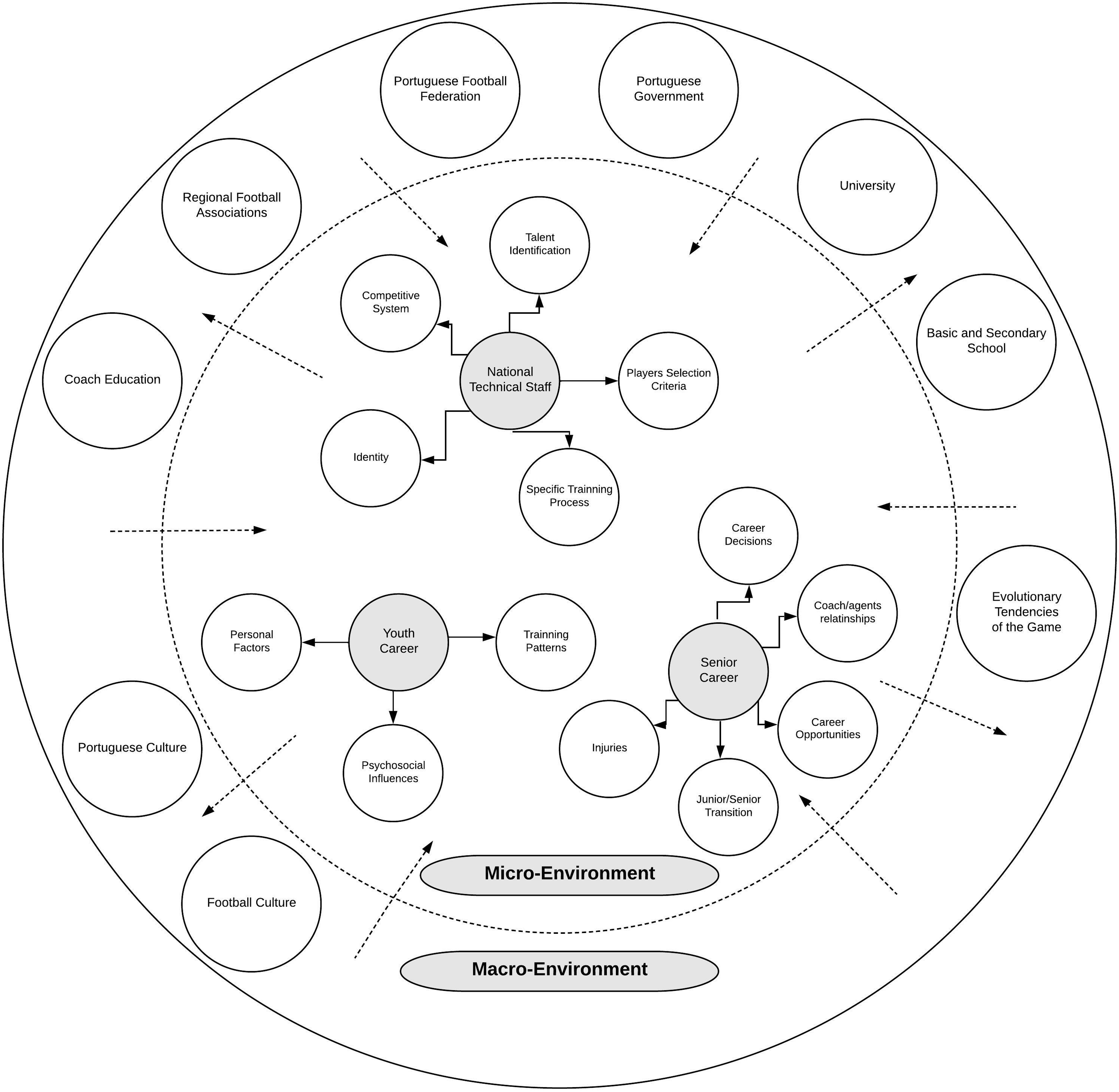
Ecological model of development for the Portuguese football gold generation.
QSR NVivo 12 software was used to code the transcripts of the interviews. Different techniques were utilized in this study to establish trustworthiness. The researcher was trained in the methods of qualitative research as outlined by several respected scholarly sources.32–35 Member checks are the most crucial technique for establishing credibility. 34 Member checks occurred twice in the present study. The first took place during the debriefing session that was held at the end of each interview. At this point, the participants were allowed to change any of their responses. In the second phase, a full verbatim transcript of each interview was sent to the participants. At this time, the participants had another opportunity to clarify, add to, or eliminate any comments that they had made during the interview. Additionally, the trustworthiness of the data was ensured by a panel of three sports psychology experts who analysed all meaning units, themes, and categories.
Results
In the following sections, we present the Portuguese gold generation of football as the case study. As proposed by Davids, Araujo, 31 skill acquisition, expert performance, and talent development in sports should consider both the macro- and micro-structure of contextualized histories and practices. Based on this rationale, as well as on previous findings using different working paradigms,16,17,28,29,31,36 we performed the data analysis (Figure 1) and proposed the “Ecological Model of Development for the Portuguese Football Gold Generation”. The present study applied two techniques (statistical analysis and qualitative content analysis). We opted to present the results in an integrated and complementary way by considering the data from the quantitative analysis together with significant qualitative information derived from interviews and a documental analysis.
Microsystem
Federation youth technical staff
The gold generation was characterized by a specific sociocultural environment primarily developed by world-renowned coach Carlos Queiroz. The work of Queiroz and his staff, which was based on his futuristic vision, had a profound impact both at the micro- and macro-level. At the micro-level, Queiroz started a revolution in the way talent identification and development programmes were designed. He did this by promoting mega tournaments for U-15 and U-13 players. The FPF contained 22 regional football associations, each of which was encouraged to select the best U-15 team to play in a three- to four-day tournament in Lisbon, which Carlos Queiroz and his technical staff observed. They then selected an initial group of 35 promising players to be part of the national team (U-15). “We invigorated these two moments (U-13 and U-15 tournaments) at a national level, where the great pyramidal work of observation was first done at the regional level. Players were observed from 9 to 12 years of age, and the best came to Lisbon for the U-13 tournament. Two years later, we watched these players again to see which players stabilized in the process. This concept of preparation in the form of observations of the players soon created a great impact on the quality of the decisions.” Coach 1 “I began to design a new philosophy of work, more judicious and more systematized, to choose players for the national team. Previously, already 90% of the players selected for the main national team played at Benfica, Porto, or Sporting Lisboa. After we started our work in the FPF, these big clubs started to contract players that first played at the national team.” Coach 1 “This generation had its own identity that was fundamental to its success, an identity of principles and concepts that has been worked since the age of 15. This was only possible because we did very rigorous talent selection work that allowed us to select the best ones at an early stage and keep a large percentage of them until the age of U-21.” Coach 1 “Almost everything I learned about the game, it was Carlos Queiroz who taught me. He made us understand the game. The training process of the national team was very different from what we did in the clubs. His training was very evolved, very systematized, characterized by many repetitions of specific and contextualized exercises with various solutions. And we had another advantage: at this time, we had periods of two or three weeks of internship only for training, even when we didńt have any games.” Player 4 “The competitive model of the tournaments organization is so important! We were so deficient in the competitive model that it was urgent to change it. You can have a great coach, great training methods, great facilities. You can have whatever you want, but if you do not have a competitive model that challenges and stimulates and stabilizes the learning from training, it becomes difficult…” Coach 1
Youth players
International path
A prospective analysis of youth (U-15 to U-20) international footballers (n = 34) that reappeared in the senior national squad reveals that 19 (55.9%) players represented the national team at the senior level, at least in one game. The analysis concerning differences between experts and intermediate football players in terms of the age of their international debuts (Table 1) reveals no significant differences (U = 139.500, p = 0.902).
Age debut in international competitions in expert and intermediate players.
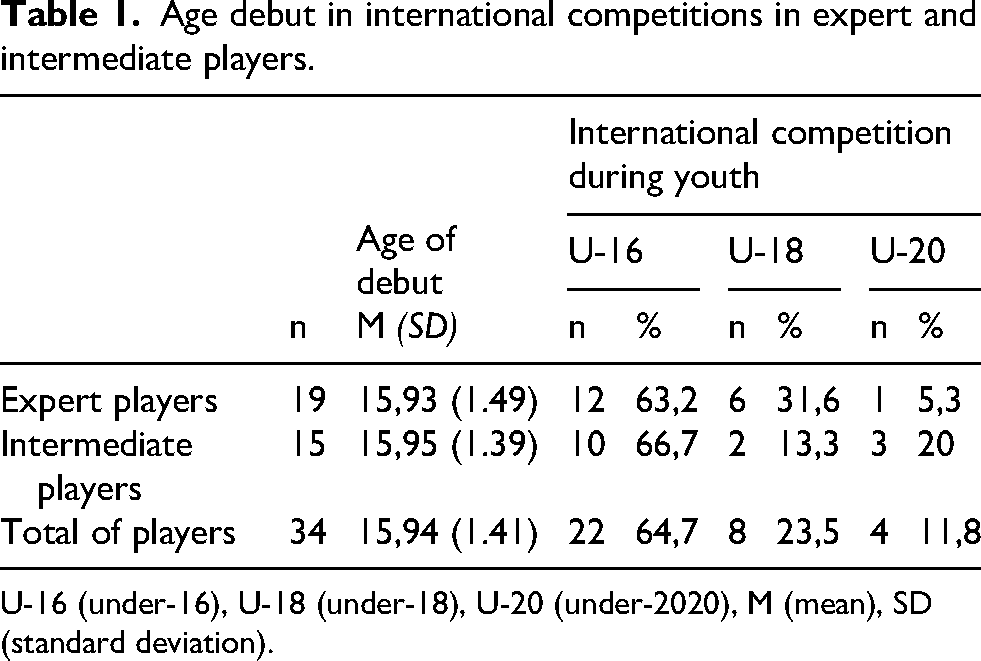
U-16 (under-16), U-18 (under-18), U-20 (under-2020), M (mean), SD (standard deviation).
The two groups did not differ for most of the variables (Figure 2) related to international participation. Some differences were noticed at U-21, as expert players accumulated more activities in competitions (panel B) and presented more aggressive behaviours. Such tendencies were also observed at U-20 (panel D).
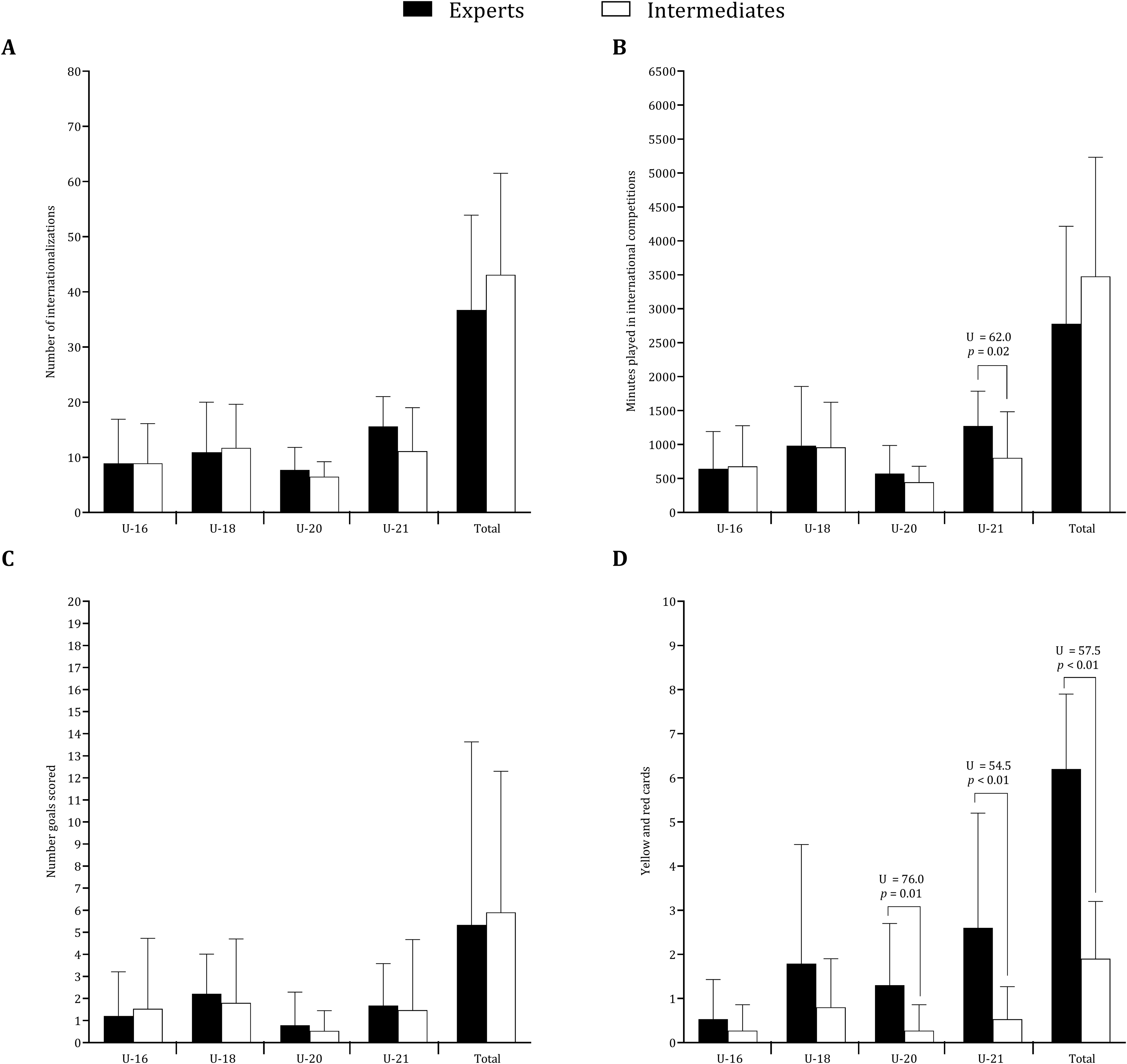
Comparisons between competitive levels (intermediate vs. experts) regarding the number of internationalizations (panel A), minutes played in international competitions (panel B), goals scored (panel C), and discipline (panel D) across various age groups.
Variables analyzed from a developmental perspective
The analysis of training patterns shows that the groups (experts vs. intermediates) did not differ in the number of activities or accumulated hours of practice spent performing structured and unstructured activities (Figure 3). However, in the semi-structured interviews, all players mentioned that throughout their careers, they regularly had the opportunity to practice and compete with older players. Additionally, both groups decreased the number of structured and unstructured activities that they performed and transitioned from sampling to specialization.
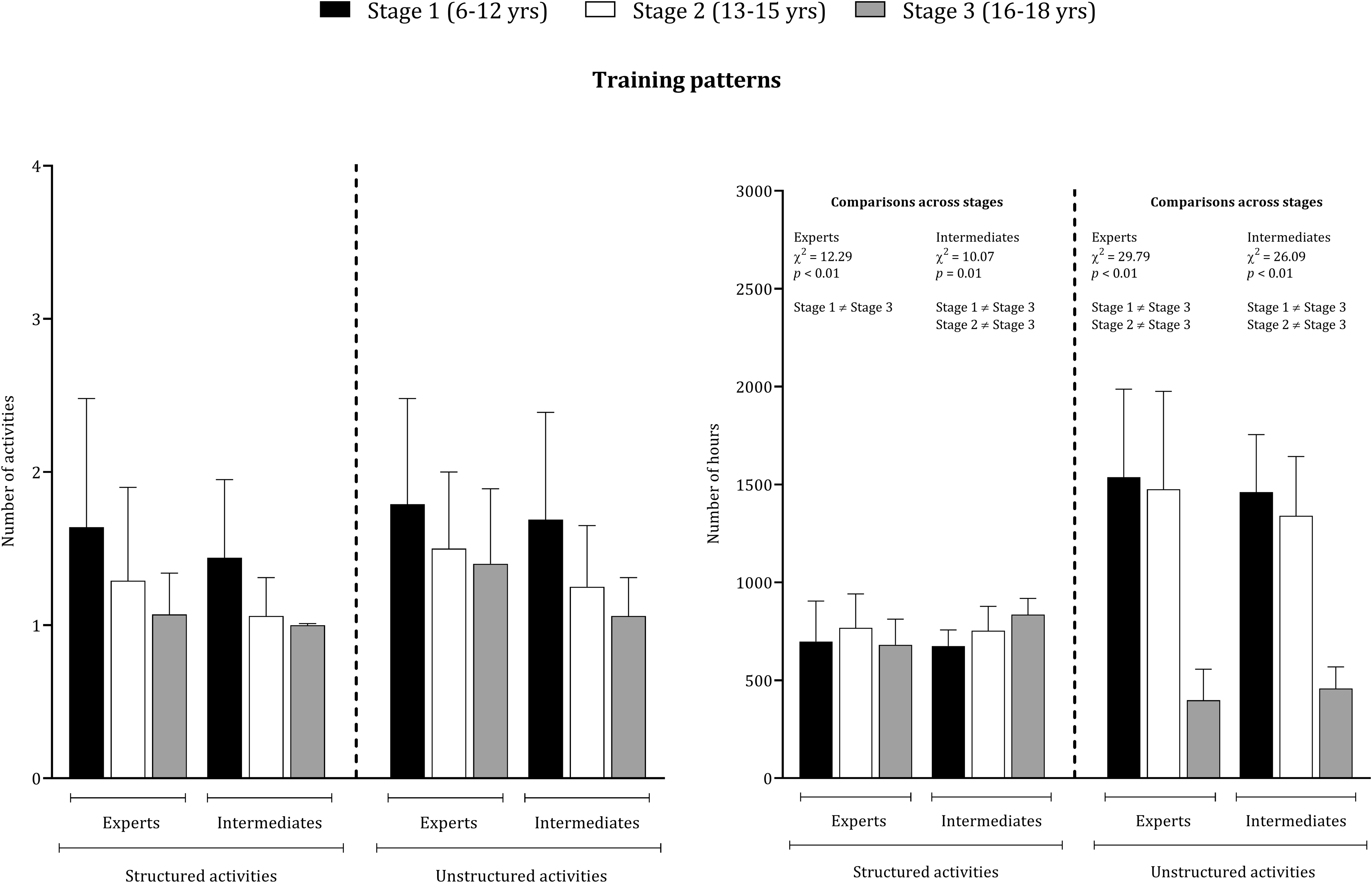
Comparison of training patterns across competitive levels (intermediate vs. experts). Panels A and B present the mean and standard deviation for the number of activities and the hours dedicated to structured versus unstructured activities, respectively.
From a developmental perspective, the results revealed that the two groups did not differ in terms of psychosocial variables, except for “coach pressure,” for which the experts reported higher values (U = 56.00; p = 0.019) than the intermediates. Additionally, similar patterns were found when analyzing differences across ages for the main variables of parent/coach support and sports peer influence as shown in Figure 4.
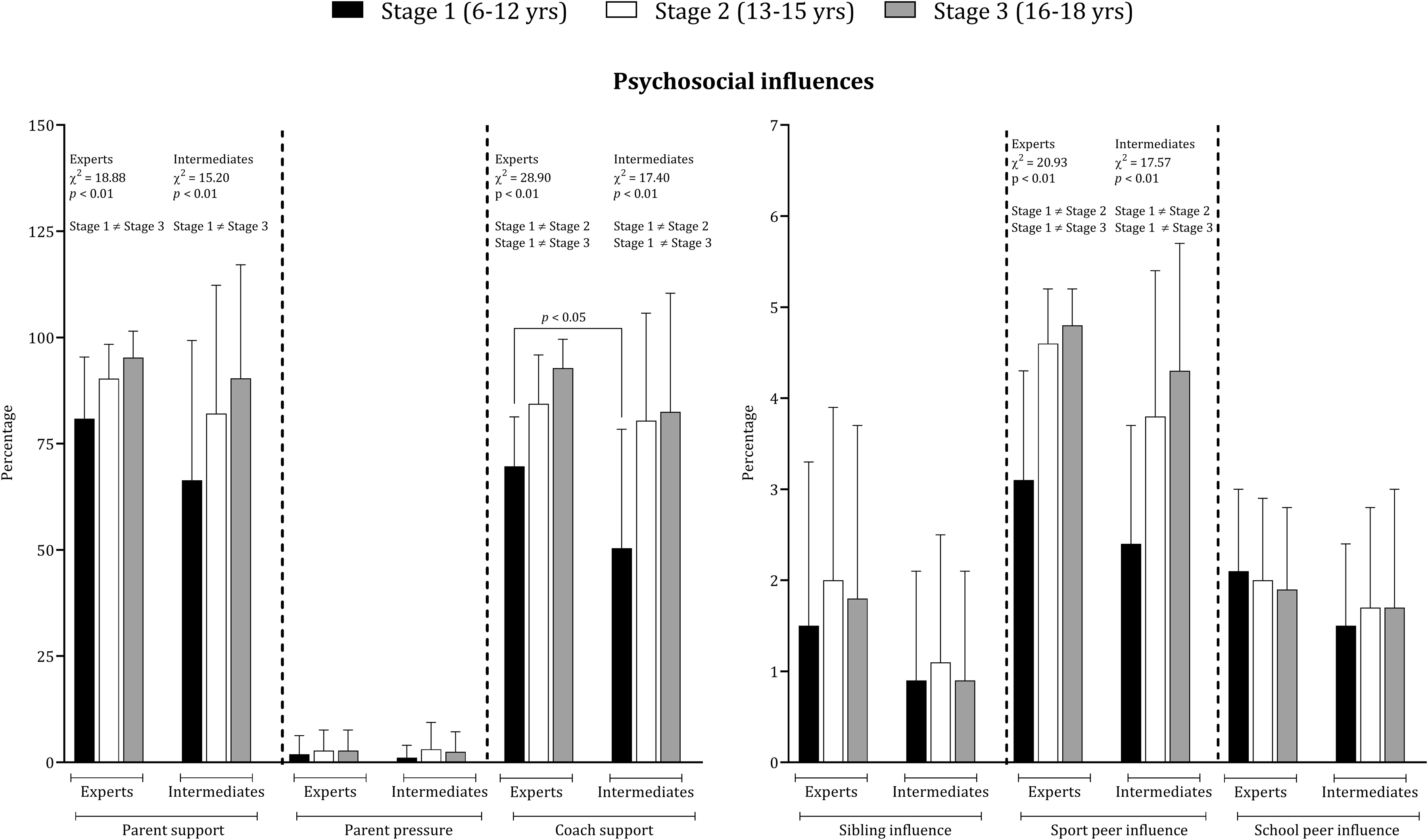
Comparison of psychosocial influences across competitive levels (intermediate vs. experts). Panel A shows the mean and standard deviation for the percentage of parent support, parent pressure, and coach support. Panel B illustrates the mean and standard deviation for the percentage of sibling influence, sport peer influence, and school peer influence.
Senior players
Although experts and intermediates’ groups presented similar patterns throughout the developmental period, the interviews revealed why they were considered fundamental to their success. Namely, they (1) helped players transition from the junior level to the senior level, (2) prevented injuries, (3) helped with career decisions, (4) reinforced relationships with coaches/agents, and (5) provided opportunities. Some intermediates revealed that they had some problems with coaches and colleagues when they started to play at the senior level. “The transition to the senior team was very hard. In a sports season, I played only one match. (…) When we started at the senior level, we had to live with the fact that they had great expectations for us. They did not look upon us as children who were there in a developing process; they were already looking at us as key, and this somehow may have conditioned the development of some and the affirmation of others.” Player 9 “The injuries have greatly damaged my career. (…) I broke my kneecap, and only because of this, I was operated on three times in a space of almost two months.” Player 29 “The injuries were a decisive determinant of my career.” Player 12 “He was the best field coach I ever had, and he's the worst person I know in the world. If we lost, it was our fault; if we won, it was his merit. (…) I had a problem with him, and I did not play anymore. It's over. I did not play anymore.” Player 1 “I also think that [my failure] was due to the fact that I had allied myself with a football agent who, at the time, had not had the necessary experience in this field. He was a beginner…” Player 25 “I played as a forward, but in a certain training session, one player was missing in the right-back position. The coach asked me if I would like to play in that position. Of course, I wanted to play in whatever position I could. That's how I started playing in the first league and how I was called up to the U-20 national team. This was the key moment of my career. I ended up always playing as right-side defense.” Player 5
Macrosystem
The EMDPFGG shaped the dynamics of the macro-environment and enabled a set of transformations. These transformations operated for the gold generation helped to develop football practice in Portugal. This is especially true as it relates to interactions between (1) the post-revolution moment of 1974, which is characterized by radical changes in cultural, social, and educational levels; (2) the events of the World Cup of Mexico (1986); (3) the increase in the quality of academic training in the area of sports sciences; (4) the openness of government structures to the publication of specific legislation regarding the promotion and generalization of sports activity, as well as the protection of the rights of high-competition student-athletes; (5) the modernization and professionalization of the FPF; and (6) knowledge of and adaptations to the evolutionary trends of the game at an international level.
This process started at Faculdade de Motricidade Humana (FMH - Faculty of Human Kinetics of University of Lisbon. First it was called INEF – National Institute of Physical Education; then ISEF – Superior Institute of Physical Education, and now it is called FMH), where Queiroz (as a student) noted the weakness in specific football training and led a movement to establish a football office. When he finished his studies, he started work as a football teacher at FMH and also took on coaching functions for youth teams of the FPF. “As it was not possible to find a teacher for the football specialization, I went to the Portuguese Sports Institute to ask Jesualdo Ferreira to be our teacher at FMH.” Coach 1 “We talk about the generation of talents, but we often forget to talk about the generation of coaches. A group of outstanding coaches emerged…” Significant other 3 “I started to increase the number of players in football because the youth football base had to grow in two components: at the elite level and at the level of the American concept “from many comes one.” (…) I received so much criticism because of the incompatibilities between athletes and their studies! (…) We began to propose a series of operations that resulted in a law, “The High Competition Athlete Statute.”” Coach 1 “We had come out of the Revolution of 1974, which called into question certain values and principles in society (…) In the national team, no one even knew the words of the national anthem (…) I forced the players to learn it and sing it. Above all, (…) our identity (…) the colors of the flag (…) I used this symbol to wake up the status quo, because everything was accommodated…” Coach 1
Discussion
Below, we discuss key results guided by an ecological dynamics theoretical framework. The EMDPFGG highlights that to understand the complex nature of talent development in football, researchers and coaches should look beyond the individual characteristics of the athlete and consider the influence of the context in which their development takes place.16,25,37
At the micro-level, technical staff members should track the development of a set of tasks to provide ideal conditions for promoting the development of players. This can be done by reformulating the criteria (and methods) used to select the most talented players, modifying the competitive system, and developing an identity by implementing a specific training process. Queiroz mentioned that he studied the evolutionary tendencies of the game to promote training sessions that developed the football player of the future by establishing a 10-year reference horizon. Additionally, the players stated that he radically changed the established methodology of training. He favoured the repetition of situations that would lead to a guided discovery of the game's solutions by considering the players’ opinions. As a result, the learner was placed at the centre of the instructional process, with less of an emphasis on the coach. 21 Instead, the coach's role was to work with football players to identify and manipulate the key constraints of practice environments.38,39
As stated by Bernstein, 40 “Repetitions of a movement or action are necessary in order to solve a motor problem many times (better and better) and to find the best ways of solving it” (p. 176). This idea suggests that practice is better understood as a form of exploration that arises as one attempts to execute a routine while the circumstances vary. Accordingly, Woods, McKeown 4 emphasized the importance of co-designing learning activities. This occurs when the coach and the athlete work together to design critical affordances that the athlete attunes to, thus guiding their behaviours. Co-designing places the athlete and their needs at the heart of the development and performance preparation process. The development of a group identity also involved the shaping of a winning mentality. Until this time, Portugal's national youth soccer teams were often beaten by their counterparts. The national technical staff sought to work on the players’ self-confidence, resilience, attention, concentration, and motivation, all of which are vital to the process of talent development. 3 Changes were brought about such that at a certain point, the question was not whether they would win the game but by how many goals they would win. In the present study, psychological factors are understood as dynamic and context-dependent processes that emerge through continuous interaction between the player and the performance environment. Likewise, player development is conceptualized as non-linear, meaning that progression is not smooth or predictable but instead marked by fluctuations, critical transitions, and key events, where similar developmental pathways may lead to different performance outcomes at the senior level.
Concerning the analysis of the developmental path of both groups, we concluded that experts and non-experts had similar training and psychosocial patterns, which is congruent with recent studies on European athletes.41,42 Importantly, the qualitative interview data help to contextualise and explain the quantitative findings. While the statistical analyses revealed largely similar training and psychosocial patterns between experts and intermediates, the interviews clarified that this similarity stemmed from a shared, highly structured developmental environment sustained from U-15 to U-20. At the same time, the qualitative accounts highlighted how non-linear factors (e.g., injuries, career decisions, coach–athlete relationships) contributed to divergent senior-level outcomes despite comparable early developmental trajectories. Nevertheless, we concluded that this group of players engaged in less-structured activities when compared with other studies.41,43 This suggests a greater specialization than previously reported for soccer players. However, some players were simultaneously successful in two sports, for example, being selected simultaneously to the national football and handball teams (player 2) or football and swimming teams (player 14). Therefore, we also argue that different paths can lead to excellence and that the practice of multi sports is one of these paths. 44
Concerning social influences, in general, the athletes of both groups talked about how they felt supported (but not pressured) by their parents, who favoured their well-being and their autonomy. 45 Many of these players had always trained and competed in older age groups, not only because they showed potential in their clubs but also because Queiroz opted to pit these teams against older players in international tournaments. Additionally, expert and non-expert players perceived their peers as having important influences on their development. This is congruent with previous studies in a Portuguese context. 41 Concerning the similarity between the patterns found for the two groups, we must also consider that this generation of players was selected jointly at the age of 14 years to be integrated into this process. Because the conditions at the time allowed it, Queiroz sought to isolate his players in a very competitive training environment that involved long internships, thus favouring the players’ development. Therefore, the insistence in the work with this group of players was consistent throughout the training process (except in special cases), from U-15 to U-20. In a way, this also explains the similarity between the training and psychosocial patterns.
All of these U-20 players were world champions and showed similar training and psychosocial standards. However, only half of them eventually represented the main national team and had successful careers at the senior level. In addition to occasional problems that they reported having with their coaches or agents, non-experts talked about the difficult transition from the junior level to the senior level. Many were unselected from national squads and their main clubs and, therefore, had fewer training and competition opportunities. Such is consistent with the available literature that shows that this transition is crucial. 23 Moreover, injuries have been reported as being largely responsible for the failure of players’ careers.41,46 Additionally, players revealed that key moments for career progression can occur at the senior level during adulthood. For example, having the opportunity to play in a different position or to replace an injured player were affordances that constrained specific skilled behaviours, 47 and the players must be ready to seize opportunities and act accordingly.
At the macro-level, the work done by Queiroz and his technical staff deserves special attention. Through a keen perception of the constraints and opportunities that emerged in that specific context and time, they stimulated a set of initiatives that provided very favourable conditions for the development of this generation of players. They focused on several specific aspects to improve the environment in which this golden generation grew. These aspects included (i) the development of a nationalist identity (among the team) in the post-revolution period, thus building a high degree of cohesion between the team and the Portuguese culture; (ii) the increase on the quality of the academic training of football coaches, which increased the quality of training and the skills of players 48 ; (iii) close collaboration with the government to promote programs to expand the number of practitioners of the sport; (iv) close collaboration with a university in order to study particular aspects of the game that directly influence sports performance; (v) changes in the structure of the FPF (and its regional associations), which promoted a strong organizational culture; (vi) focus on the athletes’ performance, evolutionary tendencies, and long-term development (10 years) rather than early results; and (vii) focus on the integral development of the athlete, thereby promoting a close collaboration with the education system and specific legislation that provided some perks to high-performing student-athletes.
This study supports several assumptions derived from recent research on the role of using an ecological approach to talent development in sports.49,50 Primarily, it highlights the importance of evaluating and ensuring the adequacy of the environmental conditions. It also emphasizes that there is no ideal model to be implemented in the development of talent in sports. Rather, coaches need to create the best possible conditions, depending on the specific environment, to enhance athletes’ capacities. While the findings of this study emerge from a highly elite and resource-rich context, some of the process-oriented principles identified (e.g., holistic leadership, long-term developmental orientation, and coherence across training and organisational structures) may offer conceptual insights for other settings; however, each developmental context is inherently unique, and the successful transfer or adaptation of such principles depends largely on the capacity of coaches and organisational leaders to innovate and tailor developmental processes to their specific contextual constraints and realities.
Conclusion
The results of this study corroborate the general understanding of the complexity of the talent development process. The environment seems to have a fundamental influence on the development of footballers. It decisively influences their autonomy, performance, and the resources they have to deal with the demands and obstacles that are placed on them. We conclude that the success of Portugal's gold generation of footballers was not simply explained by the ‘talent of the players’ but more complex ecological interactions, namely the active leadership and holistic vision of Coach Queiroz. Queiroz stimulated a set of deep reforms (ranging from the training methodology point of view to organizational issues) that defined football in Portugal. Our results also indicated that coaches who intend to raise the performance of their athletes should adopt ambitious, visionary, and holistic perspectives of the physical, technical, organizational, cultural, aspects of the game. Focusing on these aspects is a means to overcome the traditional reductionism that characterizes most scientific studies and practices implemented in the field. Conventional studies and practices are centred on specific aspects of the game, which are usually characterized exclusively by technical and tactical factors. In this sense, coaches and researchers toned to address factors that go beyond the individuality of the athlete. These factors include players’ involvement in their assessments and practices, as well as enhanced opportunities that are available only in specific contexts at specific times.
From a practical perspective, the diversity of developmental pathways identified in this study suggests that all stakeholders involved in this process (e.g., federations and youth academies) may benefit from designing talent systems that prioritise flexibility over rigid early selection criteria, allow for multiple routes to expertise, and empower coaches to adapt training and competition structures (particularly in the early years) to the individual, contextual, and evolving needs of developing players.
Footnotes
Ethical considerations
This study was conducted in accordance with the Declaration of Helsinki. The Ethics Committee of the Faculty of Human Kinetics waived the need for ethics approval and participant consent for the collection, analysis and publication of the retrospectively obtained (mainly by document analysis) and anonymized data for this non-interventional study.
Consent to participate
Although the data were anonymized and reported in aggregate, with no identifying personal information disclosed, informed consent was obtained verbally before participation. The consent was audio-recorded in the presence of an independent witness.
Consent to publication
NA
Funding
H.S., D.A., D.M and F.P. Gratefuly aknowledge the support of support from CIPER - Portuguese National Funding Agency for Science, Research, and Technology (FCT) pluriannual funding 2025–2029 (Reference: UID/06349/2025).  .
.
H.S. gratefully acknowledge the support of a Spanish government project LINCE PLUS: Multimodal platform for data integration, synchronization and analysis in physical activity and sport [PID2024-156051NB-I00] (2025–2027) (Ministerio de Ciencia, Innovación y Universidades, Agencia Estatal de Investigación and European Union).
Declaration of conflicting interests
The authors declared no potential conflicts of interest with respect to the research, authorship, and/or publication of this article.
Data availability
NA