



Abstract
The youth-to-first team phase presents a number of challenges in the careers of modern football players with stagnation, inconsistent performance and dropout being reported. The aim of this study was to investigate the perception of staff involved in professional academy football clubs around the globe, with a particular focus on youth and first team transition demands, resources as well as transitions barriers and coping among male academy football players. Participants from 29 male youth academies distributed across 29 countries took part in the survey. Our main findings suggested training and match intensity reported as being greater at the senior-level and also pressure from parents. The majority of respondents indicated their clubs having long-term strategy for player development and specific roles supporting successful player transitions. Exposure to different playing styles was deemed important to prepare players for the first team. Likewise, having the academy and the first team training on the same site was perceived to ease the transition, with the majority of respondents indicating that players are able to cope with the pressure of first team training and games. Perceptions on whether staff do not have the skills/resources to prepare players for the changes in environment and culture when players move from youth-to-senior level were unclear. Collectively, our study extends previous transition research on youth football academies suggesting the importance of a club-based playing philosophy to prepare players for the first team demands and challenges.
Introduction
Becoming a professional football player is a complex journey determined by the interplay between physical, technical, tactical, psychosocial, and environmental factors. 1 In a football academy environment, young players encounter various stressors and demands, for example, selection, team performance, contracts, social evaluation, opposition, coach and parental pressures. 2 The transition phase between youth and first team, also labelled the post academy phase, is known as one of the biggest challenges during players’ careers.3–5 Only a minority of youth football players receive professional contracts and, of those, just a proportion progress through the professional team. Youth players invest a significant part of their lives in the pursuit of a professional career and, importantly, career terminations among elite adolescent football players have also been reported as related to anxiety, depression, loss of confidence and social dysfunction. 6 Increased availability of support efforts (e.g., emotional, psychological, financial, social/environmental, material) before and after career transitions is called for to promote the young athlete's individual development, mental health and successful transition to senior sport.7–9
Within-career transitions can be normative or non-normative where normative are relatively anticipated transitions, such as, for example, moving from youth-to-senior level or changing educational level. 10 Moreover, they can be non-normative reflecting unpredictable and unexpected transitions, as when the player confronts a career-ending injury or when becoming deselected from a squad.3,11,12 The traditional dualistic view (i.e., normative vs. non-normative) of transitions has been expanded by introducing a category of quasi-normative transitions predictable for certain athletes only, such as athletes preparing for participation in specific events or making cultural transitions. 13 Furthermore, career transitions are generally known as multidimensional in nature and may coincide with other developmental occurrences in late adolescent and general life. These developmental occurrences includes not only the athletic level but also academic-vocational, psychological, psychosocial, and financial levels which may influence each other in a reciprocal manner. 14 In the transition from youth to first team, both physical and psychological requirements increase with a pressure on the player to perform and stabilize at the senior level, as well as to establish relationships with new coaches and players.10,15–17
Athletes with appropriate personal resources, coping strategies (e.g., problem-solving skills, acceptance, self-regulation, support seeking), and environmental support will likely be more satisfied with their sport participation and experience a more positive transition to senior sport as they effectively cope with the transition process.7,15,18,19 Coping has commonly been defined in the literature as various strategies used to reduce or tolerate various internal or external demands. 20 Factors known as pivotal for successful transitions are social support from peers, friends, family, coaches, and organizations who provide informational (e.g., tactical or technical advice), emotional (e.g., providing reassurance to athletes), esteem (e.g., bolstering athletes’ feeling of competence), and tangible support (e.g., travel to and from events).7,16,21,22 Insufficient organizational support, financial pressures due to a lack of sustainable income, plus limited school support concerning teacher understanding, lack of physical preparation and difficulties keeping personal relationships could result in increased stress, decreased wellbeing and stagnation in athletic development for athletes moving to senior sport.7,17,23 Various barriers encountered during the transition makes the process more challenging and evidence-based interventions to support youth-to-senior transitions and overcome barriers are still sparsely investigated in the research literature.
A greater understanding of factors surrounding the youth-senior transition among academy football players increase possibilities of continuously improving within-transition support to reduce various risk factors and barriers that can hinder player development. Over the years, several talent development and transition models have been proposed, with the Athletic Career Transition model (ACT)24,25 and the Athletic Talent Development Environment model (ATDE) 26 being two most frequently adopted in the scientific literature. The ACT model24,25 defines the outcomes of the transition as dependent on the effectiveness of athletes in coping with transition demands and barriers by use of internal (personal-related) and external (environmental-related) resources. A transition is considered successful when athlete coping is effective, with a good fit between transition demands and coping resources. A crisis transition is predicted when the athlete lacks resources, uses ineffective coping strategies, or meets excessive barriers.
In comparison, the ATDE 26 assumes the system surrounding the athletes that supports them to a successful transition from the youth-to-senior level. The ATDE can be broken down into the micro and macro levels. The micro level is determined by the communication and interaction in environments where the athlete spends most of their daily life (e.g., club, school, family, peers). The macro level refers to the social settings affecting the athlete by values, traditions, and customs of the culture (e.g., sports federations, the educational system). In addition to this, the ATDE consists of two domains involving the athletic domain, which is the environment referring directly to their sport participation, and the non-athletic domain covering life spheres outside sports. 26 The staff and the hierarchical structure of those responsible for transition programs vary among clubs which can impose different philosophies in clubs on how youth-to-senor transitions should be managed.21,27 There is also a dominance of youth-to-senior transitions studies performed by use of interviews and most of these studies are also performed in Europe although cultural differences across nations and specific conditions in sports systems can impose unique challenges for young athletes in different countries.7,15
Given the array of socio-cultural factors that significantly can impact on players’ success when moving through the post-academy phase there is still a need of increased understanding of features that can debilitate or facilitate the transition process. 5 Importantly, perspectives of how staff involved in developing and supporting players in the post-academy phase perceives players’ challenges are rather unexplored. 28 With conceptual underpinnings of both ACT and ATDE model informing our study framework, the present study is a worldwide survey with the aim to investigate how staff involved in professional academy football clubs around the globe perceives youth and first team transition demands, resources as well as transitions barriers and coping among academy football players.
Methods
Participants
This study was part of a project aiming to understand the practices and perceptions of professional football clubs on youth player development and was approved by the Aspire Zone Foundation Institutional Review Board, Doha, State of Qatar (protocol number: E2018000267). Of all the clubs part of the Aspire in the World Fellows community, representatives from 29 male youth academies agreed to participate in the study. The Aspire in the World Fellows is a community of professional football clubs and their staff who engage regularly to promote best practice in elite football training led by Aspire Academy. 29 The participating youth academies were distributed across the globe: Europe (n = 19), South America (n = 5), Central America (n = 1), North America (n = 1), Africa (n = 1), Asia (n = 1), and Oceania (n = 1). The participants who completed the survey (n = 29) were employed in a range of different roles with responsibility for supporting the youth-to-senior transition, involving Heads of Physical Training, Technical Directors, Academy Directors, Medical Services Coordinators, and Director of Research. The median number of home-grown players reported by the clubs was 8 (interquartile range [IQR]: 5 to 12). The median length players were reported to stay in the academy prior to the first team transition was 5 years (IQR: 4.5 to 6). Most (75%) of respondents also reported that their club vision with respect to youth development was to produce as many players as possible to play in the senior team. All clubs which the participants came from played or had played in the highest male professional league in their country, with many having participated in their respective annual continental competitions (e.g., the Union of European Football Associations Champions League or Europa League; n = 21). Of the 29 organizations represented, 24 had won the highest league in their country, with 21 having won their respective continental club competition (e.g., Union of European Football Associations’ Champions League), sometimes on multiple occasions.
Study design and survey distribution
The present study adopted a cross-sectional design and a survey to collect data on staff members perceptions on transition demands, resources, barriers and coping regarding academy players’ transition from youth to the first team. A panel of ten experts with five or more years of experience working in professional football at European and Middle-Asian youth academies developed the survey following procedures consistent with research conducted in other domains relevant to elite youth player development. 29 Survey questions were also informed by published work within the career transitions literature.7,15 The questions covered several areas: (a) Background and demographic information (6 items), (b) strategy and decision making (9 items), demands (19 items), and barriers, challenges, and coping influencing transition (13 items), with question formats involving mainly Likert-type response scales (Supplementary File 1). Some open-ended questions were included but were only analyzed if the qualitative responses of the respondents were not greatly scattered. For example, open-ended questions in section b about strategy and decision making were excluded when the responses could not be compiled into any meaningful patterns. Before distribution, a second group of practitioners with experience in working with professional football reviewed the survey for content validity. The online software SurveyMonkey® (Momentive Inc., USA) was used to disseminate the survey. Representatives of included organizations received an email explaining survey purpose, instructions for survey completion and participants were also advised to collect relevant information needed to complete the survey insightfully.
Statistical analysis
Data were summarised as descriptive statistics. 30 Frequency analysis was conducted with the results presented as percentage of respondents and frequency count. Qualitative terms were also assigned to determine the magnitude of the observed frequencies as follows: All = 100% of respondents; Most = ≥75%; Majority = 55 to 75%; Approximately half = ∼50%; Approximately a third = ∼30%; Minority = <30%. 31 Responses involving a numerical answer in single questions (i.e., count data) were presented as median plus interquartile range (IQR) or minimum and maximum.
Results
Transition demands
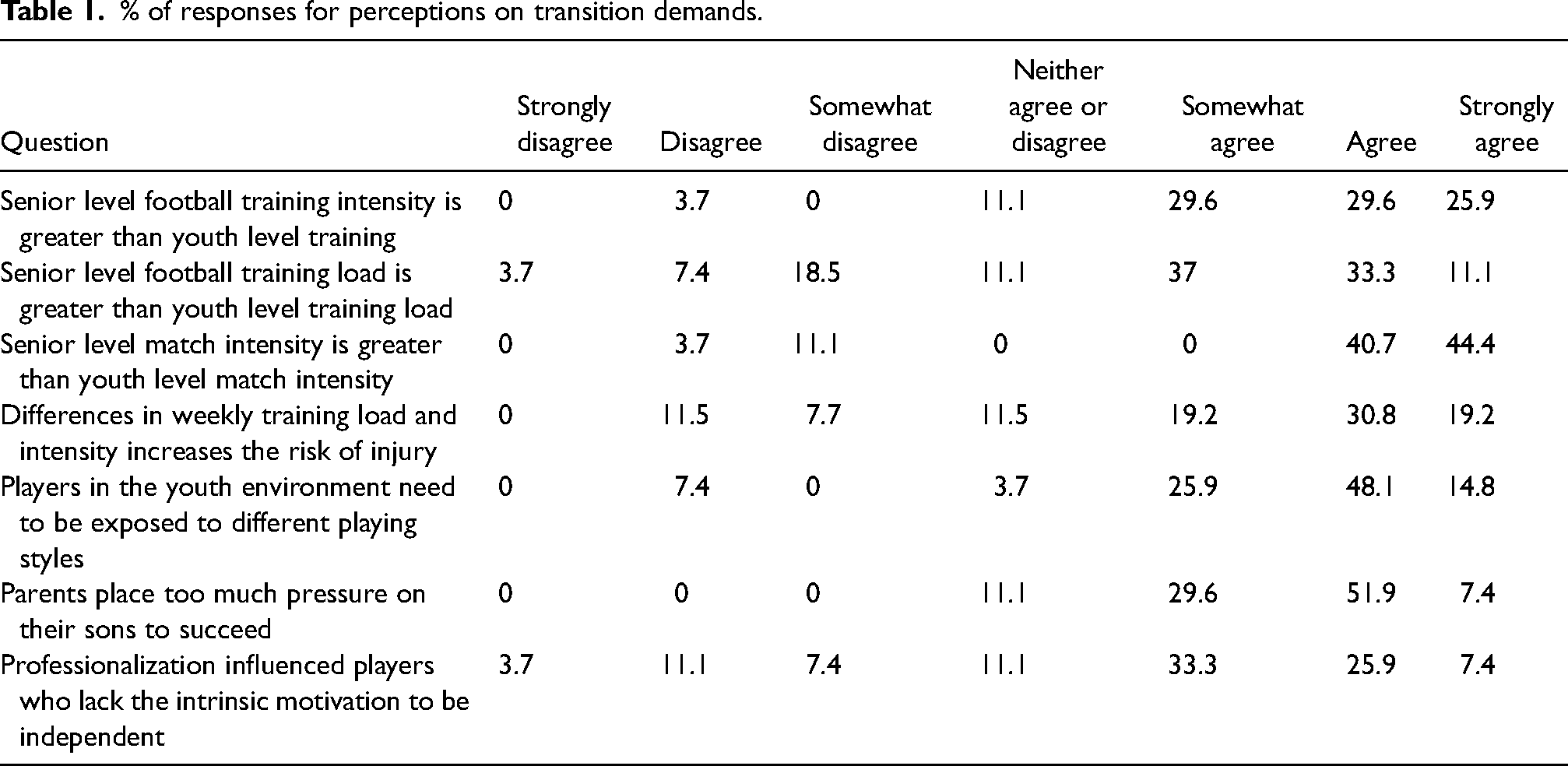
As shown in Table 1, the participants generally agreed that the youth to first team transition involved several psychological, physiological, technical and environmental demands. The majority of respondents (55.5%) agreed and strongly agreed that senior-level football training intensity is greater than youth-level training intensity, and approximately half of respondents (44.4%) agreed and strongly agreed that senior-level football training load is greater than youth-level training load. Most of the respondents (85.1%) also agreed and strongly agreed that match intensity is greater at senior-level match compared to youth-level. Approximately half of respondents (48.1%) only agreed, however, that differences in weekly training load and intensity increases the risk of injury during the early transition phase. Exposure to different playing styles on a frequent basis to prepare for the first team demands was deemed important for youth players by the majority of respondents (62.9%). The majority of respondents also (59.3%) agreed that parents place too much pressure on their sons to succeed, with approximately a third of respondents only (33.3%) indicating the increased professionalization of academies as a factor influencing the intrinsic motivation negatively of young players.
% of responses for perceptions on transition demands.
Transition resources
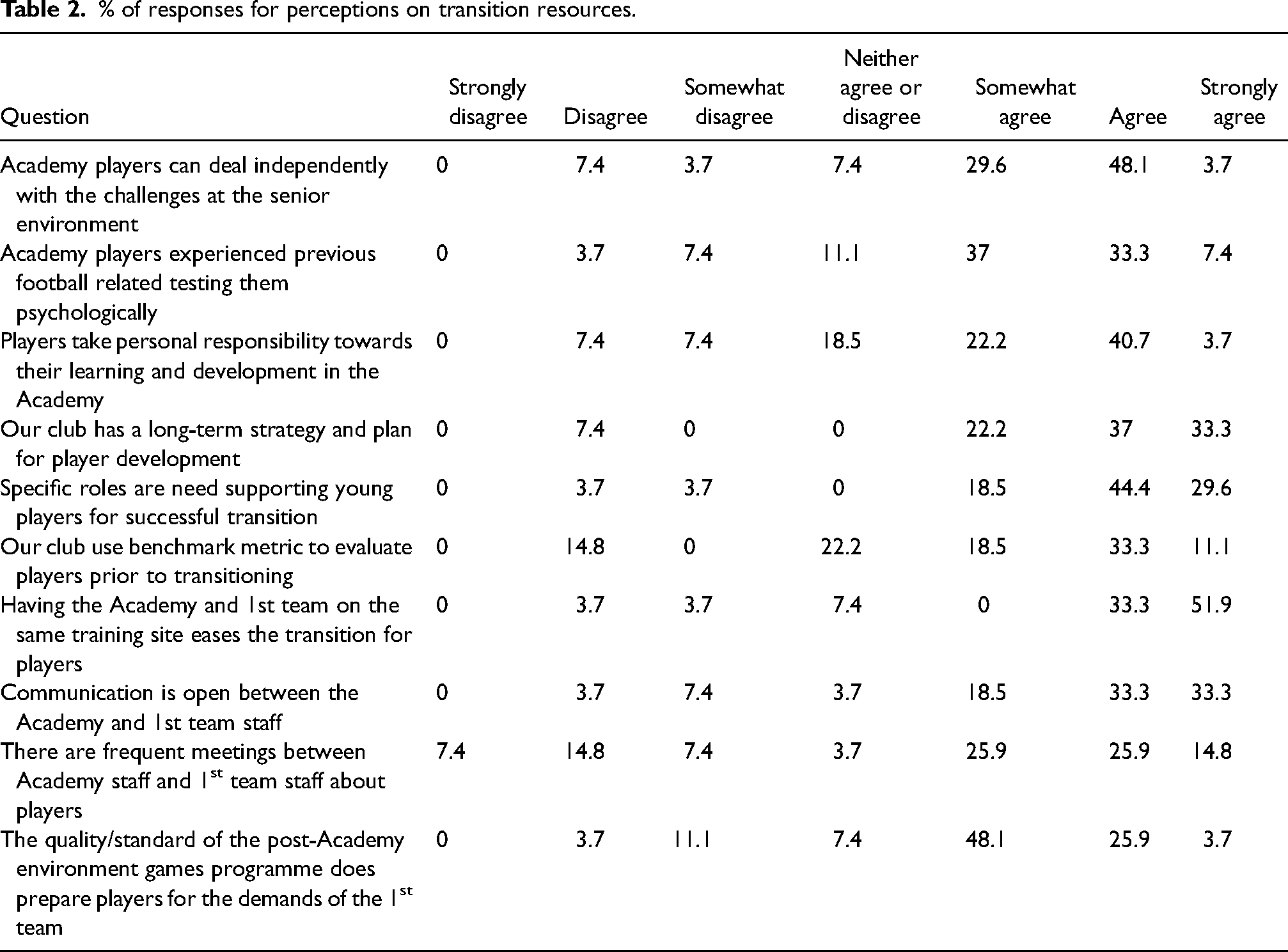
Approximately half of the respondents agreed and strongly agreed that players have the skills to independently deal with the challenges at the senior environment (51.8%), have experienced previous football related challenges within the academy environment to test them psychologically (40.7%), and take personal responsibility towards their learning and development in the academy (48%). The two most reported psychological resources respondents suggested as required for a successful transition included resilience (n = 19) and motivation/ambition/determination (n = 17).
At the micro- and macro level, the majority of respondents indicated that their clubs have long-term strategy and plan for player development (70.3%). Likewise, respondents agreed having specific roles supporting young players to successfully transition that sits outside of the first team management are needed (74%) and communication is open between the academy and first team staff (66.6%). Most of the respondents agreed and strongly agreed the academy and the first team training on the same site eases the transition for players (85.2%). The presence of dedicated meetings and consultation of objective outcome measures to evaluate player prior to the transition were indicated by approximately half of the respondents only (40.7% to 44%). Conversely, a minority of respondents agreed of the post-academy environment games programme standards are adequate for players to cope with the demands of the 1st team competition. Results were summarized in Table 2.
% of responses for perceptions on transition resources.
Transition barriers and coping
The results (Table 3) display that the participants believe several psychological, physical, technical/tactical, and environmental barriers may influence the youth-to-senior transition. These could be related to the individual player, and also the micro- or macro level system around the player. At an individual-level, approximately a third of respondents agreed players lack the game understanding on the initial transition to the professional environment (29.6%) and are not technically equipped to cope with the demands of first team football (25.9%). The majority of respondents agreed and strongly agreed biological maturity status of the player influences the timing of the transition from youth-to-senior (70.3%). Conversely, approximately a third of respondents agreed youth football practitioners may not fully understand the physical demands of senior level football (33.3%). A minority of respondents agreed players lack the game understanding on the initial transition to the professional environment (25.9%), whereas approximately a third of respondents disagreed (37%) players are not technically equipped to cope with the demands of first team football. The majority of respondents agreed players are able to cope with the pressure of first team training and games (59.3%), whereas approximately a third of respondents agreed cultural differences between youth and senior environments can pose challenges that can turn into opportunities to succeed (33.3%).
% of responses for perceptions on transition barriers.
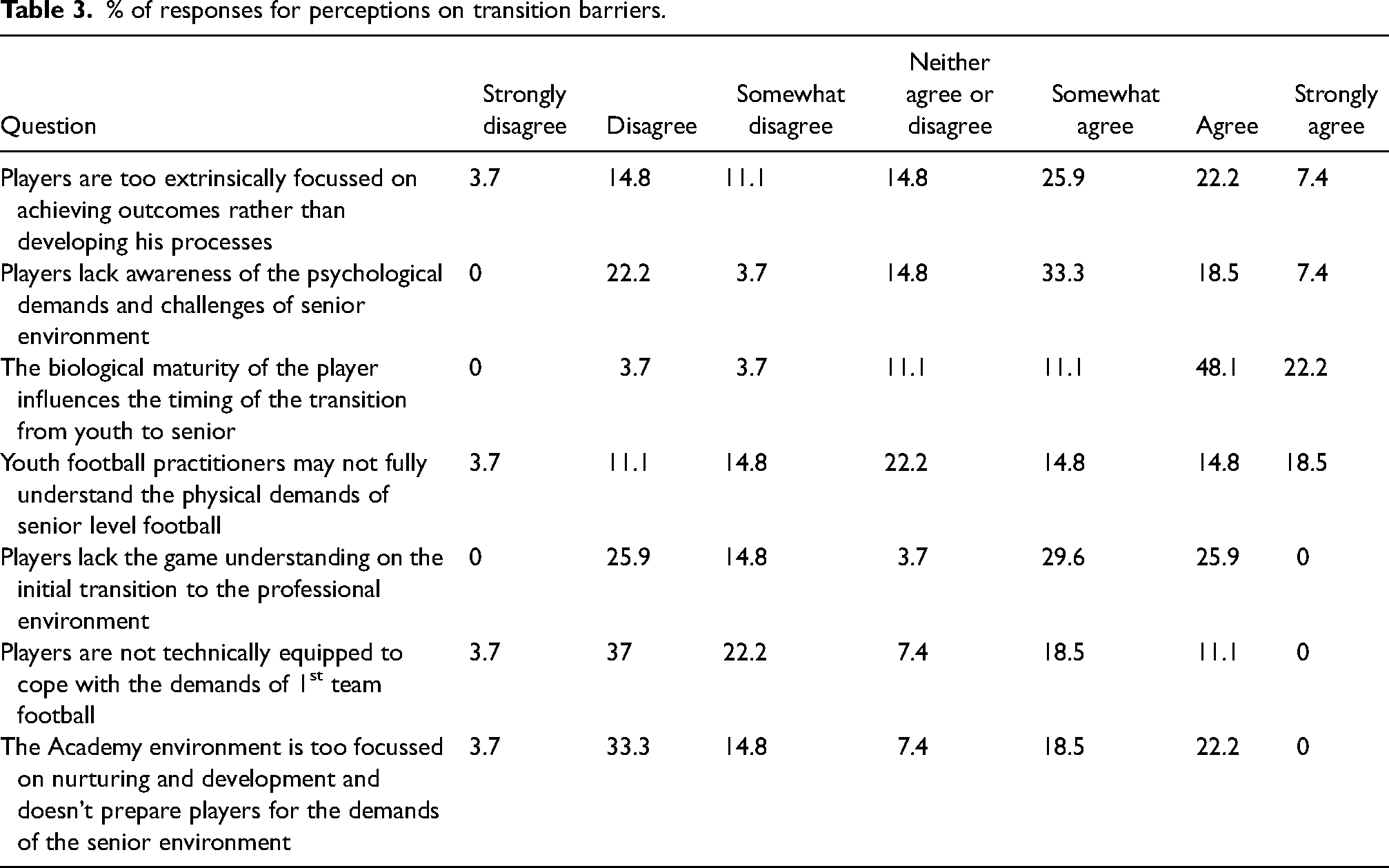
At a micro-level and macro-level, approximately 51.8% somewhat disagreed to strongly disagreed that the academy environment is too focused on nurturing and development and doesn't prepare players for the demands of the senior environment. Likewise, approximately a third of respondents disagreed coaching styles and behaviors in the academy are not reflective of what players may experience in the senior environment (29.6%). Approximately half of the respondents disagreed that staff do not have the skills/resources to prepare players for the change in environment and culture from youth-to-senior (48.1%). Conversely, the response distribution for perceptions on if coaches in the academy are too focused on competitive results suggested no clear consensus on the relevance of this particular in the youth-to-senior transition (Table 3). The majority of respondents agreed and strongly agreed third party stakeholders (i.e., agents, sponsors, media) negatively influence players and their approach to development (59.2%).
Discussion
The present study explored professional academy football club staffs’ perceptions of youth and first team transitions, with a focus on demands, transition resources, barriers in the micro and macro environment as well as coping among players. Consistent with previous investigations in this field, 27 the findings of our study revealed a majority of respondents reporting their club's vision of youth development to be characterized by the production of as many players as possible to play in the senior team. Respondents in this study perceived players to face greater demands (e.g., increased training and match intensity/load, parental pressure) when moving from the youth-to-senior level. In line with concerns expressed in previous research, 27 participants deemed professionalization having a negative influence on adolescent players intrinsic motivation. Factors like players’ awareness of physical or psychological demands, game understanding and equipment to technically cope with demands in the first team were perceived as transition barriers. Previous research has identified several additional barriers like social isolation, loneliness, non-selection, lack of playing time and a harsh environment which may hinder progression in development in the post academy phase.5,28 The current study thus supported previous research indicating the importance of academy football clubs to put effort in supporting players during the transition from academy to first team 32 and also added a worldwide perspective to existing body of research by including respondents representing various countries and cultures around the globe.
According to the ACT24,25 and the ATDE 26 models, the fact of posing greater demands on athletes may not constitute necessarily a comprehensive explanation of transition outcomes. Conversely, such an aspect may be considered as highlighting how players’ ability to cope with the demands and conditions in micro and macro environments also deserves particular attention. As previously suggested by Drew and colleagues, 7 the youth-to-senior transition occur over a shorter or longer period often in a complex and dynamic manner where demands, challenges and support needs are likely to vary over time. The fact the majority of respondents reported their club to have a long-term strategy and plan for successful transitions with specific supportive roles among staff, but a minority not being fully satisfied with post-academy environment games programmes, are important and interesting findings of our study. Formal explorations regarding specific adaption pathways within which the youth player moves through to become established at the senior level have, however, today received limited attention in the research literature. The general lack of large-scale cohort studies in the youth-to-senior transition literature 7 assessing specific adjustment challenges faced by players and the need of protective resources at the individual, micro, and macro environment levels ultimately could induce an underappreciation of actual challenges. Coaches may therefore not have access to a comprehensive evidence-informed knowledge base describing players’ development needs subsequently forcing them to make decisions on subjective parameters.33–35 Moreover, it could also impose a limitation on the extent of various support programs provided in academy clubs are sufficiently tailored to specific needs of players.
Respondents in this study agreed that having the academy and first team on the same training site eases the transition for players. Researchers in this field 7 highlighted previously that the transition can be more challenging when youth athletes and their senior counterparts train on separate sites since athletes cannot watch and learn from their senior peers. 21 Various form of stress-exposure and pressure training interventions are today receiving growing attention in the current literature.36–38 Empirical knowledge of evidence-based approaches for optimal implementations of these interventions, and particularly when tailored to academy football players, is however to a great extent still lacking in the literature. 18 Regular contact between academy players and the first team could, however, be an opportunity for introducing stress-exposure or pressure training in ecologically valid settings. Further studies are therefore warranted on players adaption pathways and implementation of promising interventions, preferably by use of prospective and longitudinal cohort designs where the interplay between various variables is also considered.
The youth-to-senior transition period is known in research literature as a risk-period not only for early career terminations but also for athletes’ mental health.7,18 Several international elite sports organizations increasingly emphasize that support systems in elite sports should consider protection of athletes’ mental health as equally important as protection of physical health. 39 Players striving for a professional career will inevitably be confronted by a several stressors (e.g., de-selections, injuries) that can threaten mental health as a natural part of the elite sports journey. The present study indicated that staff perceived resiliency and motivation as essential player qualities for successful transitions and most respondent agreed to some extent that players take personal responsibility for their development. Researchers increasingly suggest that moderate exposure to challenges and adversity may not necessarily affect mental health negatively but could also stimulate athletic growth and resiliency if adequate support to guide the athlete through the process is available.40–42 While previous literature has indicated that a range of tactical and technical knowledge is helpful to support athletes moving to senior sport,17,43 the current study goes further and indicates that rather than just having a plethora of knowledge, players should also be exposed to specific club-based playing philosophies too. Doing so will mean players will be aware of specific roles and functions of specific positions within senior sport, making the transition easier to manage. In this regard, a range of training exercises which expose players to a broad range of playing styles and more specific club-based styles are encouraged. Also, the relationship between transition demands, stressful sports experiences and successful outcomes (i.e., becoming an established player at the senior level) is highly complex and likely mediated by a number of different variables.18,44 In our study, respondents also agreed and strongly agreed that the role of biological maturity of the player might be a factor influencing the timing of the transition from youth-to-senior. More gifted players generally progress to the first team relatively early around 17 to 18 years of age whereas the majority often progress at older ages. 45
A variety of personal characteristics, coping strategies, and social support are indicated in the literature as important to support transitions to senior sports. 7 Furthermore, having a high work ethic, a passion for the sport, a high-level of personal responsibility, and motivation for the transition, in addition to support from peers, friends, family, and coaches were found as essential factors.17,46 Given our study findings, it appears development and evaluation of tailored and evidence-based support programs that can promote effectively the youth-to-senior transition and optimal learning environments can contribute to enhancing psychological qualities for both performance and wellbeing, with a particular reference to resilience. Nevertheless, our study is not without limitations and results are based on cross-sectional survey data. Although we surveyed perceptions on the youth-to-senior transitions of practitioners in club academies from around the world, future research also should consider exploring perceptions on the extent of player transitions of practitioners from first team technical staffs only on factors influencing this process. In addition to this, exploring individual strategies of clubs that facilitated successful player transitions and their extent, with reference to the crude number of players that progressed to senior football, also warrants further investigation. Likewise, the absence of information for our survey content validity is another aspect that should be acknowledged.
Conclusions
For the first time, we provided a worldwide description of the youth-to-senior transition processes in youth academies of professional football clubs. To address existing research in this field, results of the current study highlighted the importance of a club-based playing philosophy and style to prepare players for the first team demands and challenges. Taken together, our findings emphasized the importance of considering the nature of the environment 26 and the value of ensuring everyone who has a role in the transition has awareness of their responsibility and function.
Supplemental Material
sj-docx-1-spo-10.1177_17479541221135626 - Supplemental material for A worldwide survey of perspectives on demands, resources, and barriers influencing the youth-to-senior transition in academy football players
Supplemental material, sj-docx-1-spo-10.1177_17479541221135626 for A worldwide survey of perspectives on demands, resources, and barriers influencing the youth-to-senior transition in academy football players by Carolina Lundqvist, Warren Gregson, Daniele Bonanno, Lorenzo Lolli and Valter Di Salvo in International Journal of Sports Science & Coaching
Footnotes
Acknowledgements
The authors wish to thank the Aspire in the World Fellows without whom this study would not have been possible. We also acknowledge the staff at Everton FC, Club Athletico Paranaense, Athletic Club, and Feyenoord FC for their commitment, expertise, and initial suggestions on this manuscript procedures.
Declaration of conflicting interests
The author(s) declared no potential conflicts of interest with respect to the research, authorship, and/or publication of this article.
Funding
The author(s) received no financial support for the research, authorship, and/or publication of this article.

Supplemental material
Supplemental material for this article is available online.
References
Supplementary Material
Please find the following supplemental material available below.
For Open Access articles published under a Creative Commons License, all supplemental material carries the same license as the article it is associated with.
For non-Open Access articles published, all supplemental material carries a non-exclusive license, and permission requests for re-use of supplemental material or any part of supplemental material shall be sent directly to the copyright owner as specified in the copyright notice associated with the article.
