




Abstract
As it is appreciated that learning is a non-linear process – implying that coaching methodologies in sport should be accommodative – it is reasonable to suggest that player development pathways should also account for this non-linearity. A constraints-led approach (CLA), predicated on the theory of ecological dynamics, has been suggested as a viable framework for capturing the non-linearity of learning, development and performance in sport. The CLA articulates how skills emerge through the interaction of different constraints (task-environment-performer). However, despite its well-established theoretical roots, there are challenges to implementing it in practice. Accordingly, to help practitioners navigate such challenges, this paper proposes a user-friendly framework that demonstrates the benefits of a CLA. Specifically, to conceptualize the non-linear and individualized nature of learning, and how it can inform player development, we apply Adolph’s notion of learning IN development to explain the fundamental ideas of a CLA. We then exemplify a learning IN development framework, based on a CLA, brought to life in a high-level youth football organization. We contend that this framework can provide a novel approach for presenting the key ideas of a CLA and its powerful pedagogic concepts to practitioners at all levels, informing coach education programs, player development frameworks and learning environment designs in sport.
Introduction
Talent development has been described as a progressive, mutual accommodation that emerges to enhance the functionality of an athlete in embedded and dynamic sporting and non-sporting environments. 1 As part of this ‘progressive mutual accommodation’, sports practitioners are often challenged to prepare athletes for the demands of current performance environments, while simultaneously developing their performance capacity for future competition. This challenge is captured within the implementation of practical support activities operating at two integrated timescales: the micro-structure of practice (undertaken hourly, daily, weekly and monthly) and at the macro-structure of talent development (over periods of many years2,3) Contemporary non-linear pedagogical frameworks, such as the constraints-led approach (CLA), have emerged to theoretically guide practitioners through this challenge. 4 However, there is a need for continued evidence, with deeply contextualized ‘real world’ examples, to support further and improved up-take of the practical application of the CLA by sports practitioners (for notable examples, see literature5–9).
Better up-take may result from applied scientists improving the communication of key concepts of the CLA, presenting them in ways that are meaningful a to practitioners. 10 Up-take effects have also not been helped by some misinterpretations of the CLA in practice. 11 For instance, constraints could be misinterpreted as negative influences that limit skill development by over- or under-constraining practice designs for athletes during development and performance preparation. To avoid (the misconceived) effects of “over-constraining” practice tasks, many coaches elect to adopt a laissez-faire (hands off) game-centred approach, whereby the CLA is misconstrued through a ‘let the game be the teacher’ lens. 11 This is not how the constraints-led pedagogical model conceptualizes the challenges for the learner during the learning process in sport.11,12
In this paper, we aim to support practitioner understanding – of how to overcome interpretative challenges – by offering insights into how, when predicated on key ideas of ecological dynamics and conceptualized through the lens of Adolph’s notion of learning in development, 13 the CLA can offer a user-friendly developmental framework. To achieve this, we present a bespoke learning in development framework, based on the CLA, that has been established in a high-level youth football organization, informing coach education and player development.
Learning in development
Towards a user-friendly interpretation of a CLA to conceptualize player development
Ecological dynamics offers sporting practitioners a transdisciplinary theoretical framework to conceptualize learning, performance and development.14,15 More specifically, by blending concepts from ecological psychology 16 and constraints on dynamical systems,17,18 expertise, skill and talent development can be understood to emerge from the complex and dynamic interactions of an individuals’ continuous adaption to surrounding constraints (performer, environment and task), which changes over micro- and macro-timescales.2,6,19,20 Learning, therefore, occurs during continued developmental changes across the whole life-course, and concerns what the individual does about these changes. 13 This is why Adolph 13 used the phrase learning in development preferentially to learning and development.
As proposed by Renshaw and Chow 10 and as exemplified by both Woods et al. 5 and McKay et al. 21 when situated within an ecological dynamics framework, the CLA can help practitioners conceptualize the inherent non-linearity of the learner and the learning process in sport. Specifically, it highlights the nature of the continuous complex and dynamic non-linear interactions between a performer (individual), task, and environment,4,22 while offering an explanation for the emerging behaviors observed in sport through identifying key, interacting constraints. 23
The term “non-linear” refers to the notion that small changes in system properties (e.g. the physical, psychological and emotional characteristics of an individual; a team’s practice conditions) can lead to large changes in emergent behavior and vice-versa. In other words, changes are non-proportionate in non-linear systems, in that slight changes can have large effects on how a complex system behaves. 24 For example, manipulating a task constraint, such as changing the mass and size of a football in youth soccer, may lead to the emergence of qualitatively ‘new’ actions for exploiting gaps and spaces, which may not emerge when players practice with footballs of different properties. b An adult-sized (regulation size 5) football, for example, may still afford a young player the possibility to pass or dribble through the invitation of a gap between two players, but due to its weight and size, relative to the action capabilities of a young player, it may not afford the opportunity to perform certain actions, such as playing (chipping/scooping) the ball over the defenders into spaces behind them. The lack of displaying such specific actions should not necessarily be taken as a ‘lack of skill’ by practitioners. The introduction of a lighter and smaller ball (scaled to the current properties of the young player’s physical system) may, comparatively, afford young players the “chip-ability/scoop-ability” of a ball. c With this small change, the value and meaning of the context – and hence the use and motivation for such action opportunities – has changed for the young player due to changes in the individual-environment relationship (e.g. the introduction of a lighter and smaller ball better ‘fits’ the current action capabilities of the young player).
Essentially, the CLA explains how aspects of each individual, the environment and task interconnect with each other. This forms a complex system that shapes learning in development. These interconnected system features can be conceptualized as constraints because they guide or channel the direction and rate of development by providing the boundaries within which learning happens. A key point here is that constraints do not determine an individual’s learning and performance behaviors, but continually interact to guide and shape them. 19 This appreciation sets the foundations for our understanding of the learner and the learning process for each individual’s unique developmental trajectory (see Figure 1), helping us to recognize the opportunities a CLA presents.
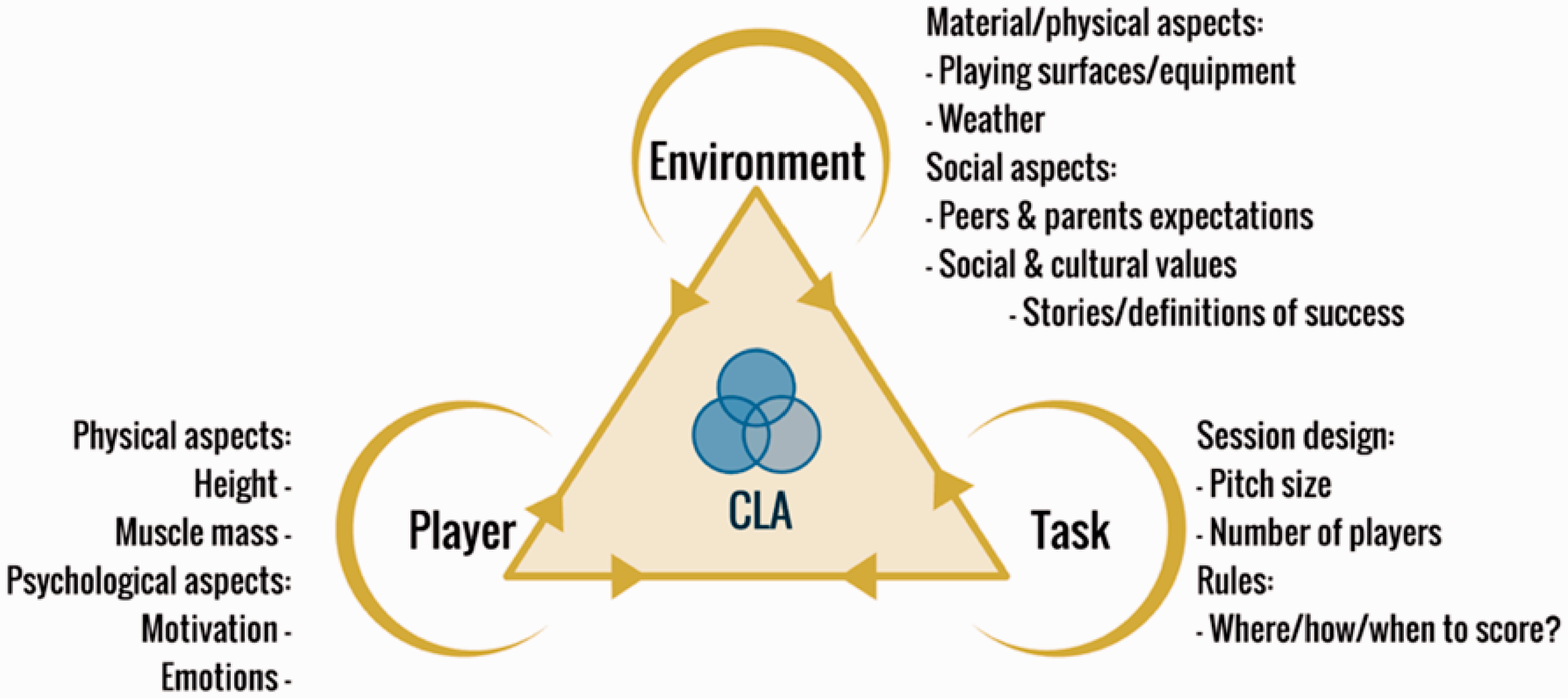
Adopted from Newell’s model of constraints (1986), conceptualizing constraints that shape and guide learning.
Critically, while the CLA helps conceptualize how skills emerge, it does not provide a framework for how to design appropriate learning environments in team sports.25,26 Principles of a non-linear pedagogy (NLP) can address this limitation, supporting practitioners to harness CLA methods in a range of practice task designs.27,28 Key principles of NLP can be summarized as: the designing of representative learning environments that facilitate opportunities for learners to develop and adapt relevant information-movement couplings, manipulation of constraints, repetition without repetition (functional movement variability) and the promotion of an external focus of attention (for detailed overviews and practical interpretations of a NLP, see literature5,28).
The key point here for practitioners is that in this framework, learning is based on an active engagement and interaction of an individual with a performance environment, 5 as they learn to attune to environmental information matched to their action capabilities. 2
Knowledge of (in the game) and knowledge about (out of the game)
In building toward his theory of Direct Perception, James Gibson 29 differentiated between ‘knowledge of’ and ‘knowledge about’ the environment. While both knowledge ‘types’ (in)directly influence perception, Gibson 29 asserted that knowledge about the environment reflects an abstracted and indirect response to things or states of affairs. This type of knowledge is typically evident in verbalized responses to questions about things or in the presentation of pictures or symbols representative of them (i.e., whiteboard scribing that shows players about their positioning in a football game). 30 In sport, such knowledge, developed through verbal responses to questions or coach-provided declarative instruction, may be useful when describing performance ex situ. However, while such knowledge may help initially orient an individual in unfamiliar regions, it does not necessarily support a performer’s capability to wayfind d during performance, in the same way that reading a recipe does not mean an individual can actually cook or that reading about a plant signifies gardening skill.5,30,31
Comparatively, ‘knowledge of’ the environment is reflective of embodied-embedded knowledge developed by, and exemplified in, activities (e.g. movements, behaviors, performances) that enhance the coupling between perception and action. 29 For the sake of reaching practitioners across the sporting landscape, we refine Gibson’s interpretation and refer to this type of knowledge as “knowledge in” the game. So, while young players may display knowledge about the game when verbalizing responses to questions posed from a coach or educator, it does not necessarily imply that they can actually perform these actions in the game. An important contention of this paper, though, is that practice tasks need to be designed by practitioners with an extensive knowledge about the game, as this knowledge about collective and individual performance can inform practice designs to support the development of a performer’s knowledge in the game. So, appreciating this: how does a practitioner actually design practice activities, using the CLA, that develops a learner’s knowledge in the game?
Designing practice tasks that supports “knowledge in” the game
In order to first promote learning ‘in the game’, practice tasks should be carefully designed to help performers detect information that specifies opportunities for action (referred to as affordances by Gibson 16 ) relative to their current performance capabilities. 10 Moreover, practice tasks should help individuals learn how to self-regulate perceptions and emotions to exploit emergent affordances for action. This can be achieved through the deliberate designing in of key affordances with which learners can interact during practice. 27 Briefly, affordances can be understood as properties of an individual-environment system, providing opportunities for action, scaled to each individual’s action capabilities (e.g. speed, strength) and body dimensions. 32 Humans are surrounded by affordances, which are always available to be perceived when these opportunities for action become meaningful. 16 For example, for some children, a ball is an object with different value and meaning, such as to be avoided, picked up, thrown or kicked. Thus, as there are many possible perceptions and actions in any given situation, practitioners need to guide a performer’s intentions toward what needs to be achieved in a performance environment. 33 In doing so, practitioners can educate the attention of players toward the perception and realization of key affordances available in the environment. 11
Next, through the lens of Adolph’s notion of learning in development, 13 we present a user-friendly developmental framework for practitioners grounded in ecological dynamics, which is currently being used by AIK Youth Football in Sweden.
A proposed learning in development framework
An example at AIK youth football
AIK Youth football (Allmänna Idrottsklubben) is based in Solna, Stockholm and engages over 1500 players between 5-18 years of age. In April 2017, after disbanding its early talent selection policy, an in-house investigation, conducted by professional coaches and sport scientists using ethnographical strategies, was carried out to inform present and future possibilities of evolving practice and player development. Specifically, a contribution of observations, field notes, document analysis and unstructured interviews connected the actions of coaches (e.g. coaching styles) and young players at AIK youth football with the socio-cultural and historical contexts within which an individual’s development occurs. Two case studies were undertaken to assess the wider socio-cultural contexts and historical influences on player development [for specific examples, see Woods 5 and Seifert 36 ].
We noted that structure of development pathways and implemented pedagogies went hand-in-glove (for better or worse), with the skills and attributes appreciated in young players being culturally embedded, founded upon specific socio-cultural and historical constraints (for further reading, see literature5,20,34). For example, global-to-local (i.e., top-down) processes were amplified in a coaching culture, where team organization and the notion of an ‘optimal’ technique had previously been prioritized over developing players’ knowledge in the game.
To soften these path dependencies, there was a need for contemporary, theoretically driven frameworks of player development (which were able to transcend historical or cultural tendencies),5,35,36 inviting practitioners to appreciate the underpinning principles of a rationale grounded in non-linearity.10,36 Recognizing that macro level (i.e., wider socio- cultural contexts) sociocultural constraints evolve over years and can be challenging to influence, initial interventions were focused at the micro level of practice task design. 37 Grounded in the theoretical framework of ecological dynamics, coaches were encouraged to adopt principles of a CLA to support player development.
In the continued and iterative effort to present the key ideas of a CLA and its pedagogic concepts to practitioners at all levels, the user-friendly learning in development framework (Figure 2) and foundations for task design model (Figure 3) were developed. The cycle illustrated in Figure 2 depicts a conceptualization of the key aspects of learning in development, while Figure 3 provides a brief insight into some foundations for football specific task design based on key principles of NLP. The key aspects of Figure 2 are categorized into three phases relating to the timing and timescales of development at macro and micro levels, as well as the coaches role in guiding the players’ development. The following sections unpack the three phases of the learning in development framework shown in Figure 2, while drawing on the summary of foundations presented in Figure 3 to help conceptualise it in practice.
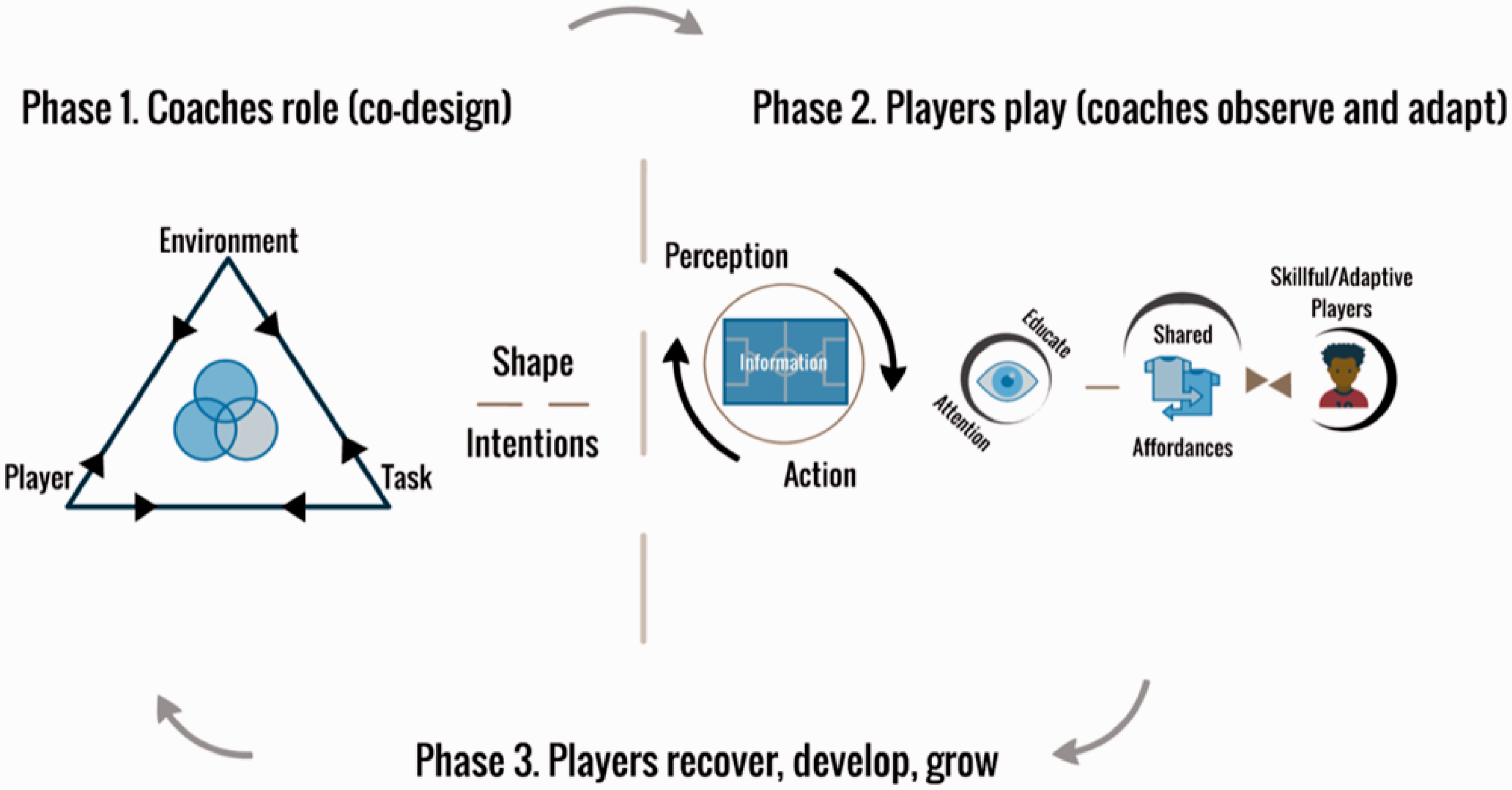
The three phases of the Player learning IN development framework, part of AIK football club’s player development cycle.
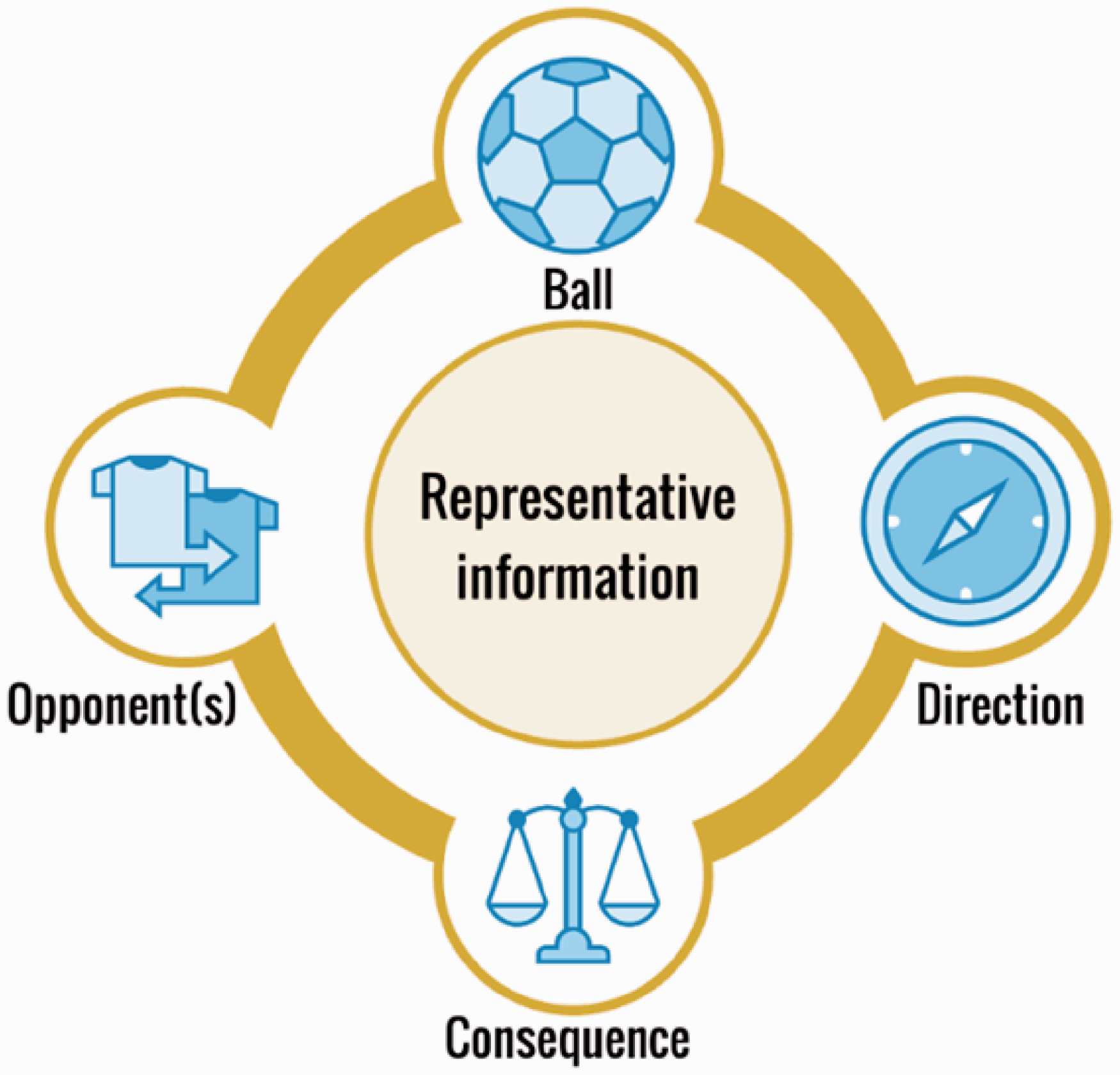
Foundations for task design model. Ball-opponent(s)-direction are key aspects of task design that shape learners’ intentions and attention. The idea of consequence (e.g., if we lose the ball and do not win it back, the opponents may score), highlights the continuity and co-adaption of attack and defence. Key information in task design is representative of the game.
Phase one
Phase one illustrates that the coaches role in this framework is to co-design a training session that develops a player’s knowledge in the game (Figure 2). Coaches at AIK are encouraged to dampen the sociocultural constraints (previously identified traditional perspectives) that advocate a constant prescription of declarative knowledge about the game, to become a facilitator of activities that place the performer-environment interactions at the core of their practice designs. 38 In doing so, learners are actively encouraged to explore the information that is available in their performance landscapes, deepening their knowledge in the game and its possibilities for (inter)action.5,39
Based on the tenets of the CLA and NLP, the coach manipulates task constraints, being responsive to environmental and socio-cultural constraints, to shape intentions that frame the players perception and action. In this framework, co-design alludes to each performer’s input in the learning process (and recognition of their unique constraints), both implicitly and explicitly. The implicit input relates to a sport practitioner’s knowledge of the performer’s current action capabilities. For example, the pitch dimensions, and ball and goals should be scaled to the physical constraints of the performers. Also, the number of players involved in practice tasks can be scaled down and constraints can be added to shape available affordances (e.g. gaps and spaces: influencing spatial-temporal dynamics) that afford more representative football interactions 5 (such as passing, manipulating the ball and dribbling in spaces and between players). The explicit co-design process is evident when adapting the session to the players intentions based on observations made during the session. To shape intentions and/or shine a light on an area for greater attention, a coach might manipulate task constraints by changing playing area dimensions, as well as adding or removing rules, players, zones and goals. This explicit co-designing of task constraints may also take place through actively involving the performers in decisions on the design of further adaptations of the learning task (for a detailed insight to principles of representative learning design, refer to Pinder et al. 40 ).
The foundations for task design graphic is suggested to provide principles for how coaches can design and evaluate ‘football’-specific learning environments (Figure 3). Indeed, a design may satisfy the criteria of ball-opponent(s)-consequence, yet still violate the criteria of information in task design is representative of the game. For example, the rule that all players must touch the ball before a goal is scored may not be a representative task constraint, 28 as it may not promote effective perception-action couplings in relation to relevant affordances available in the performance environment. In this case, the team in possession may not be attuning to the information that supports them in exploiting gaps and space so that they can penetrate and score.
Given this attunement to information to regulate action, learning, within this framework, can be understood as wayfinding 30 – an explorative process in which an individual learns to solve problems by detecting information in their environment of use for specifying (regulating and (re)organizing) actions. This perspective of the learning process is characterized as a progressive education of attention (helping each performer become attuned to the information in a specific performance environment), which is predicated on Gibson’s16,29 perception-action coupling approach for understanding how humans regulate behavior. For example, a coach observing a small sided game might want to promote the utilization of gaps and space via dribbling without denying the opportunity for passing. Adding a task constraint such as awarding a point to the team who is able to intercept a pass, places a risk on passing but does not exclude its utility. When in possession, this risk could invite players both with and without the ball to self-organize their individual and collective behaviors to support the player in possession. While the targeted intention with the task constraint is to shine a light on opportunities to dribble without removing the opportunity to pass, it also invites opportunities for teammates to continuously adapt their positions to local information (e.g. player in possession, and positioning of nearest opponents).
However, as suggested by Woods et al., 5 rules and verbal instructions utilized by coaches can have an over-constraining influence on player interactions and intentions, guiding the player’s attention to non-representative information sources. For example, a practice activity designed on encouraging ‘overlaps’ may be traditionally over-constrained by using a rule that you must pass to the overlapping player (to score). In this case, the defending team need only defend the overlap (therefore, they would just need to self-organize their interactions around the overlapping player to complete their task), especially if the coach announces the (over)constraint to the whole group. Such announcements are common when coaches declare what the theme of a certain session will be (i.e., overlaps). This prescriptive approach could promote an inherent lack of representativeness and ensuing predictability, limiting variability and thus possibilities for players to learn how explore the learning environment, to develop and exploit crucial information-movement couplings to coordinate their actions. For example, the idea of a successful overlap is not limited to an overlapping player receiving the ball, but its value includes distracting the defenders, pulling them out of position and creating other affordances for action. For example, there may be opportunities to exploit gaps more centrally, or on the inside of the defender nearest the overlapping player. Should these affordances be ignored just to comply with a coach’s prescriptive instructions on how to perform? Essentially, practice activity designs should invite opportunities for players to learn how to fine tune their attention (e.g. what information to attend to in a performance context). 41 Thus, if an external influence (i.e., declarations of a coach) reduces attunement to the information available in an environment through an over-constraining instruction or rule, then the opportunity for players to learn to exploit relevant, available information (by searching) may be limited. So, rather than imposing rules, a coach may challenge players to utilize their teams time in possession to create possibilities to play through, around or over the opposition. In other words, coaches could guide player intentions towards individually and collectively exploiting gaps and space to score a goal. The key point here is that phase one of this framework conceptualizes the coach’s role as fostering player-environment interactions through carefully co-designed practice tasks. Constraints used in this conceptualization should guide, shape or encourage actions, not necessarily eradicate, prescribe or dictate them.
Phase two
The second phase of this framework relates to the player, as they are encouraged to tighten perception-action couplings through the progressive detection of information and (re)organization of action. As explained earlier, the coach can manipulate task constraints and shape intentions to (re)frame a player’s perception-action coupling. However, coaches should be cautious of relying too heavily on augmented informational constraints, such as verbal instructions provided to players. 42 For example, if uncoordinated defending (e.g. defending at the same time but not together) is making an activity unrealistic, a coach might verbally clarify the players’ intentions and task goal when defending (i.e., “our first priority is to stop the opposition playing through, around or over us, while our second priority is to press to win the ball”). e
This guidance could also be achieved in numerous ways by manipulating the task design, such as the defenders lose accumulated points if the opposition play through them, but they only gain points by pressing and winning the ball. For the players “in possession of the ball”, the intention to play through shines a light on opportunities for playing penetrative passes in the landscape of shared affordances to pass and receive between the defenders. 43 But for the defenders, the shared affordances perceived would relate to opportunities for pass interception and the closing of spaces for opponents to play penetrative passes.
Phase three
The third phase of this framework captures the process of recovery and adaptation to training session(s). Over typical timescales of learning (days, weeks, months, years), this adaptation will change the action capabilities of the player, as they learn in development. Importantly, continued player development will re-shape this whole cycle and the co-design process, emphasising the dynamics of this learning process in this development framework. Something for the coach to reflect on when planning practice task designs throughout these different timescales (weeks, months, years), is that the perception of affordances changes as an individual’s capability for action changes. This is because, although an affordance is always available in the environment, its value and meaning for each individual may change as the individual matures, develops and grows. 16 Youth soccer performance environments are dynamic and competitive, requiring young players to learn to adapt and develop innovative solutions by continuously seeking and perceiving opportunities for action in the performance environment.44,45 The nature, type, and complexity of these settings change with learning in development as certain available affordances in the environment become more soliciting or inviting than others. 46 For example, with maturation and development, specific action opportunities emerge for young players (e.g. being able to play a long pass over the heads of opponents into space behind them) or being able to shoot past the goalkeeper from a distance away from the goal.
Limitations and challenges of this framework
There are some noteworthy challenges and limitations in introducing the knowledge and tools to base a coach education program and player development framework on the key principles of the CLA to a sports organization. Firstly, this approach takes time to learn for practitioners, with an understanding of key theoretical concepts needed. This time investment is not always prioritised within sporting environments, for a variety of reasons. Secondly, there may also be practical obstacles to overcome along the way – financial barriers and stakeholder expectations perhaps being a couple. Thirdly, local knowledge about the sport and the socio-cultural context in which the sport is carried out is required. This knowledge helps practitioners to understand and identify the socio-cultural constraints that may be shaping the club structure, parental expectations, coach pedagogy and session design. The growth of this knowledge, however, is likely to take time – meaning that the framework presented here may provide a basis for which an interested reader could initiate the pedagogical integration process, but not an end point.
Concluding remarks
In summary, this paper proposed a framework to support the practical application of the CLA in youth football. It highlighted some relevant concerns that challenge the integration of such methodologies, limiting their impact on coach education programs and player development pathways, such as the need to improve the communication of key concepts and the recognition of misinterpretations. While appreciating there is still work to be done, it is hoped that the framework we presented does address some of these challenges for practitioners. Thus, the purpose of this framework was twofold; first, to help practitioners conceptualize the inherent non-linearity and highly personal nature of learning in order to inform player development pathways, and second, to show how to integrate a CLA in practice task design. This discussion was intended to guide practitioners towards a more flexible and adaptable approach to planning, where, through the implementation and refinement of task designs, they could continually assess and evaluate each individual’s needs (within a team) over various timescales of development.
Footnotes
Declaration of conflicting interests
The author(s) declared no potential conflicts of interest with respect to the research, authorship, and/or publication of this article.
Funding
The author(s) received no financial support for the research, authorship, and/or publication of this article.
