



Abstract
The transition from junior to senior is widely regarded as one of the most critical and challenging stages in the long-term talent development pathway. Despite its career-defining nature, this phase remains underexplored, particularly regarding the challenges faced by promising young players. This study investigated players’ perceptions of the junior-to-senior transition through semi-structured interviews with 20 Portuguese football players: (1) 10 classified as successful players (39.3 ± 11.96 years; 13.4 ± 7.02 professional seasons; 5.8 ± 3.48 career clubs), and (2) 10 classified as unsuccessful (35.6 ± 12.22 years; 2.5 ± 2.59 professional seasons; 2.2 ± 2.14 career clubs). Success was defined as completing at least one full season in a top-tier European professional league. Interview questions addressed priorities in sporting experiences, psychosocial factors, and physical attributes. Interviews were audio-recorded, transcribed, and thematically analysed. Findings suggest that in a performance-driven sporting context, successful transition requires ambition, discipline, resilience, and self-reflection. Outcomes are strongly shaped by coach-player relationships, competitive environment, and the perceived importance of academic education. Persistent barriers include unrealistic expectations, external pressures, limited playing time, and the overemphasis on biological maturation and relative age effects. The influence of close social networks was found to be ambivalent, highlighting the need for gradual, personalized transition approaches supported by conscious and adaptive leadership.
Keywords
Introduction
Career transitions in sport are increasingly understood as multidimensional processes that tend to occur during late adolescence and early adulthood. These transitions involve several interrelated domains, including, athletic, academic, vocational, psychological, psychosocial, financial, and legal, all of which influence one and another. 1 From this perspective, sport transitions are commonly classified into three categories. Normative transitions refer to predictable and expected events, such as progression from youth to senior levels or advancement through educational stages. 2 Non-normative transitions are unexpected and often disruptive, including career-ending injuries or deselection from a team.3–5 Quasi-normative transitions, in contrast, are predictable only for certain athletes, such as preparing for major competitions or adapting to new cultural environments. 6
In football, success at youth level does not guarantee progression to professional status. Athlete development and the attainment of expertise in adulthood result from a dynamic and multifactorial process shaped by the interaction of physical, technical, tactical, psychosocial, and environmental factors. 7 These interactions are further influenced by context-specific conditions, which add complexity to the pathway and make progression to elite performance particularly demanding.8–9
Despite this uncertainty, young football players invest a substantial part of their lives in the pursuit of a professional career. Only a small proportion, however, obtain professional contracts, and fewer still succeed in transitioning to the first team. Among those who reach this level, only a limited number establish themselves as long-term senior players. 10 Early career termination in elite youth football has been associated with several negative consequences, including anxiety, depression, loss of confidence, and social dysfunction. 11
The complexity of these transitions has been addressed through different theoretical frameworks. Stambulova's Athletic Career Transition Model12–13 conceptualizes transitions as coping challenges, in which outcomes depend on the balance between internal resources (e.g., motivation, resilience), external resources (e.g., social support, coaching), and perceived barriers. Successful transitions occur when athletes manage these demands effectively, whereas imbalances may lead to crises requiring intervention. The Athletic Talent Development Environment (ATDE) model 14 complements this view by emphasizing the role of the social and organizational environment. Over the past decade, research grounded in a holistic ecological approach (HEA) has expanded talent identification and development beyond an individual-centred perspective, placing increased emphasis on the athletic talent development environments (ATDEs) in which young athletes are embedded. 15 Within this framework, ecological refers to the focus on environmental contexts that shape athletes’ development, while holistic denotes an understanding of these environments as complex and dynamic systems composed of multiple interrelated settings, levels, and domains. 14 From this perspective, talent development is conceptualized as a process of mutual adaptation between athletes and their ATDEs. It highlights how relationships within the club and the broader context shape development and adaptation during transitions. Together, these models offer an integrated understanding of athlete transitions, combining individual coping processes with environmental influences. This integration also reinforces the importance of a dual career approach, which promotes balance between sport and other life domains and supports more sustainable transitions. 16
Recent research continues to show that junior success is a poor predictor of senior performance.17–19 examined the junior-to-senior transition and identified a marked increase in skill and performance demands between levels. Players also reported several stressors, including strained coach–athlete relationships, difficulties with significant others, limited social support, time pressures, increased performance expectations, injuries, financial concerns, organizational stress, and reduced motivation. These stressors appear to intensify at higher competitive levels. Simpson, Didymus 20 found that athletes competing at national and international levels experience greater organizational demands than those performing at lower levels.
Within football-specific contexts, Swainston, Wilson 21 conducted a longitudinal study of the junior-to-senior transition and identified key challenges during the academy phase, such as contract-related pressure, adaptation to men's football, and preparation for first-team integration. Following promotion, players faced difficulties linked to team dynamics, limited playing opportunities, and the need to develop effective coping strategies. Similar conclusions were drawn by Lundqvist, Gregson, 22 whose global questionnaire-based study highlighted the importance of a club-wide playing philosophy, exposure to different playing styles, and long-term development strategies. In addition, Mitchell, Gledhill 23 reported that young players often struggle to adapt to the competitive and results-driven nature of first-team environments, with feelings of isolation and loneliness emerging during the early stages of transition.
Three categories of constraints – organismic, environmental, and task-related – have been proposed to shape the emergence of optimal coordination patterns. Organismic constraints derive from the intrinsic properties of the sensorimotor system, environmental constraints reflect ambient conditions and the availability of performance-relevant information, and task constraints relate to goal-specific rules and requirements that guide action. 24 As interest in this area has grown, research findings have often been organized around key constraint categories, namely environmental, player, and task constraints.25–28 While this framework has enhanced understanding of transition demands, academy environments remain highly variable. Each is shaped by the club's philosophy, development principles, governance structures, culture, geographic location, financial capacity, population density, and available resources.29–30
Consequently, talent development and junior-to-senior transitions should be viewed as individualized and dynamic processes that require context-sensitive approaches.22,31 A deeper understanding of the factors that influence this transition can strengthen support structures and reduce barriers to player development. To date, however, few studies have examined this process from the perspective of footballers who have experienced it. This gap limits the evidence available to inform effective practice. Exploring players lived experiences and identifying factors that facilitate or hinder the transition may contribute to more contextually grounded and relevant interventions in a process shaped by multiple and often unpredictable variables.
This study aimed to explore players’ perceptions of the transition from junior to senior levels, focusing on experiences related to development, training practices, educational engagement, and personal, social, and sporting growth. Specifically, it sought to examine how Portuguese professional football players perceive and make sense of their transition from junior to senior football.
Material and methods
Philosophical perspectives and design
This study adopted a qualitative, interpretive case-based approach to provide an in-depth analysis of how participants construct and negotiate meanings within a bounded social event involving a group of individuals institutionally and temporally united by a shared goal and purpose. The research was guided by an interpretative paradigm, rooted in ontological historical relativism and epistemological transactionalism.32–33 Qualitative research offers valuable insights into players’ perceptions, motivations, values, and needs. By adopting an interpretive paradigm, it becomes possible to understand and analysed players’ perceptions as they evolve alongside the context. Ontological historical relativism emphasizes that reality is apprehendable and shaped by socio-cultural interactions arising from each player's unique context. 34 Epistemological transactionalism posits that social interactions and interpretations dynamically shape knowledge. 35 These philosophical perspectives highlight the importance of a holistic and contextualized approach to understanding players lived experiences during their transition from junior to senior level.
Participants
Twenty professional Portuguese players were recruited via email or telephone. A purposive sampling strategy was employed, deliberately selecting participants who met predefined criteria related to their direct experience of the junior-to-senior transition in elite football. This approach enabled a focused and information-rich sample, while acknowledging that the findings are not statistically generalisable to the wider population of players. Two groups were established for participation: (1) the successful transition group, and; (2) the unsuccessful transition group, with each comprising 10 players. The final sample size was determined upon reaching saturation during the interview process. Inclusion criteria for the successful transition group were: (1) experience as senior-level practitioners; (2) consistent participation (playing for more than one season) in senior teams competing in major professional leagues (first division). Inclusion criteria for the unsuccessful transition group were: (1) at least 4 years in a youth elite club formation program; (2) recognition by technical staff as having clear potential to join the club's main team; (3) lack of consistent participation (at least one full season) in senior teams competing in top professional leagues (first division). All players consented to participate. The successful transition group (n = 10) had a mean age of 39.3 ± 11.96 years, 13.4 ± 7.02 professional seasons, and 5.8 ± 3.48 career clubs. The unsuccessful transition group had a mean age of 35.6 ± 12.22 years, 2.5 ± 2.59 professional seasons, and 2.2 ± 2.14 career clubs. A total of 20 interviews were conducted. Among all participants, five players were still active professionals at the time of the interviews. Of the remaining participants, five had retired within the past five years, and ten within the past ten years.
Procedures
Players participated in a semi-structured interview lasting between 58 and 177 min. The length of the interview was shaped by the participants’ level of familiarity with the topics discussed and the degree of self-reflection they felt was necessary. 36 All participants provided informed consent to take part in the study, with the interviews being audio-recorded. Once eligibility was confirmed and consent obtained, participants completed one-on-one semi-structured interviews conducted by the first author between July 2024 and February 2025. Interviews were uninterrupted and continued until their natural conclusion, with all being included in the analysis. The process began with an explanation of the study's purpose and topics, ensuring anonymity and encouraging participants to freely share their opinions (the questionnaire is available in the supplementary material). Data saturation was achieved after the first seven interviews in each group, as the final three interviews did not yield any new themes, consistent with the 9–17 interview range suggested in the literature for reaching saturation in a homogeneous population. 37
A bespoke semi-structured interview script was developed for this purpose. Its structure was drawing on the holistic ecological approach 38 which emphasizes a shift in research focus from individual athletes to the broader developmental context in which they evolve. The interview structure was further informed by an extensive review of the literature.1,15,19,25,39 The initial phase of the interview explored key dimensions of the sporting experience, including organizational and structural conditions, communication processes, the significance of dual career management, the coach's role, and training methodologies tailored to athletes’ needs. The second section of the interview examined the psychosocial dimension, focusing on players’ motivations and concerns, including psychological factors, the sociocultural environment, and the influence of family and peers. The third section addressed physical characteristics, with particular attention to physiological adaptations, maturation, and the relative age effect. For each question, players were encouraged to recount personal experiences and provide concrete examples to illustrate their responses. Following completion of the three sections, participants were invited to contribute additional perspectives on topics not covered or to elaborate further on issues they considered especially important.
The initial draft of the semi-structured interview script was reviewed by six experts for face validity. Four of these experts specialized in sports science and had experience as trainers in qualitative research programs, while the remaining two combined qualitative research expertise with professional coaching careers. Two pilot interviews were conducted with professional football players. Based on feedback from two professional players, adjustments were made to the wording of the survey and the sequence and organization of the questions to enhance clarity and relatability. These adjustments were intended to minimize digressions and repetitive responses, reduce conceptual ambiguities, and enhance the overall quality of the data collected.
All interviews followed a similar structure and were conducted either via an online platform (Microsoft Teams) or in person. With participants’ consent, each interview was audio-recorded and transcribed verbatim into a Word 2019 document (Microsoft Corporation, Redmond, WA). Transcription of the data elicited 417 pages of transcription totalling 228, 249 words. The average pages per interview were 21 and approximately 11,412 words.
Analysis
To address the aim of this study, which was to explore players’ perceptions of the junior-to-senior transition, focusing on their developmental, training, educational, and personal–social experiences, the research team used thematic analysis,40–41 adopting a combined deductive-inductive approach, based on the logic used for the development of the interview guide around three dimensions: (1) environmental constrains; (2) task constrains, and; (3) athlete constrains.25–26 Transcripts were read multiple times to foster data familiarization and immersion in the core content. 42 The first author annotated the interview transcripts with reflective notes on the player's statements, initiating a resonant and interpretive engagement with their perspectives. After gaining familiarity with the content, the first author identified initial themes and the relationships among them. These themes were subsequently interpreted in collaboration with the research team and contextualized within existing theoretical frameworks. The data were analysed using the three-step inductive thematic analysis approach outlined by Thomas and Harden. 43 Each transcript was initially coded line by line, with the resulting codes grouped into descriptive themes. These preliminary themes were then examined in relation to the research questions, enabling a synthesized and meaningful interpretation of the data. Throughout the process, themes were iteratively refined – merged, separated, or redefined – to ensure a coherent and comprehensive understanding of the emerging concepts.
Nvivo qualitative analysis software (version 14; Lumivero) was used to code the interviews’ transcriptions.
Trustworthiness
This study surpassed Creswell's recommendation of employing at least two of the eight suggested strategies to ensure validity in qualitative research.44–45
To ensure reliability, 45 several strategies were implemented. The first author verified all transcripts to correct potential transcription errors and facilitated communication among the coders through regular documented meetings and shared analyses. Codes generated by different researchers were cross-checked by comparing independently derived results. Additionally, the first and second authors independently coded five transcripts to establish coding reliability, reaching consensus on categories related to the junior-to-senior transition outlined in the interview guide. The subsequent 15 interviews were then coded, during which no additional subcategories emerged. For replicability, the first author conducted all interviews adhering to academic semi-structured protocols. These interviews were transcribed verbatim prior to analysis. The first author also compiled the written results, thoroughly reviewing all coded transcripts, and collaborated with the other authors to interpret and refine the data. Member checking 45 is an important quality control process’ in qualitative research. To enhance credibility and trustworthiness, the data were returned to participants for validation and accuracy, ensuring alignment with their lived experiences and perspectives. This verification process occurred in two stages: first, during the information session at the conclusion of each interview, where participants could adjust their responses; and second, by sending the complete interview transcripts to participants for final approval, allowing them to filter, amend, or remove any comments. The participants were invited to contact the researcher to request changes. No such requests were made, indicating that the transcripts were accurate representations.
Peer review or debriefing involves the evaluation of the data and research process by an individual with expertise in the study or the phenomenon under investigation. 45 In this study, the first author engaged in ongoing discussions with recognized Portuguese experts in the field of football talent identification and development.
Results
The coding framework was structured around four categories to capture the key dimensions of the junior-to-senior transition: (1) environment constraints; (2) task constraints; (3) players constraints and (4) the interaction of environment, task and players constraints (Figure 1).1,46,47
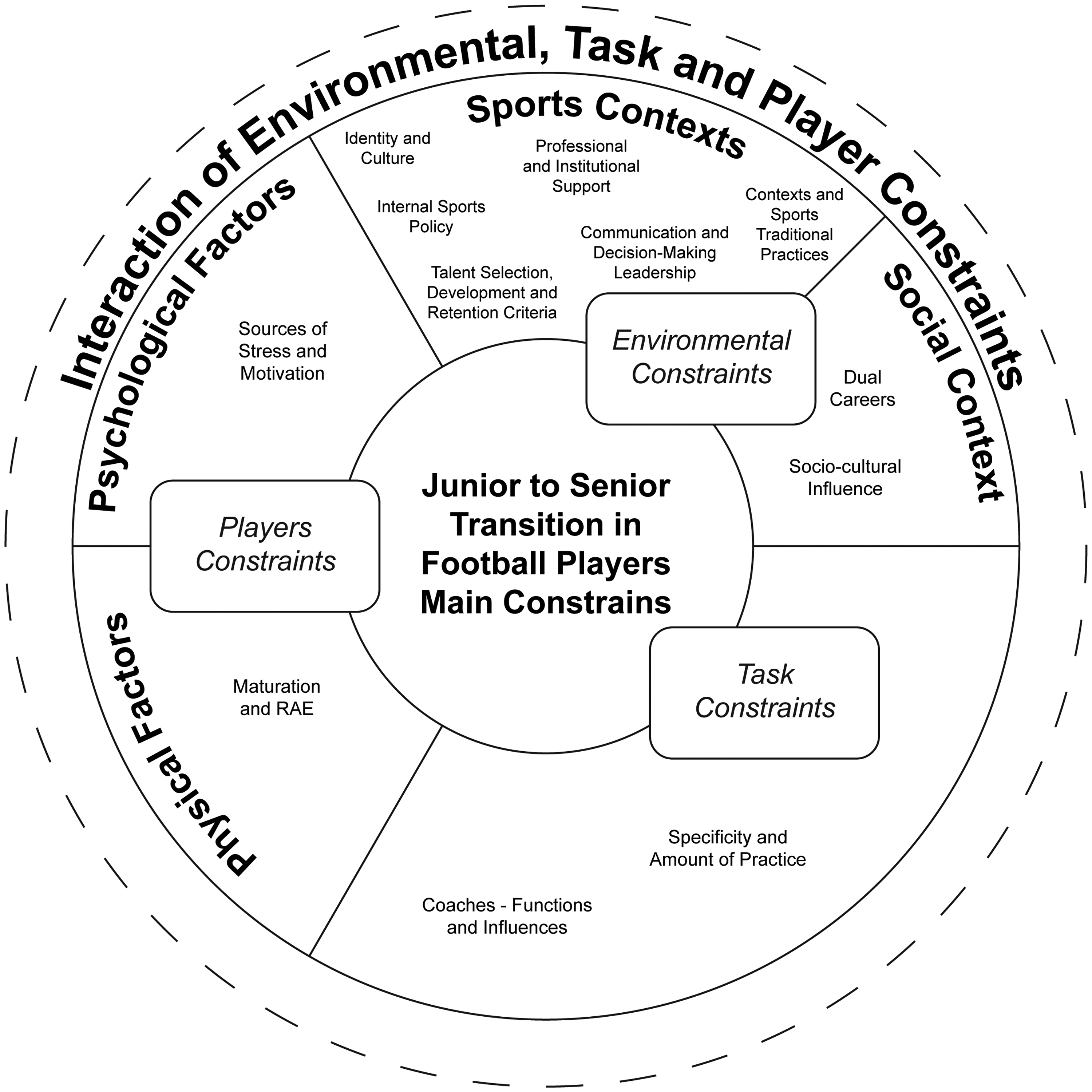
Categories of constraints identified by players as influential in shaping the junior-to-senior transition.
Environment constraints
In the following section, we address environmental constraints by analysing the sport and social contexts. Within the sport context, we examine internal policies, communication and decision-making leadership, culture and identity, talent selection, development and retention criteria, traditional sports practices, and professional and institutional support. Concerning the social context, the focus is on dual careers and sociocultural influences.
Sport contexts
Internal sports policy
Both successful and unsuccessful players (e.g., 1, 2, 3, 16, 20) attributed importance to investment in infrastructure, the quality of human resources integrated within the clubs, and the suitability of competitive moments to the needs of the athletes. The proximity and coordination between the different areas of intervention in the clubs were valued, with a call for specialized and professionalized support in the various dimensions of athlete development. It was emphasized that a sports policy focused on the organization of practice requires continuous investment, institutional stability, and a clear conceptual basis, with criteria for the identification and development of talent, as well as for the selection of coaches and other human resources involved in the process. There are factors that make a difference in enhancing the transition phase. It is essential to provide practice conditions for young athletes, whether related to infrastructure, supporting human resources, or competition moments adjusted to their needs. It is necessary to ensure there is waiting time and respect for the athlete's growth, as not everyone develops at the same pace, and a hasty sports policy is counterproductive to a development project. (…) I went through my path at a big club during a period of facility transition. We had little contact with professional players; we only interacted with our own team and staff. Proximity brings interactivity, comfort, and quality of life, which in turn brings stability. Player 20 (…) development projects are much more influenced by the combination of infrastructure, the human resources involved, applied methodologies, and the athlete. Development requires investment, stability, and foundational conceptual ideas. The earlier the key variables are defined and applied, the greater the likelihood that internal sports policy will take effect (…) for example, may involve promoting two young players to the senior squad, resulting in two fewer external signings. Player 3
The interviewees emphasized the importance of practice conditions tailored to individual growth and an integrated approach that combines infrastructure, qualified human resources, and appropriate methodologies. They also highlighted that proximity between intervention areas promotes stability and quality of development, while a clear strategy for early talent recruitment and retention strengthens the sports project and reduces reliance on external signings.
Communication and decisional leadership
Some players (e.g. 4, 5, 11, 19) considered that transversal, coherent, and close communication remains a decisive factor in the training process. They argue that communication should be based on a clear message aligned with the club's principles, objectives, and ambitions, properly adapted to the different levels of the developmental pathway. Institutional rhetoric should encompass not only aspects related to the development of social skills but also to the sporting performance of coaches and other members of the structure. The club's leadership – represented by the top leaders – must maintain coherent communication and an active presence, demonstrating effective involvement and deep knowledge of the work carried out in the various stages of development. Communication rests on two pillars: coherence and presence. From the lowest age groups to the professional level, the club's rhetoric and operational dynamics must be consistent, then adjusted according to the specificities of each level and the club's objectives. The head coach and the club president cannot exist merely as functions – they must be present. (…) what commitment or ambition can young players have, realizing that those with the greatest decision-making power might have no idea what's going on in development? Player 19 There should be more proximity between academy players and established professional players. (…) The club focuses its communication on how young players should deal with marketing and image matters, on monitoring and evaluating mental health – which are also very important. Player 11 (…) the president of my club said the same thing as the vice-president, and that this message didn’t just start with the youth academy coordinator in the hallways and end with the coach on the pitch. That gave me comfort, stability, and the drive to always give my best. You could feel there was a structure, and that regardless of the type of problem, we were all aligned to try to solve it quickly. Player 4
Interviewees highlighted that communication within the club must be coherent and involve key decision-makers, such as the coach and president, to secure young athletes’ commitment. They also pointed out the lack of proximity between the professional team and the academy, and the need for informal communication that values the human aspect. Perceived alignment and support at the highest structural level were identified as sources of stability and motivation.
Culture and identity
Consensus was observed among the players (e.g. 1, 8, 9, 12, 18) regarding the working principles and behavioural conduct standards. The importance of technical-tactical guidelines aligned with the player's sports development plan was emphasized, both in training and competition contexts. Critical understanding of the context in which they are inserted was also highlighted as a promoter of greater sports literacy and education. The earlier a young player enters a club's development system, the more the club will facilitate their transition, especially in terms of work principles and alignment with training methodologies and playing philosophy. The most obvious aspect is related to work principles and social behaviour. These shape a young player's personality and help build that sense of identity and collective club culture. If all the young players share those principles, the process becomes more uniform. Player 18 Each club has its own identity and history, and I believe that the player must understand the uniqueness of the club – just as the club must be organized in a way that allows the player to grasp that history. What I’ve noticed is that, year after year, there's a constant turnover of young players in the academy. And in this process of passing on values and shaping a player profile – both for sporting performance and later club loyalty and attachment – things get distorted. Clubs increasingly present a different player base from one season to the next. Coaches also change frequently. The focus ends up being on results, performance, and the athlete's sporting development. Young players pass through clubs for short periods, without building affinity or emotional connection; they’re only looking for sporting and competitive environments to develop their game. The club ends up creating a void of identity in its players. Player 9
The players underscored that early entry into a club's development system aids young athletes’ transition by aligning work principles, training methodologies, and playing philosophy, fostering personal identity and the club's collective culture. However, they noted that high turnover of players and coaches in academies can impair the transmission of values and the development of emotional attachment, resulting in an identity void and excessive focus on results and performance.
Talent selection, development and retention criteria
Both successful and unsuccessful players (e.g. 7, 9, 13, 14) advocate for a rigorous, equitable talent selection process with clear criteria, warning about the risks of an excessive number of athletes, which may compromise the development of the most promising ones. They emphasize the importance of an appropriate competitive context and sustained development plans, cyclically evaluated by the club. There are too many teams within clubs because talent is assessed with less demanding criteria, increasing the numbers. So how can equal opportunities be guaranteed for everyone? There are Under-17 players who play with the senior team because the level of competition in their own age group isn’t enough for them to develop in the way clubs expect. Meanwhile, there are still 20 or 25 players left in that same age group, many of whom only train and could leave, join other clubs, and have real competitive opportunities. But when it's time to win a trophy, the best players return, and those others lose their place. There's no continuity in the process. Players start their journey in the younger age groups, go through three or four different teams per age bracket, and when they reach the senior level, they’re released, and many are not remotely prepared for the demands of the transition. Teams should be smaller and focused on the development of those who are truly identified as talents. Player 14 Ensuring the same opportunities and practice conditions for everyone is difficult and depends greatly on the competitive context the club is involved in. Sometimes, it is necessary and more beneficial to let players leave. What's important at these ages is guaranteeing they get to compete. Training processes and conditions are no longer so different from club to club or coach to coach. A player with great potential, placed in a squad of 25 very similar youngsters, won’t get much playing time… That same player, in a different club reality, might find a demanding environment, playing 90 min per game, 30 times a year… Player 7
Interviewees criticized the excessive number of teams within clubs and the lack of continuity in development, which leaves players unprepared for senior levels. They advocated for smaller teams focused on genuine talent and emphasized that competitive environment and playing time are crucial, even if it requires changing clubs or playing at lower levels.
Contexts and sports traditional practices
The players (e.g. 3, 8, 10, 17, 20) recognized the value of competitive settings as fundamental opportunities when adjusted to the athletes’ developmental stages. They highlighted the importance of a diversity of settings, both national and international, in enriching experiences and skills. However, they observed that certain competitions tend to be favoured based on their characteristics and the behaviours they promote, which can condition players’ development in different ways. The demands and motivation are very high and only benefit young players when they face the challenge of senior elite-level competition. Regarding B teams and Under-23 squads, they provide many players with an extended timeframe for adaptation. The early years are tough, and not everyone grows and establishes themselves at the same pace. (…) In the best youth academies in the country, the competitive reality can be risky. The early stages of championships are monotonous. There is a lot of game volume but low defensive demands, and favourable results come naturally and without great effort. Training during this phase can be less motivating, and relaxation sets in. B teams, especially, have brought competitive and physical demands that help counteract this competitive imbalance in youth categories. Player 17 I understand the space that an age group like the Under-23 offers to the players to extend their development, but I also recognize that many Under-23 squads are made up of the same players from youth categories all the way from the youngest to juniors, whether as teammates or opponents. The profiles are the same and don’t present much potential to provide different challenges and demands. The B team context in a second or third division league is more to my liking and closer to what I experienced. I never played for a B team, but I entered a competitive space in the third division. Everything was different from what I had encountered until that moment. There was an urgent need to adapt, to relate with people I didn’t know, and to work hard to assert myself, because in that context, performance is what matters most. Player 3
Interviewees stated that B teams, Under-23 squads, and the Youth League aid transition by providing challenges and adaptation time, but warned that Under-23 may replicate youth profiles, lessening the challenge, whereas B teams in lower leagues offer a more demanding and realistic environment.
Professional and institutional support
Based on the testimonies, it becomes evident that clubs need to invest not only in infrastructure but also in specialized human resources across the various areas involved in the development process. The players (e.g. 1, 5, 6, 11, 13) also emphasized the importance of strategies that promote understanding of the development process, especially as the demands and intensity of the competitive context increase. From the athlete's perspective, I consider it essential to explore this awareness, whether focused on technical sports abilities or on managing expectations and mental health. The exposure that sporting recognition brings involves a series of factors with potential influence, and at younger ages, not intervening – which is different from controlling – does not seem to me to be a good strategy. In the end, performance and sporting results are the most important variables, but structured and strategic support can be the difference that prevents external factors from interfering with performance. Player 1
Interviewees highlighted the importance of providing young athletes with tools supporting technical, emotional, and mental development. They emphasized that clubs committed to youth development must invest in specialized resources, recognizing that structured and strategic support is crucial to minimizing external influences and safeguard performance and sporting results.
Social context
Dual career
The players (e.g. 4, 6, 11, 14, 18) value a dual career, highlighting the benefits of continuous formal education combined with sports progression, promoting skills and adaptability both on and off the field. However, while appreciating some skills that the educational context can contribute to sports practice, it was argued by an unsuccessfully transitioned player that game intelligence develops much more through regular practice, without necessarily depending on an academic path of excellence. I don't believe that players with better academic performance have a higher likelihood of being better footballers or experiencing superior development. Football has its own intelligence – a specific understanding of the game – developed through regular practice and training within a federated context. Those who have talent in football excel because they better comprehend the game and deliver stronger performances. What I think can make a difference are the post-training analysis moments and the ability for self-criticism and personal evaluation of the process. Player 14 (…) the biggest advantages were maintaining intellectual development and, very importantly, focusing on something other than 100% football at such a young age. As I developed my intellect, it brought benefits to my training and later to the game itself. I became more attentive and concentrated on different training exercises and what they aimed to develop. The structuring of my routine was also crucial – waking up early for school after training until 10 PM, going home, eating, and then preparing everything for the next day. This built resilience and a sense of responsibility that, today, I can say accompanies me in all aspects of what football demands from me. There is the issue of not being able to build a career after my training period and having to look for an alternative profession. But there is also the reality of retirement and the rest of life to live, and I have always maintained that dual awareness. Player 4
Interviewees expressed differing views on the influence of academic performance on football. Some emphasized that talent mainly relies on game-specific intelligence and self-assessment abilities, while others highlighted the importance of intellectual development and resilience, which benefit both sporting performance and preparation for life beyond football.
Socio-cultural influence
Sociocultural constraints were identified as a widely agreed-upon variable among the players (e.g. 7, 8, 10, 11, 16, 17). Essentially, family, friends, and emotional intelligence (to ensure stability in career development) can influence, positively or negatively, how young players deal with football and manage expectations. Outside of football, there are so many temptations for a young person who, at a certain point, realizes they stand out from the rest. They must develop the ability to distinguish between what is beneficial and what might bring problems for the stability and natural progression of their career. Friends and family can play both a positive and a negative role. My impression is that most of those who face these kinds of challenges from a very young age, tend to be more mature by the time they reach the final stages of youth development. They've already been through the filter of emotional resilience, learning how to deal with off-pitch issues daily, and they’re not as easily influenced. They show a different structure, a different mindset. Player 10 Young people who come from difficult backgrounds gain perspective – it speeds up their growth and forces them to identify, as early as possible, the key variables that make the difference. What a young person goes through usually shapes their personality and impacts who they are and what they want to achieve. The influence of family and close friends is another variable that's inseparable from the broader sociocultural context. They're the ones involved in day-to-day reflections and decisions. My siblings, my parents, and my girlfriend were fundamental. We were aware of how difficult and demanding it would be, and especially of the possibility that it might not work out. So, we prepared for it together, as a unit. Player 8
Interviewees highlighted the importance of the family and sociocultural environment in young athletes’ ability to handle off-field temptations and challenges. They emphasized that early-developed emotional maturity and support, especially in difficult contexts, are key for resilience, personality formation, and clarity of goals. A structured family environment based on education, hard work, and collective support was identified as fundamental in preparing athletes for the demands and uncertainties of a sports career.
Task constraints
In this section, we address the task constraints by analysing the type and amount of practice as well as roles and coaches’ influences. Particular attention is given to how these factors shape skill acquisition, athlete development, and the overall effectiveness of the training process.
Type and amount of practice
The players (e.g. 1, 5, 12, 16) agreed on the importance of a diverse and consistent history of sports practice, provided it is accompanied by variability in practice conditions. The diversity of activities, often promoted through physical education and participation in various sports, is seen as beneficial in the early stages. However, they emphasized that, from a certain age onward, the processes should gradually become more directed towards specialization. Taking part in other types of activities during my childhood brought me motor benefits and helped me develop a set of skills. (…) in training, it made sense to try out different positions throughout my development. But by the age of 16, in my opinion, processes need to become more uniform and geared toward specialization. I believe the experiences from those other types of activities and practice conditions helped me develop not just motor skills, but also social and mental abilities that made a difference when it came to transitioning. Player 5 The more hours spent on free play and the greater the variety of activities, the more developed the motor repertoire becomes, alongside improved cognitive and technical development. This often leads to better transfer of these gains to organized sport settings, especially at ages when physical attributes can be a key differentiator. However, I believe that street play and free activities have always been richer than organized activities, like those in school. There was a clear differentiation in skill levels, gender made a difference in practice groups, and the approach was more playful and educational. On the street, competitiveness ruled, the practice groups were balanced, usually groups of friends against other groups, and no one wanted to lose. It was a performance-driven sports culture managed by us. Player 16
Interviewees highlighted the benefits of free play and diverse practice during childhood for young athletes’ motor, cognitive, and social development. They acknowledged that, until around age 16, variety fosters broad skill-building, while specialization should progressively follow thereafter. They also emphasized that informal play, often with its own rules and natural competitiveness, helps shape key personality traits such as respect, hard work, and resilience.
Coaches: roles and influences
The players (e.g. 2, 9, 10, 11, 15) highlighted the coach as a leader and role model, fundamental in the acquisition of skills and development of young athletes. They emphasized the importance of a contextualized understanding of the needs of each age group and a structured methodological approach, aligned with the club's training project, to ensure continuous and balanced progress. The coach plays the most important role in development. They are seen as role models, the leader of the process from the players’ perspective. Their constant presence makes them the immediate decision-maker in the evolution and development of players’ abilities across different levels. The difference lies in the coach's ability to work on the objectives relevant to their age group while also integrating medium- and long-term development goals. If a coach is very result-oriented and less focused on the process, their influence and role are momentary. But if they focus on the process, their influence will have longer-lasting effects. Player 9
Interviewees regarded the coach as the central figure in player development, both sporting and educationally. The coach is seen as a role model and immediate decision-maker in a players’ progression, needing to balance short-term team goals with medium- and long-term development objectives. They emphasized that result-focused coaches have a temporary influence, whereas those who prioritize the learning process exert a lasting impact, easing the junior-to-senior transition.
Player's constraints
In this section, we address player constraints by analysing both psychological and physical factors. Within the psychological domain, we examine sources of stress, while in the physical domain, the focus is on maturation and the Relative Age Effect (RAE).
Psychological factors
Sources of stress, motivations and expectation management
The players (e.g. 1, 5, 7, 15, 20) identified signing the first professional contract as a crucial opportunity, often generating increased motivation but also heightened pressure to meet expectations. The inclusion of young foreign players in the youth squads was mentioned as a relevant competitive factor, which can enrich development but also raise internal demands. At the same time, the players stressed the importance of self-criticism and self-reflection as essential mechanisms for emotional management and for adjusting personal expectations considering the challenges and uncertainties of this transition phase. The sources of stress come mostly from the fact that many players lack self-criticism and become very dependent on motivating themselves or forming opinions based on the people around them – and that environment can have many origins and different interests. Strong and confident minds listen but also reflect for themselves; they don’t let others’ messages become their own. It's easier to blame the process, seeking refuge in accusing those in leadership of incompetence. This management of expectations must be triangulated between the player, their environment, and the club. (…) A professional contract should be seen as a sign of trust, an investment by the club, which automatically provides excellent conditions for development and demands greater focus on the career. Player 5 The arrival of players from outside will reduce space and opportunities for the young players. Still, I believe it brings many positive aspects, such as forcing the youngsters to deal with a type of adversity naturally to elite football. Nowadays, there is a strong focus on mental health issues and the development of strategies for self-motivation and resilience, but we know that mental makeup varies from player to player, and reactions to failure can differ widely. Player 1
Interviewees noted that lack of self-criticism and reliance on the environment cause stress, emphasizing balanced expectation management between player, surroundings, and club. A professional contract is seen as a trust signal requiring focus, but stress mainly arises from external factors. The arrival of external players, while limiting opportunities, helps youngsters face elite football challenges and underscores the need for motivation and resilience strategies.
Physical factors
Maturation and RAE
The players (e.g. 4, 5, 6, 12, 19) warned against simplistic definitions of talent based solely on physical or technical performance. They highlighted the importance of aligning the development process with the club's identity and training project, promoting models that accommodate differences in maturation rates. They also reported the need for balanced management of these factors, ensuring diversified competitive contexts with varied stimuli and demands, which foster the holistic growth of young players beyond immediate performance. With age, it becomes easier to understand the perspective of maturation in development. Putting myself in the decision-maker's shoes, always trying to stay true to the identity and philosophy I defend for football, I sought a balance between different stages of development. There are profiles which, when combined, enhance the whole. Competitive spaces allow for different combinations. I was born in the fourth quarter of the year, but I never really felt the effects of relative age because I always had competitive space to evolve. And when I didn’t have it, I looked for it in another context. Ideal decisions are made by the clubs, but practical decisions can be made by the players. Player 6 Young players born in the same year, but with up to 11 months difference, can show a big difference in maturation. They are placed in the same competitions, but the demands and stimuli they face are different. It's the clubs that need to understand that the process is not about the weekend's result – the development plan is what matters. There must be balance in this management, because I remember that the physically weaker boys, but with great technical skills, were supported by other more physical players, which balanced their strengths and allowed creativity and technique to be added to the teams. However, one dimension should not be prioritized over the other, as it's also necessary to focus on those players who are more physically developed and add strategies to help them grow in other areas. Player 12
The interviewed players emphasized the importance of acknowledging maturation differences among youth born in the same year, arguing that clubs should prioritize long-term development plans over short-term results. They highlighted the need for balanced competitive spaces that value both technical and physical aspects, fostering overall athlete growth and allowing practical decisions by players when needed.
Interaction of environment, task and player's constraints
Both successful and unsuccessful players (e.g. 3, 5, 6, 13, 15) pointed to different reasons characterizing the success or failure of their transition. The former highlighted ambition to reach the professional level, personal discipline, the positive influence of coaches, and the suitability of competitive contexts to their development as elite athletes. Players who failed at the professional level mentioned less favourable competitive contexts, relationships with coaches, injuries, and the influence of certain specificities of the contexts that arose during the transition phase as limiting factors.
Successful player's perspective
The mindset I developed, shaped by my experiences during childhood and adolescence, along with the support of those closest to me, led me to develop a personal discipline aimed at always seeking the best training or competition context for myself. My development up to the under-15 level was at one of the biggest clubs in the country. The team was balanced in terms of individual values, conditions, and quality of training was very good, but I didn’t get to play. I changed context, to a club with fewer resources. In the previous environment, we spent most of the time attacking. The change forced me to spend more time in defensive organization and to be a reference for my team in offensive moments. The variability of practice conditions and a positive competitive framework were key elements. Player 6 Career choices are fundamental. My greatest ambition has always been to become a professional football player, and from an early age I disciplined myself in training and sought to improve as much as possible in every context I went through. It's the context, combined with the choices, that can condition everything. My benchmark or quality comparison was always competition. My ambition was to compete, to understand the level I had, and to prove through training that I deserved that place. During my development years, my team was not the best, but I constantly played against superior teams that regularly challenged me. Later, when I transitioned to senior level, I always looked for contexts where I had the opportunity to play a lot. Player 3
The successful players interviewed emphasized discipline, ambition, and deliberate choices as fundamental elements for development. Always seeking the best training and competition contexts, they valued environments that offered variety, challenges, and consistent playing time. Experiencing different competitive realities was considered crucial. The diversity in training conditions, regular competition, and positive mental and emotional stimuli supported their growth and facilitated later transitions.
Unsuccessful player's perspective
(…) when I made the transition, I started higher education and met people with different profiles and backgrounds. When I compared that to entering professional football, I struggled with a reality that was not what I had imagined. I stopped seeing football with illusions; I never managed to see football as a profession. The individualism and egocentrism that exist in society generally, but which take on different forms there, made me lose interest. Coming from a relaxed environment like the one I had during youth football, where the focus was on having fun and where I played for many years with true friends, I experienced a shock and couldn’t cope with demands I felt were inappropriate. I didn’t feel that environment was mine; I felt like an outsider.
Player 13
Assuming reaching the elite was the goal, having coaches who didn’t respect my characteristics as a player, trying most of the time to fit me into their mould, was harmful. I didn’t feel valued; it always seemed like something was missing for me to truly be considered a valid option. (…) I moved to a bigger city than I was used to, with more people and distractions. (…) my focus became much more about escaping through things outside of football. Then a complicated injury appeared. I developed a personal belief that if I couldn’t reach the elite in the first few years after the transition, I wasn’t going to waste time playing in secondary leagues. The injury, certain disappointed expectations, and some personal frustration made me stop believing I would reach the level I thought I would during my development years.
Player 15
According to the unsuccessful footballers’ interviewees, the transition to professional football revealed a gap between expectations and reality, marked by individualism, loss of identity, and a lack of belonging. Adapting to a more demanding urban context, the absence of recognition from coaches, a serious injury, and unmet expectations led them to believe that, without reaching the elite level quickly, it would not be worth continuing in lower leagues.
Discussion
The junior-to-senior transition in football represents a pivotal stage in the development of young athletes, requiring substantial adaptations across athletic, psychological, social, and educational domains. This study investigated the processes underlying this transition, with particular emphasis on players’ experiences entering the senior professional environment. These findings highlight that effective transition requires treating it as a gradual process, with success driven less by isolated talent and more by coordinated support and individualised development plans.
Environmental constraints
Environmental constraints are external factors that can substantially shape the context and outcomes of players’ competitive performance. 48 Our analysis of players’ interviews identified structural, cultural, and operational factors that can either facilitate or impede young athletes’ progression toward senior football.
The internal sports policy of clubs plays a crucial role in the junior-to-senior transition. The players highlighted the importance of continuous investment in infrastructure and human resources, as well as the way these elements are integrated, resulting in specialized and professional support across the various dimensions of development. They also emphasized that the identification, recruitment, and evaluation of players are closely linked to the alignment between competitive opportunities and the specific needs of athletes (e.g., too many player options can constrain the process of standardising training and match conditions). A coherent and long-term internal sports policy, aligned with the club's strategic goals, is therefore viewed as essential to supporting successful transitions to the professional level.49–51
The footballers in this study also identified communication as a decisive factor in the development process. They emphasize the importance of clear messaging, adapted to the different stages of the development pathway and aligned with the club's principles, objectives, and ambitions. This communication should address behavioural conduct and sporting performance, originating from top-level leadership and grounded in a genuine understanding of the work carried out on the ground. The literature highlights the importance of communication to coordinated management, which promotes not only technical and tactical alignment, but also the establishment of shared values and consistent methodologies, thus helping to prevent deviations in the development of players aiming for high performance at senior level.49,52,53 Effective leadership should foster a culture of communication that is both horizontal, among peers, and vertical, across hierarchical levels, encouraging structured collaboration and transparent practices throughout athlete transitions, thereby reducing misalignment among stakeholders and clarifying uncertainties in the developmental process. 54
Through its identity and culture, a club cultivates belonging, acting as a binding force across different stages of player development. The players associate culture primarily with daily practices, particularly work principles and behavioural concepts that foster the sporting development of players, both in training and competitive contexts. The literature suggests that a club with a strong identity and shared values serves as a facilitating environment for the psychosocial development of players, supporting young athletes in adapting more effectively to competitive demands and pursuing more successful career trajectories.55–57
Among the players, there is a consensus on the importance of a demanding competitive environment and a rigorous talent selection process, supported by clear criteria, to ensure that an excessive number of players does not hinder the development of the most promising ones. The imbalance between the quantity and quality of players emerges as a key challenge, as it can compromise training dynamics, playing time, motivation, and the development of high-potential athletes. In the literature, talent identification and development programs in football are complex and multifactorial, requiring a dynamic approach that allows for the continuous reassessment of evaluation criteria over time, with decisions reflecting a strategic vision aligned with long-term development goals.28,58,59
Intermediate competitive contexts, such as B teams, Under-23 squads, or Youth Leagues, provide valuable opportunities for young players to gain experience and develop their skills. When these environments are carefully matched to the athletes’ developmental stages, they can support individual growth and facilitate a smoother transition to senior football. However, some debate exists over the potential for these competitions to become ‘comfort zones’, offering limited competitive diversity and creating unrealistic expectations, rather than truly preparing players for first-team integration. Consequently, understanding how practice and competitive environments influence player development remains a critical area for designing more effective and evidence-based sporting policies. The ecological approach provides insight into how athletes perceive and respond to environmental information, continuously adjusting their actions during competition. This perspective suggests that preparatory competitions should be designed to closely reflect the demands of future target competitions.25,60,61
Players emphasize the importance of involving specialized professionals across different areas of intervention, recognizing that the presence of multidisciplinary technical teams is essential to support the multiple transitions young athletes undergo. This structure becomes increasingly critical as the demands and intensity of the competitive environment grow. The literature emphasizes the importance of clarifying and ensuring integrated management of the players’ environment, highlighting that the presence of a personalized support team, combined with effective communication and systematic data sharing among all stakeholders, is a key factor in supporting both player performance and health.62–64
The concept of dual career is framed as a strategic approach to foster the holistic development of athletes.15,39,65 Players recognize academic education as a factor contributing to emotional stability and cognitive and social development, valuing it not only as an alternative pathway but as a complement to athletic performance. The acquisition of extracurricular skills strengthens resilience and self-regulation. However, some concerns were raised regarding the lack of coordination between clubs and schools, and one isolated opinion that academic success does not translate into better performances. Academic education serves as a strategic complement, fostering more well-rounded athletes across multiple domains and providing a stronger foundation for informed career decision-making. The perceived benefits and positive associations make this involvement a key factor in their development, contributing significantly to their holistic growth as individuals.16,66
From the players’ perspective, the family is generally viewed as the primary buffer against competitive stress; however, if family support is poorly managed, it can itself become a source of stress for the player. Sociocultural constraints are identified as decisive factors in shaping socio-emotional skills, with resilience emerging as a key competence for coping with adversity. When different significant others (e.g., coaches, family members, and peers) convey contradictory messages, a conflicting environment might have an unpredictable impact and possibly hinder adaptation and compromise the performance of young athletes. According to the literature, factors such as family pressure, the influence of agents, peer groups, and the media can significantly shape, for positively or negatively, young players’ perceptions of success, self-esteem, and career choices.15,67,68
Task constraints
During the decisive transition from youth to senior level, players expressed a shared concern about the need for specificity and diversity in performance demands. They also emphasized the central role of the coach as a key mentor, responsible for guiding, supporting and adapting players’ development. Players underscore the importance of varied perceptual-motor development throughout childhood and adolescence, recognizing the role of physical education and participation in multiple sports (in a formal way) as key contributors to a diverse athletic foundation. However, they also highlight that, from a certain age onwards, specialization in a single sport becomes essential for progressing toward high performance. Evidence suggests that overly specific training from an early age can reduce adaptive capacity, crucial for coping with the increased unpredictability and complexity of senior-level football.69–70 Consistent with this literature, an approach that emphasizes movement diversity (either through variation within football itself or via early participation in multiple sports) offers a more balanced developmental trajectory. While such approaches may result in lower sport-specific success initially, they are associated with greater long-term sustainability in achieving excellence.69–71
The coach is acknowledged as a central figure in the player development process, with a direct impact on the quality of the transition from youth to senior levels. Coach's role as a learning facilitator and designer of learning environments becomes particularly significant during the shift to high performance football; a phase marked by increased demands, competitive pressure, and emotional instability. Players emphasize that the role of the coach is complex and multifaceted, requiring not only technical and tactical expertise but also leadership, supported by communication, relational, and emotional skills, along with a deep understanding of age-specific developmental processes.56,72–74
Player's constraints
The main constraints faced by players throughout their development revolve around psychological and physical factors that significantly impact on their transition and maintenance in professional football. Players’ testimonies highlighted that emergent sources of pressure, instability, and turbulence in the pathways require a multidisciplinary approach from clubs. Stress, motivation, and expectation management are constantly a challenge. Additionally, biological maturation and the RAE are frequently overlooked variables in the assessment of medium- and long-term potential. For players, the arrival of foreign athletes and the signing of a first professional contract are seen as potentially contradictory factors. They are perceived either as sources of stress or motivation depending on the organization, personal expectations, and emotional regulation. Players also emphasized the importance of self-criticism and self-reflection as essential strategies for managing emotions and expectations in the face of the challenges and uncertainties typical of this transitional stage. Literature acknowledges that the transition to senior football can represent a decisive moment often marked by pressure; however, when appropriately managed, it can serve as a motivation and a catalyst for long-term career commitment.75–77 Integrating maturational parameters into recruitment and individual development planning (as suggested by the players) promotes evaluating talent not just on current physical performance, but also on potential for medium- to long-term development. Retaining young players with lower physical maturity but high technical and cognitive abilities and aligning their development with the club's culture and educational philosophy, fosters forms of practice that accommodate differences in maturation rates and promote diversified competitive experiences. 78 Biological maturation and the RAE are often overlooked, leading to a preference for players who are physically or technically more advanced in the short term. This bias may negatively influence practice settings and developmental opportunities and result in the premature exclusion of late-maturing but potentially high-level athletes.79–81 Nevertheless, as the transition phase approaches, and based on the players’ testimonies, biological maturation and the RAE tend to lose influence in the ongoing evaluation and adjustment of the talent development plan.
Interaction of environment, task and player's constraints
Reflecting on the factors that may have influenced their developmental trajectories, the players identified a set of interdependent elements operating at different levels of their development, which, based on their experiences, proved decisive. Players who experienced a successful transition to professional football highlighted their ambition to reach the top level, personal discipline, the positive influence of coaches, and the suitability of sport contexts to their stage of development. In contrast, those who did not make the transition pointed to limiting factors such as less favourable sport environments, particularly in what concerns competitive settings, strained relationships with coaches, significant injuries, and the lack of concrete opportunities to achieve their goal to become professional. Contextual and individual variables play a crucial role in shaping the developmental pathways of young footballers. Players’ experiences reveal that both internal and external club environments can either hinder or facilitate development, significantly impacting the success of the transition to senior football.82–87
Limitations of the study and future research
Regarding the responses collected, potential memory and rationalization biases must be acknowledged as limitations, given that they reflect subjective recollections influenced by psychological factors and the characteristics of the social environment. Also, the absence of players who developed in lower-level competitive environments or in clubs with limited resources could have provided additional and valuable perspectives on the transition process. Furthermore, the fact that all interviewees were Portuguese may constitute an additional limitation, as it introduces uncertainty as to whether the findings can be generalized to different countries, cultures, and football systems. Future research could investigate whether the use of standardized instruments during the transition phase to assess presumed predictors, such as ambition, personal discipline, self-reflection, coach–athlete relationship, sporting context, multidisciplinary support, and social relationships, reveals significant differences between more and less successful senior players. Plus, future studies could explore the perspectives of young elite talents who join high-level foreign academies, aiming to understand the differences in the final stages of the development process and how they influence the transition to senior football. Although this was outside of the scope of the present investigation, we also recommend the development of proposals for the characterization and organizational structuring of clubs, aiming to improve the development and transition processes of young talents.
Conclusion
In today's results-driven sports context, careful attention to all factors influencing player development is essential. The junior-to-senior transition is a critical phase, requiring clubs to adopt an integrated, informed approach that supports young athletes’ adaptation to professional football, fostering both individual maturity and institutional support. Players identified ambition, discipline, resilience, and self-reflection as key competencies and linked success to strong coach relationships, multidisciplinary support, and appropriately staged competitive environments. Well-structured intermediate contexts are valued but can become comfort zones if mismanaged. Biological maturation and the RAE are often underestimated, biasing talent evaluation. Family, school, and peers have mixed influences, either supporting or undermining emotional balance, while academic education complements development. The transition should be viewed as gradual, requiring safe environments, tailored strategies, and deliberate leadership. Poorly managed expectations, time constraints, and pressure for immediate results are common barriers. Ultimately, successful transition relies less on isolated talent and more on coordinated alignment of environmental, task, and player constraints for each footballer.
Supplemental Material
sj-pdf-1-spo-10.1177_17479541261441668 - Supplemental material for Crossing the line: Players perspectives on the leap from junior to senior football
Supplemental material, sj-pdf-1-spo-10.1177_17479541261441668 for Crossing the line: Players perspectives on the leap from junior to senior football by João Tomás, Honorato Sousa, Duarte Araújo, Adam Field, João Ribeiro, and Hugo Sarmento in International Journal of Sports Science & Coaching
Footnotes
Ethical considerations
This study was reviewed and approved by the Ethics Committee of the University of Coimbra (CE/ FCDEF-UC/00102024).
Consent to participate
Without any personally identifiable information being disclosed, informed consent was obtained by signing a form prior to participation.
Consent for publication
NA
Funding
The authors disclosed receipt of the following financial support for the research, authorship, and/or publication of this article: H.S. and D.A. Gratefully acknowledge the support from CIPER - Portuguese National Funding Agency for Science, Research, and Technology (FCT) pluriannual funding 2025–2029 (Reference: UID/06349/2025). 
H.S. gratefully acknowledge the support of a Spanish government project LINCE PLUS: Multimodal platform for data integration, synchronization and analysis in physical activity and sport [PID2024-156051NB-I00] (2025–2027) (Ministerio de Ciencia, Innovación y Universidades, Agencia Estatal de Investigación and European Union).
Declaration of conflicting interests
The authors declared no potential conflicts of interest with respect to the research, authorship, and/or publication of this article.
Data availability
NA
Supplemental material
Supplemental material for this article is available online.
References
Supplementary Material
Please find the following supplemental material available below.
For Open Access articles published under a Creative Commons License, all supplemental material carries the same license as the article it is associated with.
For non-Open Access articles published, all supplemental material carries a non-exclusive license, and permission requests for re-use of supplemental material or any part of supplemental material shall be sent directly to the copyright owner as specified in the copyright notice associated with the article.
