



Abstract
Despite the popularity of knee sleeves in strength sport participation, little is known about how athletes perceive to benefit from them during training or competition. Therefore, this study investigated current practices and beliefs of knee sleeves employed by competitive and recreational athletes from various strength sports. An open, anonymous survey was distributed via social media and industry experts to a cross-sectional convenience sample of competitive and recreational strength sport athletes. The 19-item survey was distributed between May and July 2025. A total of 225 respondents completed the survey (males =103 [45.8%], females = 122 [54.2%]; overall age = 36.1 ± 11.9 years; competition experience 5.5 ± 4.6 years). Respondents represented a range of strength sports (e.g., powerlifting, weightlifting, strong(wo)man, etc.) at various competitive levels (amateur to Olympic), as well as non-competitive recreational trainees. The most popular material for knee sleeves was neoprene (188; 83.6%), and the majority of respondents reported that their knee sleeves were 7 mm thick (143; 63.6%). More respondents favored manufacturer-recommended fitting knee sleeves 156 (69.3%) than tighter fitting (69; 30.7%). Perceived advantages and benefits were analyzed using content analysis principles, resulting in two categories: psychophysiological and social. Strength athletes use knee sleeves for several reasons, with the most frequently reported perceived benefits being increased stability, joint warmth, a rebound effect, and augmented maximal strength. Additional findings note that several of the perceived benefits have not been empirically substantiated, and further research is required to fully elucidate the potential benefits that knee sleeves have on strength performance.
Introduction
In strength sports such as powerlifting, weightlifting, and strong(wo)man, athletes compete to determine who can lift the greatest absolute load within the parameters of their event.1–4 Likewise, in hybrid strength sports, athletes undertake high-intensity challenges that often involve weightlifting and powerlifting exercises combined with gymnastics or calisthenic tasks. 5
It is common for athletes involved in strength sports to utilize supportive equipment in training and competition (e.g., lifting belts, knee sleeves) to enhance performance or mitigate the risk of injury caused by frequent and highly demanding training and competition.6,7 In the classic (also known as unequipped or ‘raw’) International Powerlifting Federation (IPF) division, athletes are sanctioned to wear cylindrical knee sleeves in competition if they are constructed of single-ply neoprene plus a non-supportive single layer of fabric over the neoprene. 8 Additionally, knee sleeves worn in IPF-sanctioned classic competitions must not exceed a thickness of 7 mm or a length of 30 cm, and they must originate from a manufacturer listed on the approved apparel list. 8 Importantly, the IPF states that the construction of the knee sleeve should not provide “appreciable support or rebound”; therefore, theoretically, knee sleeves should not offer substantial performance benefits to strength athletes.
Similar rules to the IPF classic division have been applied within weightlifting and hybrid strength sports. In weightlifting competitions sanctioned by the International Weightlifting Federation (IWF), athletes are permitted to wear one-piece elastic bandages or neoprene/rubberized protection around the knees, provided it is not reinforced by additional materials (e.g., straps, buckles). 9 In hybrid events such as the CrossFit Games, 10 athletes are permitted to wear knee sleeves constructed from single-ply neoprene or synthetic rubber plus a non-supportive layer of fabric over the neoprene. In this case, the knee sleeve “must not be such as to provide any appreciable support or rebound to the lifter's knees”. 10
Despite their popularity in strength sports, research investigating the use of knee sleeves in strength sport participation is limited.7,11 Moreover, a significant proportion of the available research has investigated the use of knee sleeves in clinical or rehabilitation settings rather than in athletic populations. 12 Consequently, there is minimal research that has focused on the attitudes towards knee sleeves in strength-trained athletes.13–15
Church et al. 11 reported that knee sleeves might mitigate the risk of injury by favorably altering knee biomechanics (e.g., by decreasing knee flexion angle at the bottom of the squat, enhancing support to the knee joint). Therefore, the added support from knee sleeves may boost an athlete's confidence during heavy strength training. 16 Relatedly, strength athletes might perceive greater stability when using knee sleeves, believing that sleeves prevent knee pain associated with repeated high-intensity strength training. 14 Early commentary suggested that strength athletes believe knee sleeves augment the load lifted during training and competition. 17 This performance enhancement effect is thought to be modulated by the material and fit of the sleeve, as well as the compressive properties it provides. 11 Indeed, knee sleeves might provide the athlete with a mechanical advantage that facilitates the ability to lift heavier weights or complete more repetitions at a given relative load. 13 If knee sleeves do provide a mechanical advantage, this would likely be due to the transfer of stored elastic energy from the descent phase to the ascent phase, potentially enhancing muscle effort and performance during maximal strength tasks. 18 Although some evidence suggests knee sleeves may augment maximal load lifted in the back squat for recreationally trained individuals, 19 their effects on maximal strength or muscular endurance in well-trained individuals remains limited.13,18,20
In sports science research, surveys provide a unique and meaningful opportunity to enhance understanding of the problems faced by practitioners in a real-world environment. 21 Appropriately constructed surveys can provide important contextual information to assist in the development of future interventions within distinct sport science domains. 21 This is particularly relevant to knee sleeve use, which appears ubiquitous within strength sport communities but underrepresented within the literature.
The objectives of this study were to explore (a) the prevalence of knee sleeve use in recreational and competitive strength athletes; (b) types and preferences of knee sleeves in training and competition; (c) perceived advantages of knee sleeve use across a range of different strength sports. To our knowledge, this is the first study to highlight the perceptions and beliefs of knee sleeves in strength sports and recreational trainees. The findings from this study will look to assist athletes and coaches in better understanding why strength participants use knee sleeves but also aid sports scientists in the conceptualization of experimental studies investigating the effects of knee sleeves on performance parameters.
Methods
An open international survey was used to map the prevalence, preferences, and perceptions of knee sleeves in recreational and competitive strength sports athletes. The Checklist for Reporting Results of Internet E-Surveys (CHERRIES) was used to enhance the transparency and quality of reporting and to ensure detailed descriptions of the survey findings.
22
Detailed reporting is available in
Following institutional ethical approval (ER73082354), an open, anonymous, cross-sectional survey was developed using Qualtrics (Qualtrics CoreXM Software). At the initial stage of the survey development, all research team members provided feedback on the accuracy and overall clarity of the survey related to the aims of the study. All research team members have previous experience in strength sport research and were, therefore, well-positioned to provide critical feedback and refine the survey content. Next, the survey was piloted with a small focus group of participants who met the inclusion criteria of the study to enhance the validity of the survey instrument further. The research team then tested the survey interface to ensure appropriate readability and usability. This transparent process of pre-testing, piloting, and development is considered good practice in survey development. 23 Finally, the survey was piloted with three participants who met the inclusion criteria and were selected from the authors’ network. The mean duration taken to complete the survey during piloting was 565.0 ± 118.4 s. Therefore, an estimated completion duration of 8–15 min was indicated on recruitment materials.
The final survey was registered with the Open Science Framework on May 19, 2025 (https://osf.io/tb2ye/), consisting of 19 items organized into two distinct sections (demographic information and knee sleeve use). Questions were presented as categorical (e.g., multiple choice), scale (e.g., Likert slider), or open-ended questioning and were made available to respondents between 23rd May 2025 and 23rd July 2025. The survey implemented adaptive questioning with some questions conditionally displayed based on responses to previous items. For example, where “other” was chosen, the next question would ask for elaboration. The survey ended when a respondent stated that they did not use knee sleeves in training or competition. To inhibit multiple entries from the same participant, respondents were assigned a unique user identification number based on their Internet Protocol (IP), which reduced the risk of duplicates but also permitted respondents to update or review their answers throughout the completion of the survey. No duplicate responses were detected. No incentives were offered to provide survey answers.
Sample selection and recruitment
A voluntary convenience sample of knee sleeve users was recruited through social media and emails to industry experts/gatekeepers involved in relevant sports using the authorship team's contacts and network. Participants were eligible if they used knee sleeves as part of their overall training or competition preparation and identified as either a recreational or competitive strength sport athlete. A recruitment poster was designed to assist with recruitment, outline the purpose of the research and eligibility criteria, and provide a direct link to the website and survey (via QR code). A copy of the recruitment poster is in
Data analysis
Mean and SD demographic data were calculated for the whole participant group, as well as subgroups of sex, age, strength sport, training experience, and competition experience/level. An open-ended question of “what possible advantages or benefits do you feel knee sleeves provide?” was analyzed using qualitative content analysis according to principles outlined by Miles and Huberman. 24 In qualitative content analysis, the characteristics of language are based on the contextual meaning of the text. 25 Therefore, rather than relying on preconceived categories to organize and make meaning of the data, the researcher immerses themselves in the dataset, permitting the development of themes and categories inductively. 26
The open-ended responses were read and re-read by the principal investigator to ensure familiarity with the whole data set. A series of initial keywords and themes, i.e., “codes” were then generated based on their relevance to the research question. Next, categories of codes were established inductively based on their frequency of occurrence in an iterative manner.24,27
To enhance trustworthiness, aspects of researcher triangulation were utilized. 28 Following initial categorization of the data by the principal investigator, a sample of responses was independently analyzed by a secondary investigator (D.R.). Proposed categories, as well as their associated codes, were then critically discussed and compared between all members of the researcher team for relevance and concurrence. 29 This process resulted in some minor modifications to the codes and categories to enhance the communication of results and to reduce the potential for data misinterpretation.
Results
Demographics and respondent characteristics
A total of 368 unique site visitors viewed the first page of the survey, with 284 completing informed consent. From these, 235 full responses were recorded, with 10 respondents removed as they did not currently use (or had previously used) knee sleeves in either training or competition. A final sample of 225 respondents was entered for analysis (a view rate of 61.1% and a participation rate of 79.2%).
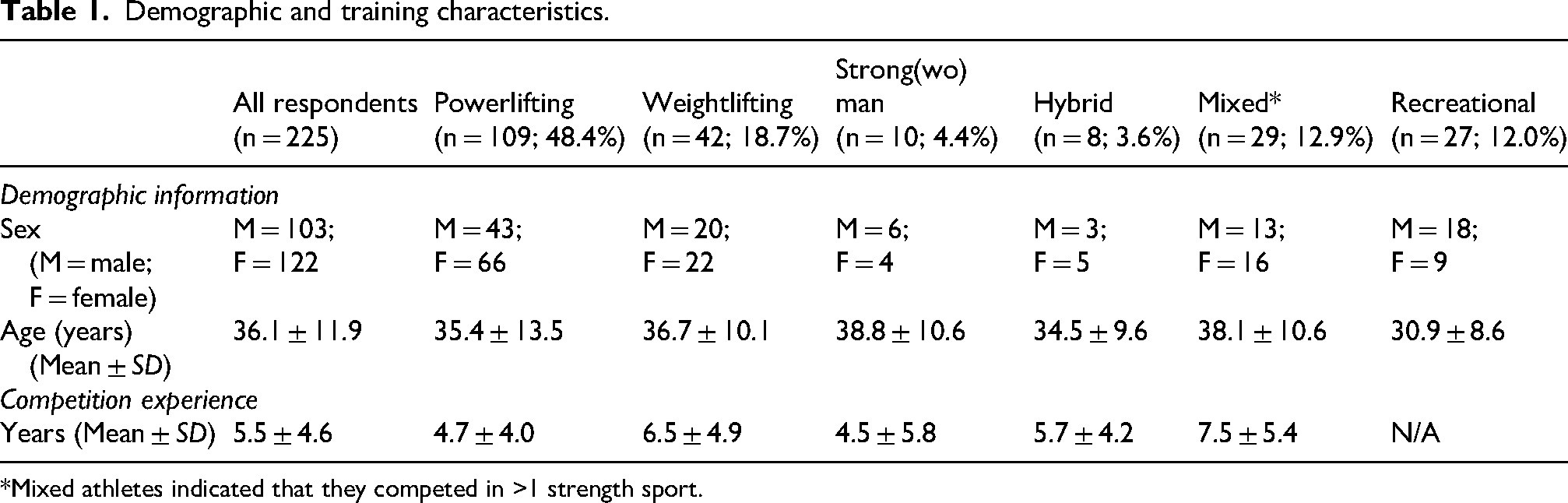
The final sample comprised 103 (45.8%) males and 122 (54.2%) females with a mean and SD age of 36.1 ± 11.9 years. A range of strength sports were represented: powerlifting (109; 48.4%), weightlifting (42; 18.7%), hybrid e.g., CrossFit, HYROX (8; 3.6%), and strong(wo)man (10; 4.4%). Twenty-nine (12.9%) respondents indicated that they were mixed strength sport athletes (involved in >1 strength sport), and 27 (12.0%) identified as recreational strength trainees (i.e., do not compete in a strength sport but use knee sleeves in strength training sessions) (Table 1).
Demographic and training characteristics.
*Mixed athletes indicated that they competed in >1 strength sport.
Of the strength sport(s) athletes, 1 (0.5%) had competed at Olympic level, 62 (31.3%) at international level, 53 (26.8%) at national level, and 82 (41.4%) at amateur level. The mean and SD number of years of competition experience across all sports was 5.5 ± 4.6. A more detailed overview of participant demographics and competition characteristics is in Table 1 and Figure 1.
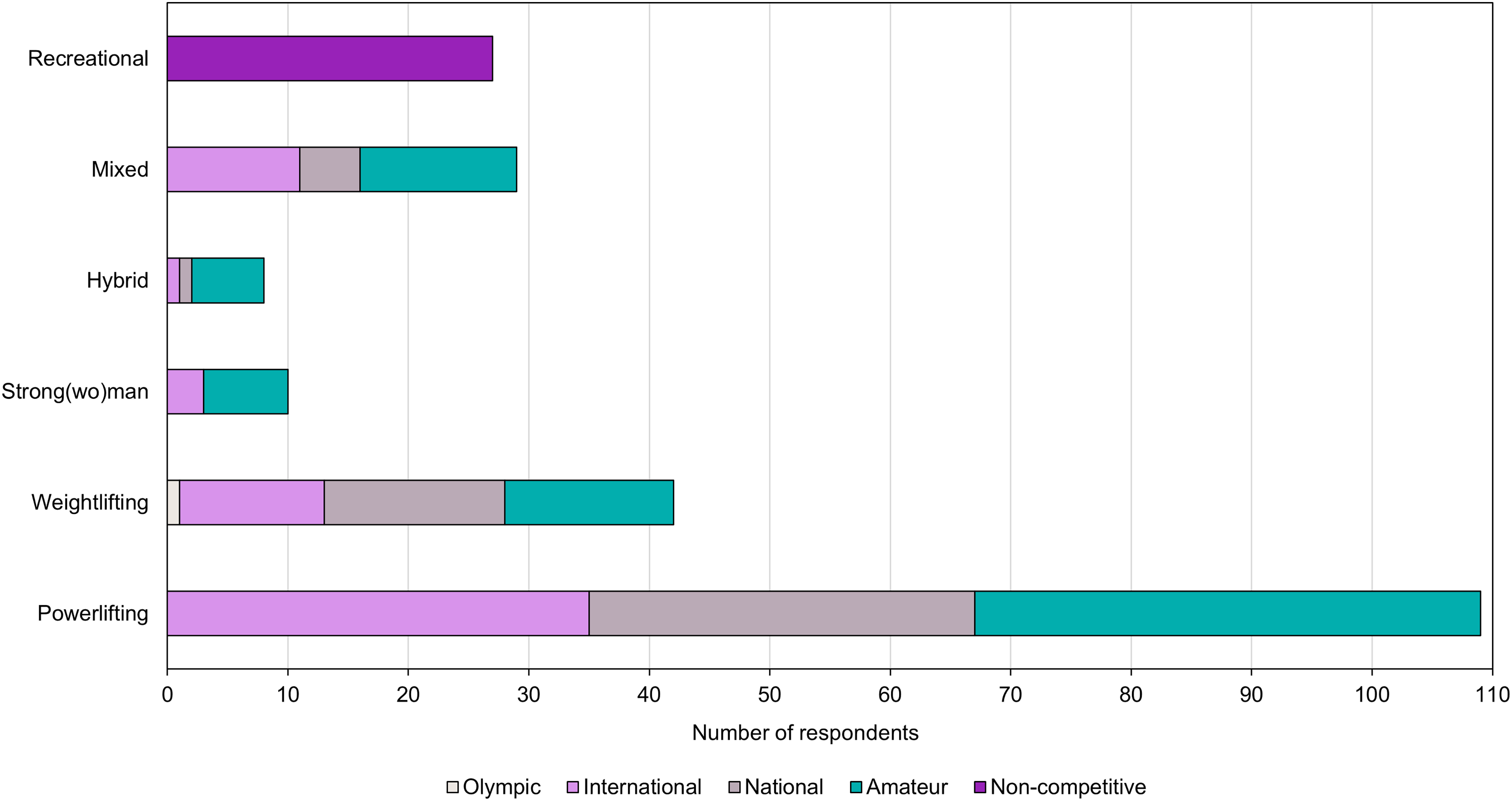
Number of respondents representing each strength sport, with colors to differentiate the level of performance. Total number of respondents n = 225.
Responses were received from 28 countries, with the most prevalent locations being the United Kingdom (145; 64.4%), Ireland (28; 12.4%), and the United States of America (18; 8.0%) (Figure 2).
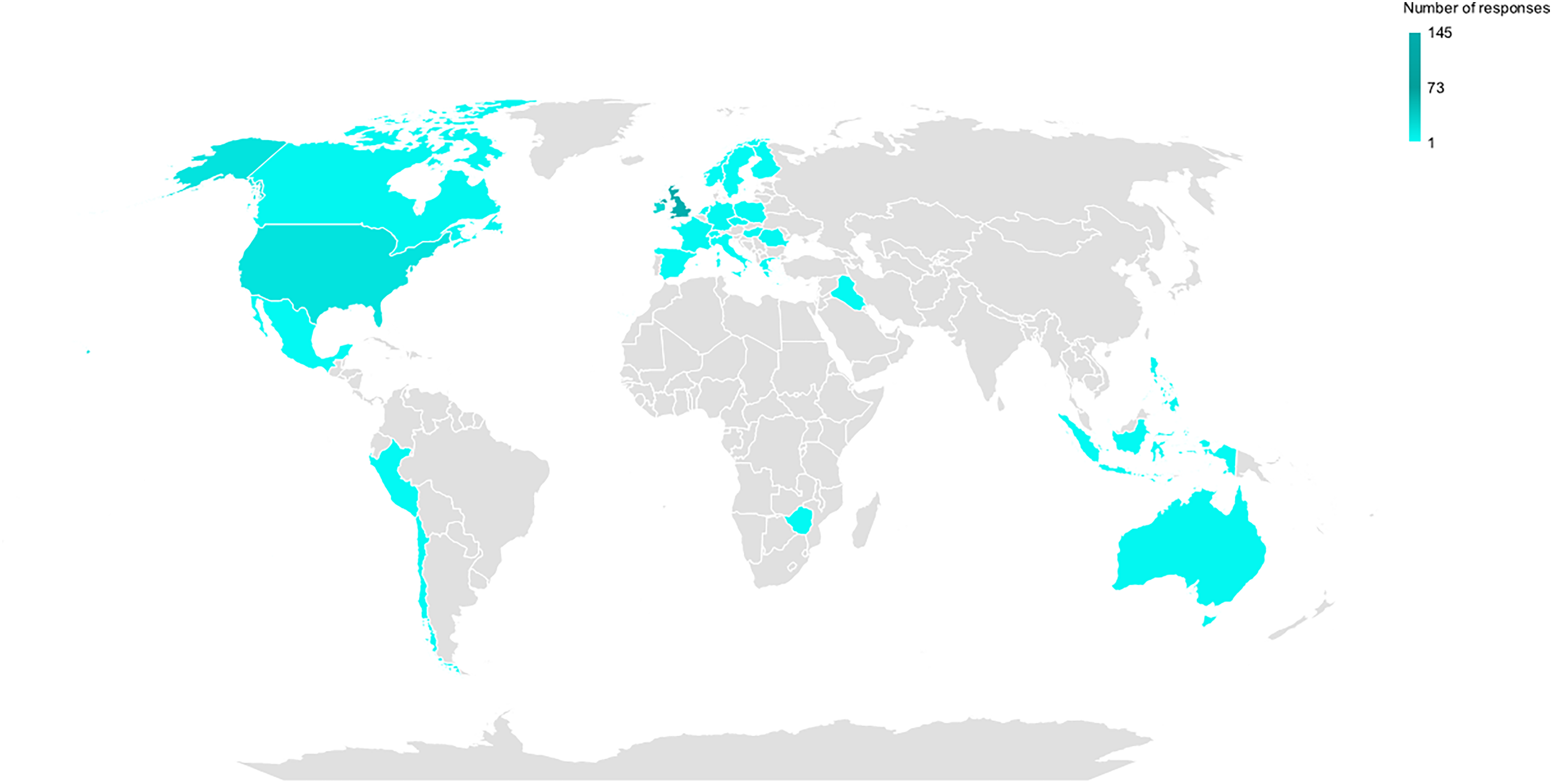
World map of the distribution of survey responses by country. Total number of respondents n = 225.
Knee sleeve characteristics
A large proportion of respondents (188; 83.6%) wear neoprene knee sleeves, with 6 (2.6%) wearing nylon. There were 31 respondents (13.8%) who were unsure of the material their knee sleeves were made of. Most respondents (143; 63.6%) reported wearing 7 mm knee sleeves, with fewer reporting 5 mm (48; 21.3%) or 3 mm (15; 6.7%) sleeves. Some respondents (15; 6.7%) stated that they owned more than one pair of sleeves with varying thicknesses between 3 mm and 7 mm, and a small proportion of respondents were unsure of the thickness of their sleeves (4; 1.7%).
A total of 156 respondents (69.3%) favored regular-fitting knee sleeves (manufacturer-recommended sizing), with 69 (30.7%) preferring tighter-fitting sleeves (one size smaller than the manufacturer-recommended sizing).
A large proportion of respondents stated that they wear knee sleeves in training (216; 96.0%), including all (26; 100%) of the recreational trainees. Of those, 49.3% stated that they wear knee sleeves for warm-up sets and 88.4% during working sets. A total of 56.0% stated that they would only wear knee sleeves for high intensity (i.e., attempting a one-repetition maximum (1-RM)). Of the 198 respondents who compete in strength sport(s), 185 (93.4%) indicated that they wear knee sleeves in competitions.
Knee sleeve habits and beliefs
All respondents (225; 100%) answered the following open-ended question: “What possible advantages or benefits do you feel knee sleeves provide?”. Content analysis of these responses yielded 18 codes, which were organized into two categories: psychophysiological and social (Figure 3). The greatest number of codes appeared in the psychophysiological category (505; 99.2%), with a second category of social accounting for a much smaller proportion of responses (4; 0.8%). The total number of coded responses was 509, based on some respondents providing multiple answers to the open question. The most common perceived benefits and advantages of wearing knee sleeves reported by the 225 respondents were stability (104; 46.2%), joint warmth (71; 31.6%), rebound effect (69; 30.7%), maximal load (56; 24.9%), and confidence (43; 19.1%). Responses organized by category and strength sport are in Figure 3.
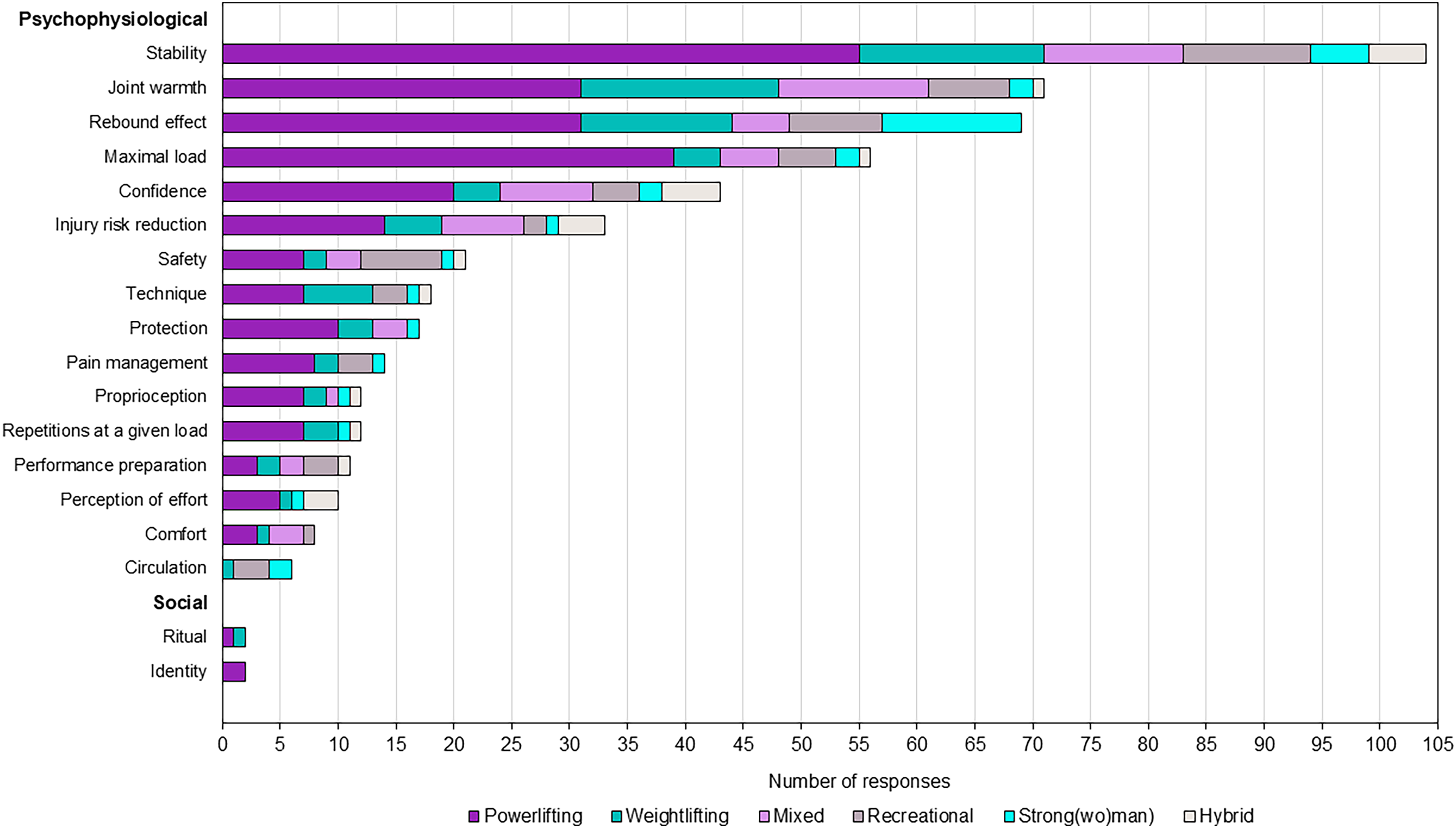
Frequency of responses provided for each code, organized by category and strength sport. Total number of responses n = 509.
Discussion
The purpose of this study was to gain a deeper understanding of the prevalence of knee sleeve use among recreational and competitive strength athletes, to investigate the types and preferences of knee sleeve practices in training and competition, and to identify the perceived advantages of knee sleeve use in various strength sports. Research investigating the use of knee sleeves in strength sport participation is limited, with a notable absence of research exploring the reasons why those involved in recreational or competitive strength sports choose to wear them. The available empirical literature suggests that knee sleeves do not appear to augment maximal strength or strength endurance in the back squat in trained individuals,13,18,20 and the evidence for alterations in biomechanics and relative muscle contribution is equivocal.15,16 However, the findings from studies reporting perceptual insights indicate that strength participants feel more stable, protected and safer using sleeves.14,15
The main findings of this study are that competitive and recreational strength trainees believe knee sleeves increase stability, provide warmth to the joint and muscles, augment strength performance and mitigate the risk of injury. Respondents also noted a strong psychological aspect to wearing knee sleeves, such as increased feelings of confidence and safety whilst performing high-intensity lifts. A smaller number of respondents considered wearing knee sleeves to be ritualistic and a way to be accepted within the culture of their sport.
Before this study, no research had been conducted exploring the collective attitudes and beliefs of strength athletes who wear knee sleeves. This study, therefore, provides novel and impactful information that will not only assist practitioners in making informed decisions about when and how knee sleeves are incorporated into training and competition strategies, but the findings will also assist sports scientists in developing experimental studies aimed at investigating the effects of knee sleeves on performance parameters.
The most prevalent response category in this study related to the perceived psychophysiological advantages and benefits of wearing knee sleeves, accounting for 505 (99.2%) of the 509 responses. The most cited perceived benefits of knee sleeves were stability, joint warmth, rebound effect, maximal load, and confidence.
The most frequently cited perceived benefit of knee sleeves provided by respondents of this study related to enhanced perceptions of stability: “my knees just feel more stable” (female amateur-level powerlifter). Indeed, strength athletes generally perceive greater stability when using knee sleeves and believe that their use prevents knee pain associated with heavy strength training. 14 Moreover, the increase in stability is thought to provide motion efficiency, improving safety during squats. 16 It is unsurprising, then, that respondents of this study (at times) described stability, support, and safety synonymously: “stability, not necessarily for strength [but] mainly as a safety tool” (male, recreational strength trainee). Previous research from Sinclair and colleagues 30 has highlighted that compared to wearing knee wraps or no sleeves at all, recreational lifters believe neoprene knee sleeves provide more stability and comfort. 30 Whilst a corresponding reduction in perceived comfort was also reported, overall, participants rated the knee sleeve as the preferred condition. Elsewhere, competitive CrossFit athletes perceive there to be “much better” knee stability wearing neoprene knee sleeves compared to a without-sleeve control condition during front squat and box jumps, as measured using a modified Global Rating of Change (GRoC). 14 The perceived increase in stability afforded by neoprene knee sleeves might, in part, explain why a large proportion of respondents favored them over other materials.
Knee sleeves might not provide any structural support at all. Instead, any benefit might originate from enhanced proprioception, i.e., the athlete's ability to detect changes in joint kinematics during lifting 31 or psychological effects (e.g., confidence). This proprioceptive effect can significantly improve knee kinematics during high-effort exercise whilst simultaneously reducing the perception of effort 32 : “[they] give me greater proprioception at the bottom of the lift” (male, national-level weightlifter). Indeed, knee sleeves are thought to ameliorate sensorimotor control, leading to enhanced joint position sense and movement patterns 33 whilst reducing unnecessary movements such as reduced knee valgus. 32 This, in turn, is likely to increase confidence during strength exercise. 19
The perceived stability and support offered by knee sleeves might be one reason why respondents considered knee sleeves to afford a prophylactic effect to prevent injuries: “[they] prevent injury (or) making existing conditions worse” (female national-level powerlifter). A large percentage of knee sleeve users reported that they use knee sleeves to mitigate injury risk, alleviate or manage existing pain during training and competition, and protect the knee joint. Respondents also indicated that knee sleeves limit hypermobility, therefore reducing the risk associated with excessive range of motion: “I have slight issues with my knees and extreme hypermobility, so would not want to squat without them” (female amateur-level powerlifter).
In weightlifting and powerlifting, the prevalence of injuries is only 2.4–3.3 per 1000 hours of training and 10.7% to 68% during competition. 34 From those, however, the knee is the most common injury site, especially in weightlifting (21% of total injuries). Knee injuries are perhaps more likely in weightlifting compared to powerlifting due to the greater depth of squatting and the subsequent high forces experienced during greater flexion angles.34,35 Powerlifters typically retain a more vertical shin angle during squat exercises, resulting in greater relative forces at the hip and lumbar spine. It is, perhaps, unsurprising that powerlifters report a higher prevalence of injuries in the lumbopelvic region. 36 Relatedly, respondents indicated that they wore knee sleeves to alleviate or manage existing pain during training and competition: “[they] support the knee, allowing lifts without or with limited pain” (male, amateur-level strongman). This might explain why strength athletes with an existing injury wear knee sleeves more frequently compared to those without an existing injury. 36
The compression provided by the knee might not only provide a proprioceptive effect but also promote warmth of the skin and muscles surrounding the knee, resulting in improved blood flow. 12 The belief that knee sleeves increase temperature around the knee, aiding blood flow, reducing warm-up time and maintaining temperature during rest was supported by several participants: “(they) help keep knees warm, I want my knees absolutely roasting” (male national-level weightlifter). An increase in muscle temperature might assist in knee joint pliability, resulting in greater kinesthetic awareness and, perhaps, increased confidence during high-intensity training. 7 Moreover, previous commentary has suggested that the compression provided by knee sleeves aids performance by increased thermal sensation which might reduce discomfort and pain by targeted warming of the knee area. 12 However, research to validate this claim is limited and much of the available literature in this area comes from clinical practice, where knee sleeves are used to assess improvements in proprioception (e.g., balance testing) or functional parameters (e.g., stair climbing, timed-up and go testing), rather than strength performance. 12 Currently, no research has investigated objective or perceived changes in thermal sensation during knee sleeve use. Given the high relative frequency with which respondents of this study reported changes in knee temperature and circulation as reasons to wear knee sleeves, future research studies would benefit from investigating this possible relationship empirically.
Respondents believe that knee sleeves enable a “rebound” effect that augments transition from the eccentric phase of a lift (e.g., the squat) to the concentric phase, permitting greater maximal loads to be lifted. Respondents also believe that knee sleeves enhance technique: “I notice a definite performance improvement during my lifts from a technique perspective” (male, recreational strength trainee). Some respondents also noted that knee sleeves allow more repetitions to be completed at a given load and help to streamline performance preparation: “[they] expedite the warm-up” (male national-level weightlifter). Respondents provided varied examples of how knee sleeves might augment maximal strength, with magnitudes ranging from “only likely 2.5 kg” (international-level powerlifter) and “no more than 5%” (amateur-level powerlifter) to “up to 20% by my reckoning” (international-level strongman). Machek and colleagues 7 reported that IPF-approved 7 mm neoprene knee sleeves significantly increased the maximal load lifted in the back squat in a group of recreationally trained, knee-sleeve-naive participants, compared to a control condition. Importantly, no significant differences were observed between a manufacturer-sized sleeve and a sized-down sleeve, suggesting that sleeves might augment maximal strength independent of tightness. It has been reported that powerlifters prefer to wear tight knee sleeves (smaller than manufacturer recommendations) in the belief that greater compression of the knee joint results in appreciable improvements in maximal strength. 7 Several powerlifting federations, however, limit lifters from acquiring assistance when attempting to wear sizes much smaller than manufacturer recommendations during competition.7,37 This might, in part, explain why respondents of this study generally favor regular fitting knee sleeves compared to tighter fitting sleeves.
Studies elsewhere have reported that in well-trained individuals, knee sleeves have no significant effects on maximum strength or the number of submaximal repetitions performed during lower body strength exercise.13,18,20 For example, Bennett et al. 18 reported that maximal load lifted by strength-trained males and females did not increase when using 7 mm knee sleeves (fitted to manufacturer recommendations) compared to a control condition. Similarly, Hatfield et al. 13 observed nonsignificant effects between commercially available neoprene knee sleeves and a without-sleeve control for the total number of repetitions per set performed on a leg press to muscular failure with 80% of 1-RM. The role that knee sleeves might play in augmenting maximal strength could be exercise-specific, though. Whilst knee sleeves do not appear to augment vertical jump performance or single-leg muscle endurance, 7 Maynart et al. 14 reported that in a group of hybrid strength participants, the maximal load lifted in the front squat was significantly greater in a knee sleeve condition (7 mm neoprene sleeve popular with CrossFit athletes) compared to a without-sleeve control. Importantly, the sleeves used in studies investigating strength parameters have incorporated a variety of neoprene sleeve types and brands, with different magnitudes of stiffness.13,15,18 Therefore, caution must be taken when extrapolating findings between studies.
Some respondents believe that knee sleeves augment repetitions completed at a given load: “I feel like I can add extra reps to a set” (male international-level weightlifter). However, the available research suggests that knee sleeves do not appear to alter the number of repetitions completed at submaximal loads to muscular failure. In a study by Hatfield et al., 13 commercially available knee sleeves (fitted to manufacturer recommendation) provided no significant main effects on the total number of repetitions completed at 80% of 1-RM or relative contribution of the vastus lateralis compared to a non-sleeve control condition in a group of strength trained males and females. Relatedly, Sinclair et al. 15 reported that at lower relative loads (70% of 1-RM recorded without knee sleeves), no change in squat technique (e.g., no change in muscle kinetics) was observed using 7 mm neoprene knee sleeves. Based on these findings, knee sleeves do not appear to augment lower body strength-endurance or alter biomechanics or relative muscle contribution in the back squat. However, when competitive hybrid athletes utilized knee sleeves during front squats at 70% of 1-RM, ankle dorsiflexion in both the lowering and upward phase of the squat increased, as well as ankle abduction (in the upward phase only). 16 Moreover, knee sleeves reduced knee flexion in the lowering phase of the back squat but increased it in the upward phase, decreased hip flexion in the lowering phase and abduction of the hip in the upward phase.
One of most frequently cited perceived benefit of knee sleeves in this study was the rebound effect, with respondents suggesting that sleeves provide a “spring”, “bounce”, “pop”, and “rebound”: “[they give me] better bounce out of the hole” (female, national-level powerlifter). This, in turn, is believed to assist transition from the lowering phase of a squat to the upward phase (and therefore permitting loads to be lifted with a lower degree of effort). This effect is thought to be achieved through mechanical deformation (i.e., stretching) of the knee sleeve, with stored elastic energy transferred to kinetic energy at the bottom of the lift, permitting greater force output in the ascent phase of the lift. 38 It is perhaps surprising that one of the most frequently cited benefits of knee sleeves provided by respondents of this study related to a rebound effect, given that in classic powerlifting and the CrossFit Games, knee sleeves must not provide “appreciable rebound”.8,10
In ‘equipped’ powerlifting, the use of specialized supportive equipment such as supportive shirts, suits, and knee wraps is permitted and designed to enhance the maximal load lifted by the athlete. 39 Indeed, knee wraps (which are typically fitted using either a ‘figure of eight’ or ‘spiral’ wrapping technique) appear to significantly increase back squat peak power 40 and peak force in the isometric squat 38 due to a ‘carry-over effect’. The enhanced mechanical output that wraps provide is likely due to their material properties, as wraps consist of a long wrap of elastic material interwoven with rubber filaments. Whilst the magnitude of performance enhancement using single-ply neoprene knee sleeves in classic powerlifting is thought to be small, equipped competitions are significantly greater, with totals on average being 15.2% and 12.7% greater in equipped lifting compared to classic.39,41 To date, there is little empirical research that has quantified the potential increase in mechanical output provided by the kinetic energy of knee sleeves. Therefore, it is unclear whether any possible increase in maximal strength observed during knee sleeve use is due to an increase in vertical impulse caused by elastic energy or rebound effect, and further research is required.
A small number of respondents stated that they wore knee sleeves ritualistically; “I’m dressed and ready to perform” (male, national-level powerlifter). Identity was also important: “it's about fitting in” (female, national-level powerlifter), suggesting strong links between the choice to wear knee sleeves and the sociocultural aspects of the sporting environment. In competitive and recreational sport environments, it is common for athletes to adjust their attitudes or behaviors based on injunctive and descriptive norms, where personal attitude influences behaviour. 42 In this sense, peer conformity can shape the athlete's actions as they strive to develop (and sustain) meaningful social relationships with other members of their community, or to maintain a favorable self-concept. 43 Indeed, strength sports clubs often form ‘tight-knit’ communities where individual athletes feel included but are also more likely to compare themselves to other athletes from that community.44,45 Conversely, some strength trainees consider themselves to be ‘wannabes’ who push themselves to be stronger and more muscular to enhance their image within their sporting community. 46 Previous research has reported that athletes with a stronger social identity are more susceptible to peer influence. 42
It is not unusual for athletes to intentionally adopt attitudes, mannerisms, or styles of dress that they perceive to be characteristic of established members of their community. 47 In individual sports, the athlete's choice of clothing and equipment can be shaped by factors such as cultural norms and societal expectations, with choices influenced by perceptions of representation or the dynamics of competition.48,49 Indeed, an athlete's choice of attire is a form of communication; how they perceive themselves and how they want others to perceive them: 50 “it's about being seen as a serious powerlifter” (female, national-level powerlifter). Moreover, sporting clothing and equipment inform others about the athlete's chosen sport or affiliations. 51 However, discussions related to athlete attire in the published sporting literature are typically confined to investigating the suitability of materials or how an athlete's clothing or equipment influences sports performance, rather than the athlete's identity. 48
Whilst only a small body of literature exploring strength sport subculture exists, 52 there is still much to learn in this domain. The frequency of responses related to identity and ritual obtained in our study accounted for only a small proportion of the overall information collected. However, our findings provide a rationale for further research exploring the sociocultural aspects of strength sports.
Practical applications
This study is the first to investigate perceptions of knee sleeve use in recreational and competitive strength athletes. There are several common beliefs held by strength athletes regarding the benefits of knee sleeves; however, many of these are either unsubstantiated or require more research. Not only do the findings of this study provide important contextual information regarding beliefs and attitudes about knee sleeve use, but they also act as a catalyst for future experimental research.
Supplemental Material
sj-docx-1-spo-10.1177_17479541251406903 - Supplemental material for Knee sleeve practices and beliefs in recreational and competitive strength sport athletes: An international cross-sectional survey
Supplemental material, sj-docx-1-spo-10.1177_17479541251406903 for Knee sleeve practices and beliefs in recreational and competitive strength sport athletes: An international cross-sectional survey by Lee Bell, Steve W Thompson, Jordan Boriel and David Rogerson in International Journal of Sports Science & Coaching
Footnotes
Acknowledgements
Thank you to all respondents for taking the time to complete the survey and to anyone who shared the survey with their network.

Ethical considerations
The Ethics Review Committee at Sheffield Hallam University approved our interviews (approval: ER73082354) in October 2024.
Consent to participate
Respondents gave written consent before starting the survey.
Funding
The authors received no financial support for the research, authorship, and/or publication of this article.
Declaration of conflicting interests
The authors declared no potential conflicts of interest with respect to the research, authorship, and/or publication of this article.
Data availability
All data is available upon request.
Supplemental material
Supplemental material for this article is available online.
References
Supplementary Material
Please find the following supplemental material available below.
For Open Access articles published under a Creative Commons License, all supplemental material carries the same license as the article it is associated with.
For non-Open Access articles published, all supplemental material carries a non-exclusive license, and permission requests for re-use of supplemental material or any part of supplemental material shall be sent directly to the copyright owner as specified in the copyright notice associated with the article.
