



Abstract
Providing athletes with control during training can enhance motor skill acquisition, a strategy that may reduce anterior cruciate ligament (ACL) injury risk by improving movement quality. A possible strategy to improve sidestep cutting (SSC) technique is by offering the athlete autonomy via self-controlled timing of feedback. This study explored the effect of autonomy on lower extremity biomechanics. Thirty male ball sports players were alternately assigned to the self-control (SC) or yoked (YK) group. Participants completed the pre-test, training, and immediate post-test the first day. One week later, a retention test was conducted. During training, the SC group could determine when to receive feedback, whereas the YK group could not. Feedback consisted of SSC score, video feedback and an external focus verbal cue. Testing and training conditions consisted of anticipated and unanticipated 45° SSC tasks. Lower extremity kinematics and kinetics were captured using 3D infrared motion capture and force plates. Statistical analysis was performed using Statistical Parametric Mapping (SPM) on data from 22 participants (alpha = 0.025). The two-way repeated-measures ANOVA revealed that training itself, for the whole sample of both groups combined, improved SSC technique. Subsequent exploratory secondary analysis (SPM one-way ANOVA within each group) revealed that the SC group had an increased hip flexion angle and a reduced knee flexion moment and hip abduction angle at the retention test, compared to baseline on the anticipated SSC. These biomechanical changes are advantageous for reducing ACL injury risk. Suggesting that autonomy, through self-controlled timing of feedback, improves the uptake of feedback.
Introduction
In football, unplanned changing of direction is one of the primary mechanisms of an ACL injury.1,2 During changes of direction several biomechanical factors, such as hip abduction,3,4 knee abduction1,4,5 and trunk lean in the opposite direction 3 lead to an increase in knee joint loading and subsequent ACL injury risk. Thus, several technique modifications to reduce ACL loading during a sidestep cut (SSC) have been proposed such as; a forefoot landing, upright trunk position, trunk lean towards the intended direction, limiting hip internal rotation, limiting hip and knee abduction.3,6,7 However, to adapt technique modifications in the long term, it is important to investigate not only what (technique modifications) but also how (motor learning) modifying techniques can be most optimally employed to reduce ACL injury risk. In-lab modification of SSC technique utilising verbal and video feedback is shown to be possible for athletes participating in multidirectional sports.8–11 To facilitate retention and transfer of these modifications to on-field movements, motor learning techniques such as verbal and visual external focus feedback can be employed. 12
Traditionally, mainly the coach decides on the type, timing and content of feedback, leaving less room for self-control for the athletes. 13 However, reaching expertise in sports requires high amounts of self-regulation and internal motivation. 14 Self-regulation is the extent to which athletes are metacognitively, motivationally, and behaviourally proactive in their own learning process. 15 Self-regulated learning is essential for maximizing training and learning efficacy.16–18 Offering the athlete autonomy is one way to increase self-regulated learning and motivation,10,19,20 aligning with the satisfaction of fundamental autonomy needs based on the Self Determination Theory21,22 and the OPTIMAL theory of motor learning. 23 Autonomy supportive behavior increases intrinsic motivation,24,25 self-efficacy, 24 and feelings of competence,25,26 contributing to long term effects on the motor skill to be learned through satisfaction of psychological needs. 27 The positive effect of autonomy on performance and learning has been shown numerous times. 28 For example, increased athlete autonomy compared to more controlled training situations increases maximal force production, 29 maximum jumping height, 30 muscular efficiency 31 and running efficiency. 32 However, the use of autonomy to improve technique and thus reduce (ACL) injury risk is relatively new.10,33
A possible strategy to implement autonomy when improving SSC technique is via self-controlled timing of feedback (i.e., the athlete decides when to receive the feedback). 10 Utilising self-controlled timing of feedback could be a way to unite self-regulation skills, motivation and feedback processing.34,35 A study previously done by this research group revealed that self-controlled timing of feedback during training resulted in better Cutting Movement Assessment Scores (CMAS) 36 during anticipated SSC compared to predetermined timing of feedback in recreational ball sports players. 10 However, the biomechanical determinants which underlie the improvement in CMAS scores remain unknown. Therefore, the aim of this study is to investigate the effect of autonomy, through self-controlled timing of feedback during training, on lower extremity SSC biomechanics. It is hypothesized that implementing autonomy improves SSC technique.
Methods
Research design
A repeated measures design intervention study, including a one-week retention test, was performed. Two groups, a self-control (SC) and a yoked (YK) group, were formed to create matched pairs. Both groups performed pre-test, immediate-post test and retention test of both anticipated and unanticipated SSC. In between the pre-test and the immediate-post test, both groups were exposed to the same four training blocks. The training included (1) anticipated SSC, (2) unanticipated SSC with catching and throwing a ball to the testleader while cutting and (3) unanticipated SSC after receiving and passing a football with their dominant leg to the testleader. During the training the SC group could indicate when they wanted to receive feedback on their SSC execution. The YK group received the exact same feedback, but were not allowed to decide when they received this feedback as they were yoked to their SC counterpart. Feedback consisted of CMAS score, video feedback and a verbal external focus feedback cue. 3D motion capture and ground reaction force analyses were performed to evaluate the effect of the self-controlling of the timing of feedback.
Subjects
Thirty healthy ball sports players (22.9 ± 1.7 years, 185.5 ± 7.2 cm, 79.3 ± 9.2 kg) were recruited from local clubs in the north of the Netherlands. To be eligible for inclusion, players had to be (1) male, (2) between 18 and 30 years old and (3) currently physically active in ball sports at a recreational level (N = 19 football, N = 1 field hockey, N = 1 squash/tennis, N = 1 rugby). Participants were excluded if they (1) had a lower extremity injury at the time of the study or (2) had prior knee surgery. Participants who were included were alternately assigned to the self-control (SC) or the yoked (YK) group based on inclusion, creating matched SC-YK pairs. Sample size calculation indicated that 28 participants were enough to achieve sufficient power, based on a power of 0.80, an alpha of 0.05 and a partial eta squared of 0.10 (medium effect) found in the previous study. 10 G*Power for Windows, version 3.1.9, was used to calculate the required sample size, 37 since sample size estimation for 1D continua does not afford two-way implementation. This sample size is comparable to similar studies in biomechanical research.6,38
All participants gave their informed consent before being included in the study. The study received ethical approval from the local Medical Ethical Committee of
University Medical Center Groningen (ID number: METc 2018.249) Participants wore their own athletic shoes and shorts. After a brief warm-up, participants completed the pre-test, training, and immediate post-test on the first day. One week later, a retention test was conducted. Before each new test or condition, participants were given sufficient time to familiarise themselves with the setup. Practically this meant that participants performed at least three practice trials after which participants could indicate that they were ready.
Procedures
Pre-test, immediate post-test and retention test
Each participant performed five trials for both the anticipated and unanticipated test conditions. The order of these conditions was counterbalanced across participants to minimise order effects. In the anticipated condition, participants knew the predetermined direction for the cut. For the unanticipated condition, the Speedlight Timing System (Speedlight Timing Systems, Swift Performance LLC, Northbrook, USA) was utilised. This system included lights indicating the running direction (45° SSC in the non-dominant leg direction, straight forward, 45° SSC the dominant leg direction). The dominant leg was defined as the preferred leg for pushing off and landing with. 10 A light randomly activated in one of the directions as the participant passed the start gate, located 3 meters away from the force plate (see Figure 1). The analysis focused only on trials performed at a 45° angle with the dominant leg in the non-dominant leg direction.
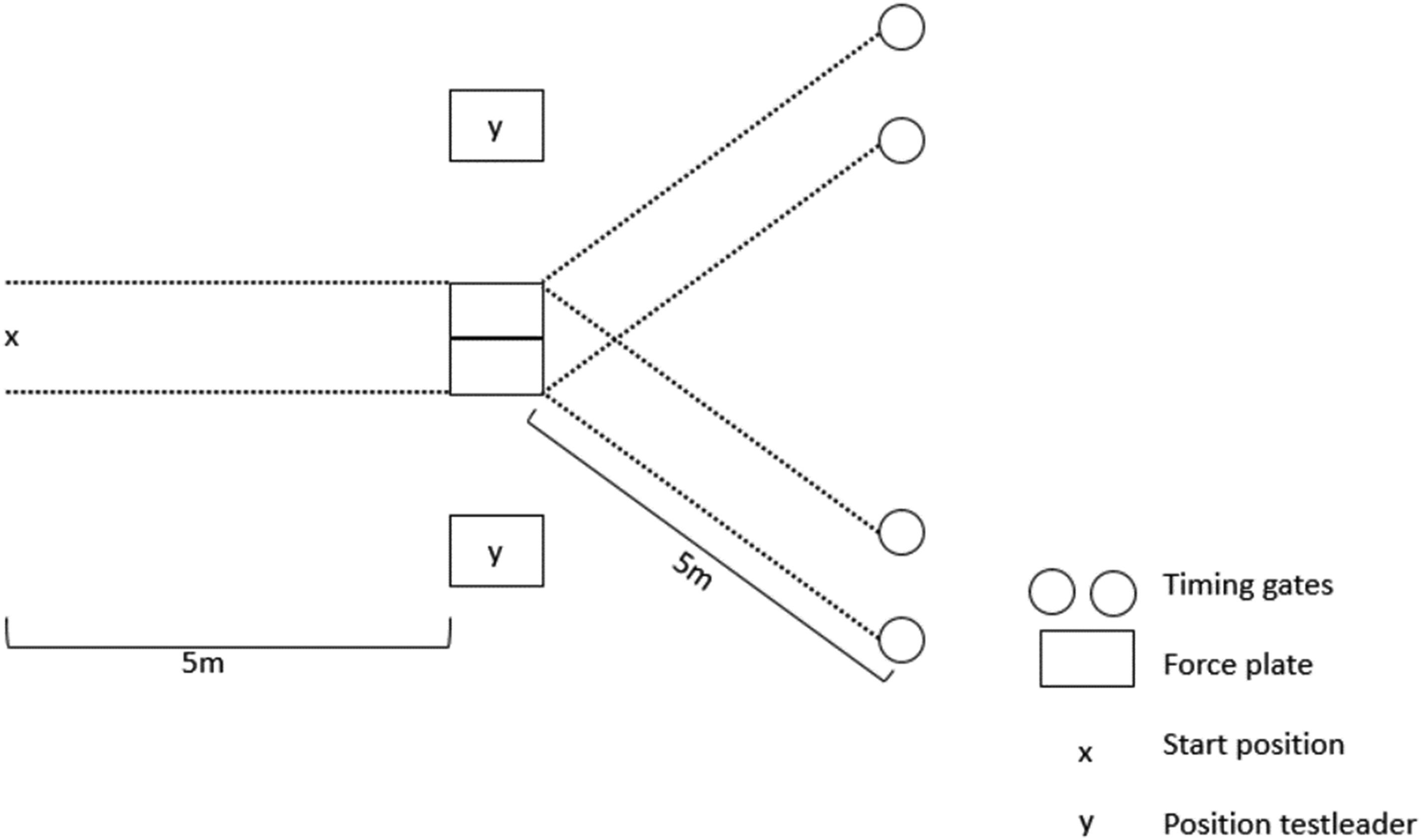
Graphical design of the test set-up. Each trial started with a five meter sprint followed by a single leg plant on a floor-embedded force plate and a 45° change of direction through the timing gates five meters away from the force plates. In the unanticipated condition, when the participant crossed the start gate, one of the timing gates randomly started to flash. x = start position participant, y = position testleader.
Training blocks
Both groups performed four training blocks of five exercise trials. Three different variations of a SSC were chosen: (1) an anticipated SSC as described for the pre-test, (2) an unanticipated SSC with catching and throwing a ball to the testleader while cutting and (3) an unanticipated SSC after receiving and passing a football with their dominant leg to the testleader. Each variation was practised six to seven times. See the study of Nijmeijer et al. (2023) for further details.
Instruction and feedback
Instruction and feedback followed the exact same process as a study done earlier by this research group. 10 Prior to each training block both groups were shown model videos (i.e., with minimal knee joint loading) of a SSC from posterior and sagittal (i.e., side of the dominant leg) views.19,39 Players were encouraged to replicate the expert's movement as best as they could. 19
Both groups were informed about the feedback process, which always involved three components; (1) CMAS score for the trial on which feedback is received, 36 (2) video feedback of this respective trial from both sagittal and posterior views, presented in a random order, (3) one verbal external focus feedback cue on how to improve their movement technique, tailored to their score. See Appendix A in Nijmeijer et al. (2023) for more detail on the individualised feedback. The SC group was permitted to determine the timing of feedback during the training blocks, whereas the YK group was not. The YK participants received feedback on the same trial as their partner in the SC group who requested the feedback. This ensured that the amount and timing of feedback were identical for both groups. No group-specific instructions or feedback were given. In total subjects in the SC group asked for feedback 7, 10, 7 and 8 times per each respective block, see Nijmeijer et al. (2023) for more information. In short, division of feedback was fairly distributed, the amount of the absolute feedback trials, and timing of feedback during the training were identical for both groups.
Apparatus
Lower body kinematics, trunk kinematics and ground reaction force (GRF) data were captured using a 100 Hz eight-camera infra-red motion analysis system (Vicon Motion Systems, Inc., Centennial, CO, USA), Vicon Nexus Software (version 2.7 Motions Systems, Inc., Centennial, CO, USA) and two 1000 Hz Bertec force plates (Bertec Corporation Columbus, OH, USA). Sixteen reflective markers, each having a 14 mm diameter, were placed based on the Vicon Plug-in-Gait lower body model (Vicon Motion Systems, Inc., Centennial, CO, USA). Additionally, five trunk markers to the sternum, clavicle, C7, T10, and right scapula were attached.
Statistical analysis
The primary outcome variables included hip, knee, and ankle flexion/extension angles, abduction/adduction angles of the hip and knee, flexion/extension moments of the hip, knee, and ankle, abduction/adduction moments of the hip and knee and vGRF throughout the stance phase (SP, initial contact until toe off). Initial contact was defined as the instant where vGRF was higher than 20N, toe off was defined as the instant where vGRF subsides below 20N.38,40 External moments and vGRF were normalised to body mass. Kinematic and force data were filtered using a fourth-order zero lag Butterworth low-pass filter with a cutoff frequency of 10 and 125 Hz, respectively. 12 The Python package optcutfreq 41 was used to determine the optimal cut off frequency of each trial using residual analysis as proposed by Winter (2009). 42 Upon visual inspection, 10 and 125 Hz for marker and force data respectively were chosen as the optimal cut off frequencies. A custom Python script (Python Software Foundation, Delaware, USA) was used to perform statistical parametric mapping (SPM), using the open-source software package spm1D 0.435 (http://www.spm1d.org). 43 First, trials were synchronised based on the first contact with a vGRF exceeding 20 N. After synchronisation, waveforms of stance were non-linearly registered as proposed by Pataky et al. (2022). 44 This allows for amplitude-phase separations and yields unique opportunities to explore relative contributions of amplitude and timing effects. In other words, after using this type of registration, analysis regarding amplitude differences between the two groups was assessed separately from timing effects, compared to simultaneously testing amplitude and timing effects (which is the result of testing linear registered data). 44
Upon inspection of the data, we unexpectedly found that eight participants executed the task incorrectly in one or more sessions (i.e., the cut was not made sharp enough at 45°, see Nijmeijer et al. (2023). These participants have been removed from the data set and the analysis is performed on 22 participants (11 in SC and 11 in YK). Participants in SC and YK group did not differ significantly in either weight, length or age (p > 0.05).
Baseline differences between the SC and YK group on the anticipated and unanticipated SSC were tested with a one way ANOVA on every variable. Two 2 × 3 repeated measures ANOVAs were performed to examine the differences between (1) group (SC and YK) and time (baseline, immediate-post and retention test), and (2) between group (SC and YK) and training exercise (anticipation, passing, throwing). The group*time repeated measures ANOVA analyses the effect of the training in both groups over time, whereas the group*training exercises repeated measures ANOVA analyses the effect within the training exercises themselves for both groups. The significance level was set a priori to <0.025 as the current paper focuses on the amplitude effects. 44 A paired t-test with Bonferroni corrections was used as a post hoc test if significant different clusters of time were found.
Results
The energy absorption phase of the SSC, the first circa 50% of the SSC, is primarily of interest in light of ACL injury prevention and thus this study focused on the results in this phase.5,45,46 Results found after the energy absorption phase are reported in full in the Appendices. The most interesting results were found in three variables in the anticipated SSC, which are reported below.
Anticipated SSC – test
At baseline, the SC group had a greater vGRF at 9–12% SP (p = 0.004) and at 26–88% SP (p < 0.001) compared to the YK group. For a complete overview see Appendix A.
No significant differences between groups over time were found (p > 0.025). No significant interaction effect between group and time was found (p > 0.025). A significant main effect of time was found for knee flexion moment (10–67% SP, p < 0.001), hip flexion angle (0–100% SP, p < 0.001) and hip abduction angle (25–85% SP, p < 0.001). Post-hoc comparisons showed that knee flexion moment was reduced at immediate post compared to baseline (10–67% SP, p < 0.001) and at retention compared to baseline (10–67% SP, p < 0.001). Post-hoc comparison further revealed that hip flexion angle was increased at retention compared to baseline (0–100% SP, p < 0.001). Regarding hip abduction angle, post-hoc comparison further revealed that hip abduction angle was significantly reduced at immediate post compared to baseline (25–68% SP, p = 0.002) and retention compared to baseline (25–62% SP, p = 0.003).
The results of the two way repeated measures ANOVA and subsequent post-hoc analysis for the anticipated SSC are displayed in full in Appendix B and Appendix G. The most telling results are displayed in Figure 2.
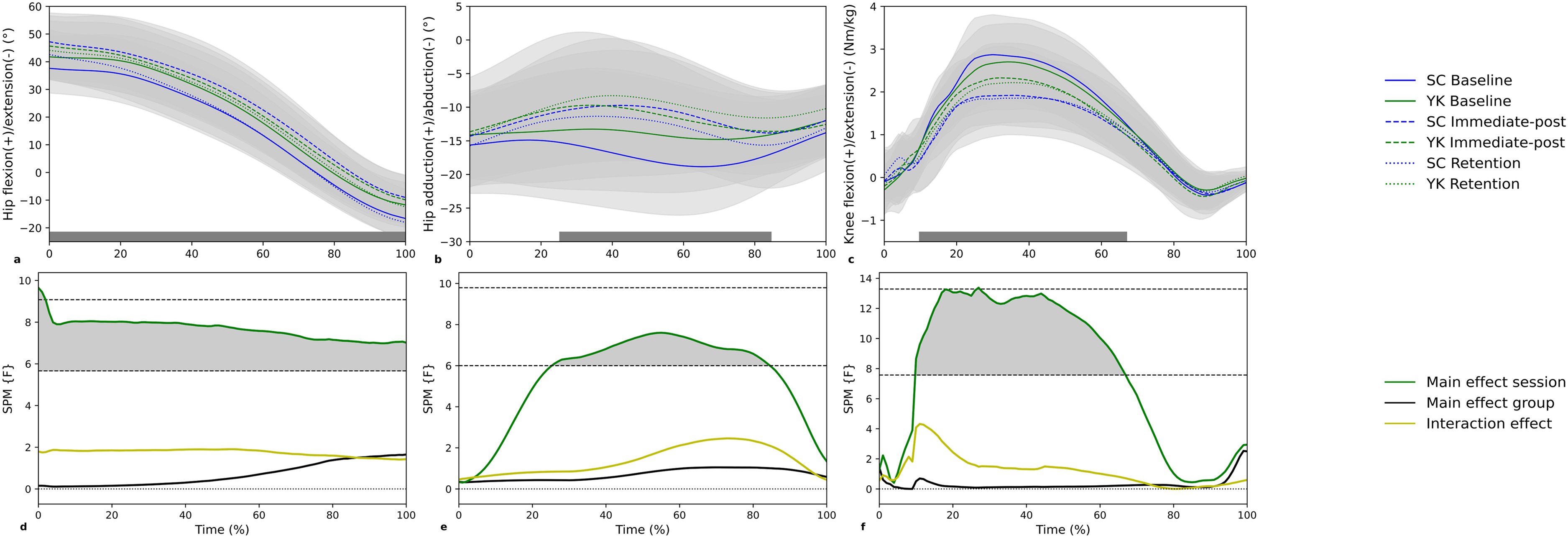
Hip flexion angle, hip abduction angle, knee flexion moment in the anticipated SSC for SC and YK on the baseline, immediate post and retention test. The grey bars at the x-axis on the top row indicate the clusters of time with significant biomechanical differences, as does the grey shaded area in the bottom row.
Unanticipated SSC – test
For vGRF, knee flexion angle, ankle flexion angle and ankle dorsiflexion moment significant differences existed at baseline between the SC group and the YK group. The SC group had a greater vGRF at 5–14% SP (p < 0.001) and 18–24% SP (p < 0.001), a greater knee flexion angle at 37–94% SP (p < 0.001), reduced ankle dorsiflexion moment at 25–55% SP (p < 0.001) of the sidestep cut compared to the YK group. For a complete overview see Appendix C.
No significant differences between groups were found (p > 0.025). Only a significant interaction effect between group and time for ankle dorsiflexion moment was found (8–88%, p < 0.001).
A significant main effect of time was found for VGRF (29–31%, p = 0.012), hip flexion angle (0–3%, p = 0.025), ankle flexion angle (0–51%, p < 0.001), ankle flexion moment (17–22%, p = 0.020 & 22–98%, p < 0.001). Post-hoc comparisons showed that hip flexion angle was increased at retention compared to baseline (0–3%, p = 0.008). Post-hoc comparison further revealed that ankle flexion angle was increased at immediate post compared to baseline (0–51%, p < 0.001) and at retention compared to baseline (1–51%, p < 0.001). Regarding ankle flexion moment, post-hoc comparison revealed that ankle flexion moment was increased at retention compared to baseline (22–98%, p < 0.001).
Relatively little technique changes occurred in the unanticipated SSC. The results of the two way repeated measures ANOVA and subsequent post-hoc analysis for the anticipated SSC are displayed in full in Appendix D and Appendix H.
Training exercises
The results of the two way repeated measures ANOVA and subsequent post-hoc analysis for the training exercises are displayed in full in Appendix E, Appendix F and Appendix I. No significant interaction effect between group and training exercise were found (p > 0.025). A significant main effect of group was found for knee abduction moment (SC > YK, 0–11%, p = 0.010), hip flexion angle (SC < YK, 37–100%, p = 0.007), hip abduction angle (SC > YK, 0–77%, p = 0.001), hip abduction moment (SC > YK, 0–15%, p = 0.004 and 24–45%, p = 0.001) and ankle flexion angle (35–100%, p = 0.001).
A significant main effect of training exercise was found for VGRF (30–97%, p < 0.001), knee flexion angle (0–3%, p = 0.025), knee abduction moment (14–27%, p = 0.006), and ankle flexion moment (32–92%, p < 0.001). Post-hoc comparisons showed that VGRF was increased in the anticipated training exercise compared to the throwing exercise (34–88%, p < 0.008) and that knee flexion angle was increased in the anticipated training exercise compared to the throwing exercise (0–2%, p = 0.008). Post-hoc comparisons further revealed that knee abduction moment was increased at the passing exercise compared to the throwing exercise (16–26%, p = 0.004).
Discussion
This study investigated the effects of autonomy, through self-controlled timing of feedback, on sidestep cutting technique in team ball sports players. It was hypothesized that autonomy of the timing of feedback would aid in improving SSC technique, which would elicit differences between the groups. The entire sample in this study (i.e., both groups combined, regardless of autonomy), was able to improve their sidestep cutting technique over time shown by a reduced knee flexion moment, greater hip flexion angle and reduced hip abduction angle in the retention test compared to the baseline in the anticipated SSC. These technique changes can decrease knee joint loading.3,47 These findings could be indicative of the efficacy of our training utilising multimodal feedback. However, on a group level, the addition of autonomy, through self-controlled timing of feedback, did not result in improvements in sidestep cutting technique in unanticipated cutting.
Even though both groups combined improved sidestep cutting technique, we noticed three trends. Namely that (1) the SC group seemed to achieve greater improvements than the YK group, (2) the differences in technique primarily occurred in the anticipated condition and that (3) there were little technique differences between the training exercises. The first seemed to be indicated by SC eliciting a greater shift in hip flexion angle, hip abduction angle and knee flexion moment over almost the entire anticipated SSC. This led us to perform a secondary, more exploratory, analysis of the data by performing a one way ANOVA, with time as the independent variable, for each group separately on the outcome variables with the group as constant, to identify differences between tests within one group. A paired t-test with Bonferroni corrections was used as a post-hoc test if significant clusters of time were identified.
Based on this secondary analysis there are indications that the SC group was able to alter their sidestep cutting technique more so than the YK group (see Appendix B). In the anticipated cutting condition, the SC group significantly decreased their knee flexion moment by ∼1 Nm/kg, increased hip flexion angle ∼10°, increased hip flexion moment by ∼1 Nm/kg, decreased hip abduction angle by ∼5° and increased ankle dorsiflexion angle by ∼10°. On the contrary, the YK group only increased ankle dorsiflexion angle by ∼5°. A decrease of 1 Nm/kg of knee flexion moment and an increase of 10° of hip flexion angle translate to a reduction of 33% and an increase of 25% respectively. In another study, this 10° increase in hip flexion angle, measured during a drop vertical jump, resulted in a reduced risk of ACL injury with a Hazard Ratio of 0.61 [95% CI, 0.38–0.99]. 47 Furthermore, the SC group also had a reduced knee flexion moment in the immediate post and retention compared to baseline, which is beneficial for ACL injury risk. 47 Finally, the SC group had a reduced hip abduction angle at retention compared to baseline and greater hip flexion angle in the retention compared to the baseline and immediate post. Both a reduced hip abduction angle and greater hip flexion angle are beneficial for reducing ACL injury risk.3,47
In the unanticipated cutting condition, only the SC group altered their sidestep cutting technique from baseline to retention. During the energy absorption phase of the SSC, the SC group had a greater hip flexion angle by ∼6°, greater ankle dorsiflexion angle by ∼6° and greater ankle dorsiflexion moment by 0.5 Nm/kg on retention. It could thus be that the effect of autonomy, in our sample, was not sufficient enough to reach statistical significance in the two way repeated measures ANOVA in the interaction effect, but that the changes in one group achieved statistical significance for the whole sample as a main effect of time.
Interestingly, these beneficial changes mostly manifested in the retention test, more so than in the immediate post-test. This indicates that consolidating the technique changes learnt takes time. It is proposed that performance on a delayed retention test, administered at least 24 h after practice is more indicative of motor learning than an immediate post-test. 48 This delayed retention test affords the athlete to consolidate the motor memory after practice, through offline learning. 49 Online learning during practice and offline learning after practice are two distinct processes, with separate neural substrates, but are interacting to afford motor skill acquisition. 50
The second trend we noticed is that there are considerably fewer changes in sidestep cutting technique during unanticipated cutting compared to anticipated cutting. For instance, in the anticipated condition the subjects were able to alter their knee flexion moment and hip abduction angle. Whereas they were not able to do this in the unanticipated condition. Unanticipated cutting affords the athlete with less time to coordinate a movement. 51 Thus it could be harder to implement the feedback related to this execution, resulting in a higher coordinative variability and multiple kinematic solutions. 52 Similarly, the SSC technique graded with the CMAS has shown that unanticipated cutting yields worse scores than anticipated cutting and less differences between the groups were found in the unanticipated SSC compared to the anticipated SSC condition.10,53 In the study of Nijmeijer et al. (2023) the SSC technique improvement in the anticipated condition primarily relied on more neutral foot positioning in the frontal plane and trunk frontal plane positioning into the direction of the SSC. This corresponds with the decreased hip abduction angle in our current study.
The third and final trend we saw were the small technique differences during the training exercises. Between the anticipation, passing and throwing exercises in training, group effects were found during SSC. However, upon closer inspection the differences were relatively small; <5° on angles and less than 0.5 Nm/kg for moments (see Appendix F and Appendix I). Besides the finding that these biomechanical differences during training are relatively small, it is of little importance to the actual effect of the intervention. For learning to occur and have an impact on SSC technique after training, it is important that kinematic changes remain after training for a certain amount of time. Conditions of learning that make performance improve rapidly within training often fail to support long-term retention, whereas conditions that create challenges and slow the rate of apparent learning during training itself often optimise long-term retention. 54 Considering the fact that the biomechanical differences during the training condition in our study are smaller than the differences between baseline and retention tests, it could be that the results of our study are a testament to the findings of previous research. 54 However, this remains speculatory as the retention test in our current study was performed a week after the training, so the effects of long-term retention remain unknown.
A strength of this study lies within the way the training was given. Several aspects were combined in order to foster motor learning. Firstly, the training was performed in such a way that participants performed random practice, which is beneficial over blocked practice for motor learning.55,56 In addition to this, participants were given multiple forms of feedback, consisting of; CMAS score, video feedback and verbal external focus feedback. The CMAS score could also be used to stimulate gamification; participants did try to reach a score as low as possible. This could ultimately increase the odds that participants would be able to incorporate this feedback in their movement strategies.10,57,58 Another strength of this study lies within its design and methodology. Utilising two subject groups, measured over three timepoints and analysed with statistical parametric mapping gives a solid insight into the process of changing movement technique.
A limitation of this study is that there were some baseline differences between the SC and YK group. When interpreting the results one should consider these baseline differences closely. These differences, except for the ankle dorsiflexion moment in the unanticipated SSC, did not remain at retention however. This indicates that for these variables, in both conditions, the technique became more similar to each other in the retention test compared to the baseline test. However, for the vGRF in both conditions no within group change was found over the sessions. Another limitation of this study lies within the fact that we did not include transverse plane biomechanics. In order to capture the 3D sidestep cutting biomechanics this study used the Vicon Plug in-Gait model, as is common in biomechanical research which focuses primarily on training effects in frontal and sagittal planes.9,38 While the accuracy of this system in the frontal and sagittal plane is good, the accuracy in the transverse plane is limited. 59 Tibiofemoral rotations utilising a more extensive model than the plug-in-gait model could still have an error of 13%. 59 Furthermore, individual marker placement also influences biomechanical outcomes, limiting the accuracy of smaller movements such as tibiofemoral rotations. 60 However, since the sagittal and frontal plane biomechanics in our sample present with reasonably large ranges of movement, the effect of variation in individual marker placement is not deemed a problem. Also, it should be noted that due to incorrect task execution (i.e., the cut was not made sharp enough at 45°) eight participants were excluded from analysis. We were not able to correct for this, as the incorrect execution came to light after the data collection phase of the study, during the data analysis. This led to a smaller sample than calculated to be necessary with the power analysis, but the size is still in line with comparable biomechanical research. 38 Due to the smaller sample it is likely that our current study was not able to reliably detect effects with small or medium effects. Another limitation could be noted in the task design regarding the SSC. In the unanticipated condition the participants were unaware of the direction of the SSC, but the options were limited. To mimic the sporting environment and preserve ecological validity, multiple (i.e., more than two) options could be implemented.61,62
Future research could aim to optimise and implement the use of more extensive biomechanical models, in order to more accurately capture transverse plane movements.63,64 Furthermore, upcoming studies could investigate parameters related to autonomy, through self-controlled timing of feedback, such as frequency and content which could ultimately increase its efficacy. Lastly, future research could investigate whether these methods are effective in changing movement execution as measured in a long-term retention test (i.e., >1 week) and optionally even if they transfer to other conditions, for instance to more sport specific tasks.65,66
In conclusion, the addition of autonomy, through self-controlled timing of feedback, did not improve SSC technique in team ball sports players after a brief training period in the primary analysis. The training and feedback itself did alter SSC technique, for the whole sample of both groups combined. Autonomy could improve the efficacy hereof, indicated by a reduced knee flexion moment, increased hip flexion angle and reduced hip abduction angle in only the SC group during the anticipated SSC, as shown in the secondary analysis. Furthermore, incorporating the feedback received during training seemed more achievable in the anticipated condition than in the unanticipated condition. Professionals in sports are encouraged to implement multimodal feedback and possibly implement autonomy, for instance through self-controlled timing of feedback, in their training to improve SSC technique.
Practical application
This study investigated the effectiveness of autonomy, through self-controlled timing of feedback, on improving sidestep cutting execution. As this study showed, sidestep cutting technique can be improved by using multimodal feedback. There are indications that self-controlled timing of feedback could improve the efficacy of the training and feedback. It is noteworthy that incorporating the feedback on SSC execution seemed to be more achievable during anticipated sidestep cutting than during unanticipated sidestep cutting. Furthermore, it should be noted that the biomechanical differences manifested mostly in the retention test and that there were few biomechanical differences during the training. When providing training to improve sidestep cutting execution, coaches and/or practitioners should be aware of these findings. Learning takes time: if the athlete shows little to no improvement during the training, this is not an indication the athlete is not learning. It implies that athletes should be given ample time and opportunity to implement the feedback received, firstly during anticipated conditions. If a coach and/or practitioner does decide to implement self-controlled timing of feedback, they should also stimulate the athlete to ask for feedback. This can be individual specific, either after well-executed or poorly-executed trials. To foster a beneficial learning climate, it is advised to consult the athlete regarding their needs regarding timing, but also frequency and content of feedback given.
Supplemental Material
sj-docx-1-spo-10.1177_17479541251364478 - Supplemental material for Does self-controlled timing of feedback improve movement execution? The role of autonomy in improving sidestep cutting technique in male ball sports players
Supplemental material, sj-docx-1-spo-10.1177_17479541251364478 for Does self-controlled timing of feedback improve movement execution? The role of autonomy in improving sidestep cutting technique in male ball sports players by KTH (Koen) Rikken, EM (Eline) Nijmeijer, F (Fabian) Vercauteren and A (Anne) Benjaminse in International Journal of Sports Science & Coaching
Supplemental Material
sj-docx-2-spo-10.1177_17479541251364478 - Supplemental material for Does self-controlled timing of feedback improve movement execution? The role of autonomy in improving sidestep cutting technique in male ball sports players
Supplemental material, sj-docx-2-spo-10.1177_17479541251364478 for Does self-controlled timing of feedback improve movement execution? The role of autonomy in improving sidestep cutting technique in male ball sports players by KTH (Koen) Rikken, EM (Eline) Nijmeijer, F (Fabian) Vercauteren and A (Anne) Benjaminse in International Journal of Sports Science & Coaching
Supplemental Material
sj-docx-3-spo-10.1177_17479541251364478 - Supplemental material for Does self-controlled timing of feedback improve movement execution? The role of autonomy in improving sidestep cutting technique in male ball sports players
Supplemental material, sj-docx-3-spo-10.1177_17479541251364478 for Does self-controlled timing of feedback improve movement execution? The role of autonomy in improving sidestep cutting technique in male ball sports players by KTH (Koen) Rikken, EM (Eline) Nijmeijer, F (Fabian) Vercauteren and A (Anne) Benjaminse in International Journal of Sports Science & Coaching
Supplemental Material
sj-docx-4-spo-10.1177_17479541251364478 - Supplemental material for Does self-controlled timing of feedback improve movement execution? The role of autonomy in improving sidestep cutting technique in male ball sports players
Supplemental material, sj-docx-4-spo-10.1177_17479541251364478 for Does self-controlled timing of feedback improve movement execution? The role of autonomy in improving sidestep cutting technique in male ball sports players by KTH (Koen) Rikken, EM (Eline) Nijmeijer, F (Fabian) Vercauteren and A (Anne) Benjaminse in International Journal of Sports Science & Coaching
Supplemental Material
sj-docx-5-spo-10.1177_17479541251364478 - Supplemental material for Does self-controlled timing of feedback improve movement execution? The role of autonomy in improving sidestep cutting technique in male ball sports players
Supplemental material, sj-docx-5-spo-10.1177_17479541251364478 for Does self-controlled timing of feedback improve movement execution? The role of autonomy in improving sidestep cutting technique in male ball sports players by KTH (Koen) Rikken, EM (Eline) Nijmeijer, F (Fabian) Vercauteren and A (Anne) Benjaminse in International Journal of Sports Science & Coaching
Supplemental Material
sj-docx-6-spo-10.1177_17479541251364478 - Supplemental material for Does self-controlled timing of feedback improve movement execution? The role of autonomy in improving sidestep cutting technique in male ball sports players
Supplemental material, sj-docx-6-spo-10.1177_17479541251364478 for Does self-controlled timing of feedback improve movement execution? The role of autonomy in improving sidestep cutting technique in male ball sports players by KTH (Koen) Rikken, EM (Eline) Nijmeijer, F (Fabian) Vercauteren and A (Anne) Benjaminse in International Journal of Sports Science & Coaching
Supplemental Material
sj-docx-7-spo-10.1177_17479541251364478 - Supplemental material for Does self-controlled timing of feedback improve movement execution? The role of autonomy in improving sidestep cutting technique in male ball sports players
Supplemental material, sj-docx-7-spo-10.1177_17479541251364478 for Does self-controlled timing of feedback improve movement execution? The role of autonomy in improving sidestep cutting technique in male ball sports players by KTH (Koen) Rikken, EM (Eline) Nijmeijer, F (Fabian) Vercauteren and A (Anne) Benjaminse in International Journal of Sports Science & Coaching
Supplemental Material
sj-docx-8-spo-10.1177_17479541251364478 - Supplemental material for Does self-controlled timing of feedback improve movement execution? The role of autonomy in improving sidestep cutting technique in male ball sports players
Supplemental material, sj-docx-8-spo-10.1177_17479541251364478 for Does self-controlled timing of feedback improve movement execution? The role of autonomy in improving sidestep cutting technique in male ball sports players by KTH (Koen) Rikken, EM (Eline) Nijmeijer, F (Fabian) Vercauteren and A (Anne) Benjaminse in International Journal of Sports Science & Coaching
Supplemental Material
sj-docx-9-spo-10.1177_17479541251364478 - Supplemental material for Does self-controlled timing of feedback improve movement execution? The role of autonomy in improving sidestep cutting technique in male ball sports players
Supplemental material, sj-docx-9-spo-10.1177_17479541251364478 for Does self-controlled timing of feedback improve movement execution? The role of autonomy in improving sidestep cutting technique in male ball sports players by KTH (Koen) Rikken, EM (Eline) Nijmeijer, F (Fabian) Vercauteren and A (Anne) Benjaminse in International Journal of Sports Science & Coaching
Footnotes
Acknowledgements
The authors would like to thank Julia Bombach and Jouke Bosma for her participation in the design of the study and the data acquisition.
Declaration of conflicting interests
The authors declared no potential conflicts of interest with respect to the research, authorship, and/or publication of this article.
Ethical approval
Written informed consent to participate and publish, from all participants, was obtained prior to inclusion. Informed written consent of participants was obtained prior to inclusion. Ethical approval was obtained from the Medical Ethical Committee of the University Medical Center Groningen, University of Groningen, The Netherlands (ID number: METc 2018.249).
Funding
The authors received no financial support for the research, authorship, and/or publication of this article.

Supplemental material
Supplemental material for this article is available online.
References
Supplementary Material
Please find the following supplemental material available below.
For Open Access articles published under a Creative Commons License, all supplemental material carries the same license as the article it is associated with.
For non-Open Access articles published, all supplemental material carries a non-exclusive license, and permission requests for re-use of supplemental material or any part of supplemental material shall be sent directly to the copyright owner as specified in the copyright notice associated with the article.
