




Abstract
Change of direction movement is common in sports and the ability to perform this complex movement efficiently is related to athlete's performance. Wearable devices have been used to evaluate aspects of change of direction movement, but so far there are no clear recommendations on specific metrics to be used.
The aims of this scoping review were to evaluate the reliability and validity of inertial measurement unit sensors to provide information on change of direction movement and to summarize the available evidence on inertial measurement units in analyzing change of direction movement in sports.
A systematic search was employed in MEDLINE (Ovid), CINAHL (EBSCO host), SPORTDiscus (EBSCO host), EMBASE and Cochrane Database of Systematic Reviews and Web of Science to identify eligible studies. A complementary grey literature search was employed to locate non-peer reviewed studies. The risk of bias of the studies evaluating validity and/or reliability was evaluated using the AXIS tool.
The initial search identified 15,165 studies. After duplicate removal and full-text screening 49 studies met the inclusion criteria, with 11 studies evaluating validity and/or reliability.
There are promising results on the validity and reliability, but the number of studies is still small and the quality of the studies is limited. Most of the studies were conducted with pre-planned movements and participants were usually adult males. Varying sensor locations limits the ability to generalize these findings. Inertial measurement units (IMU) can be used to detect change of direction (COD) movements and COD heading angles with acceptable validity, but IMU measured or derived kinetic or kinematic variables present inconsistency and over-estimation.
Studies can be improved with larger sample sizes and agreement on the metrics used and sensor placement. Future research should include more on-field studies.
Introduction
Change of direction (COD) movements are common in sports. The ability to perform efficient and controlled COD movement requires technical abilities, adequate lower extremity muscle strength and speed and is relevant for both performance and injury prevention.1–3 Agility has been identified as an important performance variable for differentiating elite and sub-elite players,4,5 and one definition of agility is the ability to change the direction of movement quickly and precisely.6–8 Better understanding of the kinematic or kinetic indicators for COD performance rather than evaluating only time or speed would provide more comprehensive understanding of COD movement and how it can be improved. 9 From an injury point of view, COD movement has been identified as a common injury situation for anterior cruciate ligament (ACL), ankle and groin injuries, due to the multiplanar nature of this high-load movement.10–14 Previous studies have shown that correcting specific biomechanical patterns with appropriate training methods can reduce the number of ACL injuries. 15 However, the previously utilized methods for recognizing incorrect movement patterns (i.e., measuring knee valgus in drop-jump tests or multiplanar side-jumps) have shown poor association with future injuries, which is most likely due to poor relation of standardized test movements to spontaneous movement patterns in sports.16–18 Inertial measurement units (IMUs) could be a solution for measuring biomechanical patterns during in-sport movements and providing relevant information about movement quality for performance enhancement and injury prevention purposes. Therefore, being able to measure COD movement in a feasible, valid and reliable way using IMUs might provide more on-field reflective information for coaches, players, sports medicine professionals and researchers.
Motion capture systems are recognized as the gold standard for movement analysis and are used to measure joint moments, ground reaction forces, contact times, velocities, joint angles and speed of COD movement.19–23 However, motion capture systems are not easily transported to field settings.19,24,25 Global positioning systems (GPS)
The initial step for useful field-based automated analysis would be the valid and reliable detection of COD events. From these identified COD events it can be possible to quantify important mechanical variables related to COD movement. Valid and reliable information on the quantity, variability and quality of COD movements within the sports setting would be beneficial to players, sport practitioners and researchers. IMUs can be an accessible tool for decision making and training for player development, providing perhaps a more precise alternative method to commonly used GPS.28,42 In addition, IMUs may provide valuable information in guiding injury prevention and executing research on athlete performance and injury prevention.43–45 Thus, the purpose of this scoping review was to map the existing research on IMU use in detecting and quantifying COD movements. The primary aim was to evaluate the reliability and validity of IMU sensors to detect COD movement and quantify aspects related to COD movement, such as COD heading angles, and accelerations during COD movement. The secondary aim was to summarize the current evidence on the use of IMUs for COD analysis, including settings, populations and sensor requirements.
Methods
Literature search and study selection
The literature search and study selection followed the PRISMA extension for Scoping Reviews (PRISMA-ScR) checklist. 46 The protocol of this scoping review was registered in the Open Science Framework (OSF) platform (https://osf.io/4xkjr/). A systematic literature search was conducted in MEDLINE (Ovid), CINAHL (EBSCO host), SPORTDiscus (EBSCO host), EMBASE, Cochrane Database of Systematic Reviews and Web of Science. A grey literature search of Google Scholar, www.clinicaltrials.gov, the ISRCTN registry, and ProQuest Dissertations and Theses was conducted. The captured records contained at least one search term in each of two categories: change of direction and measurement (e.g. IMU, motion capture, ground reaction force). The search strategy for MEDLINE (Ovid) is detailed in Appendix 1 and was adapted and modified for the requirements of the other databases. The final searches were conducted on 17 September 2020. Bibliographies of included studies were examined and original studies that were not identified in electronic searches were included in this scoping review, if they met the eligibility criteria. Search results were imported into an electronic program (Covidence, Melbourne, Australia), which was used to store articles, remove duplicates and facilitate the screening process.
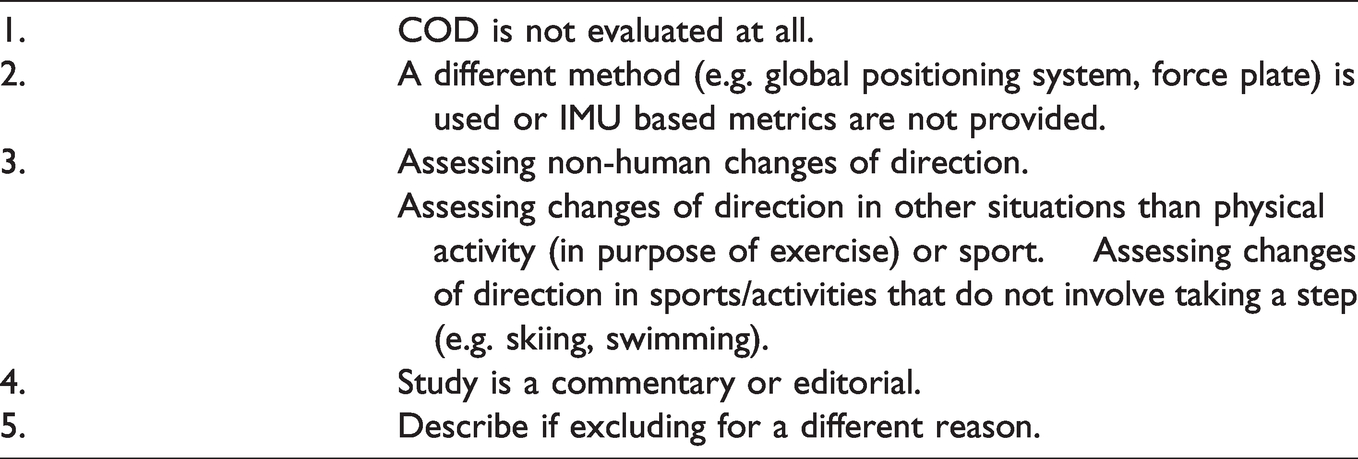
Study selection was conducted in two stages. In the first stage, the titles and abstracts of potentially eligible studies were screened using the selection criteria. All studies were categorized as included, excluded or uncertain. In the second stage, the full text of studies that were categorized as included or uncertain were evaluated using the selection criteria. The reason for excluding full text studies was documented according to the hierarchy of the eligibility criteria described in Appendix 2. Study selection was carried out by two independent reviewers (AMA, AMR). Discrepancies were resolved by a third author (LCB).
Eligibility criteria
To be eligible for this review, studies had to (1) be written in English (2) include human participants (3) analyze COD movement with IMUs and (4) evaluate a COD maneuver common to sports or physical activity for the purpose of exercise. Articles were excluded if COD movement did not include taking a step (e.g. turning while skiing). Abstracts were included in this scoping review.
Data extraction
Studies evaluating validity and reliability were categorized based on the aim (type of validity, reliability). From studies that evaluated validity of IMUs to evaluate COD movement validity type (construct or concurrent), gold standard/comparator, outcomes, validity and findings were extracted. From studies that evaluated the reliability of IMUs to evaluate COD movement, outcomes, reliability and findings were extracted. To summarize the current evidence on the use of IMUs for COD movement analysis, the following information was extracted from all of the included studies: author, year of publication, study population and sport as reported in the study, participant age range, sex and number of participants, setting (e.g. laboratory, indoor court or outdoor field) and surface (e.g. grass, wood flooring), device manufacturer and model, sensors and sampling frequency, device attachment location, condition (drill, game/practice) and type of COD (preplanned or unplanned; COD heading angle; cut, sidestep or turn, based on the terminology used in the study). Quality assessment was performed on the studies that evaluated validity and/or reliability of IMUs on analyzing COD movement, as that was the main focus of the present review. The AXIS tool for evaluating the risk of bias of cross-sectional studies was used for quality assessment. 46
Results
Study selection
In the initial search 15,165 references were identified and after removing the duplicates, 11,378 studies were screened by title and abstract. During title and abstract screening 11,193 studies were excluded. A total of 185 full-text studies were screened and 136 of them were excluded, resulting in 49 studies in the final analysis (Figure 1).
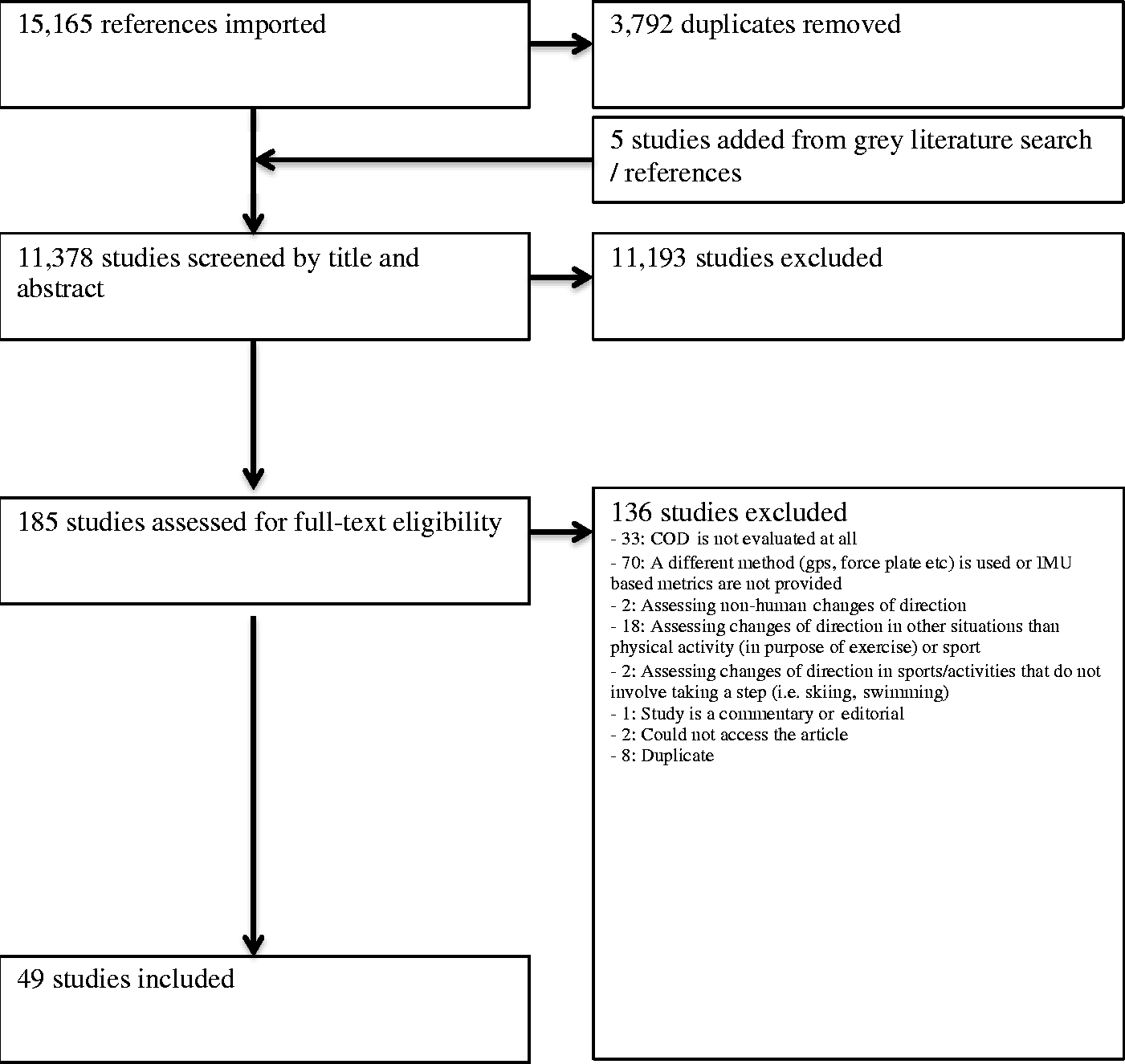
Flowchart of study selection process, and reasons for exclusion of studies regarding the use of IMUs to analyze COD movement.
Validity and reliability of IMUs
11 studies35,47–56 evaluated the validity of IMU measurement when analyzing COD movements (Table 1). Eight of these studies focused on concurrent validity of IMUs compared to a standard clinical measure or a biomechanical gold standard35,47–53 and three focused on the construct validity of IMUs.54–56 The study conducted by Netto et al. 51 was only published as an abstract. Four of the validity studies also evaluated reliability of the IMU measurement (Table 2).
Characteristics of the studies evaluating the validity of IMU when measuring COD movements.

aAbstract.
AU: arbitrary units; AU · min–1: arbitrary units per minute; AvFnet: accelerometry derived net force; CoM: center of mass; GRF: ground reaction force; IMA: inertial movement analysis; MA: motion analysis; RTS: return to sport.
Characteristics of the studies evaluating the reliability of IMU when measuring COD movements.
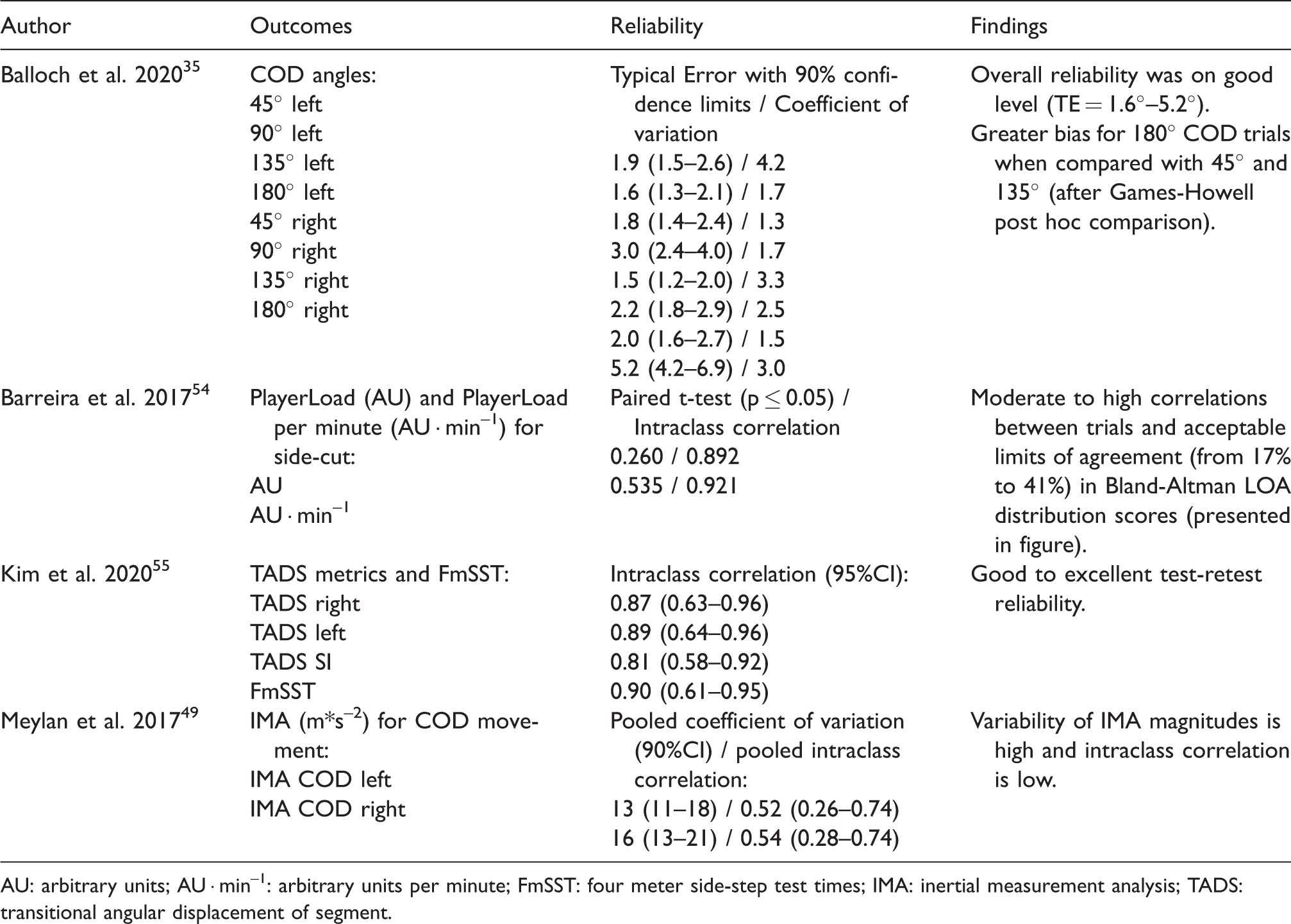
AU: arbitrary units; AU · min–1: arbitrary units per minute; FmSST: four meter side-step test times; IMA: inertial measurement analysis; TADS: transitional angular displacement of segment.
The validity of a variety of IMU-derived metrics was analyzed relative to motion capture systems, force plates and high-speed video. Three of the studies compared IMU captured mean and peak acceleration magnitudes against motion capture systems during team sport-specific movements.51–53 Both center of mass and segmental accelerations were evaluated and sport-specific movements included a modified circuit with running and cutting tasks. The results of these studies were inconclusive, showing poor (over-estimation of accelerations)51,52 or acceptable validity.
53
Three of the studies compared IMU derived peak acceleration, average loading rate (the average gradient of the resultant acceleration data from touchdown to peak acceleration within the first 140 ms of stance phase) and impulse (calculated as the integral of the resultant acceleration over time),
50
cranio-caudal and resultant acceleration converted to force
48
and IMU derived estimates of step-average component and resultant force
47
to force plate measures of magnitude and direction of ground reaction force (GRF) and center of mass acceleration.47,48,50 The conclusions from these three studies were that IMU derived estimates may provide valid information of the vertical component and magnitude of step-average ground reaction force vector during 45° COD
47
and acceptable relative measures of peak foot-strike impact forces during 45° and 90° COD,
48
but IMU derived segmental accelerations overestimated the acceleration of center of mass.
50
Two of the studies compared IMU captured heading angle and magnitude of inertial movement analysis events against high-speed video.35,49 Inertial movement analysis (IMA) is a manufacturer software function to extract acceleration and deceleration events and COD magnitude as sum of acceleration in two planes over time. These findings concluded that IMUs showed acceptable level of concurrent validity
Three studies focused on the construct validity of IMUs.54–56 Each study utilized different metrics: PlayerLoad™ (PL), which is a cumulative measure of rate of change in acceleration; 54 average instantaneous net force, which is an accelerometer derived measure of net force acting on body; 56 and novel IMU-based metrics called transitional angular displacement of segment (TADS) and symmetry index (SI). 55 The results of these studies suggest that when evaluating between participant and between task variations, 54 joint stability after rehabilitation 55 or average force produced in relation to overground speed, 56 the construct validity of these IMU derived measures is acceptable.
Four studies also evaluated the reliability of IMUs to measure COD heading angles or IMU derived metrics (IMA, TADS, SI and PL).35,49,54,55 The findings concluded good or high level of reliability when measuring COD angles of 45°, 90°, 135° and 180° 35 and test-retest reliability when measuring TADS SI of individuals with knee injury. 55 Moderate to high reliability was found when measuring within participant test-retest differences in PL. 54 Meylan et al. 49 concluded that since the typical error during testing was between 13%–21% (coefficient of variation), IMA should not be used to assess accelerations or COD movement in testing settings.
Study characteristics
Characteristics of all studies are presented in Table 3.
Characteristics of studies using IMU to evaluate COD movement.
aAbstract.
COD: change of direction; IR1: Intermittent Recovery test 1; NR: not reported.
Population, sport and age
35 studies involved adult participants with an age range from 18 to 42 years.35–37,39,47,48,50,53–80 Only three studies examined COD movement in individuals under 18 years,81–83 and one study had a combination of youth and adults. 49 In 10 studies, the age of participants was not reported.38,51,52,84–90 The population in studies was most often males. 24 studies included only male participants.35–37,39,50,53,54,56–63,65,67,68,72,73,75,79,85,87 Seven studies had only female participants,49,52,64,76,77,80,83 11 had both males and females47,48,51,55,66,69–71,78,89,90 and in 7 the sex was not reported.38,74,81,82,84,86,88
The background of the population was varying. 24 studies did not specify the sport or background of participants.35,38,39,47,48,50,51,53,54,57–59,65–67,69–71,78,82,84,86,87,90 Eight studies were focused on basketball,37,52,56,61–63,72,73 six on soccer,36,49,68,74,77,79 three on netball76,80,89 and two had multiple sports (hockey, football, rugby, and/or tennis),55,60 or rugby.75,81
Study settings
13 studies were conducted in laboratory conditions and utilized additional equipment (e.g. force-plates and motion capture systems) as a comparison to or combined with IMUs for analysis of COD movements.36,47,48,52–54,57–59,67,70,77,90 Outside the laboratory, 17 studies were conducted in indoor sport or recreation facilities (e.g. playing court, dancehall),37,50,55,56,61–64,68,72,73,76,80,82,83,85,89 nine on outdoor fields35,38,39,49,74,75,78,81,86 and two both indoors and outdoors.60,84 In eight studies, there was no mention of study settings.51,65,66,69,71,79,87,88 Type of COD was anticipated in 33 studies35,36,38,39,47,48,51–60,65–71,75,77–79,82,84,86,88,90 and in two studies49,87 the participants performed both anticipated and un-anticipated COD movements. Eight of the studies focused on free movement within games or practices where players can perform either unplanned or planned COD movements depending on the situation.37,61–64,72–74,76,80,81,83,85,89 None of the studies focused only on unplanned COD movements.
Devices and sensor attachment
19 different types of devices were used to analyze COD movements. The most common manufacturer was Catapult Innovations, Melbourne, Australia with devices used in 17 studies.35,37,39,49,52,53,61–64,67,72,73,76,80,81,89 APDM Opal IMU was used in four studies.66,69,78,86 XSENS MVN was used in two studies.68,82 Sampling rates varied from 50 Hz to 1500 Hz with the most common frequency, 100 Hz, used in 22 of 49 studies.
The location of devices was also varying. In 12 studies the devices were located on multiple body parts simultaneously (e.g. foot, shin, thigh, pelvis, and/or back)38,50,55,60,66,68,69,71,82,84,85,87 and in 18 studies the location was the between the scapulae.35–37,39,48,49,52,53,56,64,65,67,72,73,76,80,83,89 In four studies the device was on the lower back,47,77,86,88 in eight studies on the knee (inside a custom sleeve), tibia or thigh57–59,70,75,78,79,90 and in one study on the neck. 51
IMU sensors and metrics
Wide variety of different types of devices led to different combinations of used sensors. 19 studies used measurements from accelerometer only.36,48,50,51,54,56,59,60,65,67,70–72,79,82,83,89,90 13 studies used the measurements from accelerometer, gyroscope and magnetometer.35,39,47,49,61–63,66,69,76,78,80,84 Nine studies used the measurements from accelerometer and gyroscope.53,55,57,58,74,75,77,81,85
There were several metrics derived from the IMU signals used in the analyses of the included studies. Seven studies used manufacturer-based software to generate the PL metric, which is a parameter proposed by Catapult Sports that aims to explain how much work the player has done during a game or a practice.54,56,72,73,76,80,81 IMU-based measurement of joint angles were reported in five studies37,38,68,86,91 and two studies examined forces at the knee joint by producing estimates of knee joint forces with IMU-obtained data which was then processed with an artificial neural network.57,58 Accelerations were analyzed in 16 studies,36,48–52,59,64,66,67,76,79,82,83,89,92 accelerations in combination with angular velocities and specific COD angles were analyzed in 11 studies,55,61–63,69,74,75,77,78,85,88 ground impacts or soft tissue accelerations in four studies60,65,70,71 and four studies analyzed ground reaction forces by scaling the acceleration vector by the subject’s mass or comparing segmental accelerations from IMUs with center of mass accelerations, which were derived from ground reaction force measures.36,47,48,90
Condition and type of COD
In seven studies, participants were instructed to approach the COD at maximal running speed.49,59,65,75,78,79,86 In 18 studies, speed was described as running, jogging or sprinting.35,36,39,48,50,54,55,57,58,60,68,70,71,77,81,84,90 In 18 studies, there was no information regarding the running speed (not reported at all or CODs were done at varying speeds during games or practices).37,52,53,56,61–64,67,72–74,76,80,82,85,89 Four of the studies included 45° CODs,60,68,71,75 90° CODs,49,57,58,70 135° CODs36,53,67,86 or 180° CODs.54,55,59,81 19 studies included a combination of two or more COD angles ranging from 45° to 360°.35,37,39,48,50,52,56,61–65,78–80,84,85,90
Quality assessment
The quality assessment results for all validity/reliability studies is presented in Appendix 3. The study by Netto et al. 51 was not assessed, since only an abstract was available. All studies scored “yes” or “not applicable” for the questions in the introduction and results categories, and one question in the discussion category. The aims and objectives of the studies were clearly stated in all studies when applicable. Regarding the methods, most of the studies had small sample sizes, didn't define the target population clearly and didn't have the sample frame taken from appropriate population base. The sample size was not justified in any of the studies. Only three studies clearly defined the target population48,52,56 and had selected the sample from an appropriate population. The selection process was well defined in all studies and the measured risk factors and outcome variables were appropriate for the aims of the studies. Outcomes were measured correctly and statistical significance and precision were clear in most studies. Results were described and presented adequately and they were internally consistent. Also, the discussion and conclusions were justified by the results, although three of the studies did not include a discussion of limitations.49,55,56
Discussion
The aim of this scoping review was to provide information on the validity and reliability of IMU measures of COD movements and summarize the current evidence as a basis for future research. A scoping review was chosen as the field of research on wearable technology and COD is still limited and concentrates on laboratory setting evaluations with the use of motion-analysis systems or force plates or timing gates.12,93,94 Wearable technology has become an important part of movement analysis in sports and improvements in technology will open new possibilities for more precise methods. Previous studies have proposed that wearable technology is promising in evaluating movements and injury risk in team sports, but the reliability and validity of these methods has not been examined thoroughly.26,42,95
Concurrent validity
Findings from concurrent validity studies show that IMUs are able to detect COD movements and estimating the angle of COD on an acceptable level. Peak accelerations (center of mass and segmental) seem to be overestimated when compared with motion analysis and GRF, especially when looking at segmental accelerations from different body parts. Resultant (smoothed 10 Hz) and raw cranio-caudal values (device placed between scapulae) of accelerations were similar with resultant and vertical GRF in COD tasks, except in 180°. Reported Spearman’s correlations varied from no correlation at all to strong correlations as well as measurement errors.48,52,53
Four of the concurrent validity studies evaluated accelerations measured from trunk.50,51,53,92 All of these studies compared IMU measures with a different method, but the conclusions were similar: accelerometer data from trunk-mounted devices seems to be overestimated, so these results should be used with caution. Roell et al. 52 and Wundersitz et al. 53 also highlighted that higher acceleration leads to larger increases in error and that the use of the correct filtering method is important. Smoothing resultant acceleration signals of COD trials between 5 and 12 Hz gave most accurate results and eliminated differences between accelerometer and resultant GRF values.48,52,53 Reliable and valid results were reported for classifying COD activities (detection of acceleration, deceleration or 90° COD during sprinting), 49 calculating COD heading angles (45°, 90°, 135° and 180°), 35 and quantifying mechanical variables that describe the COD movement (estimate of ground-reaction forces during linear acceleration and 45° COD task). 47 In calculation of COD heading angles with a specific algorithm 180° CODs were slightly over- or underestimated, but these were within reasonable limits.
Generalization of these results to real life settings cannot be done, since these measurements were conducted in structured test settings with predetermined COD movements and speed. The next step would be to find out how well the methods that have shown acceptable validity work in sports practices and games, where movements are not predetermined. Detecting COD related variability in accelerations, COD movements and heading angles would provide coaches and players information about movement during practices and games, which would be useful in analyzing workloads and differences between and within players during the season. This information might also be helpful in creating an individual player’s COD profile based on the amount and type of CODs they perform during games and differences in accelerations. From injury prevention point of view, a COD profile could provide a baseline for determining and detecting changes in an individual player’s COD movements throughout the season.
Construct validity
Two of the convergent validity studies focused on PlayerLoad™54,56 and one aimed to introduce and validate the CaneSense™ method for knee motions and interlimb symmetry. 55 These studies showed acceptable results, but were closely related to the specified methods that manufacturers have developed. Since these algorithms are not available, the evaluation or reproduction of the results can be difficult. Accelerometry derived average net force can be used to quantify external demands in basketball 56 and detecting differences in agility after knee injury. 55 Barreira et al. 54 also concluded that the variation in accelerations between soccer players are probably due to differences in locomotive skills. Establishing construct validity for IMU-based measures for demands in different sports or situations (e.g. injury and return to sport) is important, due to the differing demands related to sport- and injury-specific factors. Understanding and being able to analyze sport-specific and individual COD movements and perhaps setting criteria for COD quality would be a useful tool for coaches and practitioners.
Reliability
All but one study 49 reported good measures of reliability, although all of the reliability measurements were done using different metrics and the placement of the devices varied (e.g. between scapulae, trunk, knee). Meylan et al. 49 analyzed the reliability of manufacturer based metrics, which showed low correlation and high variability. This means that the reliability of IMUs in COD movement analysis is promising, but no clear conclusions can be drawn. The study by Kim et al. 55 was the only one providing insight into how individuals move during a COD by using a stability index for knee. Reliability of detecting COD angles is important for detecting COD events in real life situations and it can be used in comparison with other, possibly more important COD related metrics like speed. However, future reliability studies that concentrate on IMU metrics related to the accelerations during different phases of COD and angular accelerations can provide valuable information about possibilities in detecting how consistently a player moves during a COD and how this movement varies when COD angles or running speeds change. Reliability studies would also need to be conducted in real-life situations, where movements are faster and unpredictable. There is a need for better consistency or clear guidelines for sensor placement. Having a reliable IMU-based measure for COD movement would add depth to COD testing, which is currently mainly based on speed. A reliable analysis of the mechanics of COD movements would help coaches and players identify specific factors that need to be trained. However, more research is needed to translate these findings to actionable resources for coaches and players. Additionally, the ability to reliably analyze the mechanics of COD movement would present better knowledge on players’ readiness to return to sport. A player’s COD movement profile could be followed throughout the season and between seasons, adjustments to training could be based on reliable measures.
Change of direction analysis settings
Most of the COD studies with IMUs were conducted in laboratory settings or indoor facilities. Laboratories provide precise gold-standard methods, but these studies usually lack the ability to analyze real life movements in sports, where the fluctuation of the game and other players have major effects on athletes’ movements. Since human movement is based on several different internal and external factors that can change on a daily basis, there is a need for sport- and movement-specific analysis.31,96 There is research suggesting that the risk of ACL and ankle injuries might increase when COD movements are unplanned. 13 Future studies should investigate COD movements in practice and game settings where COD can be both planned and unplanned.12,97
Most of the laboratory setting studies lack unplanned movements which may not represent the way the actual movement is performed. In a
Participant characteristics
Previous research suggests that females might be at greater risk of ACL injury during COD tasks, 102 despite the potential confounding of other physical factors, such as muscle strength.103–105 Nevertheless, very few of the included studies involved female participants. There is evidence of the importance of doing analysis on specific populations, since COD movements are influenced by age, type of sport and limb dominance. 106 Just one of the studies in this review included only youth athletes. 81 Previous studies have shown that COD ability changes throughout the specialization process of athletes in team sports, with COD deficits increasing with age and specialization.107–110 Better understanding of COD movement patterns in specific populations would further help coaches and players.
In addition, the studies in this review did not account for different characteristics of individuals performing the COD movement. For example, leg strength, limb dominance or previous training might change the way COD is performed and this should be taken into account when analyzing the movement.9,111,112 The evidence regarding limb dominance as a risk factor for ACL injury from previous motion-analysis studies is inconclusive and there is inconsistency within and between studies and populations for limbs displaying high-risk mechanics. 113 IMU-based analysis might identify new information about these factors when conducted in real life settings.
Device, sensor type and set-up
There is no gold-standard for IMU setup since the device location was inconsistent between studies. This is due to the many possibilities for where to attach the device to the body. For example, Catapult sensors are designed to be worn in a harness with the device positioned between the scapulae. As the most common device, trunk-mounted IMUs were used in most of the studies in this review. Previous research suggests that trunk-mounted accelerometers can overestimate the whole-body acceleration and the elasticized harness might be a contributing factor. 114 Concerns about securing the device underline the need for recommendations on device set-up, that are based on reliable and valid methods. Sensors (accelerometer, gyroscope and magnetometer) were used based on the objectives of the study. Accelerometer-related metrics were used most often, but gyroscope and magnetometer metrics were also utilized when determining orientations. Algorithms for detecting COD angles presented in the studies were usually based on values obtained from all sensors. The range of sampling rates used was from 6 to 1500 Hz and rates around 100 Hz where most commonly used. In general, lower sampling rates were used more for movement detection and higher sampling rates for measuring segmental accelerations. Methods for sport-specific standardized data-collection are needed. 42
IMU metrics
Based on the validity studies, IMUs are able to detect and correctly classify COD movement from other movements and provide information about COD heading angles. Information about COD counts and COD heading angle can be useful for coaches and players when analyzing the demands of practices and games and following players’ performance throughout the season. Practices should prepare the players for game demands and therefore the information on the amount and type of CODs in practice and games could be useful for coaches from injury prevention and performance enhancement point of view.115–117 No recommendations could be made for COD quality and specifying suitable metrics for COD quality analysis should be a subject for future studies. Based on the existing studies, the information provided by IMUs does not seem to be practical from a coach’s point of view so far. Since current COD tests rely on time or speed related metrics, IMU-derived metrics could provide additional information about the individual differences and variability in accelerations on different axes and angular velocities during COD movement, which could be extremely useful for coaches and players. However, future research is needed to elucidate these connections in a practical way. Differing COD angles and speed will have an effect on the accelerations and deeper analysis on these metrics might provide information on COD quality. Evaluation of COD quality might also be helpful from an injury prevention point of view, because acceleration metrics from different planes can provide information on the forces acting on joints or muscles. IMUs can measure movement patterns in three different planes of the body, which can provide relevant information regarding COD movement quality. 118 Studies in this review concentrated on COD during final foot contact. Previous research has shown that penultimate foot contact is important regarding deceleration when doing COD movement, 119 however, penultimate foot contact was not included in the analysis of included studies and should be considered in future research.
Conclusions and future research directions
COD movement is a complex and specific skill and it is related to lower extremity injuries. The studies evaluating the concurrent validity of IMUs to measure variables related to COD movement indicate that IMUs could identify COD heading angles with acceptable validity as well as detecting COD events. However, when measuring the variables related to COD movement, such as forces, acceleration and mechanical loading, the results are inconsistent and suggest that IMUs more likely over-estimate these measures, when compared to gold-standard measurements.
A multitude of devices used to monitor COD movements underline the importance of high-quality studies on reliability and validity of these devices. While most of the studies in this review measured planned COD movements, IMU-based monitoring of unplanned COD movements in real-world settings may inform injury prevention strategies and should be considered when planning future studies. Factors that affect COD performance, such as side-to-side differences, preparation time before the COD movement and an athlete’s physical capability, should be evaluated.
Footnotes
Declaration of Conflicting Interests
The author(s) declared no potential conflicts of interest with respect to the research, authorship, and/or publication of this article.
Funding
The author(s) disclosed receipt of the following financial support for the research, authorship, and/or publication of this article: PhD student Aki-Matti Alanen is supported through University of Calgary (Kinesiology Dean’s Doctoral Scholarship).
Dr Anu M Räisänen is supported through a Canadian Institutes of Health Research Foundation Program (PI C Emery) and the Vi Riddell Pediatric Rehabilitation Research Program (Alberta Children’s Hospital Foundation).
Dr Lauren C Benson is funded through a Canadian Institutes of Health Research Postdoctoral Fellowship (MFE – 164608).
