



Abstract
Coaches’ beliefs about the nature of knowledge and knowing (their epistemic beliefs) are an integral but under-researched component in the development of a philosophy of coaching. The Theory of Integrated Domains in Epistemology (TIDE) 1 offers a framework which may enhance the understanding of the development of coaches’ epistemic beliefs. The present study offers the first application of the TIDE framework to sports coaching. We present a case study of the nature and development of epistemic beliefs of a highly renowned Adventure Sports Coach (ASC), Doug Cooper, through the lens of the TIDE framework. Thematic analysis of a series of semi-structured interviews showed that early childhood experiences, strongly held beliefs about ASC as a domain of knowledge, and educational experiences in the later life were instrumental in shaping Doug's epistemic beliefs. We conclude that the TIDE framework has considerable potential for researchers and coach developers seeking to gain insight into and develop coaches’ beliefs.
Introduction
The connection between epistemic beliefs, philosophy and behaviour is integral to effective coaching and coach development.2–5 Epistemic beliefs are defined as beliefs that are related to the nature of knowledge and knowing. 6 These beliefs play an integral role in shaping a coach's behaviour4,7; for example, beliefs about the potential for learners to benefit from prescriptive instruction influence when and how much that behaviour is exhibited. While epistemic beliefs will implicitly influence the behaviour, a prominent feature of contemporary coach development is the development of an explicit philosophy of coaching8–11; a statement which guides everyday coaching decisions and actions. 12 Developing and abiding by this statement is believed to help a coach to understand their underpinning beliefs, and to ensure that their behaviours are consistent with these beliefs. However, Cushion and Partington 9 argue that research and practice in relation to a philosophy of coaching is plagued by definitional and conceptual incoherence. Acknowledging the complexity of the concept of a philosophy of coaching, the focus of this paper is on one suggestion raised by Cushion and Partington to progress the literature: the need to develop a more nuanced understanding of the role of personal epistemology. While there is an emerging body of the literature exploring the relationship between epistemic beliefs, philosophy and coach behaviour,4,7,13 this work can be further developed by considering contemporary models of the development of epistemic beliefs from the educational psychology literature; notably, the TIDE and extended TIDE frameworks.1,6 Thus, this article will explore the potential of these models for coach development.
Research has consistently documented sophisticated epistemic beliefs of coaches within an adventure sports context.3,14,15 Interviews with high-level adventure sports coaches (ASC) from paddlesport 3 and multiple adventure sports 14 reported commonality in ASC's focus on developing independent performers, the importance of coaches’ use of reflection, and acting as a catalyst for learning. Such learning intentions are consistent with well-developed epistemic beliefs; for example, in the inherently unstable adventure environment which is outside of the coach's immediate control, the belief that learners will need to construct novel solutions to subtly different problems posed by the environment is consistent with coaching practices which develop the performers capable of acting independently of the coach. Likewise, when coaches believe that there is no certainty that a solution that works on one occasion will work on another due to the dynamic nature of the environment, they are more likely to adopt problem-based learning approaches where coaches act as a catalyst for learning rather than as a director of it. Furthermore, Christian et al. 16 suggest that distinctive physical, social and temporal aspects associated with the adventure environment (rivers, mountains) are particularly conducive to fostering epistemic beliefs where coaching knowledge is viewed as complex, tentative, and uncertain; in the context of the dynamic and intricate scenarios facing ASCs, such characteristics are associated with a well-developed personal epistemology.13,17 Taken together, these findings suggest that the adventure sports domain may be particularly well-suited to the investigation of the development of coaches’ epistemic beliefs. 16
TIDE frameworks
The Theory of Integrated Domains in Epistemology (TIDE) 1 and extended TIDE 6 frameworks offer potential structures and a wealth of literature, as yet untapped by the sports coaching community 1 . As illustrated in Figure 1, the models hold that epistemic beliefs are complex and socially constructed. Complexity arises from the active construction of meaning of individuals from a diverse range of experiences. Beliefs are socially constructed in that a myriad of different factors (schools, workplaces, cultures, and religions) shape beliefs through a process of enculturation and socialisation.
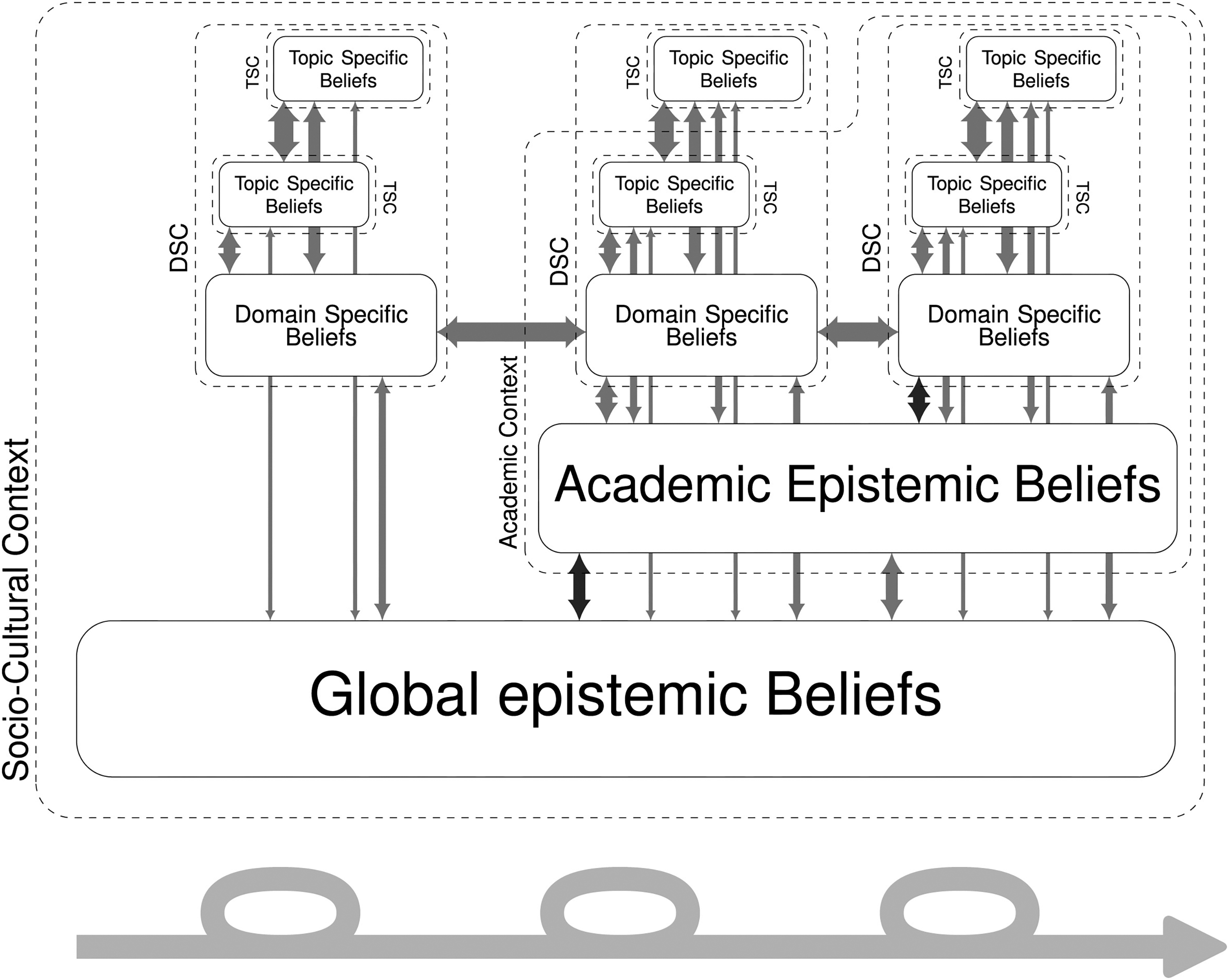
Extended TIDE framework. 6
Both frameworks include a developmental and multidimensional perspective and assume that beliefs can be both domain-general and domain-specific (domains are defined as knowledge about a particular field of study). Beliefs are thought to develop from an absolutist position (knowledge is viewed as absolute and certain facts), through multiplism (knowledge is viewed as subjective, viewing all viewpoints on a topic as equally legitimate), to evaluativism (knowledge is generated by human minds, individuals see themselves as part of the process of knowledge by evaluating and weighing different viewpoints). Additionally, beliefs are thought to develop along four dimensions: the certainty of knowledge (knowledge is fixed and absolute vs. knowledge is constantly evolving); the simplicity of knowledge (knowledge is unorganised, unrelated facts vs. knowledge is organised as highly interrelated concepts); the source of knowing (knowledge is handed down by authority vs. knowledge is acquired through logic and reasoning); and justification of knowledge (justified by personal experience and subjective opinion vs. justified by the inquiry and integration of multiple sources of information). As such, a coach holding less developed, or naïve17,18 epistemic beliefs is likely to view knowledge about coaching as absolute facts that are acquired from higher authority (more experienced coaches, books) and validated by subjective opinion; whereas a more epistemologically developed, or ‘mature’ 19 coach would view knowledge about coaching as highly interrelated concepts that are constantly evolving, personally constructed through logic and reasoning and justified through experimentation. It follows that a more epistemologically developed coach's beliefs will translate into coaching behaviours that emphasise learner-generated knowledge through challenges that are matched to the learner's capacity.4,14 Both models propose that individuals’ beliefs develop over time (from left to right in Figure 1) as a result of life and educational experiences but, importantly, that development can be ‘recursive’ (i.e., beliefs can temporarily revert to an earlier stage). In particular, Stodolsky et al. 20 argue that individuals are receptive to recursions in epistemic beliefs as they progress from well-structured and predictable learning contexts to less-structured, more independent ones. Muis et al. 1 add that such recursions may be triggered when making transitions between educational contexts (middle to high school, or at the commencement of undergraduate university). Within a coaching context, such disruptions to beliefs might occur when coaching makes the transition between roles, such as from player to coach, or from assistant coach to head coach, or between clubs.
Within the TIDE framework, Muis et al. 1 have proposed the existence of three specific types of beliefs within which four dimensions develop: global 2 epistemic beliefs, academic epistemic beliefs and domain-specific epistemic beliefs. Global epistemic beliefs are beliefs that exist outside the academic context and relate to everyday life (in the home, workplace, through interaction with peers). For example, an individual may initially believe that knowledge is acquired quickly or not at all, but later come to believe that knowledge can be obtained through systematic thinking and perseverance. Academic epistemic beliefs are thought to develop alongside the commencement of formal education and are developed through schooling. Although distinguishable from global epistemic beliefs, the generic nature of early years education means that, at this stage, individuals do not yet distinguish different domains. Domain-specific epistemic beliefs are proposed to develop when individuals are exposed to multiple and contrasting domains of knowledge; for example, physics versus philosophy. Merk et al. 6 reported that the three levels of beliefs should not be viewed as a fixed order relation; as such, not all academic beliefs are part of global beliefs and not all domain-specific beliefs are a part of academic beliefs. Rather, the levels are amalgamations of each other and have different compositions over the lifespan. 1 Specifically, academic beliefs are more reflective of global beliefs at the beginning of development but later, academic beliefs may be seen as generalisations of domain-specific beliefs, which become more influential. Merk et al. have described the relationship between levels of belief to be complex, describing them as “hierarchically structured and reciprocally influential” 6 p.85.
The extended TIDE framework proposes the inclusion of a more “fine-grained” 6 p.86 level of belief beyond domain-specific beliefs, namely topic-specific beliefs. Topic-specific beliefs are seen as epistemic beliefs that are related to certain topics or theories within a domain. For example, in the domain of sports coaching, a coach may have different beliefs regarding the topics behaviour management and learning styles. Merk et al. have justified the inclusion of topic-specific beliefs on the basis of evidence suggesting significant within-person variation in beliefs across different topics within the same domain. 21
Rationale for the present study
To date, the sports coaching literature has not engaged with contemporary developmental models of personal epistemology. This lack of engagement has resulted in a limited understanding of the broader nature and life-span development of coaches’ beliefs. As the most advanced model of personal epistemology, the TIDE framework offers the potential to gain new insight into aspects of the coach's epistemology, such as the influence of the socio-cultural context, the different levels of beliefs, and recursion in beliefs. Given the powerful influence that epistemic beliefs have on coaching behaviour, a more nuanced understanding of the processes by which these beliefs develop and would be valuable for researchers and coach developers should be developed. Thus, TIDE could offer extensive guidance to coach developers in supporting coaches to understand their personal epistemology, and its implications on their professional practice. Given the complexity of the TIDE framework, we considered an ideographic approach would be most appropriate to explore the nature and development of epistemic beliefs of a high-level ASC; accordingly, due to its commitment to studying the complexity of real-life situations and intensive rather than extensive nature, we selected a case study for the method of investigation. 22 We also considered case study fitting as a deep exploration of personal epistemology on an individual basis would likely replicate the realities of a coach developer working with their charge. Thus, the aim of this exploratory research was to understand the nature and development of epistemic beliefs of a high-level ASC through the lens of the TIDE frameworks.
Method
Philosophical beliefs
This study was conducted from an interpretive constructionist approach. Such an approach is characterised by ontological relativism (reality is mind-dependent, multiple and created) and epistemological constructionism (knowledge is subjective and socially constructed).23,24 Accordingly, we conducted a series of semi-structured interviews to elucidate the subjective experiences of the participant through the lens of TIDE. Due to its suitability to analyse participants’ experiences through a process of meaning-making, we utilised a reflexive thematic analysis to tell his story.25,26
The participant
Given his reputation in the ASC community and the nature of his detailed case study, our participant agreed to waive his anonymity. At the time of writing Doug Cooper was the Chief instructor at Glenmore Lodge, Scotland's national outdoor training centre; he has held this position since 2018 having joined the centre in 1996. His decision to be identified in this study fits with Doug's ‘knowledge sharing’ philosophy, as can be evidenced in an early email exchange: “From an anonymity perspective, I am more than comfortable with not being anonymous. As you will discover from my philosophy, I am a sharer of knowledge, and therefore the more open I can be, the more comfortable I feel and the more learning opportunities I believe there are available to all involved (D. Cooper, personal communication, May 6, 2020).”
Later, Doug branched out into other adventure sports including skiing and paddlesport. He gained the British Canoe Union's highest-level coaching awards in multiple paddlesport disciplines, and by 2005 was training and assessing mountaineers and paddlesport coaches at the highest level. Doug also started working with governing bodies of sports in course curriculum designing and coaching strategy development. In 2017 Doug designed the British Canoeing's Coach Award, a qualification that includes an embedded ‘educational philosophy’. This contribution was instrumental in British Canoeing winning UK Coaching's ‘Coaching Culture Organisation of the Year’ award in 2018. 27
Academically, Doug left school as a high achiever and went on to obatain an undergraduate degree in Outdoor Education, graduating with distinction. Later, he completed an MSc in Performance Coaching, having published several guidebooks, skills manuals and academic papers in sports coaching.28,29 He continues to research, publish and present at national conferences.
Data collection
Having gained ethical approval for the study, the first author contacted Doug at a professional association event and invited him to take part in the study. A series of three semi-structured interviews were conducted, supported by the frequent exchange of emails. Given the restrictions of the Covid-19 pandemic, all interviews were conducted online using commercially available software. The benefits of synchronous computer-mediated interviews are well-documented, not least because of the convenience they offer to both parties. 30
To capitalise on Doug's academic background, data collection included several features of participant as co-researcher. 31 Initially, Doug was involved in discussions around roles, responsibilities and goals of the research project. 32 It was agreed that Doug would actively participate in the development of the data. His involvement included shaping the format of interviews, commenting on and helping to refine initial interpretations and developing his understanding of epistemology theory, of which he had no prior understanding. It was also agreed at the outset that final interpretations of data and editorial control of the manuscript would be maintained by the research team.
The first two interviews sought to gain a retrospective insight into the development of Doug's epistemic beliefs. A priming exercise was designed prior to the first interview whereby a document entitled ‘This is your life’ posed a series of questions under seven headings. For example, questions such as ‘why do you coach?’ and ‘how did it all start?’ came under the heading ‘Thinking about you as a coach’. This exercise provided the structure for the first interview which lasted two hours. Following transcription and analysis of interview one, a series of chronological themes in relation to epistemic development were organised into hypothetical ‘chapters’ of an epistemic ‘life story’ (e.g., ‘Early foundations – acquiring knowledge’, ‘Evolving and consolidating coaching knowledge’, and ‘Imparting knowledge – the desire to share’). Following some refinement of his epistemic ‘life story’ through a series of emails with Doug, the second interview focussed on expanding on and drawing out meaning from the chapters. A set of questions (e.g., can you describe what you mean by the ‘messy and complex’ world of coaching?) based on the first author's field notes also formed part of this interview, which also lasted two hours.
The final interview sought to understand the development of Doug's epistemic beliefs (garnered from interview one and two) through the lens of TIDE. As Doug had no prior understanding of the framework, to facilitate this discussion and in accordance with his preferences, the first author shared a number of academic papers on developmental epistemology theory and the TIDE frameworks before the final interview. Additionally, given the complexity and novelty of TIDE, the first author produced an orientation video related to personal epistemology theory. The video identified and explained key areas of developmental epistemology including: developmental and multidimensional paradigms, domains of knowledge, domain classification, dominant epistemic patterns, ways of knowing and the TIDE frameworks. The second and third authors reviewed the video to ensure accuracy and impartiality. The video was made using commercially available software and lasted for 37 min. During this phase of data collection, the first author maintained a steady email communication with Doug to ensure he had sufficient resources and to offer the opportunity to ask questions or seek clarity. In agreement with Doug, the structure of the third interview followed the structure of the subject matter in the video. Although an interview guide was formulated to provide prompt and probe questions, much of the final interview was a free-flowing conversation led mainly by Doug. The interview lasted for 1 h 50 min. All interviews were recorded and transcribed verbatim.
In planning for the interviews, it was important to recognise the risk of social desirability. To reduce this risk interview questions were designed to encourage clarification (e.g., tell me about a time when…), seek out alternative explanations (e.g., how has this changed over time?) and welcome disagreement (e.g., how does that fit with your interpretation of…).
Data analysis and methodological rigour
Reflexive thematic analysis 25 was used to identify themes in relation to the central aim of the study which was to understand the nature and development of epistemic beliefs of a high-level ASC through the lens of the TIDE frameworks. The thematic analysis was conducted by the first author. Following a prolonged period of reading and rereading transcripts, relistening to the interviews and using field notes from a reflexive journal, the first author coded the data by highlighting and making notes on transcripts.
Interview three was conducted after Doug's orientation to the epistemology theory; as such, it offered a new perspective on the content of initial interviews. Thus, the three interviews were not coded sequentially, rather a fluid and recursive process of analysis was maintained. 25 Data were initially read inductively to understand the development of epistemic beliefs through early life experiences, sociocultural setting, education, employment and other experiences. Subsequently, the data were read deductively to establish how Doug's experiences related to the TIDE frameworks. Thus, the analytic procedure integrated a succession of inductive and deductive processes. 30 This dialectic movement between the personal experience and the theoretical explanation has been termed abductive reasoning. 33
Consistent with Braun and Clarke's 25 rejection of ‘either or’ choices when conducting thematic analysis, code labels were both semantic (identified surface meaning) and latent (aimed to capture underlying meaning). Theme development involved grouping codes into tentative themes and subthemes which were organised, reorganised and mapped in a number of different ways around a central organising concept that captured the shared meaning of the theme. 25 Ultimately three chronologically ordered themes, each containing a number of subthemes which represented Doug's epistemic development, were generated.
Guided by a relativist approach, and the resulting need to be explicit about methodological rigour, we suggest the following points as quality indicators of our research.24,34 First, the use of TIDE as a framework provided an appropriate scaffold to support data collection and analysis of this complex topic. Second, author reflexivity was central to understanding how, particularly the first author (also a high-level ASC, vested interest in epistemology research), impacted on the collection and analysis of data. Accordingly, the first author kept a reflexive journal and audit trail (emails, draft analyses) throughout and beyond data collection. The journal informed peer debriefing sessions with the third author following each interview; these sessions sought to review preliminary findings as well as share opinion and insight. 35 The concept of authors as ‘critical friends’ is closely connected to reflexivity. 24 At various stages of data analysis, the first author presented interpretations and themes in ‘mapping exercises’ to the third (who had also listened to the interviews) and second author (who had not listened to the interviews, thus providing an external layer of criticality). This process was not about achieving consensus but served to encourage reflection, justification and exploration of alternative interpretations and was deemed to be a particularly important aspect of the data analysis given the nature of Doug's participation in the research and the potential this had to influence the first author's interpretations. Third, member reflections were sought from Doug between interviews. Seen as a co-participatory process, these served as a practical opportunity to explore interpretations of findings and potential gaps in findings. 36 Member reflections were particularly beneficial in the development of Doug's ‘epistemological chapters’ between the first and second interviews. Finally, thick descriptions in the form of extensive quotations within the final manuscript 24 sought to provide the reader with sufficient evidence to make connections with their own lives or the lives of others. As Wadey and Day 24 have reported, thick descriptions are aligned to achieving credibility, naturalistic generalisability and transferability.
Findings and discussion
The analysis generated three primary themes in relation to the nature and development of Doug's epistemic beliefs: early evolution of beliefs, ASC as a domain of knowledge and later stage development: the paradigm shift. Due to the nature and development of beliefs being inextricably linked within the TIDE framework, the themes are chronologically ordered and chart the development of Doug's personal epistemology from childhood, through school and university to his career and ultimately to significant events in later life. In the following sections, each theme will be discussed in relation to the TIDE framework and implications for coach developers and researchers raised.
Early evolution of beliefs
Evolution from absolutism to evaluativism in childhood
When talking about his childhood experiences during the first two interviews, Doug made numerous references to the amount of freedom, independence and support that he was given at a young age: “As a kid, like seven, eight years old, and because we were living in the country, on farmland, I could just be free to roam and jump over the fence and just leg it off into open countryside. So, freedom to roam led me to making my own decisions… if you climb a hundred trees, there's a thousand ways to climb them. There's any number of ways to solve a problem, and those problems were self-generated.” “Because of the amount of freedom and autonomy I was given as quite a young person, I feel that I went from absolutism towards evaluativism in my general thinking and life quite quickly as a kid. As a child, I was constantly making sense of something and evaluating it “does it work, does it not work”. When you look at those early foundations [chapters in Doug's epistemic story]: freedom, independence, frameworks of support, they all fit neatly with multiplism and evaluativism. They don’t fit with absolutism.”
The development of Doug's global beliefs from absolutism to evaluativism fit neatly with the TIDE frameworks. The age by which this appeared to have occurred does not. Although, as Muis et al. 1 it is to be noted, there is some debate in the literature around whether children are capable of evaluativist thinking, these authors also postulate that development is normally a function of transition through educational contexts; this clearly isn’t the case with Doug. Muis et al. have also suggested that the process of epistemic change might be influenced by the domains of knowledge with which individuals interact. Specifically, Muis have proposed that beliefs may change more readily in more ill-structed domains (and associated instructional environments) than well-structured domains (with more rigid, formal instructional environments). Although exploring countryside, building rafts and climbing trees might not be considered a domain of knowledge in a formal sense, it is these “ill-structured experiences” 1 p.10 that seem to have contributed to the development of his global beliefs at this young age.
Restrictive influence of school
Although Doug experienced academic success at school, he felt that formal schooling had a restrictive influence in the development of his academic epistemic beliefs: “I was coming into school with a multiplist, evaluativist kind of developmental period [way of thinking], and then I'd kind of come into the classroom and suddenly it's… I'm having absolutes…and when you're asking the ‘what if’ questions …there isn’t a ‘what if’ question, it's “no this is what it is” … I was being taught, and I was being held in this sort of absolutism kind of setting.” “I think the global beliefs are very strong and influence everything, and they started very young…they're underpinned by my life growing up, by my key people. I'd suggest that my global beliefs overrode or overshadowed those academic beliefs, and almost null and voided them, because my global beliefs developed stronger than the academic beliefs which have been thrown me at school, so although the schooling and undergrad university were very good, I think all they did was strengthen my global beliefs as opposed to add [to them], I could almost be as blunt as that.”
Regarding the influence of school in the development of epistemic beliefs, TIDE frameworks were influenced by Schraw 37 who have suggested that schools shape and change students’ beliefs primarily by being influenced by their teachers’ epistemic beliefs, but also by them providing a ‘training ground’ for the development of critical thinking. As such, TIDE holds that in the early years of education, academic epistemic beliefs are amalgamations of global beliefs, but as individuals progress through their education, global epistemic beliefs become less dominant. 1 TIDE also incorporates Schommer's 38 proposition that children of parents with a higher level of education encouraged their children to think independently. As such, these children were less likely to believe in simple, certain knowledge and led Schommer to propose that family life might notably influence the epistemic beliefs of childrens. In contrast to the TIDE framework's prediction that academic beliefs developed in school eventually become more dominant than global epistemic beliefs, in Doug's case, it seems that the freedom, independence and support provided by his family had far more influence on the development of his personal epistemology than what he describes as ‘the restrictive influence of school’.
Recursion to earlier stages
Despite feeling that his global epistemic beliefs evolved toward an evaluativist perspective at a relatively young age, in the final interview Doug very quickly picked up on the concept of recursions to earlier stages in the TIDE framework: “So, I just wonder, if I’m unpacking it correctly [Kuhn & Weinstock model from video], I just wonder whether… it's not linear ‘you do this, you do that, you do that’ at any one stage, it's more cyclical… and you… I’m always a little bit sceptical when I see a very linear journey because I don’t think the gaining of knowledge and learning happens in that linear way. And I really liked the absolutism, the multiplism, the evaluativism but I think there are times that I would have moved to one, and then perhaps moved back to the other.” “So at the moment I’ve gathered as much information as I can…I’ve evaluated what I think works, and come to a bit of a conclusion at this time and place. The thing is you might now put a whole load more things in my knowledge bank and the question is, does that put me back in multiplism; because now I’ve got far more things which makes it more subjective and I might not be comfortable in the evaluativism stage anymore?
Although the concept of recursion to earlier stages of beliefs has received limited research attention, it is generally accepted that recursions happen when an individual enters into a new educational [learning] context and ‘revisits’ a previous epistemic stage.1,39,40 Despite the concept of recursions resonating strongly with Doug, it is unlikely these are shifts in entire developmental stages (e.g., recursion to multiplism from evaluativism). Kuhn and Weinstock 41 have proposed that critical thinking is inherent at the evaluativism level of epistemological thinking, as it is the “vehicle that promotes sound assertions and enhances understanding” 41 p.124 whereas, critical thinking is irrelevant to the mulitplist given their belief that assertions are merely opinions, that multiple realities exist and truth is not directly knowable. As Doug is clearly a critical thinker, this makes recursions on the scale discussed in the interview unlikely.
Bendixen and Rule 39 have offered an alternative explanation. These authors have proposed that epistemic change is initiated by a Piagetian-style process of cognitive disequilibrium. When an individual begins to question their beliefs about knowledge they enter into a three-stage process of change (epistemic doubt, epistemic volition, and resolution strategies) before advancing their beliefs. Additionally, Bendixen and Rule offer a metaphor of their dimensional and developmental view of personal epistemology where epistemic change is likened to the growth of a rosebush. In this conceptualisation, the rosebush grows upward from a seedling to mature growth and during development individual branches experience their own cyclical growth. As branches are pruned back, new and stronger growth occurs in individual branches and ultimately, in the rosebush as a whole. As the branches grow independently, they may be at different stages of growth but despite being pruned, overall growth is still happening. In this metaphor, general upward growth refers to stage-like developmental progression and branches to specific dimensions. Thus, Bendixen and Rule view recursions as ‘pruning’ that are essential for long-term growth. This analogy fits nicely with Doug's question about whether the impact of new knowledge causes recursion to an earlier stage; it may be more appropriate to view new knowledge for Doug as ‘pruning the branches’ for long-term development rather than recursions as described in TIDE.
In summary, the evolution of Doug's personal epistemology represents a shift to evaluativist global beliefs from a young age. Whilst this transition is characterised by conceptions of freedom, autonomy and independence leading to an increasing ability to coordinate subjective and objective knowledge in a participation context, it also manifests itself in subsequent coaching behaviours as he makes the transition into coaching adventure sports: “I liked having my own independence when I was a youth and as I was developing, and that independence I had then was very powerful and beneficial to me. So therefore, when I'm coaching, developing independence in others, is core to what I like doing… I just want people to feel they've got the freedom to direct their own learning, so for me, in my coaching, there's freedom within the decision making, that decision making can allow them to either direct their own learning or directs where they want to go, or what they want to get out of their time with me.”
Adventure sports coaching as a domain of knowledge
Domain knowledge is defined as a body of knowledge that individuals possess about a specific field of endeavour, and is an integral component of the TIDE framework. Despite the early evolution of Doug's global beliefs, these did not immediately translate into beliefs about coaching: “I'd say when I moved into coaching as an early coach, I started from this absolutism place because I was trying to make sense of it, but then again, fairly quickly kind of moved on to, kind of multiplism and to evaluativism and working out what actually works when I'm working with people.”
ASC as an all-pervading domain of knowledge
It became apparent early in the final interview that Doug holds clear views on the existence of adventure sports coaching as a domain of knowledge in its own right:
In addition to his beliefs about the existence of the domain, Doug goes on to allude to a harmonious personal connection to it:
“I've found a domain that fits fairly and squarely with my beliefs…I believe that my academic and global [beliefs] have just kind of merged together as one…I couldn't start to differentiate between global and academic [beliefs] once I have that adventure sports coaching domain-based academic beliefs, which just merged into a kind of me the entity…My beliefs are completely embedded (in the domain).”
When discussing whether he felt his early development to evaluativist global beliefs about knowledge applied to other knowledge domains, it became apparent that Doug's beliefs about knowing in ASC are so intertwined with his global beliefs that they have become almost all-pervading and influence how he views knowledge in general:
“I'm struggling to think in a different domain because I'm too biased in my thinking, and then I’ll start making assumptions about that domain…So, I struggle a little bit when you say ‘how would that fit in that domain’? I think I'm influenced and I think I'm biased so strongly in what I believe that I can't help look at that [other] domain through my own [ASC] domain spectacles.”
This feeling was further highlighted when discussing journal articles that the first author shared with him to orientate him to epistemology theory. Doug took exception to the way that mathematics is referred to as a hard, pure domain and the way he views it as being taught (as hard, absolute rules):
“I've read all these papers, and they're constantly referring to maths, maths, maths, and I don't like it. They’ve pigeonholed maths into being this kind of absolutism (Sic), it just gets my back up… I don't like how it's seen as a domain… I want to see it differently; maths comes to life to me when I'm doing tidal vectors [a marine navigation skill] and helping somebody do sea crossings. Maths comes to me when I'm taking a bearing [a navigation skill], or helping people to work out a bearing off the top of their heads on the mountain.”
Doug's personal epistemology is inextricably linked to a domain of knowledge with which he has a deep personal connection. Contrary to the TIDE frameworks, which propose a downward influence from domain through academic to global beliefs, Doug feels that the opposite is true. In his mind, his global epistemic beliefs which were galvanised in childhood, have remained stable. He also feels that his career development has led to the ‘discovery’ of adventure sports coaching which he views as a domain of knowledge in and of itself. He describes the connection between his global beliefs and beliefs about ASC as a domain of knowledge as synergistic and feels that his beliefs are embedded within the domain. Evidently, this connection is so strong that it has become all-pervading way of viewing knowledge in general. As Doug puts it, he sees the world through his ‘domain spectacles’.
This finding is significant in terms of the domain-specificity/ generality aspect of the TIDE frameworks. Research in personal epistemology has long grappled with the issue of whether epistemic beliefs are domain-general (individuals espouse similar beliefs about knowledge and knowing across different domains, e.g., physics and philosophy) or domain specific (epistemic beliefs differ between domains).18,42 The TIDE frameworks assume epistemic beliefs can be either be domain-general or domain-specific and propose that epistemic beliefs may impact various facets of cognition and motivation differently. In Doug's case, the all-pervading nature of one particular domain of knowledge lends itself to the notion of epistemic beliefs as domain-general. In fact, Doug's assertion that he struggles to think in a different domain due to his biases and connection to ASC constitutes an extreme level of domain-general beliefs. Perhaps such strong views are a function of Doug's prolonged immersion working, studying and living within the domain and this has helped shape his domain-general thinking. The influence of enculturation in the acquisition and development of epistemic beliefs is a central aspect of the TIDE model; indeed, TIDE holds that an individual's beliefs are embedded within a broader socio-cultural context and this appears to be particularly significant in Doug's case.
Topic-specific beliefs within the domain
As previously mentioned, Merk et al.
6
extended the original TIDE framework by adding another layer of belief, topic-specific beliefs, to reflect the idea that individuals may hold different beliefs about given topics within a domain, particularly in more multi-disciplinary domains. The notion of topic-specific beliefs within the extended TIDE framework resonated with Doug: “Specifically, for adventure sports coaching, I don't think the other one [original TIDE model] works well, whereas in the case of the extended TIDE one, with the topics, 100% yes.” “Throughout the middle of me will be constructivist [approach to coaching]; however, when I'm working with a group of kids getting them into paddling for the first time, chances are I'll be taking a more behaviourist approach to get them up and running. Those topic-specific beliefs allow me to say: ‘that's okay, when I'm working with this group, the best way for me to individualise and work with this group is that way’. And it's slightly different to my core beliefs, but it works and I can justify it.”
Doug views the ASC domain as eclectic and multidisciplinary, and even though some roles may require methods more associated with a different epistemic position (coaching beginners from a behaviourist perspective) his beliefs are flexible enough to accommodate this because of the strength of his core (global and domain) beliefs. Clearly, the topic-specific beliefs aspect of the extended TIDE framework resonates with Doug as they capture the nuances of a highly multidisciplinary domain.
The TIDE framework provides a guide for researchers and coach developers as they assist aspiring coaches to explore their beliefs about knowledge in the coaching domain. To capitalise this, practitioners should explore how coaches view knowledge about coaching 43 in comparison with other domains (e.g., psychology, biology, and education). Such discussions may help coaches develop their own beliefs about coaching knowledge as a domain and the topics that might exist within their conception and, ultimately, how they come to know these topics and the domain as a whole.
Later stage development: the paradigm shift
This final theme relates to the development of Doug's beliefs about developing others, particularly in a coach development context. The theme is formed from Doug's description of an instance from his Master's degree programme which led to a paradigm shift in his thinking about coaching and coach development. Doug described how a reductionist approach to organising coaching knowledge into ‘boxes’ had helped him to develop his own understanding, but that his Master's programme had led him to appreciate ‘messy and complex’ nature of learning about coaching: “And it was that concept … to embrace the messiness and embrace the complexity of coaching and if we try and put it into boxes, and keep it in boxes, we're not actually doing anybody any favours because that's not what happens in coaching; there are too many variables. So, embracing the messiness, the complexity of coaching, and not protecting our new coaches from that I think is really important now; and that's what I've changed. And on any level one [coach development] course I'll be the first to say: ‘This is really hard folks’! So that was a massive paradigm shift from a reductionist approach to a far more holistic approach.” “I think if we structure things for them (aspiring coaches) in a way that works for coaches, that fits into the philosophy, because we need something to guide people through this messiness, they need a cause and compass to help them navigate through these challenges which are coaching.”
The idea of a holistic approach to developing coaching knowledge whereby developing coaches are encouraged to ‘embrace the messiness’ of coaching knowledge is an interesting consideration for coach developers. Encouraging developing coaches to explore their beliefs about knowledge in both general and coaching-specific contexts at an early stage may appear daunting and unwieldy. However, as Doug points out, philosophising about coaching may provide, the ‘cause and compass’ that coaches need to navigate the inevitable messiness of their practice. 9 The TIDE framework offers a structure to aid coach developers scaffold conversations in relation to a philosophy of coaching.
Future directions
Despite the TIDE framework's potential to add new insight into the nature and development of personal epistemology in a sports coaching context, it should not be adopted to a coaching context uncritically. TIDE has been developed in the contexts of education and educational psychology and is thus heavily biased towards these, and other traditional academic disciplines. Although the authors of the TIDE 1 and extended TIDE 6 frameworks describe the relationship between layers of belief as complex and reciprocally influential, there is a clear predisposition towards the significance of academic beliefs and domains, particularly as the gateway to the domain-specific context. This creates a somewhat rigid framework that struggles to accommodate non or less-academic domains. Notwithstanding, the extended TIDE framework does assume that domain and topic-specific beliefs can develop outside of the academic context (see Figure 1), though the examples cited refer to ‘interactions with workmate's and ‘private contexts’ 6 p87, thus neglecting other potential non-academic domains in professional and vocational spheres. Although it goes without saying that sports coaching, as a multidisciplinary area, contains academic components (biomechanics, motor control), its status as a domain (academic or otherwise) in its own right has yet to be determined. Thus, future research should further refine the TIDE framework to ensure its compatibility with the sports coaching context. This refinement may involve a reappraisal of the role of the academic beliefs layer of the framework, specifically how they act as a gateway in the interaction between global and domain-specific beliefs.
Furthermore, research that seeks an understanding of coaching as a domain of knowledge in and of itself would also benefit how ‘less traditional’ domains of knowledge might fit within the framework. Although Doug clearly considers ASC as a domain of knowledge and connects to the concept of topic-specific beliefs within the domain, seeking greater clarity on the form and function of the domain would be advantageous. One method to achieve greater clarity on ASC, and sports coaching in general, could be through its classification. Traditionally, researchers have classified domain knowledge on a number of continua; for example, as more or less academically orientated, well-structured vs. ill-structured 44 ; by the existence or absence of a unified paradigm, and hard vs. soft paradigm. 45 Such systems of classification have been associated with the notion of a ‘dominant epistemic pattern’, an indication of the nature of knowledge within that domain. 1 For example, knowledge about physics, as an academic, well-structured, unified and hard paradigm domain might be very different in nature to knowledge about coaching which may be considered to be less academically orientated, less structured and less paradigmatically unified. Equally, further research which focused on the multidisciplinary nature of coaching, potentially by exploring the topic-specific layer of beliefs, would shed greater light on coaching as a domain of knowledge and ultimately assist coach developers in supporting how knowledge is developed.
Conclusions
This original research is the first to examine the development of a sport coach's epistemic beliefs through the lens of the most contemporary model of personal epistemology, the TIDE framework. Our findings show that TIDE is an efficacious framework to study personal epistemology in a sports coaching context. Exploring Doug's personal epistemology through the TIDE framework revealed three significant, chronological influences on his epistemic beliefs in relation to coaching adventure sports. Firstly, the freedom, independence and support he enjoyed shaped the early evolution of his beliefs. Subsequently, Doug's early career experiences saw the maturation of his views of ASC as an all-pervading domain of knowledge, with which he held a deep, harmonious connection. Finally, a ‘paradigm shift’ induced via postgraduate education dominated the latter development of his beliefs. Whilst we have presented themes chronologically, it is important to stress the non-linear nature of the development of Doug's epistemic beliefs; that is, a development characterised by recursions and paradigm shifts.
In anticipation of further research on the topic of refining TIDE for the sports coaching community, our present recommendations for coach developers and researchers interested in developing epistemic beliefs to consider are threefold. First, to help developing coaches understand and appreciate their personal epistemology and its influence on their philosophy, they should invest time in a deep exploration of formative experiences and how these have influenced their current conceptions of knowing. As TIDE is embedded in the sociocultural context, this exploration should include how experiences in the home, of sport, being coached, of school may have shaped beliefs. Second, activities that allow developing coaches to explore and develop beliefs about sports coaching as a domain of knowledge in and of itself would result in a personally constructed perspective of their craft. Such activities should be founded upon questions that explore how coaches classify coaching as a domain of knowledge, how coaching compares to other domains and beliefs about ways in which coaches come to know. Finally, practitioners would be well advised to consider the manner in which they frame coach development from the outset; specifically, the extent to which learning about coaching is presented as holistic, complex, tentative and uncertain. The clear implication here is for coach developers to encourage trainees to think philosophically about their beliefs surrounding coaching from the outset.
Perhaps the final word on the value of talking about personal epistemology should go to Doug: EC: “Okay, shall we leave it there?”
DC: “Yeah, that's good. I enjoyed that!”
Footnotes
Declaration of conflicting interests
The author(s) declared no potential conflicts of interest with respect to the research, authorship, and/or publication of this article.
Funding
The author(s) received no financial support for the research, authorship, and/or publication of this article.
