




Abstract
The world of competitive sport can present a challenging environment for Christian athletes and coaches. The culture of competitive sport, and particularly the attitude to winning, can cause athletes and coaches to question how their Christian faith should shape participation and/or whether they should participate at all. Few empirical studies have explored how Christian coaches frame their practice to align with their faith and reconcile the potential contradictions and challenges of coaching within competitive sporting environments. That said, there has been a recent increase in the number of studies exploring the potential relationship between sports coaching and the concept of servant leadership – a framework which is commensurate with a Christian world view. The aim of this paper is to contribute to these debates by presenting empirical evidence to explore the philosophies, intended practices and sociocultural factors influencing how Christian coaches sought to lead in competitive sporting environments. One hundred and ten coaches (female = 24, male = 86) completed an online qualitative questionnaire which explored their beliefs about leadership and coaching practice. This paper considers the ways in which Christian coaches’ might seek to frame their leadership behaviours within the context of competitive sport and how their approaches might align, or otherwise, with the theoretical tenets of servant leadership.
Introduction
Academic scholarship investigating the relationship between Christianity and competitive sport has revealed a considerable number of tensions. Stevenson 1 reported that Christian athletes wrestled with a series of personal factors including: the importance of winning, the importance of social status, the expectations of others, and relational dynamics with opponents and with their coach. Whilst some researchers have continued to discuss and problematize these issues from an athlete perspective (e.g. 2 , 3 ), the specific body of literature surrounding the relationship between sports coaching and Christianity raises a number of fundamental questions about whether competitive sport is a legitimate vocational field for Christians. In one of the few published studies on this topic, Bennett, Sagas 4 reported how coaches might view themselves as a ‘living contradiction’ unable to reconcile the desire to win alongside their Christian faith. Indeed, it would be fair to say that this literature has offered limited theoretical clarity for Christian sports coaches seeking a sound and legitimate rationale/foundation for their work. The starting point of this paper is that the professional practice of the coach encompasses factors broader than the pedagogical facilitation of athlete proficiency. Instead, we focus on the overarching concept of ‘leadership’ with a view to offering Christian sports coaches an operational framework in relation to their practices and responsibilities regarding athletes and teams in competitive sport. The central aim of our study was to explore the philosophies, intended practices and sociocultural factors influencing how Christian coaches sought to lead in competitive sporting environments. To this end, the paper explores how the connections between faith, servant leadership theory and sports coaching might be better understood.
Servant leadership and sports coaching
Servant leadership places the individual at the heart of the developmental process. As a result, the needs of followers outweigh the emphasis on organizational goals.5,6 The scholarly construct of servant leadership has been principally attributed to Robert K. Greenleaf.
7
Greenleaf
8
described the concept as follows: The Servant-Leader is servant first … it begins with the natural feeling that one wants to serve, to serve first. Then conscious choice brings one to aspire to lead … the best test, and difficult one to administer is this: Do those served grow as persons? Do they, whilst being served, become healthier, wiser, freer, more autonomous, and more likely themselves to become servants? And, what is the effect on the least privileged in society? Will they benefit, or at least not further be harmed? (p. 7) A fresh critical look is being taken in these times at the issues of power and authority, and people are beginning to learn, however haltingly, to relate to one another in less coercive and more creatively supporting ways … A new moral principle is emerging which holds that the only authority deserving one’s allegiance is that which is freely and knowingly granted by the led to the leader and in response to, and in proportion to, the clearly evident servant stature of the leader.
8
(pp. 9–10)
In order to better understand its operationalization, researchers have attempted to model servant leadership in various ways (e.g.14–18). For example, in his synthesis of work in this area van Dierendonck 14 has proposed six key characteristics of servant leaders: (i) empowering and developing people, (ii) humility, (iii) authenticity, (iv) interpersonal acceptance, (v) providing direction, and (vi) stewardship. van Dierendonck 14 goes on to combine these key characteristics with the antecedents of the leader’s predisposition to serve, a consideration of culture and the leader’s individual characteristics to produce a conceptual model of servant leadership (see Figure 1). The outcome is a modelling of the expected outcomes of servant leadership around six broad concepts which comprise: high quality leader-follower relationship, a positive psychological climate, self-actualization, enhanced follower job attitudes, better performance and improved organizational outcomes. In terms of the aims of the present investigation, this modelling requires us to consider the antecedents, characteristics and perceived outcomes of Christian sports coaches’ leadership approaches in order to review the conceptual fit with servant leadership.
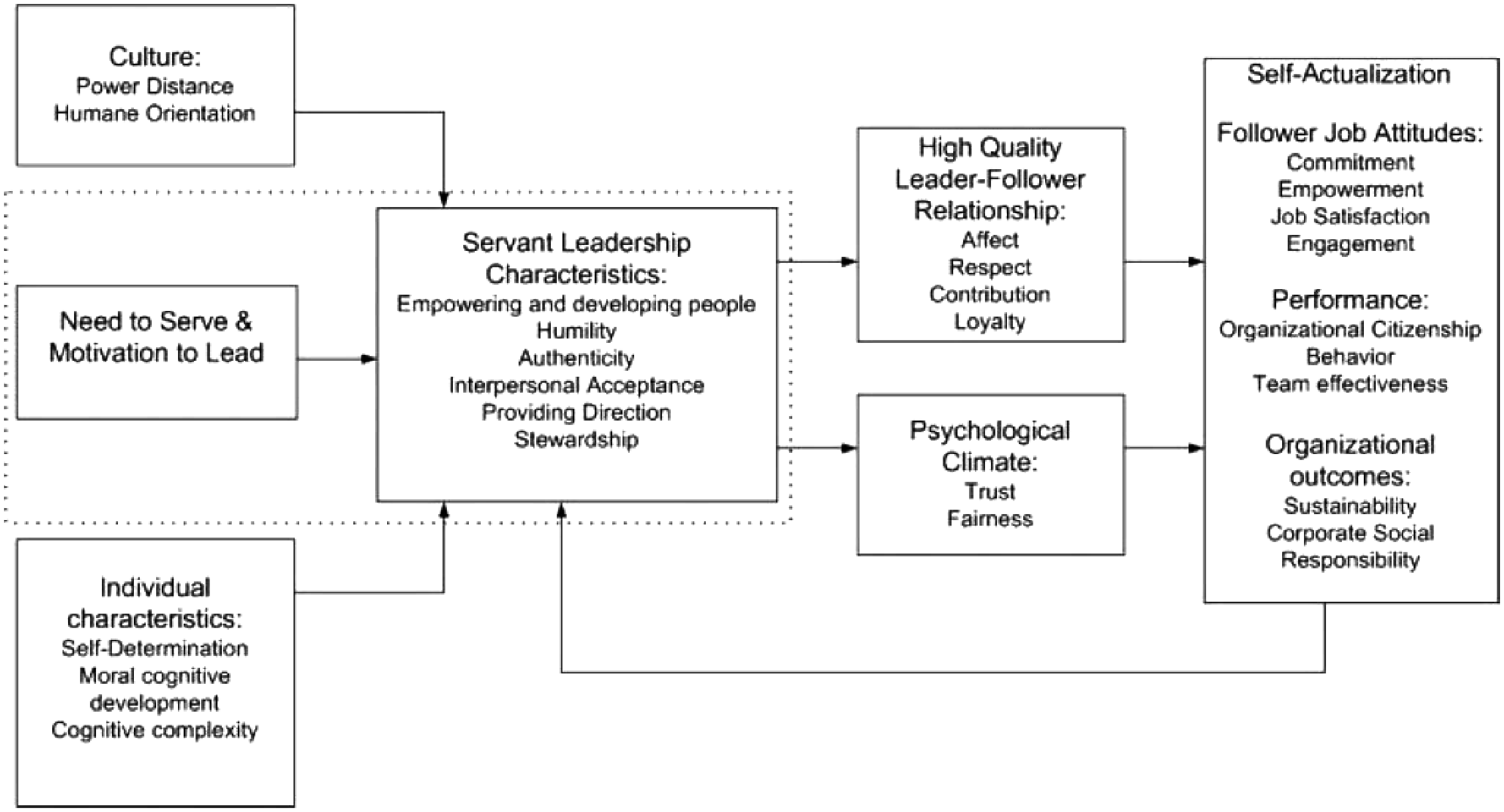
A conceptual model of servant leadership 14 (p. 1233).
The vast majority of research surrounding servant leadership has focused on either evolving conceptual frameworks, developing quantitative survey measures, or model development. 19 Parris and Welty Peachey 19 note that 14 different instruments were used in the 27 studies which they reviewed, yet none has reliably and consistently established a measure or factor structure which fully captures the breadth of servant leadership characteristics or has become the predominant tool of choice within the field. 20 These instruments have largely been constructed through cross-sectional investigation and have focused more on the development of the tool, than on the phenomenon of servant leadership itself (e.g. 18 ,21–23). Synthesizing leadership research in sport management over the past 40 years, Welty Peachey, Zhou 24 constructed a preliminary conceptual model and established some emerging themes which they considered to require immediate attention. Amongst these, the potential for servant leadership to offer a model for ethical leadership was proposed, along with the need to consider sport leadership from a multilevel perspective. Overall, Parris and Welty Peachey 19 concluded there is dearth of empirical research into servant leadership a viewpoint with which Gray, Wharf Higgins 25 and Burton, Welty Peachey 26 concurred arguing that qualitative work was particularly needed in this area.
Another recent advancement in the field centres around Billsberry, Mueller’s 27 call to embrace leadership from a social constructionist perspective. Critical of post-positivistic approaches, Billsberry, Mueller 27 proposed that leadership should be seen as a sociocultural process of perceptual evaluation and behaviour dependent on all stakeholders (i.e. leaders, followers and other influencers), rather than as a quality or skillset solely held by any one individual. Ferkins, Skinner 28 similarly proposed that leadership should be considered a “collective achievement” (p. 77). Whilst numerous scholars advocate further research into shared leadership approaches28,29 and, in particular, servant leadership,29,30 Billsberry, Mueller 27 suggest that social constructionist approaches to investigating leadership necessitate understanding that most leaders deploy Implicit Leadership Theories (ILTs) rather than aligning to any specific model. ILTs are proposed to form over the individual’s lifespan and are unique constructions of belief and behaviour formed through, for example, relationships and observations. Welty Peachey, Zhou 24 highlight that most leadership research in sport has done little more than examine the direct effect of leadership and has paid insufficient attention to the mediating factors which might help explain the relationship between, for example, coach and athlete. Indeed, more recent research has focused on the relational aspect between leader and follower. 29 Burton, Welty Peachey, 26 for example, investigated the role of servant leadership in relation to developing perceptions of an ethical climate in sporting organizations. They found that servant leadership was directly related to fostering trust and, as a consequence, perceptions of an ethical climate were enhanced through procedural justice. That said, these studies only peripherally feature coaches as one ‘type’ of leader within the complicated structures of many sporting organizations.
To date, relatively few studies have been conducted into servant leadership amongst sports coaches. Those that have been undertaken reveal tentative connections to positive outcomes concerning affect and athlete satisfaction but this has provided little in-depth understanding of the philosophical foundations or intended practices of servant leaders (e.g.
31
,
32
). Nevertheless, Vinson and Parker
33
argued that servant leadership demonstrated excellent potential as a framework on which Christian sports coaches could found their practice. Gillham, Gillham
34
examined the relationship between servant leadership, coach effectiveness and other social behaviours, providing rigorous evidence to suggest that athletes’ may perceive a stronger coach-athlete relationship if they consider their coach to be trustworthy, empathetic and servant-hearted. However, as these authors acknowledge, the evidence concerning the relationship between servant leadership and coach effectiveness was much less strong. Jenkins’35,36 attempt to review the concept in relation to legendary basketball coach John Wooden ultimately proved much more convincing in terms of pragmatism and paternalistic leadership. Other sport-related literature based on a framework of servant leadership has highlighted the potential of such approaches in relation to the coach-athlete dyad.6,10,37–39 Azadfada, Besmi
40
further confirmed the benefits of athlete perceptions of servant-hearted behaviour from their coach in terms of athlete satisfaction; however, as with much of the empirically-based work in this field, little insight has been offered regarding the beliefs, intentions and motivations of sports coaches from their own perspective. A central aim of this paper is to offer some form of corrective in this respect by presenting empirical evidence from coaches themselves around the following questions:
To what extent do the philosophies of Christian sports coaches reflect the theoretical foundations of servant leadership? To what extent does the intended practice of Christian sports coaches reflect the theoretical foundations of servant leadership? What sociocultural factors influence the philosophies and intended practice of Christian sports coaches?
To reflect the distinction between servant leadership and other frameworks, we focus particularly on the theoretical foundation of other-person-centredness. Furthermore, whilst we acknowledge the utility of multilevel perspectives, 24 this investigation is delimited to consider solely coaches’ perspectives of their leadership practices. Before elaborating on our findings in relation to these questions, it is to a consideration of research methodology that we initially turn.
Methodology and methods
Adopting a constructionist epistemological standpoint and an interpretivist theoretical perspective, this investigation sought to explore the leadership philosophies, intended practices and sociocultural influences of Christian sports coaches. A constructionist epistemology requires commitment to understanding phenomena and recognizing that meaning is continually negotiated and re-negotiated by social actors. 41 Furthermore, this process of meaning-making is acknowledged to be temporal and situated. 42 Our interpretivist theoretical perspective required the foregrounding of this exploratory investigation in inductive understandings of the meaning-making of our participants. 43 Such approaches value individual construction of meaning by all stakeholders, including ourselves, recognizing the influence we all may have on each other. Additionally, we acknowledge that theory (e.g. servant leadership), personal values and experiences may shape our understandings. 41 For example, it is important for us, as researchers, to acknowledge that our own evangelical Christian beliefs undoubtedly shaped each stage of our investigations. However, bias which is appropriately mitigated is essential to good inquiry. 44 In order to ensure that bias generated by our own beliefs and knowledge was appropriately mitigated, we acted as critical friends throughout – examples of this process are detailed further below.
Participants and procedure
Ethical approval for the study was granted by the Research Ethics Committee of a UK Higher Education Institution. Participants comprised 110 coaches who responded to an invitation to complete an online qualitative questionnaire administered via onlinesurveys.ac.uk (female = 24, male = 86). The participants were drawn from an extensive internet search for sports coaches openly proclaiming a Christian faith or working for overtly Christian educational institutions or charities (for example, Baylor University (Texas, USA); Christians in Sport (UK)). The search was restricted to coaches featured on websites published in English. Participants were also requested to circulate the email invitation to anyone who they considered might fall within the stated inclusion criteria of being actively engaged in sports coaching and proclaiming a Christian faith. In addition, invitations were sent to the administrators of a number of national (UK) and international Christian sports organizations with a request that the email be forwarded to anyone meeting the above inclusion criteria. Overall, 1,570 named, individual, invitations were sent out with 84 respondents from the USA or Canada and 26 from other countries including the UK. In line with our methodological assumptions, we do not consider this sample to be representative of the broader population of Christian sports coaches, we merely deployed a broad exploratory procedure to try and gather perspectives from a wide range of people. Furthermore, we do not seek to compare based on various demographic groupings – this is not a traditional cross-sectional survey, but exploratory qualitative research. Nevertheless, to aid the reader’s appreciation of the data, we have provided the gender, nationality and role (children’s or adults’ coach) of each participant. In the interests of anonymity, pseudonyms are used throughout the present discussion.
Participants were asked to affirm that they accepted the UK Evangelical Alliance ‘Basis of Faith’ 45 and to complete demographic information including gender, nationality and coaching role. Acceptance of this basis of faith ensured our sample were actively trying to live-out their faith - as opposed to identifying as ‘Christian’ in a nominal sense. Participants were then asked to complete six open-ended (qualitative) questions which comprised: 1) Please tell us about your coaching journey, 2) Please tell us about your coaching practice, 3) To what extent is there a relationship between your Christian faith and your coaching practice? 4) What is your personal approach to leadership within your sporting context? 5) What values do you seek to promote within the sporting environment(s) in which you operate? 6) How do you evaluate your success as a sports coach? Each question appeared on a separate page of the online questionnaire. Participants were encouraged to write as much as they could in response to each question and were also provided with a number of prompts to help them understand the kind of information that they could provide. For example, the prompts for question 1 comprised ‘How long have you been involved with coach?’, ‘Why and how did you get involved in coaching in the first place?’, ‘How, if at all, has your coaching role developed or changed over time?’, ‘Why and how did you get into your present coaching role’? The respondents were also invited to add any further information that they thought might be relevant in a free-text box. The questionnaire enabled respondents to save their progress at any time and so complete at a later date if desired. In order to ensure the inductive nature of our research, neither these questions, nor the data analysis processes to follow, were overtly grounded in servant leadership theory in an a-priori fashion.
Data analysis
The survey results comprised 38,218 words of text in response to the six open questions (M = 390.00 ± 292.35 words per respondent, Range 32-1,803). The five stage thematic coding analysis model outlined by Robson and McCartan 43 was utilized commensurate with our constructionist epistemological position and examines the ways in which philosophies, intended practices and sociocultural influences were shaped by the Christian faith of the participants. This approach has evolved from the general principles established by Braun and Clarke, 46 although is especially applicable for exploratory and inductive inquiries. Following familiarization with the data, initial codes were created by encapsulating the principal meaning of the text units reported within the survey responses; these were then collated to represent notable themes (Steps 1-3). For example, first order themes included ‘to make sessions fun and safe’, ‘building athletes’ relationship with God’ and ‘desire to serve’. a By considering the nature of the relationships between the themes, an expanded network was created which was then integrated and interpreted to produce the final thematic structure (Steps 4-5). This process did not require legalistic consideration of the frequency of text units or volume of themes, but was ultimately concerned with the resonance, coherence and understandability of the final thematic structure. Both authors completed these processes independently at first and then engaged each other in reflective discussion concerning the analysis process. The final thematic structure was, therefore, agreed through collaborative reflective discussion and features three main categories: (i) building the environment, (ii) holistic athlete development, and (iii) service and calling.
Rigour
Commensurate with our constructionist and interpretivist stance, we embrace Smith and Sparke’s 47 rejection of universal, pre-ordained, criteria to weigh the relative credibility of our research. Rather, the rigour of any investigation should be considered through an informed, principled and strategic decision-making process relative to the context of the research in question; Sparkes and Smith 48 describe this as connoisseurship. To this end, we invite the reader to consider whether we have achieved resonance, 49 meaningful coherence 49 and understandability. 50 Resonance will be achieved if the understandings we describe are meaningful on a more than superficial level. Do the quotations we have selected, and our interpretations of them, ring true with your own experiences such that you can truly empathize with the participant? Smith 51 describes this, in part, as naturalistic generalization. Meaningful coherence will be achieved if the reader considers that this research meets its principal aim, i.e., that it actually explores the philosophies, intended practices and sociocultural factors influencing how Christian coaches sought to lead in competitive sporting environments. Understandability will be achieved if the reader perceives a demonstrably collaborative, appreciative and developing comprehension of the interplay between servant leadership and Christianity. The principle of understandability is an adaptation of that proposed by Ghaye, Melander‐Wikman 50 in relation to Participatory and Appreciative Action and Reflection investigations. Finally, as researchers, we engaged in meaningful dialogue throughout each stage of the investigation in order to act as critical friends. 52 For example, the first author selected the quotations to illustrate each of the three major categories and wrote the first draft of each section. The second author then reviewed the selection, interpretation and exposition of each quotation. Resultantly, some quotations were removed, others added, and some amendments made to the accompanying analysis. We do not consider that our agreed understanding represents the truth in a generalizable sense, but a plausible analysis of how the participants’ philosophies, intended practices and related sociocultural factors influenced their approaches to leadership in competitive sporting environments. Furthermore, through this critical friendship we aim to provide a credible insight into the connections between servant leadership and Christianity.
Results and discussion
The three major categories of (i) building the environment, (ii) holistic athlete development, and (iii) service and calling are presented below with illustrative quotations from the participants to demonstrate their philosophies, intended practices and relevant sociocultural influences. In each category, we consider the extent to which these aspects reflect the theoretical foundations of servant leadership. Furthermore, we explore the extent to which the accompanying analysis might further an understanding of the relationship between servant leadership and Christianity.
Building the environment
A clear feature of the data from our investigation related to the significant amount of effort and focus placed by participants upon building what they considered to be the optimal environment for their athletes to develop. These environments exhibited a number of key features, most notably strategies to ensure the physical and emotional safety of athletes, procedures to facilitate the development of a loving ‘family’ feel, and a commitment to building relationships founded on trust, humility and honesty. For example, Brad (male, United States, children’s and adults’ coach) stated: I love serving athletes, pushing them to excel beyond their pre-determined expectations, seeing the team achieve more than they ever thought possible. I love seeing each athlete grow in all aspects of their lives and grow from kids into young adults. My responsibility is to create an environment that is safe, where athletes want to learn and push themselves. A community where they are loved, encouraged, supported and challenged every day to excel in all areas of their lives. On the field, in the classroom, in their relationships and most importantly, in their faith … The responsibility of the coach is to create an environment where athletes wants to be, where they can learn, grow, and be better every day. It requires preparation, building relationships and trust, and serving the team on a daily basis. The women [student/college athletes] are sometimes a thousand miles from home and I am the only ‘parent’ they have at the moment. So, I have to wear several hats at the same time, holding them accountable, working with them with classes, sometimes their personal life, and sometimes the support they need when family members take sick or die. I have had about five players who have lost parents and they look to me as the voice of reason in an irrational situation in their mind. I am a pretty ‘tough’ coach. I have very high expectations of my athletes and I hold them to a high standard both on and off the mat. This teaches my athletes to always be at their very best, and in return they get consistency from me. They always know what I expect from them and that does not change. They know that I am always on their side - I always have their back and they can trust me. Having trust in your coach is so important. Even when I make choices they don't agree with, they still trust that I am doing the best I can for the team … I teach the kids that they must take care of each other - that is true teamwork. And that is true both on and off the mat. Hold each other accountable. When I coached collegiate women's volleyball for 13 years I did so with a proactive, intentional approach to set the tone that our program is ‘counter-cultural’ to sports in the United States. We strived to value all participants in the athletic experience … teammates, players on the other team, officials, and spectators. We focused on educating our spectators with our ‘Sportsmanship Code’ and having leaders in the small crowd to give informal correction/feedback when someone was being negative. Over the 13 years we had some highly successful (in games won) seasons, and some less successful seasons. The approach though, was to recruit and mentor student-athletes who wanted a Christian environment that would work hard to improve our volleyball skills and life skills. Understanding is not always necessary for belief, but in our world, which has attempted to ‘explain away’ God’s presence or active role in our lives, it certainly aids in belief. As a coach, I have always tried to be as inclusive and compassionate as possible, realizing that all athletes possess different abilities and gifts. For me, every athlete - from the least skilled to the most - has a vital role to play in the overall success of a team. Christianity plays a huge role in my coaching. I coach at a Christian school, so I am able to implement my faith in everything I do. I practice forgiveness and grace with my athletes and that is one of the areas they see it most. When they mess up, no matter how angry I get, I do find forgiveness for them. They are given second chances and an opportunity to grow. I hope my athletes see Christ in my life in the words I speak and the choices I make. I don’t coach the athletes to win - I coach my athletes to do their very best, work harder than anyone else, and finish as a family. Usually that ends in winning, but when it doesn't, they walk away with good Christian-based values and ethics.
Holistic athlete development
Of the four components that van Dierendonck
14
identifies as the outcomes of Servant Leadership approaches (self-actualization, enhanced follower attitudes, performance and improved organizational outcomes), our data revealed the greatest support for those which were related to the development of the person – namely self-actualization and follower attitudes. Along with several other coaches, Carl (male, United States, children’s and adult’s coach) referred to athletic improvement and winning, but considered these secondary matters: I rarely think about wins and losses as being what they are, I think about winning as performing at a high level and losing as performing at a low level … Coaches are responsible for the overall development of their players, not just the sport-specific performance. Coaches are to round their players into good players, solid citizens, and superior students. To be honest, the wins will always be a part of it because that is what people look at first. It is also hard to keep your coaching job if you are not successful on the field. Seeing my players become better over the years and watching them go from young adults into grown-ups is what I see as successful. Knowing that they are ready to ‘take on the world’ after they graduate. To see how they have gained confidence and know that they can be successful in whatever they choose. I love to see when a player comes to our school and grows in their faith as they learn more about God, while they are here. It’s even better when I see players arrive here and are not Christians or not strong Christians and they find a relationship with God that they can carry with them the rest of their lives. That is the ultimate goal as a coach. To see them happy, prepared and have a foundation with God! What excites me about coaching is mentoring young women at a pivotal time in their lives. They are beginning college, trying to figure out life, trying to discern God's will for their lives, navigating responsibility and freedom, etc., and I get to be right in the middle of it all … helping to shape decisions, character, life choices, spirituality and lives. All in the name of sports!! I treasure this role, and I know I will be held accountable to God one day for the job I have done. Leadership is very important. We do not have enough good leaders because we don’t have enough people that care more about others than they do themselves. I have always defined leadership to my players as ‘serving others.’
Service and calling
The concept of service represented the most prominent theme in our investigation. Our coaches demonstrated very little difficulty in rationalizing such an approach within their role as a competitive sports coach and certainly did not express concerns about contradictory identity or practice.
4
Respondents discussed a number of factors which both influenced their approach to service, and which characterized their leadership practice in this regard. Findings revealed that coaches sought to treat others as more important than themselves, considered their abilities to be ‘gifts’ from God, and sought to demonstrate numerous pro-social behaviours such as humility and forgiveness. For example, Pierre (male, Canada, children’s coach) said: There is a huge connection between my faith and my coaching … I try to display ways in which a Christ-like character impacts how we do sports, from practice to game-day. It involves things like servant leadership, where I will have leaders on the team have more serving responsibilities rather than the younger new players, as well as display that as a coach. I also try to foster an attitude of treating others more highly than yourself, even if they treat you poorly in return. I always want my players to keep the big picture in mind, not get fixated or emotional on individual plays, players, referees, or games. Everyone needs to be treated with respect, no matter what. I strive to promote a servant leadership style, both for myself as a coach and also for the leaders on the team. This includes a strong emphasis on humility. I am not an all-powerful dictator whose methods and authority should never be questioned. I am looking for any way to make the team better, not to make me look better. My Christian faith helps me to not focus on how good I am or what people think of me or my coaching. My focus is on using the gifts and abilities that God gave me to serve him, giving him the glory. I get pleasure from seeing others’ success and progress as a whole person and I believe God does too. Service is of vital importance in my leadership role as a coach, but especially when working with teens and young adults, there must be a healthy boundary to this service. I serve them that they may learn and develop their skills to go on and serve others as well - whether that is as an active athletic participant or as a coach themselves. It is easy to fall victim to exploitation in coaching when your emphasis is on ‘serving as mission,’ because others can perceive your compassion as a sign of weakness … It is important to be assertive and firm in training, discipline, and in expectations. Sometimes, you have to ‘push’ people to both show them how much you believe in them and to make them believe in themselves. It is hard to measure success as a coach in anything truly tangible. You could measure it based on the success of the team or individuals that you coach but the real measure of success runs much deeper. If people gain in confidence, and ability, and the people you coach feel that you have served them well then you have done your job well. I believe there is a direct relationship in that I view my coaching as a ‘calling.’ I don't know that everyone possesses the patience to do this … Just as not everyone can be a teacher. Don't get me wrong, my coaching and teaching both are sometimes met with frustration or bouts of anxiety (usually over whether or not I am effectively ‘reaching’ those I am working with), but for me, even these moments have the potential to be transformative. The frustration and/or anxiety is a sort of hardship or, dare I say, ‘suffering,’ in its own way. I have had the good fortune of achieving a pretty high level of success (as defined by wins/losses/championships) over the past several years and I do think it is somewhat important because that is a key element of sport and competing and why we play games. I do know however from having had a lot of success that winning will never ever completely satisfy one’s soul and purpose in life. In fact, all great success does is create greater pressure and less enjoyment if that becomes are only focus as a coach. I have come to better terms of getting great pleasure and fulfilment from seeing teams grow and develop over the course of a season. Real satisfaction in seeing and hearing from current and former players in our programme how their involvement with this team has affected their lives. I will always want to win the next game … but I don't have to any more.
Conclusion and recommendations
The central aim of our study was to explore the philosophies, intended practices and sociocultural factors influencing how Christian coaches sought to lead in competitive sporting environments. Our analysis of qualitative questionnaire responses from Christian practitioners suggests that where servant leadership features as a key point of reference, coaches adopt an athlete-centred approach which often translates into an intentional desire to develop and empower those with whom they work. Such approaches could be considered to be the coaches’ unique and bespoke ILTs. Amidst an environment of trust and support this, in turn, plays out in the promotion of a series of key values and attributes which have the potential to enhance the holistic development (emotional, relational, spiritual, physical) of the athletes themselves and to impact their life beyond sport. A strong feature of the data within this investigation relates to the considerable effort and focus placed by participants on building what they considered to be the optimal environment for their athletes to develop. These environments comprised a number of elements, most notably strategies to ensure physical and emotional safety, procedures to facilitate the development of a loving ‘family’, and a commitment to building relationships founded on trust, humility and respect. It is clear that the Christian faith of our participants represented a strong antecedent in constructing their ILTs.24,27 Overall, it is evident that there was a strong connection between the philosophies and intended practices of participants and the theoretical foundations of servant leadership.
There is also a strong sense of the sociocultural influences impacting these coaches. Whilst overtly focusing on the empowerment and growth of their athletes, respondents also acknowledged (albeit somewhat subliminally), the ever-present shadow of the importance of winning and the inevitability of the success of their role being judged by tangible and objective aspects. Such findings resonate with previous research (e.g. 4 , 71 ) and highlight the difficulties of striving to act in a vulnerable and humble manner within an environment which lauds notions of status power and pride. 56 As an initial exploration, we have not been overly concerned with contextual demographic factors such as coaching experience, different sports, gender etc. Future investigations should pay more explicit attention to such factors in order to better understand the dynamic between servant leadership and sports coaching.
Throughout this paper we have advocated a socially constructionist approach to understanding leadership, commensurate with Billsberry, Mueller. 27 Many of our participants implied that the coach-athlete relationship and broader contextual factors were central in shaping their approach to leadership, and therefore acknowledged the notion of their ILTs as a collective achievement, rather than being about their individual capabilities and behaviours. Nonetheless, future research should consider more overtly the perceptions of other stakeholders in these contexts (i.e., athletes, assistant coaches etc.) if the notion of ‘collective achievement’ is to be more fully explored. In this sense, we hope that this exploratory investigation might act as a starting point from which further longitudinal research might be developed and through which greater interaction between researcher and participant might be possible in order to better understand the construction of coaches’ approaches to leadership. In terms of practical recommendations, Christian coaches seeking to enhance the holistic development of their athletes should consider how the principles of Servant Leadership might enrich the environments they facilitate. Furthermore, Christian coaches seeking to better understand how to reconcile the pressure to win with their faith-informed world view should consider whether the principle of other-person-centredness might offer a suitable frame to underpin their practice.
Footnotes
Declaration of conflicting interests
The author(s) declared no potential conflicts of interest with respect to the research, authorship, and/or publication of this article.
Funding
The author(s) received no financial support for the research, authorship, and/or publication of this article.
