



Abstract
Williams and Hodges (2005) stated five myths that soccer coaches held when organizing their athletes’ practice. However, their arguments were based, majorly, in laboratory studies which limit their validity. Here, we performed a systematic review to verify the validity of their claims and map the current scenario of how coaches can manipulate factors of practice (augmented information, focus of attention, demonstration, and practice schedule) to support learning and performance in soccer. The results, in terms of each category or the myths presented, are, in most cases, not unanimous and much more must be performed to support, or criticize, coaches’ practice. We provide an encompassing view that provides general ideas for practice and future research.
Keywords
Introduction
How should one organize practice to achieve efficiently the potential of my soccer athletes? This is the life question of coaches and sport professionals. An option is to follow tradition: organize practice in the same way previous generations have done. Despite being a possible route, tradition can be flawed if followed without some skepticism; rigid views ultimately exclude positive innovations. This, unfortunately, was Williams and Hodges 1 argument for soccer practice. In their terms, in soccer, “coaching practice is […] based on tradition, intuition and emulation rather than empirical evidence.” (p. 637)
In their seminal paper, Williams and Hodges 1 listed five myths that, based on the motor learning literature, should be reconsidered in soccer practice:(1) “Demonstration is always effective in conveying information to the learner”;(2) “Specific, blocked practice of a single skill is essential for skill learning”;(3) “Augmented feedback from a coach should be frequent, detailed and provided as soon as possible after the skill has been performed”;(4) “Prescriptive coaching is always better for skill acquisition than instructional approaches based on learning by guided discovery”;(5) “Game intelligence skills are not amenable to practice and instruction.” Refuting each of these, the authors formulated ideas that coaches could implement or aspects to manipulate in practice improving skill acquisition in soccer.
Broadly, their paper required a reconceptualization of coaching practice in terms of day-to-day activities in the field. However, their arguments were majorly based on results from laboratory-based studies. Per se, this is not problematic; much of the knowledge in motor behavior is based on simplified/controlled experiments (see 2 ). However, there are specifics of laboratory-based settings that prevent generalization of the William and Hodges 1 arguments for field-based activities (such as soccer).
Most studies employed inside of the laboratory are based on simple tasks such as reaching/aiming to a stimulus presented on a tablet (see 3 ). However, not all manipulations performed in these tasks generalize to tasks that involve, for instance, the whole body. Wulf and Shea 4 showed that common manipulations in motor learning (usually implemented in simple tasks) had opposite effects when more “complex” tasks are considered. For instance, considering the contextual interference effect (i.e., random practice eliciting worse results in practice but better results in transfer/retention tests, see5,6), the authors found that random practice generated worse results compared to blocked-practice conditions when novice individuals were learning movement patterns with many degrees-of-freedom (see also7,8).
Indeed, not only manipulations’ effects change, but simplifications made in laboratory-designs might be sufficient to elicit qualitatively different behaviors compared to field-based settings. Individuals might attend different informational variables and act/move differently. For instance, Dicks et al. 9 investigated visual behavior of goalkeepers during a penalty kick under different perception/action requirements; varying whether the goalkeeper would see the penalty through video or in-situ and whether the response was to verbally indicate direction, simulate movement, or intercept the ball (only for in-situ). The sequence of visual fixations changed depending on the context: individuals in the real setting fixated their gaze on fewer visual locations and initiated the fixation at the final spatial location almost one second earlier than in the video situation. This questions the validity of adaptations made in laboratory designs to study behavior commonly performed outside of controlled settings (see also 10 ).
Newell 11 clarifies that the emergent movement coordination (as well as perception-action couplings) is a result of the interaction between organism, task, and environment. Environmental constraints relate to the physical environment around the individual (e.g., luminosity, ground firmness, buoyancy) while the task constraints relate to the rules, goal and implements of the task. Note that these constraints direct the relevant perception and action parameters in a situation (see 12 ). For instance, when one jumps or dives to defend a ball kicked to the goal, body's inertia and type of soil will modify how and when one needs to start moving and the information attended in deciding to where to jump. This is different from when stating “right” or “left” after seeing a movement pattern in a video. Thus, researchers must consider the task and environmental constraints where the experiment takes place when translating findings from the motor learning literature to soccer pedagogy. One cannot simply translate “accepted” principles in motor learning literature to practice without considering whether such principles are not just consistent instantiations of the constraints employed. In other terms, the experimental designs of the studies utilized in Williams and Hodges 1 arguments might not be representative to generalize to soccer practice. 13 Such argument should also be in mind when attempting to generalize findings from different sports to soccer as these present different constraints on perception and action.
A key point, however, is that Williams and Hodges, 1 at that time, had few soccer-specific studies available in the literature to base their arguments and, thus, cannot be blamed to hold on to traditional motor learning literature. After more than 15 years, we aim to investigate how aspects manipulated by the soccer coach (practice organization, instructions, feedback) influence motor skill acquisition in soccer. a For this we performed a systematic review. The goal is to describe how researchers studied manipulation in practice conditions and instructions in soccer and, if possible, reevaluate the myths presented by Williams and Hodges. 1 We also included new aspects of practice (i.e., focus of attention, self-controlled practice) not considered in the original paper.
Methods
Search strategy
This systematic review has followed the preferred reporting items for systematic reviews and meta-analyses (PRISMA) statement. 16 We conducted the search in June 2020 on three electronic databases (Scopus, Web of Science, and Pubmed).
Two researchers with expertise in motor behavior and soccer (first and last authors) developed the search terms. The initial search terms included “Soccer” or “Football,” and “Demonstration” or “Modeling” or “Observational learning,” “Verbal instruction,” “Focus of attention” or “Attentional focus,” “Contextual interference,” “Variability of practice” “Feedback,” separately for each search. In total, we performed six searches in each database. We also examined the references cited in the articles to identify articles that might be considered for inclusion.
Eligibility criteria and data extraction
The following inclusion criteria were used to select articles for this review: 1) the study was published in an English-language peer-reviewed journal, 2) presence of the descriptor related to soccer (for example, “soccer”) and the factor (for example, “feedback”) in the title and/ or abstract and/ or keyword of the article, 3) aim to analyze the effects of the factor (for example, “feedback”) on the technical and tactical skills of soccer. Where inclusion was uncertain, two researchers discussed the study relevance and decided. The exclusion criteria applied in the review were studies published in books, book chapters, theses, dissertations, reviews, annals of conferences, and articles of systematic review. We initially analyzed the articles based on the inclusion criteria, and subsequently, evaluated the articles based on the exclusion criteria. There was no restriction on the publication year of the papers.
Two researchers performed data extraction. Both read all identified studies in full to become familiar with the methods and main findings. Information extracted included author, year of publication, title, objective, study design, sample size, age and gender of participants, phases of study, outcome measures, and main findings. In cases of disagreement, the two researchers discussed until they reached consensus.
Analyses
First, two raters performed a quality assessment based on the PEDro Scale 17 and, if any inconsistency emerged, they reached agreement through discussion and reassessment. The initial agreement was of 84%. Second, the studies were classified in terms of the categories “Demonstration and Verbal Instruction,” “Focus of Attention,” “Condition of Practice,” and “Augmented Feedback.” These categories are a variation of Schmidt et al. 18 chapters, with the difference that we added separate categories for instructions (i.e., demonstration and verbal instruction) and focus of attention. We narratively described each category in terms of the questions asked, whether the study demonstrated superior/inferior performance and/or learning effects (retention and/or transfer) comparing different experimental groups and considering the technical/tactical skill being assessed.
Results
Figure 1 presents the results of the search. We identified a total of 1726 articles from the primary search of databases. Following removal of 464 duplicates and 761 publications referring to books, book chapters theses, dissertations, reviews, annals of conferences and articles of systematic review, 500 articles were retained for the examination of the titles and abstracts. Of these, we selected 74 studies for full-text review and assessed according to the eligibility criteria. Finally, we included a total of 44 articles in the systematic review.
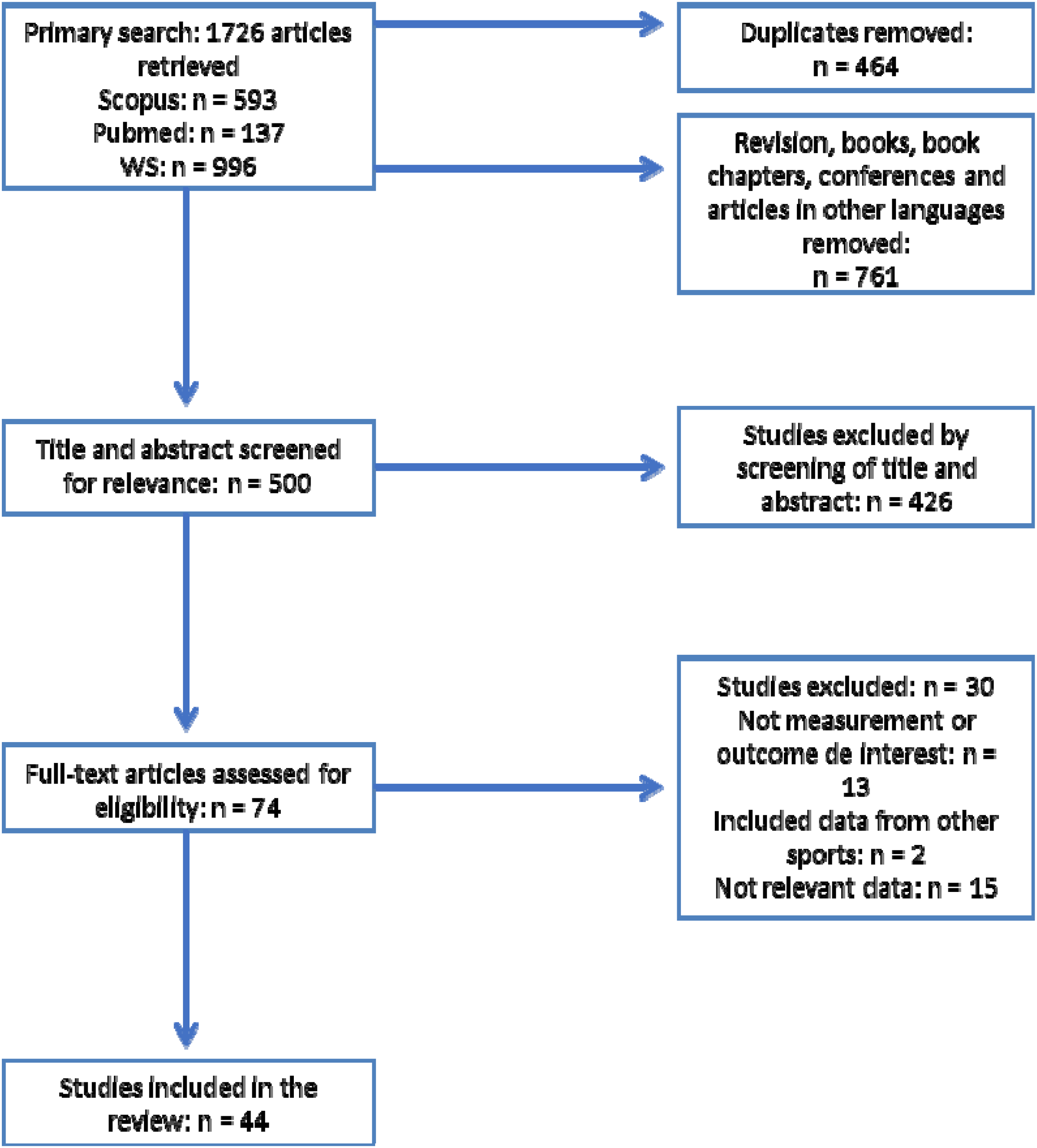
Flow diagram of the literature search.
In total, the 44 studies included 1736 participants comprising 1442 (83.1%) men and 294 (16.9%) women. Most studies recruited participants over 18 years of age (n = 24), with a lower number of studies with populations of 10-year-olds (n = 8), 11- to 14-year-olds (n = 7) and 15- to 17-year-olds (n = 7). In addition, most of the participants analyzed were classified as skilled in football (n = 26), followed by novice or inexperienced (n = 18) and less skilled with only 6 studies. All studies were published between 2000 and 2020.
Ten articles analyzed demonstrations, modeling, or verbal instructions (Table 1); 14 analyzed focus of attention (Table 2); 10 analyzed conditions of practice (Table 3) and 10 analyzed augmented feedback (Table 4). Of these studies, 30 analyzed only performance effects and 14 considered using learning tests (retention, transfer). Specifically, 41 studies looked at soccer-specific motor skills and 3 focused on small-side games performance. Thirty-six studies were performed in the field, while the rest (n = 8) were performed in a laboratory setting.
Summary of the demonstration, modeling and verbal instruction studies.
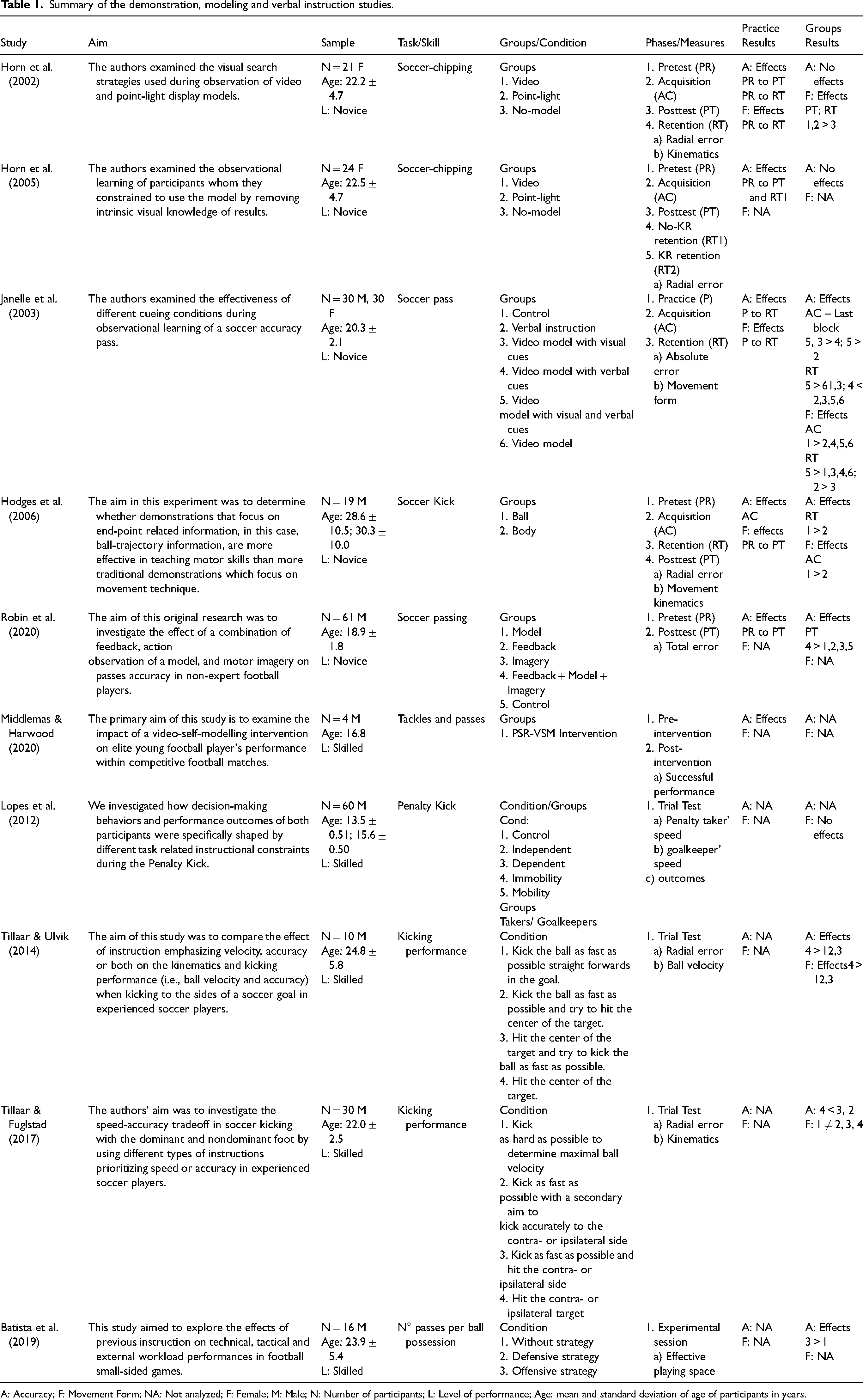
A: Accuracy; F: Movement Form; NA: Not analyzed; F: Female; M: Male; N: Number of participants; L: Level of performance; Age: mean and standard deviation of age of participants in years.
Summary of the focus of attention studies.
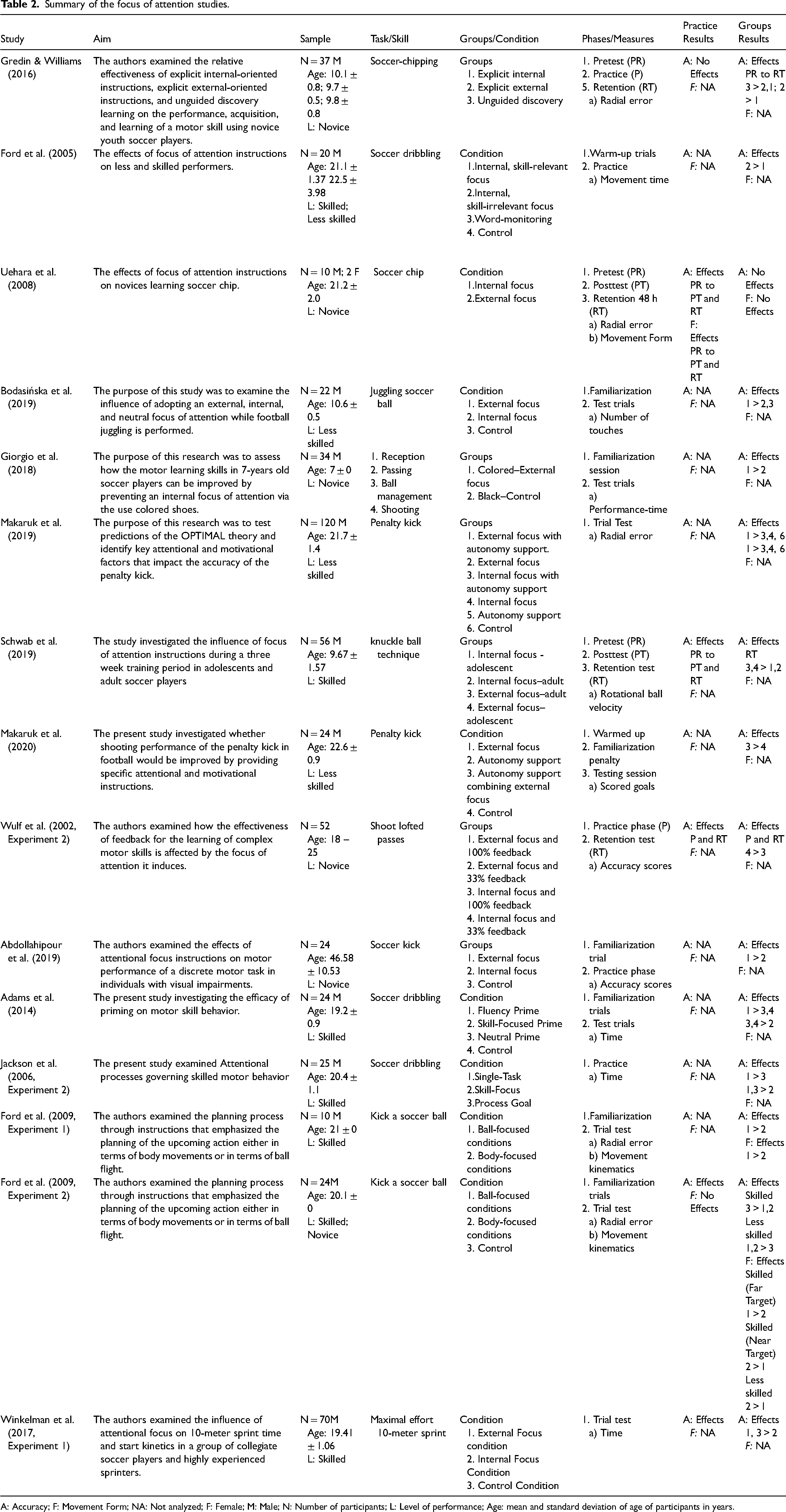
A: Accuracy; F: Movement Form; NA: Not analyzed; F: Female; M: Male; N: Number of participants; L: Level of performance; Age: mean and standard deviation of age of participants in years.
Summary of the conditions of practice studies.
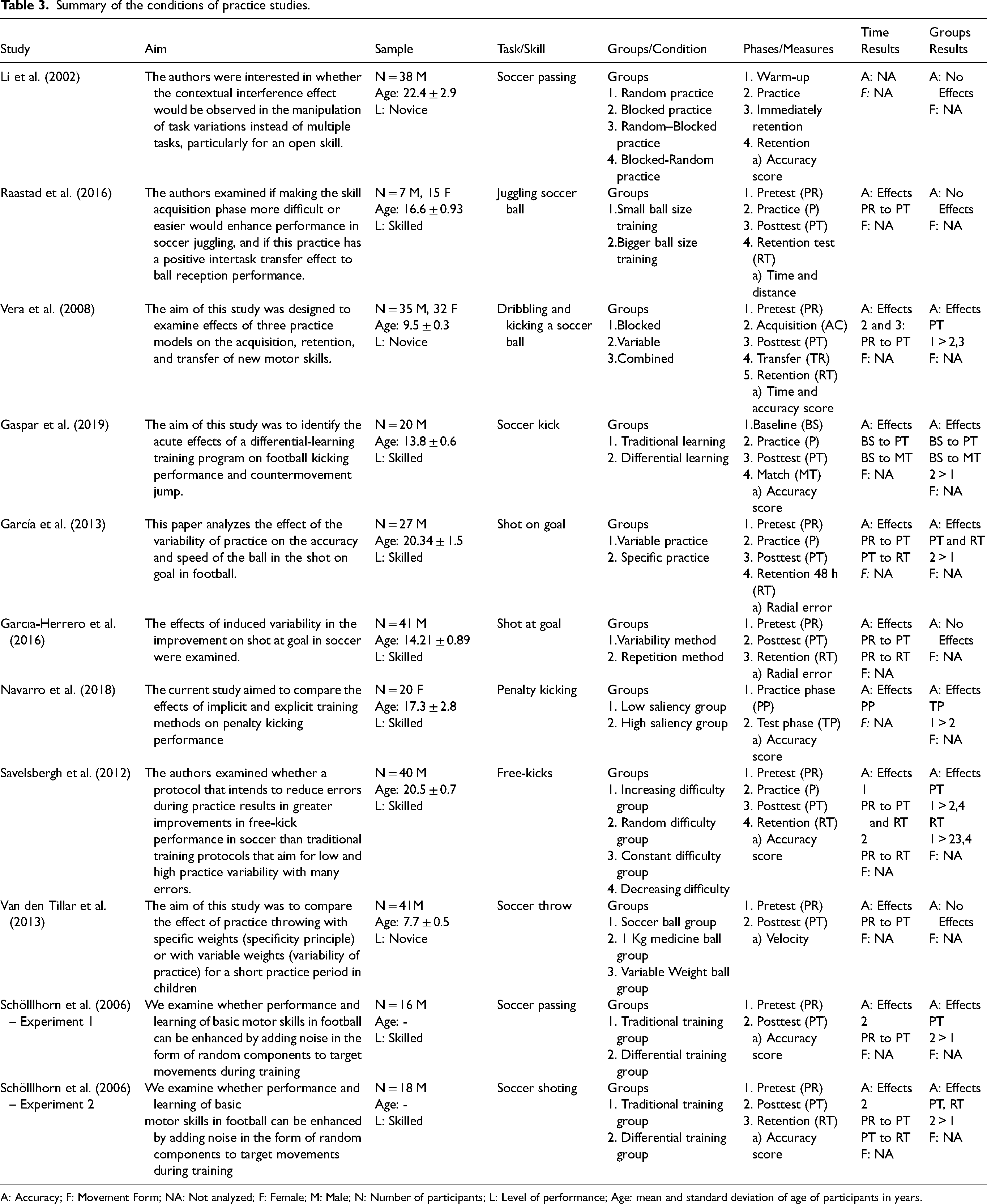
A: Accuracy; F: Movement Form; NA: Not analyzed; F: Female; M: Male; N: Number of participants; L: Level of performance; Age: mean and standard deviation of age of participants in years.
Summary of the augmented feedback studies.
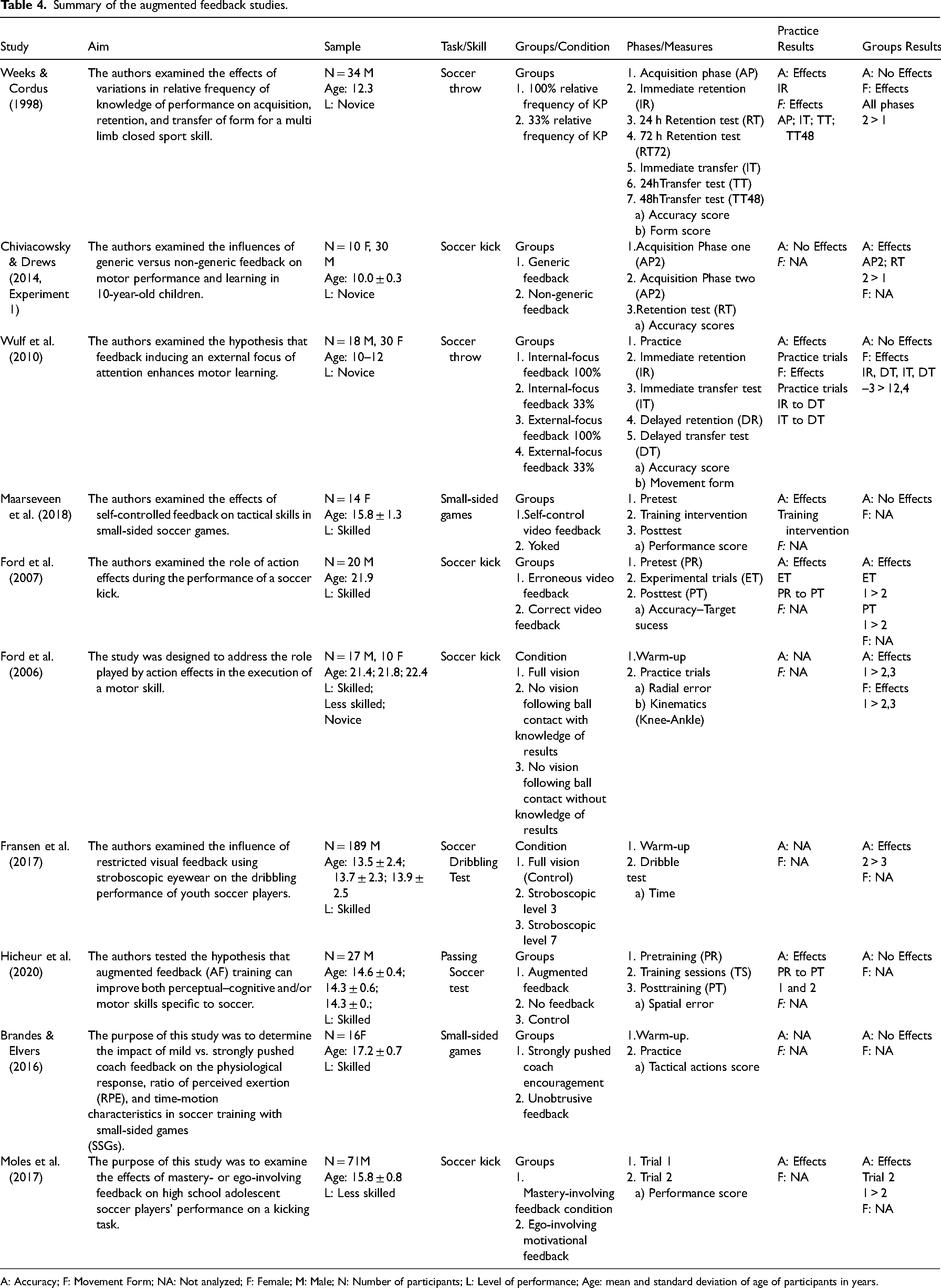
A: Accuracy; F: Movement Form; NA: Not analyzed; F: Female; M: Male; N: Number of participants; L: Level of performance; Age: mean and standard deviation of age of participants in years.
Considering the PEDro scale, we found a scoring of 5.16 ± 1.00 out of 11 criteria. This scoring refers to a modest quality of studies. This might reflect a tendency of motor learning studies to not report whether subject allocation was secret, whether the subjects were blinded to their manipulation, to not state eligibility criteria, and to not employ blinded interventions and evaluations. Supplementary Table 1 shows all the scores for all studies.
Demonstration, modeling, and verbal instruction
Table 1 describes the 10 studies found for Demonstration, Modeling, and Verbal Instruction in soccer. From these, nine papers assessed technical skills (all used measures of performance and four also described kinematics) and one assessed a tactical skill.
Six of these studies were related to demonstration. Two studies concerned with what aspect of the skill that must be demonstrated. Both studies converged to the idea that showing only the most valuable information seems to be either sufficient (point-light displays, 19 ) or even better (only the motion of the ball, 20 ) than showing the full body motion considering performance and movement pattern. Three other studies concerned with the interaction of demonstration with other factors. Robin et al. 21 showed that demonstration with feedback and imagery were necessary for better results in passing compared to any of these factors separated (and a control group). Janelle et al. 22 study goes in the same direction of the previous studies by showing that full body videos are superior only when accompanied by visual and verbal cues—identifying what must be observed. In a different direction, Horn et al. 23 showed that the positive effects of demonstration weakens (even comparing to a control group) when knowledge of results is limited in soccer chipping. All these studies had novices as participants and only Robin et al. 20 did not implement retention tests to measure learning.
Middlemas and Harwood 24 concerned with the actual implementation of demonstration in a training season to observe long-term results. They investigated how skilled athletes, during the season, responded (improved) when practicing tackles and passing with self-modeling videos. The athletes showed no changes in performance in this study.
Four studies focused on the effects of instruction on performance of skilled athletes—no study employed retention or transfer tests. Van den Tillaar and Ulvik 25 and van den Tillaar and Fuglstad 26 investigated the effect of emphasizing speed and/or accuracy on kicking performance, ball, and movement kinematics. They found that, for the first study, an accuracy instruction favored ball velocity and accuracy of the shot and, for the second study, that such requirements modified the movement pattern of the players’ knee and hip motions. Lopes et al. 27 investigated the effect of instructions to penalty takers and goalkeepers on penalty performance. The instructions referred to whether goalkeepers should stay still or be moving before the penalty kick (immobile/mobile conditions), and/or takers’ should decide the ball direction by looking at the goalkeepers positioning or not (dependent/independent conditions). The authors found that takers approached the ball faster in the control condition compared to the dependent condition and goalkeepers moved faster in the mobile compared to the control condition. Finally, in the only study analyzing tactical skills, Batista et al. 28 found that instructing the team on a more offensive strategy increased distance covered in small-sided games compared to no instructions or more defensive strategies.
Focus of attention
Table 2 describes the 14 studies (15 experiments) found for Focus of Attention in soccer. All of them analyzed performance and only one 29 considered movement kinematics. All studies considered learning (or performance of) a given motor skill; none considered tactical skills.
From all studies, we see three main questions investigated. The first, and most studied, is whether external focus is superior to internal focus and control groups (with studies including interactions with other manipulations). From these, we see that, in most studies, the external focus is the most beneficial.29,30,31,32,33,34 However, this is not unanimous. For instance, Uehara et al. 35 found no differences between internal and external focus and Gredin and Williams 36 found that an unguided practice was better than both explicitly guiding internal or external focus; both studies in learning the soccer-chipping. Abdollahipour et al. 37 found superior performance for external focus (compared to internal focus) but no effect of learning (the groups already started differently) in practicing the soccer kick. Finally, in a performance study, Winkelman et al. 38 found that feedback that induces internal focus of attention was worse than feedback inducing external focus and control conditions.
Probably given the result that the external focus is not always superior to internal focus, a second question that we identified was what are the factors that modulate focus of attention effects. The resulting picture is not clear. Wulf et al. (, 39 Experiment 2) showed that, when considering relative frequency of knowledge of results (33 vs 100%), there was only a difference between internal focus groups (groups which focused on their own movement pattern); the 100% feedback was superior. The external focus groups were similar in learning. Schwab et al., 34 considering adolescents and adults, found support for external focus in learning the knuckle ball technique. However, only adults showed learning (effects from pre-test to retention). The study of Ford et al. (, 29 Experiment 2) is also exemplary on the possibility that the focus of attention is dependent on other things. Looking at Table 2 we see that groups differed dependent on the location of the target (near or far) and the initial level of skill (less or more skilled). For instance, in terms of accuracy, for the far target, skilled participants had better results in the control condition (compared to either type of focus), while there were no differences between foci in the near target. For the less skilled, the control group had better results in the near target (compared to either type of focus) while the opposite was true for the far target. Movement pattern results also showed this dependence. Of importance, Makaruk and colleagues32,33 showed that only when the external focus of attention group had autonomy support (the group could choose the order of targets) that benefits of the focus were observed compared to internal focus and control group.
Finally, a question that is highly relevant for coaches was “does the location of the focus matter?”. Only Ford et al. 40 compared the possibility of focusing on skill-relevant or skill-irrelevant aspects of the soccer dribbling. In both, internal focus was employed. Their results showed that focusing on skill-irrelevant aspects was the most beneficial for performance. However, there were no retention or transfer tests—which prevents a discussion on learning.
Conditions of practice
Table 3 describes the 10 studies (11 experiments) found for Conditions of Practice in soccer. All studies only focused on movement outcomes/performance (no evaluation of movement patterns) and a single study considered tactical skills. We observed three main topics of discussion. The first, and most common, evaluated whether variable/random practice would be more effective in promoting motor learning than constant/blocked practice. The three studies with novices found no effects of groups when varying the passing, 41 when varying dribbling and kicking 42 and when varying parameters of the soccer throw-in. 43 These studies either did not find learning results (retention/transfer) or did not analyze them. The other five studies that evaluated variable practice, in skilled individuals, found no differences between groups in shooting to goal,44,45 or found a superior effect for differential learning (variations that aim to induce perturbations in the kicking pattern) compared to traditional training (variations in kicking position only) in accuracy (46,47—Experiments 1 and 2). For García et al., 44 García-Herrera et al., 45 and Schöllhorn et al. ( 47 —Experiments 1 and 2), all groups showed retention effects while Gaspar et al. 46 only investigated acute effects of training.
The second topic studied under Conditions of Practice was the difficulty that coaches must induce to foster motor learning. Two studies considered the issue. Raastad et al. 48 found that decreasing the size of the ball (increasing difficulty) did not affect performance of juggling soccer ball in skilled participants—no group showed learning effects. Savelsbergh et al. 49 showed that increasing difficulty during practice (increasing the distance from the goal and required height of the ball during the kick) led to better retention of the free kick than random difficulty, constant difficulty, and decreasing difficulty in practice. From these groups, only increasing and random difficulty showed retention effects.
Finally, a single study 50 investigated the effects of implicit and explicit training on penalty kicking performance by manipulating saliency of the difficulty of the task. One group practiced in a decreasing size of target condition where the changes were small (2 cm) from one trial to the next (low-saliency). The other group performed in a condition which changes in target size were random but changed each time by a minimum of 10 cm (high-saliency). The group who had low-saliency showed better retention than the high-saliency, which led authors to argue that implicit learning was more beneficial.
Augmented feedback
Table 4 describes the 10 studies found for Augmented Feedback in soccer. All studies considered a measure of performance with three also evaluating changes in the movement pattern. Two studies considered tactical skills. We identified four major questions asked. First, the question of whether augmented feedback was necessary—in addition to regular sources of perception of error (i.e., vision). The two studies provided mixed results. Hicheur et al. 51 showed no effects of augmented feedback on passing accuracy compared to a no-augmented feedback group in skilled athletes. Ford et al. 52 showed that kicking with vision of the ball trajectory after ball contact with added knowledge of results was the best condition compared to only knowledge of results or no information for both skilled athletes and novices. The results of movement patterns followed these effects. Note that Hicheur et al. 51 demonstrated general learning effects while Ford et al. 52 were only concerned with performance effects.
On a related theme, studies questioned how individuals use the vision of the ball trajectory. Ford et al. 53 showed that providing erroneous feedback of the ball trajectory (showing a lower height trajectory than the actual performed)—even with veridical knowledge of results—decreases performance and causes individuals to compensate the observed trajectory in skilled athletes. Fransen et al. 54 went in the same direction to show that decreasing the rate at which skilled athletes can track their dribbling also decreases their performance in a dribbling task. Both studies, nevertheless, were only concerned with acute effects of the manipulations.
The third question is how frequent a coach must provide augmented information? Weeks and Kordus, 55 using prescriptive knowledge of performance showed that a frequency of 33% was better for transfer than 100% in terms of movement pattern. The study showed no retention effects. Wulf et al., 56 considering an interaction with focus of attention, found that 100% knowledge of performance inducing external focus led to better results in performance and movement pattern during practice. Finally, van Maarseveen et al., 57 studying the performance on small-sided games, found that a group that could choose when to receive knowledge of performance (i.e., a self-controlled feedback condition) had no better performance than its yoked group during practice.
Lastly, three studies questioned effects of feedback in terms of their psychosocial features. For instance, Chiviacowsky and Drews 58 asked which type of feedback—generic or not—would facilitate acquisition of the soccer kick in novices. The difference between these types of feedback was in terms of whether it related to the skill being performed (non-generic) or to an inherent capacity of the person (generic). These affect how performers view their abilities: as fixed capacities or malleable skills. The study supported the usage of non-generic feedback. Similarly, Moles et al. 59 investigated mastery-involving or ego-involving feedback in the performance of kicking in novices. Ego-involving feedback emphasizes “natural” abilities and winning (e.g., “You must be a naturally talented soccer player”) while mastery-involving feedback relates to effort, self-improvement, and learning (e.g., “You must be a really hard-working soccer player”). The authors found a superior result for mastery-involving. Brandes and Elvers 60 compared tactical results comparing pushed coach encouragements with unobtrusive feedback in skilled athletes and found no results in performance.
Discussion
To organize and implement pedagogical strategies inside the soccer field is a challenge that is still far from being surpassed, despite being a soccer coaches’ daily concern. Williams and Hodges 1 presented criticisms on “traditional” thinking implemented by coaches and offered new ways to look to practice. In this paper, we evaluated how the area empirically addressed such criticisms through a systematic review. Below, we, first, discuss whether such myths hold in face of current empirical results; second, discuss the main questions asked and, third, provide our view that might help coaches in integrating our results.
Discussing the myths
There are reasons for an applied field to not be directly in touch to the most updated knowledge in academia. One can think that Williams and Hodges 1 criticisms were based on two of them. First, the criticisms were partly based on a common delay that scientific knowledge presents in reaching daily life practice. This is expected given one should always be careful to generalize specific scientific findings to everyday practice. However, this is not the main reason for their criticism. Williams and Hodges 1 pointed out an avoidance to modify ongoing practices when knowledge is available. Neglecting robust scientific evidence is not only counterproductive but also dangerous. Nonetheless, one should always ask whether the criticism is valid. Most arguments were based on laboratory-task-based studies that might not generalize to soccer practice.
The first myth discussed by Williams and Hodges was that “Demonstration is always effective in conveying information to the learner.” Their argument was based on the idea that demonstrations were necessary only if learning a movement pattern was the “goal” of the instruction; else, it would be overly constraining. How constraining a demonstration is still needs to be addressed empirically (even if contemporary views share such assumption, see61,62). However, in line to their arguments, the studies found that less than the whole-body demonstration is sufficient for learning19,20 and demonstrations directed by cues are preferred. 21 Nonetheless, studies failed to find a negative influence of demonstration—at least when compared to controls or other manipulations 23 —in learning these skills.
The second myth is “specific, blocked practice of a single skill is essential for skill learning.” Their argument against the statement was based on the at-the-time convincing results on contextual interference (see 5 ). Nonetheless, the issue is less clear than what Williams and Hodges suggested. First, most studies that found some effects of variability during practice were only interested in acute effects 46 (but see 47 )—something that is in direct contrast to the contextual interference phenomenon (decreased performance in practice, increased retention, and transfer). Second, the positive effects of variability were present only in skilled individuals (something acknowledged by Williams and Hodges). Third, two studies found no differences despite both “repetitive” and “varied” groups showing retention results.44,45 Thus, it might be that specific, blocked practice of a single skill might not be inferior to variable and/or random practice.
The third myth posed was “Augmented feedback from a coach should be frequent, detailed and provided as soon as possible after the skill has been performed.” Their argument opposing the statement was based on the “classic” empirical evidence on reduced frequency of feedback, 63 summary of feedback, 64 fading-out feedback 65 (for a review, see 2 ). Our results are not fully supportive to the claim. Despite Hicheur et al. 51 showing no increased performance for providing augmented feedback when there is availability of internal feedback (vision) and Weeks and Kordus 55 showing that less knowledge of performance was beneficial, Wulf et al. 56 claimed that this was dependent on whether the feedback would induce external/internal focus—with 100% feedback inducing external focus being the most powerful in practice. Also, Weeks and Kordus 55 found no group effects in the retention tests—only in transfer.
The fourth myth was “Prescriptive coaching is always better for skill acquisition than instructional approaches based on learning by guided discovery.” Their argument was based on the idea that it is possible that guiding instead of prescribing is a more successful coaching style. While the present review only focused on specific aspects of practice, we claim that the general results are not in favor of this claim. All studies that compared specific instructions with control groups did not have “worse” performances when assessing retention or transfer. Even, when considering the “autonomous” feedback schedule (i.e., the self-controlled feedback frequency), results do not favor such point. 57 A question that fits to the discussion and relate to one posed for the first myth is how much a prescriptive coaching style constrains behavior. It could be that, in line to the dynamical systems theory,66,67 prescription is impossible as no one can control all aspects of practice prescribing practice's outcome. In the end, individuals are always searching in their own ways and finding their own solutions 68 and the coach (despite what he/she thinks) is just part of the overall search process.
Finally, the fifth myth posed was “Game intelligence skills are not amenable to practice and instruction.” Different than the previous four myths, Williams and Hodges contrasted this statement based on well carved studies directly addressing or implementing sports skills. Despite not being on soccer per se, these studies on other sports showed that game intelligence could be acquired through practice. This is sufficient to challenge the view that game intelligence was something inherited/ innate as “tradition” would hold.
The state of the art in the soccer scientific literature
Despite our attempt to evaluate Williams and Hodges 1 arguments, one main result of this systematic review is that there are few studies investigating technical and tactical skill acquisition in soccer. For instance, we found only four studies that concerned with instructions on soccer,25,26,27,28 the main concern for a coach during practice. More important, we found only one study 24 that observed whether the employed manipulations had effects on actual matches—the main outcome for coaching. Thus, a first message is that the field still requires more studies to assess how a coach should organize and implement his/her practice.
There are two other gaps here. First, there is a large majority of studies investigating a given motor skill acquisition rather than tactical skills. This might be an effect of our decision to search for common aspects of learning that the coach manipulates. For this reason, the present review might have included more studies that are concerned with testing theoretical postulates, implementing soccer skills just as a part of the experimental paradigm. Thus, how to instruct players in terms of tactical skills seems to be an open field—relegated, mostly, to studies on small-sided games. Second, despite the emphasis on motor skills, few studies analyzed the kinematics or kinetics of the movement patterns being learned. This supports the idea that these studies were more concerned in investigating theoretical hypotheses (framed in terms of performance rather than kinematic variables) than the actual sports skills assessed. The addition of movement kinematics analysis (investigating the actual coordination pattern) might facilitate comprehension of the actual changes that occur in the motor skill being learned. This would help to deal with issues of individuality,61,69,70 and avoiding the limitation to comprehend the mapping between movement outcomes and movement pattern.
Another point that limits the consideration of these findings is that the studies varied in terms of intervention days. Considering that these skills might involve longer time scales of practice to demonstrate qualitative changes, there are few studies conducted for longer than 5 days (11 only, majority in the conditions of practice category). As it is the case for the motor learning literature overall, the literature still does not understand how a given manipulation during practice might elicit long term changes in soccer. Again, this is problematic as expertise (or even a satisfactory level of skill in soccer) takes years to develop and differences observed given manipulations in the short-term might be attenuated (or dissipate) in the long-term.
We found large variation in how much studies are concerned with theoretical or practical aspect of the categories reviewed (e.g., focus of attention, demonstration, augmented feedback). While some studies provide results that coaches can apply directly, others are questioning mechanisms that would base learning under the given condition. For instance, we found studies in demonstration considering how to implement the demonstration. Janelle et al. 22 was the most representative for coaches. They examined the effectivity of different instructional conditions. On the contrary, point light displays 19 and less than whole-body demonstrations 20 seem far from the real context of soccer. This decreases even further the number of studies that could base coach practices.
For focus of attention, the main question seems to be mostly directed to whether internal or external focus is more beneficial. Despite general claims pointing to external feedback, 71 there were more nuances than expected. Luckily, the literature already started to consider potential interactions between focus of attention to other aspects of practice (e.g., autonomy support, knowledge of results provision, level of skill,29,32,33,39). An interesting direction might be to, beyond considering these interactions, address how everyone accommodates one or other focus (e.g., 72 ), an issue not discussed in the reviewed studies.
On Condition of Practice, the literature is still uncertain about whether and how to induce variation in practice. Even if one disregards the results, there is not a comprehensive study comparing all the degrees of variation—from constant practice to differential learning (see 73 ). It is important to consider how the skill level of the individuals interacts with induced variation and long-term retention/transfer. A related question, that the literature needs to keep on investigating, is how to manage difficulty, as few studies seemed to concern about that. Note that the issue on difficulty is a major consideration that would naturally encompass individual level and task complexity (see 8 ).
Finally, on Augmented Information, there is a broader series of questions that should be followed upon in future studies. These encompass the traditional questions on frequency and knowledge of results/ knowledge of performance administration, but also new ones that concern about the psychosocial effects of feedback. This is an optimistic scenario: there is interest! This is important for soccer as there are too many possibilities in a real setting in how and when to administer feedback. We are still lacking studies on the topic, especially if we consider that feedback returned as a main topic for the literatures on self-controlled practice74,75 and self-efficacy.76,77 The direct and interactive effects of knowledge of results (and knowledge of performance) in motivation and learning are still to be fully unraveled.
Finally, we did not include in our review but there is a growing literature on the behavior of coaches. These include not only the description of how coaches behave78,79 but also interventions in their behavior.80,81 To a degree, these papers are the ones that directly address the issues of modifying coaches’ practices and, thus, would be most related to solving Williams and Hodges 1 criticisms. The issue goes beyond the current paper as it touches on coaches’ attitudes toward practice rather than how factors of practice must be manipulated. Nonetheless, this seems a fruitful pathway if one is willing to overcome barriers such as the one discussed here from motor learning to teaching practice.
What can a coach do?
The message from the present discussion is that more needs to be done to consider Williams and Hodges 1 arguments. On the good side, alternative solutions (e.g.,47,82) emerged after Williams and Hodges 1 manuscript. These solutions treat and discuss the same aspects (e.g., augmented feedback, variability of practice, focus of attention) through new perspectives. There are approaches, pedagogical models, theoretical models recently presented that would not oppose, for instance, blocked to random practice in the same way as Williams and Hodges did (e.g., constraints-led approach, 83 nonlinear pedagogy, 84 teaching games for understanding, 85 ecological dynamics 82 ).
Nonetheless, even these new advances need more studies to guide specific parts of practice. In fact, the area of motor learning, as we hope to have demonstrated, is not yet at the position to provide general guidelines of practice—be it in soccer or any other applied field. One can enumerate issues in all categories discussed above (see, for instance,4,7,74,86) and the current results demonstrate that.
The main problem is the lack of consideration of the constraints 11 in the general statements made about common manipulations in motor learning. The pattern of findings might be instances of a given set of constraints rather than general statements (laws) of learning: it is not that variable practice (or any other manipulation) does x or y; it happens to do x or y when task and organism constraints are a and b. These manipulations might have general features that we will keep failing to understand if we disregard the constraints.
How to encompass all these results under a single (and useful) view for practice? Our group has been pushing the idea that change (be it at the technical or tactical level) is a process of search. 61 This search occurs in terms of individual (or team's) tendencies in perceiving and acting and the relative difference of individual (team's) tendencies to the task requirements. The role of the coach is to guide the learner motion through a landscape of information to attend and potential actions to perform, also noting the effects of these changes on performance. Learning would occur as the learner attends most useful informational variables and responds in terms of more efficient and effective movement patterns.61,87,88 Note that, in line to the dynamical systems approach, motion through or changes in this landscape bring instability into the system and the coach must be aware of how to deal with this.
This view seems suitable as it starts from the consideration of the task and perceptual-motor constraints (task space and perceptual-motor workspace). That is, the manipulations and their potential effects are dependent on the perceptual-motor workspace and its relation to the task space. Considering the specifics of soccer, coaches and researchers will understand the outcome of practice considering the constraints that organize the relation between organism, environment, and task. One can raise the question: If everything is dependent on specific constraints, how can one consider general ways to act?
We think that there are general principles of practice that coaches would be able to follow; these can be extracted beyond the specifics of constraints. b To understand, or intervene, in a specific scenario (e.g., is demonstration appropriate for this situation?), constraints must be acknowledged. However, there is a potential principle (way of working) that would be general for every situation on which demonstration, for instance, is used. Figure 2 summarizes the ideas discussed below.
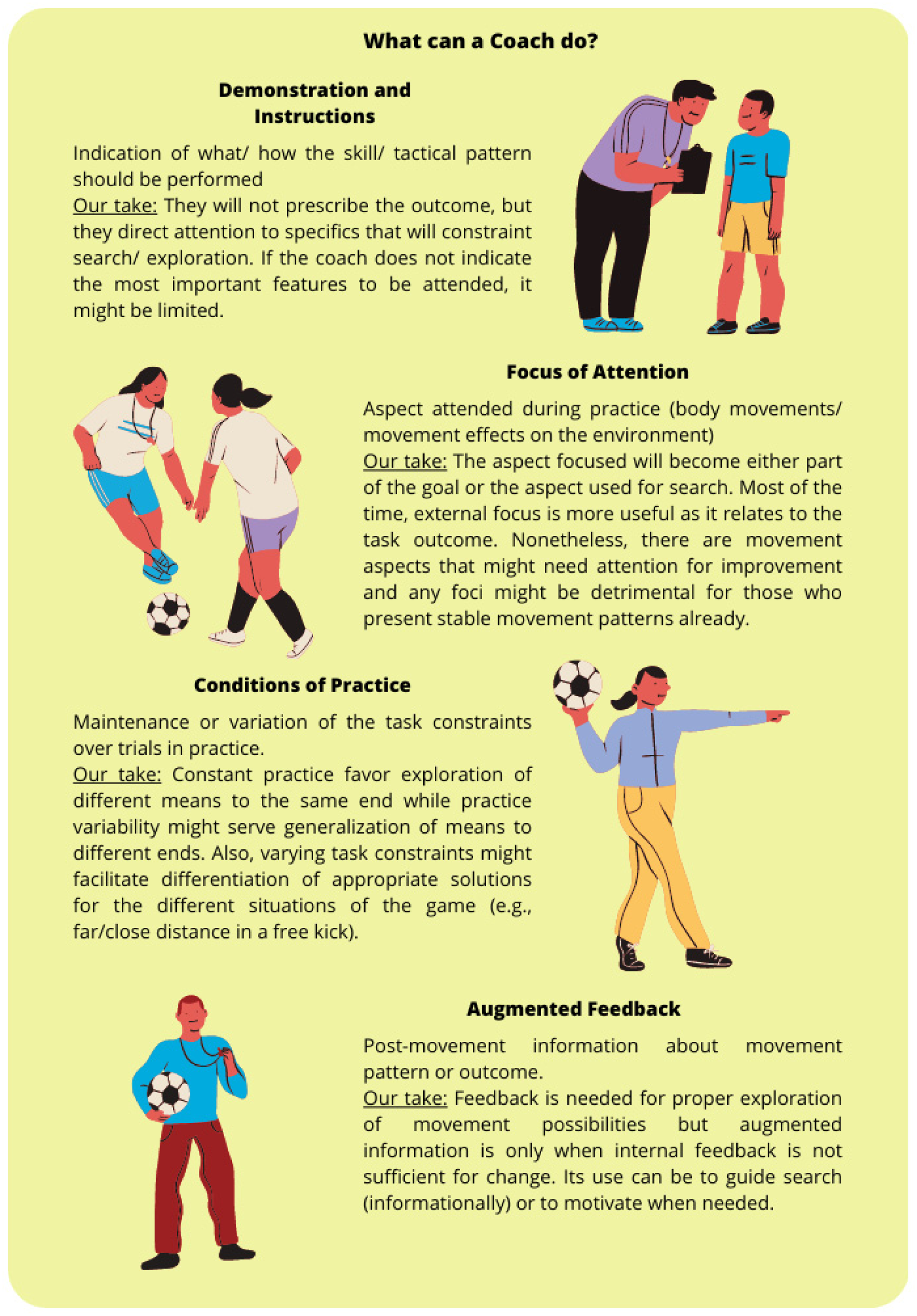
Summary of the suggestions for coaches considering the learning aspects reviewed in this manuscript.
Demonstration and verbal instructions provide a range of aspects of the movement that individuals can focus, guiding the next attempts/trials that the individual will perform. Individuals will inevitably follow aspects of the demonstration (or instruction) to modify their movement pattern. This aspect focused becomes part of the task for the individual—this constrains the search in terms of this aspect. 62 For instance, a kicking technique (as the knuckle ball 34 ), has peculiarities (small jump after the kick) that, if instructed or demonstrated, individuals might attempt to perform. Whether such peculiarity is a result of all the motion of the body or something that the coach must instruct is something that we still do not know, but the fact is that the individual will be using this as a constrain in their search. This might be non-useful. Note, however, that, if the aspect attended is useful for learning, then these types of manipulation will lead to positive change. It is not surprising, then, that “unguided” demonstrations are not as effective19,20,21,24 when compared to guided ones.
In terms of instructions, the results follow above idea as all studies demonstrated that instructions influenced how learners performed the task—instruction, then, is changing the constraints of the practice task.25,26,27,28 Thus, one must consider that demonstrations/instructions are not problematic as thought by Williams and Hodges. 1 The issue lies in that demonstrations/instructions (or more generally, “prescriptions”) might not be as constraining to guide search—directing attention might be the main point.
On this point, the results on the focus of attention are interesting. In general, the idea that the focusing on the effects of movements on the environment shows positive results (compared to internal focus). 71 This makes sense as it is in the effects on the environment that one is evaluated in the task and, thus, search should be, preferentially, directed to it. Note that the results were not unanimous, focus of attention depends on other factors. The divergent results seem to demonstrate that, while for most tasks directing focus to external aspects seems useful, there are aspects that still need to be considered in the focus of attention literature. One, there might be some redundancy between internal and external foci. There are potential cases where important aspects of the movement might be equally sufficient to achieve good results in the task (e.g.,89,90). Two, results have demonstrated that, for experts, attempting to modify well-stabilized perception-action coupling through inducing any focus of attention might be problematic. 91
One must also consider the myth on blocked practice being essential (in comparison to random practice) through new lenses. Following, 92 these types of practice emphasizes distinct aspects of the skill: while constant practice favor redundancy exploitation (e.g., different kicking patterns that place the ball at the same spot in the goal), varying constraints would favor generalization (e.g., a kicking pattern that is suited to place the ball in different spots in the goal). Also, considering the nonlinear nature of the constraints, varying constraints might allow individuals to differentiate responses (e.g., perceive that the instep kicking pattern is not useful for large distance free kicks) and demonstrate better decision making (e.g., modify the kicking pattern to a straight kick). More recent studies have shown that continuous variations of task or instructions might be useful in keeping the search going—increasing creativity.93,94 Note that, if the task is redundant (it allows different movement patterns to reach the same goal), individuals practicing in a constant regime might end up being similar to those in a variable regime.95,96 In line with this, in our results, we found no differences between groups in most cases; only the differential learning approach led to differences in expert individuals (for three studies).
The myth on augmented feedback frequency also changes when one considers our view. We have previously found that how feedback relates to the task space modifies how individuals modify their behavior in a trial-to-trial basis 97 and that such relation can also vary considering motivational issues.76,77 Also, information about task and perceptual-motor workspace might be available only through feedback in cases. Thus, an issue might not be about more or less feedback, but how much these are necessary for search or how must these constrain the search. An example, in line with these ideas, is that an individual that is already modifying its attempts to perform the task considering the observed outcomes, might not need augmented feedback. Clearly, knowledge of performance (in the prescriptive sense) might be useful to guide change if one sees the learner “stuck” in a range of bad solutions. Knowledge of results might also be useful to motivate if motivation and search is decreasing. In line to these thoughts, when allowed to decide when to receive feedback, individuals seem to vary in their needs. 75
Most studies found were related more to information manipulation (of movement or ball trajectory) influences on movement pattern and learning. From those studies which considered variations of knowledge of results and performance, we found 55 that less knowledge of performance favored transfer (but equal retention) than more knowledge of performance. This might relate to an effect of 100% of information about the movement pattern over constraining the individual search (decreasing generalization). Also, self-controlled knowledge of performance did not differentiate performance in small-games performance 57 : sufficient feedback amount for one group could have been sufficient for the second one.
Limitations
The present systematic review has, at least, two important limitations. First, in discussing the myths proposed by Williams and Hodges 1 and in presenting our results, we based ourselves in terms of statistical significance to describe results of the papers found in our review. This is no different than what Williams and Hodges 1 performed when discussing results from “classic” studies. However, as it is more acknowledged today, statistical significance is limited by several factors (e.g., sample size, effect size) and one cannot consider the lack of statistical significance as evidence for the lack of effect (see 98 ). Nonetheless, each study found here was almost unique in terms of its manipulations and, different than other areas, the papers fail to reach a satisfactory level of homogeneity in design and individual characteristics to use an encompassing measure of effect size. More important, this review encompasses a period on which was not common for authors to, first, state the effect sizes and, second, to share the data to allow reanalysis. This puts further pressure on future studies to replicate and extend current findings. To avoid overemphasizing given results, we tried to also give emphasis to the questions currently asked in the area which show how the area might be already moving to a new status.
A second limitation is that the usual implementation of studies on aspects of practice and instruction disregard the fact that soccer practice and learners technical and tactical development is not a single session (or few sessions) endeavor. Nonetheless, we focused on these studies. What might be missing, in fact, is a more coherent (and longitudinal) research on general soccer programs that encompass emphases to specific manipulations rather than others, measuring both technical and tactical training and, more important, consequent match performance. This would clearly require integration to fields such as motor, cognitive, and social development as to give soccer practice its required attention. Only then, one will be able to claim what is to be the next tradition.
Supplemental Material
sj-docx-1-spo-10.1177_17479541231168930 - Supplemental material for Challenging traditions: Systematic review of practice, instruction, and motor skill acquisition in soccer
Supplemental material, sj-docx-1-spo-10.1177_17479541231168930 for Challenging traditions: Systematic review of practice, instruction, and motor skill acquisition in soccer by Matheus M Pacheco, Luiz M M de Oliveira, Carlos C A dos Santos, José R M Godoi Filho and Ricardo Drews in International Journal of Sports Science & Coaching
Footnotes
Declaration of conflicting interests
The author(s) declared no potential conflicts of interest with respect to the research, authorship, and/or publication of this article.
Funding
The author(s) received no financial support for the research, authorship, and/or publication of this article.

Supplemental material
Supplemental material for this article is available online.
Notes
References
Supplementary Material
Please find the following supplemental material available below.
For Open Access articles published under a Creative Commons License, all supplemental material carries the same license as the article it is associated with.
For non-Open Access articles published, all supplemental material carries a non-exclusive license, and permission requests for re-use of supplemental material or any part of supplemental material shall be sent directly to the copyright owner as specified in the copyright notice associated with the article.
