




Abstract
In response to calls for examples from sports settings that highlight successful collaborations between skill acquisition specialists and coaches, this study evaluated the effectiveness of a skill acquisition coach education intervention. After an analysis of practice by a skill acquisition specialist, which provided context to impact learning design, two senior coaches from British Para Swimming with no prior knowledge of skill acquisition principles were observed and interviewed. The intervention harnessed coach experiential knowledge by emphasising development in understanding of theory underpinning three key principles of skill acquisition (i) implicit learning, (ii), focus of attention, and (iii) contextual interference, and encouraging informal and experiential learning between sessions. Following the intervention, coaches had adapted their approach to practice design to incorporate theory-informed techniques. Coach observations and interviews highlighted a range of novel findings in skill acquisition. First, outcomes indicated the use of implicit learning techniques in the form of analogy or metaphor cues can facilitate learning for athletes with intellectual disabilities. Second, coaches reported the learning benefits of utilising external and holistic focus cues in the elite athlete setting. Finally, through an increased understanding of the learning-performance distinction, coaches described the benefits of incorporating contextual interference, which emphasised temporal spacing between learning events. The coaches’ interpretation and implementation of skill acquisition theory are discussed with reference to potential avenues of exploration in future research.
Introduction
The skill acquisition specialist has been described as a sport scientist who examines the theories and processes underpinning motor learning and control and works closely with coaches and athletes to help translate research into practice. 1 Despite potential for skill acquisition to inform coaching and enhance athlete development, there is a disconnect between scientific theory and applied practice.2–4 Concurrently, there remain fewer skill acquisition specialists collaborating with coaches than there are practitioners from any other sport science field.5,6 To bridge theory and practice, researchers have called for more examples of successful collaborations between skill acquisition specialists and coaches in sports settings. 6 In response to this call, here we document two case study examples of such collaborations in elite Para swimming.
A major challenge for skill acquisition specialists is to identify the gaps between existing research and current applied practice to provide context to begin to impact learning design. 7 In our investigation into coaching practices at British Para Swimming, 2 discrepancies were highlighted in relation to three established lines of enquiry in skill acquisition literature, (i) implicit learning, (ii) focus of attention, and (iii) contextual interference. Consequently, the focus on these skill acquisition principles will now form the basis of the design, delivery, and evaluation of a six-week coach education intervention for elite coaches on the British Para Swimming programme.
Implicit learning refers to the acquisition of skills in the absence of explicit information about how the skill should be performed. 8 This is contrasted with explicit learning, where acquisition is accompanied by a conscious understanding of skill rules. 8 Findings indicate implicitly learned skills are less susceptible to performance breakdown (or ‘choking’) under pressure, as attempts to consciously control or ‘reinvest’ movements are inhibited by lack of access to explicit skill knowledge. 8 Consequently, performance is reliant upon more adept automatic (or implicit) control processes. 8 In the sport or performance context, metaphor or analogy learning cues have been shown to facilitate implicit learning. Specifically, analogies camouflage explicit movement information by coding it symbolically. In this way, rich information is ‘chunked’, and the complexity of the skill integrated into a simple biomechanical metaphor requiring fewer working memory resources. 9 In swimming, the adoption of a more automatic mode of motor control as a function of analogy instructions was demonstrated by Komar et al., 10 who reported analogies improved movement efficiency during the underwater phase of the breaststroke.
Focus of attention research is based on the premise that not all coach instructions are optimal for the acquisition of skills. Like implicit learning, it is suggested instructions should seek to facilitate a more unconscious neural self-organisation through ‘goal-action coupling’ to promote effective and automatic movement planning and execution. 11 Typically, this is supported by guiding a performer's attention towards task-specific factors, thereby prioritising perceptual information which is also contextually relevant.12,13 In this way, performance and learning in, for example, aiming tasks (e.g., golf or darts) can benefit from external focus cues (i.e., a focus towards the target or movement effects).14,15
Where external foci are challenging to identify (e.g., in non-implement tasks), holistic focus cues, which conceptualise the feeling of the movement overall (e.g., ‘a smooth rotation’, ‘explosive on the breakout’) have been shown to confer similar learning benefits.16,17 In contrast, tasks which require the performance of aesthetic/form skills with high precision could also benefit from relevant internal foci (i.e., a focus on component parts of the body movement).13,18,19 Additionally, it is suggested increased bodily focus, or ‘somaesthetic awareness’ during practice may be required during initial stages of technique change or refinement to destabilise ingrained movement patterns before later (re)automatising skills via external focus. 20 In relation to swimming, research has reported external focus cues (e.g., ‘push the water back’) enhance performance relative to internal cues (e.g., ‘pull your hands back’).21,22
Contextual interference describes the inverse relationship between motor performance (i.e., immediately observable, short-term behaviour) and learning (i.e., long-term retention and transfer) as a function of practice scheduling. Specifically, repetition or ‘blocked’ skill practice (e.g., AAA BBB CCC) improves performance but impairs learning, while task-switching or ‘random’ practice (e.g., ACBABCACA) impairs performance but enhances learning.
23
This learning benefit through practice variability is explained via cognitive mechanisms which operate as a function of switching back and forth between skills involving the repeated (re)construction
24
or elaboration
25
of memory traces, or between skill variations (e.g., AA
In our analysis of coaching practices at British Para Swimming in relation to these learning principles, 2 we reported that in contrast to most of the recommendations of best practice, coaches utilised more traditional explicit approaches to coaching, emphasised internal focus cues, and incorporated low levels of variability. Interviews revealed coaches had no formal knowledge of skill acquisition principles, which is perhaps unsurprising given the lack of skill acquisition information in formal swimming coach education or certification resources. 29 The findings then provided a framework for subsequent interventions with coaches at the National Performance Centre and facilitated the skill acquisition specialist's ability to influence coaching practice and bring learning strategies more in line with theory-informed approaches. 7
In the analysis of practice coaches also did not report significantly changing their approach for athlete disabilities beyond more obvious adaptations for physical and intellectual constraints. 2 Again, this could be explained by the lack of formal guidance available for coaching disabled athletes.30,31 However, theory-informed guidance has begun to emerge particularly in relation to coaching athletes with intellectual disabilities, 32 who at the time of writing make up 34% of the British Para Swimming Team and a large proportion of athletes in Parasport. Recommended strategies are based on limited cognitive abilities which can impair the processing and retention of coach instructions and include simple and repetitive coach cues and the gradual introduction of contextual interference techniques.32,33
Considering the cognitive characteristics of intellectual disabilities, i.e., reduced working memory capacity and the relative preservation of implicit memory mechanisms,34–36 it is possible more implicit learning techniques, which place less demand on working memory resources, are also advantageous for learning. For example, adopting an external focus reduces working memory involvement in favour of more automatic or implicit motor control structures through neural self-organisation in response to the task goal. 37 In line with this, it has previously been reported external focus can facilitate motor learning in children with intellectual disabilities. 38 Additionally, analogy cues have been shown to benefit motor learning in children with autism spectrum disorder. 39
In previous examples of successful skill acquisition interventions, changes to practice design have been implemented by embedding a skill acquisition specialist in the daily training environment – an approach suggested as necessary to develop appropriate working relationships and sport-specific knowledge.5,31 However, many Olympic and Paralympic organisations, including British Para Swimming, operate on a de-centralised programme, where most coaches and athletes are based remotely in clubs across the home nations. In this context, embedding a skill acquisition specialist in the daily training environment is not possible.
A potential solution to address barriers to the integration of skill acquisition expertise across such programmes lies in coach education. However, formal education processes, such as coaching workshops, have been ineffective in changing practice, 40 and coaches report a preference for learning ‘one-to-one’ 41 and informally via experiential learning. 42
Hence, the current study explored the effectiveness of a coach education intervention which acknowledges learning preferences. Specifically, in a follow-up to our practice analysis, 2 two senior coaches from British Para Swimming with no knowledge of skill acquisition principles participated in a one-to-one educational approach conducted by a skill acquisition specialist with experience in the sport. This placed an emphasis on developing the coaches’ understanding of theory underpinning implicit learning, focus of attention, and contextual interference, and encouraging coach experiential learning between sessions. In this way, it was hoped coaches would be facilitated in harnessing their own experiential knowledge in their approach to practice design and begin to identify and implement learning strategies more aligned with research-informed techniques, when and how they saw fit.
Method
Participants
Two male SEQ (Swim England Qualification) Level 3 swimming coaches took part in the study. SEQ Level 3 is currently the highest swimming coach qualification. Coaches were approached to participate by the skill acquisition specialist based within the British Para Swimming (BPS) team having been previously approached to take part in the initial practice analysis. 2 At the time of the intervention, Coach 1 (C1) was 40 years of age with 18 years coaching experience in total, eight years coaching Para athletes, and was part of the coaching team with BPS at the Tokyo Paralympic Games in 2021. He was the Head Coach of a large swimming club comprising mostly non-disabled swimmers (this is typical of Para swimming coaches, where Para swimmers are regularly based remotely rather than in National Performance Centres) and three Para swimmers who have subsequently been selected for the Paralympic Games in Paris 2024. One of these swimmers won two Paralympic Gold medals in Tokyo 2021. Coach 2 (C2) was 38 years of age with 17 years coaching experience in total, 11 years coaching Para athletes, and was a national level Para swimming coach. He has experience coaching seven internationally classified Para swimmers and 25 Para swimmers through the England talent development pathway who subsequently became internationally classified. C2 also holds a Swim England Coaching Tutor qualification which allows him to deliver and assess coaching courses.
As part of the current analysis, C1 coached a non-disabled 16-year-old nationally competitive male swimmer during pre-intervention, and another non-disabled 16-year-old nationally competitive male swimmer during post-intervention. C2 coached an experienced 20-year-old internationally competitive male Para swimmer during pre-intervention, and a 24-year-old Paralympic Silver and World Championship Gold medallist male swimmer during post-intervention. Different athletes were used for the pre- and post-interventions due to logistical and time constraints, and the nature of elite level sport (e.g., injuries, competitions, and training cycles). Both of C2's swimmers were internationally classified as S14 athletes – denoting intellectual disability, and both were matched for the severity of their impairment as a function of their psychometric testing during classification. Consistency in experience level and disability classification across athletes for both coaches was a selection criterion to account for potential differences in coaching and learning strategies as a function of individual differences.
The education intervention and all observations and interviews were conducted by the skill acquisition specialist and first author of this study. At the time of the intervention, he was 37 years of age and had been based full-time at BPS within the National Performance Centre in Manchester for five years. Through immersion in swimming and the coaching environment, he had acquired sport-specific knowledge to facilitate relevance, confidence, and empathy in the education process. He had also built a friendly relationship with the coaches through various informal meetings and competitions which facilitated the interpersonal knowledge or ‘soft skills’ essential to successful working relationships between support staff and coaches. 43
Ethical approval to conduct the study was provided by Manchester Metropolitan University Faculty Ethics Committee. All participants gave written informed consent before data collection.
Procedure
Coach observation
Coaches were observed delivering a one-to-one coaching session with their athlete both pre- and post-intervention. The pre-intervention observation was conducted as part of the practice analysis presented in Powell et al. 2 Post-intervention observations and interviews took place ten weeks after the final coach education session (see, Figure 1). On both occasions, coaches were asked to design and deliver a session, lasting anywhere between 60–90 min (i.e., the typical duration of a training session at BPS minus the warm-up and ‘swim-down’), with a focus on learning technical skill/s. Sessions were video recorded using a Sony Handycam camera and coaches were fitted with a WM8S UHF Wireless Lavalier microphone. Recorded sessions were transcribed using YouTube's video transcription service. The transcripts were then checked for accuracy and coach dialogue was coded as either instructions or feedback.
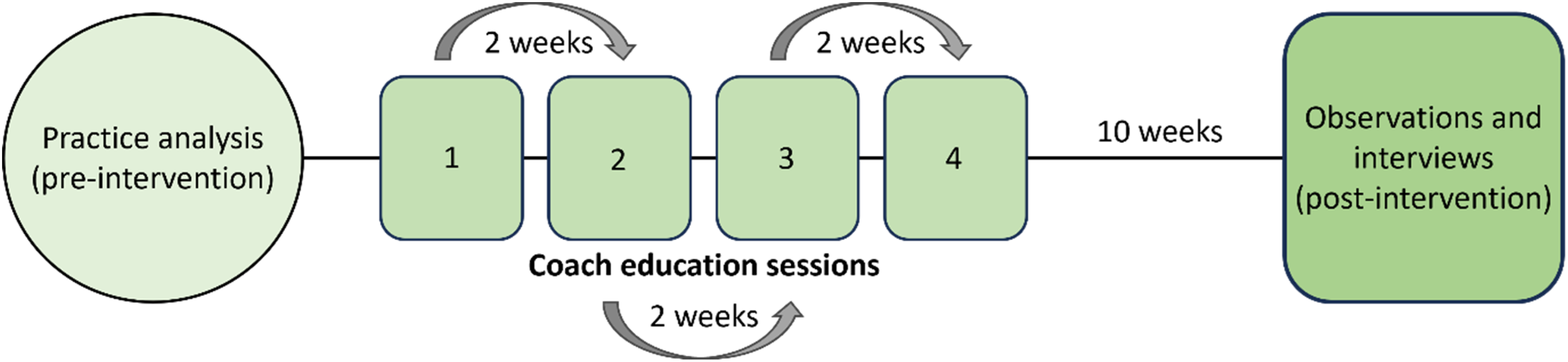
Timeline for the skill acquisition coach education process.
Coach education
Coaches each participated in four ‘one-to-one’ online development sessions covering theory and applied practice relating to key principles of skill acquisition research. One session took place every two weeks, and each lasted approximately two hours. The sessions were titled as follows: session 1 ‘Implicit learning: analogies, cognitive processing, and performance under pressure’, session 2 ‘Focus of attention: the science of coaching cues and language’, session 3 ‘Contextual interference: variability in practice and the learning-performance distinction’, and session 4 ‘Recap and reflections’.
Central to the sessions was the dissemination of the coaches’ own observed practices in relation to these skill acquisition principles, obtained from the pre-intervention analysis of practice. The use of the coaches’ own data served as a means of identifying the gaps between research recommendations and applied practice. In this way, the coaches’ own practice examples provided practical relevance and meaning to the sessions. The individual sessions followed a basic and flexible structure of: (i) introduce the broad theory of the skill acquisition principle and the broadly associated underlying mechanisms, (ii) describe the coaches’ own observed practices in relation to the skill acquisition principle discussed (which included figures illustrating proportions of practice approaches observed from the individual coach and the wider coaching team), (iii) provide examples of effective skill acquisition techniques used previously by the skill acquisition specialist in swimming, including video recorded examples, and (iv) key takeaways. Coaches were encouraged to ask questions and share ideas whenever possible to tailor discussion towards their own specific needs. 44 Throughout the sessions, coaches were reassured that there was no right or wrong approach per se, and that this process was as much about informing research through the knowledge of expert coaches as it was about informing applied practice.
Coach interview
The pre-intervention coach interviews were conducted and recorded as part of the initial practice analysis, 2 and are not described in the current study, other than a reiteration that the coaches reported no knowledge of skill acquisition principles immediately prior to the intervention. For the post-intervention, a semi-structured interview was designed to allow flexibility in questioning. Clarification, elaboration, and detail-oriented probes were used throughout to elicit richer data. 45 The interviews, which were conducted in-person following the session observation, aimed to explore coach perspectives both in relation to the session observed and coaching more generally following the intervention and took between 35–40 minutes.
Questions included asking the coach what specifically they were asking or encouraging their athlete to focus on or think about during skill execution in the session and why; how the session and practice blocks within were structured and why; what the purpose/rationale was behind any analogy learning cues which may have been used in the session; how their approach to language and coaching cues both in the session and more generally may or may not have been influenced by participation in the process; how their approach to session planning in terms of structure, scheduling, or content in the session and more generally may or may not have been influenced by participation in the process; and what aspects of the coach education process they did or did not find to be effective and why. Coaches were reassured that there were no right or wrong responses/approaches and that their own subjective insights were valuable and would serve to inform research. Interviews were also video recorded using a Sony Handycam camera, with coaches fitted with a WM8S UHF Wireless Lavalier microphone. Interviews were transcribed using YouTube's video transcription service. Transcripts were checked for accuracy.
Measures
Skill acquisition principles of interest
The skill acquisition principles featured in the initial practice analysis 2 and subsequently in the current intervention (i.e., implicit learning, focus of attention, and contextual interference) were identified through the skill acquisition specialist's immersion in the sport and consultation with the sports science and coaching staff at BPS. 7 Specifically, through discussions and informal observations of coaching practice two things stood out. First, dialogue between coaches and athletes featured prominently. More restrained in their ability to talk to athletes during skill practice or competition (i.e., when the swimmer is swimming), coaches would sometimes spend three, four, or five minutes talking to swimmers both before and after athletes attempted skills. Second, training was based on detailed session plans, often written weeks in advance, denoting every feature of every metre to-be-swam or skill to-be-practiced.
This meant that the scheduling or structure of each practice session (i.e., the amount of variability or repetition involved) was also significant (and pre-determined). Consequently, not only did existing practices appear to have the potential to map onto the concepts of analogy learning, focus of attention, and contextual interference, but they also offered a practical means of both observing training in relation to established principles of skill acquisition and potentially influencing practice design without stretching too far from current approaches (increasing the likelihood of coach buy-in). As a skill acquisition practitioner at the National Performance Centre, or working with designated athletes on specific performance goals, there are several other fields and associated techniques in skill acquisition which play an important part in the role (e.g., ecological dynamics and constraints-based learning). However, it was beyond the scope of the current paper to incorporate all facets of skill acquisition and so those considered to have the greatest potential for impact were prioritised.
Implicit learning
For implicit learning, any examples of analogy learning techniques (e.g., ‘like a torpedo off the wall’; ‘a windscreen wiper action’) used by the coaches were recorded and described. Identification of analogies was facilitated by Winkelman's 46 cue anatomy framework, which describes three categories of analogy cues in sport: (i) scenario-based analogies (i.e., reference to an analogous scenario, such as ‘you’re scraping the froth off the top of a cappuccino cup’ for the arm movement on a swimmer's breaststroke); (ii) constraint-based analogies (i.e., the channelling of pertinent movement information, such as ‘imagine you’ve got a pole going through your body from fingers to legs’ to guide a swimmer's glide position off the turn or dive); and (iii) object-based analogies (i.e., featuring imagery of an inanimate object, such as ‘you’re squeezing a tennis ball between your ankles’ for a swimmer's set position on a jump start).
Although implicit learning and analogy cues were distinct from focus of attention cues in the coach education, overlap exists in their analyses. That is, in line with previous research2,46–48 all analogies were also recorded as external focus cues in the focus of attention analysis. Analogies which conveyed some element of feel (e.g., ‘imagine the wall is red hot’) were still recorded as external (vs. holistic) cues because the explicit information would still be expected to be coded symbolically (vs. kinaesthetically).
Focus of attention
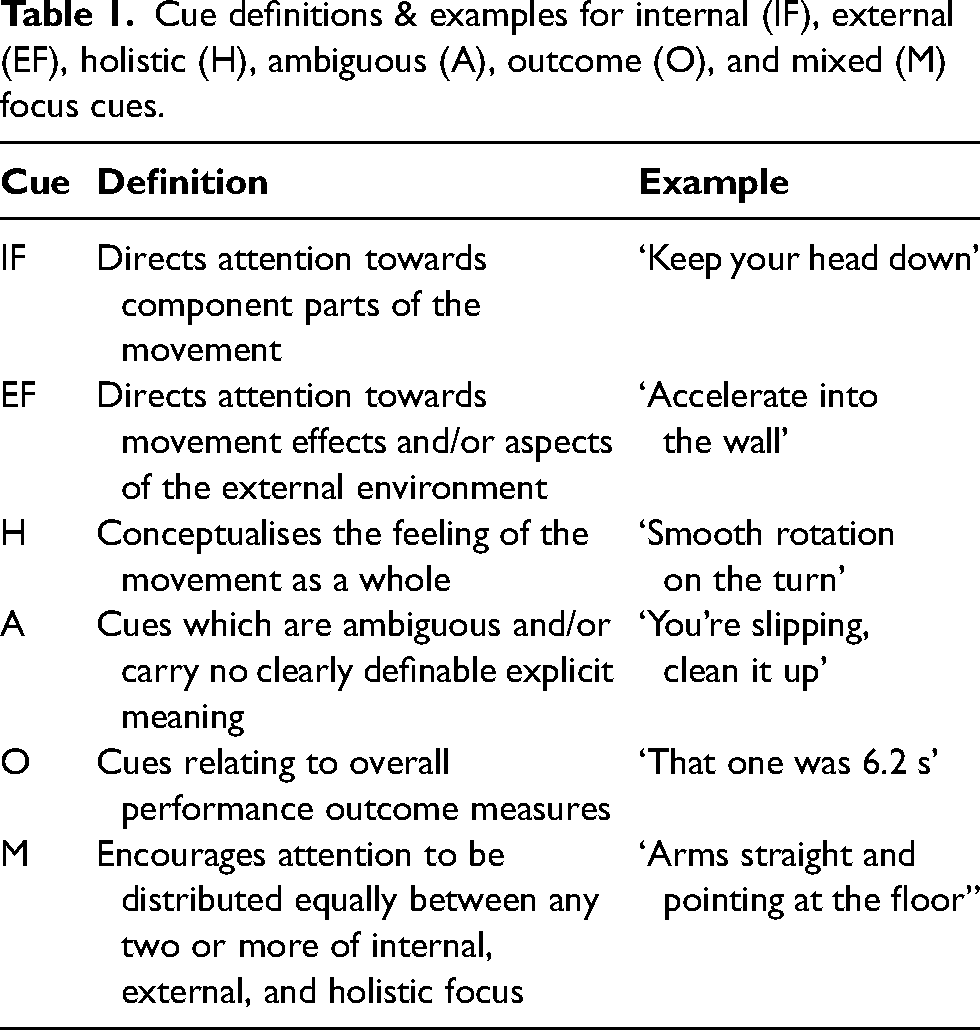
To analyse the coaches’ use of focus of attention (FOA) cues, a table of definitions for FOA cues was designed and adapted from previous FOA observation research 2 (see Table 1). The FOA cues were categorised as internal focus (IF), external focus (EF), mixed focus (M), holistic focus (H), ambiguous focus (A), and outcome focus (O) a . Identification of internal and external cues during coach observation was further assisted with reference to Winkelman's 46 cue anatomy framework. Specifically, internal focus cues typically involve a biomechanical emphasis with focus on component parts of body movements (e.g., ‘extend the knees on the push-off’; ‘rotate the hip’). External cues typically emphasise some element of distance (e.g., proximal, or distal), direction (e.g., towards/away, or up/down), or descriptions (e.g., action verbs or analogies/metaphors). Holistic focus cues conceptualise the overall feeling of the movement (e.g., ‘a smooth rotation’).
Cue definitions & examples for internal (IF), external (EF), holistic (H), ambiguous (A), outcome (O), and mixed (M) focus cues.
All coach dialogue during the session was coded as either instructions or feedback, and each set of instructions and feedback were then coded for FOA cues. This was to account for the potential increase in coaches’ use of outcome cues during feedback, i.e., knowledge of results (vs. knowledge of performance). As coach feedback is often interwoven with instruction for ensuing practice, 50 feedback was recorded as finished where coaches switched from past to future tense, at which point instructions began. Instructions can either be technically oriented (i.e., pertain directly to technique refinement) or task-oriented (i.e., pertain indirectly to technique refinement via the learning activity). Task-oriented instructions were not recorded as FOA cues unless they were directly relevant to the athlete's subsequent FOA. For example, if the task focused on the ‘pull’ (i.e., the arm component of the freestyle stroke), “200 m with no leg kick” (indirect) would not be recorded as a FOA cue, whereas “200 m arms, with fists every other 50” (direct) would. Cue frequencies were converted into proportions within each set of instructions and feedback which were then converted into overall session proportions. In this way, proportions reflected the FOA emphasis before or after any given skill practice. For example, a coach could be recorded using 10 IF cues and no other focus cues during two minutes of instructions, and only 2 EF cues with no other cues during another twenty seconds of instructions. However, it would be interpreted that on both occasions the coach is encouraging 100% internal and 100% external focus respectively in their swimmer prior to attempting a skill. As such, the total number of each cue observed was not considered in the overall analysis.
This method would help in accounting for inherent difficulties in using exclusively external focus cues when coaching complex motor skills. 47 That is, effective adoption of external cues may still require initial full debriefing of movement fundamentals using multiple internal cues. Once the basics of the movement are understood, the coach may then begin to identify and emphasise key associated external components of the task on subsequent skill attempts, which may require a lower frequency of cues. This approach would also help to account for any differences in session duration pre- and post-intervention, along with differences as a function of the skills being coached. For example, coaching a greater number of dives pre- or post-intervention would afford more opportunities for dialogue with the athlete than extra 200 metre freestyle sets.
Three members of the research team initially coded the first recorded session independently to reach consistency in assigning codes and an inter-rater reliability check produced an agreement level of 85%. Where discrepancies occurred, discussions were held until a consensus was reached. 51 The first author then coded the second transcript.
Contextual interference
Each practice session was video recorded and mapped out chronologically onto an Excel spreadsheet recording pool length and lengths swam, skills practiced (stroke type, start, turn, finish), any equipment used (e.g., snorkel, fins, paddles), and brief descriptions of any coach instructions prior to skills practiced. Spreadsheet content was corroborated through a triangulation of coach observations, interviews, and session plans. Contextual interference (CI) was calculated as the percentage of opportunities taken to change skill (or skill variation) practiced versus the percentage of opportunities not taken. Opportunities taken to change skill were coded as ‘1’ and opportunities not taken were coded as ‘0’. Thus, the first skill practiced in each session was not coded as there was no preceding skill practice. Opportunities to change not taken (i.e., repetition) were categorised as blocked practice. Opportunities taken to change skill were categorised as either between-skill variability (i.e., changes between fundamentally different skills) or within-skill variability (i.e., discernible variations in the execution of the same overarching skill). For example, changes between swimming strokes (e.g., breaststroke to butterfly) were recorded as between-skill changes, whereas variations in the same overarching skill of the freestyle stroke (e.g., freestyle with or without a snorkel) were identified as within-skill changes. In this way, each session produced a proportion of CI in the form of blocked practice (low CI), between-skill variability, and within-skill variability. Coach instructions helped guide the analysis and identify changes within-skills which might otherwise be difficult to discern (e.g., ‘this time dive a little deeper’). Coach instructions also served to highlight the focus of the skill practice. Specifically, skill changes which were simply a by-product of the constraints of the pool (e.g., the turn halfway through a 100 m backstroke swim) but were not part of the intended learning focus, were not recorded as skill changes.
Qualitative analysis
For the analysis of qualitative data, recurring patterns of meaning (‘themes’) were identified using Clarke and Braun's six-phase approach to thematic analysis, 52 which served to provide the researcher with a descriptive account of the concepts investigated. This approach to qualitative analysis provides a comprehensive story of the interpretations and experiences of the individuals under study.45,52 The process of thematic analysis involved first the researcher familiarising themselves with the interview transcripts by reading and re-reading them several times to identify broad statements of interest. The researcher then began coding these data to identify larger patterns and themes.
Finally, the themes were reviewed, refined, and named to capture two main themes which each had three suggestive sub-themes. The analysis involved a mostly inductive approach as the objective was to develop understanding of informed coach perspectives through the underlying structure of experiences evident in these data. However, the latter stages also involved deductive processes. Specifically, the aims of the study necessitated a focus on coach descriptions and rationales which pertained, at least loosely, to the skill acquisition principles of interest. Additionally, the appellation of themes was influenced by terminology in skill acquisition literature (e.g., ‘beyond performance’). Indeed, approaching qualitative data in this way is not uncommon, as Gibbs 53 (p45) noted: “It is very hard for analysts to eliminate completely all prior frameworks … inevitably qualitative analysis is guided and framed by pre-existing ideas and concepts”. The thematic analysis was initially conducted by the first author and subsequently shared with two other authors who acted as ‘critical friends’, questioning themes and assumptions to generate reflection among the research team. 54 Discussions were continually assessed for alignment with the dataset to ensure themes were reflective of the transcripts.
Results
Two main themes were identified that represented the coaches’ interpretation and experience of the coach education and their subsequent approaches to practice design: (1) a less prescriptive approach, and (2) beyond performance. The main theme of a less prescriptive approach pertained to the learning principles of both implicit learning and focus of attention as the coaches discussed their interpretation and experience of these interchangeably, resulting in both quantitative and qualitative overlap in the analyses of these principles. This theme was associated with the sub-themes, relatable, self-discovery, and simplicity. The main theme beyond performance was associated with the sub-themes recap, doing something different, and psychology not physiology. In the following section, the main themes will be discussed in detail with supporting excerpts from both C1 and C2, alongside quantitative findings from the related learning principles.
A less prescriptive approach
Implicit learning
In the pre-intervention, C1 used one analogy learning cue (‘it's like a windscreen wiper action’), and C2 used three analogy cues (e.g., ‘like a soldier standing to attention’). In the post-intervention, C1 made use of three analogy cues (e.g., ‘like a cartoon character going off the cliff it goes out and then it just goes pshhht, straight down’), whereas C2 now placed a large emphasis on analogy cues and was observed using them on 54 occasions (e.g., ‘so your legs are like propellers on the boat’).
Although C1 only used analogies on three occasions in the session, their potential benefits appeared to resonate during the post-intervention interview: It's become more about making it relatable to the athlete - sometimes the simplest form of instructions can be the most beneficial. For example, I could see (athlete's name) legs were crossed on the start. I could talk about angles, they need to be six inches apart etcetera, but I said, ‘imagine you’re squeezing a tennis ball between your ankles’; not being too technical – they can relate to it. On one of his jumps, he was crouched forward so I said to him, ‘imagine you’ve got a pole going through your body from fingers to legs’. After that he was in a much better line. (C1)
C2 used a small range of analogy cues overall, each linked to a boat metaphor, but used these cues repeatedly (e.g., ‘kayak body’, ‘propeller legs’, and ‘paddle arms’). This more focused and non-prescriptive approach was a deliberate learning strategy developed through participation in the education process, and in response to the individual needs of the athlete and their intellectual disability:
I was trying to be very short in my communications, I didn’t want him to get lost in my words … as part of the recap it was two key words: one was torpedoes, and one was kayak … he understood it and it just simplified quite complex movements.
I started trying to use more and more analogies and that seemed to stop me talking as much and helped him get it straight away and helped him visualise what I’m looking for … I was conscious of confusing him with too much information. (C2)
C2 further explained that even in the short space of time since beginning the process, they had noticed the benefits of analogy learning with other athletes with intellectual disabilities in their home training programme: The S14 s in particular have been really responsive to it, and their (subsequent) movements are way less mechanical … With (athlete's name) today too I found the use of analogies or metaphors and summarising complex movements like that just hits home really well. (C2) In our office now we’ve got a whole wall filled with analogies and metaphor type cues we can use with athletes and we all just keep adding to it when we get new ideas. The other coaches have found it really effective. (C2)
Focus of attention
In the pre-intervention, the first author coded FOA cues from 43 sets of instructions and feedback for C1, and 47 for C2. In the post-intervention, the first author coded FOA cues from 29 sets of instructions and feedback for C1, and 26 sets for C2. Both coaches emphasised internal focus cues during the pre-intervention observation (C1 = 62.9%, C2 = 45.2%), whereas they switched to more holistic focus cues (C1 = 36.1%) or external focus cues (C2 = 67.8%) post intervention (see, Figure 2).
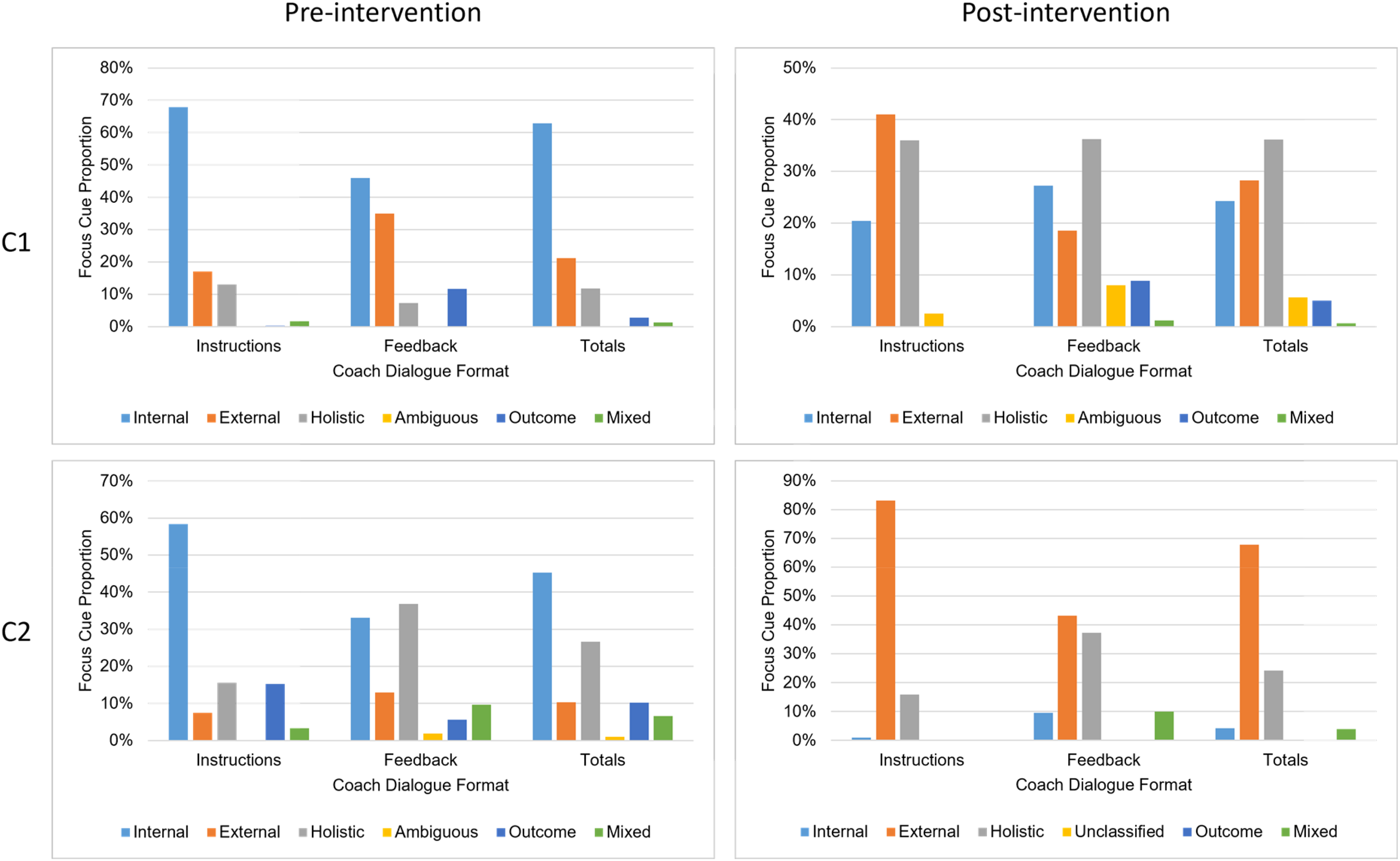
Focus of attention cue emphasis for coach observations both pre- (left) and post- (right) coach education for coach 1 and coach 2.
In the interview, C1 described the aims of the session – in relation to improving component parts of skills – with a more holistic FOA emphasis for the athlete: We spent some time thinking about being neat and tidy, so good lines through their hands into their shoulders, head position, hips, and knees. Then we spent some time being more powerful, and then it was about bringing those elements together. (C1)
When questioned on the thinking behind the type of some of the cues observed during the session (e.g., ‘it's got to be explosive; it's got to be powerful, but it's got to be neat and tidy all right’) C1 described the shift towards more holistic focus cues as a deliberate learning strategy, developed through participation in the coach education process, and aimed at encouraging athlete learning through exploration and guided discovery: This is one of the bits I’ve taken on board from this whereby a bit less (explicit prescription) and not too much all the time. Maybe previous years I’d be sort of constantly giving specific instructions … like you’ve seen he's picking things up for himself, and sort of self-discovery is really important. (C1)
C2 also reflected that prior to the intervention, as their own knowledge and interest in the biomechanics of swimming had grown over time, so too had their use of more prescriptive internally focused cues during training: I think as my knowledge increased, I started to use more internal focus cues … I like to know how the anatomy should work through the water, like how the arms link to the legs and so on, so I think I’ve become naturally more internally focused with my cues to athletes … whereas now I think I’ve realised the importance of external cues and analogies as well in summarising movements to get the movements going. (C2)
Beyond performance
Contextual interference
See Table 2, C1 incorporated no between-skill variability in the pre-intervention practice session, while C2 incorporated low levels of between-skill variability (12.5%). Coaches made use of higher levels of within-skill variability in practice during pre-intervention (C1 = 44.7%, C2 = 53.1%). In the post-intervention, C1 incorporated moderate levels of both within-skill (17.9%) and between-skill variability (20.5%). C2 incorporated low levels of within-skill variability (15.2%) and relatively high levels of between-skill variability (41.3%).
Levels of within-skill variability, between-skill variability, and blocked practice both before and after the skill acquisition education intervention for coach 1 and coach 2.
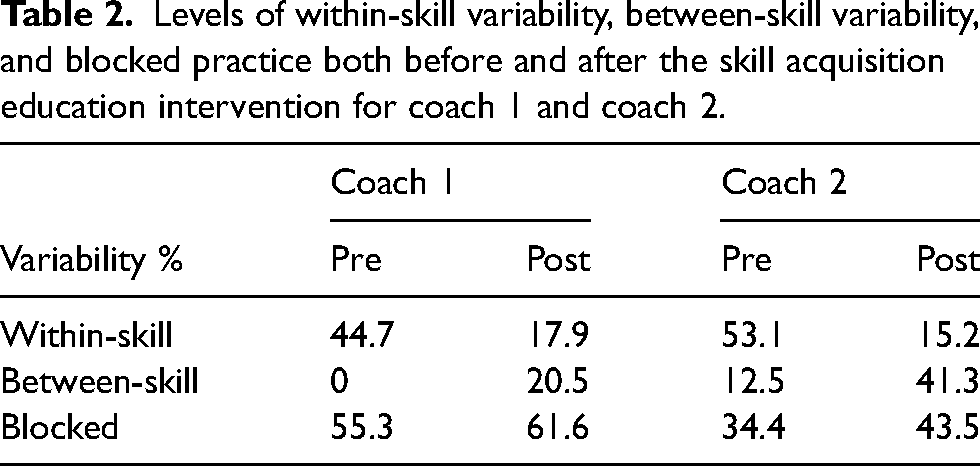
In the post-intervention, levels of blocked practice had risen slightly for both coaches. As part of the education process, the intervention addressed the concept of optimal challenge,
23
and the increase in blocked practice may have been in-part to compensate for the increased challenge as a function of greater between-skill variability. Indeed, coaches described their acknowledgement of optimal challenge in a way which maps onto these results: With the younger athletes I’d be a bit more systematic, and we’d go through gradually ABCDEFG, whereas because some of these swimmers have done that already it was right, do a bit of G and then do B for a bit, then we did A and then some of C, then we did F and then back to A, so we varied it up but in line with their level. (C2)
In the interview, C1 described their reflections on variability following the intervention both as a means of assessing and enhancing athlete learning. In doing so, C1 also alluded to their attempts now to design practice underpinned by an understanding of the learning-performance distinction:
It's one of the techniques we’ve been trying out since we started (this process) … your brain is processing all of the information and now we’re going back to what we’ve done - I want to see if you can put it into practice without me giving you the information … it's realising that just because someone has done something well for thirty minutes, it doesn’t mean it's ingrained. If I were to learn how to introduce myself in Japanese, I could do it for thirty minutes and regurgitate it but in a week, I’d have forgotten it.
So now it's do a skill, do something different, go back to it, do something different, so you’re mixing it up. This season in particular I’ve seen some good results using that system, and to be honest when I think back before (this process) some of my best sessions were the unstructured ones. (C1)
In reflecting on the process in general, C1 described how the concept of variability in practice had resonated with him, but also how the approach to education, with an emphasis on coach understanding of scientific theory (as opposed to prescriptive guidance on the implementation of skill acquisition techniques), had been crucial to influencing practice design and harnessing the coach's existing knowledge and expertise:
One of the things I view differently now is there's a difference between how you want to work physiologically and how you want to work psychologically - some coaches get it the wrong way round, and I think I was one of them.
It's important to understand the science but you shouldn’t be led by the science because you need to figure things out for yourself. As soon as we discussed the idea of variability; doing a bit here and a bit there and changing things, that made a lot of sense to me, so I’m able to then think about how I can play around with that myself. (C1)
C2 described their approach to variability in the session and more generally across training cycles following the intervention, again with an emphasis on an increased understanding of the learning-performance distinction. Bandwidth feedback techniques accompanied the adopted practice structure,
55
and together formed part of a learning strategy designed with the athlete's intellectual disability in mind:
We purposely put some switch off swims of something completely different just as a bit of a spacing effect … then revisited the movement as a recap and the second time I gave less direction. I think previously I would work on AAA and progress to BBB and then CCC, whereas today in the first part of the main set I kind of did AB, stayed there, reinforced it, had a bit of a gap doing something else, and then went back to AB. Then the second part of the main set was ABC, stay there, change, then recap it. I kept it very focused. I didn’t want him to get confused with too many things.
I think understanding the difference between performance and learning has influenced planning and periodisation for the whole season. In training I’ll do a performance session rather than a learning session now so I get the opportunity to see what's been learned because how much have they actually learned … Looking back I’d go through loads of drills and skills and go through every detail and come away going that's amazing they’ve done that really well, then after a period of time I’d come back to it and it looks terrible and I’m having to repeat everything … adding more variability through the week with focus points I’m seeing less of a breakdown in technique … there's definitely an upward trend in efficiency and that's evidence of what we’re doing. (C2)
Discussion
The study examined the efficacy and impact of an online skill acquisition education intervention with two coaches from the British Para Swimming Team. Following an initial analysis of practice, 2 coaches with no formal knowledge of skill acquisition principles had adapted their approach to practice design to incorporate theory-informed techniques. The purpose of the intervention was to develop the coaches’ understanding of theory underpinning key principles in skill acquisition research. In this way, the intention was to provide coaches with a framework of understanding, through which they could harness their own experiential knowledge of effective coaching practice and incorporate innovative ideas and techniques as they saw fit. As such, the study did not set out with specific or quantifiable hypotheses in mind, but rather to explore what, if any, concepts resonated with coaches, and in turn how skill acquisition theory might be interpreted and applied by the coaches themselves in a high-performance setting.
Concerning implicit learning, C2 in particular had shifted to using more analogy or metaphor-based cues - an approach influenced by their athlete's intellectual disability. That is, as part of the coach education, the skill acquisition specialist had described the potential benefits of analogy instructions for athletes with intellectual disabilities, facilitated by anecdotal evidence from applied practice and underpinned by theoretical implications of the approach. Specifically, intellectual disabilities typically involve a deficit in short-term working memory capacity, with a relative preservation in more long-term, implicit memory processes.34–36 Consequently, intellectually disabled athletes can struggle processing and retaining information presented in the form of explicit (or internal focus) coach instructions. 32 Analogies are used to promote the use of more implicit (long-term) memory structures as they serve to camouflage explicit movement information by coding it symbolically. 56 As such, provided the athlete is familiar with the visual representation associated with the analogy (e.g., ‘flat like a soldier standing to attention’), it can be understood (processed) at an unconscious level (implicitly) without exhausting working memory capacity. C2's reflections that their intellectually disabled athletes’ subsequent movements (both in the observed session and with athletes in their home club) were “way less mechanical” evidenced facilitation of more implicit (or automatic) motor control as a function of analogy cues. ‘Mechanical’ movements are indicative of a more conscious form of motor control, as opposed to more automatic modes of control which would typically be characterised by fluidity in movement. 15
It is possible that the coaching of intellectually disabled athletes amplifies any detrimental effects of explicit coach instructions, and in turn any beneficial effects of more implicit, non-prescriptive instructions such as analogies. Given the substantial proportion of intellectually disabled athletes on the British Para Swimming Team (34% at the time of writing), this offers a promising opportunity for future skill acquisition research. Indeed, researchers have already demonstrated that external focus cues, thought to operate through similar mechanisms to analogy cues (i.e., reduced conscious or working memory processing) benefit learning for children with intellectual disabilities. 38 However, researchers have yet to examine the extent of this benefit relative to individuals without learning impairments. Exploring this could have important implications for disability sport.
Through the education process, coaches had shifted from emphasising internal focus cues to more holistic (C1) or external/analogy focus (C2). The theme a less prescriptive approach encapsulated coaches’ interpretations and experiences in relation to both implicit learning and FOA development, and for C1 this manifested in the utilisation of more holistic focus cues to encourage learning through guided discovery. In this way, holistic cues (e.g., ‘I want you in a nice, neat line’) served to camouflage more explicit (prescriptive) movement information by coding it kinaesthetically. 57 However, C1 was also still placing a large emphasis on internal focus. Initial findings suggest internal focus cues could benefit learning in sports such as swimming, where a somatic focus prior to skill practice can improve processing of relevant proprioceptive task information (i.e., feedback from the water) through increased congruence between instructions and feedback. 18
Furthermore, alternative FOA research proposes that once athletes reach a certain level of skill, continuous improvement occurs as a function of increased bodily focus, or ‘somaesthetic awareness’ during practice. 58 Specifically, it is suggested expert performers are required continually to switch between reflective (or conscious) modes of bodily awareness (e.g., when refining skills during practice) and largely automated states (e.g., when competing). 58 That informed coaches here were still choosing to emphasise internal focus cues, alongside holistic and external cues, perhaps lends support to these more interactional perspectives on FOA and skilled action. 59 Nevertheless, research should seek to differentiate the circumstances under which varying proportions of FOA cues might be optimal. 60
In relation to contextual interference, coaches recorded higher levels of between-skill variability post-intervention and slightly higher levels of blocked practice. In the interviews, coaches described their approach to variability as dependent on the level of skill of the swimmers. As the concept of optimal challenge formed part of the education process, 23 the increased blocked practice was likely a deliberate strategy designed to compensate for the increased challenge through greater between-skill variability.
Increased between-skill variability following the intervention also resulted in lower within-skill variability. Specifically, the within-skill variability recorded in the pre-intervention took the form predominantly of part-task training drills, whereby athletes progressed through various stages of practice drills in which the focus of learning changed at each stage throughout – thus in the absence of any process of switching back and forth between skills or skill variations to facilitate acquisition via either memory (re)construction, 24 elaboration, 25 or the development of movement schemata. 26 In the post-intervention, coaches were still utilising part-task training techniques, however, stages of drills were now interspersed by short sets of alternative skill practice, thereby incorporating a process of switching back and forth between the same to-be-learned skills. This approach to variability allowed the coaches to revisit or ‘recap’ the to-be-learned skills later in the practice block, session, or even training week.
The shift in practice design appeared to result from an increased awareness and understanding of the learning-performance distinction, 61 encapsulated in the theme beyond performance, and manifested in a form of variability which could be more closely associated with psychological research into the spacing effect. 62 That is, whereas the contextual interference effect in skill acquisition literature emphasises enhanced learning as a function of switching randomly and repeatedly between skills on each skill practice attempt, 23 the spacing effect emphasises the learning benefit of temporal spacing between learning events. In adopting this approach, coaches reported seeing less of a breakdown in technique over the season. As such, if this is the type of variability informed coaches are choosing to adopt in practice, and given the inconsistencies previously reported in relation to the contextual interference effect in the applied setting,63,64 researchers should undertake more research into the potential learning benefits of temporal spacing in sport.
Limitations
It is important to note potential study limitations. First, coaches were observed (pre- and post-intervention) coaching their athlete one-to-one. Although one-to-one coaching often forms part of swimming practice sessions (e.g., if an athlete requires specific attention and/or if multiple coaches are on deck), it does not represent a typical full swimming session, whereby coaching a large group of swimmers occurs simultaneously. Nevertheless, one-to-one coaching provides a more concentrated representation of a coach's approach to coaching and learning design (i.e., type of language and variability should remain the same).
Due to logistical and time constraints, and the nature of elite level sport (e.g., injuries, competitions, and training cycles) different athletes participated in pre- and post-interventions. However, for each coach, matching of athletes for age, gender, experience level, and disability classification took place. Additionally, through psychometric test results, intellectually disabled athletes were also matched for extent of impairment. Consequently, coaching approaches would not be expected to differ as a function of the athlete coached. That stated, elite level coaching often involves tailoring practice at an individual level, and coaches may use techniques such as variability differently to achieve varying optimal levels of challenge for learning for different athletes. 23
Finally, as coaches were only formally observed once post-intervention, findings were susceptible to social desirability bias. Specifically, coaches may have gone out of their way to demonstrate the use of techniques involved in the coach education. However, interviews captured more long-term perspectives, and it was hoped any such effects would be mitigated by the emphasis placed on no right or wrong approach, with practices guided by informed coach expertise. Moreover, changes in relation to variability pre- and post-intervention may have worked both ways. For example, one of the coaches indicated that observation as part of the research project limited their use of repetition in practice during the pre-intervention. 2
Summary and future research
Overall, the skill acquisition coach education influenced practice design. In particular, coaching practices had been adapted to align more closely with established recommendations from skill acquisition research. More importantly, coach interviews indicated the incorporation of new perspectives and approaches into the daily training environment in a way which was natural to them. This included novel strategies in elite sport, such as the use of analogies to facilitate learning among athletes with intellectual disabilities, the use of holistic and external cues, and the use of variability through temporal spacing. Key to this was the development emphasis on coaches’ understanding of skill acquisition concepts and the mechanisms which underpin learning effects. The purpose of this approach was to harness coaches’ own experiential knowledge in practice design. 42 More specifically, just as athletes do not learn as effectively when coaches prescribe movement solutions, the skill acquisition specialist should guide a coach to finding their own solutions.
In acting as a reflective practitioner, the aim for the skill acquisition specialist was to guide and facilitate coach experiential learning between sessions, to enhance the coaches’ own toolbox of skills, refine their coaching philosophies, and to help synthesise scientific knowledge with the essential knowledge they have already acquired through years of experience. The coaching of Para athletes amplifies the significance of this experiential knowledge because Para athletes possess a range of disabilities, each with unique implications for learning. Furthermore, given there remain significant unresolved areas of debate in skill acquisition research, providing expert coaches with the information for themselves, and seeing what resonates and what works in practice for them, should provide as useful an avenue for furthering our understanding of skill acquisition principles as any other.
The study responds to recent calls for more examples of successful collaborations between skill acquisition specialists and coaches in sports settings. 6 Specifically, in demonstrating the efficacy of a short, online coach education intervention this paper provides evidence to support the scope of skill acquisition provision, beyond practitioners assisting coaches while embedded in the daily training environment. For future research, opportunities for skill acquisition specialists to be embedded in sport remain scarce. Those who are, should seek to share their experiences where possible. There are challenges in conducting controlled experimental research in elite sports settings, but the benefits of skill acquisition provision can also be demonstrated through case study experiences of skill acquisition specialists,7,65 the experiences of coaches receiving skill acquisition provision, 5 or through coach education interventions. 66 Currently lacking are the documented experiences of elite level athletes receiving skill acquisition support.
To facilitate future collaborations between skill acquisition specialists and coaches, investigators should undertake further practice analyses in other sports. Specifically, each sport involves unique demands for athlete learning and development. Identifying discrepancies between theory and practice can provide context to impact learning design and contribute to a framework of understanding which can guide both theoretical and applied perspectives. In line with this, effective measurement tools are an important part of the process in evaluating practice. For example, the Representative Practice Assessment Tool (RPAT) allows coaches themselves to assess and enhance practice design in tennis, 67 and the development of such tools for other sports would benefit coaches and practitioners alike. The authors hope that progress in these endeavours will help bridge the gap between skill acquisition theory and practice and strengthen the case for skill acquisition provision in sport.
Footnotes
Acknowledgements
The authors would like to say a heartfelt thanks to the coaches at British Para Swimming for their time, receptiveness, and enthusiasm throughout. Their knowledge and insights are invaluable to the field. Thank you also to the athletes for being willing participants in the coaching sessions, and to Dr Philip Kearney for his contribution to the initial practice analysis study. Finally, thank you to the reviewers for their thoughtful and insightful recommendations which improved the paper.
Declaration of conflicting interests
The authors declared no potential conflicts of interest with respect to the research, authorship, and/or publication of this article.
Funding
The authors received no financial support for the research, authorship, and/or publication of this article.

