




Abstract
This study set out to gain insight into the practices adopted by elite level Paralympic swimming coaches and to shed light on the knowledge and rationale underpinning their approaches. Coaching sessions were delivered by nine senior coaches from the British Para swimming (BPS) World Class Programme. A coaching session was observed from each coach and a semi-structured interview was recorded and transcribed to explore their intentions and rationale for the structure and content of the session delivered. Results indicated that coaches: (i) predominantly emphasised internal focus instruction and feedback cues, (ii) incorporated relatively low levels of between-skill variability and higher levels of within-skill variability, and (iii) applied mostly explicit learning techniques such as part-task training and verbal feedback, but also incorporated some implicit learning techniques such as analogies and constraints-based learning. Interview data indicated coaches had limited knowledge of key skill acquisition principles. The study serves to highlight potential gaps in understanding on the side of both research and applied practice in the hope of facilitating future collaborations between coaches and skill acquisition practitioners.
Keywords
Introduction
Experimental research in skill acquisition has identified a range of techniques that can enhance athlete learning and performance.1–3 Despite this, exploratory investigations suggest coaching practices often contrast with the scientific recommendations of best practice.4–6 In highlighting the gap between research and applied practice, studies indicate coaches rarely refer to academic journals when seeking to expand their knowledge, 7 and tend to adopt techniques guided by tradition, intuition, and the emulation of other coaches. 8 A notable limitation of much previous research, however, has been the failure to capture the coaches’ intended training outcomes and justifications for their approach. 9 The current study set out to examine both the practices and rationale of elite level coaches in the British Para swimming World Class Programme (BPS) in relation to three prominent lines of skill acquisition research: (i) focus of attention, (ii) contextual interference, and (iii) implicit learning. It is hoped that this link between coaching practices and research recommendations will serve to highlight and explain potential gaps in understanding on both sides, and thereby facilitate future collaborations between coaches and skill acquisition practitioners.
Focus of attention (FOA) refers to the location of an individual’s attention in relation to the performance task/environment. 3 Attention can be directed either internally towards parts of the body movement, or externally towards the intended movement effect (e.g., motion of an implement, hitting a target, exerting force against an object). 10 Research has consistently demonstrated that adopting an external (vs. internal) FOA can enhance the learning and performance of motor skills in a wide range of sports tasks. 3 The benefits of an external focus (EF) of attention are most commonly explained via the constrained-action hypothesis. This hypothesis suggests an internal focus (IF) of attention constrains the neuromuscular system and inadvertently disrupts the body's automatic movement control processes impairing performance fluency and accuracy. 11 An external focus of attention is thought to promote greater automaticity in movement control. In relation to swimming, EF instructions (e.g., “push the water back”) have been shown to improve performance relative to IF instructions (e.g., “pull your hands back”).12,13
Although FOA effects are now well established in the motor learning literature, little is known in relation to how findings have translated to the applied setting. In one frequently referenced study, 84.6% of athletes participating in the USA Track and Field Outdoor National Championships reported that their coaches most often provide instructions during practice that promote an internal FOA. 5 The remaining 15.4% reported receiving a mixture of IF and EF instructions, and none reported receiving exclusively EF instructions. Similar findings have emerged in volleyball, 4 baseball, 6 and ballet. 14 As such, it may be that elite coaching practices in relation to attentional foci in sport are sub-optimal for skill learning and performance.
A second key skill acquisition principle relates to the amount of practice variability incorporated during the learning process. The Contextual Interference (CI) effect refers to the relatively robust finding that the learning of multiple skills, or variations of a single skill, is enhanced as a function of interference during practice. 1 High levels of CI emerge when the learner switches between multiple skills throughout practice (e.g., ACBABCACA), whereas low levels of CI are involved when one skill is practiced repeatedly before moving on to the next skill (e.g., AAA BBB CCC). The latter schedule is typically referred to as blocked practice. 15 Findings reveal that although low levels of CI typically produce better performance during practice, high CI typically leads to better performance during retention and transfer tests. 16
Theoretical explanations for the CI effect are based around cognitive processes during performance. For example, the forgetting-reconstruction hypothesis 17 proposes that high levels of CI cause the performer to forget repeatedly task-specific information between practice trials, thereby requiring them to (re)construct the action plan on each attempt. This process is thought to develop the learner’s ability to retrieve and construct action plans, thus enhancing the acquisition of skills. Similarly, the elaboration hypothesis 18 suggests that high CI causes the performer to engage in a process of comparing and contrasting the skills being practiced. As a result, a more elaborate and distinctive representation of the motor skill is created in memory. Such theories derive from robust experimental findings for the CI effect. However, results from applied settings involving more complex motor skills have been less consistent, 19 leading to an alternative suggestion that CI practice benefits relate simply to one of specificity with the performance context.15,20 That is, if competition features high CI, high CI practice might produce skills which are more transferable to competition, and vice versa if competition features low CI.
In addition to uncertainty surrounding potential CI effects, little is known about the extent to which coaches incorporate CI into training. In one recent study, Buszard et al. 21 examined practice among skilled youth tennis players. More specifically, the authors assessed the levels of CI involved in practice as a product of two further variables: (i) between-skill variability, and (ii) within-skill variability. Between-skill variability describes the switching between different skills during practice (e.g., practicing a tennis serve followed by a backhand), whereas within-skill variability refers to discernible variations in the execution of the same skill (e.g., practicing a T serve followed by a wide serve). It was reported that tennis practice comprised very little between-skill variability, but relatively high within-skill variability.
Implicit learning describes the process of acquiring a skill in the absence of conscious or explicit knowledge about how that skill is performed. In contrast, explicit learning refers to the acquisition of a skill alongside a conscious understanding of the facts and rules pertaining to that skill. 22 Experimental research indicates that implicit (vs. explicit) learning produces skills which are more robust in the face of performance-induced pressure and fatigue, without slowing the rate at which those skills are acquired. 2
The implicit learning benefit has been explained via reinvestment theory. 23 According to this theory, performers in situations involving psychological stress (e.g., competition), will, to varying degrees of propensity, attempt to control consciously previously automated movements, causing those skills to break down (a phenomenon termed reinvestment). Conscious motor control operates as a function of accessing explicit, rule-based knowledge of a skill in working memory. Reinvestment theory suggests that implicit learning minimises the accrual of such knowledge, thereby reducing the opportunities for reinvestment and performance breakdown.
Recent research has identified a range of implicit learning techniques conducive to the applied sport setting. Teaching skills using analogies serves to code movement instructions symbolically, thereby camouflaging the rules pertaining to the skill and minimising the accrual of explicit knowledge. 2 The subsequent facilitation of a more automatic mode of processing has been demonstrated in swimming, where Komar et al. 24 reported that instructional analogies improved inter-limb coordination during the underwater phase of the breaststroke. Constraints-based learning (CBL) is also thought to promote implicit learning processes by way of a reduction in the accrual of explicit skill knowledge. 25 According to this framework, coordinated movements emerge as a function of learners adapting to the constraints imposed on them during practice. These constraints involve the individual characteristics of the learner (organismic constraints), the requirements of the task (task constraints), and the environmental conditions (environmental constraints). 26 Constraints can be manipulated such that the desired movement emerges through a process of self-organisation, rather than via prescriptive (explicit) instruction. For example, Guignard et al. 27 manipulated the swimming speed (task constraint) and the fluid flow (environmental constraint) in a flume and reported that elite swimmers adapted their open pool technique to maintain performance by changing their arm-to-leg coordination pattern, without any explicit instruction to do so.
While implicit learning benefits have been demonstrated consistently in experimental settings, there is a paucity of research examining the extent to which coaches actually adopt these learning techniques. Only one study has examined the use of analogy learning in the applied setting to date; Guss-West and Wulf 14 surveyed professional ballet dancers and reported that dancers make use of analogy cues (e.g., “feeling like a swan”) to facilitate performance 28% of the time. In swimming, applied insights from previous observation research indicate that elite coaches rely heavily on more traditional skill acquisition techniques such as verbal feedback and part-task training, which involves the decomposition of skills into component parts through the explicit prescription of drills (e.g., the full swimming stroke is reduced to the kick component); yet coaches are also shifting towards the use of more contemporary implicit and ‘non-linear’ methods like CBL.28,29 However, the use of such techniques in the applied setting appears to have evolved intuitively, and coaches may be unaware of the theoretical context underpinning their efficacy. 30
To date, very little applied skill acquisition research has been conducted among Para athletes, with concerns regarding population validity or the extent to which research settings are representative of performance contexts.31,32 Individualised case studies from skill acquisition specialists have begun to demonstrate the efficacy of implementing a CBL approach to coaching in Para sport. 33 However, as with coaches of able-bodied athletes, little is known regarding the adoption of such research-based techniques in the applied Para coach setting. In one study investigating knowledge in elite level coaches of Para swimmers, coaches, who had come from non-disabled coaching backgrounds, reported having to obtain disability-specific knowledge independently, but that by and large coaching approaches to learning did not differ between their Para and non-disabled athletes. 34 Furthermore, these coaches, and other elite Para and non-disabled athlete coaches still report informal learning opportunities (e.g., trial and error; observing or communicating with other coaches) to be the most beneficial for coach development.35–37
The current study set out to gain insight into the practices adopted by elite level Paralympic swimming coaches and to shed light on the knowledge and rationale underpinning their approaches. It was hypothesised that quantitative data obtained from the observation of coaches during practice would reveal that (i) coaches would make use predominantly of internal FOA cues, 5 (ii) coaching sessions would comprise relatively low levels of both within-skill and between-skill variability, as this would reflect the conditions typically experienced during competition performance,15,20 and (iii) coaches would heavily apply more traditional explicit learning techniques, such as verbal feedback and part-task training.28,29 Qualitative data obtained from coach interviews was used both to corroborate quantitative findings and to explore the coaches’ knowledge of the key principles and recommendations from skill acquisition research.
Method
Design
A mixed-methods design was used to explore coaching practices within the British Para swimming World Class Programme. Specifically, coach observation through video analysis of coaching sessions provided quantitative data for FOA cues, CI levels, and implicit learning techniques. These observations were supplemented by semi-structured coach interviews designed to elucidate coach knowledge and understanding of the formal recommendations from the three lines of research under investigation, along with their rationale for adopting any given approach. In this way, the qualitative results served to provide context and meaning for the quantitative data. 38 The design adopted was classified as a concurrent mixed methods design and allowed comparison of the methods.39,40
Participants
Nine coaches from the British Para swimming (BPS) World Class Programme were recruited to take part in the study. Coaches had between 10 and 35 years of coaching experience (Mexperience = 18.6, SD = 8.5), and were aged between 35 and 59 (Mage = 45.6, SD = 8.8) at the time of the analysis. The swimmers coached in the swim sessions were both male (N = 8) and female (N = 2) (one coach coached two male swimmers separately), ranging from ages 16–24 years, with impairments both physical (S7 N = 2, S9 N = 4, S10 N = 3) and visual (S12 N = 1). All of the swimmers were internationally classified and had competed at international level representing BPS and were therefore considered elite-level athletes. Ethical approval to conduct the study was provided by the first author’s university Faculty Ethics Committee. All participants and parents gave written informed consent before data collection.
Coach observation
Coaches were asked to design a one-to-one coaching session with a BPS swimmer of their choice, lasting anywhere between 60-120 minutes, including ‘some focus on both swim strokes and starts and/or turns’. The latter criteria was included to assess potential differences in the coaching of skills typically considered to represent distinct segments of a swim race, involving different sets of biomechanical expertise (i.e., starts/turns are performed either from the block or underwater). 41 In relation to the objective of the sessions, coaches were simply instructed that the session should be centred on learning/improving technique. This is in contrast to a focus on performance parameters such as times, rates, and/or an emphasis on physiological factors such as endurance. Sessions were video recorded using a Sony Handycam camera and coaches were fitted with a wireless microphone. Coach observation videos were transcribed using Youtube’s video transcription service. These transcripts were then checked for accuracy and to delineate where each set of instructions and/or feedback had started and finished. As has been suggested in skill acquisition literature, coach feedback provided following the completion of a practice trial is often interwoven with instruction meant to influence the ensuing practice. 42 In these instances, feedback was recorded as having finished and instructions began at the point where coach feedback switched from past to future tense. Coach instructions and feedback were also recorded as either start/turn or swimming stroke focused (i.e., all swimming outside of starts and turns).
Measures
Focus of attention
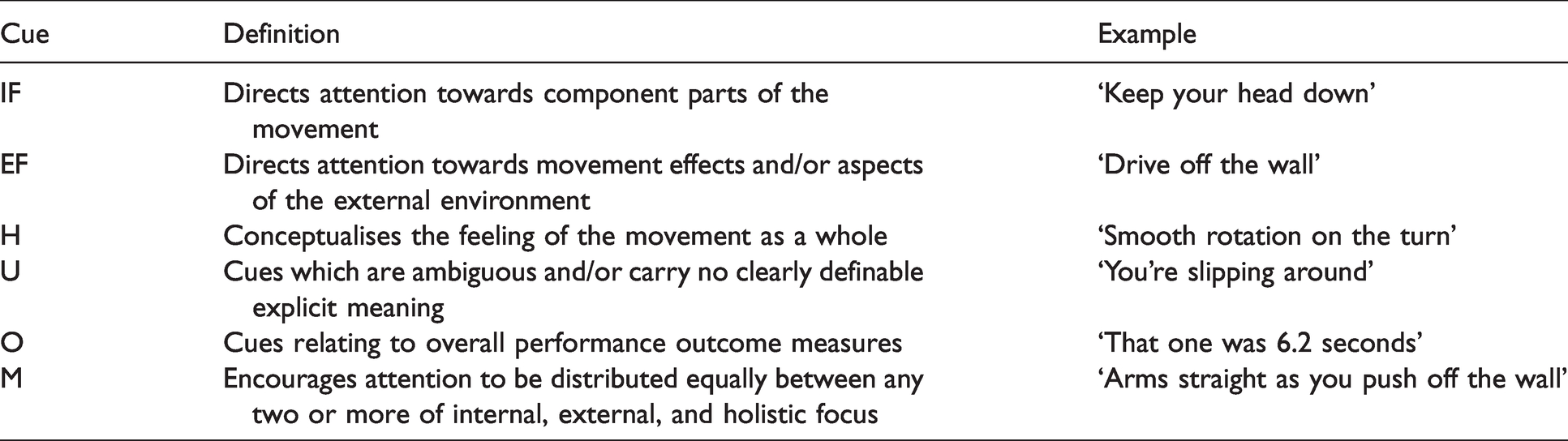
In order to analyse the direction of attentional focus within the coaches’ instructions and feedback, a table of definitions for FOA cues was designed based on previous FOA research (see Table 1).3,5,43 The FOA cues were categorised as internal focus (IF), external focus (EF), mixed focus (M), holistic focus (H), unclassified focus (U), and outcome focus a (O). Holistic cues conceptualise the feeling of the whole movement (e.g., ‘a smooth rotation’), in contrast to internal cues which direct attention to component parts of the movement (e.g., ‘head down on rotation’). In this way, holistic cues serve to code explicit movement information kinaesthetically, which is thought to confer similar learning benefits to external cues via the facilitation of automatic processing. 44 Each set of instructions and feedback, marked as either swimming stroke or start/turn practice, were then coded for attentional focus cues in each session. As instructions can also take two forms in that they can either be technically-orientated (relate directly to refining technique) or task-orientated (relate indirectly to refining technique through the learning activity to be participated in), FOA cues were not recorded for task-orientated instructions in instances where the cues did not actively interfere with the task focus. For example, if the task focus was the arm pull, “swim without legs” would not be recorded as a FOA cue, whereas “swim with your hands in a fist” would be recorded as a FOA cue. Frequencies for each type of cue were converted into proportions for each set of instructions and feedback. In this way, proportions reflected the likely FOA generated by the coach immediately prior to or after any given skill practiced by the swimmer. As such, the total number of any given cue used was not taken into account in the overall analysis. For example, a coach might be recorded during one set of instructions using 24 IF cues and no other focus cues over a period of two minutes, and in another set of instructions using only 1 IF cue with no other cues over a period of ten seconds. However, on both occasions it would be interpreted that the coach is encouraging 100% internal focus in their swimmer prior to attempting a skill. Importantly, this method of analysis would also help to account for the inherent difficulties in using exclusively external FOA cues for complex motor skills, as highlighted in previous research. 45 In particular, the use of EF cues might still require a full debriefing of the fundamentals of the movement (using IF cues) for initial practice trials, before emphasising a key external component on subsequent attempts once the basics are understood. This method also helped to account for differences between coaches in the amount of dialogue used. The transcript for the first recorded video was initially coded independently by three members of the research team to reach consistency in assigning the codes, and a check of inter-rater reliability was performed, producing an agreement level of 80%. Where discrepancies occurred, discussions were held until a consensus was reached. 46 The remaining transcripts were then coded by the primary researcher.
Cue definitions & examples for internal (IF), external (EF), holistic (H), unclassified (U), outcome (O), and mixed (M) focus cues.
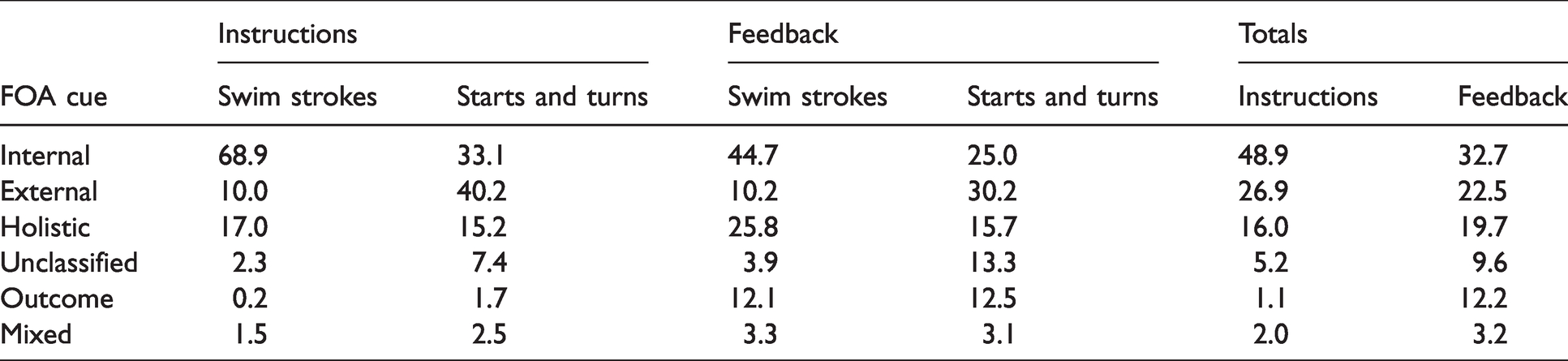
Coach instruction and feedback FOA cue proportions for swimming stroke and start/turn skill practice.
Proportion of each coaching session comprising within-skill variability, between-skill variability, or blocked practice.
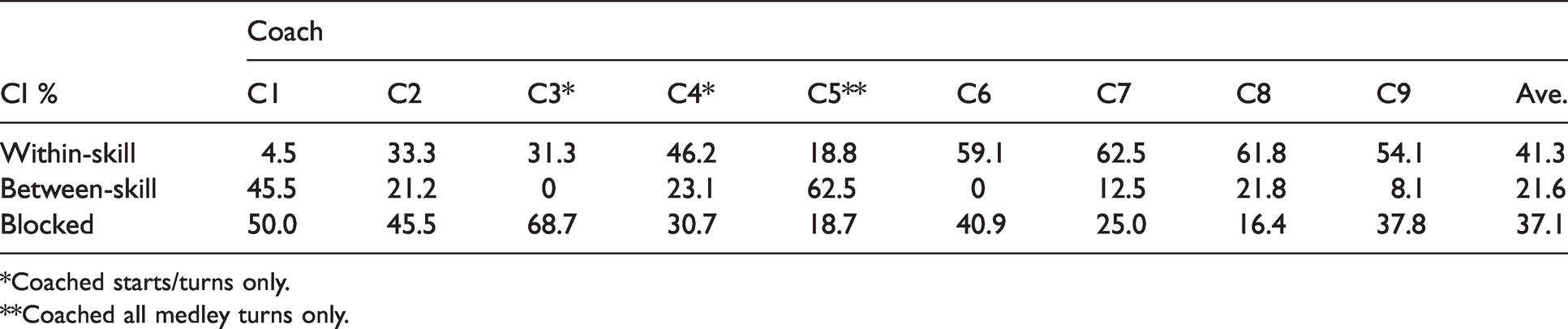
*Coached starts/turns only.
**Coached all medley turns only.
Contextual interference
For contextual interference, the video recorded practice sessions were mapped out chronologically onto an excel spreadsheet recording the pool length and lengths swam, skills practiced (stroke type, start, turn, finish), any equipment used, brief descriptions of any coach instructions given prior to practice trials, and any distinct practice or recovery blocks. The spreadsheets were corroborated through a triangulation of coach session plans, coach observations, and coach interviews. CI was calculated as the percentage of opportunities taken to change the skill, or skill variation practiced (relative to the previous attempted skill) versus the percentage of opportunities not taken. Opportunities taken to change skill were coded as ‘1’, and opportunities not taken were coded as ‘0’. As such, the first practice trial in each session was not coded as there was no preceding trial. Opportunities to change not taken (i.e., low CI) were categorised as blocked practice. Opportunities taken to change were categorised as either within-skill variability (discernible variations in the execution of the same skill), or between-skill variability (changes between different skills). For example, changes in a swimming drill that related to the same overarching skill of freestyle stroke (e.g., freestyle with or without a snorkel) were identified as within-skill changes, whereas changes between the strokes (e.g., freestyle to backstroke) were identified as between-skill changes. In this way, each coaching session provided a proportion of CI in the form of within-skill and between-skill variability, and a proportion of blocked practice. Coach instructions were used to guide the process of analysis. In particular, coach instructions would help to identify changes within-skills which might otherwise be difficult to discern (e.g., ‘this time dive deeper off the wall’). Coach instructions also served to highlight the focus of the learning trial. In this way, skill changes which were simply a by-product of the constraints of the pool within the learning activity (e.g., the turns at each end of a 100 m backstroke swim), but were not intended as part of the learning focus, were not recorded as skill changes in the analysis. Coach instructions, along with a ‘variability line’ of 100 metres, were also used to delineate variability in practice. More specifically, if coach instructions comprised a practice block of 8 × 25 metres, variability would be coded every 25 metres. If instructions comprised 3 × 100 m swims variability would be recorded every 100 m. However, if recovery swims or instructions involved trials over the variability line of 100 m (e.g., 4 × 200 m), variability would still be recorded every 100 metres.
Implicit learning
For implicit learning, two prominent examples of implicit learning techniques identified in skill acquisition literature were investigated: (i) analogy learning, and (ii), constraints-based learning. Any examples of these techniques used by the coaches were recorded and described. Examples of constraints-based learning (CBL) were defined as any instance where the coach manipulated constraints specifically to facilitate implicit learning through self-organisation and/or exploration of the perceptual landscape as a function of the applied constraint. CBL was not recorded in instances where constraints were used in order to facilitate explicit learning methods such as part-task decomposition through the prescription of drills. For example, if a snorkel were used to remove the breathing element of a stroke in order to allow focus to be directed towards arm movement in a freestyle arm drill, this was not recorded as an example of CBL. In this way, coach instructions were also used to aid the coding process. The purpose of this coding process was to attempt to identify and isolate ‘pure’ examples of non-linear pedagogy (implicit learning techniques). Observation also related to whether implicit learning techniques were subject to explicit contamination through the concurrent use of explicit (rule-based or declarative) instructions or feedback. In addition, overlap between the two analyses exists in that analogies were also recorded as external focus cues based on previous research.45,47 This was regardless of how analogies were phrased, on the basis that all analogies share the property of being understood implicitly via imagery. That is, if an analogy emphasised the feel of a movement (holistic), it was still recorded as an analogy, and also as EF. If the phrasing of an analogy was unclassified (ambiguous), it was not recorded as an analogy as by the nature of the phrasing it could not be understood implicitly.
Coach interviews
A semi-structured interview comprising ten questions was designed to allow flexibility in questioning for the interviewer. Clarification, elaboration, and detail orientated probes were also used throughout the interview process to elicit richer data. 48 Questions included asking the coach what type of things they were encouraging their athlete to focus on or think about when attempting to execute a skill and why; how they structured the session and individual practice blocks and why; what the thinking/rationale was behind any implicit learning techniques they may have used; how they tend to adapt sessions for athletes with different disabilities or sessions that include non-disabled athletes; and if they were able to provide both positive and negative examples of coaching practice in relation to the facilitation of learning. Coaches were not asked explicitly about their knowledge of skill acquisition research principles as the intention was not to give the impression of right or wrong, but to allow the coach to feel comfortable and open when articulating responses. Openness was also facilitated by the primary researcher’s relationship with the coaches, built up over the previous eighteen months working as part of the same team. Interviews were recorded with a video camera and wireless microphone for transcribing.
Given relatively little is known concerning elite coaching perspectives and approaches to skill acquisition, a thematic interpretational content analysis was identified as the appropriate analytical method.49–51 This approach has the potential to generate knowledge through the development and interpretation of themes from the interview transcripts. It also allows the researcher to deal with blurred boundaries between categories of text, with the goal of minimising the overlap between categories. 50 Following this procedure, the first step involved immersion and familiarisation with the transcribed data. More specifically, this comprised reading the transcripts repeatedly and identifying meaningful segments of the raw data pertaining to skill acquisition practices/principles/perspectives/knowledge/intentions/rationale, whilst also noting down initial thoughts in relation to these. These segments or ‘meaning units’ were tagged initially with short paraphrases reflective of their content. Tags were then coalesced into clusters of topical commonality which generated lower order and higher order categories. For example, raw data tags such as, ‘keeping the athlete fresh’ and ‘preventing neural fatigue’, were grouped to create the lower order theme of ‘physical/psychological recovery’. Although the analysis involved predominantly inductive procedures, the latter stages of the process also involved an element of deductive reasoning. In particular, the objectives of the study necessitated an element of honing in on coach rationales that pertained, at least loosely, to the three principles of skill acquisition investigated. Furthermore, the appellation of higher order themes identified was influenced by skill acquisition literature (e.g., level of challenge). This approach to qualitative data analysis is not uncommon, as Gibbs 51 (p45) noted: “It is very hard for analysts to eliminate completely all prior frameworks … inevitably qualitative analysis is guided and framed by pre-existing ideas and concepts”.
Following this phase, the primary researcher thoroughly re-examined the raw data, meaning units, tags, and categories, before the second, third, and fourth authors acted as ‘critical friends’ in reviewing and discussing the categorisation of lower and higher order themes with the primary researcher. These discussions served to ensure transparency of process and diligence in verification of the organisation of the data.52,53
Results
Focus of attention
As can be seen in Table 2, coaches on average emphasised internal focus cues (instructions = 48.9%, feedback = 32.7%) during practice more than external focus cues (instructions = 26.9%, feedback = 22.5%). Differences in cue emphasis were observed when instructions and feedback were analysed as a function of practice type (swim strokes vs starts & turns). In particular, during the coaching of starts and turns, coaches emphasised external focus cues (instructions = 40.2%, feedback = 30.2%) more than internal focus cues (instructions = 33.1%, feedback = 25.0%). This was compared to the coaching of swim strokes, where coaches emphasised internal focus cues (instructions = 68.9%, feedback = 44.7%) more than external focus cues (instructions = 10.0%, feedback =10.2%). In addition, coaches overall emphasised a wide range of other FOA cues (holistic focus cues: instructions = 16.0%, feedback = 19.7%; unclassified focus cues: instructions = 5.2%, feedback = 9.6%; outcome focus cues: instructions = 1.1%, feedback =12.2%; mixed focus cues: instructions = 2.0%, feedback = 3.2%).
Coach interviews indicated that the coaches had limited knowledge of the principles of FOA research. Coaches were asked what they wanted their swimmers to think about or focus on during skill execution in both swimming stroke and start and turn practice trials; examples of cues they like to use to promote the desired focus; and what their rationale was behind this. Responses typically described internal (bodily focus) or holistic (e.g., swim-specific general movement focus such as rotation, glide, or streamline) FOA cues for all skills, and centred on cue simplicity rather than type of cue:
‘Generally when I’m giving feedback it will be ‘glide’ or ‘head position’, so instead of a long conversation with them usually it would be short and snappy so they can remember’. (C2)
‘Yeah I try not to over talk too many times when I give him his skill so sometimes it’ll just be a sentence of, ‘keep your hands or fingers in a fist’ and swim one length’. (C9)
‘I watched him swim some backstroke first and then I broke the stroke down using the BLABT principle which is body position, legs, arms, breathing, timing … I always like to break the strokes down and start with body position and kick first’. (C6)
‘I don’t know what you call it but in swimming the five key elements are body position, kick or leg action, arms, breathing, and timing, so whenever I do stroke technique development I basically follow that process so develop body position and kick first and then work on adding the arms in’. (C7)
‘It’s about your body awareness because (when) you are at the wall, it’s then knowing where your arms and your legs are so you can rotate as quickly as possible’. (C5)
‘But a lot of swimming is just body position so everything will relate back to that generally’. (C2)
‘It might be as simple as ‘you’re slapping – try and clean that up a little bit’, and then where possible probably wouldn’t say more than that as I’d be hoping he’ll try and figure it out for himself’. (C8)
‘So imagine you’ve got like a little finger or a pea in your belly button and you’ve gotta suck it in so it stays there … to a young person it’s dead simple. Also when I say stand to attention like a soldier everyone knows what I mean’. (C7) ‘When placing his feet on the wall I might reference that the wall is red hot to then try and push off the wall really quickly and give him something to visualise’. (C9)
Contextual interference
Across the nine coaching sessions, training on average comprised 41.3% within-skill variability, 21.6% between-skill variability, and 31.7% blocked practice (see Table 3). Three of the nine coaches (C3, C4, C5) chose to focus only on starts and/or turns in their sessions. Within these sessions, C3 coached one turn (backstroke turn) throughout the session, while C4 coached the freestyle turn, butterfly turn, and dive starts. C5 coached a medley swimmer and chose to coach all three medley turns in the session. This contributed to a between-skill variability score (62.5%) which was significantly higher than the average (21.6%). The remaining six coaches all incorporated aspects of both free swimming and starts and/or turns practice, as per the session guidelines. Although C6 coached both the butterfly start and the backstroke, this was done with two different swimmers meaning no between-skill variability was recorded.
Coach interviews indicated that the coaches had no knowledge of the formal recommendations made by CI research. A common theme reported by the coaches to explain the level of variability in their sessions was the level of challenge involved for the swimmers. Manipulating the level of challenge typically involved breaking skills down into smaller component parts after initially observing the skill as a whole, before building back into the full skill/swim – a process described by many of the coaches as, ‘whole-part-whole’ (also referred to in the skill acquisition literature as part-task decomposition or part-task training)
54
: ‘The structure was pretty simple, it was whole-part-whole … I work on a very simple philosophy of you look at the whole, you break it down into parts, and then you put it back together again as a whole and you can assess what effect you’re having on the execution’. (C3) ‘If you notice in the drill generally I’ll go whole-part-whole. So the whole stroke, break it apart, back to whole, you know what I mean’. (C2) ‘When I felt he did that really well then we progressed, if he wasn’t doing it very well then we just stayed there’. (C7) ‘On the first few lengths I put a snorkel on him so he didn’t have to figure out when to breathe and could just focus purely on his head position and his body’. (C7) ‘If you give them too many things to focus on you don’t get anything done and I wanted to really focus on body position so fins just make that easier for them’. (C6)
‘I’m a very structured person in terms of building things up … I could have continued a lot longer than we did, I normally like to make sure again … I’d rather spend the majority of the session just doing one thing over and over again … To me there’s no point practicing something and then going and doing something else’. (C6)
‘After 16 years old if you’re teaching a new skill the amount of retention of that skill they can maintain is very little so actually repeating the process time and time again will help reinforce that skill so I will often repeat the skill many times and transfer it into their swim slowly’. (C9) ‘I believe if you’re gonna do a good job on starts you’re only gonna get about 12 in a session because you’re gonna end up with neural fatigue…so what we did is small blocks, little recovery swim activating the core, small blocks, little recovery swim (again)’. (C1) ‘The key element focusing on the turns themselves was the idea that if you have two fast, two steady turns each 125 … the idea behind that is it’s more raising awareness of the differences on those steady to fast’. (C8) ‘I put him at a disadvantage where one of the hand drills he wasn’t allowed to use his fingers, he had to use fists (every 10 metres then every 25), which reduces the amount of catch in the water, so then when I introduced the fingers back he could feel the difference … he understood what poor felt like and what great felt like’. (C9)
Implicit learning
Five of the coaches made use of analogy learning techniques at some point during their session. One coach used analogies four times during their session, and four coaches used one analogy each in their sessions. Analogies were used in an attempt to convey appropriate body positions, speed of movements, and other movement effects to the swimmers.
‘Imagine it’s red hot (the wall) and you don’t want to burn your feet’. (C9)
‘It’s almost like a windscreen wiper action’. (C6)
‘So I want you flat like a soldier standing to attention’. (C7)
Four examples of CBL were recorded from four of the nine coaches. Three examples involved the coaches manipulating the environmental constraints, and one example involved the manipulation of task constraints, 26 such that the swimmers would be directed implicitly towards the to-be-learned movement solution. First, C4 identified that their swimmer wasn’t getting into their kick quickly enough off the wall and instructed the swimmer to perform a number of tumble turns without the aid of a wall to push-off and gain propulsion. As such, the natural (intended) solution to regaining the now constrained propulsion in order to change direction quickly would be to start kicking straight away. Second, C6 instructed their swimmer to balance a rubber duck on their forehead during a backstroke drill in an attempt to facilitate learning to keep the head still. Third, C1 attempted to encourage the learning of core and trunk engagement during the freestyle stroke by creating imbalance through the use of one paddle and one fin on opposite sides of the swimmer’s body. Fourth, C9 manipulated the task constraints for their swimmer during a freestyle drill such that every 10 or 25 metres they switched between a flat hand and a fist shape on the pull through the water. The contrast in feel was designed to encourage the exploration of the perceptual-motor landscape in order to find more effective movement solutions when the hand was flat. Each of these examples of CBL were implemented in conjunction with explicit coaching methods. More specifically, rather than the swimmer finding the movement solution within the designed constraints through the exploration of the movement alone, the movement solution was also described explicitly to the swimmer and reiterated prior to each practice trial. For example, ‘the principle of this drill is I’m trying to get you to kick your legs straight away when you’ve turned’ (C4). ‘So this is forcing you to keep that head really still because when we’re swimming we don’t want to be bouncing around so again duck on your head, head nice and still okay’ (C6). ‘I want you to concentrate on the engagement of the core … I’m not looking for perfect streamlining, just for you to be able to lift it’ (C1). ‘I want you to count your strokes fist to 25 and then stroke count hands to 25 and see if there’s a difference’ (C9). Practice trials were then also followed up with explicit forms of feedback provision relating to the movement solutions, including prescriptive feedback (e.g., ‘okay so now I want you to lift your tummy and hips but still keeping that head still’; C6), or questioning techniques (e.g., ‘so did you feel anything in your hip flexors?’; C1).
During the interviews, all coaches showed limited knowledge of the fundamental principles of implicit learning. Two of the nine coaches neither implemented any implicit techniques in their sessions, nor provided or discussed any examples of implicit techniques used or observed in previous sessions. Among the remaining seven coaches, the interviews indicated that each coach had developed their own experientially and informally derived understanding of implicit learning techniques, which produced both consistencies and inconsistencies in the data. For example, there appeared to be little consensus among these coaches regarding when to implement implicit techniques during practice, with decisions based on subjective judgement and experience: ‘There’s a time and a place for probably being a bit more prescriptive. I couldn’t tell you as and when, it would probably be more gut feel’. (C8)
Greater consistency emerged in relation to why these coaches might adopt implicit learning techniques, and in their descriptions of the perceived effects. In particular, the coaches described various constraints-based approaches to learning as helping to enhance the swimmer’s understanding and awareness of their movements:
‘So it’s promoting that ability to understand actually that push-off didn’t work … it’s making sure they understand what impact a technical element has and getting them to feel it gives them that deep-seated understanding’. (C1)
‘One of the interesting things I’ve seen done is trying to drive off the blocks and being restricted with a towel round the waist so they’re having to find a way, so in terms of actually making the athlete more aware that’s probably one of the best I’ve seen’. (C8)
‘So we’ll try and make a difference but could he actually feel there had been any difference and then feedback for myself on why they were observed as well … in the race on the second turn he needs to know that was either great or that was a crap one … he needs awareness to adapt and evolve as the race is going on’. (C8)
‘I gave him a chance to explain it which gave me a chance to see what his self-awareness was, what does he know about it … so they know why they’re doing it and they can think about it when you’re not there’. (C7)
Discussion
The current study examined both the practices adopted by elite level coaches in swimming, and the rationale underpinning their approaches. Based on previous findings, it was hypothesised that (i) coaches would make use predominantly of internal FOA cues, 5 (ii) coaching sessions would comprise relatively low levels of both within-skill and between-skill variability,15,20 and (iii) coaches would heavily apply more traditional explicit learning techniques.28,29
As predicted, elite coaches most often encouraged swimmers to focus their attention internally during skill practice when providing both instructions (48.9%), and feedback (32.7%). This is compared to the coaches’ use of external cues, which on average comprised 26.9% of the emphasis during instructions and 22.5% of the emphasis during feedback. The predominantly internal focus instructions to a lesser extent reflect those reportedly used by elite track and field athletics coaches (84.6% internal focus), 5 volleyball coaches (88.9% internal focus), 4 and baseball coaches (69% internal focus). 6 However, the current findings revealed that the type of skills being coached influenced the type of cues that were observed. For example, during the coaching of starts and turns, coaches emphasised external focus cues (instructions = 40.2%, feedback = 30.2%) more than internal cues (instructions = 33.1%, feedback = 25.0%), in contrast to the coaching of swim strokes which involved more internal (instructions = 68.9%, feedback = 44.7%) than external (instructions = 10.0%, feedback = 10.2%) cue emphasis. This may be because starts and turns offer more opportunities to interact with the environment (e.g., the wall or the block), and coaches are taking advantage of this. Equally, the complexity of start and turn skills (movements involving multiple degrees of freedom executed both through the air and underwater at speed) may be less amenable to skill breakdown, which forms the basis of internal cues. 55 The coaches’ rationale for their use of internally focused attentional cues was typically based around cue simplicity and the facilitation of somatic awareness. However, when probed further, isolated examples of practice emerged which could be said to more closely align with recommendations from scientific research. These included the use of analogies to facilitate athlete understanding (C5 & C9), 2 and the deliberate use of alternative (unclassified) cues which serve to camouflage explicit information and facilitate learning via guided discovery (C8). 44
The predictions in relation to the level of practice variability observed in the coaching sessions were partially supported. In particular, between-skill variability was low in seven of the nine coaching sessions (two of these seven were recorded as zero), and moderately high-to-high in the remaining two. This suggests that coaches typically coach specific skills in large practice blocks without incorporating additional skills. However, this pattern of results was reversed in relation to within-skill variability. More specifically, within-skill variability was moderate to high in seven of the nine coaching sessions, and low in the remaining two. These findings are similar to the practices observed among skilled youth tennis players. 21 This is perhaps surprising given that tennis performance in competition requires variability in order to react to, and outwit opponents in an open environment, whereas swimming performance in competition requires repeatedly performing the same skill within a closed environment. In this way, if the contextual interference benefit for complex skills relates only to one of specificity between the learning and performance context,15,20 it may not emerge as a function of the practice scheduling observed in the current study.
During the interviews, coaches did not demonstrate knowledge of any of the formal recommendations from contextual interference research. Coach rationale for session structure typically concerned the level of challenge involved for the swimmers. This was manipulated using a skill development process of ‘whole-part-whole’ (i.e., part-task training), whereby skills were firstly observed, then broken down into component parts (less challenging), before being built back in to the full skill or stroke (more challenging). As such, sessions and practice blocks often took the form of drills through which the athletes would progress contingent on performance. In this way, a large proportion of the variability observed did not involve the swimmers switching between skills or skill variations (i.e., back and forth), but rather progressing through the different elements or stages of that skill, whereby the focus of learning changed at each stage throughout. According to theoretical explanations, the mechanism through which contextual interference exerts its effect operates as a function of switching back and forth between skills or skill variations, strengthening the memory trace of the skill either by facilitating a process of forgetting and then reconstructing movement schemas (the forgetting-reconstruction hypothesis 17 ) or comparing and contrasting movement patterns (the elaboration hypothesis 18 ). Consequently, although the coaches were incorporating relatively high levels of (within-skill) variability into practice sessions, this type of variability may not confer the learning benefits suggested by scientific research.
Further in line with the study hypotheses, coaches were observed using predominantly more traditional explicit approaches to skill acquisition, but as in previous investigations of this kind, there were indications that coaches are shifting towards the use of more contemporary implicit techniques.28,29 However, the implicit learning strategies adopted were consistently supplemented by explicit coaching methods. For example, five of the coaches made use of analogy learning techniques at some point in their sessions, but on each occasion the analogies were used alongside multiple other FOA cues, including internal cues. Four coaches were also observed incorporating a form of constraints-based learning into practice drills within their session. However, rather than allowing the athlete to find the desired movement solution within the designed constraints, the coaches simultaneously used prescriptive instructions and feedback to describe the explicit rules that govern the movement. Furthermore, in the case of both analogy and CBL techniques, athletes were typically asked to provide explicit verbal reflections following each practice trial. Consequently, although evidence of the use of implicit learning techniques is encouraging, it may be that the potential learning benefits of these approaches (i.e., limiting the accrual of explicit skill knowledge) are compromised by the coaches’ method of delivery. This suggests that a greater understanding of underlying mechanisms is needed for such techniques to be used effectively.30,56
Coaches did not demonstrate knowledge of skill acquisition research in relation to implicit motor learning. There was also no consensus among coaches with regards to when implicit techniques should be implemented, or how they exert their effects on learning. This perhaps provides evidence that the benefits of such approaches have been discovered by some coaches intuitively rather than through coach education programmes. Greater consensus emerged in relation to why coaches adopt implicit techniques. In particular, the coaches described such techniques as a method to further increase athlete awareness and understanding of skills. The notion that implicit techniques might enhance more explicit cognitive processes such as these is in direct contrast to the suggestions from implicit learning research. 2
A potential limitation of the study relates to its ecological validity. During the interviews two coaches (who recorded high within-skill variability) indicated that they would typically progress through the stages of the drills more slowly and incorporate significantly higher levels of repetition (i.e., lower variability) when not being observed for the purposes of the research. As such, the practices observed (relatively high variability) may in part stem from the coaches’ desire to demonstrate a range of skills in one session rather than for pedagogical purposes. Furthermore, the coaches were asked to conduct sessions on a one-to-one basis with their swimmers, which is not typical of interactions in most training sessions where a number of swimmers are coached simultaneously.
Overall, the current study highlights a disconnect that exists between applied coaching practice at the elite level and the scientific recommendations of best practice which emanate from three prominent lines of skill acquisition research. It must be noted, however, that these lines of research do not constitute the full spectrum of learning theory within skill acquisition literature. Furthermore, commonalities reside among these lines of research themselves. For example, it is suggested that both external FOA and implicit learning operate as a function of reduced conscious processes in movement control. 57 Alternative lines of research argue that an increase in conscious processing, via, for example, an internal FOA, can also be beneficial in elite athlete learning, such as when attempting to change or modify well established motor skills.58,59 Other applied research suggests that optimal learning of swimming skills occurs via the interaction between implicit learning techniques such as CBL, and subsequent explicit learning facilitated by dialogue between athlete and coach. 60 The coaches in the current study appear to have developed their own practice-informed theories of how to coach, presumably through informal learning opportunities and personal experience of what works for them.35–37 That these approaches could be said to incorporate elements of techniques reflected in a range of research perspectives perhaps only strengthens the need to harness coaches’ experiential knowledge in future research. 61 Equally, current research presents a potential problem for coaches insofar as attempting to reconcile best practice approaches where the associated underlying learning mechanisms are conflicting or unknown. In particular, traditional explanations for the CI effect infer a cognitively demanding explicit learning process in working memory (via reconstruction or elaboration), whereas FOA and implicit learning techniques are designed to reduce working memory involvement. A practical solution may lie in an alternative theory for the CI effect, which proposes that the excess demands placed on cognitive resources through task switching actually prevents explicit processing in working memory, and instead promotes learning via implicit pathways. 62 As such, more ecologically valid testing of scientific theory and results is needed to provide clarity on skill acquisition research recommendations. These aims can be achieved through greater collaboration between coaches and skill acquisition practitioners, and research that takes place ‘in situ’. It is hoped that in highlighting potential gaps in understanding on the part of both sides, the current paper goes some way towards facilitating this process.
Footnotes
Declaration of Conflicting Interests
The author(s) declared no potential conflicts of interest with respect to the research, authorship, and/or publication of this article.
Funding
The author(s) received no financial support for the research, authorship, and/or publication of this article.
