



Abstract
Flywheel resistance training is a very useful method to optimize athletic performance. However, research assessing the different loading conditions hypothesis during flywheel resistance training is scarce. The aim of this study was to assess the influence of the loading conditions used during flywheel resistance exercise on improvements in athletic performance. Twenty nine (29) athletes were randomly assigned to three different flywheel resistance training groups: vertical-directed exercises (VR), horizontal-directed exercises (HR) and a mixed group (MIX). Performance assessment included one repetition maximum (1-RM) in the half-squat exercise, countermovement jump (CMJ) performance and change of direction (COD) ability (5-0-5 agility test). For the 1-RM squat, significant improvements were found in the VR (p = 0.011) and MIX groups (p = 0.015). All groups showed significant increases in CMJ height (p < 0.05), and significant decreases in 5-0-5 time with the non-dominant leg (p < 0.05). As regards 5-0-5 with the dominant leg, the VR (p = 0.004) and MIX groups (p = 0.001) showed significant decreases in 5-0-5 time. Non-significant group × time interactions were noted. In conclusion, all groups showed similar improvements in 1-RM squat, jumping and COD performance. However, the inclusion of vertical-directed exercises seems to optimize increases in 1-RM squat.
Introduction
Change of direction (COD) ability and jumping performance are considered crucial in many sports. Several authors have suggested that an increased COD ability is essential for successful participation in intermittent sports.1,2 Some studies have supported this by using COD performance as a criterion for player selection in intermittent sports.1,3 In the same line, jumping ability is a key variable in sports, as it is a decisive action in intermittent sports.4–6 Consequently, improvements in both COD and jumping performance are one of the main goals of training programmes, especially during the pre-season, when strength and conditioning coaches have a greater time (e.g., 3–5 weeks) to develop players’ physical qualities. 7
There have been reports of increases in CMJ performance (e.g., jump height) after resistance training programmes using different methodologies, including traditional resistance training (e.g., free weights, stack machines), 8 plyometrics,9,10 Olympic weightlifting movements, 11 isokinetic resistance training 12 and accentuated eccentric loading. In contrast, some of the above-mentioned resistance training methods have failed to elicit improvements in COD performance, 13 possibly due to the type of exercise and the load used. A possible explanation for these findings is the relevance of the orientation of force application (e.g., vertical vs horizontal).14,15 Despite the considerable number of articles evaluating changes in jumping performance, research assessing the influence of horizontal- versus vertical-directed resistance exercises on COD performance improvements is scarce. Gonzalo-Skok et al. 16 examined the influence of vertical- and horizontal-directed plyometric training on COD performance (e.g., “V” cut test) in intermittent sports players, showing no significant differences between the two training methods, while Ramirez-Campillo et al. 17 suggested a mixed method (i.e., a combination of horizontal- and vertical-directed plyometric exercises) as the most appropriate to improve COD performance.
The pre-season period allows for a greater amount of time and focus to be dedicated to improving physical performance (jump and COD performance). 18 In the last few decades, flywheel resistance training has emerged as a useful strategy not only to promote muscular hypertrophy and strength gains, 14 but also to increase athletic performance, including COD and jumping performance. 19 When performing the movement correctly, flywheel devices allow for brief episodes of the so called “eccentric overload”, that is, greater force or power values in the eccentric phase than the concentric phase are produced. 14 Some researchers have suggested that this eccentric overload provides a great mechanical stimulus for both the muscular and tendinous tissues 19 which benefits early neuromuscular (e.g., strength and power increases) and performance (e.g., jumping and COD ability) adaptations. In addition, flywheel devices allow the performance of highly specific and multi-planar exercises, which better replicate the actions found in sporting environments.20,21 However, in spite of the previous promising performance improvements following flywheel resistance training methods, research assessing the influence of force orientation during flywheel exercise is limited. Therefore, the aims of the present study were (1) to assess the usefulness of different loading conditions (i.e., vertical, horizontal, and mixed) during different flywheel exercises on squat strength gains, vertical jump increases and COD performance, and (2) to check if adaptations in these variables differed depending on the loading conditions used. It is hypothesized that the strength gains will be specific to the loading conditions used in training.
Methods
Participants
Thirty-three male recreational athletes (age = 23.40 ± 5.34 years; height = 1.77 ± 0.07 m; body mass = 75.35 ± 13.96 kg) from different intermittent sports (e.g., football, futsal, tennis, and basketball) took part in the study. Although all participants reported at least 12 years’ experience in their respective sports, they were not familiar with flywheel resistance training. All participants were following a three days/week specific on-court training regime in their sport, but at the time of the study, they were not involved in any strength programme. Before participating, each participant provided written informed consent in accordance with the Declaration of Helsinki and approved by the Ethics Committee of the University. According to the aim of the study, participants were stratified based on their 1RM/body mass strength and randomly assigned to one of the three different flywheel resistance training programmes, using these vertical-directed exercises (VR group, n = 11; 22.6 ± 4.0 years; 1.79 ± 0.09 m; 75.5 ± 14.1 kg), horizontal-directed exercises (HR group, n = 8; 22.0 ± 4.1 years; 1.76 ± 0.05 m; 74.9 ± 11.4 kg) or a mix of vertical- and horizontal-directed exercises (MIX group, n = 10; 24.9 ± 6.3 years; 1.77 ± 0.09 m; 75.6 ± 16.8 kg). A priori statistical power of the sample was calculated (power 0.8, p < 0.05, CI = 95%), indicating that 30 participants were required. Initially, all groups included 11 participants, but during the study, a total of four participants dropped out, being three from the HR group and one from the MIX group. These drop outs were not related to injuries nor to reasons related to the study.
Before testing, all participants completed two familiarization sessions with the flywheel exercises, where they performed two sets of 10 repetitions in each exercise: squat, horizontal split squat, vertical split squat, and lunge. In addition, these familiarization sessions to practise all tests (i.e., 5-0-5, CMJ and squat strength). At least three days apart from the second familiarization session, participants completed a testing session comprised of the 5-0-5 test, CMJ and 1-RM squat. This same testing session was repeated one week after the training intervention.
COD performance test
The ability of participants to perform a single and rapid 180° COD over 5 m was evaluated using a modified version (stationary start) of the 505 test 20 Participants started in a standing position with their preferred foot behind the starting line, followed by accelerating forward at maximal effort until reaching a line placed at 5 m. Two trials pivoting on both dominant (i.e., preferred kicking leg) and non-dominant leg were completed, and the fastest time recorded by means of a contact platform (Chronojump Boscosystem, Barcelona, Spain) was used for analysis. Two minutes of rest was allowed between trials. This test showed an intraclass correlation coefficient (ICC) of 0.87, a coefficient of variation (CV) of 3.4%, and a smallest worthwhile change (SWC) of 0.05 s.
Jumping performance test
A bilateral CMJ without arm swing were performed in a contact platform (Chronojump Boscosystem). Participants performed the jumps starting in a standing position with their hands in their hips; they flexed their knees using a self-selected depth and then jumped as high as possible. Each participant performed five maximal CMJs interspersed with 45 s of passive recovery. The best and worst of the trials were eliminated, and the three remaining jumps were averaged. The ICC for this test was 0.955, with a CV of 3.4%, and a SWC of 1.08 cm.
Maximum dynamic strength test
The 1-RM test was carried out using a linear position transducer (Chronojump Boscosystem), which recorded the bar position with an analogue-to-digital conversion rate of 1000 Hz. A specialized software application (Chronojump Boscosystem version 1.8.1) automatically calculated the relevant kinetic and kinematic parameters. 22 For the 1-RM estimation, participants started from a shoulder-width stance apart and the barbell resting on the upper back, approximately at the level of the acromion, with the knees and hips fully extended. Each participant descended until their thighs were parallel to the ground and subsequently, ascended to the upright position. Participants started with an absolute load representing 50% of their body mass and, thereafter, the load gradually increased until the mean propulsive velocity was < 0.5 m·s−1. Using this submaximal load, participants performed three maximal-intended repetitions and the specialized software of the linear position transducer automatically estimated the 1-RM. Several studies have supported the use of movement velocity for 1-RM estimation. 22 Rest interval between sets was set at 3 min.
Training programme
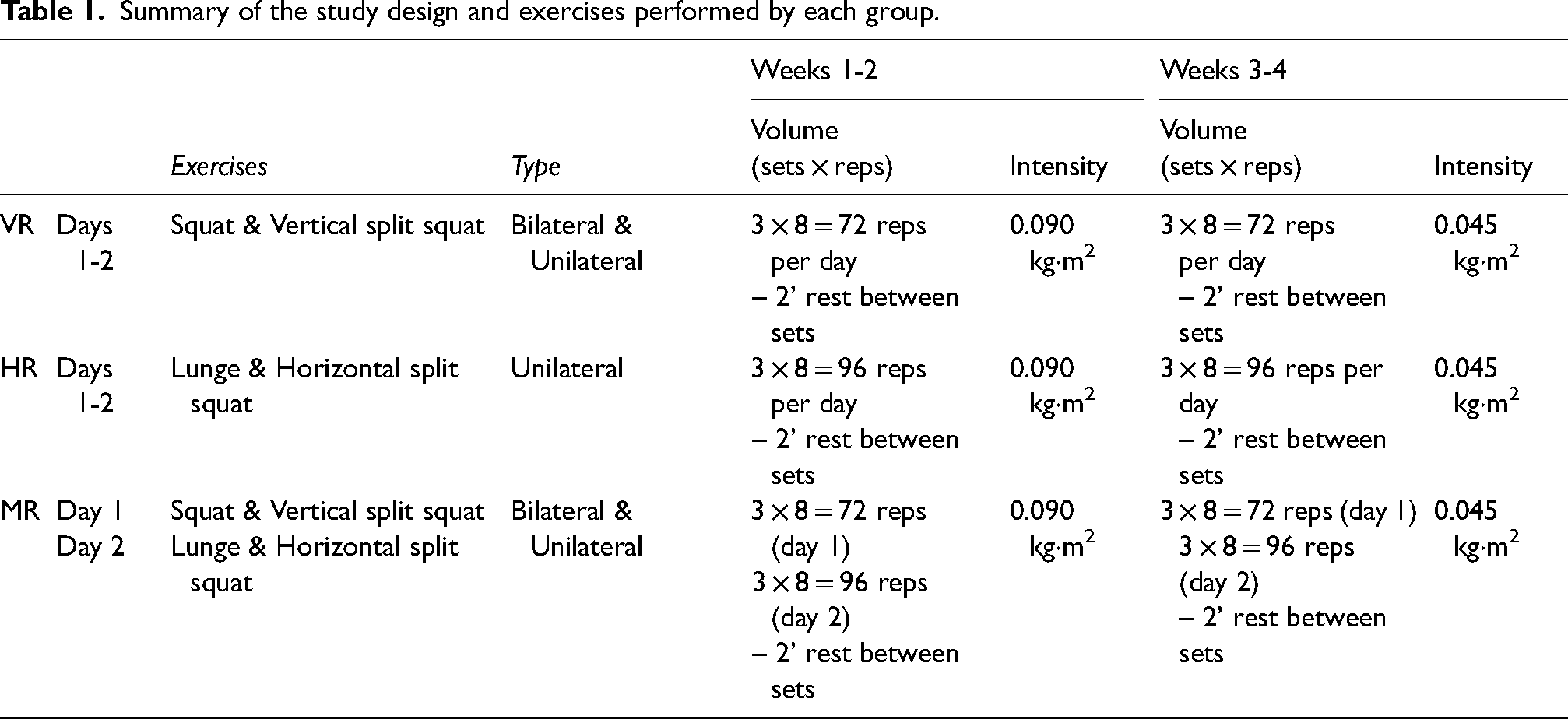
One week after the pre-test, participants started a 4-week flywheel resistance training intervention using a conical pulley device (VersaPulley, Iberian Sportech, Sevilla, Spain). All three groups performed two training sessions per week, with an equated training volume (i.e., two exercises, three sets of eight repetitions each session). After a standardized warm up, every group performed one set of eight reps of 5-0-5 test at maximum speed with 30 s of rest between repetitions. On the other hand, before of flywheel training, subjects did three sets and four repetitions of SJ (weeks 1 and 2) and CMJ (weeks 3 and 4) with the 30% of 1-RM.The inertial load used for flywheel training was 0.090 kg·m2 during the first two weeks, and 0.045 kg·m2 during weeks three and four, while the widest part of the conical pulley was selected for the strap rewind height aiming to maximize movement velocity. 23 This programming approach was used to combine different inertial loads, which has been proposed as optimal to improve athletic performance.23,24 The training programmes differed based on the exercises performed, which emphasized either horizontal (HR group) or vertical-directed force (VR group), or a combination of both (MIX group). During all training sessions participants were fully encouraged to perform the concentric action as fast as possible and to delay the braking phase to the last part of the eccentric action, which facilitate the achievement of eccentric overload. Table 1 shows the schedule of the study and the exercises used in each training group. Figure 1
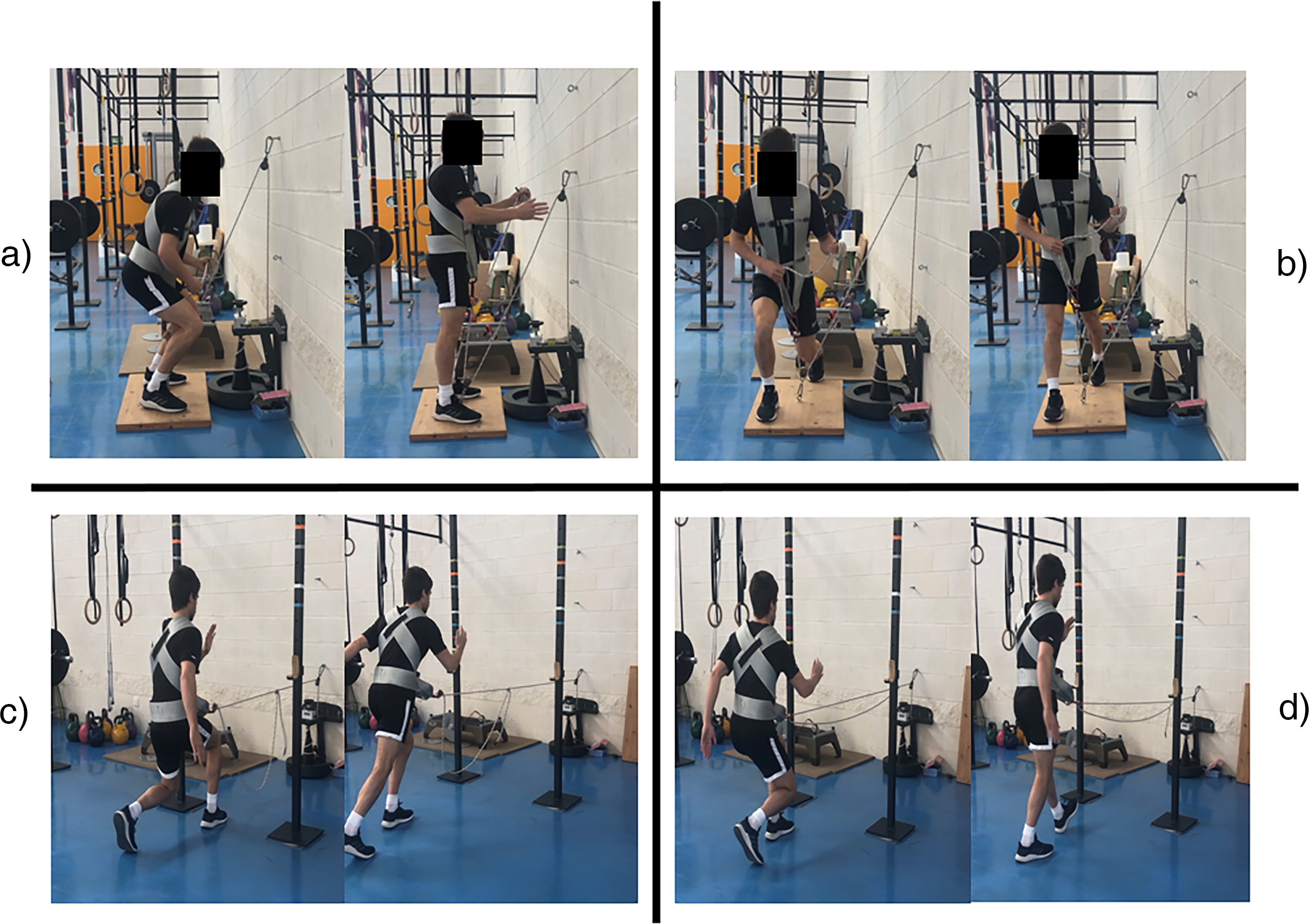
Exercises used during the flywheel resistance training program. The VR group used exercises A and B, the HR group used exercises C and D, while the MIX group used all.
Summary of the study design and exercises performed by each group.
Statistical analysis
All statistical analysis were performed using the SPSS statistical package version 25.0 (IBM, New York, NY, USA). After confirming data normality using the Kolmogorov-Smirnov test, the effectiveness of each program (VR, HR, and MIX) was assessed using a 3 (VR, HR, and MIX) × 2 (pre and post) mixed ANOVA was used. If needed, a Bonferroni post hoc test was used for pairwise comparisons. Statistical significance was set at p < 0.05. In addition, Cohen's d effect size (ES) was calculated to assess the magnitude of changes, being interpreted as trivial (< 0.2), small (0.2-0.5), moderate (0.5–0.8) and large (> 0.8).
Results
There was a main effect (p < 0.001) for time in all the performance variables. However, no group × time interactions were found in 1-RM (p = 0.309), CMJ (p = 0.956), 5-0-5 D (p = 0.730) and 5-0-5 ND (p = 0.282). Table 2 shows all pre- to post-changes in performance variables. For the 1-RM squat, significant improvements were found in the VR (p = 0.011) and MIX groups (p = 0.015), and a trend for significance in the HR group (p = 0.093). All groups showed significant increases in CMJ height (p < 0.05). Regarding 5-0-5 with the dominant leg, both the VR (p = 0.004) and the MIX groups (p = 0.001) showed significant decreases in 5-0-5 time, while the HR group showed a non-significant trend for 5-0-5 time decrease (p = 0.066). For the 5-0-5 with the non-dominant leg all groups showed significant decreases in 5-0-5 time (p < 0.05).
Pre- to post-changes in strength, jumping and COD performance by group.
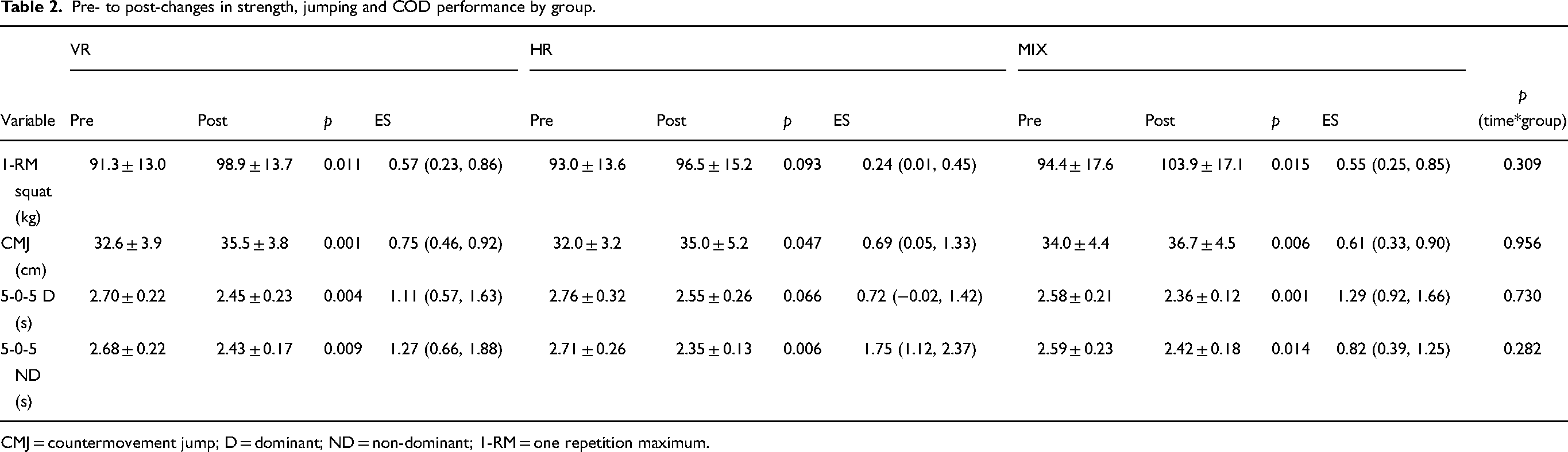
CMJ = countermovement jump; D = dominant; ND = non-dominant; 1-RM = one repetition maximum.
The ES values for between-group comparisons are shown in Table 3. Despite the lack of group × time interactions, VR and MIX groups showed greater improvements in 1-RM, although of small magnitude (ES = 0.32–0.34), than the HR group. For 5-0-5 ND the HR group showed greater performance increases of small (ES = 0.44) and moderate (ES = 0.70) magnitude than the VR and the MIX group respectively. In addition, HR group showed slightly greater improvements (of small magnitude) than the VR (ES = 0.24) and MIX (ES = 0.22) group.
Between-group differences (ES) in the performance changes.
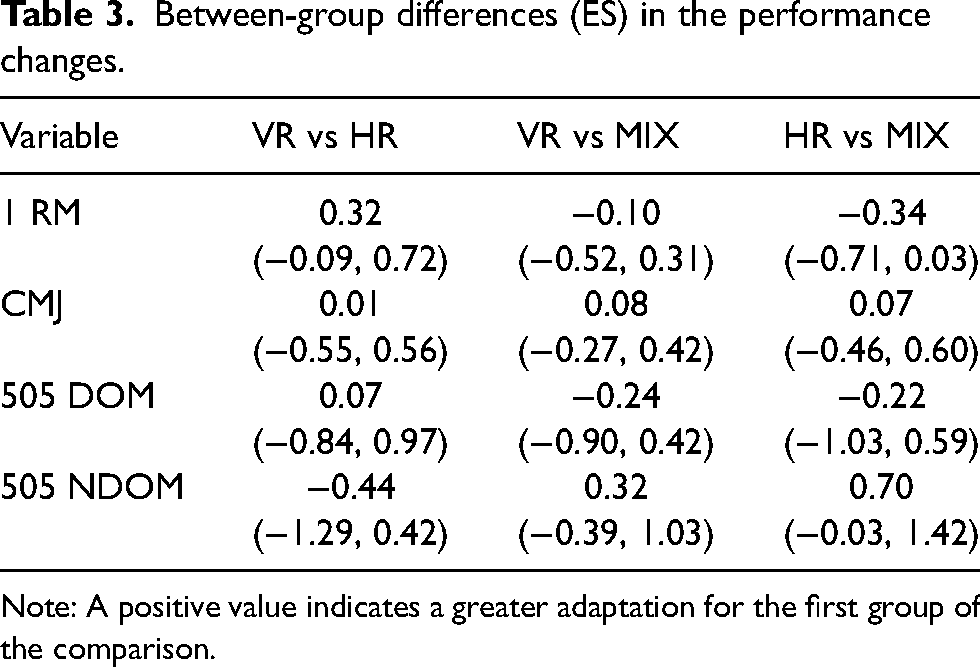
Note: A positive value indicates a greater adaptation for the first group of the comparison.
Discussion
The aim of the present study was to assess the influence of the different loading conditions used during flywheel training (i.e., vertical, horizontal, and mixed) on squat strength gains, vertical jump increases and 5-0-5 completion time. The main finding of the present study is that in recreational athletes, the improvements in performance variables are not significantly different when comparing the three training approaches. However, the group that trained using horizontal-directed exercises was the only not reaching significant improvements in 1-RM squat.
Studies have linked maximal strength levels in the squat exercise to improved sprinting and decreased 5-0-5 completion time.25,26 In the present study, despite the non-significant time × group interactions, within group changes showed that both VR and MIX groups significantly improved their 1-RM squat, while the HR group did not show a statistically significant increase. In addition, between-group comparisons showed small greater improvements (ES = 0.32–0.34) in both VR and MIX groups compared with the HR group. This is in line with Contreras et al., 27 who reported that a vertical-directed exercise (e.g., squat) was possibly more effective in increasing 1-RM squat strength than a horizontal-oriented exercise (e.g., hip thrust). However, it should not be discarded that the improvements in VR and MIX groups are partially caused by similarities between the training exercises (flywheel squat) and the testing exercises (free weight squat). These results are of significant practical application, as increases in 1-RM squat during pre-season periods have been previously linked to improvements in sprint performance. 28 As both VR and MIX groups performed the flywheel squat exercise during training, the present results confirm the widely reported usefulness of this exercise in improving 1-RM strength. 20 Despite part of these improvements may be attributed to the sample training status (e.g., recreational players), it should be highlighted that previous research using flywheel devices used longer training programs (e.g., 5–12 weeks). Therefore, it should be highlighted that the present study showed these improvements after a 4-week training program, which match with the habitual duration of the team-sports pre-season and could therefore be used by strength and conditioning coaches.
A recent meta-analysis 14 has shown the positive effects of flywheel resistance training in CMJ height increases. However, to date, no research has assessed whether the use of different vector-directed flywheel resistance exercises leads to distinct CMJ increases. The improvements in CMJ found in the three different groups were almost identical (about three centimeters in each group), with all showing ES of moderate magnitude and similar increases of 2.7 cm (MIX), 2.9 cm (VR) and 3.0 cm (HR). Further, between-group comparisons showed trivial differences when comparing all training groups (ES < 0.1). This is in line with previous studies reporting similar increases in vertical jump performance after plyometric training using either vertical or horizontal exercises, 10 or mixed vertical and horizontal exercises in recreational athletes of intermittent sports. 17 Moran et al. 15 confirmed this idea in a recent meta-analysis in which force direction in plyometric exercises had no relevance to improving CMJ. While Contreras et al. 27 suggested vertical resistance exercise as possibly most appropriate to improve vertical jump performance, other authors have shown the efficacy of horizontal exercises (e.g., hip thrust) in improving CMJ performance. 29 In addition, Gonzalo-Skok et al. 30 reported similar significant improvements in CMJ performance after a flywheel training intervention in both vertical and multidirectional training groups. It can be hypothesized that the exercises considered as horizontal induce a positive effect in vertical jump performance, likely by their similar movement patterns to the CMJ, including knee and hip extension. Thus, it is possible to consider the selection of either horizontal, vertical, or mixed flywheel exercises as suitable when aiming to improve CMJ performance in recreational athletes.
The importance of COD actions in many sports explain the necessity to find training interventions leading to improve this ability. Flywheel resistance training have been suggested as an optimal stimulus for improvements in COD ability, 20 being even more effective than traditional resistance training in improving this ablity. In agreement with this, all groups in the present study showed significant reductions in 5-0-5 completion time, the improvements being of moderate to high magnitude (see Table 2). Despite some authors suggesting that different vector-directed exercises may lead to distinct performance adaptations, the current study shows that all training groups similarly improved COD performance. Although the mangitude of changes showed by the HR group were slighlty higher compared with both VR and MIX group, these changes did not reach statistical significance. This is in line with previous research using plyometric10,16 and flywheel training, 20 where similar improvements in COD performance were found in both vertical and horizontal groups. Improvements in 5-0-5 performance in the current study (7–10%) were higher than the improvements reported by Manouras et al. 10 (3–4%) and Gonzalo-Skok et al. 16 (3%), which can be explained by the lower level and the relatively limited resistance training background of the participants in the current study. Again, the results of the present study support the inclusion of flywheel resistance training when aiming to improve COD ability.
The present study is not without limitations. The characteristics of the sample, with limited resistance training experience, favoured the significant improvements found in all groups. Further, the relatively small sample size and the lack of a control group limit the conclusions of the study. Future studies are required to assess whether the influence of vertical, horizontal or mixed exercise selection during flywheel training leads to distinct performance adaptations in athletes with higher resistance training experience. Other factors such as the slight difference in training volume (e.g., repetitions per session) and exercises type (bilateral vs unilateral) may have also affected the results of the present study. In addition, training intervention comprised eight training sessions (i.e., 4 weeks – 2 sessions/week), which might be insufficient to find differences between the training groups. However, due to limited time available during pre-season periods in most sports (e.g., handball, football, basketball), the present study design is in line with the real sports calendar, and therefore represent a possible training scenario.
Practical application
Flywheel resistance training, in spite of the different loading contitions (e.g., vertical or horizontal exercises) is highly effective in improving 1-RM squat strength, CMJ performance and COD ability. Strength and conditioning coaches should be aware that, both VR and MIX, but not HR group, showed improvements in 1RM squat (with moderate ES). Thus the inclusion of vertical-directed exercises is recommended when aiming to optimize 1-RM squat increases. There were no apparent differences between either horizontal-, vertical-directed, or a combination of horizontal and vertical-directed flywheel exercises in promoting improvements in, jumping and COD performance. Of note is that improvements in jumping and COD performance were visible after a short-term (i.e., four weeks) training intervention. Due to the congested calendar of most team-sports, with pre-season periods of approximately 4 weeks, this study highlights flywheel resistance training as a powerful stimulus to achieve performance adaptations in such periods.
Footnotes
Acknowledgements
No financial support was received to carry out this study.
Declaration of conflicting interests
The author(s) declared no potential conflicts of interest with respect to the research, authorship, and/or publication of this article.
Funding
The author(s) received no financial support for the research, authorship, and/or publication of this article.
