



Abstract
Although the impacts of traditional sets (TS) versus cluster (CL) sets resistance training have been broadly explored among recreationally trained populations, no studies have previously compared these set configurations among elite Judokas. Twenty-two elite male and female Judokas (age = 17.5 ± 1.2 years) performed identical periodized 4-week hypertrophy and strength blocks (8 weeks in total). Following this, for the final 4-week power training block, the cohort was separated into either TS (n = 11) or CL (n = 11) set structures. CL were prescribed by including 45-second intra-set rest every two repetitions. One-repetition maximum (1RM) and peak barbell velocities of the back squat and bench press, and countermovement (CMJ) jump height were assessed before and following each 4-week mesocycle. Significant strength and power improvements were observed after the 4-week hypertrophy training block (1RM bench press = Δ3.82 kg, ES [95% CI] = 1.34 [0.76, 1.93], p < 0.001; 1RM squat = Δ4.71 kg, ES = 0.52 [0.07, 0.96], p = 0.024; CMJ height = Δ0.54 cm, ES = 0.62 [0.16, 1.07], p = 0.008) and after the 4-week maximal strength training block (1RM bench press = Δ1.5 kg, ES = 0.68 [0.21, 1.41], p = 0.004; 1RM squat = Δ5.47 kg, ES = 0.61 [0.15, 1.06], p = 0.010; CMJ height = Δ0.45 cm, ES = 0.71 [0.23, 1.17], p = 0.003). However, no time × group differences were observed between the TS and CL groups following the 4-week power training block. Though traditional periodized resistance training improved neuromuscular qualities of elite junior Judokas, no between-group neuromuscular differences using either TS or CL suggests that both methods may be used as part of periodized training programs.
Introduction
The ability to produce high amounts of upper- and lower-body power contributes to successful performance(s) across numerous sporting contexts. 1 Indeed, higher mean, peak, and relative power output often separate elite from sub-elite athletes,2–4 or even starters from nonstarters within various team sports.5–8 In Judo specifically, we have recently shown that superior lower body absolute and relative power-generating capabilities differentiate elite-level junior medal winners from non-medalists. 9 Thus, training strategies that optimize neuromuscular power qualities appear to be an important factor in the success of Judoka athletes. However, few studies have investigated the effects of specific power training strategies to improve neuromuscular upper- and lower-body power in elite-level Judoka athletes.
Many elite combat athletes split their training time between strength and conditioning sessions, and mat-based technical/tactical training. In the context of Judo, technical/tactical training may consist of numerous sessions of Randori, whereby athletes perform high-intensity one-on-one throwing and grappling sessions. Furthermore, repeat Nage-komi (throwing training) in addition to Randori practice each week, both of which are broadly considered high-intensity training,10,11 can increase training volume and fatigue, which, if not properly managed, may lead Judo athletes to experience overtraining-related symptoms. 11 As such, complementary strength and conditioning practices aimed at improving neuromuscular qualities while concurrently minimizing fatigue are paramount to optimizing physical performance and mitigating overtraining risk among elite Judokas. Despite this, our previous review of the current strength and conditioning practices for elite Judokas suggests a paucity of research exploring the effects of resistance-based training modes that not only improve physical performance, but minimize the magnitude of neuromuscular fatigue developed during training programs. 12
Of the available evidence, conventional power training methods, including plyometrics 13 and Olympic weightlifting,10,14 have demonstrated efficacy to improve various neuromuscular outcomes among elite Judokas (see Harris, Foulds & Latella 12 for a detailed review). However, regardless of the typical low volume prescription (i.e. one to three sets, and ≤6 repetitions) and more extended inter-set rest (i.e. ≥2 minutes) of these training modes, 15 peak power and velocity per repetition may decrease throughout the set, and may markedly decrease during each successive set across the training session.16,17 In addition, concurrent training, where athletes perform strength and conditioning sessions in conjunction with technical/tactical training, may lead to attenuated neuromuscular adaptations due to inadequate rest and competing physiological demands. 18 Among youth athletes, despite some evidence to suggest favorable recovery stress states during high training workloads compared to adults, 19 nonfunctional overreaching with inadequate rest leading to burnout and overuse injuries/overtraining presents a considerable concern. 20 Therefore, conventional power training methods performed with intra-set rest periods, especially during periods of concurrent training may be an alternative approach to optimize neuromuscular adaptations while minimizing cumulative training fatigue. This training set structure is known as “cluster sets”, which is typically prescribed with intra-set rests of between 15 and 45 seconds per cluster (i.e. every two repetitions).16,17 Compared to conventional set structures, cluster sets (CL) may improve the short-term lower body power of physically active adults 21 and older adults. 22 In addition, CL may also result in less mechanical/metabolic fatigue 23 and lower rating of perceived exertion (RPE) scores 24 across the working set in well-trained adults when volume and intensity are matched. However, heterogeneous study designs, often recruiting recreationally or well-trained adult populations, and using different CL configurations (e.g. from 5-second to 45-second intra-set rest, every one to three repetitions), make it difficult to extend these findings to elite sporting contexts and to junior athletes specifically. Thus, further exploration into the effects of CL on neuromuscular performance outcomes among elite junior athletes is needed.
The aim of this study is to conduct a short-term training intervention investigating the effects of power training using two different set configurations (i.e. CL compared to traditional sets [TS]) on neuromuscular qualities in elite junior Judokas, with volume and intensity equated. Namely, the power training block comparing CL and TS paradigms will follow a traditional block periodization sequence (i.e. preceded by strength and hypertrophy mesocycles, respectively). We hypothesize that CL will yield similar, or slightly superior improvements in upper- and lower-body strength, and jump performance compared to TS over this short training block (see Morales-Artacho et al., 21 and Davies et al., 25 ). Regardless of neuromuscular outcomes, we believe our findings will provide a useful foundation for CL application in high-performance combat sport settings. For example, manipulation of set structure via CL may help reduce monotony of program design, or provide stimulus variability (i.e. greater repetition velocity via attenuation of intra-set fatigue) where otherwise, a reduction in load would be required to achieve the same outcome during training. The findings of this study will prove helpful for strength and conditioning coaches when designing programs for different phases within an annual training plan for elite Judokas.
Methods
Participants
Twenty-two healthy, trained junior male and female Judoka athletes, who have competed at the national or international level, participated in this study. All participants had been involved in full-time Judo, and strength and conditioning training for at least 2 years, training ∼18 hours/week (not including any off-site training camps or competitions). All participants were free from injury at the time of this study and maintained participation in all regular Judo training sessions (six days/sessions per week) throughout the study. Before study participation, each participant or parent/guardian provided written informed consent. All training and testing sessions were conducted at the Inspire Institute of Sport, India, and project approval was granted by Edith Cowan University Human Research Ethics Committee (ethics approval number: 21747).
Procedures
Training processes
The entire intervention was 12 weeks in duration, divided into 4-week mesocycles to match the training cycles and domestic competition(s) schedule per the International Judo Federation 2018 calendar year. Specifically, the intervention was performed between May and July under the supervision of the lead author (DMH). As per standard periodization sequencing models, 15 in the first training mesocycle block, participants undertook 4 weeks of hypertrophy training, which consisted of higher training volume loads with lower training intensities. Then, participants undertook 4 weeks of moderate and heavy strength training (i.e. maximal strength block). Finally, participants undertook 4 weeks of power training (i.e. power block). All participants (n = 22) performed each exercise within the hypertrophy and maximal strength phases using TS and repetition loading schemes (i.e. no intra-set rest). However, during the final 4-week power training block, participants were separated into two groups to compare the effects of power exercises performed using TS (n = 11) or CL (n = 11) on neuromuscular performance outcomes. Participants were stratified by sex and age during this final mesocycle block and matched for lower body strength (i.e. maximal squat strength). Participants performed all exercises as prescribed within the CL group but with a 45-second intra-set rest implemented after every two repetitions with a set. Across all mesocycles, resistance training programs were performed three times per week. Details of the programs for each mesocycle block, including the exercises, volumes, and intensities, are shown in Tables 1–3. Before each testing and training session, participants were instructed to perform a standardized 15-minute warm-up consisting of dynamic muscle stretching, joint range of motion, and light cycling performed at a RPE between two and 3 out of 10.
4-week hypertrophy mesocycle.
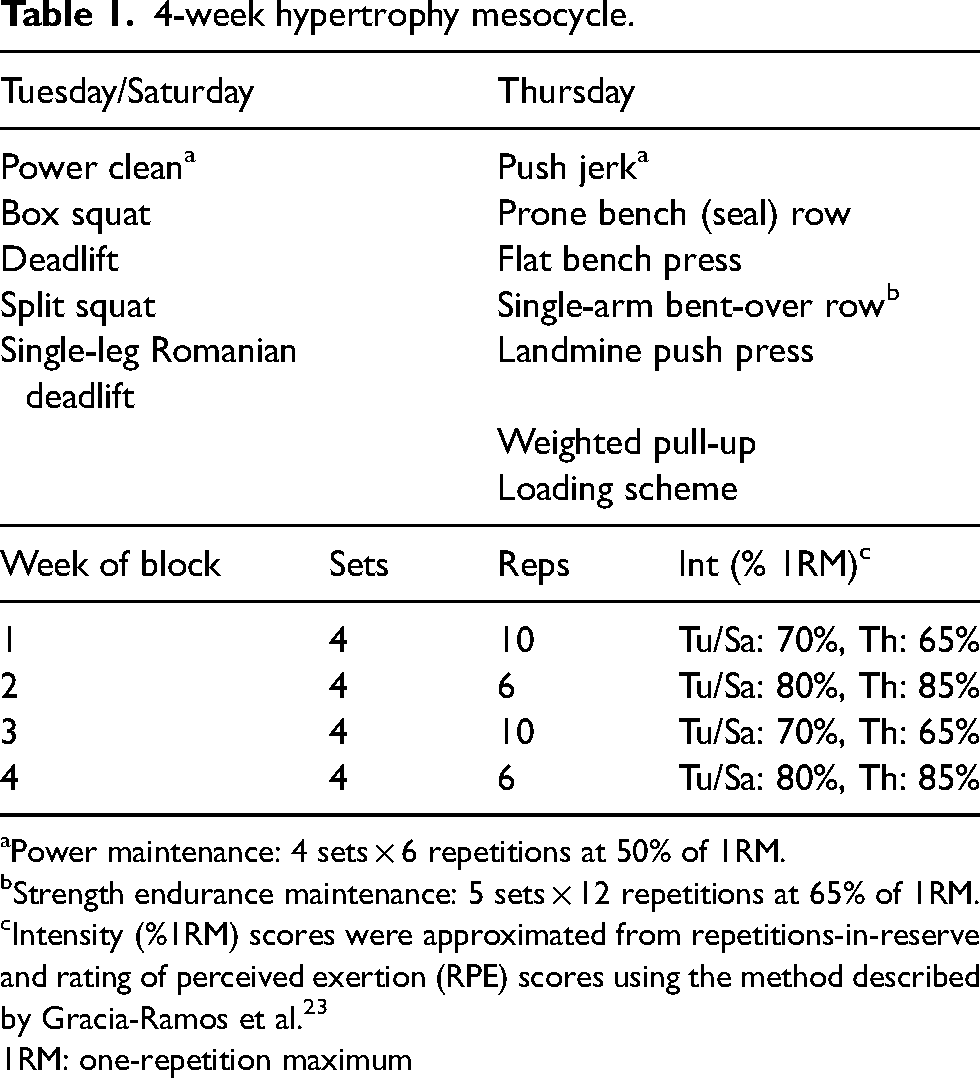
Power maintenance: 4 sets × 6 repetitions at 50% of 1RM.
Strength endurance maintenance: 5 sets × 12 repetitions at 65% of 1RM.
Intensity (%1RM) scores were approximated from repetitions-in-reserve and rating of perceived exertion (RPE) scores using the method described by Gracia-Ramos et al. 23
1RM: one-repetition maximum
4-week maximal strength mesocycle.
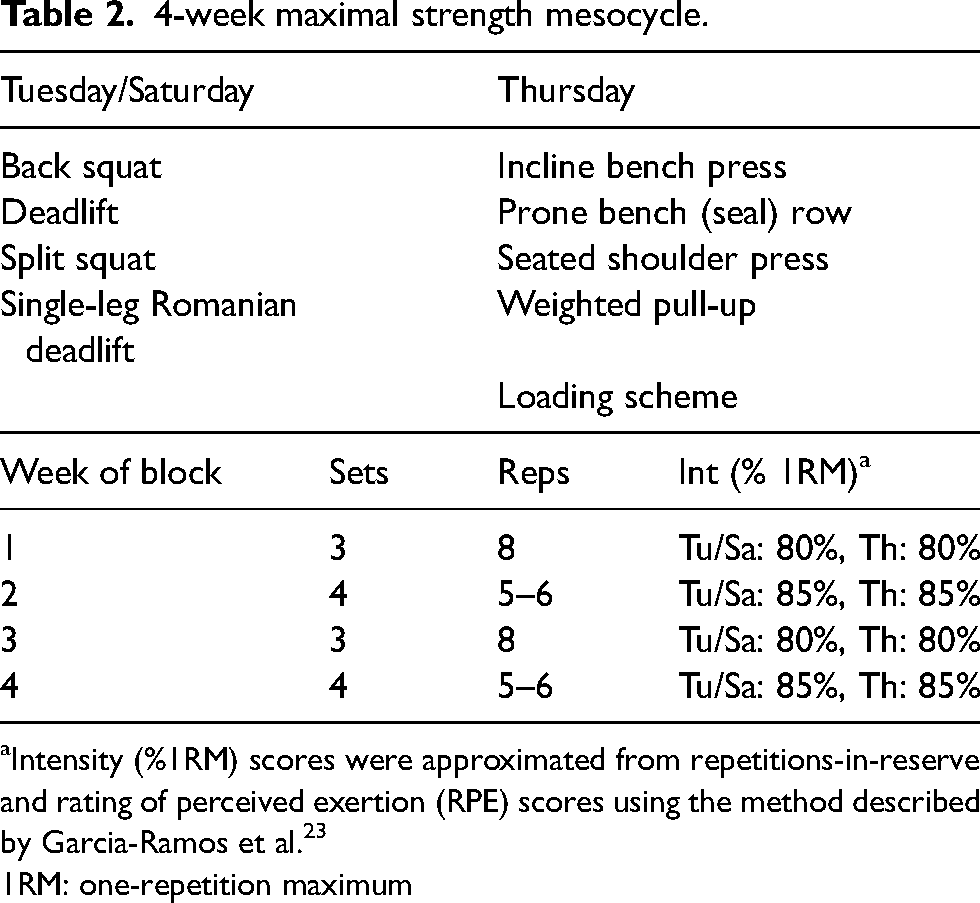
Intensity (%1RM) scores were approximated from repetitions-in-reserve and rating of perceived exertion (RPE) scores using the method described by Garcia-Ramos et al. 23
1RM: one-repetition maximum
4-week power mesocycle.
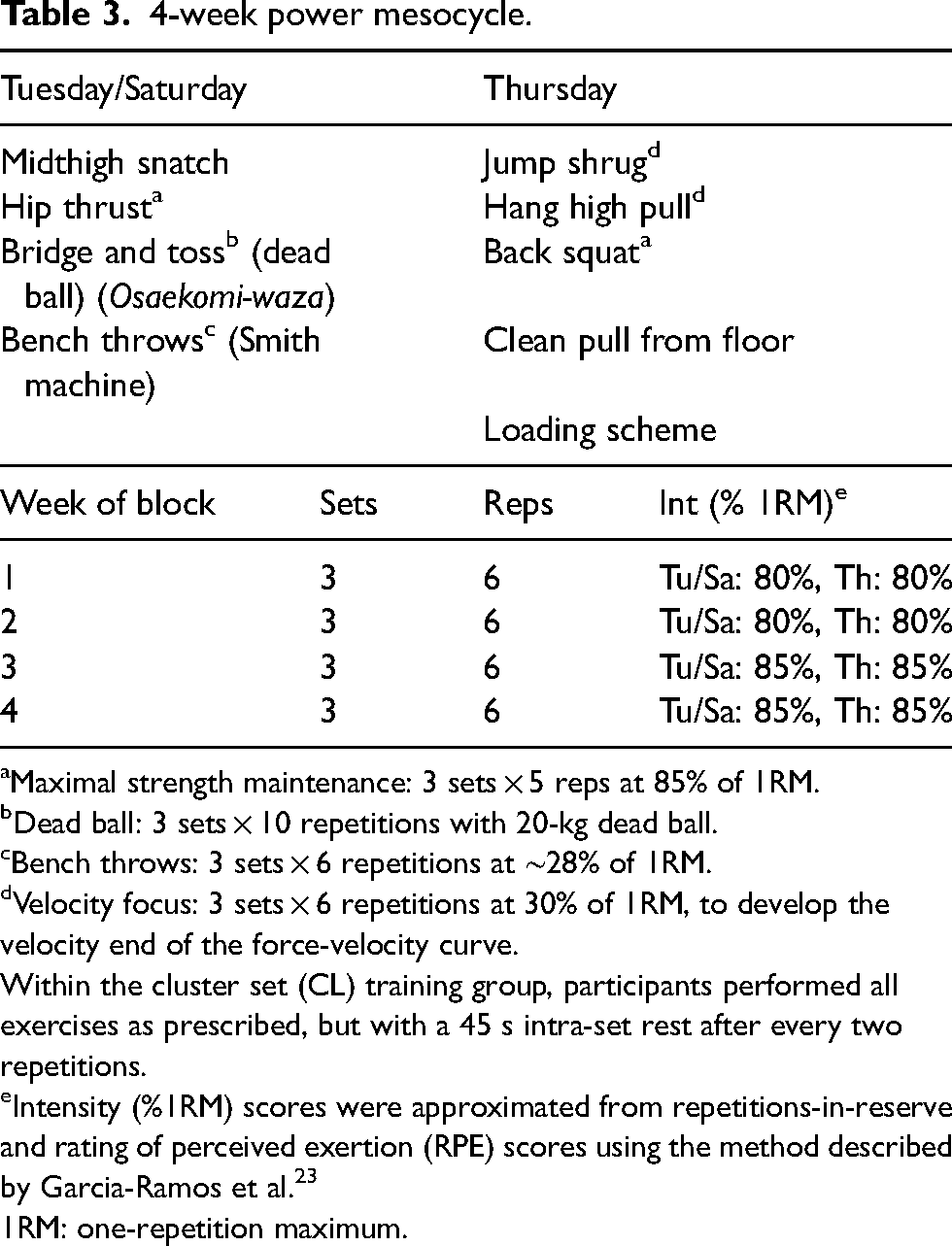
Maximal strength maintenance: 3 sets × 5 reps at 85% of 1RM.
Dead ball: 3 sets × 10 repetitions with 20-kg dead ball.
Bench throws: 3 sets × 6 repetitions at ∼28% of 1RM.
Velocity focus: 3 sets × 6 repetitions at 30% of 1RM, to develop the velocity end of the force-velocity curve.
Within the cluster set (CL) training group, participants performed all exercises as prescribed, but with a 45 s intra-set rest after every two repetitions.
Intensity (%1RM) scores were approximated from repetitions-in-reserve and rating of perceived exertion (RPE) scores using the method described by Garcia-Ramos et al. 23
1RM: one-repetition maximum.
Testing procedures
The testing outcomes were performed at baseline and at each subsequent timepoint (i.e. 0, 4, 8, and 12 weeks, respectively). They included anthropometric testing (i.e. height, weight, and body fat percentage) and performance testing. The performance tests included maximal strength (one-repetition maximum [1RM]) of the upper- (bench press) and lower-body (squat) with velocity measures, and countermovement jump (CMJ) height. At baseline and following each mesocycle training block, each of the testing outcomes was performed at the same time of day, 48 hours after the final training session of that block. This timeperiod was selected to conform with the day-to-day technical training of the Judokas while also minimizing any training-related fatigue.26,27
Maximal strength and velocity
All participants were tested for 1RM back squat and bench press strength using a competition standard Olympic bar (20 kg) and weight plates (Fitness World, UP, India). For both tests, each participant performed 10 repetitions at a low intensity before gradually increasing the load in 5–10% increments until they could not complete a full repetition. The number of sets before reaching the 1RM was four to six, and a three-minute recovery period was granted between each set. By following these standardized protocols, maximal strength testing (i.e. 1RM back squat and bench press) has consistently demonstrated excellent reliability (ICC = 0.99 both tests). 28 In addition, during the 1RM testing, a linear position transducer (GymAware, Kinetic Performance Technology, Canberra, Australia) was attached to the end of the bar and used to record peak velocity. Peak velocity was used to ensure athletes were meeting their true 1RM. Consistent with the methodology outlined in Orange et al., 29 the linear position transducer was specifically placed on the floor perpendicular to the right collar of the barbell, with the tethered cord attached to the proximal end of the right collar using a Velcro strap. The linear position transducer was recorded at a sampling frequency of 200 Hz and is considered reliable to capture kinematic data during both the bench press (ICC = 0.79) and squat exercises (ICC = 0.87). 29
Vertical jump height
Jump height was assessed via a CMJ performed on a portable jump mat (Probotics, Huntsville, AL, USA) using the protocol previously described by Markovic et al.,
30
which has been reported as highly reliable (ICC = 0.98). Each CMJ attempt required athletes to place their hands on their hips and, using a self-selected countermovement, jump vertically as high as possible and land in the same position on the mat. Each athlete performed three CMJ trials with a 1-minute recovery between each attempt, and the average of the three attempts was used for analysis. Vertical jump height was determined by converting flight time into jump height with the following conversion equation: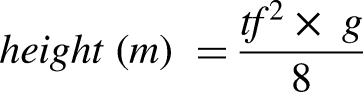
Statistical analysis
Statistical analysis was conducted using SPSS software version 27 (SPSS Inc., Chicago, IL, USA). Data are presented as mean ± SD, with the normality of the data confirmed using the Shapiro-Wilk test (p < 0.05). Both clinical magnitude-based inferences and the null hypothesis significance testing were performed to assess changes in the dependent variables. Paired t-tests were employed to assess changes in each dependent variable (i.e. performance outcomes) after the hypertrophy and maximal strength training phases. For the power training block, baseline (i.e. at pre [8 weeks]) between-group differences, and within-group pre–post (i.e. pre [8 weeks] vs. post [12 weeks]) differences, were tested using independent samples t-tests. A two-factor mixed ANOVA was performed to evaluate the influence of time (pre [8 weeks] vs. post [12 weeks]) and group (TS vs. CL) on each dependent variable following the power training phase. The level of significance was set at p < 0.05. Effect sizes were either represented as Cohen's d for the paired t-tests or as partial eta squared (ηp2) for the two-factor mixed ANOVA models. The magnitude of Cohen's d effect sizes was quantified as follows; trivial <0.25, small 0.25–0.50, moderate 0.50–1.0, or large >1.0. 31 Partial eta squared was classified using 0.01, 0.06, and 0.14 and is considered small, medium, and large effect sizes, respectively. 32
Results
Table 4 shows the baseline characteristics of the 22 participants included in this study. In addition, baseline group averages are also presented for each power training group (i.e. TS vs. CL groups), respectively.
Participant characteristics.
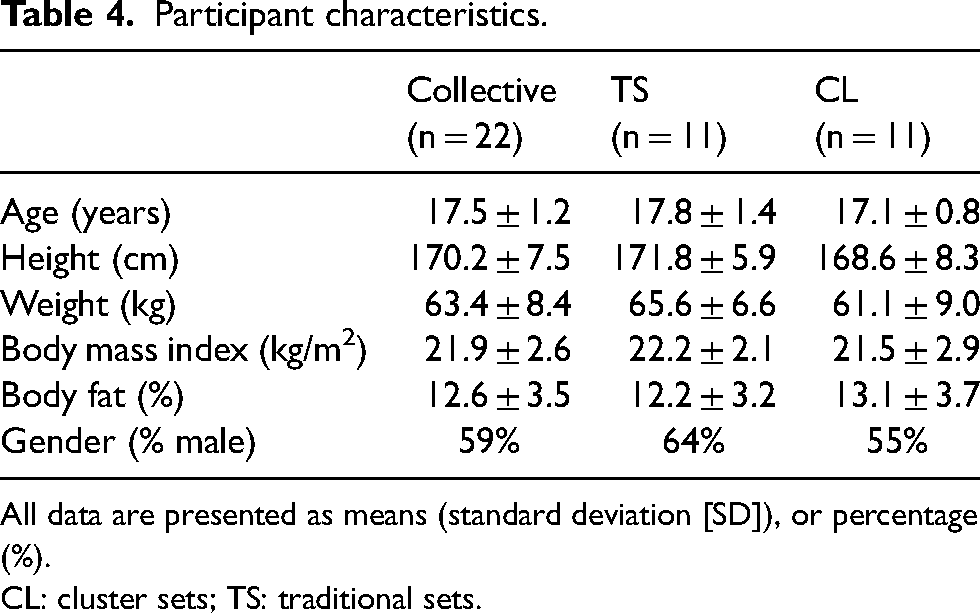
All data are presented as means (standard deviation [SD]), or percentage (%).
CL: cluster sets; TS: traditional sets.
The group performance real change data and p-values following hypertrophy and strength blocks are shown in Table 5. In the hypertrophy phase, paired t-tests revealed a large significant pre–post (0–4 weeks) improvements in 1RM bench press (Δ3.82 kg, ES [95% CI] = 1.34 [0.76, 1.93], p < 0.001), and a moderate significant difference for the 1RM squat (Δ4.71 kg, ES [95% CI] = 0.52 [0.07, 0.96], p = 0.024). In addition, a moderate but significant difference was observed in CMJ height (Δ0.54 cm, ES [95% CI] = 0.62 [0.16, 1.07], p = 0.008).
Real change scores for the collective group (n = 22) following two mesocycle training blocks of hypertrophy and strength.
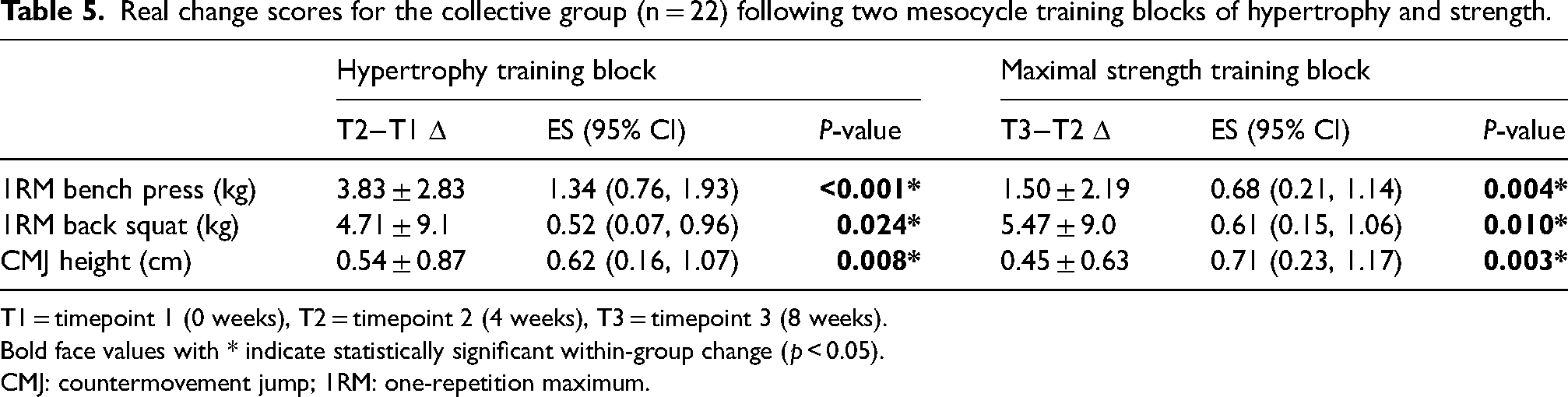
T1 = timepoint 1 (0 weeks), T2 = timepoint 2 (4 weeks), T3 = timepoint 3 (8 weeks).
Bold face values with * indicate statistically significant within-group change (p < 0.05).
CMJ: countermovement jump; 1RM: one-repetition maximum.
Following the maximal strength phase, there were moderate but significant improvements in for 1RM bench press (Δ1.5 kg, ES [95% CI] = 0.68 [0.21, 1.41], p = 0.004), 1RM squat (Δ5.47 kg, ES [95% CI] = 0.61 [0.15, 1.06], p = 0.010), and CMJ height (Δ0.45 cm, ES [95% CI] = 0.71 [0.23, 1.17], p = 0.003). No significant differences were observed for the velocity scores across hypertrophy (peak concentric 1RM bench press velocity Δ = 0.04 m·s−1 ± 0.09, p = 0.067; peak concentric 1RM squat velocity Δ = 0.01 m·s−1 ± 0.05, p = 0.203) and strength (peak concentric 1RM bench press velocity Δ = 0.03 m·s−1 ± 0.09, p = 0.089; peak concentric 1RM squat velocity Δ = 0.01 m·s−1 ± 0.05, p = 0.505) mesocycles, which indicated that athletes were consistently reaching their true 1RM during pre- and post-testing of each mesocycle.
Independent samples t-tests revealed no significant differences between TS and CL groups at 8 weeks (pre) for 1RM squat (TS, 134.9 ± 17.9 kg [95% CI = 122.8, 146.9]; CL, 133.0 ± 9.9 kg [126.3, 139.7]; p = 0.76) or 1RM bench press (TS, 69.7 ± 13.7 kg [60.4, 78.9]; CL, 69.0 ± 11.9 kg [60.9, 77.0]; p = 0.91). The individual and group mean pre-to-post scores of the 1RM bench press, 1RM squat, and CMJ performance outcomes between the two training groups after the power training phase are presented in Figure 1.
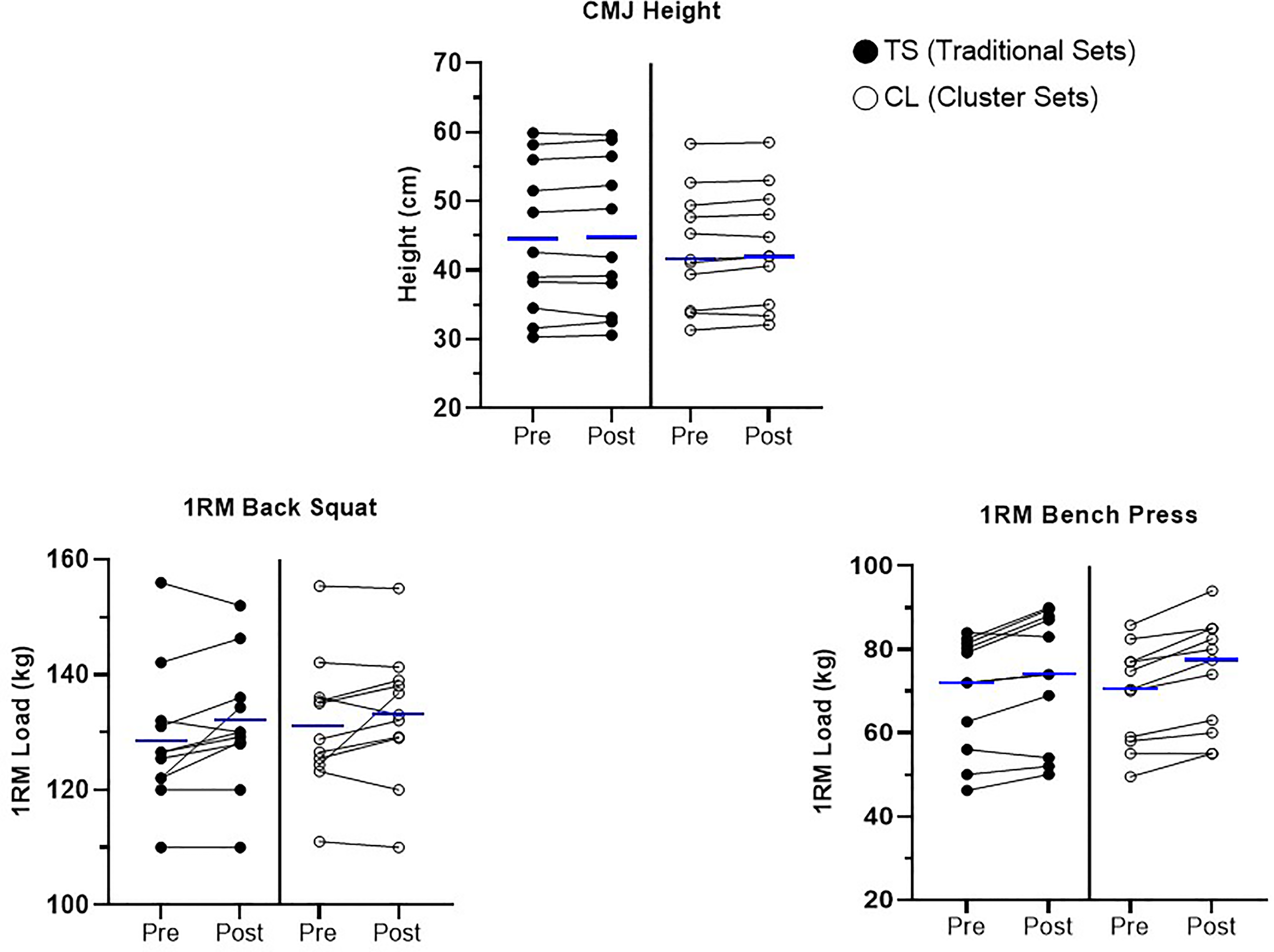
Pre-to-post within-group changes of the traditional sets (TS) and cluster sets (CL) groups following 4 weeks of power training. Prescores represent timepoint 3 (8 weeks) and post-scores represent timepoint 4 (12 weeks). The solid horizontal blue lines represent the group mean scores. None of the time × group values were statistically significant (p < 0.05), RM: repetition maximum.
After the power training mesocycle, the two-factor mixed ANOVA's revealed significant large main effects of time for the bench press 1RM (F(1,20) = 39.56, p < 0.001, ηp2 = 0.664) and for the 1RM squat (F(1,20) = 5.96, p = 0.024, ηp2 = 0.230). There was also a significant large main effect of time for CMJ height (F(1,20) = 5.14, p = 0.035, ηp2 = 0.204).
There were small and nonsignificant time × group interaction effects seen for the 1RM bench press (F(1,20) = 0.247, p = 0.624, ηp2 = 0.012), 1RM squat (F(1,20) = 0.153, p = 0.700, ηp2 = 0.008), and for the CMJ height (F(1,20) = 1.70, p = 0.207, ηp2 = 0.079).
No time × group interactions were observed for the peak concentric 1RM bench press velocity (F(1,20) = 0.163, p = 0.737, ηp2 = 0.006) or the peak concentric 1RM squat velocity (F(1,20) = 163, p = 0.691, ηp2 = 0.008), which indicated that athletes across both training groups were consistently reaching their true 1RM during pre- and post-testing within the power mesocycle.
Discussion
Exploring the effectiveness of different training strategies that serve to improve neuromuscular strength and power qualities, while minimizing resistance training-induced fatigue, may improve performance in elite-level Judo athletes. This study found that (1) as hypothesized, power training using both TS and CL produced similar changes in all neuromuscular outcomes assessed and (2) a traditional periodization sequence (i.e. hypertrophy < strength < power) led to substantial improvements in upper- and lower-body neuromuscular performance.
The use of CL training paradigms has been used in numerous healthy21,22,33 and sporting contexts, 34 however, to our knowledge, this is the first time it has been trialed with elite Judokas. Following the 4-week power training mesocycle, the ANOVA models revealed significant main effects of time, with improvements noted for the 1RM bench press (range of 2.9–3.2%), back squat (range of 2.7–3.5%), and CMJ height (range of 0.2–1.2%) at 12 weeks (post). However, when comparing groups (i.e. time × group interactions), we found no statistically significant differences between CL and TS groups for any neuromuscular outcomes after 4 weeks of power training, respectively. Despite a lack of between-group differences, the findings offer promise that the implementation of CL into the power training cycle can be just as effective as more established TS methods, and is the first to do so in this specific cohort. Indeed, our results suggest that CL are comparable to TS in inducing small improvements in strength and power qualities of elite Judokas within a 4-week power training mesocycle. Moreover, these findings are akin to other reviews demonstrating similar effects between CL use and TS for improving neuromuscular outcomes.25,35 Though not a primary focus of this study, it has been suggested that different CL paradigms (i.e. using undulating or ascending CL structures) used within power-focused mesocycles may depend on the training goals and strength levels of the athlete(s), and/or the stage of the training plan. 36 As a follow-up from our preliminary results, further studies should contrast different CL paradigms, and look to implement training programs over longer time periods where small differences in neuromuscular adaptations (e.g. velocity or power) may become more apparent, especially with the use of methods designed to maximize these qualities.
A strong point of this study was the traditional periodization sequencing used in the lead-up to the power training mesocycle, which effectively meant groups were trained similarly before undertaking TS or CL, and matched closely in terms of strength, age, and sex. To our knowledge, only a handful of studies have examined the effects of periodization training, using conventional periodized block sequencing, on neuromuscular performance outcomes among elite Judokas. 12 Of these, two studies explored the training-related effects of traditional block periodization on maximal upper body strength (i.e. 1RM bench press),10,14 and one study on maximal lower body strength (i.e. 1RM squat). 10 The current study showed that 8 weeks of hypertrophy and strength training improved upper- and lower-body maximal strength by 10.2% and 8.2%, respectively. This is comparable to previous evidence showing that 8 weeks of periodized strength training (three sessions/week) among 13 senior Judoka athletes led to significant increases in maximal bench press and squat strength (11.6% and 7.1%, respectively). 10 In contrast to our findings, Franchini et al. 14 showed somewhat smaller nonsignificant differences in the maximal bench press (3.4%) after 18 weeks of periodized strength training (three sessions/week) among 10 elite senior Judokas. The disparate results may be due to the diverse training methods employed across studies. For example, 11 weeks of the 18-week training program employed by Franchini et al. 14 targeted particular Judo conditioning activities (i.e. pulley machines, wrist flexion exercises, etc.) with a variety of mixed strength/power and conditioning training methods (i.e. complex training, aerobic conditioning, Randori, rowing, etc.). In addition, the bench press exercise was only performed as part of a complex training sequence, with the intended goal to improve Judo-specific power outcomes, which may partly explain the smaller improvement in bench press strength in the study by Franchini et al. 14 compared to our current study.
Following the initial 8 weeks of periodized resistance training, our results indicate a significant improvement in CMJ height (∼2.4%). This is not surprising given the improvements shown in our study for lower body maximal strength (∼3.6%). However, these results were modest (ES = 0.62–0.71), so it is difficult to determine the meaningfulness of the CMJ changes despite reaching statistical significance. Indeed, the evidence is mixed regarding the effects of resistance training on CMJ performance among Judokas, with limited periodized resistance training literature to compare our results to. Of the available evidence, Branco et al. 37 showed no change in CMJ performance following 8 weeks of combined Judo specific and resistance training. On the other hand, Fukuda et al. 38 demonstrated marked improvements in CMJ power (∼26.7%) following 4 weeks of Judo-specific (nonresistance) training among junior Judokas. Some caution is needed when comparing results, and particular attention should be given to the training ages of participants across studies. For instance, our participants were considerably older (∼4 years), with more training experience than the participants in Fukuda et al. 38 It is feasible that younger athletes with lower training ages may be more sensitive to CMJ improvements via neurological adaptations or improved biomechanical proficiency. 39 Nevertheless, despite the conflicting evidence, CMJ testing should be considered a useful metric for elite Judokas, particularly considering that lower body anaerobic power is a key factor underpinning successful competition outcomes,9,40 and may also differentiate domestic from international-level competitors. 41
This study is among a handful to explore the effects of traditional periodized sequencing on neuromuscular outcomes among elite Judo athletes and, to our knowledge, is the only study comparing two different set configurations during a subsequent 4-week power training mesocycle in Judokas, despite a similar study being completed in active university students. 21 Irrespective of this though, several limitations should be considered. First, we opted to explore maximal strength qualities, and so future studies should look at the effects of TS and CL on submaximal force-velocity outcomes, particularly since CL training may modulate squat force-velocity relationships at submaximal loads more so than TS. 42 Second, high-level Judo performance requires meaningful contributions from all three metabolic systems. 12 However, we only included dependent variables that targeted the ATP-CP system. Therefore, the effects of each mesocycle and set configuration on the aerobic and anaerobic glycolytic systems remain unclear and require further investigation. We also acknowledge that there were no direct measures of fatigue included throughout the training intervention, even though CS implemented in this fashion were partly designed to minimize fatigue accumulation. While the similar CMJ performance scores observed between groups in this study may well indicate comparable fatigue states following 4 weeks of either CS or TS power training, future research should aim to incorporate specific fatigue measures while comparing CS to TS resistance training among athletic populations. Finally, the power training block employed in this study was 4 weeks in length, which may have been too short a time to detect any significant neuromuscular differences between TS and CL groups, especially as both groups we performing similar exercise(s). Therefore, longer duration studies are warranted to repudiate or confirm our preliminary findings. The effect of improving the neuromuscular qualities measured in our study on specific Judo performance outcomes should also be examined in the future.
Conclusion
In this study, hypertrophy followed by strength training mesocycles improved both upper- and lower-body strength and power over an 8-week training period for elite Judokas. During a subsequent 4-week power-focused mesocycle, despite collective improvements over time in strength and power, there were no time-by-group differences observed between CL and TS in neuromuscular qualities. As such, both TS and CL training may be appropriate programming choices for strength and conditioning coaches of elite Judokas during short-term power training blocks. CL paradigms may be a useful programming alternative to TS for elite Judokas to reduce monotony of program design and enable stimulus variability (despite the use of the same exercise).
Footnotes
Acknowledgments
The authors would like to acknowledge the Inspire Institute of Sport, India for their assistance with this project.
Author’s contribution
DMH and CL conceptualized the research project. DMH analyzed the data and prepared the manuscript for publication. DJO and CL edited the manuscript and provided expert feedback regarding the interpretations of the results.
Declaration of conflicting interests
The authors declared no potential conflicts of interest with respect to the research, authorship, and/or publication of this article.
Funding
The authors received no financial support for the research, authorship, and/or publication of this article.
