



Abstract
Policy that disallows body checking (BC) lowers the injury and concussion rate for youth ice hockey players. However, little is known about how disallowing BC influences in-game metrics of performance. This prospective cohort video-analysis study examined offensive performance in Under-15 (ages 13–14) and Under-18 (ages 15–17) youth ice hockey players in leagues allowing and disallowing BC. Fifty-two games were filmed (n = 13 BC, n = 13 non-BC) for Under-15 and Under-18 non-elite (lowest 60% and 45% divisions, respectively) divisions in Calgary, Canada. Footage was analyzed for offensive performance metrics on the puck-carrier using the validated ice hockey adapted team sport assessment procedure. Puck metrics included how the player acquired puck possession (e.g. conquered puck from an opponent, received pass from a teammate) and the outcome (e.g. shot on goal, lost puck to opponent). The puck metrics were used to compute a performance composite score for each player that accounted for the quantity (rate of puck possessions per shift time) and quality (a ratio of positive performance metrics to all metrics) of play. Mean difference's (MD) in performance composite scores were compared using multivariable linear regression (adjusted for player position and cluster by team-game) between leagues allowing and disallowing BC for both age groups. Analyses revealed no significant MD in the performance composite scores between players in BC and non-BC leagues for both age groups (Under-15: MD = 0.02, 95%CI: −0.08, 0.12; Under-18: MD = −0.06, 95%CI: −0.16, 0.03). These findings suggest no differences in offensive performance when BC is disallowed in Under-15 and Under-18 non-elite leagues.
Introduction
Ice hockey is a popular Canadian sport with over 470,000 youth registrants in the 2019–2020 season. 1 While popular, participation is unfortunately associated with high risk of injury, including concussion.2–4 The high injury risk is largely attributed to the fast-paced gameplay with regular player-to-player physical contacts and collisions.3,5 Player-to-player physical contacts can be separated based on severity into body contacts and body checking. 6 Body contacts are identified as being legal and of lower intensity, which may or may not affect the player being contacted. 6 Body checking is defined by Hockey Canada as “a technique where a player uses forceful contact to hinder or impede the progression of the opposing puck carrier by separating them from the puck.” 7 Body checks can be identified by use of significant force and is the main mechanism for injury in youth ice hockey.6,8 Coaches are tasked with educating and demonstrating to players how to deliver and receive a body check and body contact. 7
Prior to 2013, body checking was first introduced in most Canadian youth ice hockey jurisdictions at the Under-13 (U13, formerly Pee Wee, ages 11–12) level. However, previous studies have identified body checking as the single most consistent risk factor for injury (including concussion) in youth players.3,8,9 Moreover, U13 players in leagues allowing body checking are at a 3-fold greater risk for both injury and concussion compared with players in equivalent leagues disallowing body checking.9,10 To reduce this burden, Hockey Canada implemented an evidence-informed policy change in 2013 to disallow body checking in all U13 leagues across Canada and delay body checking until the Under-15 (U15, formerly Bantam, ages 13–14) level. Since this national policy change, there has been controversy among the hockey community on whether disallowing body checking at the U13 level was positive for the sport. Some argue that delaying body checking to the older age group has resulted in reduced player skill level, lower game excitement and increased learning of unsafe playing habits (e.g. players skating with their head down) that could increase injury risk. 11 Lower player skill level may be of utmost concern for coaches and players. These concerns raise debate as to when body checking should first be introduced to players, with some contending that the first exposure could be earlier than the U13 level, if taught properly. 12 However, previous research has found that introducing body checking at the Under-11 level (U11, formerly Atom, ages 9–10) was associated with an increased risk of injury. 13 Moreover, players introduced to body checking at the U11 level were at a higher risk of injury at the U13, U15 and Under-18 (U18, formerly Midget, ages 15–17) levels compared with players who were not introduced to body checking until the U15 level. 13
Although no national policy change has been introduced by Hockey Canada to restrict body checking beyond the U13 level, various local and provincial youth ice hockey associations in Canada have introduced policy within their organizations to disallow body checking at the non-elite U15 level. Evaluation of this policy change within these non-elite age groups found a 56% reduction in the injury rate when body checking was prohibited. 14 In 2016, Hockey Calgary (a local association in the province of Alberta, Canada) extended this policy to disallow body checking in non-elite U18 divisions. This policy change was unique because Hockey Calgary disallowed body checking in two of the four non-elite U18 divisions (divisions 5–6; 20% of all competitive teams), but allowed body checking within the upper two non-elite divisions (divisions 3–4; 25% of all competitive teams). Unfortunately, further controversy exists with coaches and the hockey community for policy disallowing body checking for concerns with players not fully developing proper skills and diminished game excitement. 15 Moreover, Hockey Canada supports the removal of body checking for not only reducing the injury burden, but also promoting player and team skill development. 15 Therefore, measuring player in-game performance for all players is an important consideration to inform players, parents, coaches, and association administrators of the impact that policy disallowing body checking has on the game.
Sport performance measures can vary from individual athlete biological response and adaptation under different conditions and training regimes to measuring team-based performance.16,17 Considering all variables for the assessment of player performance, previous video analysis research has identified actions made by the puck carrier (i.e. offensive performance) to be most important. 18 Methods to examine offensive performance include a human rater examining footage with predefined variables or artificial intelligence and machine learning techniques that use algorithms to analyze gameplay based on predefined landmarks and specified parameters. Multiple companies (e.g. Iceberg Sports Analytics, InStat Sport) offer services for artificial intelligence and machine learning analysis of sport;19,20 however, the validity of the parameters and techniques used, especially for youth sport has not been reported. Therefore, we opted to use the ice hockey adapted team sport assessment procedure (TSAP) as an optimal method for examining offensive performance because it has been validated against coach expert evaluations, was shown to be reliable across multiple human raters, and can be related to prior youth ice hockey research.17,21,22 Previous video analysis of offensive performance using the ice hockey adapted TSAP in elite (upper 30% divisions) U13 ice hockey leagues allowing and disallowing body checking found that leagues disallowing body checking had a greater rate of offensive passes completed to teammates with no differences in any of the other performance metrics. 23 To date, there is no evidence on whether body checking policy influences offensive performance in non-elite U15 and U18 leagues. Therefore, the purpose of this study was to assess the differences in offensive performance composite scores between leagues allowing and disallowing body checking. The primary objective was to compare the offensive performance composite score between equivalent non-elite (lowest 60% of all divisions, divisions 4–8) U15 divisions allowing and disallowing body checking in Calgary, Canada. The secondary objective was to compare the offensive performance composite score between U18 upper (divisions 3–4; body checking allowed) and lower (divisions 5–6; body checking disallowed) non-elite divisions (lowest 45% of all competitive divisions) in Calgary, Canada. Exploratory objectives included comparing offensive performance metrics used to create the performance composite score between leagues allowing and disallowing body checking for both the U15 and U18 age groups.
Materials and methods
Study design and participants
This prospective cohort video-analysis study included U15 (ages 13–14) and U18 (ages 15–17) non-elite (lowest 60% of all competitive U15 divisions and lowest 45% of all U18 competitive divisions) youth ice hockey players in Calgary, Canada. Players were anonymous; therefore, inclusion into this study was based on being analyzed for at least one offensive performance variable during gameplay. Thirteen regular season games were filmed from a list of all games based on research assistant availability for both the U15 2014–2015 (body checking allowed) and 2015–2016 (body checking disallowed) regular season of play between January and March. Thirteen regular season games were also selected and filmed for both the U18 divisions 3–4 (body checking allowed) and divisions 5–6 (body checking disallowed) cohorts between January and March for the 2016–2017 season. As this was the first study to assess offensive performance in U15 and U18 leagues, the sample size was based on previous research assessing player physical contact behaviours before and after policy disallowing body checking in games.6,24 As such, there was no a-priori sample size estimation based on the offensive performance outcomes. Ethics approval for this study was granted by the University of Calgary's Conjoint Health Research Ethics Board (CHREB ID: E-20252).
Procedure
A notice was sent to all Calgary U15 and U18 ice hockey teams at the start of the season (September) indicating that the University of Calgary's Sport Injury Prevention Research Centre research team may be filming games throughout the season. Regular season games between January and March (at least 3 months into the season of play) were identified by a research coordinator. This timing was chosen to allow players on a team to practice together and adjust to their league's rules (e.g. allowing or disallowing body checking). To reduce the likelihood of altered player actions and team gameplay, no warning was given to specific teams prior to filming a selected game. At the arenas, three research assistants were utilized to collect data. One research assistant would record the game using a Sony Handycam model HDR-PJ540 video camera (1920 × 1080 full high-definition quality at 60 frames per second) with a tripod for stability. The position of the video camera during filming depended on the arena design; however, the most appropriate position for the camera placement was in the viewing stands, as high as possible, and located near centre ice. The instructions for recording the game were to always follow the puck in the camera's field of view and show the scoreboard after each stoppage in play to allow the video analyzer to orient themselves in the game. Two research assistants were collecting in-game shift-time data for all players (one research assistant per team) based on the players on the ice and the time on the score clock when player line-changes occurred. The ideal location for the shift-time recorders was in a corner in their selected team's defensive zone to clearly see jersey numbers while still having clear view of the scoreboard. After game film and shift-time data were collected, shift-times were summated as a total game shift time for each player number on each team, and footage was uploaded from the video camera onto a secured server and imported into Dartfish version 7.0 video analysis software (Dartfish, Switzerland). Dartfish allowed for the coding of offensive performance variables directly on the video clips using a custom-created tagging panel that consisted of all TSAP performance puck metrics and player numbers for each team-game. Dartfish also allowed the video clips to be viewed frame by frame to ensure that no action was missed during the game. Games were analyzed for the offensive performance measures using Dartfish on a 27-inch Mac (Apple, California) desktop computer.
Offensive performance measures
All footage was analyzed by one rater (ATK) who had previous experience as an ice hockey player and coach and was trained for the offensive performance measures by an expert rater (LN) who led prior work that adapted the TSAP to ice hockey and validated the metrics against coach expert evaluations. 21 Games were analyzed for the puck carrier using the previously validated and reliable ice-hockey adapted TSAP.21,22 The ice hockey adapted TSAP includes two main categories of variables – puck possession and puck outcome. Puck possession variables included all possible scenarios that a player could receive possession of the puck, and included the following metrics: (1) conquering the puck from an opponent; (2) receiving a pass from a teammate; (3) receiving a free puck (Table 1). Puck outcome variables included the following metrics: (1) offensive/intentional pass completed to a teammate; (2) successful shot on goal; (3) lost puck to an opponent or stoppage in play; (4) successful icing to clear the defensive zone; (5) neutral/unintentional pass to a teammate (Table 1). The total game shift time and number of each puck possession and puck outcome metrics for all individual players was further used to calculate three global performance variables (volume of play, efficiency index, performance composite score). The volume of play and efficiency index global performance variables were used to measure a player's quantity and quality of play, respectively, while the performance composite score (main outcome) was calculated by multiplying the volume of play and efficiency index variables together for an aggregate performance measure (Table 1). Position of play (forward, defence) was also collected for each player based on their position for their first shift of the game. Intra-rater reliability was assessed for the video analyzer (ATK) using the first 34 game actions (approximately the first 5 min of a game) in the first five videotaped games (n = 170 total game actions). One game action included a player number, puck possession metric, and puck outcome metric. Re-test was completed 14 days after the initial viewing and rating.
Descriptions of the team sport assessment procedure's offensive performance puck actions.
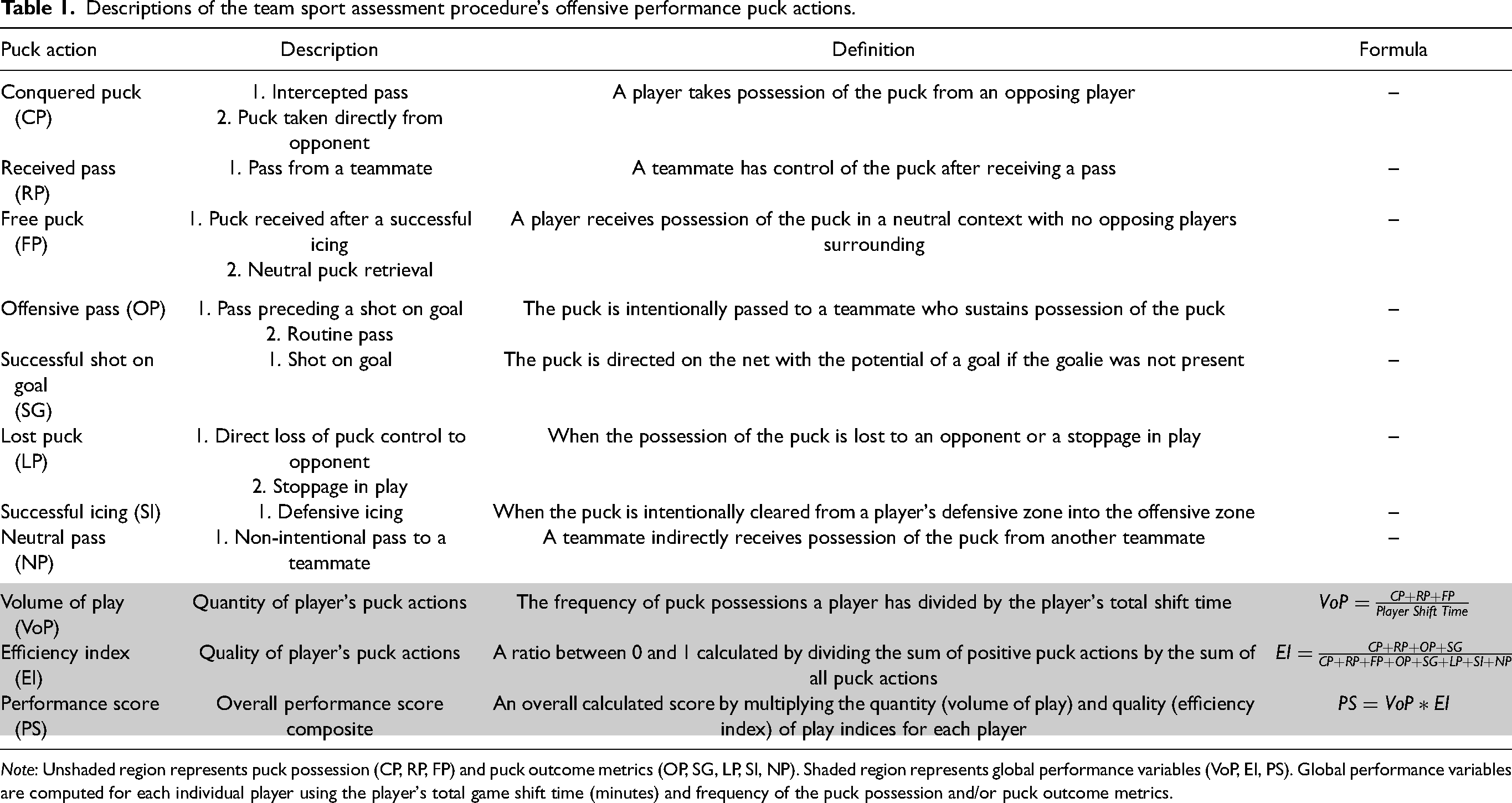
Note: Unshaded region represents puck possession (CP, RP, FP) and puck outcome metrics (OP, SG, LP, SI, NP). Shaded region represents global performance variables (VoP, EI, PS). Global performance variables are computed for each individual player using the player's total game shift time (minutes) and frequency of the puck possession and/or puck outcome metrics.
Analysis
Stata version 16.1 (StataCorp) was used for all statistical analyses and alpha (α) was set at 0.05 (95% confidence intervals). 25 Cohen's Kappa was used to assess intra-rater reliability on the puck possession and outcome metrics, and ability to identify player numbers.
To answer the primary and secondary study objectives, mean and mean differences for the performance composite score between body checking and non-body checking leagues were compared using separate multiple linear regression models adjusted for player position (forward or defence) and cluster by team-game. Exploratory analyses compared mean volume of play and efficiency index variables by body checking status using multiple linear regression models adjusted for player position (forward or defence) and cluster by team-game. Incidence rates (per player per minute) and incidence rate ratios (IRR) were compared for each individual puck possession and puck outcome metric using multiple Poisson regression models adjusted for both player position (forward or defence) and cluster by team-game, offset by individual player shift-time (minutes). In all analyses, player position was first assessed as an effect measure modifier using the Wald test. 26 If the Wald test was not statistically significant (p ≥ 0.05), player position was assessed as a potential confounder based on a β-coefficient change of greater than 10% for the body checking variable. If position did not modify nor confound the relationship between body checking and each outcome, it was removed from the model, and the univariate estimates (with adjustment for cluster by team-game) were reported. If player shift-time (minutes) was missing, it was estimated based on mean in-game shift times for players without missing data in the same cohort (e.g. U15 age group with body checking allowed) and playing the same position (forward or defence).
Results
Intra-rater reliability from the Cohen's Kappa (k) statistic scored as almost perfect agreement for identifying player numbers (k = 0.94), puck possession metrics (k = 0.92), and puck outcome metrics (k = 0.93) based on Landis and Koch criteria for agreement. 27
Missing shift-time data were estimated for 28 players (4% of all players) in the U15 cohort (n = 27 in 2014–2015 cohort (body checking allowed); n = 1 in 2015–2016 cohort (body checking disallowed)) and 27 players (4% of all players) in the U18 cohort (n = 1 in divisions 3–4 cohort (body checking allowed); n = 26 in divisions 5–6 cohort (body checking disallowed)). The mean game shift time (minutes) for defence positions was higher than for forward positions in the U15 2014–2015 body checking (forwards: 14.67 min (SD: 2.91), defence: 17.79 min (SD: 4.31)) and the 2015–2016 non-body checking (forwards: 15.76 min (SD: 3.15), defence: 18.06 min (SD: 3.57)) cohorts. A similar pattern was observed in both the U18 body checking divisions 3–4 (forwards: 15.23 min (SD: 3.93), defence: 16.82 min (SD: 3.91)) and non-body checking divisions 5–6 (forwards: 14.73 min (SD: 3.50), defence: 18.27 min (SD: 3.82)) cohorts.
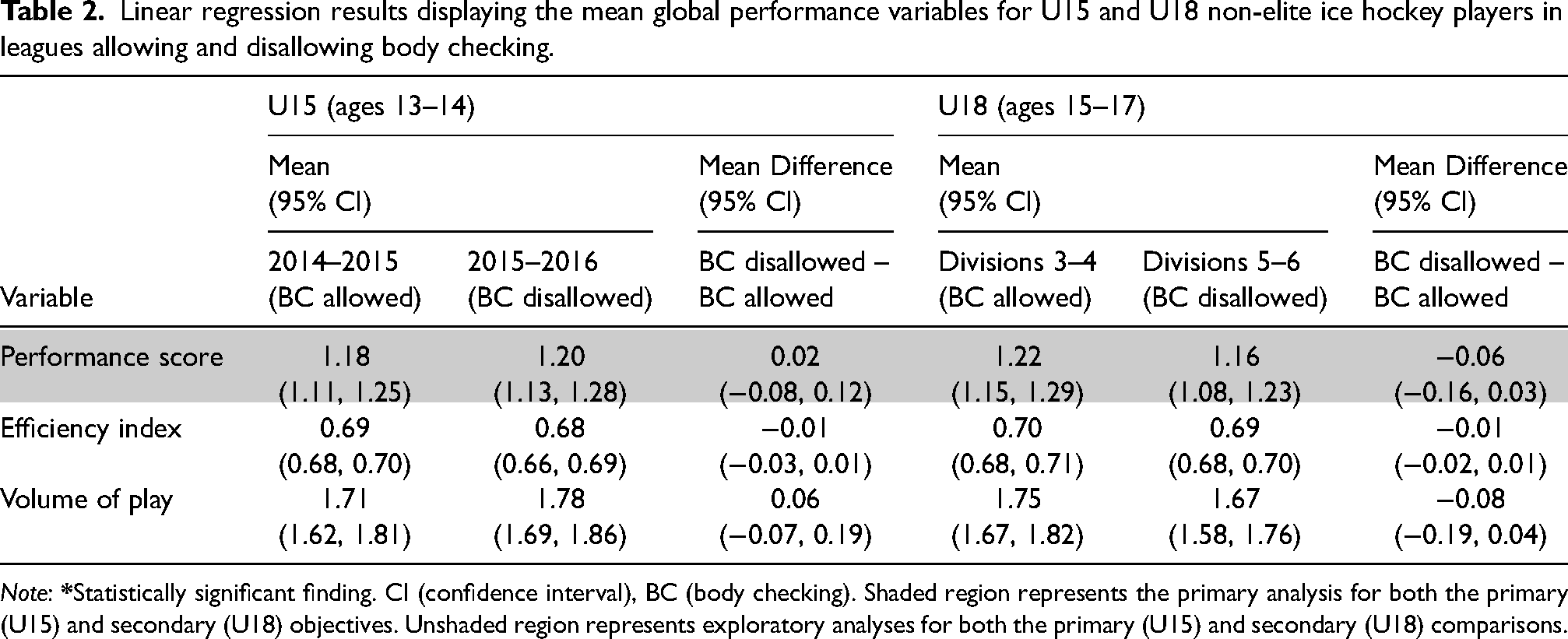
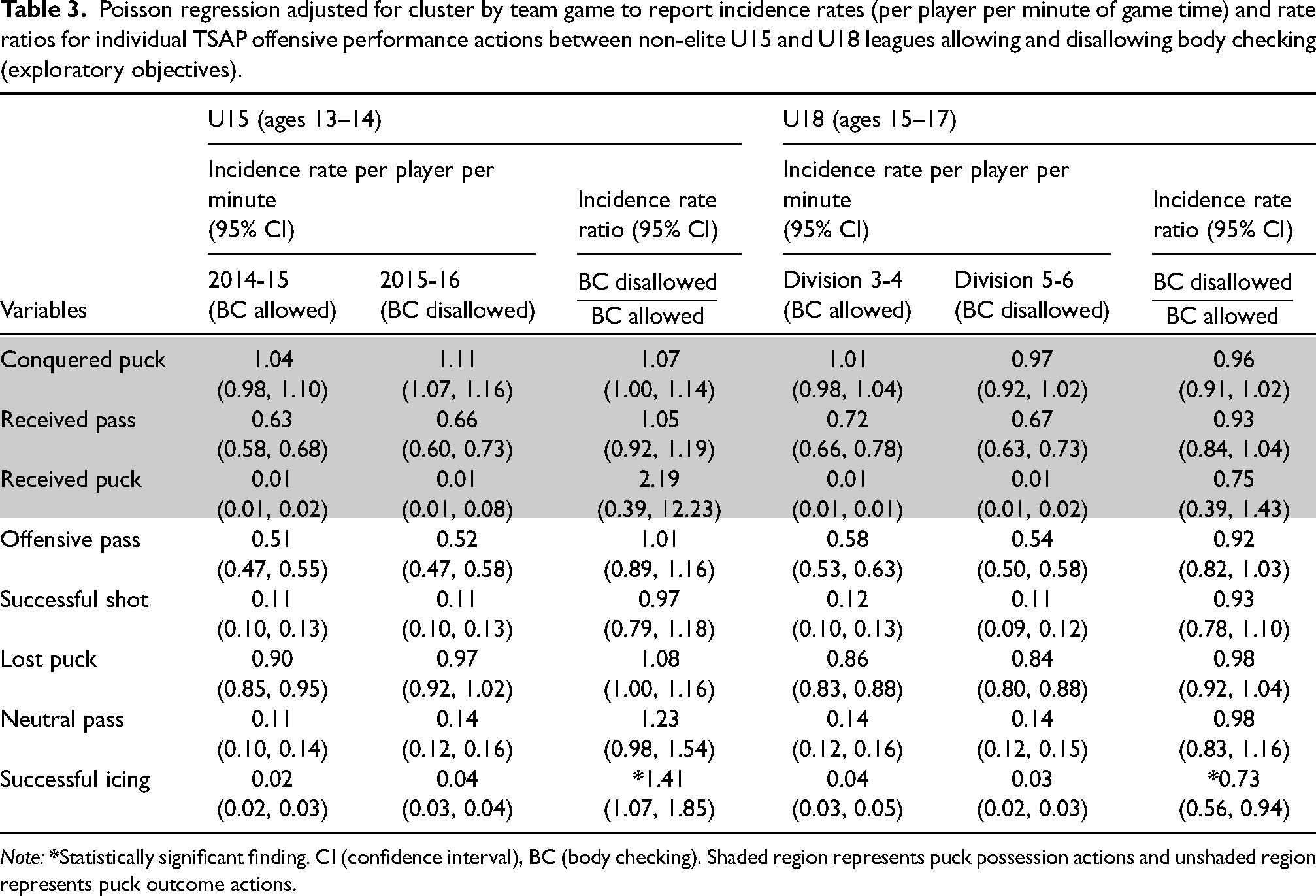
In total there were 19,474 game actions analyzed in the 26 games from the U15 cohorts (9,476 in 2014–2015/body checking from 356 players, and 9,998 in 2015–2016/no body checking from 341 players) and 18,630 game actions in the U18 games (9,457 in body checking divisions 3–4 from 358 players, and 9,173 in no body checking divisions 5–6 from 330 players). For all analyses, player position did not modify nor confound the relationship between body checking policy and any of the performance variables; therefore, univariate models (adjusted for cluster by team-game) were reported. The univariate linear regression analyses (adjusted for cluster by team-game) showed no statistically significant differences in the mean performance composite scores between leagues allowing and disallowing body checking for both the U15 and U18 age groups (Table 2). Exploratory univariate linear regression analyses (adjusted for cluster by team-game) also showed no statistically significant differences for volume of play (quantity of play) and efficiency index (quality of play) measures (Table 2). Further exploratory analyses showed no differences in the incidence rate and IRR between all individual puck possession (conquered puck, received pass, received puck) and almost all puck outcome (offensive pass, successful shot, lost puck, neutral pass) metrics by body checking status for both age groups (Table 3). However, there was a statistically significant 41% increase in the rate of successful icing in U15 leagues disallowing body checking and a statistically significant 27% decrease in the rate of successful icing in U18 leagues disallowing body checking (Table 3).
Linear regression results displaying the mean global performance variables for U15 and U18 non-elite ice hockey players in leagues allowing and disallowing body checking.
Note:
Poisson regression adjusted for cluster by team game to report incidence rates (per player per minute of game time) and rate ratios for individual TSAP offensive performance actions between non-elite U15 and U18 leagues allowing and disallowing body checking (exploratory objectives).
Note:
Discussion
This study was the first to examine the influence of policy disallowing body checking on offensive player performance at the Canadian U15 and U18 non-elite age groups. We found no differences in the performance composite scores between divisions allowing and disallowing body checking in both age groups. Exploratory analyses showed no difference in the mean scores for the quantity (volume of play) and quality (efficiency index) of play by body checking status for both age groups. Further exploratory analyses of individual TSAP puck actions showed no differences in the rate of puck possession (conquered puck, received pass, received puck) and most puck outcome (offensive pass, successful shot, lost puck, neutral pass) metrics. These exploratory analyses supplement the main analysis showing that no differences in the performance composite scores reflect similar rates for all puck possession and almost all puck outcome metrics between body checking and non-body checking leagues. Interestingly, there was an estimated 41% increase and 27% decrease in the successful icing to clear the defensive zone puck metric in U15 and U18 leagues (respectively) where body checking was disallowed. The mechanism behind this exploratory finding is unknown, but could be a result of differing rates of penalties being assessed by referees, or differences in coaching tactics. The rate of successful icing was infrequent in all cohorts, which could suggest that this action is not as important to performance as other more frequent metrics (e.g. conquered puck, offensive pass). Interestingly, players in the U18 divisions 3–4 had the highest performance score, followed by both U15 cohort, and the U18 divisions 5–6 cohort.
These findings are consistent with previous video analysis research measuring offensive performance, and adds an interesting piece to current claims that disallowing body checking has led to detrimental effects on puck-related player performance. 23 Disallowing body checking is controversial in ice hockey due to it previously being taught as a fundamental component to the game. However, increased awareness for the high injury and concussion risk to players challenges the benefits of allowing body checking at the younger ages and lower-level divisions of older players. 8 This study's assessment of offensive performance adds a crucial component to the current literature on the removal of body checking to understand if basic metrics of in-game offensive actions are changing. Despite the evidence supporting policy prohibiting body checking, there is currently a lack of data examining the social acceptance of such change amongst ice hockey players, parents, and coaches.
Other team-based performance measures have been suggested in other sports. For example, criteria developed in soccer includes more specific metrics to measure a team's offensive strategy of passing length (short, medium, long), pass effectiveness (if the team ball possession was effective or not), location of ball possession starting zone, and the relationship to scoring a goal. 28 This method may be effective for coaches to develop offensive tactics and strategies; however, it would be difficult to adapt to ice hockey due to the game's fast-pace on a small playing surface with constant turnovers in puck possessions. Moreover, assessing the TSAP variables in the context of goals scored may be problematic as goaltenders have varying skill levels that would not be influenced by body checking policy changes. Other team-based offensive performance metrics have targeted individual player behaviours, especially in the presence of specific coach instruction. 29 These types of measures would not be feasible in the current study due to the anonymous player data and potential biases in player behaviours if it was apparent they were being studied. 30 Altogether, we argue that the ice-hockey adapted TSAP was suitable for examining the association between body checking policy and in-game offensive performance actions.
The main limitations with video analysis techniques include analysis of actions only captured in the camera's field of view and differing footage quality. We aimed to minimize these potential limitations by always following the puck carrier and using the same filming protocol with the same camera quality across all games. Blinding the rater to body checking status of a game was not possible due to analysis across multiple years and could have resulted in differential misclassification bias of the estimates away from a null finding for the performance variables. However, perceptions for a video analyzer's belief of the policy's influence on offensive performance would have to be understood to identify the mechanism and magnitude of this bias. If blinding were possible, due to clear differences of in-game physicality between the cohorts, it would be simple for the rater to detect the body checking status of the cohort. Moreover, U18 players analyzed for the secondary objective were expected to differ in performance levels based on the body checking cohort (divisions 3–4) being of a higher division than the non-body checking cohort (divisions 5–6). Therefore, the expected difference in performance levels between cohorts and the null findings in the offensive performance composite score could lead to multiple interpretations. With the assumption that upper non-elite U18 divisions, which allowed body checking, have players of higher skill level than the non-body checking lower non-elite divisions, the null findings lead to speculation on the influence of disallowing body checking on offensive performance. First, the results may suggest that players in the lower divisions with disallowed body checking (divisions 5–6) had better performance when body checking was disallowed (to gameplay that closely reflects divisions 3–4). Alternatively, the difference in performance between players in divisions 3–4 and divisions 5–6 may be minimal; therefore, disallowing body checking may not necessarily have affected offensive performance in only one of the cohorts. Future research with matched divisions allowing and disallowing body checking at the U18 non-elite level is warranted. Lastly, the performance variables used in this study measure offensive performance while in possession of the puck. Body checking is typically used as a defensive tactic; therefore, future creation of defensive performance variables utilizing a similar paradigm to the TSAP is required to determine differences in player defensive performance (i.e. when not in possession of the puck).
Conclusion
This was the first study to examine the association between individual offensive player performance and policy allowing or disallowing body checking in U15 and U18 levels. The results show no differences in the performance composite score, with similar rates for almost all individual offensive actions between leagues allowing and disallowing body checking. There was a higher rate of successful icings to clear the defensive zone for players in U15 leagues disallowing body checking, but a lower rate in U18 leagues disallowing body checking. These results in combination with previous injury surveillance support Hockey Calgary's decision to disallow body checking at the U15 and U18 non-elite levels for the promotion of player safety. The findings also support the introduction of a national policy change to disallow body checking in non-elite U15 and U18 divisions across Canada.
Footnotes
Acknowledgements
The Sport Injury Prevention Research Centre is one of the International Research Centre's for Prevention of Injury and Protection of Athlete Health supported by the International Olympic Committee. We acknowledge funding from the University of Calgary's Markin Undergraduate Student Research Program, Integrated Concussion Research Program, Canadian Institutes of Health Research, Alberta Innovates Health Solutions, Alberta Children's Hospital Research Institute, Hotchkiss Brain Institute, and Alberta Children's Hospital Foundation. A.T. Kolstad holds a CIHR Frederick Banting and Charles Best Doctoral Scholarship and UCalgary Eyes High Doctoral Award. C.A. Emery holds a Canada Research Chair in Concussion. We acknowledge Hockey Canada, Hockey Calgary, and all the coaches and parents involved for their time and support in completing this research project.
Data availability statement
Data are available upon reasonable request. Deidentified participant data are held by Dr Carolyn Emery and the Sport Injury Prevention Research Centre, Faculty of Kinesiology, University of Calgary.
Declaration of conflicting interests
The authors declared no potential conflicts of interest with respect to the research, authorship, and/or publication of this article.
Funding
The authors disclosed receipt of the following financial support for the research, authorship, and/or publication of this article: This work was supported by the Alberta Innovates – Health Solutions under Grant number 3685.
