




Abstract
In this study, a dinitrodiphenyldiquinoline derivative is synthesized, purified, and characterized, and its adsorptive ability is examined for the first time. Twelve common polycyclic aromatic hydrocarbons are chosen as potential adsorbates for removal by using dinitrodiphenyldiquinoline as an adsorbent surface. The adsorptive capacity and the efficiency of removal depend on several variables such as adsorbent dose, polycyclic aromatic hydrocarbon initial concentration, pH, and contact time. This paper summarizes the adsorbent parameters and the kinetic models that can optimize and describe the adsorption process used to treat aqueous solutions of polycyclic aromatic hydrocarbons. Experimentally, the optimum adsorbent dose, the initial concentration, and contact time are found to be 0.1 g, 1 ppm, and 60 min, respectively. Mathematical treatment of the adsorption data reveals that the adsorption of all the polycyclic aromatic hydrocarbons by dinitrodiphenyldiquinoline adopted a pseudo second-order adsorption model. As a result, the dinitrodiphenyldiquinoline derivative is found to be a very good adsorbent surface for several hazardous organic pollutants such as polycyclic aromatic hydrocarbons.
Keywords

Introduction
Organic and inorganic pollutants are considered to be a critical issue, especially if they exist in drinking and clean water resources. Many previous studies have reported high levels of various contaminants in different water types.1–3 Over the last two decades, researchers have devoted significant efforts to finding efficient methods to eliminate or at least minimize the concentrations of pollutants in different water resources. Generally, organic and inorganic pollutants are very complicated to remove or reduce efficiently when conventional physicochemical methods are used, such as filtration, coagulation, sedimentation, flocculation, phytodegradation, photolysis, or ozonation, despite these methods being considered the most common and effective treatment processes.4–10 Therefore, easier techniques are found to be more effective, such as adsorption; the adsorption technique involves using cheap, safe, and large surface area and recyclable adsorbent materials. Recent publications have investigated and reported different chemical, physical, and biological techniques for contaminated water treatment.1–3 In particular, adsorbent surfaces can be used to reduce or remove organic pollutants and are classified as natural adsorbents (such as charcoal, clays, clay minerals, zeolites, and ores) 11 and synthetic adsorbents (such as diphenyldiquinoline (DPDQ)). 12 In a previous study, our group investigated the adsorptive ability of a DPDQ derivative against phenol as an organic pollutant. 12
In this context, polycyclic aromatic hydrocarbons (PAHs) are considered to be one of the most common organic pollutants that exists at high levels in the environment, especially in water resources. 13 PAHs are chemically stable in the environment, not easily biodegradable, and can accumulate over time to very dangerous doses in the environment,14–17 and can cause carcinogenic, mutagenic, and toxic effects.18–25 The prime source of PAH emissions is the combustion of fuels, forest fires, volcanic eruptions, some biological activities, and anthropogenic sources.26–28 Furthermore, creosote and coal tar usage are categorized as the main sources of PAH compounds in environmental elements such as air,29,30 soil and sediments,31,32 water resources, and animal and plant tissues.33,34 Recent studies have demonstrated that long-term exposure to PAH environmental pollutants may adversely affect human health.35,36 Therefore, adsorbents with large surface areas and high numbers of adsorption sites are needed to remove PAHs from the environment effectively.
This study aims to investigate the efficacy of dinitrodiphenyldiquinoline (DNDPDQ)
Results and discussion
Preparation of adsorbent 3
The adsorbent candidate
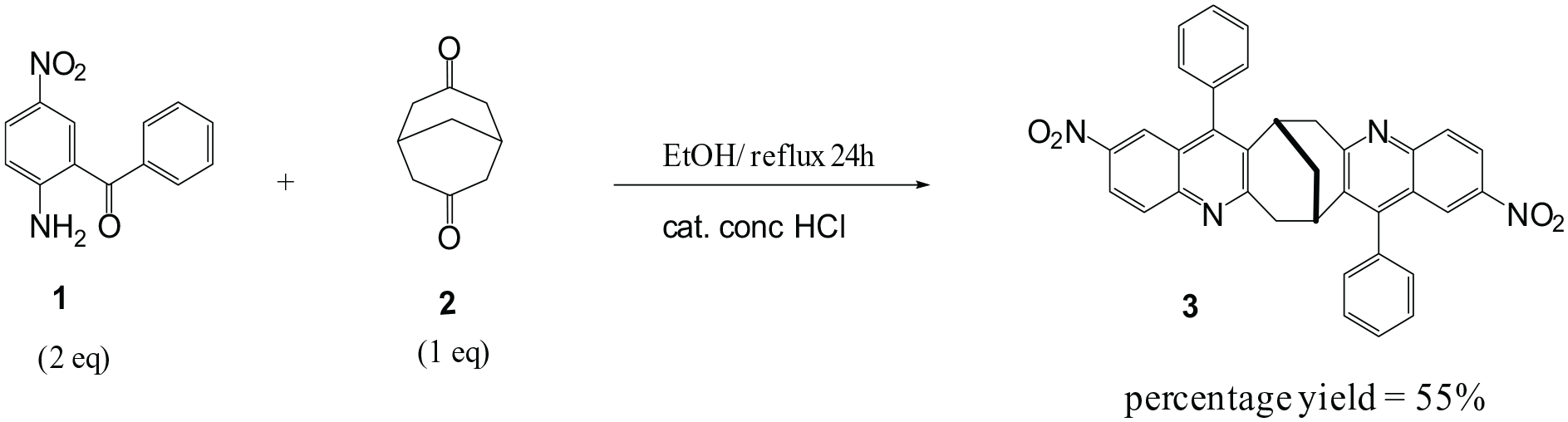
Synthesis of the dinitrodiphenyldiquinoline (DNDPDQ)
Adsorption of Phenanthrene, Anthracene and Fluoranthene (PAF)
Contact time effect
The removal efficiency vs the contact time of phenanthrene, anthracene and fluoranthene (

Structures of phenanthrene, anthracene, and fluoranthene.

(a) The effect of contact time on the adsorption of
Adsorption kinetics
Kinetic modeling of the adsorption process was achieved by mathematical treatment of the adsorption data presented in Figure 2. The adsorption kinetics of
The rate constant values for adsorption of PAH on the DNDPDQ adsorbent.
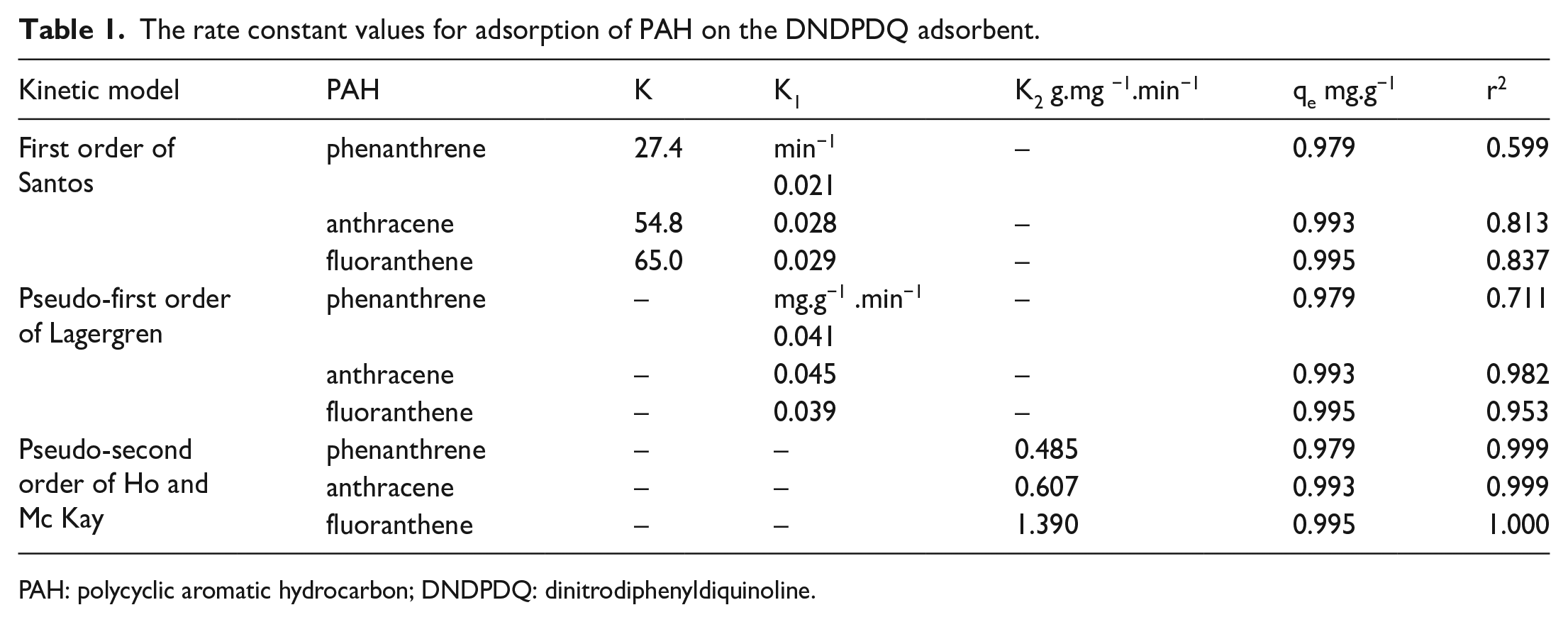
PAH: polycyclic aromatic hydrocarbon; DNDPDQ: dinitrodiphenyldiquinoline.
Adsorption of Chrysene, Benzo(a)anthracene, Pyrene, Benzo(b)fluoranthene, and Benzo(k)fluoranthene (CBPBbBk
)
Contact time effect
The removal efficiency (%) vs contact time (min) for the adsorption of chrysene, benzo(a)anthracene, pyrene, benzo(b)fluoranthene, and benzo(k)fluoranthene (

Structures of pyrene, benzo(a)anthracene, chrysene, benzo(b)fluoranthene, and benzo(k)fluoranthene.

(a) Effect of the contact time on the adsorption of
Adsorption kinetics
The kinetic model adopted for each PAH was achieved by applying the first order of Santos, the pseudo first order of Lagergren, and the pseudo second order of Ho and McKay for the adsorption of
The pseudo-second-order adsorption kinetic model was found to have the highest level of linearity as shown in Figure 4(d) compared to the first-order adsorption kinetic model shown in Figure 4(b) and the pseudo-first-order adsorption kinetic model shown in Figure 4(c). The results of the kinetic studies are presented in Table 2.
The rate constant values for adsorption of

Adsorption of Dibenzo(a, h)anthracene, Benzo(a)pyrene, Benzo(g,h,i)perylene and Indo(1,2,3,4-c,d)pyrene (DBapBghiI)
Contact time effect
The removal efficiency (%) vs contact time (min) for the adsorption of dibenzo(a,h)anthracene, benzo(a)pyrene, benzo(g,h,i)perylene, and indo(1,2,3,4-c,d)pyrene (

Structures of dibenzo(a,h)anthracene, benzo(a)pyrene, benzo(g,h,i)perylene, and indo(1,2,3,4-c,d)pyrene.

(a) The effect of the contact time on the adsorption of
Adsorption kinetics
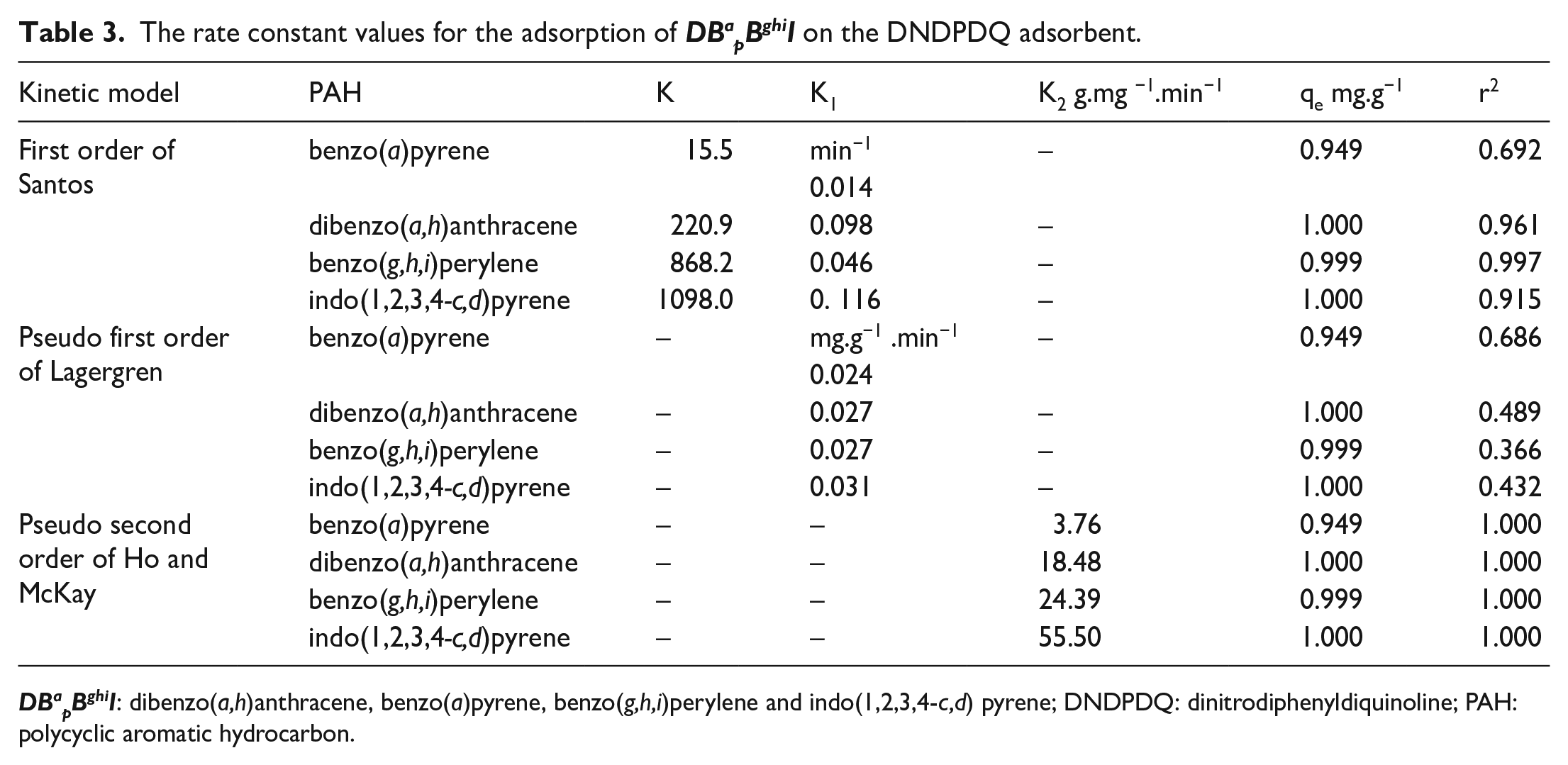
As in the previous sections, the first-order adsorption of Santos, the pseudo-first order of Lagergren, and the pseudo-second order of Ho and McKay kinetic models were applied. The adsorption kinetics of
The rate constant values for the adsorption of
The efficiency removal was enhanced by the presence of a polyaromatic moiety, which is responsible for different motifs of interactions that possibly explain the adsorption process between the adsorbent and adsorbate molecules. The most common interaction is π–π stacking, which can exist in the form of face–face, face–edge, or edge–edge interactions. Table 4 compares the data for the DNDPDQ adsorbent with some reported adsorbents in the literature. It is obvious that the removal efficiency of DNDPDQ is much higher than those of other studies. Therefore, DNDPDQ proves to be an excellent adsorbent compared to those listed in Table 4.
Comparison of the removal of PAHs by DNDPDQ (

PAH: polycyclic aromatic hydrocarbon; DNDPDQ: dinitrodiphenyldiquinoline.
Conclusion
The presence of different hazardous organic pollutants in water resources is considered a serious problem for the environment and humankind. In this study, the DNDPDQ derivative
Experimental
Chemicals and reagents
All chemicals used in this study, including 2-amino-5-nitrobenzophenone, bicyclo[3.3.1]nonane-3,7-dione, ethanol and HCl, and PAHs, were commercially available and purchased from Aldrich Chemical Company (analytical grade). They were used without further purification.
Instruments and analysis
The concentrations of the PAHs (NAP, ANT, FLA, BaA, CHR, BbF, BkF, DahA, PYR BaP, IcdP, and BghiP) were determined using a high-performance liquid chromatography (HPLC) instrument (Shimadzu SCL10Avp fitted with a photo diode array (PDA) detector (SPD M10Avp) at 254 nm). The AHYPERSIL Green PAH 100 X 4.6 mm column was used.
The instrument parameters were as follows: eluents: (A: H2O and B: CH3CN); the gradient was 40% of B up to 5 min and then increased gradually at a flow rate of 1.6 mL/min. After 30 min, the gradient was kept constant at 100% of B.
Contact time effect
The optimum contact time in which the adsorption has reached the equilibrium is used later to determine the adsorption rate constant. In the process of determining the rate of the adsorption process, the adsorption experiments were carried out using 100 mL (1 ppm) of standard PAH solutions at pH = 7, and the supernatant was analyzed for residual pollutants at different contact time intervals.
Batch adsorption experiments
Batch adsorption experiments were performed to investigate the optimum adsorption conditions of three aqueous solutions containing 1 ppm of each of the four PAH compounds onto the prepared DNDPDQ

where A is the amount of PAH (mg/g) adsorbed at equilibrium,
C1: initial concentration of PAH in mg/L, Ct: equilibrium concentration of PAH in mg/L
V: solution volume of the flask in L, and m: the dosage of the adsorbent in g.
Footnotes
Declaration of conflicting interests
The author(s) declared no potential conflicts of interest with respect to the research, authorship, and/or publication of this article.
Funding
The author(s) disclosed receipt of the following financial support for the research, authorship, and/or publication of this article: The author would like to thank the Scientific Research Support Fund (SRSF, Jordan) for financial support through the research grant EWE\2\03\2011, and Mutah University for providing the necessary technical support needed to complete this research.
