




Abstract
A CuI coordination polymer based on the N,N’-bis(3-pyridinecarboxamide)-1,4-butane (3-dpyb) ligand, namely [Cu(3-dpyb)0.5Cl], is hydrothermally synthesized and structurally characterized, and is used as a catalyst precursor to synthesize multi-walled carbon nanotubes. Interestingly, the as-grown multi-walled carbon nanotubes exhibit high performance in removing dyes from solution and can serve as a low-cost and fast adsorbent. In addition, the adsorption behavior of this new adsorbent fits well with the Freundlich isotherm and the pseudo-second-order kinetic model.
Introduction
To date, adsorption is a widely used technique for the separation and removal of pollutants from wastewaters.1–3 Carbon nanotubes (CNTs) are emerging as potential adsorbents because of their well-defined cylindrical hollow structure, large surface area, high aspect ratios, and easily modifiable surfaces. 4 In the last decade, the use of CNTs for the removal of organic and inorganic pollutants has been investigated, and performances comparable to those of commercial adsorbents have been obtained.5–8 Considering the relatively high cost of single-walled CNTs (SWCNTs), multi-walled CNTs (MWCNT) adsorbents may be more promising for practical use.
In addition, many techniques have been developed to fabricate MWCNTs including arc discharge, 9 carbon dioxide reduction, 10 and chemical vapor deposition (CVD). 11 For the CVD method, Fe, Co, and Ni have been most reported.12–14 Some assisted techniques, such as high-intensity electron irradiation, 15 direct current plasma enhancement, 16 electrostatic-control, 17 and magnetism-assisted methods have been utilized. 12 However, most of these methods suffer from the disadvantage of introducing external templates and additives or exhibit poor uniformity.
Coordination polymers (CPs) with various architectures have been employed as sacrificial precursors for synthesizing highly dispersed metal/metallic compounds/carbon materials or composites with high specific surface areas and thermal stability by the calcination–thermolysis method.18–21 Herein, using Cu-CP as a catalyst precursor, a simple and controllable method is described for the synthesis of MWCNTs with uniform diameters. CuCl2·2H2O and N,N’-bis(3-pyridinecarboxamide)-1,4-butane (3-dpyb) were selected as starting materials to react under hydrothermal conditions, with the expectation of obtaining a homogeneous catalyst precursor. As expected, we obtained a 2D layer with a 3-connected {63} topology, [Cu(3-dpyb)0.5Cl] (
Results and discussion
Single-crystal X-ray diffraction analysis revealed that complex

(a) The coordination environment of the Cu(II) ions in
The IR spectrum of complex
Next, we use the title CP as a combined catalyst precursor for preparing CNTs by the CVD method. The morphology of the MWCNTs was characterized using scanning electron microscopy (SEM) and Transmission electron microscopy (TEM), and typical images are shown in Figure 2(a) and (b). The diameter distribution measured from the TEM images is given in Figure S4, which shows a narrow peak centered at about 60 nm. The Raman spectrum of the MWCNTs is shown in Figure 2(c), where two independent D and G peaks are observed, and the G/D intensity ratio is 0.94, indicating the high quality of the MWCNTs. 25 To investigate the main origin of the defects of functionalities and/or the presence of other carbonaceous impurities in our sample, we characterized the MWCNTs using TGA and IR analysis. The TGA curve and IR spectrum are given in Figures 2(d) and S5, respectively. It can be seen that the MWCNTs start to oxidize at 432°C, and rapid oxidation occurs at 707°C. The catalyst residue is about 7 wt% after oxidation, suggesting that a part of the catalyst residue exists in the sample. The IR spectrum (Figure S5) shows many peaks, indicating that the MWCNTs contain rich functional groups. The strong signals around 3425 cm−1 and 1400 cm−1 in the spectrum are attributed to the O–H stretching vibrations of the phenolic groups and the bending vibrations of the O–H groups, respectively. In addition, the stretching band for C=O at 1635 cm−1 and the stretching vibrations of C–O around 1138 cm−1 are also observed. 26 The OH and COOH moieties of the MWCNTs may provide additional coordination and/or adsorption sites, which may coordinate with multiple metal centers and/or adsorb organic molecules to afford MWCNTs with enhanced adsorption properties.

(a) SEM image, (b) TEM image, (c) Raman spectrum, and (d) TGA curve of the MWCNTs.
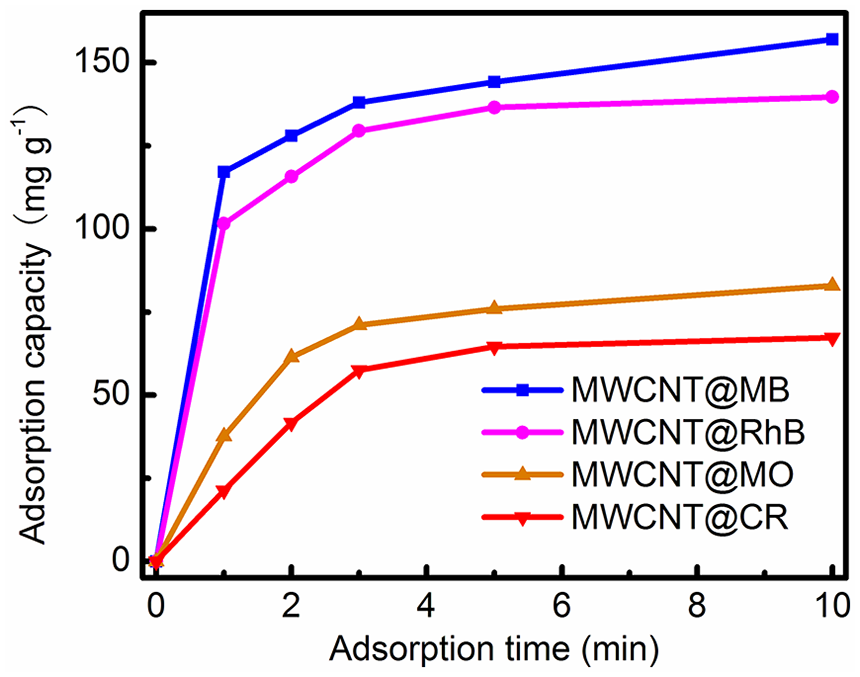
Nowadays, dye contaminants in water have become a potential risk to both human health and ecological systems.27–29 At present, a number of methods such as photocatalytic degradation, sonochemical degradation, Fenton-based oxidation, and ozonation have been developed to remove dyes from wastewater.30–33 However, the cost of the above techniques is high, mainly due to the fact that they cannot be reused. It is therefore important to find a low-cost adsorbent with reversible adsorption capability. The low cost of our MWCNTs motivated us to investigate their dye adsorption capability. Four dyes, methylene blue (MB), rhodamine B (RhB), methylene orange (MO), and congo red (CR), were used to investigate the adsorption performance of our MWCNTs. In a typical experiment, MWCNT powders (~5 mg) were put into an aqueous dye solution (100 mL, 10 mg L−1), followed by stirring at room temperature. At time intervals of 1 min, the dye concentration was measured by using a UV-Vis spectrophotometer at the maximum absorbance of each dye (664 nm, 553 nm, 465 nm, and 490 nm for MB, RhB, MO, and CR, respectively) (Figure 3). The dye adsorption amount qt (mg g−1) was calculated from the equation: qt = (C0–Ct)V/W, where, C0 and Ct (mg L−1) are the liquid-phase concentration of the dyes at the beginning and after time t (min), respectively. V (L) is the volume of the solution, and W (g) is the mass of the MWCNT powder used. The adsorption capacities of the MWCNTs for MB, RhB, MO, and CR at room temperature are 157.0, 139.7, 82.9, and 67.3 mg g−1, respectively (Figure 4). Compared with other adsorbents, the adsorption capacities of the MWCNTs for MB, RhB, MO, and CR are not the highest. However, we note that the adsorption capacities of our MWCNTs for RhB and MO are much higher than those of other MWCNTs (Table 1). In addition, the adsorption of dyes on our MWCNTs is very fast.
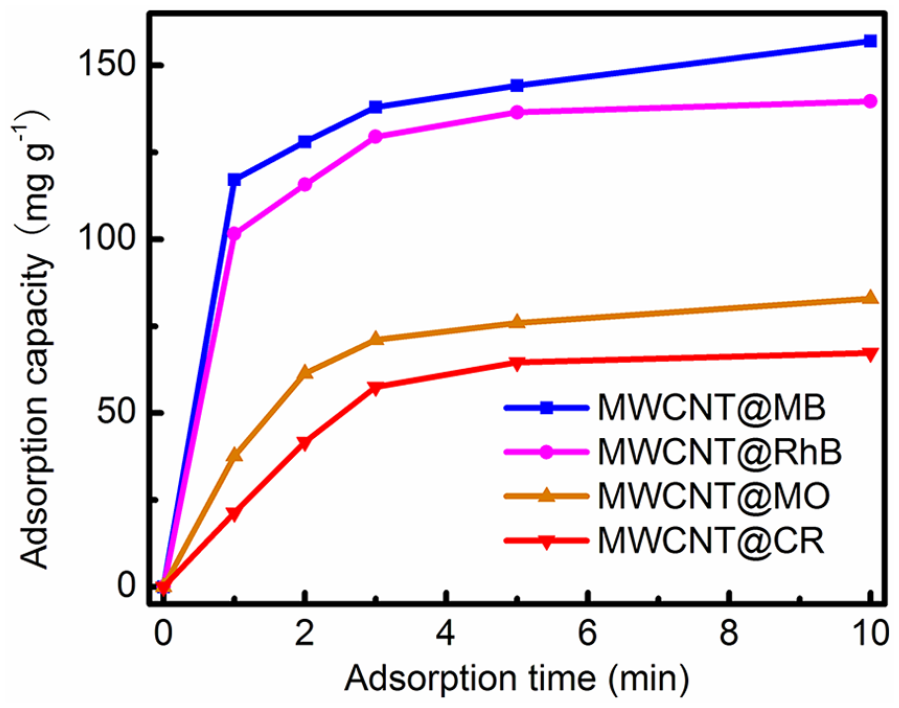
The adsorption capacities of MB/RhB/MO/CR at different times in the dark.

UV-Vis spectra of MB (a), RhB (b), MO (c) and CR (d) solutions after different adsorption times with the MWCNTs.
Adsorption performance comparison of the title MWCNTs with other materials.

The BET surface area of the MWCNTs is 40.11 m2 g−1 (Figure 5), demonstrating that their high performance toward dyes might not be due to their porosity. However, the pore size of the MWCNTs is ca. 1.97–11.08 nm, being larger than the molecule sizes of MB, RhB, MO, and CR, which indicates that the molecule size might contribute to the high uptake amount of MB, RhB, MO, and CR. The presence of OH and COOH in the MWCNTs and methyl groups in MB and RhB might contribute to the formation of abundant hydrogen-bonding interactions, which could favor MB and RhB adsorption. Furthermore, the greater number of π–π stacking interactions between the aromatic rings of MB and RhB and the benzene ring of the MWCNTs might contribute to their excellent adsorption performance toward MB and RhB.

Nitrogen adsorption and desorption isotherms of the title MWCNT. The inset shows the pore size distribution.
We further investigated the desorption performance of the MWCNTs by dipping them (after 10 min of MB, RhB, MO, or CR adsorption) into ethanol solution. The adsorbed (Ad) MB, RhB, MO, and CR gradually desorbed (De) and changed the color of the ethanol to blue, pink, yellow, and orange, respectively. The amount of MB, RhB, MO, and CR in ethanol reached about 141.1, 133.9, 78.8, and 62.7 mg g−1 after 30 min (Figure 6), which suggests that about 96% adsorbed MB, 95.9% adsorbed RhB, 95.1% adsorbed MO, and 93.2% adsorbed CR can be desorbed. The residual unreleased dyes can be ascribed to chemical adsorption. Therefore, considering this high reversible adsorption ability and the low cost of our MWCNTs, they show significant potential for use as an adsorbent to remove dyes efficiently.

Photographs showing the color change of the dyes after adsorption (Ad) and desorption (De).
An adsorption isotherm expresses the relationship between the amount of adsorbate adsorbed per unit weight of adsorbent (qe, mg g−1) and the concentrations of adsorbate in the bulk solution (Ce, mg L−1) at a given temperature under equilibrium conditions. They are very useful in providing information about adsorption mechanisms, surface properties and the affinity of an adsorbent toward an adsorbate. 45 The adsorption of the four dyes with the MWCNTs was studied with an adsorption time of 10 min, and a temperature of 25°C. To determine the mechanistic parameters associated with different dye adsorption, the adsorption data were analyzed according to the well-known Langmuir and Freundlich isotherm models.46,47 Taking the sample of MB adsorption as an example, the Langmuir model assumes uniform energies of adsorption on the surface and no transmigration of the adsorbate in the plane of the surface, and can be expressed as

where qe is the amount of adsorbate adsorbed per unit weight of adsorbent (mg g−1), Ce is the equilibrium concentration of the adsorbate (mg L−1), and Qmax and b are Langmuir constants related to the maximum adsorption capacity (mg g−1) and the energy of adsorption (L mg−1), respectively. The Freundlich isotherm is the earliest known relationship describing adsorption equations. This fairly satisfactory empirical isotherm can be used for non-ideal adsorption that is multilayer adsorption. The Freundlich isotherm is represented by

where qe is the amount of adsorbent adsorbed at equilibrium (mg g−1), k is the Freundlich constant, n is the heterogeneity factor which is related to the capacity and intensity of adsorption, and Ce is the equilibrium concentration (mg L−1).
The experimental results showed that the adsorption data could be fitted with both the Langmuir and Freundlich isotherms. The adsorption constants evaluated from the isotherms for MWCNTs are listed in Table 2. The Freundlich model was found to be a better fit for dye adsorption by MWCNTs, which suggests the adsorbent surface was heterogeneous in nature. The n value obtained from the Freundlich isotherm was larger than unity, indicating that the interaction forces between the dyes and MWCNTs were strong.48,49
Langmuir and Freundlich isotherm constants and their correlation coefficients.

During an adsorption process, it is necessary to investigate the adsorption kinetics. Figure 3 shows the data for the adsorption of the dye solutions by MWCNTs at different time intervals. About 73.5% adsorption occurred within 10 min for MB, suggesting that the MWCNTs had fast adsorption kinetics toward dye solutions. The kinetic data were analyzed using pseudo-second-order kinetics,45,48,49 which is based on the assumption that chemisorption is the rate-determining step, and can be expressed as

where qe is the adsorption capacity at equilibrium and q t is the loading of the dye at time t. The parameter k2 (g mg−1 min−1) represents the pseudo-second-order rate constant for the kinetic model. The slope and intercept of the linear plot of t/qt against t yield the values of qe and k2. The plots of t/qt versus t are given in Figure 7 and the parameters of qe (mg g−1), k2 (g mg−1 min−1), and R2 are shown in Table 3. The large correlation coefficients (R2 > 0.99) suggest that dye uptake by the MWCNTs follows the pseudo-second-order kinetic model.

Kinetic adsorption data plots for MWCNT@MB: the transformed rate plot t/qt versus t.
Rate constants and correlation coefficients of the pseudo-second-order kinetic model.

Conclusion
In summary, high-quality MWCNTs were successfully synthesized over a CuI-CP as a catalyst precursor via the CVD method. The as-grown MWCNTs exhibited fast adsorption capacity toward organic dyes. Possible adsorption mechanisms have been proposed, including hydrogen-bonding interactions and π–π stacking interactions along with the effect of mesopores. This research may open up new perspectives for applications in the fields of pollution control.
Experimental
Materials and measurements
All reagents were obtained from commercial sources and were used without further purification. The 3-dpyb ligand was prepared according to the literature method. 50
FTIR spectra were recorded on a Varian 640-IR spectrometer (KBr pellets). The elemental analyses (C, H and N) were carried out on a PerkinElmer 240°C elemental analyzer. Powder X-ray diffraction (PXRD) data were collected with an Ultima IV instrument with a D/teX Ultra diffractometer at 40 kV and 40 mA with Cu–Kα (λ = 1.5406 Å) radiation over the 2θ range of 5°–50°. The morphology and structure of the MWCNT sample was characterized by SEM (Nova NanoSEM 430) and high-resolution transmission electron microscopy (HRTEM, JEOL2010 at 200 kV). Laser Raman spectroscopy was used to estimate the quality of the MWCNTs. The specific surface area and pore structure of the samples were investigated with an automatic volumetric sorption analyzer (ASAP 2020 M) using N2 as the adsorbate at −196°C. The UV-Vis absorption spectra were obtained using a SP-1900 UV-Vis spectrophotometer. The thermal stabilities of the title complex and the MWCNTs were analyzed with a thermogravimetric analyzer (NETZSCH STA 449C).
Preparation of the title complex [Cu(3-dpyb)0.5Cl] (1 )
CuCl2·2H2O (0.034 g, 0.20 mmol), 3-dpyb (0.030 g, 0.10 mmol), and NaOH (0.016 g, 0.40 mmol) were dissolved in water (12 mL) at room temperature, then sealed in a 23 mL Telfon reactor and heated at 120°C for 4 days. After slow cooling to room temperature, the obtained red block crystals were filtered and washed with distilled water. Yield: 15% based on Cu. Anal. calcd for C8H9ClCuN2O: C, 38.72; H, 3.66; N, 11.29. Found: C, 38.75; H, 3.61; N, 11.26. υmax (KBr)/cm−1: 3396 (s), 1662 (s), 1604 (s), 1550 (s), 1481 (m), 1433 (w), 1379 (s), 1332 (w), 1045 (s), 767 (w), 709 (w).
Preparation of the title MWCNT
The above synthesized complex (80 mg) powder was placed in a quartz boat inside a quartz tube (diameter 80 mm, length 1100 mm) located in a horizontal electrical furnace. The furnace temperature was increased to 800°C under an argon flow (300 mL min−1, 99.999% purity) over 40 min, followed by the reduction of the catalyst under a hydrogen atmosphere (200 mL min−1, 99.999% purity) for 60 min, and the CuI-CP was calcined to CuO nanoclusters. The reactor was then heated to the desired temperature under an argon flow. The MWCNT synthesis was performed under a gas mixture of C2H4 (10 mL min−1), Ar (300 mL min−1), and H2 (200 mL min−1) for 30 min. In subsequent heating under a H2 atmosphere, the CuO nanoclusters were reduced to Cu and aggregated into Cu nanoparticles. Following completion of the experiment, the system was cooled to room temperature under Ar to give the MWCNTs.
X-ray crystallography
X-ray diffraction data for complex
Crystal data and structure refinements for complex

R1 = Σ||Fo| − |Fc||/Σ|Fo|.
wR2 = Σ(w(Fo2 − Fc2)2)/Σ(w(Fo2)2)1/2.
Supplemental Material
Revised_Supporting_information – Supplemental material for From coordination polymer to carbon nanotube: Preparation, characterization and rapid adsorption capacity toward organic pollutants
Supplemental material, Revised_Supporting_information for From coordination polymer to carbon nanotube: Preparation, characterization and rapid adsorption capacity toward organic pollutants by Hong-Yan Lin, Yi-Fei Wang, Yuan Tian, Guo-Cheng Liu and Jian Luan in Journal of Chemical Research
Footnotes
Declaration of conflicting interests
The author(s) declared no potential conflicts of interest with respect to the research, authorship, and/or publication of this article.
Funding
The author(s) disclosed receipt of the following financial support for the research, authorship, and/or publication of this article: The support of the National Natural Science Foundation of China (No. 21501013, 21671025, 21971024) and the Key Laboratory of Polyoxometalate Science of the Ministry of Education are gratefully acknowledged.

Supplemental material
Supplemental material for this article is available online.
References
Supplementary Material
Please find the following supplemental material available below.
For Open Access articles published under a Creative Commons License, all supplemental material carries the same license as the article it is associated with.
For non-Open Access articles published, all supplemental material carries a non-exclusive license, and permission requests for re-use of supplemental material or any part of supplemental material shall be sent directly to the copyright owner as specified in the copyright notice associated with the article.
