




Abstract
In this study, we report an investigation into the steric (cone angle, θ) and electronic properties of ligands in Ru-catalyzed C–H arylation of aromatic benzamides bearing 8-aminoquinoline as an N,N’-bidentate-directing group. The study employs [RuCl2(p-cymene)]2 as a precatalyst, and a ligand, under study, as a cocatalyst. Various electronically and sterically different monodentate and bidentate phosphine ligands were examined. Other ligands such as phosphites and amines were also tested. The study reveals that while bidentate phosphines, phosphites, and aryl and alkyl amines were found to be ineffective, monodentate triarylphosphines represented by triphenylphosphine were found to be the most effective ligands in the Ru-catalyzed C–H arylation under the conditions specified. In addition, the study reveals that there is a correlation between the steric effects, cone angle (θ) and the reaction efficiency. Thus, for symmetrical phosphine ligands, as the cone angle increases, the yield of the CH arylation product gradually decreased. Moreover, the electronic properties of triarylphosphine ligands influenced the reaction as demonstrated by the decreased ability of electron-poor ligands to promote the reaction. The study also reveals a correlation between the electronic parameter, υCO, of the triarylphosphine ligand and the reaction efficiency. As the carbonyl stretching frequency increases, the reaction yield gradually decreased.
Keywords
Introduction
C–H bond functionalization1–6 has risen as a powerful atom economical strategy for formation of chemical bonds. Direct functionalization of C–H bonds provides rapid access to desired functionalized products from simple and readily available starting materials, thus manifesting atom- and step-economies. Controlling regiochemistry or site-selectivity is a major issue in the field of C–H activation/functionalization.7–18 As a strategy to circumvent the issue, monodentate-7–18 and bidentate-directing groups19–28 have been developed. Directing groups have allowed, via chelation-assistance, a wide range of efficient C–H bond activation reactions such as arylation, hydroxylation, carbonylation, acetoxylation, alkynylation, and alkenylation reactions. The directed C–H bond fuctionalizations have been possible with the catalysis of second-row transition metals mainly represented by Pd, Rh, Ru, and less by the earth-abundant first-row transition metals such as Fe, Mn, Ni, and Co.
The use of 8-aminoquinoline as a bidentate-directing group is now well-established.19–28 Recently, Aihara and Chatani
24
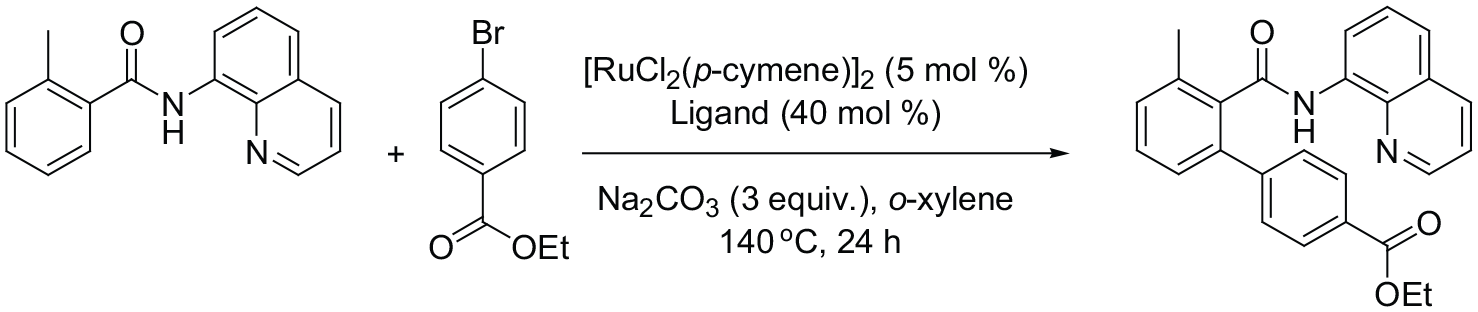
reported Ru-catalyzed C–H bond arylation of aromatic amides using 8-aminoquinoline as a directing group. Among other reaction conditions, [RuCl2(p-cymene)]2 (5 mol%) and PPh3 (40 mol%) were used as a catalyst system (Scheme 1). Hence, benzamide bearing 8-aminoquinoline (

Original Ru-catalyzed C–H bond arylation of benzamides bearing 8-aminoquinoline as a directing group as reported by Aihara and Chatani et al. 24
Although it was reported that the use of PPh3 as a ligand was essential for the reaction (no reaction in the absence of PPh3), 24 investigation of the effects of ligands in Ru-catalyzed C–H bond arylation using bidentate-directing groups is not reported to date. The incentive would have been to seek insights into the reaction details such as the influence of the ligand steric and electronic effects on the reaction efficiency,29–35 for instance, whether substitution of the aryl group can cause any change in reactivity of the phosphine or even the active catalysts in the Ru-catalyzed C–H activation reaction. The modification of substitution could be altered by varying the position of the substituent on the aryl group and/or by varying the electronic properties of the substituent whether it is an electron-donating group or an electron-withdrawing group. In addition, it was also proposed to replace the aryl groups on the phosphine with an alkyl group in order to see if this could result in any change in the reaction efficiency. It was an aim to seek knowledge of any correlation, at all, between the Tolman steric cone angles of phosphine ligands or bite angles of bidentate phosphines and the reaction outcome.29–35 In particular, the quest was for information on the influence of the Tolman steric cone angle (θ) parameter and electronic property parameter (carbonyl stretching frequency (υCO)) in Ni(CO)3L complexes of ligands in Ru-catalyzed C–H bond arylation. 29 The carbonyl stretching as coined by Tolman is the carbonyl frequency of Ni(CO)3L (L: phosphine ligand) in CH2Cl2 and is a measure of electronic effects of the phosphine ligand. 29 Ultimately, any trends in reactivity or correlations obtained between steric and/or electronic properties of ligands and reaction efficiency could provide guidance toward judicial ligand design in catalytic C–H bond functionalization. To that end, we wish to report herein a study that we have conducted toward the ligand effects in Ru-catalyzed C–H bond arylation assisted by 8-aminoquinoline as an N,N’-bidentate-directing group. The study involved various and electronically different monodentate and bidentate phosphine ligands, and among others, aryl amines and carboxylic acids.
Results and discussion
At the outset of the study, established Ru-catalyzed arylation condition was employed.
24
Thus, 2-methylbenzamide bearing 8-aminoquinoline as a bidentate-directing group (
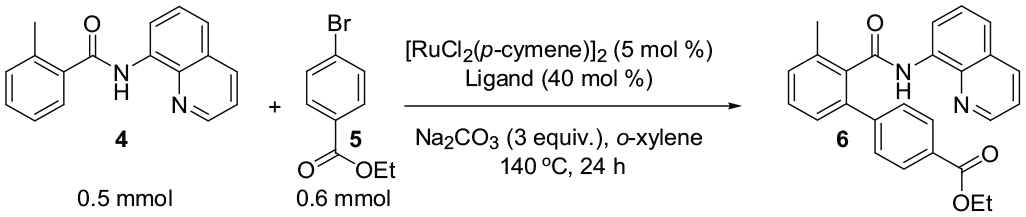
Ru-catalyzed C–H arylation of benzamides bearing 8-aminoquinoline as a bidentate-directing group.
In order to gain insights into the effect of ligands in the reaction, various monodentate and bidentate phosphine ligands were examined under the reaction conditions (Figure 1). The ligands differ in substitution and electronic properties of the aryl group in the case of aryl-based ligands such as triarylphosphines. Trialkylphosphines were also used in the study along with phosphines that have both alkyl and aryl groups or the sterically bulky electron-donating t-butyl groups. Some phosphines have electron-donating alkyl groups and dialkylamino groups, while others have heterocycles. The study employed bidentate phosphine ligands as well. The phosphines were sterically and electronically different as they differ in cone angles, θ, for monodentate phosphines or different bite angles for bidentate phosphines.29–35 The results are summarized in Table 1. The table lists the ligands used in the study with their respective literature-reported cone angles and carbonyl stretching frequencies, υCO, for monodentate phosphine ligands and bite angles for bidentate phosphine ligands.29–35 The majority of phosphines used in the study have reported cone angles and stretching frequencies and are listed in the table as given by the studies29–35 used. However, some cone angles were not available in the literature.29–35

Ligands used in the study.
Results of ligand effect study in Ru-catalyzed C–H bond arylation.

80 °C was used as a reaction temperature.
While the standard PPh3 (
The fully fluorinated triphenylphosphine, tri(pentafluo-rophenyl)phosphine, P(C6F5)3 (
The sterically bulky and electron-rich alkyl phosphines such as tris-t-butylphosphine P(t-Bu)3 (
When one cyclohexyl group is replaced by a biphenyl group, the reactivity of the phosphine dropped to 25% (CyJohnPhos,
Bidentate phosphines such as bis(diphenylphosphino)methane (
The N-counterpart to PPh3 and triphenylamine, NPh3, was tested, but was found to be ineffective (
Pyridine (
As a result, in this study, monodentate triarylphosphines, represented by triphenylphosphine, are the most effective in the reaction under the reaction conditions specified. The results suggest that a monodentate phosphine is required, as bidentate phosphines were found to be unsuccessful. The results obtained and observations made will hopefully contribute to the ligand design in metal-catalyzed C–H bond functionalization reactions. Work is currently underway to further investigate steric and electronic effects of ligands in metal-catalyzed C–H functionalization reactions.
Conclusion
Effects of steric (represented by the Tolman cone angle, θ) and electronic properties of ligands have been investigated in Ru-catalyzed C–H bond arylation of aromatic amides bearing 8-aminoquinoline as an N,N’-bidentate-directing group under the reaction conditions specified. While bidentate phosphines, phosphites, and aryl and alkyl amines were found to be ineffective, monodentate triarylphosphines represented by triphenylphosphine are the most effective in Ru-catalyzed C–H arylation under the conditions specified. The study revealed a correlation between the steric parameter, the cone angle, θ, of symmetrical phosphine ligands and their efficiency in the reaction. As the cone angle increases, the reaction yield gradually decreased. This trend was attributed to the increased steric bulk around the lone pair on the phosphorous atom, as the cone angle increases. Consequently, the ability of the phosphorous atom donor to bind and coordinate with the Ru metal center is gradually diminished. The study also reveals that electronic properties of ligands can influence the reaction. Specifically, the presence of electron-withdrawing groups in the triarylphosphine decreases the reaction efficiency to a total shut-down with electron-poor triarylphosphines fully substituted with such groups. It was also found that there is a correlation between the electronic parameter, υCO, and the reaction efficiency. As the carbonyl stretching frequency increases, the reaction yield gradually decreased. As a result, it can be concluded that steric and electronic properties of ligands influence the Ru-catalyzed C–H arylation. Based on the obtained correlations between the steric and electronic properties and the reaction efficiency, the role of the ligand is not purely steric or electronic, but probably both. The results obtained will hopefully provide directions and guidance toward judicial design of ligands not only of potential use in metal-catalyzed C–H bond functionalization reactions, but also in metal-catalyzed reaction as a whole. Work is currently underway to further investigate ligand effects of metal-catalyzed C–H bond functionalization.
Experimental
Ru-catalyzed C–H arylation directed by 8-aminoquinoline; general procedure
2-Methyl-N-(quinolin-8-yl)benzamide
28
(
3’-Methyl-2’-(quinolin-8-ylcarbamoyl)-biphenyl-4-carboxylic acid ethyl ester (6 )
2-Methyl-N-(quinolin-8-yl)benzamide
28
(
Supplemental Material
Jounrnal_of_Chemical_Research_Submission – Supplemental material for Investigations into the ligand steric and electronic effects of Ru-catalyzed C–H bond arylation directed by 8-aminoquinoline as a bidentate-directing group
Supplemental material, Jounrnal_of_Chemical_Research_Submission for Investigations into the ligand steric and electronic effects of Ru-catalyzed C–H bond arylation directed by 8-aminoquinoline as a bidentate-directing group by Hamad H. Al Mamari and Yousuf Al Lawati in Journal of Chemical Research
Supplemental Material
Revised_Supporting_Information – Supplemental material for Investigations into the ligand steric and electronic effects of Ru-catalyzed C–H bond arylation directed by 8-aminoquinoline as a bidentate-directing group
Supplemental material, Revised_Supporting_Information for Investigations into the ligand steric and electronic effects of Ru-catalyzed C–H bond arylation directed by 8-aminoquinoline as a bidentate-directing group by Hamad H. Al Mamari and Yousuf Al Lawati in Journal of Chemical Research
Footnotes
Declaration of conflicting interests
The author(s) declared no potential conflicts of interest with respect to the research, authorship, and/or publication of this article.
Funding
The author(s) disclosed receipt of the following financial support for the research, authorship, and/or publication of this article: This research work was supported by the Sultan Qaboos University Research Fund (grant no. RF/SCI/CHEM/19/01).

Supplemental material
Supplemental material for this article is available online.
References
Supplementary Material
Please find the following supplemental material available below.
For Open Access articles published under a Creative Commons License, all supplemental material carries the same license as the article it is associated with.
For non-Open Access articles published, all supplemental material carries a non-exclusive license, and permission requests for re-use of supplemental material or any part of supplemental material shall be sent directly to the copyright owner as specified in the copyright notice associated with the article.
