Two complexes of N1-(2-aminoethyl)propane-1,3-diamine (AEPD), [Ni(AEPD)2](NO3)2 (1) and [Cu2(μ-Cl)2(AEPD)2](NO3)2·2H2O (2), are prepared and identified by elemental analysis, Fourier transform infrared spectroscopy and UV–Vis spectroscopy, and single-crystal X-ray diffraction (for 2). Spectral and structural data reveal that the AEPD ligand transfers from nickel to copper in the reaction between 1 and copper chloride. All coordination modes of the AEPD-based ligands are studied by analysis of the Cambridge Structural Database. The nickel atom in 1 has octahedral geometry (NiN6) while X-ray structure analysis revealed that the copper atom in the binuclear structure of 2 has an elongated square-pyramidal geometry with a CuN3OCl2 environment. In the crystal network of 2, water molecules and cationic complex units along with the nitrate ions form different hydrogen bond motifs. The thermodynamic stability of the compounds and their charge distribution patterns is studied by density functional theory and natural bond orbital analysis. The ability of AEPD and its complexes to interact with 10 selected biomacromolecules is investigated by docking calculations.
Ligand transfer reactions between two metallic complexes are interesting reactions which have been observed between Fe/Ru,1 Th/Mn,2 Mn/Ni,3 Mn/Pd,3 La/Mg,4 Y/Mg,5 Pt/Th,6 Fe/Co,7 Sn/Pt,8 Cu/Fe,9 Cu/Co,9 Sn/Au,10 Sn/Ni,10 Ti/Pt,11 and Ti/Ru couples. In some cases, the ligands transfer from a cluster species9 or transferring of the ligand is accompanied with electron transfer between metals.6 This reaction can occur as single or multiple ligand transfer1,8,12 and commonly occurs for organometallic species.1,4–6 The occurrence of the reaction seems to be driven thermodynamically if a mismatch of coordination in the starting complex is more unfavorable than in the product.
Studies on coordination modes of the organosulfur compounds and their transformations on bimetallic complexes and clusters are informative in gaining insights into the hydrodesulfurization (HDS) process (a catalytic process that is used to remove sulfur from organosulfur compounds in fossil fuel feedstocks).13 These types of reactions have been employed for the synthesis of chiral complexes.1 It is known that the catalytic activity of metals involves the mobility of species chemisorbed on metallic surfaces or the transfer of ligands between metal atoms,14 thus ligand-transferring complexes may be a good choice for catalytically active compounds.
Herein, we report on the ligand transfer of N1-(2-aminoethyl)propane-1,3-diamine (AEPD, Figure 1) between two non-organometallic compounds, a complex of nickel(II), [Ni(AEPD)2](NO3)2, and copper(II) chloride, to produce [Cu2(μ-Cl)2(AEPD)2](NO3)2·2H2O. The complexes were characterized by elemental analysis, Fourier transform infrared spectroscopy (FTIR) and UV–Vis spectroscopy, and X-ray analysis (for 2). For the study of the thermodynamic stability and charge distribution patterns, density functional theory (DFT) and natural bond orbital (NBO) analyses were performed.
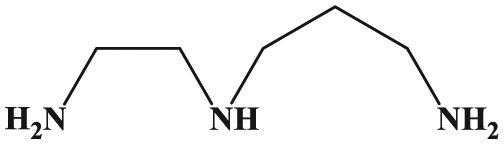
Structure of N1-(2-aminoethyl)propane-1,3-diamine (AEPD).
The biological properties of nickel15–17 and copper18–22 complexes make these complexes a good choice for biologically active compounds. For the study of the biological activities of the AEPD ligand and its complexes, docking calculations were run to investigate the possibility of an interaction between these compounds with 10 biomacromolecule targets:21,23,24 BRAF-kinase, cathepsin B (CatB), DNA-gyrase, histone deacetylase (HDAC7), recombinant human albumin (rHA), ribonucleotide reductases (RNR), thioredoxin reductase (TrxR), thymidylate synthase (TS), topoisomerase II (Top II), and B-DNA. These proteins were selected either due to their reported roles in cancer growth or as transport agents that affect drug pharmacokinetic properties (e.g. rHA). DNA-gyrase was included to study the possibility of anticancer properties and their activity as antimalarial agents.25 The knowledge gained from docking on B-DNA should be useful for the development of potential probes for DNA structure and new therapeutic reagents for tumors and other diseases.26
Experimental
Materials and instrumentation
All starting chemicals and solvents (Merck, Aldrich) were used as received without further purification. Infrared spectra (as KBr pellets) in the range 4000–400 cm–1 were recorded with a FTIR 8400-Shimadzu spectrometer. The carbon, hydrogen, and nitrogen contents were determined using a Thermo Finnigan Flash Elemental Analyzer 1112 EA. The melting points were measured with a Barnsted Electrothermal 9200 electrically heated apparatus. The electronic spectrum was recorded in water using a Shimadzu model 2550 UV–Vis spectrophotometer (190–900 nm).
Synthesis of bis[N1-(2-aminoethyl)propane-1,3-diamine]nickel(II) nitrate [Ni(AEPD)2](NO3)2 (1)
AEPD (0.40 g, 3.41 mmol) was added to a stirred solution of Ni(NO3)2·6H2O (0.50 g, 1.72 mmol) in EtOH (20 mL). The reaction mixture was heated under reflux for 5 h, cooled, and filtered. A violet precipitate formed which was collected by filtration. Yield: 0.34 g, 48%; m.p. 143 °C (decomposed). Anal. Calcd for C10H30N8NiO6 (%): C, 28.80; H, 7.25; N, 26.87. Found: C, 29.01; H, 7.29; N, 27.05. IR (KBr disk): 3299 m (νas NH2), 3249 s (νs NH2), 3161 m (ν N−H), 2923 m (νas CH2), 2874 m (νs CH2), 1598 m (δ NH2), 1447 m (δas CH2), 1378 s (ν4), 1345 s (δs CH2), 1090 (ν2), 1049 m (ν C−N), 885 m (ν6), 505 m (ν Ni−N) cm−1. Molar conductivity (1 × 10⁻³ mol L−1, DMF): 128 Ω−1 cm2 mol−1.
Synthesis of bis[(μ-chloro)N1-(2-aminoethyl)propane-1,3-diamine]nickel(II) nitrate dihydrate [Cu2(μ-Cl)2(AEPD)2](NO3)2·2H2O (2)
Complex 1 (0.15 g, 0.36 mmol) was added to a stirred solution of CuCl2·2H2O (0.06 g, 0.35 mmol) in EtOH (20 mL). The reaction mixture was heated under reflux for 5 h, cooled, and filtered. Blue crystals suitable for X-ray diffraction studies were obtained by slow evaporation of the solution over a few days and these were collected by filtration. Yield: 0.02 g, 7%; m.p. 160−180 °C (decomposed). Anal. Calcd for C10H34Cl2N8Cu2O8 (%): C, 20.27; H, 5.79; N, 18.91. Found: C, 20.44; H, 5.80; N, 19.06. (KBr disk): 3398 s (νas H2O), 3339 s (νs H2O), 3275 s (νas NH2), 3248 s (νs NH2), 3166 m (ν N−H), 2946 m (νas CH2), 2879 m (νs CH2), 1670 m (δ H2O), 1597 m (δ NH2), 1437 m (δas CH2), 1378 s (ν4), 1320 m (δs CH2), 1236 m (ν1), 1088 (ν2), 1042 m (ν C−N), 826 m (ν6), 632 m (ρr H2O), 518 (ρw H2O), 450 m (ν Ni−N) cm−1. UV–Vis (H2O, λmax (nm)/ε): 608/127 (d→d).
Crystal structure determination
Data were collected at 173 K using a Rigaku FRX/Pilatus P200 diffractometer (Mo radiation). Intensity data were collected using ω scans. All data were corrected for Lorentz and polarization effects. Absorption effects were corrected based on numerical absorption corrections. Structures were solved by direct methods (ShelxS) and refined by full-matrix least-squares against F2 using ShelxL.27 Diagrams of the molecular structure and unit cell were created using Ortep-III28,29 and Diamond.30 Crystallographic data and details of the data collection and structure refinement are listed in Table 1, selected bond lengths and angles in Table 2, and hydrogen bond geometries in Table 3.
Crystal data and structure refinement for 2.
Empirical formula
C10H30Cl2Cu2N8O6·2(H2O)
Formula weight, g mol−1
592.43
Crystal size, mm3
0.15 × 0.09 × 0.06
Temperature, K
173
Crystal system
Triclinic
Space group
Unit cell dimensions (Å, °)
A
6.77668(13)
B
8.3959(3)
C
10.4842(3)
Α
74.624(2)
Β
89.0616(18)
Γ
83.298(2)
Volume, Å3
571.16(3)
Z
1
Calculated density, g cm−3
1.722
Absorption coefficient, mm−1
2.15
F(000), e
306.00
θ range for data collection (°)
2.0–28.2
h, k, l ranges
−9 ⩽ h⩽ 9, −10 ⩽ k⩽ 10, −13 ⩽ l⩽ 13
Reflections collected/independent/Rint
17,946/2512/0.029
Data/ref. parameters
2512/168
Goodness-of-fit on F2
1.04
Final R indexes [I ⩾ 2σ (I)]
R1 = 0.0255, wR2 = 0.0745
Final R indexes [all data]
R1 = 0.0273, wR2 = 0.0756
Largest diff. peak/hole, e Å–3
0.78/−0.37
Selected bond lengths (Å) and angles (°) for 2 with estimated standard deviations in parentheses.
Bond length (Å)
Bond angle (°)
Cu1–N5
1.9865(14)
N5–Cu1–N1
168.42(7)
Cu1–N1
1.9960(15)
N5–Cu1–N2
93.09(6)
Cu1–N2
2.0388(15)
N1–Cu1–N2
84.01(6)
Cu1–Cl1
2.3441(4)
N5–Cu1–Cl1
91.74(5)
Cu1–Cl1i
2.7401(4)
N1–Cu1–Cl1
91.05(5)
N6–O7
1.231(2)
N2–Cu1–Cl1
175.06(4)
N6–O8
1.252(3)
N5–Cu1–Cl1i
93.69(5)
N6–O9
1.245(2)
N1–Cu1–Cl1i
97.65(5)
N2–Cu1–Cl1i
92.95(4)
Cl1–Cu1–Cl1i
87.806(14)
Cu1–Cl1–Cu1i
92.194(14)
i: −x, −y+ 1, −z+ 2.
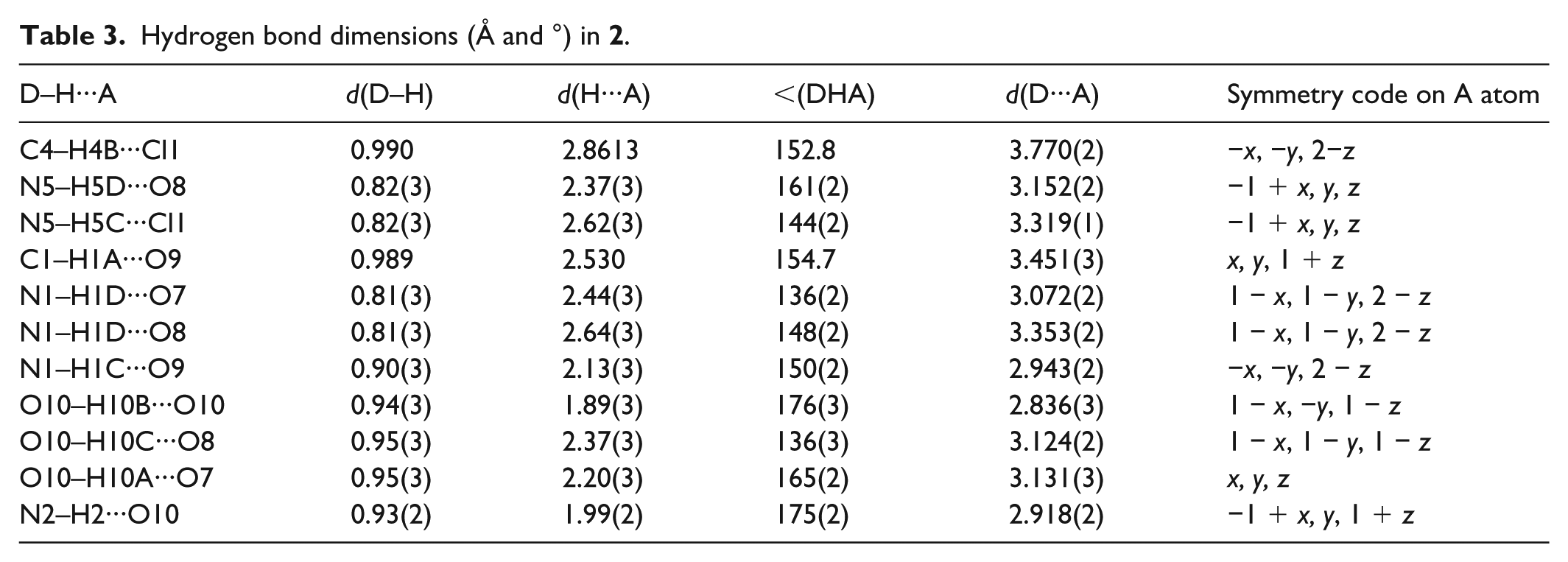
Hydrogen bond dimensions (Å and °) in 2.
D–H···A
d(D–H)
d(H···A)
<(DHA)
d(D···A)
Symmetry code on A atom
C4–H4B···Cl1
0.990
2.8613
152.8
3.770(2)
−x, −y, 2−z
N5–H5D···O8
0.82(3)
2.37(3)
161(2)
3.152(2)
−1 + x, y, z
N5–H5C···Cl1
0.82(3)
2.62(3)
144(2)
3.319(1)
−1 + x, y, z
C1–H1A···O9
0.989
2.530
154.7
3.451(3)
x, y, 1 + z
N1–H1D···O7
0.81(3)
2.44(3)
136(2)
3.072(2)
1 − x, 1 − y, 2 − z
N1–H1D···O8
0.81(3)
2.64(3)
148(2)
3.353(2)
1 − x, 1 − y, 2 − z
N1–H1C···O9
0.90(3)
2.13(3)
150(2)
2.943(2)
−x, −y, 2 − z
O10–H10B···O10
0.94(3)
1.89(3)
176(3)
2.836(3)
1 − x, −y, 1 − z
O10–H10C···O8
0.95(3)
2.37(3)
136(3)
3.124(2)
1 − x, 1 − y, 1 − z
O10–H10A···O7
0.95(3)
2.20(3)
165(2)
3.131(3)
x, y, z
N2–H2···O10
0.93(2)
1.99(2)
175(2)
2.918(2)
−1 + x, y, 1 + z
Computational details
All structures were optimized with the Gaussian 09 software31 and calculated for an isolated molecule using DFT32 at the B3LYP/6-31G(d, p) level of theory for ligand and B3LYP/LanL2DZ for complexes as well as by NBO analysis.
Docking details
The pdb files 4r5y, 3ai8, 5cdn, 3c0z, 2bx8, 1peo, 3qfa, 1njb, and 4gfh for the nine receptors, BRAF-kinase, CatB, DNA-gyrase, histone deacetylase (HDAC7), rHA, RNR, TrxR, TS, and Top II, respectively, used in this research were obtained from the Protein Data Bank (pdb).33 The full version of Genetic Optimisation for Ligand Docking (GOLD) 5.534 was used for the docking. The Hermes visualizer in the GOLD Suite was used to further prepare the compounds and the receptors for docking. The optimized structure of compounds was used for docking studies. The region of interest used for GOLD docking was defined as all the protein residues within 6 Å of the reference ligand “A” that accompanied the downloaded protein. For B-DNA, the region of interest was defined on the DNA backbone within 10 Å of the O4, DT19 and O2, DT19 atoms for the major and minor grooves, respectively. All free water molecules in the structures of the proteins were deleted before docking. Default values of all other parameters were used and the compounds were submitted to 10 genetic algorithm runs using the GOLDScore fitness function.
Results and discussion
The reaction between AEPD and nickel(II) nitrate provides complex 1. Treatment of 1 with copper(II) chloride forms complex 2 by transferring the AEPD ligand from nickel to the copper atom. During this reaction, the nitrate ions transfer from 1 to act as counter ion in 2; only one of the two chlorides was replaced by one nitrate ion. The complexes are air-stable and soluble in H2O and dimethyl sulfoxide (DMSO).
Spectroscopic characterization
In the IR spectra of complexes, three frequencies at 3100−3300 cm−1, which can be assigned to the symmetric and asymmetric stretching vibrations of the N−H bonds, reveal the presence of an amine ligand in these structures. Comparing these peaks with those of the AEPD ligand35 reveals that these peaks shift by 17−92 cm−1 to lower frequencies after complex formation, supporting N3-donor donation of AEPD toward metal atoms. No significant shift was observed for the δ (NH2).
Four bands in the IR spectra of the complexes in the range of 800−1400 cm–1 (ν4, ν1, ν2, and ν6) can be assigned to vibrations of the nitrate groups.36–38 The free nitrate ion has D3h symmetry and three infrared active vibrations, but this symmetry is lowered to C2v and Cs in metal complexes, to give up to six infrared active vibrations. In 1 and 2, the nitrate groups participate in hydrogen bonding that can decrease the nitrate symmetry.39
The presence of a water molecule in 2 affects the IR spectrum in three regions,40,41 including 3300–3400 cm–1 for asymmetric and symmetric OH stretches, 1670 cm–1 for H2O bending, and 200–600 cm–1 for “librational modes.” These modes are due to rotational oscillations of the water molecules restricted by interactions with neighboring atoms and they are classified into three types—wagging (ρw), twisting (ρt), and rocking (ρr)—depending on the direction of the principal axis of rotation.36,42,43
Metal–ligand interactions can be studied in the IR spectra below 600 cm−1.44 In this region, a band at 505 and 450 cm–1 for 1 and 2, respectively, was assigned to the M−N stretching vibrations.45 In the UV–Vis spectrum of 2, there is a broad absorption attributed to the d–d transition (2Eg→2T2g).
Description of the structures
The N1-(2-aminoethyl)propane-1,3-diamine unit is potentially tridentate and can bind to the metal centers in different coordination modes. A structural study of the Cambridge Structural Database (CSD) database reveals that there are three coordination modes for the title unit (Table 4). Among them the “mer-Two Chelates” coordination mode is common (89%) and there is one example of the “(Nb,Nc);Na” mode in which M is cadmium(II).51
All coordination modes for the N1-(2-aminoethyl)propane-1,3-diamine-based ligands.
Based on the spectral and physical properties of the complex 1 and also using the CSD database, we can predict a structure for 1. The FTIR spectrum of 1 confirmed N3-donation of the AEPD toward the copper atom along with the presence of the nitrate ion in this structure. The CHN analysis proved a 1:2 M:L ratio in 1. The molar conductivity revealed that 1 is a three ionic compound.52,53 CSD studies confirmed that the AEPD ligand is commonly coordinated to the metal centers in mer form. A study of the CSD database revealed that there are 12 examples for coordination of the AEPD to the nickel atom.54–62 In all of them the AEPD has one coordination mode, mer-Two Chelates (Table 4). Among these analogues, seven of them have the [Ni(AEPD)2]2+ unit in their structure,54,56,57,59 confirming that this unit is commonly formed in the reaction between AEPD with a nickel(II) ion. Based on these observations, it seems that the formula of [Ni(AEPD)2](NO3)2 for 1 is reasonable.
Crystal structure of [Cu2(μ-Cl)2(AEPD)2](NO3)2·2H2O (2)
X-ray analysis of 2 (Figure 2) reveals an ionic compound with a binuclear structure of copper in the cationic unit. Each copper atom is coordinated by two chloro ligands and one N3-donor AEPD with a coordination number (CN) of five. A pentacoordinate geometry may adopt either a square-pyramidal or a trigonal bipyramidal structure. To determine the geometry for such complexes, the formula of Addison et al.63 was applied. The angular structural parameter (τ) value for 2 was calculated to be 0.11 indicating an almost square-pyramidal geometry around the copper atoms, which is the common geometry for copper complexes with CN = 5.21 In addition to these five dative interactions, the copper atoms interact with one oxygen atom (O8) belonging to the adjacent nitrate ions at a long distance (2.888(2) Å) to complete its pseudo-octahedral geometry.
Ortep diagram of the molecular structure of complex 2. The ellipsoids are drawn at the 50% probability level.
Searching the CSD database reveals that there are 10 analogues for complex 2 (all structures containing the base presented in Figure 3; structures containing N3-donor macrocyclic ligands were omitted for precise results)64–72 with τ value in the range of 0.02−0.36 and square-pyramidal geometry. In all structures the ligands are coordinated in mer form, and based on the ligand direction, these analogues have two isomeric forms which are presented in Figure 3. The “a” isomer is common while there is only one example of an isomer “b.”67 In all complexes, the AEPD-based ligand and one chloro ligand are located in an equatorial plane and another chloro occupies the axial position. Comparing the two Cu−Cl bond length averages for all complexes revealed that the axial is longer than the equatorial, showing the z-axis elongation at these structures.73 Comparing two isomers of “a” and “b” reveals that the elongation isomer “a” is more significant than that in “b.” Complex 2 belongs to category “a”; the average of three Cu–N bond lengths (2.007 Å) are comparable with the CSD average (Figure 3). The difference between axial and equatorial Cu–Cl bond lengths in 2 is 0.396 Å (CSD average: 0.406 Å), confirming elongated square-pyramidal geometry around the copper atom. The cationic unit is centrosymmetric with a center of inversion at the center of the Cu1/Cl1/Cu1i/Cl1i plane and Ci symmetry. Two copper and two chloride ions are located on the mean plane through them with no root mean square (r.m.s.) deviation. The bond lengths and angles of the nitrate counterions (1.231(2)–1.252(3) Å, 119.1(2)–120.7(2)°) revealed that these groups are slightly asymmetric. A mean plane through the nitrate groups revealed that these units are perfectly planar with no deviation (r.m.s. = 0.000 Å).
CSD average (coordinated bond lengths and angles) for analogues of complex 2. (a) amine ligands have anti position, (b) amine ligands have syn position.
In this structure, the AEPD ligand is coordinated to the copper atom in its common mode (Table 4), N3-donor, by forming one five- and one six-membered non-planar chelate rings. The bond angle of the six-membered chelate ring (93.09(6)°) is larger than the five-membered one (84.01(6)°). A tridentate ligand can coordinate to the metal in facial or meridional forms. In the mer form, there are two angles of 90° and one of 180°, while in the fac form there are three angles of 90°.42 In complex 1, two coordinated bond angles of the AEPD ligands deviate from 90° due to the chelating bite angle, while the third is 168.42(6)°, confirming the mer form (135° is exactly half way between fac and mer). The AEPD ligand does not have a chiral center, but a new one (N2) is formed upon coordination. Thus, the complex has two chiral centers with different enantiomeric forms. However, the crystals overall consist of a racemic mixture of R,S and S,R isomers in alternate layers.43,74
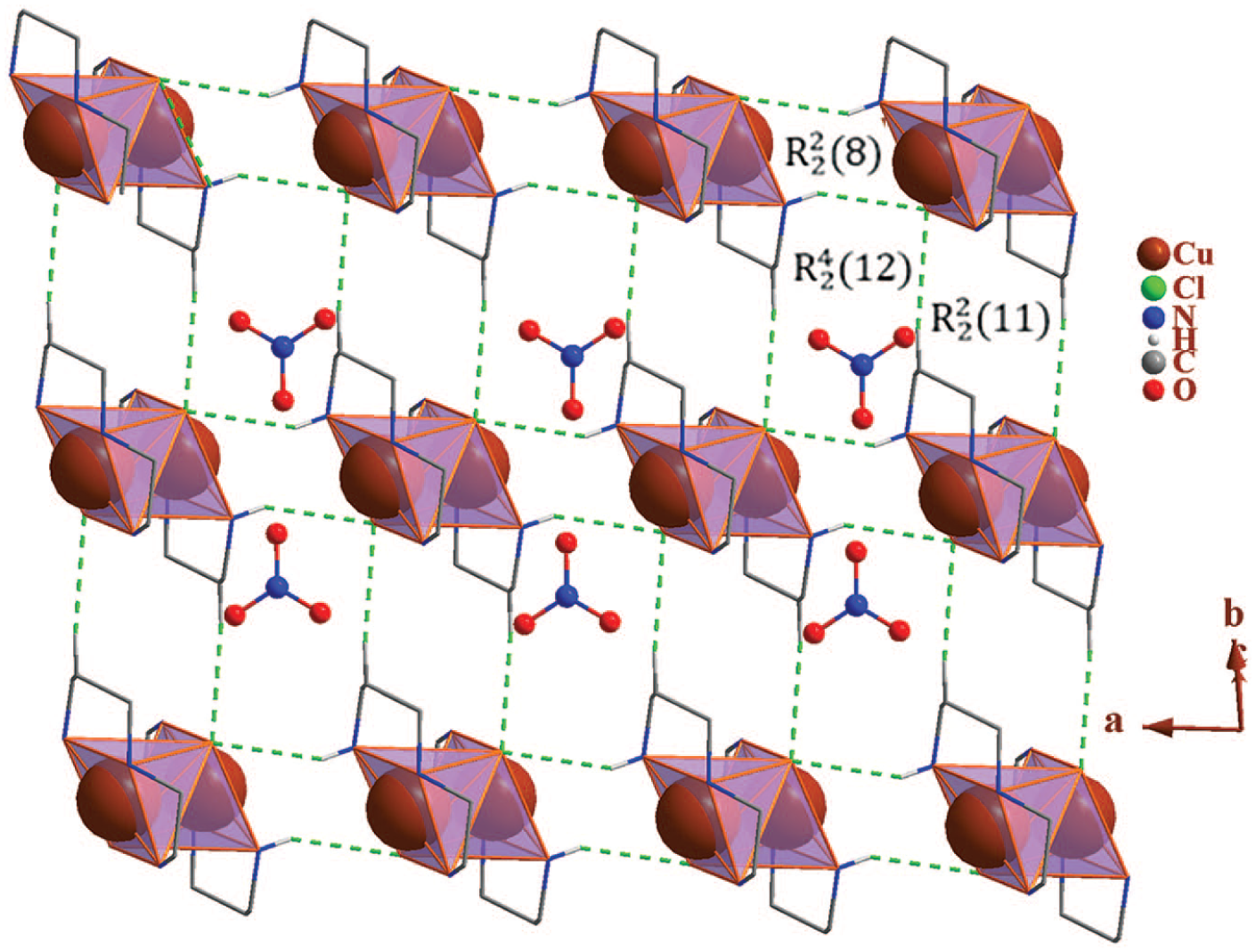
In the crystal structure of 2, there are intermolecular C–H···O, C–H···Cl, N–H···O, N–H···Cl, and O–H···O hydrogen bonds (Table 3 and Figure 4). The carbon and nitrogen atoms act as proton donors, whereas the oxygen and chloride participate in hydrogen bonding as proton acceptors. The oxygen atom of the water molecule acts as a proton donor and an acceptor at the same time. Among these hydrogen bonds, two N–H···Cl hydrogen bonds participate in the formation of one R22(8) hydrogen bond motif (two acceptors, two donors with a degree of 8)36 between two neighboring units. Also, four N–H···O hydrogen bonds form a R44(20) motif between nitrate and two cationic units. Also, other motifs including, R44(16), R22(10), R22(11), R42(12), R12(8), R44(12), and R21(4) were formed.
Packing of 2 showing the hydrogen bonds and hydrogen bond motifs. Only the hydrogen atoms involved in hydrogen bonding are shown. Water molecules were deleted for clarity. Each CuN3Cl2 unit is shown as a square-pyramid.
Theoretical studies
In order to propose a structure for 1 (based on the spectral and physical properties) and to enable comparison of the theoretical structure of 2 with that of the solid state one, DFT calculations were performed for isolated molecules and optimized structures of both compounds are presented in Figure 5. In the ionic structure of 1opt, the nickel atom has an octahedral geometry by coordination of two mer N3-donor AEPD ligands. The dihedral angle between two mean planes through the two bonded AEPD ligands is 85.79°, confirming these ligands are perpendicular to each other. In 2opt, the difference between two Cu−Cl bond lengths is 0.538 Å, which is higher than that of the solid state result (0.396 Å). Also, the axial Cu−Cl bond length of 2opt is longer than that of 2 (0.214 Å), revealing that elongation of the square-pyramidal geometry around the copper atom in an isolated molecule is higher than in the solid state. The distance between the copper atom and the nearest oxygen atom of the nitrate ion is 2.539 Å, which is smaller than that of the solid state result (2.888(2) Å) and showed that the geometry in theoretical species is highly tending to octahedral than in the solid state species. 2opt belongs to the “a” class of isomer (Figure 3) and two-coordinate AEPD has the mer configuration.
Optimized structures of the two complexes 1 and 2.
To study the charge distribution pattern of the AEPD ligand before and after complexation, an NBO analysis was performed (Table 5). In the optimized complexes, the calculated charge on the metal atoms (Ni: +0.94, Cu: +0.67) is lower than the formal charge (+2) owing to electron donation of the ligand upon complexation. These calculations reveal that the charges on the carbon atoms in 1opt and 2opt are positive compared to the free ligand, showing that the carbon atoms play an important role in electron donation toward the metal atom and decreasing the charge on it. The maximum charge variation was observed for the chloride ion (+0.52).
The NBO analysis results for optimized complexes 1opt and 2opt along with AEPD.
C
H
NAEPD
NNitrate
ONitrate
Cl
Metal
AEPD
−0.31
0.27
−0.84
–
–
–
–
Complex 1opt
−0.25
0.28
−0.87
0.68
−0.52
–
0.94
Complex 2opt
−0.25
0.30
−0.84
0.70
−0.51
−0.48
0.67
AEPD: N1-(2-aminoethyl)propane-1,3-diamine.
The values are the average charge on similar atoms.
In the optimized structure of the ligand, the lowest unoccupied molecular orbital (LUMO) is delocalized on the side amine group, while the highest occupied molecular orbital (HOMO) is on the centered amine unit (Table 6). In 1opt, the anionic nitrates have significant quota at the HOMO and LUMO, while in 2opt these orbitals are delocalized on the cationic unit and metal atoms along with chloride ions have significant quota at these orbitals (Table 6). DFT calculations reveal that after complexation, the HOMO/LUMO gap is decreased by −12.53 and −16.80 eV in 1 and 2, respectively (Table 6).
HOMO and LUMO orbitals for complexes 1opt and 2opt along with AEPD.
To predict the biological activities of the AEPD ligand and its complexes, interactions of these compounds with 10 macromolecular receptors were studied using GOLD34 docking software. The GOLD docking results are reported in terms of the values of fitness, which means that the higher the fitness, the better the docking interaction of the compounds.25 The results of the docking presented in this work are the best binding results out of 10 favorites predicted by GOLD.
The general features from the GOLD docking prediction (Table 7) show that all the studied structures can be considered as biologically active compounds. Based on the calculated values, the best predicted targets for AEPD, 1 and 2 are HDAC7, DNA-gyrase, and TrxR, respectively. Coordination of the AEPD to the copper atom highly increases the ability of the molecule to interact with proteins compared to the nickel atom. Docking studies reveal that all the studied compounds can be placed in the major and minor grooves of a DNA molecule, which make these compounds a good choice for DNA-binding studies. Among these compounds, AEPD and complex 2 have the highest score in binding to the minor and major grooves of DNA. The docking results of the interaction between AEPD with B-DNA (minor and major grooves) are shown in Figures 6 and 7, respectively.
The calculated fitness values for AEPD and complexes 1 and 2.
B-DNAs/Maj
B-DNAs/Min
BRAF-kinase
CatB
DNA-gyrase
HDAC7
rHA
RNR
TrxR
TS
Top II
AEPD
22.65
37.97
27.53
20.12
28.94
33.81
27.96
26.65
29.03
26.25
29.37
Complex 1
19.61
32.97
25.24
18.22
36.56
2.48
19.44
25.44
30.19
34.54
34.77
Complex 2
25.52
31.83
34.75
25.58
46.99
37.20
45.58
36.54
48.33
44.05
43.29
AEPD: N1-(2-aminoethyl)propane-1,3-diamine; CatB: cathepsin B; HDAC7: histone deacetylase; rHA: recombinant human albumin; RNR: ribonucleotide reductases; TrxR: thioredoxin reductase; TS: thymidylate synthase; Top II: topoisomerase II.
Docking study results showing the interaction between the AEPD and B-DNA (minor groove).
Docking study results showing the interaction between complex 2 and B-DNA (minor groove).
Conclusion
In this work, two new complexes of AEPD, [Ni(AEPD)2](NO3)2 (1) and [Cu2(μ-Cl)2(AEPD)2](NO3)2·2H2O (2), were synthesized and their spectral (IR, UV–Vis) and structural properties were investigated. The metal atom in 1 is octahedrally coordinated by two N3-donor AEPD ligands, while the elongated square-pyramidal geometry in 2 was achieved by an N3-donor AEPD ligand along with two bridging chloro ligands. CSD studies revealed that among the three coordination modes that have been observed for AEPD-based ligands, the “mer-Two Chelates” coordination mode is common (89%, as observed in 1 and 2). In 2, the axial Cu−Cl bond lengths are significantly longer than the equatorial one, confirming z-axis elongation in this structure. In the crystal network of 2, the cationic complex, nitrate ions, and water molecules form different hydrogen bond motifs. NBO analysis reveals that the carbon atoms of the ligand play an important role in electron donation toward the metal atom. Based on DFT studies, the HOMO/LUMO gap was significantly decreased in complexes relative to the ligand. Docking studies reveal that the AEPD ligand and its complexes can interact with biomacromolecules (BRAF-kinase, CatB, DNA-gyrase, HDAC7, rHA, RNR, TrxR, TS, Top II, and B-DNA). In addition, the best predicted targets for AEPD, 1 and 2 are HDAC7, DNA-gyrase, and TrxR, respectively. The binding ability of the copper complex toward the studied biomacromolecules is higher than the nickel example. Since these compounds can interact with the DNA, studying their anticancer activities might be interesting.
Supplemental Material
checkcif_3 – Supplemental material for A novel ligand transfer reaction: Transferring an N3-donor amine ligand from Ni(II) to Cu(II)—structural, spectral, theoretical, and docking studies
Supplemental material, checkcif_3 for A novel ligand transfer reaction: Transferring an N3-donor amine ligand from Ni(II) to Cu(II)—structural, spectral, theoretical, and docking studies by Zahra Mardani, Sima Dorjani, Keyvan Moeini, Majid Darroudi, Cameron Carpenter-Warren, Alexandra MZ Slawin and J Derek Woollins in Journal of Chemical Research
Footnotes
Declaration of conflicting interests
The author(s) declared no potential conflicts of interest with respect to the research, authorship, and/or publication of this article.
Funding
The author(s) received no financial support for the research, authorship, and/or publication of this article.
ORCID iD
Zahra Mardani
Supplemental material
Supplemental material for this article is available online.
MardaniZGolsanamlouVJabbarzadehZ, et al. J Coord Chem2018; 71: 4109–4131.
74.
HakimiMMardaniZMoeiniK, et al. Z Naturforsch2013; 68b: 272.
Supplementary Material
Please find the following supplemental material available below.
For Open Access articles published under a Creative Commons License, all supplemental material carries the same license as the article it is associated with.
For non-Open Access articles published, all supplemental material carries a non-exclusive license, and permission requests for re-use of supplemental material or any part of supplemental material shall be sent directly to the copyright owner as specified in the copyright notice associated with the article.