



Abstract
Background:
This study aims to evaluate the efficacy and safety of dual antiplatelet therapy (DAPT) versus single antiplatelet therapy (SAPT) for patients with a first-ever embolic stroke of undetermined source (ESUS).
Methods:
We assembled a multicenter cohort and a propensity score-matched (PSM) subset to compare DAPT with SAPT. The primary outcome was a composite of recurrent ischemic stroke, myocardial infarction, or all-cause death, and the safety outcome was major bleeding. Follow-up extended to 3 years (median, 2.6 years). We used Cox proportional hazards models to complement time-stratified (piecewise) analyses and restricted mean survival time (RMST).
Results:
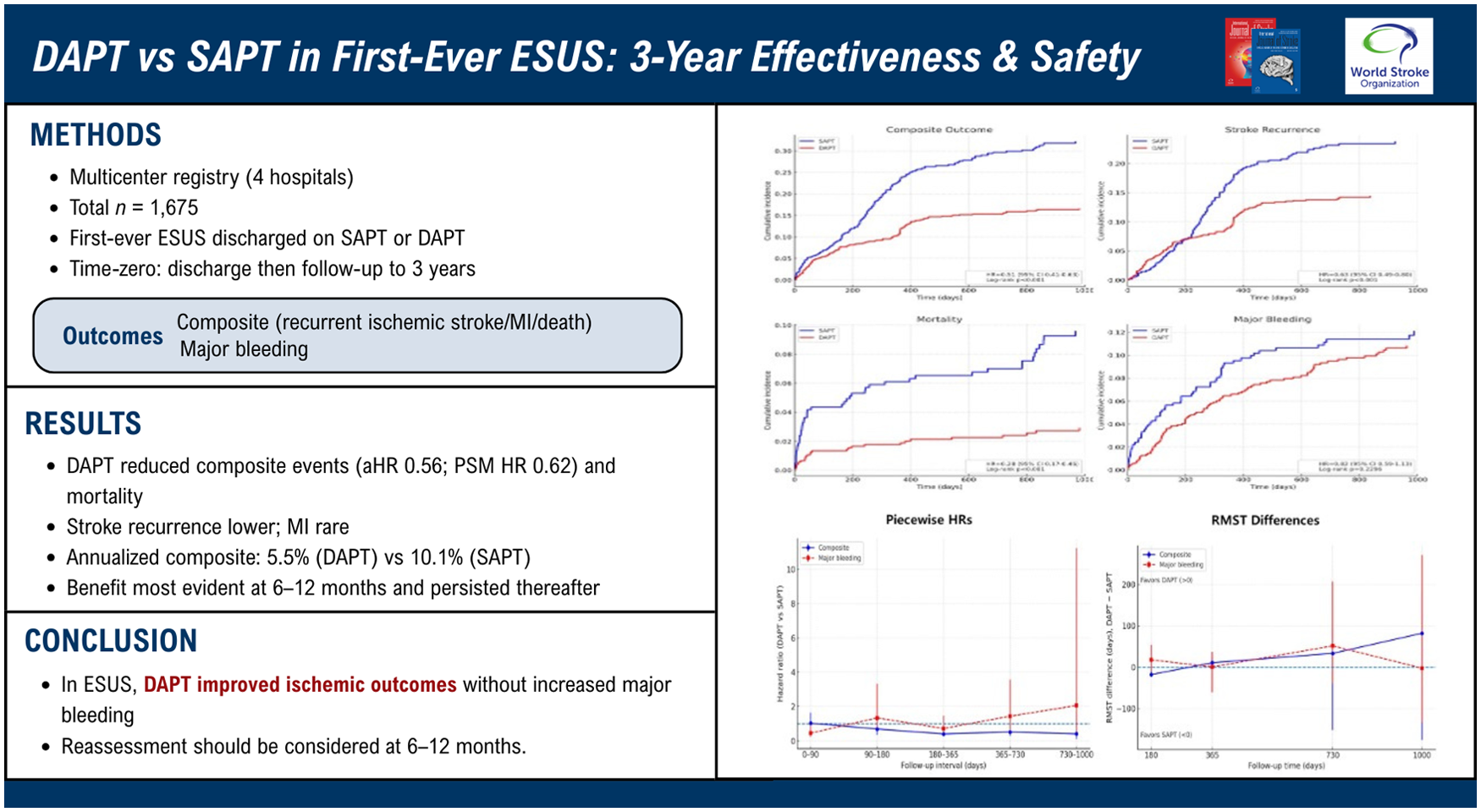
In the total cohort (n = 1675), DAPT was associated with a lower hazard of the composite outcome (adjusted hazard ratio (HR) = 0.56, 95% confidence interval (CI) = 0.44–0.70). Stroke recurrence and mortality were likewise reduced, while myocardial infarction events were infrequent. There was no significant difference in major bleeding between groups (e.g. incidence-rate ratio ≈1.0; p > 0.05). The annual incidence rate for the composite was 5.5%/year with DAPT versus 10.1%/year with SAPT. Time-stratified analyses revealed that the ischemic benefit was most pronounced between 6 and 12 months and appeared to persist thereafter. Bleeding, however, showed only a numerical increase beyond 1 year without statistical significance. RMST differences favored DAPT from 1 year onward and increased over 1000 days.
Conclusion:
In this ESUS cohort, DAPT was associated with fewer ischemic events and no increased major bleeding. The benefit was most evident at 6–12 months and was sustained over a longer follow-up period.
Get full access to this article
View all access options for this article.
References
Supplementary Material
Please find the following supplemental material available below.
For Open Access articles published under a Creative Commons License, all supplemental material carries the same license as the article it is associated with.
For non-Open Access articles published, all supplemental material carries a non-exclusive license, and permission requests for re-use of supplemental material or any part of supplemental material shall be sent directly to the copyright owner as specified in the copyright notice associated with the article.
