




Abstract
Background and Objectives:
In patients with minor stroke, intravenous thrombolysis is recommended only for those with disabling symptoms, yet no standardized definition exists, and the treatment decisions remain subjective. This study aimed to evaluate the effect of thrombolysis in minor stroke using routine care registry data.
Patients and methods:
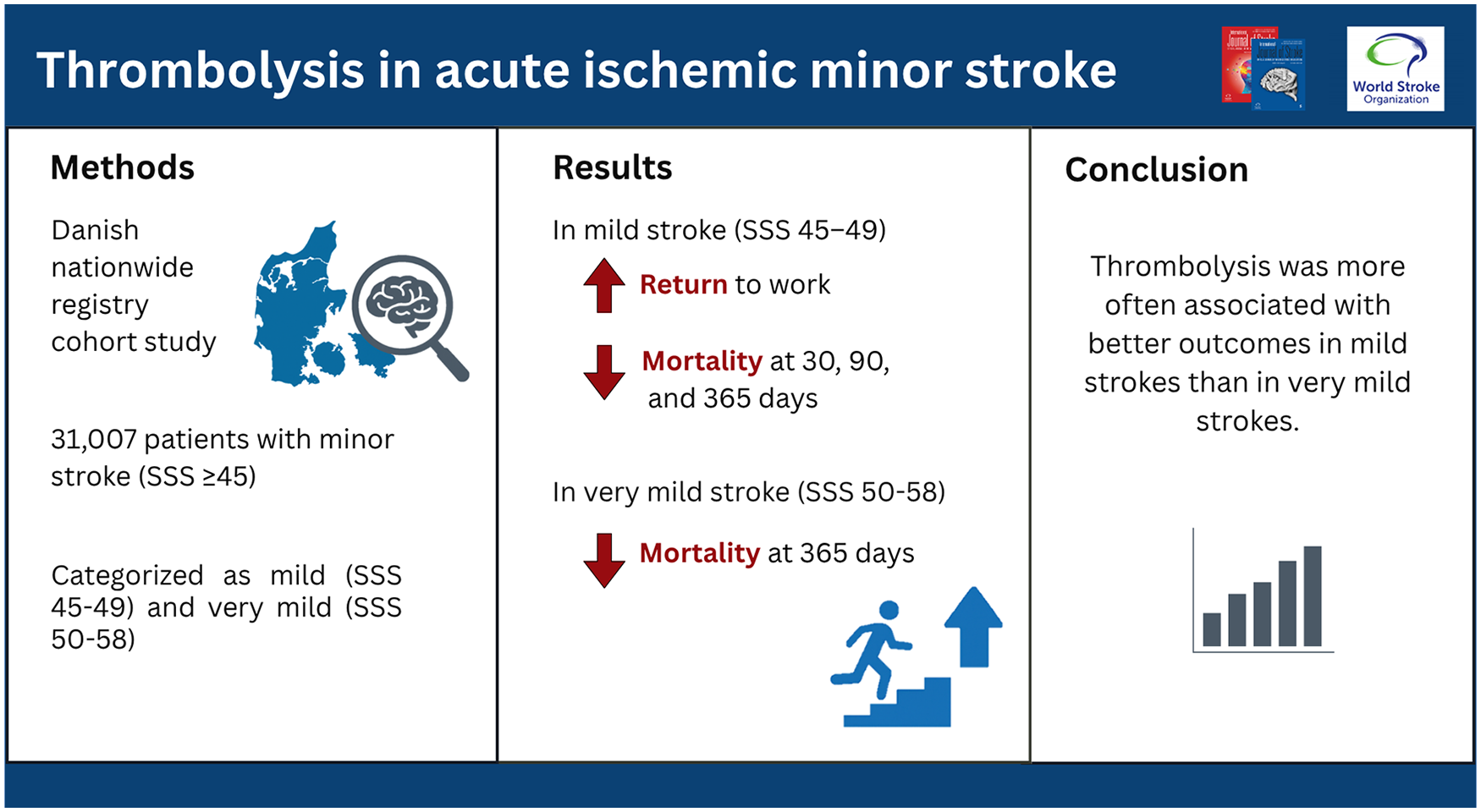
A Danish nationwide register-based cohort study included patients with minor stroke (Scandinavian Stroke Scale (SSS) ⩾ 45) from 2011 to 2021. Patients were categorized as having mild strokes (SSS 45–49, approximated National Institutes of Health Stroke Scale (NIHSS) = 5–6) or very mild strokes (SSS 50–58, approximated NIHSS 1–4) to pragmatically distinguish disabling from non-disabling symptoms. Return-to-work, use of homecare, typical stroke complications, recurrent stroke, and mortality were compared in patients treated with and without thrombolysis. Analyses were adjusted for vascular risk factors, demographics, and clinical characteristics using inverse probability of treatment weighting.
Results:
Among 31,007 included patients, 1910 with mild strokes and 4052 with very mild strokes received thrombolysis. In patients with mild strokes, thrombolysis was associated with a higher rate of return-to-work (adjusted hazard ratio = 1.33), lower risk of pneumonia (adjusted relative risk (aRR) = 0.40), and lower mortality (aRR = 0.58, 0.50, and 0.50 at 30, 90, and 365 days, respectively). In patients with very mild strokes, thrombolysis was not associated with improved outcomes, except lower mortality at 365 days (aRR = 0.78).
Discussion:
Intravenous thrombolysis was more often associated with better outcomes in patients with mild strokes than in patients with very mild strokes.
Get full access to this article
View all access options for this article.
References
Supplementary Material
Please find the following supplemental material available below.
For Open Access articles published under a Creative Commons License, all supplemental material carries the same license as the article it is associated with.
For non-Open Access articles published, all supplemental material carries a non-exclusive license, and permission requests for re-use of supplemental material or any part of supplemental material shall be sent directly to the copyright owner as specified in the copyright notice associated with the article.
