




Abstract
The United Nations Convention on the Rights of the Child sets out the rights to which all children should have access. Included in the Convention is children’s right to participate and have a say in matters affecting them. This right is equally applicable within a research context as it is in children’s everyday lives. This desk-top study reviews published ethics guidelines and university ethics documents associated with research involving children in school contexts, to determine the presence of children’s participation rights. It draws attention to how growing understandings of children’s participation rights, and the ethical issues associated with these, are inadequately encompassed within ethics guidelines and documents.
Introduction
Over the past 25 years there has been an increasing recognition of the positive value of listening to children about their views and experiences, and a growing number of research projects have focused on ascertaining children’s perspectives (Bell, 2008; Ericsson and Boyd, 2017; Faldet and Nes, 2021; Murray, 2019; Tisdall, 2012). The emphasis on listening to children’s perspectives has grown since the publication of the United Nation’s Convention on the Rights of the Child (UNCRC) (UN, 1989). The UNCRC is an international document which sets out the rights to which all children should have access. Included within this is Article 12, which articulates children’s right to have a say in all matters affecting them. Part 1 of Article 12 of the UNCRC reads: States Parties shall assure to the child who is capable of forming his or her own views the right to express those views freely in all matters affecting the child, the views of the child being given due weight in accordance with the age and maturity of the child (UN, 1989).
This right (along with all rights in the UNCRC) is indelible and is, therefore, equally applicable within a research context as it is in children’s everyday lives. This paper is concerned with how children’s rights within the UNCRC, specifically Article 12, are reflected in ethics guidelines developed by United Kingdom (UK) universities for school-based research involving children. It offers new insights into how children’s rights are reflected, or otherwise, within these ethics’ guidance documents.
This paper was prompted following discussions with several experienced academic educational researchers within the UK who expressed concerns and frustration around being met with barriers when attempting to seek university ethical approval for school-based research in which children were to be involved as research participants, co-researchers or leaders of research. These barriers included university ethics committees not wanting to approve research where children would be discussing school experiences considered to be of a sensitive nature, questioning whether children were too young to participate in research, and questioning whether children were capable of leading research projects. All concerns by university ethics committees were raised from a perspective of protecting children, rather than from wanting to support their participation and their right to have a say in matters affecting them. Anecdotal evidence also suggested that university ethics guidance documents paid little attention to ethical issues associated with supporting children’s active participation in research. These conversations, coupled with the author’s own experience of conducting research in schools with children for over 30 years, led her to undertake a small-scale study to explore the area further. The study aimed to illustrate which ethical issues are prioritised within university ethics guidance for school-based research involving children, with a specific focus on ways in which principles relating to Article 12 of the UNCRC are reflected in these guidance documents.
Throughout this paper, the term ‘child’ or ‘children’ will be used to refer to all children up to the age of 18, in line with the United Nation’s (UN) definition (UN, 1989: 4).
The paper starts by providing contextual information about the changing view of children, childhood and children’s involvement in research. It then provides an overview of children’s rights within the UNCRC, outlining details of the principles underpinning Article 12. Following this, ethics guidance, intended to support those researching with children in school contexts, are analysed to determine the presence and importance placed on children’s rights. This documentary analysis was undertaken in two stages. Firstly, ethics guidance published by organisations concerned with research ethics, including NGOs, was analysed; and secondly, an analysis of publicly available ethics guidance documents from across 30 universities in the UK was undertaken. Both sets of documents were scrutinised to identify whether, and if so how, children’s rights, particularly those within Article 12 of the UNCRC, were reflected in these documents. Analysing findings from a children’s rights perspective presents a new lens through which to view ethical considerations and requirements for children’s involvement in school-based research. I argue that within university ethics documents, there is a significant lack of attention given to children’s rights under Article 12, and to recognising that children are capable social actors who play an increasingly prominent role as research participants and leaders of research.
Context: The changing view of children, childhood and children’s involvement in research
In the late 1990s the perception of children changed from children being perceived as immature and lacking in ability, to being recognised as competent social agents in their own right who are capable of forming and expressing their views (Christensen and Prout, 2002; Clark, 2005; James, 2001; Mayall, 2002), and who have valuable contributions to make (James and Prout, 2015). This recognition of children’s agency continues today (Ericsson and Boyd, 2017; Loveridge et al., 2024; Woodrow et al., 2022; Woolhouse, 2019) and is applicable to all children, including very young children (Cassidy, 2017; Wall et al., 2019). As part of this paradigm shift, it is acknowledged that if we are to gain deeper understandings about children’s lives, experiences and perspectives, it is essential to seek their views (Lundy, 2007; Starkey et al., 2014; Woolhouse, 2019). This has led to developments in research practices which are now far more inclusive of children (Doyle et al., 2022; Loveridge et al., 2024).
Christensen and Prout (2002) identified four categories which outline children’s involvement in research: children as object, subject, social actor and co-researcher. They assert that these categories can coexist and are not intended to be viewed as a model for progression. While I fully agree with this thinking, for the purpose of illustrating the shift in children’s involvement in education research, I suggest viewing the categories along a continuum in which children as ‘object’ is located at one end, and children as ‘co-researcher’ at the opposite end. ‘Children as object’ represents research performed on children, where children are not considered to be social actors within the research, and researchers may, for example, seek the perspectives of adults about children’s experiences. Moving along the continuum, ‘children as subject’ reflects research in which children are viewed as having subjectivity and act as research informants, but where researchers make judgements about children’s ‘cognitive abilities and social competencies’ (Christensen and Prout, 2002: 481). Positioned further along the continuum is the category of ‘children as social actor’. Here, researchers set out to seek children’s views, recognising that children have their own, autonomous perspectives, understandings and experiences. Finally, ‘children as co-researcher’ represents research in which children are active participants and involved in data collection (Christensen and Prout, 2002: 481). Viewing children’s varying levels of involvement in research along a continuum is helpful to illustrate the changing and increasing emphasis placed on children’s participation. In addition to these four categories, however, I suggest a fifth category could also be introduced, located further along the continuum to represent research designed and led by children (Christensen and James, 2017; Mayne and Howitt, 2015; Thomas, 2017).
The profound changes in the positioning of children within research, have necessitated researchers to adopt methodological approaches that acknowledge and respect children’s changing role. These developments, coupled with the growing acknowledgement that of children’s right to have a say about matters that affect them as stipulated in Article 12 of the UNCRC (UN, 1989), have added a new level of complexity to ethical issues relating to children’s participation in school-based research. Notably, there are challenges associated with realising children’s rights while also ensuring children are protected from harm that may arise from their involvement in research (Kern et al., 2021), however, despite the growth in participatory, collaborative and co-designed research, guidance relating to these newly arising ethical challenges is sparce (Loveridge et al., 2024).
Children’s rights within the UNCRC: An overview
All human rights apply to children, however, the UNCRC sets out additional rights specifically intended for children. It provides a manifesto for the welfare and protection of children, and the promotion of their agency and participation in decision-making. The UNCRC has been ratified by every nation across the world, with the exception of the United States of America. The UK government ratified the UNCRC in 1991, indicating its consent for articles within the Convention.
To provide a contextual overview of children’s rights within the UNCRC, consideration will be to seminal work which classified children’s rights as Provision, Protection and Participation rights, known commonly as the 3p’s (Lansdown, 1994; Osler and Starkey, 1998). While the 3p’s classification of children’s rights is not without critique (Quennerstedt, 2010), it presents a useful basis for considering ethical issues associated with school-based research involving children. This classification also reflects the language used during initial conversations with education researchers in which concerns were first raised about university ethics requirements prioritising issues relating to protecting children, and the lack of attention paid to ethical issues associated with supporting children’s participation in research.
Children’s provision, protection and participation rights within a research context
Children’s Provision rights include their rights to education, good health and an adequate standard of living. Within a research context, ethical considerations associated with children’s Provision rights are concerned with ensuring that the purpose of the research contributes, directly or indirectly, to enhancing children’s well-being (Hill, 2005). Children’s Protection rights incorporate rights that protect children from harm, including any form of abuse, exploitation, neglect or discrimination. In the context of research, children’s Protection rights are reflected in ethical considerations associated with protecting children from harm, stress, distress discrimination and injustice (Hill, 2005). Finally, children’s Participation rights encompass children’s rights to express their views and be listened to. Within a research context, ethical considerations relating to children’s Participation rights include, for example, ensuring children are enabled to make informed decisions about consenting/dissenting to participating in the research (Hill, 2005), and that children’s rights under Article 12 of the UNCRC are recognised.
To help more fully understand children’s rights within Article 12, consideration was given to the General Comments of the UN’s Committee of the Rights of the Child’s (UN, 2009) (hereafter referred to at the Committee), which outlines key principles underpinning children’s rights encompassed within the Article. Developing insights into the intentions of Article 12 is necessary to add clarity to issues about which ethics documents need to be mindful when considering the involvement and participation of children in school-based research.
Children’s rights under Article 12 of the UNCRC
The overarching principles inherent within Article 12, as identified by the Committee, are outlined below.
(i) Children have a right to express their view freely in all matters affecting them
Article 12 states that a child has the right to express their views ‘in all matters affecting the child’ (UN, 2009: para 26). This statement provides a basis on which all research involving children should be built. Thus, if research relates to an area that affects the child, there is an expectation that children’s perspectives will be listened to. Integral to this principle is children’s right to express their views ‘freely’. The Committee explains that the word ‘freely’ means that a ‘child can express her or his views without pressure and can choose whether or not she or he wants to exercise her or his rights to be heard’ (UN, 2009: para 22). Adults must not, therefore, impose their views on children and measures need to be taken to ensure children feel at ease to voice their opinion without fear of negative consequences, even where their views may be considered controversial (Robinson and Taylor, 2007). Care must also be taken to ensure children do not feel under pressure to voice their opinion if they chose not to.
(ii) We should start from the assumption that children are capable of forming their own views
The Committee asserts that: [we] . . . should presume that a child has the capacity to form her or his own views. . .; it is not up to the child to first prove her or his capacity (UN, 2009: para 20).
Additionally, the Committee: . . .discourages . . . [the introduction of] age limits either in law or practice which would restrict the child’s right to be heard in all matters affecting her or him. . . even when she or he may be unable to express them verbally (UN, 2009: para 21).
Thus, the starting assumption should be that children are capable of forming their own views, and it is up to adults to provide children with information in a way that they can understand to support them to form their own views [see also (iii) and (iv) below].
(iii) Children’s views should be taken seriously
To acknowledge children rights under Article 12, it is not sufficient to merely listen to what children say, their views must also be taken seriously. The Committee asserts that ‘. . .simply listening to the child is insufficient; the views of the child have to be seriously considered when the child is capable of forming her or his own views’ (UN, 2009: para 28). The Committee expresses its view that a child’s age cannot determine their level of understanding and states: . . .age alone cannot determine the significance of a child’s view. Children’s levels of understanding are not uniformly linked to their biological age . . . the views of the child have to be assessed on a case-by-case examination (UN, 2009: para 29).
Implementing Article 12, therefore, requires adults to take children’s views seriously and to value the perspectives of all children; this right applies regardless of whether or not adults agree with children’s views. There is also a need to recognise that children’s levels of understanding cannot be determined solely by their age.
(iv) Adults have a responsibility to equip children with information to enable them to form a view
In further acknowledgment of the Committee’s stance that children should be seen as capable, the Committee clearly stipulates that it is the responsibility of adults to equip children with the knowledge they need to form a view, and to be fully supportive of facilitating children to express their views on a matter. The Committee states: . . .it is not necessary that the child has comprehensive knowledge of all aspects of the matter affecting her or him, but. . . has sufficient understanding to be capable of appropriately forming his or her own view on the matter.
Thus, the onus is on researchers to adopt flexible and inclusive approaches when communicating with children to ensure that ways of imparting information align with children’s needs and preferences.
(v) Adults should support all children to express their views and acknowledge that children use different means to express these views
There is an expectation that adults will adopt a flexible approach when supporting children to express their views. The Committee asserts that children: should be equipped with, and enabled to use, any mode of communication necessary to facilitate the expression of their views. Efforts must also be made to recognise the right to expression of views for minority, indigenous and migrant and other children who do not speak the majority language (UN, 2009: para 21).
And. . .
full implementation of article 12 requires recognition of, and respect for, non-verbal forms of communication including play, body language, facial expression, drawing and painting through which very young children demonstrate understanding choices and preferences (UN, 2009: para 21).
Full support should, therefore, be given by adults to encourage children to express their views, and adults need to be open to children choosing how to express their views through whatever means children choose. Efforts should also be made to ensure all children, including very young children, and minority as well as mainstream groups, are supported to express their views.
(vi) Children should be able to receive and impart information through a media of their choice
In addition to the principles ingrained within Article 12, it is also necessary to draw attention to Article 13 of the UNCRC which articulates children’s rights to receive and impart information through a mode of their choice.
Article 13 states: The child shall have the rights to freedom of expression; this right shall include freedom to seek, receive and impart information and ideas of all kinds, regardless of frontiers, either orally, in writing or in print, in the form of art, or through any other media of the child’s choice.
The above principles underpinning Articles 12 and 13 of the UNCRC all have ethical implications for children’s participation in school-based research.
Methods
To address the aim of determining whether, and if so how, UK university ethics documents associated with school-based research involving children reflect consideration of children’s rights, two sets of documents were identified for analysis. Firstly, published ethics guidance concerned with children’s involvement in school-based research were identified through undertaking a systematic key word search of three main education databases, the British Education Index (BEI), the Australian Education Index (AEI) and the United States of America Education Resources Information Centre (ERIC), along with Google Scholar and Google keyword searches. Search terms included ethics guidance; ethical activities; education research; research; children, adolescents, youth, child, teenager, young people, combined with ‘OR’ and ‘AND’. From this searching, some ethics guidance was immediately identified, and further guidance was identified by scrutinizing research publications reporting on children’s involvement in school-based research for details of ethical guidelines referenced within these publications. Searching was limited to publications from 2013 onwards, however, this did not preclude references within publications to ethics guidelines published prior to this date. As a result of this searching, the following ethics guidance documents were included:
• The British Educational Research Association’s (BERA) Ethical Guidelines for Educational Research (BERA, 2018). During the process of writing this paper, the BERA updated their 2018 ethical guidance. This latest guidance was, therefore, also included (BERA, 2024).
• The Scottish Educational Research Association’s (SERA) Starting points for Educational Research in Scotland (SERA, 2020).
• Scottish Educational Research Association (SERA) Ethical Guidance for Educational Research (SERA, 2005).
• The American Educational Research Association (AERA) Code of Ethics (AERA, 2011).
• The UK’s National Centre for Research Methods (NCRM) Research with Children Guidance Papers (NCRM, 2023).
• Ethical Research Involving Children (ERIC) (Graham et al., 2013).
• The European Early Childhood Education Research Association’s (EECERA) Ethical code for early childhood researchers (EECERA, 2015).
• The UK’s Research and Innovation (UKRI) Research with children and young people (UKRI, 2023).
• Research with children: ethics, safety and promoting inclusion: Guidance about managing the risk of harm, obtaining informed consent and what researchers should do if they have concerns about a child (National Society for the Prevention of Cruelty to Children (NSPCC), n.d.).
Secondly, publicly available ethics documents from the websites of 30 UK universities were identified. For some universities, several relevant documents were available, for example, Ethics Guidance, Principles and Codes of Practice, as well as Ethics Review Forms and other documents accessible through online links, while for other universities, only one ethics document was available. The analysis focused on all available ethics documents for each university. Both stages of the analysis involved systematically reviewing the ethics documents to gain an in-depth understanding of the content (Krippendorff, 2018). During the content analysis, all explicit and implicit reference to children’s rights generally, and to Articles 12 and 13 specifically, were recorded and used as data (Labuschagne, 2003). Evidence of ethical considerations were noted, applying the 3p’s classification of children’s Protection, Provision and Participation rights. Published guidance, as well as university ethics documents, were analysed to determine whether university ethics documents reflected the available published guidance relating to children’s involvement in school-based research. This was important as, if findings supported anecdotal evidence and illustrated that university ethics documents did not adequately represent children’s participation rights, it was relevant to know if there was also a lack of consideration given to these within published ethics guidance.
Limitations
The review of university ethics documents was limited to 30 UK universities, thus ethics documents from all UK universities were not included. Furthermore, through only reviewing those documents that were publicly available from the 30 universities included in this study, it is acknowledged that some ethics-related documents from these universities may be excluded due to restrictions of access. However, it was noted that in cases where several ethics documents from one university were available (e.g. Ethics Guidance, Ethics Principles, Ethics Codes of Practice, Ethics Review Forms), similar ethical issues were referenced in each of the documents, suggesting that where an ethical issue was of importance to a university it would be included, even where only one ethics document was available for review. It is also acknowledged that this desk-based study is limited to ethics guidance documents, and discussions taking place during university ethics review meetings have not been included. Additionally, the study is restricted to ethics documents within a narrow band, that is, those relating to children involved in school-based research. However, this ‘dipping our toe’ into exploring which aspects of children’s rights are emphasised and which are sidelined within ethics guidelines, is intended to offer new insights and highlight findings within this specific and growing area.
Findings: The presence of children’s rights in published ethics guidance and university ethics documents associated with children’s involvement in school-based research
Findings relating to the presence of children’s rights within published ethics guidance and university ethics documents are presented below in the context of children’s Provision, Protection and Participation rights.
Ethical considerations relating to children’s Provision rights
Both published ethics guidance and university ethics documents reflected children’s Provision rights within one main area, that of beneficence.
The principle of beneficence
Within published ethics guidance, the most prominent ethical consideration relating to children’s Provision rights was around the principle of beneficence. Beneficence was described as the need to ensure research is relevant and worthwhile to research participants in their context (SERA, 2005, 2020), and sets out improve children’s status, rights, or well-being (EECERA, 2015; Graham et al., 2013; UKRI, 2023). It was acknowledged, however, that at times the benefits to research participants might be compromised in an endeavour to achieve long term goals and gains (BERA, 2018, 2024; Graham et al., 2013). In such cases, the welfare and rights of children needs to be balanced against the social benefits of the research, and there should be an underlying expectation that the research will lead to improving children’s wellbeing, lives and experiences in the longer term (BERA, 2018, 2024; EECERA, 2015; Graham et al., 2013; NCRM, 2023; NSPCC, n.d.; UKRI, 2023).
Ethics guidance documents from all 30 universities acknowledged the principle of beneficence. Ethics documents from 19 universities stated that research outcomes should be of benefit to the future well-being and lives of children generally, with seven of these universities acknowledging that research may not directly benefit the children involved. These seven universities, plus an additional nine universities (of the 19 mentioned above) suggested researchers should justify how the benefits of the research will outweigh any risks and disruption caused to children as an outcome of their involvement in the research.
Ethical considerations relating to children’s Protection rights
Within published ethics guidelines and university ethics documents, children’s right to Protection focused on three main areas as detailed below.
(i) Protecting children from harm, distress, or discomfort
The welfare and protection of participants was a key concern in all reviewed ethics guidelines. They commonly stressed the need to minimise harm, distress and discomfort caused to participants before, during and after the research, and to ensure support and safety protocols were in place if a child displays signs of distress or discloses information of a concerning nature (AERA, 2011; BERA, 2018, 2024; EECERA, 2015; Graham et al., 2013; NCRM, 2023; NSPCC, n.d.; SERA, 2005, 2020; UKRI, 2023). Aligned to this, some guidance also made reference to researchers’ obligations to protect the rights welfare, dignity, values and autonomy of research participants (AREA, 2011; UKRI, 2023).
Consistent with issues raised in published ethics guidance, the ethics documents from all 30 universities required researchers to establish safeguarding and protection policies and practices. These included taking measure to minimise harm, distress and discomfort caused to children during the conduct of the research, and putting in place specific measures to follow should a child disclose information of a sensitive or worrying nature.
(ii) Secure storge of children’s personal details
There was a strong emphasis within published ethics guidance on the need to securely store data and dispose of data relating to children’s personal details, and to adhere to General Data Protection Guidance (GDPR) requirements (AERA, 2011; BERA, 2018, 2024; EECERA, 2015; Graham et al., 2013; NCRM, 2023; SERA, 2005, 2020; UKRI, 2023). Similarly, documents from all 30 universities included requirements for data relating to children to be securely stored and disposed of.
(iii) The protection of children’s identity
Within published ethics guidelines it was acknowledged that any information shared by children should be treated confidentially and sensitively, and should not reveal their identity (AERA, 2011; BERA, 2018, 2024; EECERA, 2015; Graham et al., 2013; NCRM, 2023; SERA, 2005, 2020; UKRI, 2023). Aligned with this thinking, all 30 universities placed requirements on researchers to keep confidential and anonymise all data received from, and relating to, children.
Ethical considerations relating to children’s Participation rights
The presence of children’s Participation rights within the ethics guidance is discussed below in the context of the principles underpin Article 12 and 13 of the UNCRC.
(i) Children’s right to express their views freely in all matters affecting them
In line with one of the fundamental principles of Article 12, published ethics guidance referenced children’s right to have a voice and to express their views freely (BERA, 2018, 2024; Graham et al., 2013; EECERA, 2015; SERA, 2005, 2020; NCRM, 2023). It was acknowledged that to fulfil children’s right to be listened to under Article 12, measures need to be in place to ensure children have equal opportunity to express their views, ‘irrespective of their age, gender, ethnicity, disability, literacy level or any other specific characteristics/circumstances’ (Graham et al., 2013: 109). Specific reference was also made to the need for the selection of research participants to be inclusive and non-discriminatory (AERA, 2011; NSPCC, n.d.), for consideration to be given to how marginalised and hard to reach children will be identified and included in research (Graham et al., 2013), and the ethical implications of silencing and excluding children from research (UKRI, 2023).
A further aspect relating to children’s right to voice their views, was the need to put in place a complaints procedure should children have concerns or complaints about any aspects of the research process (NSPCC, n.d.).
Reference to children’s rights to express their views, however, was far less evident in university ethics documents. Documentation from only two of the 30 universities made explicit reference to Article 12 of the UNCRC and children’s rights to express their views. Implicit reference to children’s rights to express their views was made by a further nine universities through acknowledging that the rights of participants should be respected, however, no explicit or implicit reference to children’s right to express their views was made within the documents from the remaining 19 universities.
(ii) Children are capable social actors who are able to form their own views
In line with principles underpinning Article 12, published ethics guidelines portrayed children as capable of forming their own views and as active research partners, collaborators (BERA, 2018; EECERA, 2015, 2024; Graham et al., 2013; SERA, 2005, 2020), agenda-setters and consultants (NCRM, 2023). There was also an assumption that children should not be viewed as vulnerable and incapable of providing consent because of their age (UKRI, 2023), and that research should be conducted with, rather than on children (NCRM, 2023).
Within the university ethics documents, however, conflicting perspective relating to viewing children as ‘capable’ were articulated. As noted above, explicit or implicit reference to children’s rights to express their views was made by 11 universities, however, ethics documents from three universities labelled children a ‘vulnerable’ or ‘minors’, suggesting that children are lacking in agency and competence.
(iii) Children’s views should be taken seriously
The need to value the contribution to research made by children was strongly articulated within published ethics guidance (BERA, 2018, 2024; EECERA, 2015; Graham et al., 2013; NCRM, 2023). This contribution encompassed both the information children provide through their participation in research, as well as their involvement in setting research priorities, identifying research questions, and developing methodological and ethical frameworks (NCRM, 2023).
Aligned to valuing and respecting children’s voices were ethical issues associated with the anonymisation children’s participation in research. The overarching view within the ethics guidance was that research participants, in particular children, should be anonymised within publications and other outputs to protect their identity (BERA, 2018, 2024; SERA, 2005, 2020). However, some guidance also acknowledged that researchers should recognise participant’s right to be identified if they wish to be (BERA, 2018, 2024; Graham et al., 2013).
Of note, although ethics documents from 11 universities made reference to respecting the rights of participants in research, there was no explicit reference made in any of the reviewed university ethics documents about taking children’s views seriously or valuing the contribution made be children.
(iv) Adults have a responsibility to equip children with information to enable them to form a view
Published ethics guidance strongly articulated that before consenting to participate in research children should understand what the study involves, why their participation is necessary, what it entails, what will happen to information they give, and to whom it will be reported, and it was the researcher’s responsibility to equip children with these details (AREA, 2011; BERA, 2018, 2024; NCRM, 2023; NSPCC, n.d.; SERA, 2005, 2020; UKRI, 2023).
Within the ethics guidance consent was viewed as an ongoing process, with opportunities needed for participants to reaffirm their consent at different points throughout the research (NCRM, 2023). It was also widely acknowledged that children should be informed of their right not to participate, and to be able to withdraw from the research at any time without giving a reason and without any negative consequences (AERA, 2011; BERA, 2018, 2024; EECERA, 2015; Graham et al., 2013; NCRM, 2023; NSPCC, n.d.; SERA, 2005, 2020).
There were conflicting views within published ethics guidance about renumerating or compensating children for participating in research. Renumeration/compensation was seen as way of valuing children’s involvement, however, there was also the view that it may place pressure on children and influence their decision in favour of participating (AERA, 2011; EECERA, 2015; Graham et al., 2013; NCRM, 2023).
Within university ethics documents, all 30 universities articulated the need to gain children’s voluntary and informed consent, assent or dissent in non-coercive ways, and that children should be able to withdraw their participation at anytime without giving reason. By implication, this places a requirement on researchers to equip children with sufficient knowledge to be able to make an informed decision regarding their participation/non-participation. However, the ethics documents from only five universities made reference to the importance of children being able to understand information to enable them to make informed choices about their participation/non-participation. None of the university ethics documents considered the issue of payment or renumeration for children participating in school-based research.
(v) Adults should support all children to express their views and acknowledge that children use different means to express these views
If children are to be supported to express their views freely, the environment should optimise children’s chances to participate meaningfully in the research (NCRM, 2023). Researchers should demonstrate that they are competent, have the appropriate skills to conduct research with children, and know how to build positive working relationships where children feel at ease to voice their opinions (Graham et al., 2013; NCRM, 2023). Furthermore, data collection methods need to be appropriate for the children involved in the research (BERA, 2018, 2024; SERA, 2005, 2020), and conducive to supporting children to express their views freely (Graham et al., 2013). Aligned to choosing suitable data collection methods is the need to be mindful of the researcher-child power relationships, and how these are navigated to build trusting relationships that support children’s participation and expression of their views (EECERA, 2015; Graham et al., 2013; NCRM, 2023). Published ethics guidance also stressed that researchers need to be aware of, and sensitive to, children’s actions and non-verbal behaviour especially where these indicate a child is not comfortable with a situation (BERA, 2018, 2024; NCRM, 2023).
Documentation from two universities articulated the need for consideration to be given to adult-child power relations. In one case researchers were encouraged to acknowledge that children may feel obliged to participate and to express views they think adults want to hear, and in the other it was suggested that researchers should take measures to develop trusting and supportive relationships so children feel at ease to voice their opinions. None of the university ethics documents made explicit reference to supporting children to express their views. However, documents from three universities noted that researchers should be aware that children use different means through which to express their views in relation to consenting, assenting or dissenting to participating in research, with one of these universities suggesting that pictorial methods could be used when seeking consent/assent from very young children. Additionally, a further university required researchers to consider and employ appropriate research methods tailored to participants.
(vi) Children should be able to receive and impart information and ideas through a media of their choice
Some published ethics guidance acknowledged children’s rights under Article 13 of the UNCRC, to receive and impart information through a media of their choice (Graham et al., 2013; NCRM, 2023; SERA, 2005, 2020). Specifically, reference was made to needing to have appropriate mechanisms in place to enable children to express or withdraw assent or consent (NCRM, 2023; SERA, 2005, 2020), particularly for children with literacy or language difficulties or who are unable to consent in writing (NCRM, 2023).
As noted earlier, one university required researchers to adopt appropriate research methods to suit the research participants, and three other universities required researchers to be aware that children use different means through which to express their views in relation to consenting, or otherwise, to their participation. Ethics documents from three universities, including one of the universities requiring researchers to recognise that children express their views through varied means, suggested researchers should consider how to feedback research findings to children in ways they will understand. However, this was not framed as a children’s right per se, rather as a suggestion for good research practice.
(vii) Children should be informed and updated about the research progress and findings
A further ethical issue present in the published guidance and aligned to children’s Participation rights but which does not fit neatly into any of the above principles underpinning Articles 12 and 13, is the need to inform children about the research progress and findings (EECERA, 2015; NCRM, 2023; SERA, 2005) and to do so in a way that is appropriate and meaningful for children (BERA, 2018, 2024; EECERA, 2015; Graham et al., 2013; NCRM, 2023; SERA, 2005, 2020).
As previously indicated, ethics guidance from only three universities suggested that children should be informed about the research findings, however, no university ethics documents required researchers to update children about the progress of the research.
Discussion
The growing awareness of children’s rights, particularly those related to listening to children’s views, coupled with the increasingly active role of children as participants and leaders of research, has resulted in an expansion in the number, nature and complexity of ethical issues relating to their involvement. As illustrated in the findings above, children’s Provision rights, in particular the need to ensure research with children is justifiable and will ultimately lead to improvements in children’s lives and well-being, featured prominently in both published ethics guidance and in ethics documents from all 30 universities. Similarly, children’s Protection rights were also significant with published guidance and university documents, with all 30 universities requiring measures to be in place to minimise risks, protect children from harm and distress, anonymise participants and their data, and securely store and dispose of any data. Of concern, however, is that in many cases ethical issues relating to children’s Provision and Protection rights within university documents tended to be framed from the perspective that researchers have a moral responsibility and duty of care for participants, rather than as prioritising children’s rights. Furthermore, there was a sense that some university ethics requirements were partially aimed at protecting universities from laying themselves open to problems arising due to processes not being in place to safeguard participants and protect them from harm. This raises important questions about the extent to which realising children’s rights are a motive for requiring researchers to adhere to university ethics principles.
Reference to children’s Participation rights were more highly emphasised within published ethics guidance than within university documents, with principles underpinning Articles 12 and 13 of the UNCRC being only minimally reflected in university documents. Explicit reference to Article 12 and/or children’s right to express their views was evident in ethics documents from only two of the 30 universities. Although a further nine universities recognised that the rights of participants should be respected, over half of the sample made no reference to children’s right to express their views. Moreover, none of the documents included explicit reference to needing to view children as capable social actors, with ethics documents from three universities actively working against this stance by referring to children as ‘vulnerable’ or ‘minors’.
The lack of reference within university ethics documents relating to children’s rights to express their views resulted in a downward domino effect in terms of the emphasis (or lack of) on ethical issues associated with children’s Participation rights. For example, where ethics documents did not acknowledge children’s right to express their views, they also tended not to acknowledge other aspects of children’s Participation rights, including the need to recognise children as capable social actors, to take children’s views seriously, and to support children to express their views.
The distinct lean towards emphasising aspects of children’s Provision and Protection rights within university ethics documents overshadowed recognising children’s Participation rights. For example, with regard to children’s right to anonymity, this was presented in the ethics documents of all 30 universities as an issue relating to protecting children, with no university documents acknowledging that the anonymity/non-anonymity debate could be considered in terms of children’s Participation rights. There was no mention of situations where children might prefer non-anonymisation and to be recognised for their input. Viewing anonymity as the default position (Saunders et al., 2015) and ‘unproblematic’, especially where participants want recognition for their participation and wish their identity to be known (Korkiamaki and Kaukko, 2023: 56) raises ethical issues that are currently overlooked in university ethics documents. Connected to this is the issue of visual anonymity/non-anonymity which raises additional ethical complexities (Spencer, 2002) particularly where children express that they do not want to be visually anonymised. Where children are reduced to ‘faceless objects’ in the interest of research ethics, such anonymisation may present them ‘not only as faceless but also as voiceless’ (Korkiamaki and Kaukko, 2023: 57). The blanket, non-negotiable approach to participant anonymity within university ethics documents reflects the lack of emphasis placed on children’s Participation rights and viewing children as capable social actors. If children’s Participation rights are to be fully recognised, university ethics documents need to enter a more messy territory and consider complex ethical issues associated with acknowledging children’s Participation rights, alongside their Provision and/or Protection rights.
Similar to the blanket requirement for participant anonymity, university ethics documents were unquestioning in their approach to requiring researchers to establish measures to seek informed consent from participants, and to make provision for participants to be able to withdraw from the study without giving reason. The emphasis around this requirement was rooted in children’s Protection rights, aiming to protect children from being involved in research when they do not want to be, with no consideration given to children’s Participation rights associated with seeking consent. University ethics requirements focused most heavily on the need for children to know they had a choice about participating/not participating, thus reflecting Protection rights, rather than reflecting Participation rights by requiring children to be equipped with information to enable them to form a view and make an informed decision about their participation. There was also a lack of consideration given within university ethics documents to how researchers might assess the competence of children to consent or dissent to their participation (Skanfors, 2009).
Minimal attention to ethical issues relating to children’s Participation rights is a worrying pattern evident across university ethics documents. Further ethical concerns arise in relation to children’s participation and their right to have their views taken seriously. Despite it being well documented that during the research process some children’s voices can be silenced, marginalised and/or misappropriated (Robinson et al., 2020; Spencer et al., 2020), and care needs to be taken about how input from children is analysed and represented in the reporting of findings (I’Anson, 2013; Spencer, 2021), none of the university ethics documents raised either of these issues as an ethical concern. The ethical implications of ‘translating’ children’s voices (Robinson et al., 2020) within research cannot be ignored, especially as increasing numbers of children now act as research participants and leaders.
It was apparent that university ethics documentation expected researchers to seek ethics clearance prior the start of a research project, paying due regard to ethical issues relating to the planning and conduct of the research. In adopting this approach, however, a lack of attention is given to ethical issues associated with the analysis of data and the reporting and dissemination of research findings (Shafi, 2020; Skånfors, 2009). The increase in participatory, collaborative and co-designed research with children requires a move to more extended and on-going ethical deliberations as new issues arise and need to be considered during the course of the research (Loveridge et al., 2024). Thus, not only is there an emphasis within university ethics documents on ethical issues concerned with children’s Provision and Protection rights, and a relative neglect in emphasis on issues concerned with children’s Participation rights in the planning of the research, there is almost no requirement for consideration to be given to children’s rights and related ethical issues that may arise during the research process, or during the data analysis and dissemination of findings.
Given the lack of emphasis placed on children’s Participation rights within university ethical documents associated with school-based research involving children, there is a need unravel a whole new, emerging set of ethical dilemmas that need to be considered at all stages of the research process. Although published ethics guidance goes a long way towards recognising children’s Participation rights, these are not routinely reflected in university ethics documents. As a starting point to help address this issue and to draw together ethical considerations for school-based researchers to contemplate when planning and undertaking research, Figure 1 below highlights questions which could be incorporated into university ethics documents to ensure consideration is given to children’s’ Participation rights.
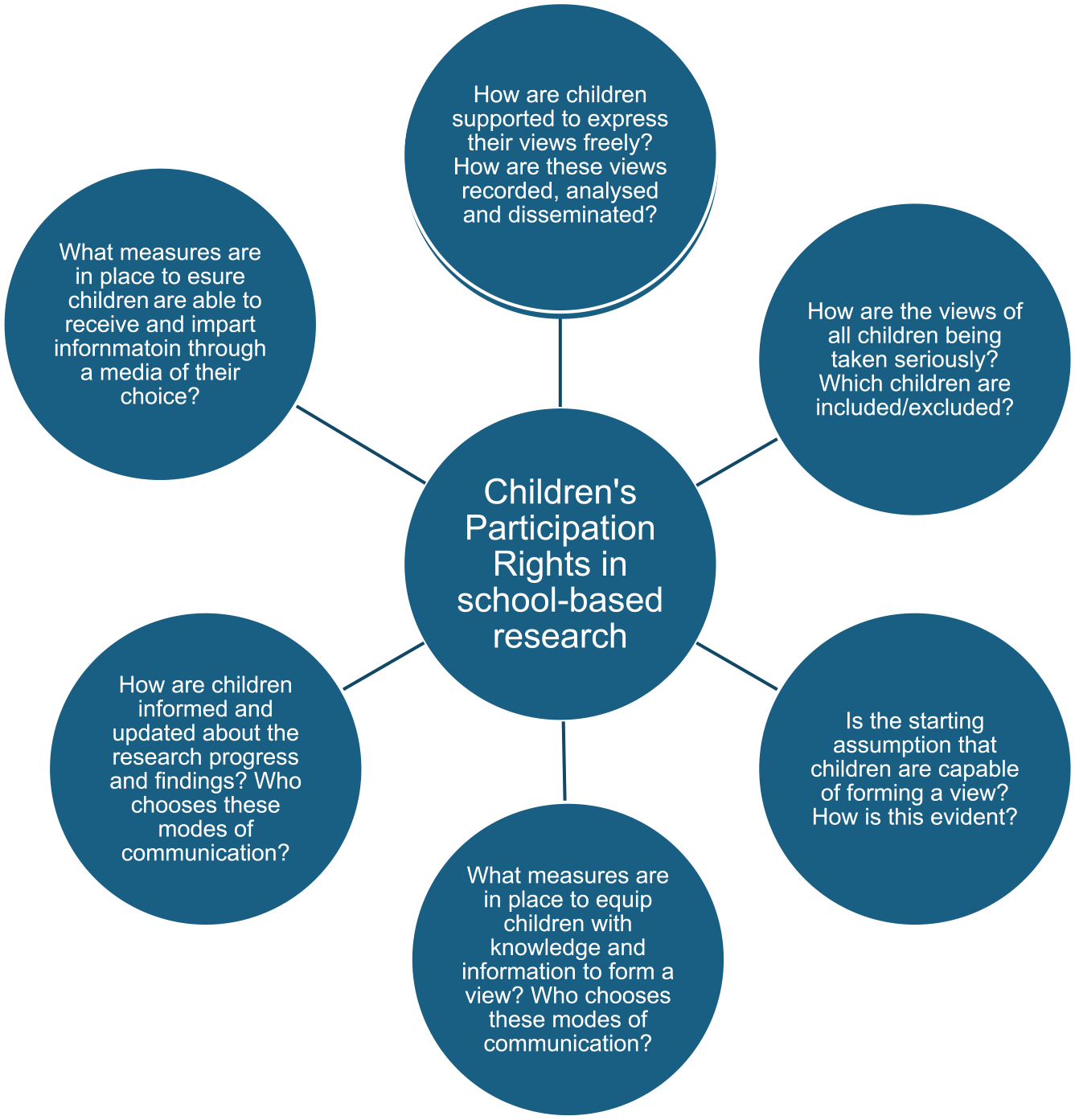
Children’s Participation rights in school-based research: ethical considerations and questions to consider when planning and undertaking research, analysing data and disseminating findings.
Conclusion
Although historically research ethics has emphasised participants’ protection, especially in the case of children’s participation (Buchanan, 2024), the benefits of involving children in research are no longer overshadowed by the perceived risks. Children’s involvement in research is vital to enhance understandings about their lives and experiences, and to uphold their right to participate in all matters that affect them, as stipulated in the UNCRC (UN, 1989). The review of university ethics documents has demonstrated the prominence of ethical issues associated with children’s Provision and Protection rights, and the relative absence of those associated with Participation rights. This paper breaks new ground and makes an original contribution by highlighting how university ethics documents, concerned with children’s involvement in education research, are somewhat detached from the complex nature of ethical issues relating to the increasingly prominent role played by children in research. University ethics requirements associated with children’s right to Participation have not kept pace with the developing understandings of children’s rights or with theories of childhood. There is, therefore, a need to transform university ethics guidelines and requirements to redress the unequal balance given to ethical issues associated with Provision, Protection and Participation rights. Ethics considerations need to accommodate, more thoroughly, issues associated with children’s participation in research, including making specific reference to children’s Participation rights rooted in Articles 12 and 13 of the UNCRC. They also need to move beyond the existing narrow requirement of considering ethical issues concerned only with the planning and undertaking of research identified prior to the start of the research, and pay greater attention to ethical issues which emerge during the conduct of the research, data analysis and dissemination of findings.
Footnotes
Declaration of conflicting interests
The author declared no potential conflicts of interest with respect to the research, authorship and/or publication of this article.
Funding
The author(s) received no financial support for the research, authorship, and/or publication of this article.
Ethical approval
No ethical approval was required.
