




Abstract
Graduate students typically first experience research ethics when they submit their masters or doctoral research projects for ethics approval. Research ethics boards in Canada review and grant ethical approval for student research projects and often have to provide additional support to these novice researchers. Previous studies have explored curriculum content, teaching approaches, and the learning environment related to research ethics for graduate students. However, research does not exist that examines students’ actual experience with the research ethics process. Qualitative description was used to explore the research ethics review experience of 11 masters and doctoral students in health discipline programs. Data analysis revealed four themes: curriculum, supervisor support, the ethics application process, and students’ overall experience. The results of this research suggest ideas for enhancing curriculum, deepening students’ relationships with supervisors, and developing the role of research ethics boards to support education for novice researchers. This study contributes to comprehension of the research ethics experience for graduate students and what they value as new researchers.
Keywords
Introduction
Graduate students in health programs at the masters and doctoral levels in Canada often conduct research with human subjects as part of their studies. For many students this is their first experience as a researcher and, hence, they have much to learn about research methodologies, conducting a literature review, designing and implementing a research project, and disseminating results. Consideration of ethics is a key focus in conducting research involving humans, and students must learn research ethics principles and apply them throughout their projects.
In Canada, the Tri-Council Policy Statement: Ethical Conduct for Research Involving Humans (TCPS 2) outlines three core principles for research ethics: respect for persons, concern for welfare, and justice (Canadian Institutes of Health Research et al., 2014). These values are reflected in research through free and informed consent, respect for privacy and confidentiality, data access and information security, minimizing harm and maximizing benefit, inclusiveness and justice, and respect for vulnerable populations.
The ethics review process is often the student’s first experience with research ethics and serves as an important component of their education as a researcher (DePauw, 2009; Michael Smith Foundation Health Research, 2007). Novice researchers often need support as they strive to incorporate ethical principles into their research with human participants.
Research ethics boards (REBs) 1 in Canada are comprised of researchers, community members, and others with specific expertise (e.g. in ethics, in relevant research disciplines) and are established by institutions to review the ethical acceptability of research involving humans conducted within their jurisdiction. These boards provide review and approval for student research projects and, therefore, need to understand what students learn through curriculum and what support they receive from academic supervisors in order to identify what assistance the REB might offer.
The focus of this research project was to investigate graduate students’ experience with research ethics; specifically, this research sought to bring greater understanding to:
what graduate students in health disciplines learned about research ethics principles;
what perceptions of research ethics the graduate students had; and
what the experience of graduate students was with applying research ethics principles when they conducted health research projects.
Literature review
A broad search for literature on the topic of graduate students and research ethics was conducted to establish what and how they are taught the principles of research ethics in health programs, and how they translate their learning into research practice. Five interconnected themes related to curriculum content, teaching approaches, learning environments, research relationships, and REB processes were found to impact students’ experiences with research ethics. There was, however, a paucity of research describing students’ actual experiences with the research ethics process.
Graduate curricula in health disciplines vary in content on ethics, principles of research ethics, and responsible conduct of research. Designated courses in basic ethical theory, virtue ethics, and moral reasoning are necessary for students to learn how to identify and address ethical issues and discrepancies (Aita and Richer, 2005; Demir Küreci et al., 2008; Schmaling and Blume, 2009; Weyrich and Harvill, 2013). However, most institutions with health science programs do not invest enough in research ethics education for their graduate or post-doctoral students, despite the availability of abundant peer-reviewed content developed by experts in the field (McDonald et al., 2011).
Curricula should also include instruction on the ethical dissemination of research findings for those graduate students who wish to publish a thesis or dissertation. Research by Arda (2012) found that doctoral candidate students in health sciences were deeply concerned with ethical concerns regarding fraud, plagiarism, and undeserved authorship. The scientific integrity of publications depends on these novice researchers being trained in critical reading and writing skills.
A variety of teaching approaches have been utilized to promote deeper understanding of research ethics principles. Research ethics in academic programs has been taught through a variety of methods, including didactic lectures, written assignments, group discussions, guest lectures, movies and videos, development and analysis of case studies, peer presentations, and role-play (Chapman et al., 2013; Eisen and Parker, 2004; Löfström, 2012; Rissanen and Löfström, 2014). Semester-long courses, workshops, and specialized training programs (Loue, 2014), laboratory orientations, combined in-class and online programs (Cho and Shin, 2014), and experiential learning (Teixeira-Poit et al., 2011) have all been demonstrated to be effective.
The Panel on Research Ethics (PRE) in Canada provides an online tutorial on research ethics that is freely available to anyone, though predominantly used by people conducting research with humans (Panel on Research Ethics, 2014). Academic institutions in Canada may mandate completion of this tutorial before students under their affiliation are approved to conduct research with human participants. Similarly, the National Institutes of Health (NIH) in the USA have training requirements for the responsible conduct of research (RCR); however, there are no set standards for the skills required to practice ethical research. Research by Plemmons and Kalichman (2013) found that RCR instructors held diverse opinions regarding what ought to be taught in RCR courses.
Bowater and Wilkinson (2012) proposed that it is important to have a learning environment that provides a safe space for active engagement with ethics issues. Students’ perceptions of the organizational climate impact the ethical decisions they make with regard to research (Langlais and Bent, 2013). Faculty commitment to integrate research ethics topics into academic activities is essential; however, some academic leaders assume the principles are well known and do not need to be taught (Adams, 2012; Freeberg and Moore, 2012). Contrary to this belief, students may in fact need more instruction and guidance and often feel quite lost in tackling their first ethics application. University programs need to create and foster a culture of ethical research that reinforces scientific integrity, as ensuring regulatory compliance alone is not good enough to preserve public trust (Minifie et al., 2011).
The positive relationship between graduate students and their academic supervisors is essential to support a student’s self-confidence with research ethics. Supervisors influence students’ knowledge and perceptions of responsible conduct of research by socializing them into a research community that values research integrity (Fisher et al., 2009a). Transmission of knowledge is best when the mentor provides direct instructions and practical guidance, and integrates the research ethics process into supervision by sharing their own experiences (Fisher et al., 2009b; Richards, 2010). Commitment to academic and research integrity should be notable in teaching, advising, and mentoring activities (DePauw, 2009).
The last related theme from the literature focused on the role that REBs have with students. When REBs share knowledge and negotiate the ethics review process, the experience is more positive for novice researchers (Boyd et al., 2013). Students who develop relationships with REBs have better understanding of processes governing research ethics and use that knowledge to mitigate risks in health research (Shore, 2009; Snowden, 2014). When students attend REB meetings for the review of their research project they show ownership for their research, can answer ethical concerns, and benefit from the educational experience (Heasman et al., 2009). Some REBs also include a student member of the board whose experiences can then be used to mentor other students with research ethics processes (Walton et al., 2008).
Knowledge of research ethics and ethical theory may not be consistently integrated in curriculum requirements for masters and doctoral students in health disciplines who plan to conduct research with human participants. Existing literature indicates that students want more education and practice with ethical dilemmas related to research. Relationships with supervisors, academic learning environments, and contact with REBs all affect what and how graduate students learn about research ethics principles. There is no research, however, that specifically examines student perspectives on the research ethics process and how they integrate ethical principles into their research projects.
Method
The primary purpose of this study was to explore masters and doctoral students’ knowledge and perceptions of research ethics principles and describe their experience with applying them in research practice. Fundamental qualitative description provides a comprehensive summary of the participants’ events in their natural setting. This methodology allows for the presentation of data in everyday language from the participants, capturing their beliefs, behaviors, and perceptions to richly convey their personal experiences (Neergaard et al., 2009; Sandelowski, 2000).
A social constructivist perspective aims to understand the world that participants live and work in, and how their experiences contribute to their ways of understanding their world. Framing a study from a constructivist paradigm with relativist ontology fosters openness to multiple realities and understandings (Denzin and Lincoln, 2011: 13). In the research community, student researchers, faculty supervisors, and REB members each represent different experiences and understandings of research ethics and the ethics review process; hence, knowledge creation can be reciprocally shaped through dialogic interchange.
This investigation was founded on existing knowledge of research ethics principles (Canadian Institutes of Health Research et al., 2014) and the use of naturalistic inquiry to explore graduate students’ experience with no prior commitment to spin one theoretical view. With this approach, data are interpreted with low inference through inductive reasoning to convey facts accurately and in proper sequence in order to understand the ‘who, what and where’ of the phenomena (Neergaard et al., 2009; Sandelowski, 2000).
Graduate students in health disciplines having completed their masters or doctoral programs in the past 5 years were the purposeful sample for this project as they had recent research ethics experience to draw on and were able to provide rich data specific to the research question. A sample size ranging between 8 and 12 participants can provide complete and adequate data for a homogenous sample in qualitative research (Sandelowski, 1995). The sampling strategy should be adequate to achieve a sufficient level of depth, and appropriately represent the individuals addressed in the research question (Guetterman, 2015); thus, a target sample size of 10 participants was determined to be appropriate and relevant for this descriptive inquiry.
The use of social media has been established as an effective way to muster specific populations that may be difficult to recruit for research (Kapp et al., 2013; O’Connor et al., 2014; Ryan, 2013). Social media was used as the recruitment strategy for this study because of the following challenges. Masters and doctoral students who had graduated from their programs were unlikely to keep in touch with the academic institutions, so posting recruitment materials in those venues was unlikely to reach them. As most universities are public institutions in Canada, they are not allowed to provide an individual’s contact information for the purpose of contacting a person to participate in research (Freedom of Information and Protection of Privacy Act, 2015). Direct recruitment through professor contacts was considered but may have put the scholars in a position of power over or conflict of interest with their students if they maintained an ongoing work relationship after graduation.
Therefore, Facebook and Twitter social media were used to access a large number of potential participants and a mixed sample of graduates from different health programs and universities across Canada. A Facebook site and Twitter account were created exclusively for recruiting the targeted number of participants for this research project; no data were collected directly from either social media site. Twitter and Facebook messages, including a brief description of the project and contact information, were communicated to health and academic research communities across Canada over a 6-week period. Once the target number was reached and participants had been confirmed, the Facebook and Twitter accounts were closed. Students who expressed interest in participating were provided a letter of information and consent form, with an interview date and time arranged at their convenience.
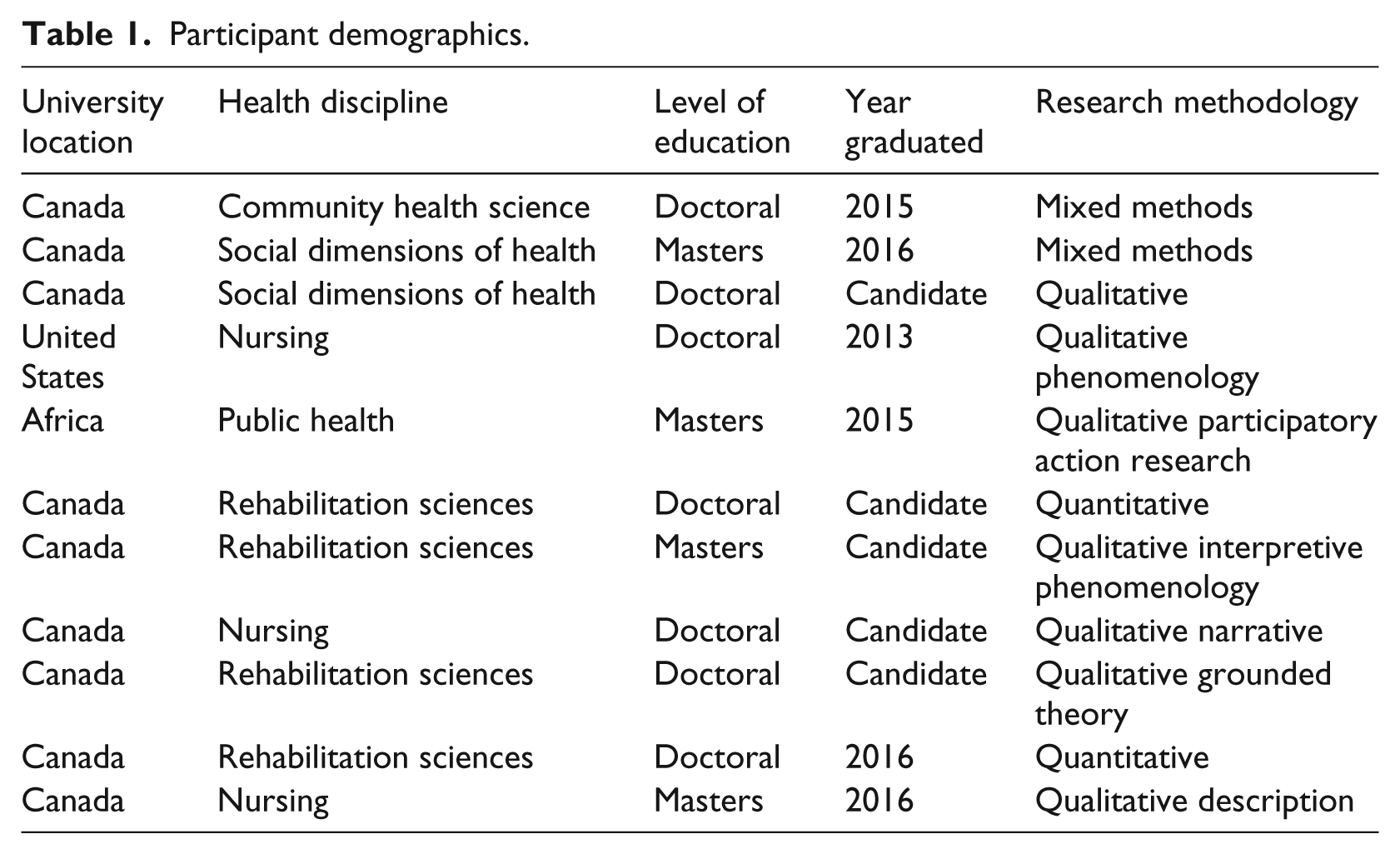
Eleven graduate students who were enrolled in five different universities volunteered to participate. The students represented a variety of health disciplines and were at various stages of degree completion. Participants had used quantitative, qualitative, and mixed methods in their research designs related to a wide range of health research topics (see Table 1).
Participant demographics.
Data were collected using 1-hour interviews conducted via phone or in person and audio-recorded with the participants’ consent. Semi-structured interviews, using open-ended questions, were used to guide the conversation while also allowing participants flexibility to share their story in their own sequence of events. Participants were invited to review their interview transcript and verify the accuracy of data representation and sequencing.
Thematic analysis is an independent, reliable approach to identify, analyze, and report the patterns and themes across multiple interviews (Vaismoradi et al., 2013). Each transcript was read through twice: the first time to review content against the audio recording and to gather general knowledge, and the second time to focus on key messages. Codes and themes were defined and applied to the focus words after the second reading. The analysis was data-driven for authenticity and consistency, and to eliminate researcher bias. Any repeated data, surprises, or data similar to the literature were coded and categorized and the categories were reviewed for relationships.
Ethical considerations for this project were respected through the three core principles of the Tri-Council Policy Statement (Canadian Institutes of Health Research et al., 2014): respect for persons, concern for welfare, and justice. All participants were honored for their participation and the knowledge and values that they shared. Consent was fully informed and participants had the opportunity to withdraw at any time without consequence or to choose not to answer any of the interview questions. The dual roles of the researcher as a research ethics leader and REB chair were discussed with participants prior to the interview, so they were fully informed of the purpose and intentions for this project. Risks and benefits, and the protection of confidentiality and privacy were explained to each participant, and no identifiable participant information is included in the dissemination of the findings. Prior to commencing research activities, ethical approval was obtained from the Athabasca University Research Ethics Board.
Results
The data analysis resulted in four themes that were categorized to align with the original research questions: curriculum content, support from supervisors, the ethics application process, and the graduate students’ perceptions and overall experience.
Curriculum content
Participants described that curriculum content in both masters and doctoral level programs is delivered through research methodology courses but a minimum amount of time is devoted to it. Some doctoral students were required to complete a separate ethics course, and some students voluntarily took extra ethics workshops. Research ethics tutorials like the TCPS 2 CORE tutorial (Panel on Research Ethics, 2014) are not mandatory for all students in programs where research is conducted with human subjects, and only half of the participants in this study had completed the CORE tutorial. Three of the participants had completed the US Office of Human Research Protections tutorials (US Department of Health and Human Services, Office of Human Research Protections, nd) as they had attended university in the United States or conducted international research. The graduate students noted that training modules provided by government agencies responsible for the protection of research involving humans should be utilized consistently in academic programs.
Participants indicated that current academic curriculum content related to research ethics is lacking depth and specific instruction on research ethics principles and how to integrate them into research practice. All of the students requested more detailed instruction regarding the ethics application process and information on how to create participant recruitment materials such as letters of invitation and consent forms.
Four of the 11 students believed that graduate programs should include a mandatory research ethics course, and one participant suggested that that requirement would then heighten awareness of research ethics across the university, not just at the health science department level. Another participant shared that ethics material delivered in health program courses was not translated for research practice, even though the basic ethics principles could be applied. She proposed that ethics content from various academic courses should be connected through knowledge translation activities.
Support from academic supervisors
In Canada, masters and doctoral students are assigned a supervisory committee of two or more faculty members to provide advice and assessment throughout their program. Initially, students usually work closely with one committee member who is recognized as their academic supervisor as they conduct their research. Other committee members become involved as the program progresses, and in the end students defend their research to all members of their committee along with an external examiner.
All of the participants identified the need for a positive working relationship with their academic supervisor and that it was instrumental for their success, but only half of the participants described feeling that they had received sufficient support. The students who did feel supported identified how supervisors mentored them and described what good support looked like. Characteristics of academic supervisors recognized as being supportive included: experience with supervising graduate students; a teaching style that allowed for self-directed learning; encouragement of critical thinking and integration of ethics principles; mentorship; significant research and field experience; and being approachable and easy to work with.
Participants who did not feel supported described their supervisors as providing broad suggestions with little hands-on support, or being disengaged from the mentorship process. These students expressed frustration and experienced time delays because they were navigating the research ethics application process on their own. Student participants who did not feel supported by their academic supervisors often turned to other members of their supervisory committee for assistance and used these meetings to discuss ethical concerns or to search out expertise in a particular area. Unfortunately, the feedback from committee members sometimes differed from their supervisors, thus causing more confusion for the student.
Ethics application process
The ethics application process is a key step in the research ethics experience for graduate students. Some had to apply to more than one research ethics board (REB) and found that health institution boards were more demanding with provisos. Students felt that REBs put too much emphasis on minor details of application documents rather than the actual ethical considerations for their projects. Electronic submission systems and obtaining operative approvals from research sites posed additional challenges. Every graduate student received provisos from the REB they had applied to, and the provisos were often focused on the dual role and qualifications of the researcher, justification of sample size and inclusion criteria, recruitment and consent processes, and data management. If a student had previous experience with the ethics application process, it was easier for them to complete the initial application and respond to requests for modifications.
Some of the students reported receiving support from REBs through website information, examples of completed applications, templates for participant materials, and ethics workshops. Other participants had not experienced access to these types of REB resources, and suggested that all REBs should have similar education materials available. Novice researchers want clear information on details of the ethics review process and completion of application forms. Participants stated that conflicting or overlapping questions should be removed from the application, and three students suggested that REBs should revise their forms to be more applicable to qualitative methodologies. Other suggestions for REB support included a ‘frequently asked questions’ document, video tutorials or webinars to demonstrate completion of an application, examples of participant materials and consent forms, guidelines for confidentiality, and requirements for data storage, retention, and destruction. Further, student researchers would like the option to submit an ethics application for pre-review and to make revisions before their submission progresses to a full board or delegated REB review.
Some of the graduate students reported that the REBs had a designated contact person for student projects, and an expedited process for review of student projects, making the process more efficient. For others who did not experience this type of support, communication could be enhanced through greater accessibility to ethics office staff. Other avenues for improving communication between researchers and the REB include simultaneous electronic notifications to the student (co-investigator) and the supervisor (principal investigator), and use of chat lines. Participants also indicated that if academic and health authority REBs took advantage of opportunities to collaborate in harmonized review processes and shared understandings of the complexities of research conducted in health systems, the ethics review process would be more positive.
Graduate students’ perceptions and overall experience
The depth of the graduate students’ perceptions was reflected in their overall experience. Many of the students remarked on the importance of research ethics to protect participants, especially vulnerable populations, safeguarding the balance of benefits and risks for each individual involved in their projects. Participants shared that the research ethics process strengthened their research design through adding credibility and quality to their work; for the participants, these added benefits helped justify the time and work involved with the ethics review process. Half of the participants noted that the research ethics process was more than just an application, and that they needed to integrate ethics throughout their research project. Two of the students expressed increased confidence in their role as a researcher as a result of the ethics review process.
The 11 participants identified four research ethics principles as the most important to integrate into health research with human participants. First, the dual role of the researcher as both a student and a clinician was significant, and they were careful to mitigate any power over participants during recruitment. Student researchers focused on developing trusting relationships with both research participants and work colleagues in a transparent and culturally safe manner. Secondly, the student researchers respected confidentiality and privacy with the location of interviews and focus groups, secure storage of research data, and the protection of identity for both participants and work colleagues in dissemination of research results. The third important principle was consideration for vulnerable population groups as participants in research. Each of the graduate students targeted a population often seen as vulnerable for participation in research, including student mothers, adolescent mothers, university students, frail elderly, caregivers of spouses with dementia, parents of children receiving health services, breast cancer patients, patients with pain, and marginalized people. The students described their concerns for the welfare of these individuals and the need to balance risks and benefits. Informed and ongoing consent of participants was the fourth research ethics principle noted as most important, and the consent process had to be appropriate, e.g. verbal (versus written), consent forms read to participants with poor reading comprehension.
The depth of perceptions and overall experience with research ethics described by the graduate students was remarkable and revealed in their descriptions of their research. One participant reflected on her role as the researcher: ‘I feel like it’s protective of my caregivers and I feel so strongly about them that I want them to have that. So I’m sort of pleased to provide that to them’ (Participant 11). Another participant shared her thoughts on the impact for research integrity: ‘It really does test a researcher to balance between the rigor of a study and the quality of a study and the respect for the population that’s providing you with the data’ (Participant 1). A third perspective shared was thoughtful about the participants’ experience: ‘I think it holds researchers accountable to being transparent and ethical and respectful and considerate to people that they’re asking for information from so that it avoids treating participants as just participants. Like they’re people living their life and giving their time and it’s the people that are going to help you make the difference and you need to treat them well’ (Participant 7).
Trustworthiness
Credibility for this study was established through regular peer debriefing with the supervisory committee throughout the project timeline. Transcripts of interviews were compared to audio-recordings for referential adequacy and reviewed by participants to verify accuracy. Representation of an accurate description of participants’ experience in proper sequence is essential in qualitative description (Neergaard et al., 2009; Sandelowski, 2000); herein, a summary of the research findings was sent to each participant for member-checking and validation of results. Member-checking, also recognized as member reflection, allows for a direct affirmation of the research findings and interpretations (Lincoln and Guba, 1985; Tracy, 2010). Involving participants in interpretation of data can enhance the trustworthiness of results (Birt et al., 2016).
The role and bias of the researcher was acknowledged through bracketing and reflection, and documented in a methodological journal during the course of this study. As a REB chair, the researcher often provided ethical review for student research projects, and issued provisos related to recruitment and consent, privacy and confidentiality, data security, dual role, and potential conflict of interest. These reviews stimulated this exploration of students’ knowledge and perceptions of research ethics principles, but in order to gain a fresh perspective and understanding, the researcher had to set aside previous assumptions through bracketing. The researcher also chose to recruit through social media, rather than the two institutions where she is a member of the REBs, in order to avoid any potential for conflict of interest, coercion or power over participants who may have submitted student research projects to these boards.
Limitations
Limitations for this research project include limited engagement with participants (just one interview) and a single source of data (versus triangulated data). It might also have been valuable to use negative case analysis as a way to help confirm the study’s findings. The results are limited in transferability to other graduate student populations outside of health programs; however, the rich description may enable readers to assess the applicability of the findings of this research to another population of student researchers. The focus of this research was on providing a comprehensive, descriptive summary; a more in-depth, detailed interpretation was not planned for this study.
Discussion
This inquiry provided a rich, descriptive account of graduate students’ experience with research ethics. The strengths and weaknesses of curriculum content related to ethical principles and suggestions for enhancement were outlined. Future studies could help identify curriculum requirements to meet student needs (e.g. through using the Delphi method) and evaluate the effectiveness of separate ethics courses. Faculty could be engaged in research to gain a better understanding of how they can integrate more ethical content into graduate programs, including research training conducted in laboratory settings.
The relationship between a graduate student and his/her academic supervisor impacts all aspects of the student’s ethical training, and is instrumental in contributing to their self-confidence as a novice researcher. Characteristics of a supportive academic supervisor were identified in the present research; however, additional exploration with faculty regarding their perspectives could further clarify how the role of the supervisor can be strengthened.
Connections with REBs have significant influence on students’ ethical research practice; therefore, REBs need to invest in opportunities for improving support and educational resources provided to these novice researchers. REBs might also collaborate with faculty to host joint presentations that focus on enhancing the skills of both supervisors and students for integrating research ethics in practice. Research ethics staff should be accessible to students, as effective communication between the research ethics office and researchers is essential for a positive experience.
Conclusion
Qualitative description, within a constructivist framework, was used to gain a better understanding of what graduate students in health disciplines learn about research ethics principles in curriculum, what support they receive from academic supervisors, what perceptions they have of research ethics, and how they apply ethics in research practice. Eleven graduate students from nursing, rehabilitation sciences, community science, public health, and social dimensions of health participated by sharing their experience through interviews.
This inquiry has provided student researchers a voice to describe how they assimilate research ethics principles into health research practice. The students shared their heightened awareness of research ethics and confidence in their roles as novice researchers. Academic faculty and the research ethics community can assimilate this knowledge and respond by addressing the identified gaps in education and support. Each member of the research community has a significant role to play in endorsing this next generation of health researchers with ethical research practice.
Footnotes
Declaration of conflicting interests
The authors declared no potential conflicts of interest with respect to the research, authorship, and/or publication of this article.
Funding
The author(s) disclosed receipt of the following financial support for the research, authorship, and/or publication of this article: The Athabasca University Graduate Student Research Fund (grant number 21946) and the Access to Research Tools Award (2015) provided support for this project.