




Abstract
Around the world, a growing number of communities are voicing their demands for authority in the governance of research involving them. Many such communities have experienced histories of exploitative, stigmatizing, intrusive research that failed to benefit them. To better understand what strategies communities are developing in order to have a say in research oversight, we conducted a scoping review of the international peer-reviewed and grey literature. Three primary strategies were identified: (1) guidelines; (2) community review boards; and (3) community advisory boards. Guidelines include documents developed by, with, or for communities to outline ethical behavior or conduct in research with or within the community. Community review boards offer ethical review of research protocols, much like traditional research ethics boards, but are community led and focus on community interests. Community advisory boards consist of representatives from a given community and are developed to advise institutions or research teams on community-level ethical matters pertaining to research projects. Initiatives led by Indigenous communities far outnumbered others in the sample, reflecting the legacy of continuous Indigenous resistance to research as a tool of colonialism. In several cases, communities in marginalized neighbourhoods, where harmful and exploitative research practices have taken place, emphasized the significance of community-led governance grounded in shared geographical and social contexts. We discuss some of the beneficial and challenging features of each type of strategy and offer recommendations for stakeholders who wish to support community-led efforts in research ethics.
Keywords
Introduction
Around the world, a growing number of communities are voicing their demands for authority in the governance of research involving them, seeking control and oversight in various aspects of the research process, including those related to priorities, methods, and ethical decision-making (Shore et al., 2011a). Many such communities have experienced histories of harmful research, where researchers have entered, intruded on communal life, consumed valuable resources, extracted information, published stigmatizing narratives, or never returned with results. These practices have left many communities distrustful of researchers, with good reason.
The current infrastructure of research ethics governance consists of historical codes of research ethics (e.g. the Declaration of Helsinki, the Belmont Report), national committees (e.g. Canada’s Panel on Research Ethics, the Office of Human Research Protections in the United States), regulatory bodies (e.g. the Food and Drug and Administration), regulatory guidelines (e.g. the Common Rule), and Research Ethics Boards (REBs). 1 While extensive, this infrastructure largely focuses on ethical protections at the level of the individual research participants and fails to adequately represent communities impacted by, and implicated in, research. As a result, many communities lack adequate protection from potential research harms. In response, communities have mobilized to develop strategies that articulate a community ethic related to research, writing guidelines for researchers, developing community-led research review processes, or becoming researchers in order to lead or collaborate on research projects involving them. 2
Throughout the course of colonial history, Indigenous peoples have experienced significant research-related harms under research governance structures that have excluded their communities and undermined their sovereign right to self-determination. Resisting these colonial research practices, many Indigenous communities have developed governance structures and ethical guidelines to determine how research should be conducted within their communities or territories (Kuhn et al., 2020). Other communities, bounded together through various shared identities (e.g. a neighbourhood, a medical diagnosis), have drawn inspiration from these approaches and also sought to claim a voice within research governance (Gunay et al., 2023). While Indigenous Peoples have the right to self-determination as recognized in treaties and the United Nations Declaration on the Rights of Indigenous Peoples (UNDRIP), this is not the case for other communities claiming authority in research governance, who often lack clear leadership structures, boundaries, and membership criteria 3 . Nonetheless, in many cases, these communities have organized and led grassroots initiatives in their demand for more inclusive systems of research governance (Clairmont et al., forthcoming).
Despite these developments, to our knowledge, there has been no systematic overview of community approaches to research governance. Furthermore, given the vast diversity and complexity of this work, the literature on this topic has not yet been comprehensively summarized. To map existing strategies in this space, we conducted a scoping literature review of the international peer-reviewed and grey literature published on community-led approaches to research governance. Here, we summarize what was found in relation to the strategies communities are using to claim a voice in research governance.
Methods
We chose a scoping review as our methodological approach because we are unaware of any comprehensive examination of strategies of community-led approaches to research governance. Furthermore, discussions of this topic are evolving and heterogeneous, taking place in both peer-reviewed and grey literature, including materials developed and disseminated by communities themselves. Our scoping review was informed by the five-stage methodological framework proposed by Arksey and O’Malley and adapted by Levac and colleagues (Arksey and O’Malley, 2005; Levac et al., 2010). We followed the Preferred Reporting Items for Systematic Reviews and Meta-Analyses Scoping Review Extension (PRISMA-SrC) guidelines (Tricco et al., 2018).
Search strategy
The peer-reviewed literature search was conducted using the SCOPUS database in October and November of 2021. We also conducted initial searches with Medline, Web of Science, and PAIS index; after an abstract scan, we determined that these databases did not retrieve enough papers relevant to our review. The key terms we used were “research ethics governance,” “research ethics oversight,” “research ethics review,” “research ethics committee,” “community-based,” “community-engaged,” “community-driven,” “participatory,” and “Indigenous,” combined with derivative and indexed terms for each database. After our first search, we conducted a second database search on SCOPUS, with the added terms “research ethics” and “community advisory board” to capture any potential literature excluded from our main search strategy. A librarian helped develop and validate our search strategies for each database.
Our grey literature search was focused on capturing documents shared outside of traditional academic publications, particularly those produced by communities. When we began, it was clear that traditional grey literature databases (e.g. Canada Commons) did not yield relevant results, so we instead identified grey literature sources using the Google custom search engine for phrases related to the topic (e.g. “representation of community voices in research ethics,” “research ethics review process by and for communities”), drawing on a grey literature guide published by the University of Toronto (Stapleton et al., 2018). Screening was restricted to only the documents that appeared on the first 10 pages of results, after which no additional relevant results were retrieved. This approach resulted in a total of 100 results per phrase, narrowed down from the millions. We applied no date restriction to either the peer-reviewed or grey literature searches, as we sought to capture the full breadth of community-based governance strategies in this relatively new discussion. Our search strategies for both the peer-reviewed and grey literature included English terms only. No language restriction was placed on the peer-reviewed search at the stage of title and abstract screening, as SCOPUS only indexes titles and abstracts published in English.
Screening process
Documents were included for the review if they were: (1) Related to research governance or oversight; and met at least one of three additional inclusion criteria: (1) Represented a community voice or perspective; (2) Involved a discussion of strategies, demands, or justifications related to community-led research governance; and/or (3) Related to Indigenous research governance. Documents were excluded from the review if they did not meet the necessary inclusion criterion and at least one of the three additional criteria. Four types of documents that were commonly excluded include: (1) Discussions of the ethics of community-based participatory research (CBPR); (2) Discussions of research ethics or governance that failed to include a community perspective or focus; (3) Documents reporting results of clinical or biomedical research; and (4) Manuscripts referring to ethics approval from university-based REBs.
The peer-reviewed searches were imported into Rayyan for title and abstract review. The grey literature was downloaded on the date of access and titles were exported into an Excel table for screening. Two members of the research team (AG, PF) independently screened the titles and abstracts of the peer-reviewed literature for inclusion. If the articles met the inclusion criteria, they went through a full-text review. ED and PF followed the same process to independently screen the grey literature. If conflicts arose between research team members, they were resolved by a third team member who had not originally screened the document (ED or AG). The references of all documents included for full-text review were screened to identify any additional documents that met the inclusion criteria. As a final strategy, we emailed an online survey to a wider community of experts working in this space requesting documents which may be relevant to our review. The experts consisted of authors or community leaders identified through the data extraction process, our existing contacts, and the broader network of stakeholders we met at events throughout the project.
Data extraction
We systematically extracted data from the final set of documents including authorship, document type, journal (if applicable), year, country, study type, relevant community, the identity of the authors and/or voice represented (when possible, e.g. Urban Indigenous, community members from a particular neighbourhood), as well as any content related to strategies employed by communities. One peer-reviewed paper included for full-text review (Hsieh et al., 2019) was translated using DeepL translation service from Taiwanese to English prior to data extraction.
Data analysis and synthesis
Extracted data was imported into NVivo 12 for analysis. Following Levac et al.’s (2010) scoping review methodology, thematic analysis of the data was undertaken to guide the inductive process of codebook generation (Clarke and Braun, 2021). Three team members (ED, AG, PF) read the extracted data from several documents and independently formed an initial set of codes. Here, data was open-coded, to provide a rich description of the overall data set without adhering to a pre-specified conceptual framework. The team then compared the codes for internal homogeneity and external heterogeneity, until a shared list of codes was developed. This initial list was then used by ED, AG, and PF to independently code a new set of documents, and another meeting was held to refine the codes and verify coding consistency. This process was repeated until a codebook was generated to systematically code the data, which was externally validated by team member SN. While the codebook defined rules for assigning each code, coding consistency was continually re-evaluated by ED, AG, and PF.
At the outset of analysis, data was organized under several major themes that structured the scoping review as a whole (strategies, demands, justifications, benefits, and challenges)4. Under the theme of strategies, we initially generated 25 codes. After examining these codes and coded extracts in relation to each other, sub-themes of primary strategy types and supplementary strategy types were constructed. For example, strategies encompassing written guidelines (e.g. guidelines, manifestos, recommendations) were collapsed into a single sub-theme of guidelines as a primary strategy type. Strategies constituting actions that led to the development of established strategies (e.g. a workshop that helped in the formation of community research guidelines, the process of capacity building) were grouped as supplementary strategy types. Three primary strategies stood out as the most common and comprehensive forms of community-led research governance, each of which is presented below, along with a brief summary of supplementary strategies found in the review.
Results
Figure 1 provides an overview of our selection process. A total of 772 sources were retrieved for screening through the two database searches, including 272 peer-reviewed and 500 grey documents. An additional 141 documents were sourced from previously identified documents determined to be key texts for our review (n = 56); citation chaining (n = 74); and a survey distributed to experts (n = 11). After removing duplicates, a total of 909 sources were retrieved for title and abstract screening. Following the title and abstract screen, 262 documents met the inclusion criteria to be included for full-text review. We were unable to retrieve 6 of the 262 documents in full-text, resulting in a total of 256 documents screened at this stage (137 peer-reviewed documents; 119 grey documents). After the full-text screen, 125 documents were included for data extraction and analysis. Of these, 59 were retrieved from the peer-reviewed literature and 66 from the grey literature (Figure 1).
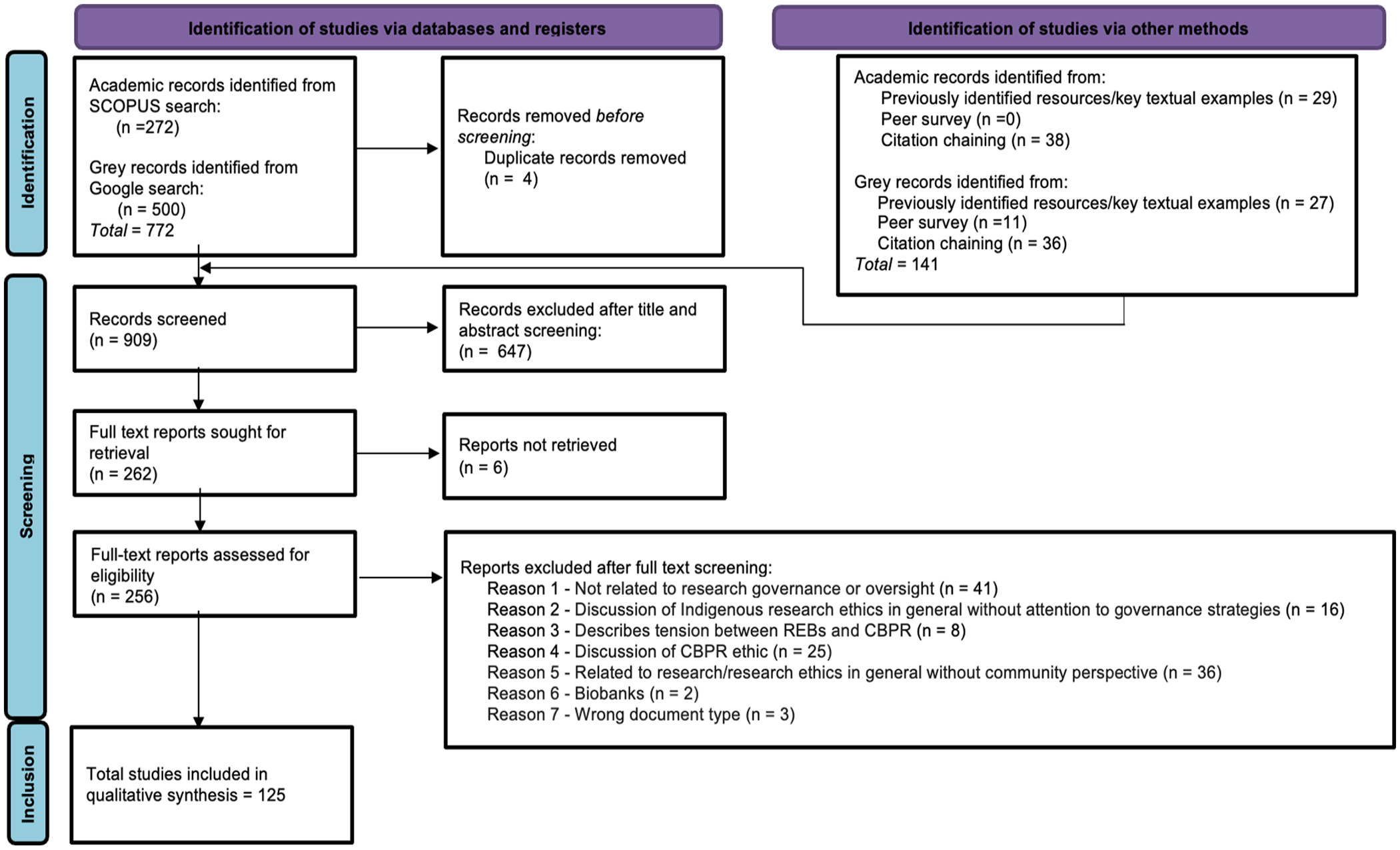
PRISMA flowchart.
Strategies
The primary strategies identified in our review fall into three main categories: (1) Guidelines; (2) Community Review Boards; and (3) Community Advisory Boards. A total of 76 instances of these three strategies were identified through this review. 5 Of these, 38 are guidelines; 24 are Community Review Boards; and 14 are Community Advisory Boards (see Figure 2). All strategies are approaches implemented or in development by, with, or for community groups as avenues to achieve control in community research governance. These are not strict category boundaries, and in many cases, communities employ more than one of these strategies in conjunction. Below, we offer summaries and examples of each of these strategies. We chose to present our data in this format as we believe it will be the most helpful for both researchers interested in gaining a better understanding of community-led strategies and communities aiming to develop their own.
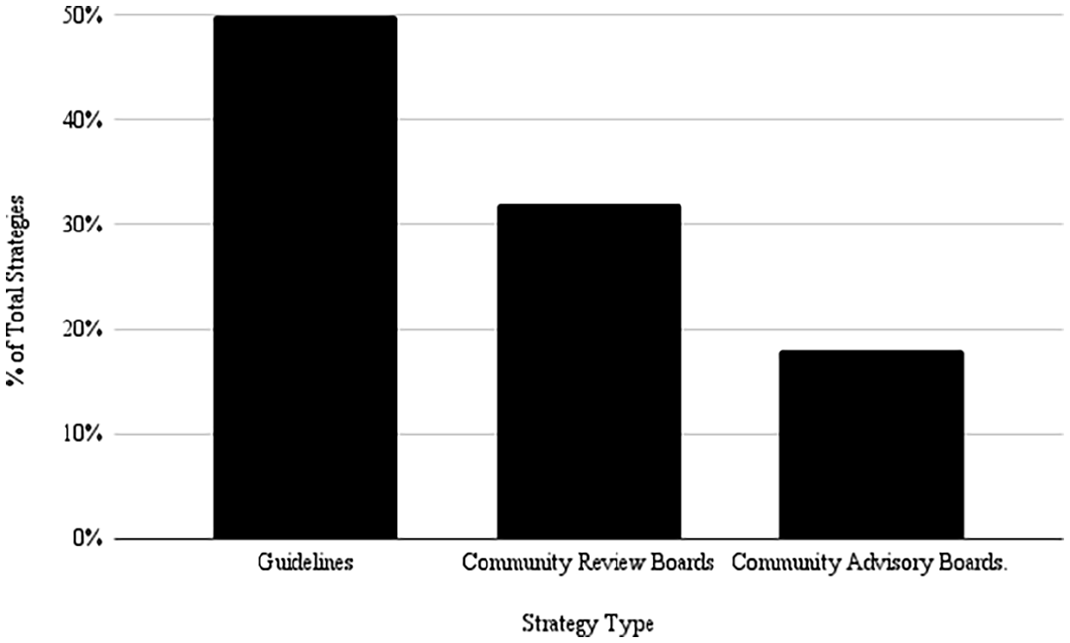
Types of community-led strategies identified within review.
Guidelines
The most common strategy identified through our review was guidelines, making up 38 of the total 76 primary strategies. Guidelines include documents developed by, with, or for communities to outline ethical behaviour or research conduct in projects with or within the community. Such documents usually require the reader to reflect on the community’s expectations of the research project and researchers. Guidelines are known by a variety of names, including: “principles,” “recommendations,” “manifesto,” “framework,” “protocol,” “booklet,” “statement,” and “code of ethics.”
Communities developed guidelines varying in scope and definitions. More than half of the guidelines identified in our review are focused on research with Indigenous communities (n = 22). Some guidelines represent sovereign Indigenous communities (e.g. Kahnawake School Diabetes Prevention Project Code of Research Ethics) while others are developed for Indigenous populations composed of many communities or nations, including urban Indigenous communities (Yukon Research Centre, 2013; Brunger, 2013). In other cases, guidelines represent patient populations (People with AIDS Advisory Committee, 1983; World Duchenne Organization), residents of a particular neighbourhood (The Jane Finch Community Research Partnership, 2020), the LGBTQ+ community (Canadian Professional Association for Transgender Health, 2019; Ontario Public Health Association, 2002), or communities formed by shared life-experiences, such as having experienced gender-based violence (Bradbury-Jones, 2020).
Guidelines we identified have been developed by communities (People with AIDS Advisory Committee, 1983), researchers (e.g. Jamieson et al., 2012), or in collaboration between communities and researchers (South African San Institute, 2017). In some cases, guidelines were researcher-initiated but formed in collaboration with a community (Alook, 2020; Neufeld et al., 2019), and in other cases, their development was initiated by a community organization (Old Brewery Mission, 2021).
Guidelines speak to many different audiences. Most guidelines outline ethical conduct for researchers (“Researchers should anticipate potential risks” (Bradbury-Jones, 2020)), and some speak directly to the reader (e.g. “stop with the elitism” (Boilevin et al., 2018)). Guidelines often list principles or checklists to encourage researcher reflexivity or support conversations that might take place between researchers and communities or community-based organizations (“guiding questions for researchers can help support researchers to engage in self-reflection” (Salway et al., 2021)). Some guidelines are offered to communities as a resource. For example, the Guidelines for Research with Aboriginal Women, released by Quebec Native Women (QNW), describe that they are written for “Aboriginal women, QNW members and employees, decision-makers and managers in the Aboriginal communities, and researchers,” in order to “help manage the many research proposals received and make informed decisions on whether or not to become involved in those projects” (Quebec Native Women, 2012). While less common, some guidelines are directed toward research funders, to inspire them to “ask hard questions about their agendas, unlock more meaningful knowledge, and therefore achieve greater impact” (Chicago Beyond, 2018).
Examples of guidelines
The OCAP Principles
The movement toward community-based forms of research governance is grounded in the work and resistance of Indigenous communities (Friesen et al., 2017). Within Canada, an early and influential demand for First Nations data sovereignty can be seen in the First Nations Principles of OCAP (Ownership, Control, Access, and Possession) (Schnarch, 2004; The First Nations Information Governance Centre, May 2014). OCAP asserts First Nations’ jurisdiction and authority over information pertaining to their communities. These principles were created in recognition of the power held in data, and its potential for both positive and negative impacts, through its collection, presentation, and ownership. While the OCAP principles are specifically developed for First Nations, they have had a tremendous impact on community-led research ethics guidelines; they were cited by 20 documents in our review, including those developed by First Nations, non-First Nations Indigenous communities, and non-Indigenous communities.
The San Code of Research Ethics
The San Code of Research Ethics is the product of a collaboration between the Indigenous San Peoples, a heavily researched community in South Africa, and the EU TRUST project. This collaboration sought to target the practice of “ethics dumping”, eliminate unwanted, unhelpful, and exploitative research in the San community, and acheive fair research partnerships. The code asks that researchers form authentic and trusting relationships with the San Peoples, abide by San principles for ethical research, which include fairness, respect, care, and honesty, and to partake in a process of community approval (South African San Institute, 2017). To our knowledge, the code is the first of its kind to be developed by an African Indigenous group; however, since its publication, the San Council has received many requests from other communities who would like their support in developing their own code of ethics (Chennels and Schroeder, 2017).
Research 101: A Manifesto for Ethical Research in the DTES
The Downtown Eastside (DTES) neighbourhood in Vancouver, Canada, is a heavily researched community and a site of remarkable activism, particularly related to harm reduction. In response to community members’ experiences with exploitative and unethical research practices, Research 101: A Manifesto for Ethical Research in the DTES was developed by members of the DTES community in collaboration with a researcher from Simon Fraser University, as an outcome of a series of workshops and discussions surrounding this issue (Neufeld et al., 2023). The resulting guidelines acknowledge that research can entail “pitfalls” or “potential,” and articulate a “local knowledge and expertise on community ethics” (Boilevin et al., 2018). They offer guidance to researchers by collating DTES community members’ perspectives on how to conduct research respectfully and ethically in their community, to ensure that the community sees direct benefits and is not harmed through research. The document also includes recommendations for developing a Community Review Board in the DTES as a future step to develop community-led research governance (Boilevin et al., 2018).
Community Review Boards
Community Review Boards (CRBs) were the second most common community-led research governance strategy in our review, representing 24 of the 76 primary strategies. CRBs function like traditional Research Ethics Boards (REBs) insofar as they review and assess the ethicality of research proposals. However, CRBs are community-operated and focus on reviewing only research protocols involving or targeting their community.
Like guidelines, CRBs vary in scope, as do the community groups associated with each CRB. More than half (n = 13, 54%) of the CRBs identified within the review are specific to Indigenous nations (Cape Breton University, 2022; Maar, 2007), and the others represent communities formed by a shared geographical location, including neighborhoods (e.g. Red Hook, Brooklyn (Fox et al., 2018)), cities (e.g. Flint, Michigan (Key, 2017)), or states/ provinces (e.g. The Labrador Aboriginal Health Research Committee (Brunger et al., 2014).
CRBs typically operate alongside existing review processes at universities or hospitals, making up for the lack of representation of community members often seen on institutional REBs (Nicholls et al., 2023). Some are recognized by governments as having authority to review protocols in lieu of conventional REBs, and certain regulations require researchers to receive approval from respective CRBs as well as institutional REBs. However, many CRBs also lack any formal authority or recognition.
While CRBs often follow conventional review processes, some incorporate additional processes specific to the community to augment or adapt the typical requirements of research ethics review (e.g. sharing a meal, requiring that researchers are present in person for meetings) (Shore et al., 2014). CRB members are usually members of the relevant community who have received some training in research and research ethics. They provide opportunities for community representatives to review research protocols at a local level and raise community-specific concerns, supplementing traditional review processes that tend to focus on individual, rather than community-level, risks (Flicker et al., 2007; Neufeld et al., 2023).
Examples of Community Review Boards
The Bronx Community Review Board
The Bronx Community Review Board (BxCRRB) was established in 2010 as part of a community-academic partnership between the Albert Einstein College of Medicine and the Bronx Health Link. The Bronx is a racially diverse, heavily researched, and socioeconomically disadvantaged borough of New York City, where residents experience poorer health outcomes on average compared to other boroughs. The board consists of volunteer members who are residents of the Bronx and who have received training in bioethics and clinical research design (del Campo et al., 2013; Guishard et al., 2021). The BxCRRB model was inspired by developments in Indigenous research ethics that focused on ensuring: (1) researcher goals are compatible with community needs; (2) research is designed and executed in partnership with the community; and (3) the community is involved in the process of knowledge collection and production (del Campo et al., 2013). The BxCRRB requires that researchers and the Bronx community reach an official agreement on processes surrounding data ownership, stewardship, dissemination, and publication for research projects involving the community.
The Community-Based Organization Partners Community Ethics Review Board
The Community Based Organization Partners Community Ethics Review Board (CBOP CERB) was established in Flint, Michigan in 2009 (Key, 2017). The board consists of community members from Flint with experience in both conducting research and serving on ethics review boards. In addition to reviewing and critiquing research proposals, the CBOP CERB identifies opportunities for community research partnerships, suggests community engagement strategies, vets research ideas, and provides letters of support for approved research projects. The board also educates the Flint community on research and provides a “feedback loop” between researchers and the community (Key, 2017).
Cowichan Tribes Nation-Led Ethics Review Process
To assert their right to self-determination within the research process, the Cowichan Tribes of British Columbia, Canada, collaborated with the First Nations Health Authority and Island Health to establish a Nation-led, in-person research ethics review process for a study focused on preterm births in the community (Cowichan Tribes, 2021). Before the review process, Cowichan Tribes and Island Health created several documents to guide the review process, including a standard operating procedure and a proposal for the review process. Before the review, they enlisted the Research Advisory Committee (RAC) for the research project, consisting of Cowichan Elders and mothers with lived experience of having a term or preterm infant, to help review the ethics application. The in-person review began with a blanketing ceremony, and four traditional dances, including drumming and songs, in order “to center the review in Cowichan traditions,” (Cowichan Tribes, 2021). Attendees then moved inside for a prayer, a traditional story and song, the presentation of gifts, and a shared meal. Next, small groups reviewed the ethics application and reconvened to share feedback and engage in collaborative discussions about the proposed project. Island Health conducted a separate review process of the project as well (Cowichan Tribes, 2021).
Community Advisory Boards
The third strategy type identified through our review was Community Advisory Boards (CABs), representing 14 of the 76 primary strategies. CABs often consist of representatives from a given community who advise institutions or research teams on community-level matters pertaining to research projects. Almost all (86%, n=12) of these represented a given neighborhood or jurisdiction; unlike the other primary strategies, a minority (25%, n=4) represented Indigenous communities.
Born from the climate of community activism surrounding the HIV/AIDs epidemic in the 1980s, CABs were among the earliest strategies to secure community voice in clinical trial research. Ever since this hard-won stride, CABs have been a key strategy in the field of global health for ensuring the cultural and ethical acceptability of research. While CABs vary greatly depending on the nature of the research project, the research institution, and the geopolitical context, two main models for CABs predominate: broad community and study-specific (Lawrence and Stewart, 2016). The broad community model involves a group that represents a given community at large, while the study-specific model represents a specific group or population, usually formed to consult on a particular project. The broad community model CABs are often a part of a research center or institution, working in the long-term within or with a specific community (e.g. a neighbourhood). On the other hand, study-specific CABs tend to be more short-term, as they are established to represent a community for the duration of a research project.
While CABs and CRBs both oversee institutional research projects from the community perspective, they can be distinguished based on the roles they play within such oversight. They also differ in how they are established and their degrees of authority within the research governance process. CABs are developed to advise on various dimensions of research. They are typically established by an institution or research team, often after funding for a project has already been secured. They tend to play a limited role in the ethical review and approval if any; their efforts are focused largely on providing a community perspective that can shape various aspects of research (e.g. methods, recruitment, dissemination of information). Conversely, CRBs are established to conduct ethical reviews of research projects impacting a given community. They tend to be embedded in, and established through, community organizations; therefore, they are often more independent of the academy than CABs, although sometimes they receive funding through academic partnerships. They are mixed in terms of whether their recommendations are considered binding.
Examples of Community Advisory Boards
The Pitt Men’s Study Community Advisory Board
The Pitt Men’s Study CAB was established in 1984 and is still ongoing. Initially, the CAB served as a communication link between researchers and the community of men at risk of or living with HIV in Pittsburgh, and was established by a community activist and organizer who had been hired to recruit research participants for an AIDs cohort study. Over the years, the CAB took on a variety of other functions, including reviewing research protocols, educating the community, relaying concerns from study participants to researchers, disseminating research findings, and engaging in advocacy efforts. Unlike other CABs who often review research in an advisory capacity, approval from the Pitt Men’s Study CAB is required before an investigator can begin research (Silvestre, 2010).
Tak Province Border Community Ethics Advisory Board
The Tak Province Border Community Ethics Advisory Board (T-CAB) was established by the Shoklo Malaria Research Unit (SMRU) in the Tak Province Border of Thailand in 2009 (Pratt et al., 2015). The CAB consists of 15 members from the heterogenous border community, which is made up of several overlapping sub-communities, and includes a significant number of displaced persons, economic migrants, and refugees. While all members of T-CAB are from the border community, it is coordinated by two staff members from SMRU. The T-CAB advises researchers on the acceptability and ethicality of proposed research projects, acts as a bridge to the border community, and provides information to the SMRU regarding whether studies are considered beneficial for the community. While the T-CAB is responsible for providing feedback on research, no studies have been deemed unacceptable to date, and members have shared that they do not feel they have the authority to take action if their recommendations are not respected (Pratt et al., 2015).
Morehouse School of Medicine Prevention Research Center Community Coalition Board
The Morehouse School of Medicine Prevention Research Center (PRC) Community Coalition Board was established in 1999 to better represent residents of a low-income and predmoniantly African American community in Atlanta, Georgia (Blumenthal, 2006). While the chair of the board and the majority of its members are required to be community representatives, it also includes academic and agency representatives (e.g., from public schools, the local community health center). Early on, the board developed a set of research priorities and community values to guide its work. The Community Coalition Board reviews and offers recommendations on research protocols, and also plays a role in agenda setting for the PRC, ensuring that community priorities are taken up in research efforts (Blumenthal, 2006).
Other strategies
Several other supplementary strategies were identified throughout our initial coding process, but were not common, relevant, or robust enough to be grouped into one of the three primary strategies we highlight here. These included the establishment of community-led research centers and institutes, many of which were home to CRBs or responsible for the development of guidelines. They were also often responsible for conducting community-led research, as well as implementing and disseminating results. Our review also identified examples of agreements or contracts used within research to protect communities, often within the context of co-developed or participatory research projects (Well Living House and St. Michael’s Hospital, 2012).
Another example of a unique strategy is the Hives for Humanity “Empowering Informed Consent” resource card, created as a tool for people living in the DTES in Vancouver. It is a small, laminated card meant to be carried inside a community member’s wallet for easy access when approached by a researcher, journalist, or other cultural producers in the neighbourhood. It lists questions that community members could ask someone (e.g. what was the research’s ethics process, how was the potential risk for trauma and stigma stemming from the research considered, who is funding the project, how will the results will be shared and contextualized?) to empower the individual’s ability for their consent to be truly ‘informed’ (Hives for Humanity, 2019). We also coded as supplementary strategies community research governance-related activities such as workshops or events (which often led to the development of one of the primary strategies (Bull et al., 2019b)), capacity building efforts, and advocacy for legal or policy changes (Ontario Public Health Association, 2002).
Discussion
Increasingly, heavily researched communities around the world are taking steps to limit harmful research. Communities have empowered themselves to resist research incursions they experience as colonial, exploitative, disrespectful, or unethical, yet little is known about the strategies they have developed for advancing community-led research governance. Our scoping review of both peer-reviewed and grey literature identified three primary strategies: (1) guidelines, (2) Community Review Boards (CRBs), and (3) Community Advisory Boards (CABs). Guidelines were the most common strategy we encountered within the review, followed by CRBs and CABs. Each of these strategies seeks to enforce a community-level ethical standard for research involving and /or impacting the community as a collective. Below we highlight some considerations related to the communities represented in the review, the advantages and disadvantages of each of the three primary strategies we identified, and how different stakeholders might learn from and take up these strategies in their distinct roles. We hope these reflections will be helpful to researchers, REB members, and practitioners of community-led research governance.
Communities seeking a voice
Unsurprisingly, Indigenous communities were over-represented amongst communities developing strategies of resistance in research governance. This was expected, given the extensive and ongoing history of harmful research conducted with Indigenous communities 6 and the various forms of resistance Indigenous communities have enacted for many decades to assert their sovereignty (Friesen et al., 2017; Smith, 2021). As seen from this review, while the self-determination of Indigenous people may be recognized by UNDRIP, this often does not carry over into the domain of research, in which colonial relationships still tend to dominate (Brunger, 2011). What is noteworthy here, however, is the influence that many Indigenous communities have had in terms of paving the way for other communities to develop their own community-led strategies in research governance.
In contrast, some communities were under-represented in the data, despite their histories of being subjected to research harms. While we anticipated seeing more patient-led strategies of research governance by groups who have been exposed to harms and experience significant distrust in medicine and medical research (e.g. service users in the realms of mental health and reproductive health), representation of these groups was limited or non-existent. Instead, what formed the basis for several of the communities enacting resistance in research governance was a shared neighbourhood. 7 These neighbourhoods were often sites of concentrated poverty and other intersecting forms of marginalization. As these neighborhood communities were longstanding recipients of harmful and exploitative research, strategies were often created out of exhaustion and frustration from being subjected to numerous projects that failed to produce any felt benefits for the community (e.g. Shore et al., 2015; Neufeld et al., 2019; The Jane Finch Community Research Partnership, 2020). Expressing this sentiment, one set of guidelines produced by Chicago Beyond is titled Why Am I Always Being Researched? (Chicago, 2018).
Guidelines
One significant advantage of developing a set of research guidelines for one’s community is that the investment of time and resources is relatively minimal. Guidelines can be drafted on a weekend, or within several workshops or meetings, and can then be made immediately available for others to view. If guidelines are seen as representing community views, they can continue to speak for a community over time, without requiring continuous resources and labor on the part of community members. However, unless there is continued effort and support to revise them regularly, they may not stay up to date with the interests and concerns of the community (Johnson, 2009). Guidelines, given that they are shareable documents rather than processes, can be distributed widely. This means they can be easily circulated to researchers as well as other relevant stakeholders and may have a broader impact than other, less public-facing strategies. Other communities may also be more likely to see them and take inspiration as well, particularly if the process for developing the guidelines has also been described and shared. 8
The most prominent hurdle associated with guidelines as a strategy of community-led research governance is one of enforcement. Most guidelines are still just guidelines. This means that researchers (or any audience, including REB members and funders) can choose whether to take them up or not. As such, potentially harmful researchers that guidelines are ultimately written for may simply ignore them, or be entirely unaware of them. As in the experience of the co-authors of the Manifesto for Ethical Research in Vancouver’s DTES, community-created guidelines for ethical research may be primarily read and used by researchers who are already inclined to listen to community members, who are perhaps the least in need of reminders of what the community considers to be ethical practice (Neufeld et al., forthcoming). Thus, guidelines may be an important starting point, but are unlikely to transform entrenched practices of unethical or exploitative research in a community on their own.
Community Review Boards
Unlike guidelines, a Community Review Board (CRB) requires a longstanding and continuous stream of time, effort, and resources from community members to sustain. Furthermore, the review of research protocols, even when presented in more accessible forms, as requested by some CRBs, can still be onerous and require a high degree of literacy with research methods and academic language (Guishard et al., 2021; Gunay et al., 2023; Kuhn et al., 2024; Solomon Cargill, 2018). Many heavily researched communities may therefore lack the capacity to create a CRB or keep it running (Carroll-Scott, 2020).
Perhaps most importantly, when it comes to regulated research review, many CRBs lack regulatory authority and may be seen as offering a service that is redundant and time-consuming for researchers, who also need to undergo a mandatory institutional ethics review. As such, CRBs can end up in a position where they hope researchers will undergo community review of a project but lack the ability to enforce such a standard. Some researchers may utilize CRBs in hopes of seeking their support in facilitating recruitment of community members or contextualizing the project, but this recognition is an instrumental one rather than a moral one. Some impacted communities have therefore advocated or piloted a process whereby institutional REBs work in tandem with CRBs, for example completing a joint review of a research proposal or requesting that institutional ethics approval is contingent on a successful community review (Shore et al., 2011a; Shore et al., 2011b; Neufeld et al., 2023). In other cases, CRBs seek recognition so that they can operate independently of institutional IRBs; in such cases, they must balance federal regulations and community-level concerns (Shore et al., 2014).
One important exception to this lack of authority can be seen in Indigenous CRBs, whose approval is sometimes required. In Canada, the Tri-Council Policy Statement: Ethical Conduct for Research Involving Humans (TCPS2) states that “Research ethics review by the institutional REB and any responsible community body recognized by the First Nations, Inuit or Métis authority . . . is required in advance of recruiting and seeking and obtaining consent of individuals” (Tri-Council Policy Statement, 2022). However, not all First Nations, Inuit or Métis people are represented by this requirement, particularly those who live in urban settings where organizations may or may not be established to represent them (Cape Breton University, 2022; Maar, 2007). 9 While this authority rests in the sovereignty and self-determination of Indigenous Peoples, this recognition has not been granted to all communities of Indigenous Peoples.10 Non-Indigenous communities face different hurdles with regards to seeking authority in relation to research governance; not only are they non-sovereign, but they tend to lack recognized structures of leadership and membership (Gunay et al., 2023). Of the three strategies we identified, CRBs tend to be the most grassroots and community-led in comparison to the others. Guidelines were sometimes community-led, but also sometimes written for “vulnerable” communities by researchers or other advocates, and CABs tend to be made up of mostly community members but established by and for academic research teams. This means that CRBs may better represent community interests, and more easily avoid power dynamics or conflicts of interest that may arise from being affiliated with an institution (del Campo et al., 2013; Guishard et al., 2021). However, this also means they may be less likely to find reliable sources of operational funding and may struggle to sustain themselves (Neufeld et al., 2023; Shore et al., 2011a, 2014).
Community Advisory Boards
Community Advisory Boards (CABs) also involve significant time and resource costs. Both broad and study-specific CABs tend to run over a lengthy time-frame (months, years, and sometimes decades) and involve regular meetings in which community members are tasked with various aspects of proposal review and research consultations. One significant advantage of CABs is that they are often funded by a university or a grant that is associated with a university, which can provide a form of stability that can be hard to find in other community-led research governance initiatives (Morin et al., 2003; Newman et al., 2011).
On the other hand, the lack of independence of CABs can come with shortcomings, limiting their power and ability to reject or significantly change research protocols. In some cases, research projects are already approved by funders and/or institutional REBs before a CAB is established, making changes more difficult to implement. CABs also often serve in an advisory capacity, in which power is often not shifted to community members in any fundamental way. However, some CABs are given institutional authority to approve research projects and thus officiate community review or involvement as a mandatory step for researchers in the research ethics process. Nevertheless, because CABs are typically formed by institutions rather than community members themselves, challenging research governance structures and actualizing radical change may be more difficult to achieve from within, even when granted such authority (Cargill, 2023; Pratt et al., 2015).
The use of multiple strategies
As noted above, the three primary strategies we identified within our review are not always implemented in isolation, as many communities employ multiple strategies in conjunction. For example, The Kahnawake School Diabetes Prevention Project (KSDPP), which began in 1987 as a CBPR project led by professionals from several community-serving organizations in Kahnawake and two universities in nearby Montréal, now includes variations of all three strategies: a Code of Research Ethics, an advisory board, and a community review process (Delormier et al., 2015; Kahnawake Schools Diabetes Prevention Project, 2023; Tekwatonti McGregor, 2017, November 1). While the Code of Research Ethics outlines “the obligations of the partners throughout all phases of the research process,” the CAB and CRB ensure a “multistage process that requires community consultation and community involvement” (Kahnawake Schools Diabetes Prevention Project, 2023). After decades of development, KSDPP is now deeply embedded in the community, but has faced recent challenges related to a decrease in available resources (Tremblay et al., 2018).
Lessons for stakeholders
A variety of stakeholders in the domain of research ethics can support communities to have a greater say in governing research that pertains to them. Crucially, members of local REBs can help educate researchers about the interests of communities that may be impacted by a proposed project. REBs can also ensure that researchers consult with relevant community groups in relation to research protocols prior to obtaining ethics approval. However, in order to do so, REBs must familiarize themselves with local community-led research governance initiatives at their own discretion, which may be difficult to acheive given the lack of centralized documentation of such efforts (Bull et al., 2019a; Moore, 2015). University-based community-engagement departments (e.g. Simon Fraser University, 2013) can play an important role in opening up communication channels between community organizations and REBs and also help funnel needed resources to support community organizing, which may lead to the development of guidelines or CRBs (Neufeld et al., forthcoming).
Researchers and institutions also have an important role to play. Researchers can seek out guidelines, CRBs, or CABs and engage with them before they develop a research project to ensure community input. Those already invested in the allied practices of community-engaged research might easily augment their process to include such forms of community-led governance as well. Indeed, many successful community research governance strategies were born out of respectful and balanced community-academic partnerships; support for such partnerships on the part of institutions and funders can help transform who is represented and what kinds of expertise are valued in the academy (Shore et al., 2014). Policy makers can adapt regulations to provide explicit acknowledgement of community-led review, guidelines, and advisory boards, and require that researchers defer to community voices when appropriate. Finally, funding organizations may consider how they can create new funding streams that could be accessed to support community-led strategies in research governance or how they might better incorporate community representation into their decisions regarding funding allocation (Carroll-Scott, 2020).
Strengths and limitations
The scoping review method of peer-reviewed and grey literature was useful in our mapping of community-led strategies in the research governance space. Testing different databases to ultimately utilize SCOPUS and Google helped to balance the breadth and specificity of our search. Leveraging our social networks was essential to identifying additional documents created by communities, which would have otherwise been missed. Our data analysis framework (Clarke and Braun, 2021; Levac et al., 2010) was conducive to reflecting community perspectives and the complexity of approaches in research governance, while also offering a conceptual synthesis of different strategy types. Importantly, co-author SN, a researcher who has collaborated with communities engaged in this work, verified our analytic decisions and reflexivity throughout the research process, thus strengthening the rigour of our study (Johnson et al., 2020).
As the literature search was conducted using English terms, our results likely missed relevant articles published in other languages. In addition, given the nature of the Google search engine, it is likely that the retrieved results were biased by geographic location and search history. This provides a potential explanation for why much of our grey literature search results are focused on, and based in, Canada, where our team is located. It also means that our grey literature search may be hard to replicate. Additionally, given our search strategy, it’s possible that the review failed to capture relevant community-led initiatives related to governance in biobanking, how research funding is distributed, or other strategies we haven’t considered.
Another limitation of this review is that it was biased toward identifying examples of strategies that are most likely to be associated with written descriptions that have been made publicly available. For example, the most common strategy identified by our review was community research guidelines which are, by nature, a written record meant for wide public distribution. By contrast, CRBs are not intrinsically associated with any publicly available documentation and some may intentionally choose not to have an online presence. 11 The final strategy we identified illustrates this point best. The creation of some form of a CAB to guide the research process is a near-expected feature of most CBPR projects today, and because they are so ubiquitous, it seems plausible that only a small percentage will be described in written records of the kind identified by our review (Newman et al., 2011). Similarly, written agreements (e.g. MOUs) between researchers and a given community are fairly common, but are often not shared publicly. Thus, the prevalence of written records of strategies identified in our review is not necessarily an indicator of the actual prevalence of those strategies as used in the real world, but rather a reflection of which strategies have been documented.
Conclusion
Born out of human rights abuses of marginalized populations, systems of research ethics have become bureaucratized, institutionalized, and often focus on academic interests over those of communities. Given the lack of representation from those the field was meant to originally protect, it is unsurprising that so many communities continue to report experiences of research as exploitative, harmful, and unethical. In turn, many communities have taken up the torch, seeking to develop their own strategies for research governance to augment those put in place by governments and institutions. Increasingly, however, many are recognizing the failure of conventional forms of research ethics governance to represent, protect, and include communities impacted by research. Community-led strategies in research governance can help to fill this gap and catalyze meaningful change in the domain of research ethics. The strategies documented here represent substantial efforts on the part of communities and advocates to rewrite the rules and processes of research ethics, putting the views of those most marginalized in the name of research front and center. In light of these findings, we call on members of REBs to educate themselves about local community-led strategies of research governance, researchers and funders to take expressed community interests into account, and regulators to acknowledge the important role that communities can, and should, play in advocating for their interests in research.
Footnotes
Acknowledgements
Thank you to Genevieve Gore for help setting up the search strategy.
Declaration of conflicting interests
The author(s) declared no potential conflicts of interest with respect to the research, authorship, and/or publication of this article.
Funding
The authors disclosed receipt of the following financial support for the research, authorship, and/or publication of this article: This research was funded by the Social Sciences and Humanities Research Council (SSHRC) of Canada (grant # 430-2020-00327).
Ethics approval
Not applicable.
