




Abstract
Background:
Critical and engaged qualitative scholarship depends on high-quality graduate training. The need to reexamine graduate student mentorship has become particularly pressing, given the high level of mental health distress experienced by students. It is unclear whether mentorship emerging within the student–advisor relationship is sufficient to ensure comprehensive mentorship. Innovative, experiential pedagogical approaches that integrate emotional and intellectual aspects are limited but may play a vital role in mentorship. There is a critical need to develop and study creative mentorship initiatives for emerging qualitative scholars.
Methods:
This study used interpretive description methodology and a community of practice theoretical framework to describe a faculty-mentored experience for graduate nursing students at the 2016 Qualitative Health Research Conference (FM-QHR) hosted by the International Institute for Qualitative Methodology. Participants completed written journals elucidating their experiences throughout FM-QHR. The textual data were analyzed using a constant comparative group analysis process, leading to the development of salient and interconnected themes.
Results:
Six graduate students and four faculty mentors submitted journals. Three interrelated themes articulate how this FM-QHR initiative enlivened a community of authentic scholarship: Questioning the Academic Self: Unvoiced Experiences of Angst, Uncertainty, and Fear; Cocreating Authentic Community through Shared Vulnerability; and Generative and Emergent Empowerment.
Conclusion:
These findings provide compelling insights into the importance of assisting students to navigate the emotional experiences that are a part of qualitative graduate training. Relational, mentorship initiatives hold potential to not only alleviate emotional distress but also support student empowerment, socialization, and entrance into a community of international qualitative researchers.
Keywords
Critical and engaged scholarship depends on the creation of high-quality training environments for graduate students who will be the ones to push the boundaries of what we now see possible (Canadian Association of Schools of Nursing, 2011; Hill et al., 2014). This will require innovative initiatives that focus on increasing the relational engagement that graduate students share with one another and a community of qualitative scholars (Andersen & Watkins, 2018). These types of initiatives hold potential to ensure more comprehensive mentorship within the process of qualitative research training (Kayama et al., 2013). Traditional mentorship has predominantly focused on the advisor–student relationship (Shacham & Od-Cohen, 2009; see Table 1 for the definition of key terms). However, it is unclear whether this primary mentorship relationship can ultimately meet the complex needs faced by students. Innovative learning strategies may further support students and prepare them for postgraduate careers, but more evidence is required. One example can be found in the work of Welch (2017), who explored virtual mentorship in doctoral studies: Students’ personal, emotional, and academic needs were addressed in an integrated manner. Within this novel initiative, doctoral students appreciated building community with a diverse group of experienced faculty mentors.
Definition of Key Terms.

There is a pressing need to develop experiential learning opportunities to foster research skills and scholarly productivity (Conn et al., 2014; Nolan et al., 2008). Faculty-mentored initiatives can cultivate students’ capacity as future researchers through empowerment, increased confidence, and the development of diverse research capabilities (Cepanec et al., 2016). The creation of intentional spaces for collaborative learning within community of practice (CoP) also facilitates quality scholarship (Shacham & Od Cohen, 2009; Wenger, 2009). CoP are “groups of people who share a concern or a passion for something they do and learn how to do it better as they interact regularly” (Wenger-Trayner & Wenger, 2015, p. 1). It is imperative that CoP extend beyond the students’ university environment to ensure students have opportunities to engage in diverse research networks, allowing them to thrive in extremely challenging environments (Conn et al., 2014; Shacham & Od-Cohen, 2009).
What makes the reexamination of graduate student mentorship particularly urgent is the mounting evidence of the high level of psychological distress experienced by students (Evans, Bira, Beltran-Gastelum, Weiss, & Vanderford, 2017, 2018; Gloria & Steinhardt, 2014 Guthrie et al., 2017; Levecque, Anseel, De Beuckelaer, Van Der Heyden, & Gisle, 2017; Smith & Brooks, 2015). Recently, the academic world has been alarmed by evidence that one in three doctoral students develops a psychiatric disorder, specifically depression (Levecque et al., 2017). The structure of academic contexts makes it difficult for students to remain connected with who they are outside of academia. Further, the emotional and relational aspects of graduate work have not been addressed well. The silencing and hidden nature of these emotional experiences may be contributing to the current mental health crisis in academia.
Research-focused, relational mentorship holds potential benefits for students and faculty, creating reciprocal advantages academically and personally (Kayama et al., 2013; Morrison-Beedy, Aronowitz, Dyne, & Mkandawire, 2001). To explore a new approach to mentorship, a group of faculty members and graduate students from the University of Manitoba collaboratively developed the Deeper Dives into Qualitative Research project. This innovative initiative was created to facilitate an authentic, situated learning experience that would prepare students to become contributing members of a qualitative CoP (Wenger, 2009). Through their faculty-mentored experience for graduate nursing students at the 2016 Qualitative Health Research (FM-QHR) conference students were immersed in local, national, and international networks of researchers who shared a passion for qualitative research and interacted with these scholars to learn more about their shared research interests.
Aim and Research Question
This exploratory study aimed to describe this faculty-mentored experience from the perspectives of students and faculty. The research question was as follows: How do mentors/mentees make sense of their experiences in “Deeper Dives into Qualitative Research: A Faculty Mentored Experience for Graduate Nursing Students at the 2016 Qualitative Health Research conference hosted by the International Institute of Qualitative Methodology” (FM-QHR)?
Advancing Qualitative Scholarship: A Faculty-Mentored Experience for Graduate Nursing Students
In this project, “Deeper Dives into Qualitative Research: A Faculty-Mentored Experience for Graduate Nursing Students at the 2016 IIQM Qualitative Health Research Conference,” (FM-QHR) students were funded to participate in the 2016 QHR conference. Within this initiative, students received intentional mentorship from participating faculty members and fostered relationships within an international community of qualitative scholars (see Table 2 for an in-depth description of FM-QHR). Before FM-QHR, students developed individualized learning goals with their advisors and faculty mentors. During FM-QHR, participants dialogued daily about the conference proceedings, accomplishments, opportunities for learning, and strategies to “dive deeper” into qualitative research. Students and faculty documented their daily experiences in a reflective journal. Following the conference, participants facilitated a Community of Qualitative Inquiry event for faculty and students.
Description of the FM-QHR Initiative.

Note. Details of the concurrent research project can be found in Table 3. FM-QHR = faculty-mentored experience for graduate nursing students at the 2016 Qualitative Health Research Conference; IIQM = International Institute for Qualitative Methodology.
The QHR conference, which included 2 days of preconference workshops and a 3-day conference, was the focal point of this initiative. Students participated in various workshops, conference proceedings, and networking events. The conference also provided an opportunity for students to develop their presentation skills and receive feedback and support, as each student completed an oral or poster presentation.
Theoretical Perspective
A social theory of learning within CoP (Wenger, 2009) was the theoretical perspective which guided this work. This theory is based on constructivist assumptions and focuses on the relationship of the learner to the social context of learning (Lave & Wenger, 1991; Wenger, 2009). This perspective assumes that learning transpires through real-world experiences, which occur while participating in a CoP (Wenger, 2009). In FM-QHR, students learned within a community of relationships and were able to engage in real-world research experiences. Students observed presentations, presented their own research findings, and actively networked with peers, faculty, and scholars within a supportive conference environment. Thus, teaching and mentorship involved developing “inventive ways of engaging students…of opening their horizons…and of involving them in actions, discussions, and reflections that make a difference to the communities that they value” (Wenger, 2009, p. 215). This theory is especially pertinent for the education of graduate students who will work within CoP and for whom identity formation and role development within that community is key to professional growth (Andrew, Ferguson, Wilkie, Corcoran, & Simpson, 2009).
Design and Method
Methodology
We used interpretive description methodology, a qualitative approach for knowledge development in applied health fields (Thorne, 2008; Thorne, Kirkham, & MacDonald-Emes, 1997). This approach aims to study phenomenon within their embedded context to provide conceptual descriptions that characterize and account for variation and to produce relevant findings to guide education and practice (Thorne, 2008; Thorne, Kirkham, & O’Flynn-Magee, 2004). Interpretive description is based on constructivist assumptions and provided procedures for identifying themes and patterns among multiple subjective perspectives using inductive analysis (Thorne, 2008). The credibility of our findings was enhanced by a clear articulation of our analytical process, incorporation of participant quotes, and confirmation of our findings by research participants. It is important to note that most of the researchers were also participants for this study. Johnston, Wallis, Oprescu, and Gray’ (2017) approach to using researchers’ personal experiences as data also informed our study procedures (see Table 3). They proposed that researchers consider usability, credibility, trustworthiness, and auditability to ensure rigor when using one’s own experiences as study data. They assert that researchers’ dual roles could offer valuable insider insights if they consider these quality criteria while collecting data and are transparent about their methods.
Research Study Procedures.
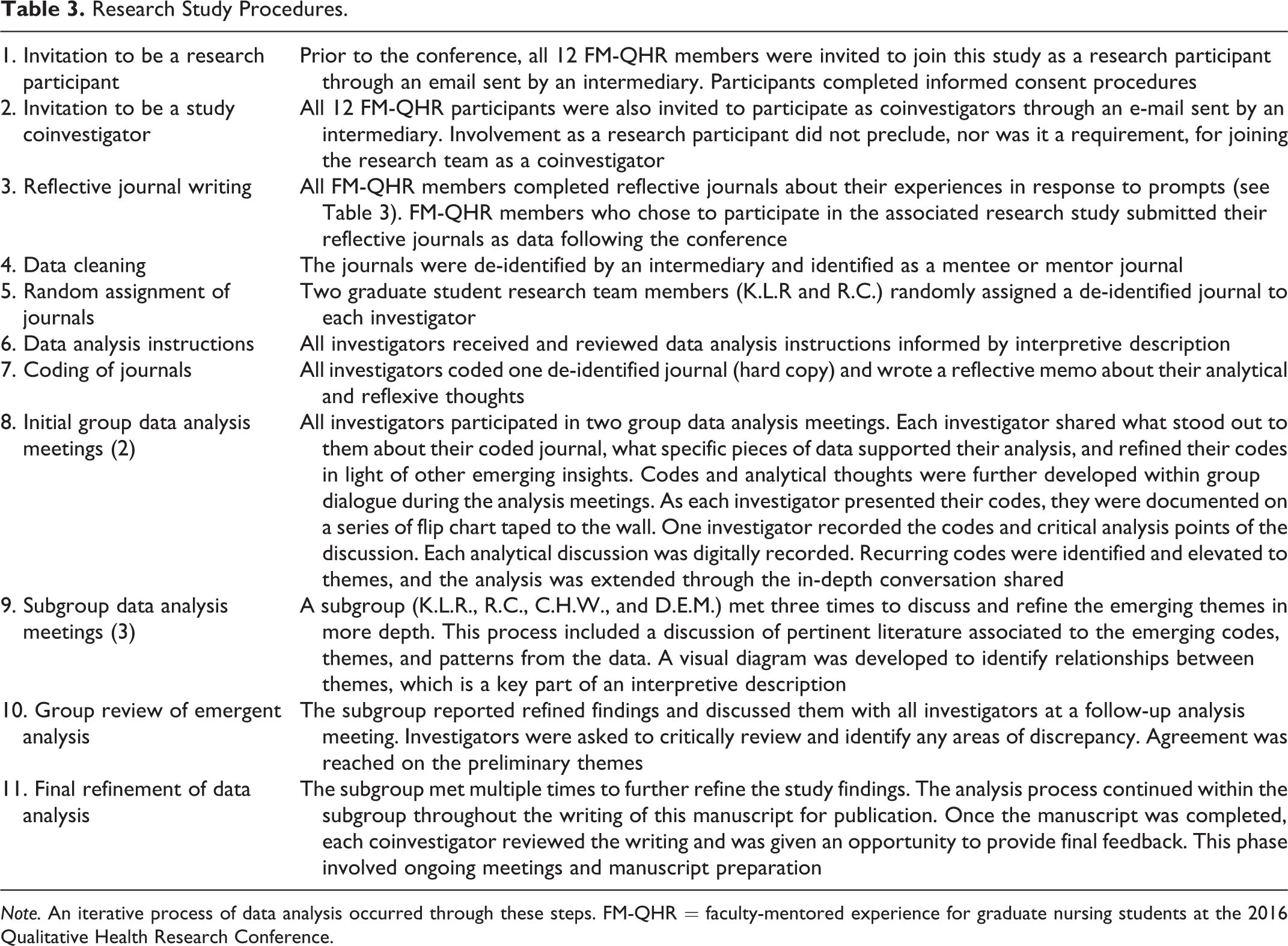
Note. An iterative process of data analysis occurred through these steps. FM-QHR = faculty-mentored experience for graduate nursing students at the 2016 Qualitative Health Research Conference.
Method
This study received institutional research ethics board (REB) approval, and care was taken to ensure that participants did not feel coerced to participate either as a study participant or investigator. Special consideration was given to the process of recruiting students, who are a vulnerable group of people due to the existing power differential between faculty and students. Graduate student principal investigatorsworked closely with two faculty mentors to lead the analysis process and managed all data. An intermediary was used to recruit all participants to avoid coercion (see Table 3 for study procedures), and all coinvestigators signed an oath of confidentiality.
Participants wrote reflective journals about their experiences in response to prompts (see Table 4). Prior to the conference, FM-QHR participants were invited to join this study, and after signing informed consent forms, they submitted their reflective journals as data (Jacelon & Imperio, 2005; Phelps, 2005; Spowart & Nairn, 2014). Reflective journals, or participant diaries, can elicit rich qualitative data. They give the participant a greater influence over the research agenda, provide a private space for the sharing of emotions, elucidate complexity in learning processes, and enable the participant to document experiences at a convenient time that is close to the studied experience (Jacelon & Imperio, 2005; Phelps, 2005; Spowart & Nairn, 2014). As well, journals allow temporal data collection over time, thus providing insight into participants’ processes (Spowart & Nairn, 2014). Limitations of reflective journals include the lack of nuances present in verbal communication and an inability to probe participants to elucidate further insights. However, in this study, the group data analysis meetings offered a forum for participants to further reflect on the data and authenticate experiences if they chose to do so (Spowart & Nairn, 2014). As well, participants needed to be literate and ideally comfortable with sharing reflective thoughts with others (Jacelon & Imperio, 2005; Spowart & Nairn, 2014). Both of these criteria were met in our population.
Journal Prompts for Mentors and Mentees.

All FM-QHR members were invited to participate as coinvestigators. The de-identified journals were randomly assigned to the coinvestigators. To promote a consistent approach to the group data analysis procedures, all investigators reviewed instructions informed by interpretive description. Participants hand coded one journal before attending three group data analysis meetings. Data analysis was an iterative process (Thorne, 2008; Thorne et al., 1997). An iterative analysis involves moving between pieces of data and the larger perspective offered by the data. This entails engaging in an intellectual process where the data and existing knowledge interact with one another, transforming the data into research findings (Thorne et al., 2004). This process makes way for an interpretive description that moves beyond description alone.
At the first two meetings, participants brought their coded journal and memos about their analytical thoughts while coding. The two graduate student PIs moderated the group analysis meetings and designated a person to record notes on large sheets of paper visible to all participants. Everyone had the chance to share what stood out to them about the coded journal and what specific pieces of data supported their analysis. Participants also had the opportunity to refine their codes in light of other emerging insights. This approach enabled a constant comparative process (Glaser & Strauss, 1967) for the group data analysis. The codes were then collapsed into themes, and the relationship between the identified themes led to the development of the experiential process (see Figure 1).
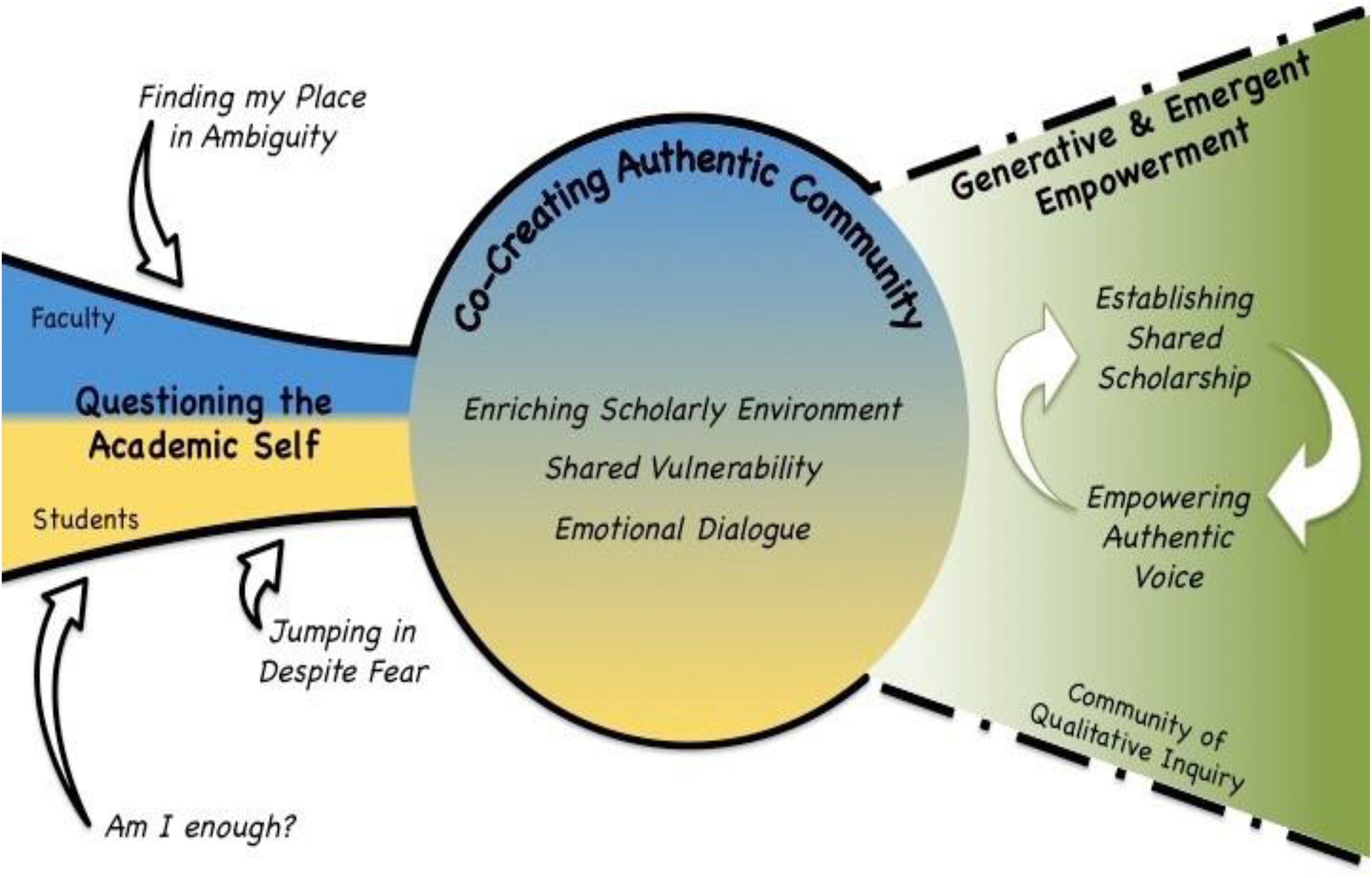
Enlivening a community of authentic scholarship.
After two group meetings, a subgroup, consisting of the two graduate students (K.L.R. and R.C.) and two faculty mentors (C.H.W. and D.E.M.), met to discuss the emerging themes in more depth. The subgroup then shared the findings with the larger group. Once agreement was reached on the preliminary themes, the subgroup met again to finalize the study findings. Refinement of the analysis occurred through the writing of this article. Through this iterative process, there was a prolonged immersion in the entire data set by the lead investigators, focused immersion in individual reflective journals by the coinvestigators, and repeated group data analysis meetings to identify initial interpretations, review and refine themes, and arrive at a final interpretive description.
Findings
There were 10 reflective journals, which were written by six graduate students and four female faculty mentors. The journals varied in length from 6 to 25 double-spaced pages. Three interrelated themes comprise this interpretive description: Questioning the Academic Self: Unvoiced Experiences of Angst, Uncertainty, and Fear; Cocreating Authentic Community Through Shared Vulnerability; and Generative and Emergent Empowerment. The relationship between these themes and the process of mentorship across the FM-QHR initiative is illustrated in Figure 1.
Questioning the Academic Self: Unvoiced Experiences of Angst, Uncertainty, and Fear
A questioning of the academic self emerged as QHR approached, and mentees prepared for the experience. Mentees felt significant fear, trepidation, and uncertainty. They wrestled with questions of academic inadequacy, felt ambiguous about what lay ahead, were unsure about the mentorship process, and worried about how the qualitative scholars they would meet would receive them. Nevertheless, what accompanied this fear was a growing excitement and anticipation about the learning and connection they might experience alongside their student peers and mentors. In analyzing the reflective journals, one of the most striking “aha” moments was to come upon mentees’ descriptions of their fears and realize they were not voiced or explored before attending QHR, they were held silently by each student. The mentors, although aware of this fear and potential vulnerability, failed to raise this topic before the FM-QHR experience.
Can I Do This? Am I Enough?
The FM-QHR experience was the first time that most of these graduate students had attended a QHR conference, and none of the participants had attended a conference together with the intent of purposeful mentorship. Initially, each mentee worried that they would be inadequate, experienced anxiety, and feared judgment. Unfortunately, there was no explicit conversation about this before the conference. One student wrote: “I am a novice—will I do this important work justice? I feel inadequate….” Students experienced heightened self-doubt when they had not previously presented at an academic conference: “Sheer panic, stress, and anxiety were my first reactions regarding presenting a poster presentation…I’d never done a poster presentation…I was feeling very vulnerable.” In the reflective journals, one of the doctoral students articulated her fear of being seen as an “imposter” or “fraud” by Deeper Dives members or conference attendees: It can be…intimidating to be with highly qualified individuals, particularly when one is just starting the PhD program and feeling that maybe I shouldn’t be in the program, i.e., not having enough capacity to do justice to the program. I’ve heard the term feeling like an “imposter”…I think this is how I feel.
This is not a small matter in academic life. We might take a page from radical hermeneutic philosophy to more fully explore these students’ experiences. For Caputo (1987), radical hermeneutics arises at the point of breakdown, the loss or withdrawal of meaning—it arises “in the thunderstorm” (p. 271). He speaks of the flux as those points of withdrawal of meaning, as the thunderstorm, an excursion into the desert, the abyss. He helps us understand that in human life, there are times when “the thin membranes…we stretch across the flux, in the thin fabric we weave over it, there are those spots where the surface wears through and acquires transparency which exposes the flux beneath” (p. 269). What is most important from this perspective is to not shut down in these moments of breakdown but to allow the flux to stay in play (Caputo, 1987). Through the process of graduate studies, similarly, there are points of breakdown, excursions into the desert, where students must wrestle with how to accommodate the flux: the uncertainty, fear, questioning, and sometimes the very breakdown of the “academic” self. The fear and uncertainty experienced before QHR represented one of those spots where the flux was exposed.
At the conference, and within the analysis process, mentees were surprised to learn that participating faculty also faced questions of inadequacy and worry. The questioning of the academic self was a mirrored experience; however, faculty mentors approached this differently. Although they similarly felt like “imposters” among more seasoned researchers, mentors had gained the ability to trust the process of placing themselves at risk despite the angst they felt. The key difference at the outset of this experience was mentors’ self-efficacy. Mentors believed in their ability to face these challenges, they carried the knowledge that risking failure, pushing the self to the edge of discomfort, into the flux of academia, is the essence, the very soul of academic life. It is this spot where expanding who you now are, what you now understand, becomes possible. They trusted this process differently than the mentees because they had lived it, survived it, and even grown within experiences of failure (Clark & Sousa, 2018).
Not Knowing: Finding My Place in Ambiguity
The mentee’s uncertainty about the structure of the mentorship intensified the emotional discomfort experienced before the conference. Apprehension surfaced for three mentees who felt that expectations, roles, and responsibilities were more ambiguous than what they could have been: I also had questions concerning expectations about the mentoring experience, how will this unfold?…How will we (the graduate student group) engage with the mentors?…The most challenging aspect of my participation…was not knowing and being confused about how I was to experience faculty mentorship. The challenges I felt…as a mentor were the number of students here to support, and trying to make sure they all felt supported and connected within the process of the week. I had to let go of that sense of needing to “organize” them, trusting that they would find their own path, as well as the one we worked to create for them.
Jumping in Despite Fear
Despite the ambivalence, and fear experienced, there was a growing sense of anticipation and excitement as participants approached sharing the conference experience. This novel, risk-taking experience was enticing, and participants seemed to reach a point of Jumping in Despite Fear. Despite their feelings of discomfort, mentees and mentors also reflected on their abilities, learning objectives, and the desire to develop scholarship within a supportive community; they started to imagine new possibilities. These dissonant experiences ultimately became the birthplace for new learning and engagement in community: “participating at the faculty-mentored experience…brought about mixed feelings of excitement and anxiety. I was excited…knowing that this would create several opportunities for my growth as a researcher” (mentee).
Mentors were also eager to engage in this experience with the students. One mentor spoke about the unique opportunity this created to connect with a student she was advising: I was very excited when my graduate student was selected for this experience, and she was thrilled…[I wanted to] build a deeper and richer relationship with my graduate student by introducing her to colleagues that I might know and new colleagues I meet that might be interested in her area of research….
Co-creating Authentic Community Through Shared Vulnerability
An Enriching Scholarly Environment for Learning and Entering Community
The QHR conference was an integral part of this shared learning experience. Students gained critical substantive knowledge by interacting with expert researchers who were open, engaged, and encouraging. One student shared, “The keynote speakers simplified what can be very convoluted topics and theories, so that concepts were easier to comprehend.” Students left the conference feeling that these scholars had embraced them; they had taken risks in sharing their work and felt validated. This facilitated growing confidence in the students; they came to see themselves as qualitative scholars, who had significant contributions to make to this scholarly community. One student reflected on the value of these interactions: The most rewarding part of…QHR was the exposure to other qualitative researchers. The openness displayed by these qualitative researchers in their willingness to share their knowledge and experience, as well as build future research collaborations, was significant to the development of my future research goals.
Although the QHR conference was critical to this learning experience, what made it highly unique was the act of bringing participating faculty and students together in a shared community with the explicit purpose to learn together, support one another, and connect on a relational level. As a group, participants moved outside the boundaries and expectations of the traditional academic environment into the beauty of Kelowna, BC. One mentor wrote: I have always been drawn to this idea that when you remove yourself from the “intense daily demands” of your writing, research, and life outside academia, to be with other scholars who are pursuing similar work, that a new space opens up—it is there that you find time for reflection, to stop and take in where you are at, where you have come in your scholarly work, and to explore new possibilities for where your work can go next.
Shared Vulnerability
As students and faculty entered into community, conversations about the vulnerability they experienced in their scholarly work emerged. Although these experiences of vulnerability were different for faculty and students, this was a shared experience. As students began to experience emotional safety and hear the challenges still faced by the faculty mentors, they became empowered to voice struggles they had held silently. One student shared: “this experience created a safe environment where students can be vulnerable without the fear of being reprimanded, punished, or judged.” What was particularly helpful was having faculty share their own experiences of fear, uncertainty, and vulnerability. It was surprising for students to learn that faculty also questioned themselves and struggled emotionally. With this knowledge, students learned they were not alone in feeling vulnerable. One mentor’s quote powerfully reflected this experience of shared vulnerability: Students don’t hear professors talk a lot about times when they fail or are unsure of themselves. I think it is really interesting that we don’t talk about this a lot with our students—failure, uncertainty, and doubting ourselves seems to be a “hidden” scholarly conversation, and with that hiding, I think we sometimes leave students to flounder out there on their own, feeling as if they are the only ones having this experience. How affirming it is to share our insecurities, as well as successes when we dare to take risks and move into that space of scholarly “discomfort” (although not a discomfort that completely paralyzes us!).
Opening a Dialogue About the Emotional Side of Academic Life
During the analysis discussions, one of the most striking events occurred in the first meeting when a student noticed that many words in the journals focused on emotions. This initiative allowed the emotional side of academic life to emerge and claim its voice—shared experiences of self-doubt, vulnerability, fear, worry, excitement, and a shared desire for the acceptance of one’s work—these were made explicit and given a presence. This finding was a surprise and caused us to think more critically about the meaning of this mentored experience.
As faculty members, many of us have experienced and continue to experience intense emotion in our own academic lives. However, in the analysis, there was a realization that for the most part, student–faculty conversations primarily focus on the cognitive and evaluative piece of our shared scholarship. Within the journals, “caring” was one of the emotion-laden words that emerged: “the faculty-mentored experience was extraordinary. Faculty were so supportive and willing to share, to listen, and to provide guidance; I felt they actually cared about the students they were mentoring.” Students identified specific approaches that facilitated this experience of caring and support. This included faculty openly sharing their graduate student experiences and the difficulties they continue to face. Taking the risk to open to a shared vulnerability was central to giving students the experience of feeling cared for and realizing that the faculty were human beings too (this was a surprise!). Students felt understood by the mentors. One student took away the following message: “Life as a PhD student is challenging, but we are not alone, there is always someone there to turn to, to offer support, and to be encouraging…reach out and do not be afraid to be vulnerable.”
The relational connection that developed was facilitated by the underlying intent to create an emotionally safe environment where students would feel supported in taking scholarly risks. What became particularly intriguing was the realization that despite this, there had been no conversation about emotions or the discomfort of this risk in the meetings before QHR. It was only in the experience that this emerged. As participants tentatively embraced a shared vulnerability and moved outside the routines of everyday academic life, different selves showed up. Gradually, selves that were unknown, had been hidden, selves that were emotionally “managed” (Hochschild, 1983; Holstein & Gubrium, 2000) to meet the perceived social roles and mores set out by “academia,” came into being. The inner selves of both faculty and students found the space to breathe and with that the inner self, the struggling, reaching, growing, and vulnerable self was made visible and valued. This is what made it possible to enliven a community of authentic scholarship.
Feminist theorists claim that theories of critical thinking have focused too exclusively on rational processes of knowledge acquisition. Thayer-Bacon (1993) argued for a new understanding of the relationship that caring and emotion have to thought development. She proposed a theory of constructive thinking in which knowledge of oneself and one’s perspective is as essential as reasoning skills. Drawing on Belenky, Clinchy, Goldberger, and Tarule’s (1986) work on Women’s Ways of Knowing, she argued that there must be the effort to share who you are with other(s), while attempting “to understand and gain knowledge from a communion that is a real exchange, with valued contributions made from all involved in the epistemic experience” (Thayer-Bacon, 1993, p. 327). In this approach to acquiring knowledge, one must open not only one’s mind but also one’s heart to the world (Belenky, Clinchy, Goldberger, & Tarule, 1986, p. 141). This requires opening to emotion and a relational way of being. This is a process that aims to open the knower to reclaiming the complexity of the human self, allowing different voices to emerge and enter a dialogue with each other. A relational epistemology values caring and supporting the other; it is in this place that different voices can emerge, and all of these voices contribute to scholarly work. She argues that it is not enough for students to confirm themselves as knowers, they need to become members of a community of knowers (Thayer-Bacon, 1993). This relational epistemology was enacted in the FM-QHR initiative. What was required was openness and engagement from FM-QHR participants, as well as from the community of qualitative scholars at QHR. Together, this is what made a shared vulnerability possible; essential to this process was a shared modeling and experience of human, imperfect, but attainable scholarship.
In their discussion of the developing narrative identity of the social self, Holstein and Gubrium drew on the work of Hochschild (1983) who argued there is a need to engage our emotions: It is our emotions that will help us “locate our true selves” (Holstein & Gubrium, 2000, p. 49). Emotions have a signal function that can help guide us. When embedded in social life (i.e., academia), there is the possibility that we intentionally manage our emotions, and the “distortion of the managed heart” (Hochschild, 1983, p. 22) disconnects us from our authenticity. It is likely that we also become detached from the authenticity of the other. The inner self may not be destroyed, but we are no longer in touch with it (Holstein & Gubrium, 2000, p. 49). Embracing a shared vulnerability and attending to the emotions in this experience assisted faculty and students to engage with their human selves, in community with one another. All of this belongs to academic life, to academic community, but this is a process that will not happen without cultivation. There needs to be a shared, relational, and purposeful intent to open this up. One student reflected on the impact of this way of being: It was exactly what I needed to experience early on in my PhD program. Everything that I was experiencing and feeling was normalized. It was as if I recognized that I was ok even if I was scared, vulnerable, feeling like I didn’t belong, struggling, wondering if I was doing the right thing (pursuing PhD). I realized that I was ok, that indeed, I am in the right place at the right time.
Generative and Emergent Empowerment
This unique learning experience, and specifically, this relational way of being, led to innovative scholarly outcomes that would not have occurred otherwise. As participants took risks to share new aspects of themselves, unencumbered by the traditional culture of academia, they experienced a generative and emergent empowerment. The relational outcomes were central to facilitating innovative and creative scholarly initiatives following the conference.
Engaging in Collaborative Scholarship
Students and faculty with previous relationships, as well as those who had only limited interaction before QHR, learned together in new ways. Participants felt that the “creative and generative force that came from engaging with one another” at QHR enriched their collaborative learning, as well as the scholarly initiatives they became a part of. These outcomes extended far beyond the boundaries of the conference experience and significantly impacted individual academic careers, as well as student–faculty collaborations. The very act of studying the FM-QHR initiative led to scholarly work that ultimately produced this academic article. It was a unique experience for students to work alongside their peers and mentors in the process of creating the grant application, obtaining ethics approval, and completing the analysis. This project created an environment in which role modeling and mentoring occurred within a collaborative and diverse context. This cocreation was innovative as mentorship in graduate work can become primarily focused on the individual student and advisor relationship (Shacham & Od-Cohen, 2009). It was very different for students to write applications and analyze textual data in a group environment. The implicit, taken-for-granted thinking of mentors was exposed for students to witness and engage with actively. Students also provided important insight and created new openings in the interpretive work developed, which enriched this experience of shared scholarship.
One faculty member explained that this engagement effectively broke down the traditional binary divisions created between faculty and students. She mused about the nature of this barrier and what might be possible by purposefully dismantling these distinctions: A rigid distinction between faculty and graduate students and a focus on individual scholarly work does not always lead to the best outcome. Faculty and students do have very different roles, and we need healthy boundaries within those roles; however, underneath those distinctions, each of us are human beings, committed and passionate about our scholarly work. How is it that we so often connect with one another primarily as scholars, and not as human beings? And, if this became possible, what would that mean to our participation in scholarly community?
There were also scholarly outcomes that had a significant and enduring impact on the research community within the College of Nursing and at the University of Manitoba. Student and faculty networking led to a Community of Qualitative Inquiry event (continuation of the CoP), which featured Dr. Amanda L. Kenny from La Trobe University, Bendigo, Australia, an internationally renowned qualitative scholar and a member of the IIQM advisory board. Dr. Kenny presented an engaging, interactive workshop focused on the contribution research makes outside the boundaries of academia. During this CoP evening, faculty and students also had an opportunity to share the preliminary findings from this study. Additionally, Dr. Kenny will return to the University of Manitoba for further workshops at a university-wide level, and she is now collaborating on three separate research projects with College of Nursing faculty members. Further, Dr. Alexander Clark, chair IIQM Board and associate vice president of research, University of Alberta, was a previous Helen Glass scholar. Bailey Sousa, director, IIQM, also came as a guest to the College of Nursing. IIQM has demonstrated a strong commitment to maintaining the professional, collegial relationships developed through this initiative.
Empowering Authentic Voice
The extensive commitment and passion that students have for their research is significantly connected to their identity and the hopes they hold for their future. Students often feel fearful that their work will not stand up within the scholarly community. However, through risking themselves by sharing their work within the safety of the FM-QHR experience, students did find their authentic voice and ultimately inspiration from the affirmation they received. This feedback from other participants and qualitative researchers acted as strong motivation for moving forward. One student had a transformational experience as other scholars expressed an appreciation for her work, giving it credibility. …what a surprise when I actually gave my presentation…I realized that I knew my topic, that I was indeed passionate about my topic, and that I could actually speak with an authoritative voice on my topic. I realized that there was genuine interest in my research topic and questions were thoughtfully posed. I was actually amazed at how good I felt. A memorable moment for me during my poster presentation was when a lady walked up to me and requested that I talk about my poster. After sharing the contents of my poster with her, she seemed to be very interested in my work and told the story of her mom and how the story was related to my research study…We talked for a while about the significance of my study and what I hope to accomplish through my study. It was gratifying to know that I would not only be adding to the body of knowledge through my research study but also giving hope to people. I felt more confident and exhilarated that my study counts and look forward to continuing with my research study.
Discussion
These findings highlight the unique socialization challenges that students face as they transition from professional roles into emerging research scholars. Within graduate school, students are asked to manage highly complex emotional and cognitive demands (Cantwell, Bourke, Scevak, Holbrook, & Budd, 2017; Clark & Sousa, 2018; Hill et al., 2014). Students enter their studies with established professional identities, and this transformation can lead to identity disruption and role crises (Woods, Cashin, & Stockhausen, 2016). In our study, students found it particularly challenging to adopt the role of a novice, as they worked to redefine themselves and their nascent work. This role transition resulted in experiences of vulnerability and isolation.
Within this initiative, these challenges were addressed as students experienced socialization into a broader community of qualitative researchers (Woods et al., 2016). The participants described a process of becoming and belonging, which resonates with the concept of identity formation in social learning theory (Wenger, 2009). Informal mentoring and meaningful interactions allowed participants to reflect on their personal needs and identity while gaining insights and role expectations from peers and mentors. Participants mutually engaged with each other on an emotional and cognitive level, which powerfully shaped students’ academic identity formation as qualitative researchers (Woods et al., 2016).
Our findings revealed that knowledge related to research inquiry found in textbooks and graduate coursework is not sufficient; it is essential to create opportunities for graduate students to tap into the lived knowledge of research inquiry, which is held within communities of scholars (Wenger-Trayner & Wenger, 2015). In FM-QHR, meaningful participation within an international community of qualitative researchers became a “living curriculum” (Wenger-Trayner & Wenger, 2015, p. 4). Real-life situations within a community of scholars were the pedagogical focus rather than behaviorism and cognitivism within an individual learning process (Woods et al., 2016). This approach resonates with relational epistemology (Thayer-Bacon, 1993), which assumes that the self is formed in relation to others. Our points of view, the language we use, our innovative solutions for problems, and how we think are all developed through social interactions.
The scholarly impacts borne from this initiative could be a result of the students’ experiential learning within a research community, which assisted them to find their authentic voice (Wenger, 2009). A social theory of learning argues that “legitimate peripheral participation in CoP” (Lave & Wenger, 1991, p. 30) is essential to students’ development. Initially, new members learn at the periphery, and through acquiring the knowledge, values, attitudes, and skills of a community, they move toward more central membership (Lave & Wenger, 1991). Our findings illuminate how FM-QHR facilitated students engaging in progressively complex scholarly activities and discussions, within the context of an emotionally safe mentorship environment (Lave, 1988; White, 2010). The subsequent personal empowerment and interpersonal connections resulted in notable and shared scholarly outputs. Our findings are consistent with other researchers who have conceptualized graduate education as a trajectory of legitimate peripheral participation in communities of researchers (Lee & Roth, 2003) and who found that CoPs were a vital component of graduate education (Wisker, Robinson, & Shacham, 2007).
This research also articulated the significant value of acknowledging our shared vulnerability within a CoP. The FM-QHR initiative did not only enhance students’ knowing, doing, and being but also helped students to process their previously hidden emotions related to experiences of vulnerability and their fear of failure. Participants were able to share new aspects of themselves, including their insecurities, fears, and struggles. Learning to understand and regulate emotional responses was a critical component of meaningful participation in a research community (Guldberg & Mackness, 2009).
Our findings are also consistent with the work of Clark and Sousa (2018), who have recently articulated academic life as extreme knowledge work. They discuss the centrality of human work in academia and argue that attending to our emotional experiences as academics is critical to living a balanced, happy academic life. This is seen as one of the most challenging aspects of academia because it requires that we ask deep, penetrating questions of ourselves (p. 115). Unfortunately, in most academic workplaces, this human work, work on the self that allows us to be present and work well with others, is not sufficiently attended to (Clark & Sousa, 2018). They also draw attention to the vulnerability academics feel in relation to experiences of failure, despite it being an essential aspect of scholarship. Similarly, in our work, the value of vulnerability and openness about failure emerged as being critical to supporting graduate students. Further, it offers one compelling exemplar of how to effectively challenge the stigma associated with conversations about struggle and failure in academia (Kegan & Lahey, 2016).
Implications
These findings highlight a number of key implications for qualitative research training. They challenge the current emphasis on individual approaches to graduate education and illustrate a need to develop social learning experiences outside the boundaries of course and thesis work. In the context of the alarming levels of graduate student mental health challenges (Evans et al., 2017, 2018; Guthrie et al., 2017), it is no longer acceptable to look away from the distress and disconnection present in academia. Universities need to create innovative approaches that act to engage and support students. This novel FM-QHR initiative offers one exemplar of embedding the graduate student experience in a community of mentorship. This facilitated student access to diverse sources of knowledge and emotional support. Critical to this initiative was the privileging of relational connection in which the painful emotions of academic life were acknowledged, voiced, and held within a scholarly community. Initiatives such as these hold high potential for alleviating the isolation and mental distress that occurs in graduate work.
Given the importance of the affective element for FM-QHR participants, we need to consider approaches that more effectively nurture graduate students in the emotional work of academic life. This professional wisdom is difficult to learn through reading a textbook. As educators, we need to model caring as an important part of scholarly thinking and find ways to be much more attentive to our students’ emotional experiences (Thayer-Bacon, 1993).
A final implication of this work is that students need to see faculty as human beings who also struggle, fail, and have the strength to talk openly about their failures. This normalizes and supports students in their fears of failure and may provide resilience during future experiences of failure. Clark and Sousa (2018) suggest the creation of a relational network as a key to growth in the context of failure. This initiative provides evidentiary support that purposefully creating an authentic, relationally focused CoP has the potential to address the distress experienced by students during their studies, opening them to the growth that is possible with risk-taking and failure in the context of their academic lives.
Limitations
Study limitations include the potential for perceived pressure to participate, despite efforts to decrease feelings of coercion. Students or faculty may have felt obliged to participate to show their commitment to the nursing profession or academic institution. The participants in this initiative/study were predominantly female, and the perspectives of male participants may differ from those reported here. Another limitation of this study was an explicit focus on nursing graduate students; however, the findings may have application at an interdisciplinary level. We were unable to collect extensive sociodemographic information due to the possibility of identifying participants. The authors also acknowledge the lack of concurrent data collection and data analysis (Thorne, 2008). The brief, intensive, immersive experience at QHR precluded the concurrent data collection and analysis that is typical of interpretive description (Thorne, 2008). As well, participant journals were the only source of data, and thus, we were unable to probe specific participants to clarify meanings. Lastly, we did not explore participants’ perspectives of FM-QHR over time. Longitudinal work could elucidate the long-term impact of this initiative.
Future Research
There is a critical need for continued research about innovative initiatives for supporting and mentoring students in graduate studies. In future research studies, it will be critical to elucidate the impact of experiential mentoring on students’ professional identity. Other qualitative approaches could be adopted to extend these initial research findings. Currently, we are pursuing our third research study associated with a College of Nursing Endowment funded mentored experience for graduate nursing students at QHR. Within the next project, arts-based research approaches will be used with discourse analysis to further knowledge development around the creation of a community of reciprocal mentorship between students and faculty. It is also important to explore how these types of initiatives impact faculty member’s engagement with graduate students, as well as within their local academic settings. One of the critical areas for future knowledge development is understanding how to comprehensively translate the FM-QHR experience into the everyday academic lives of students and faculty. This translation may hold significant potential for alleviating the mental health distress experienced by graduate students and faculty members (Evans et al., 2017, 2018; Gloria & Steinhardt, 2014; Guthrie et al., 2017; Levecque et al., 2017; Smith & Brooks, 2015).
Conclusion: Enlivening a Community of Authentic Scholarship
Each FM-QHR participant experienced a transformation on some level, from small incremental changes in points of view to transformations in firmly held beliefs (Mezirow, 2000; Rieger, 2017). For example, hearing the fears and challenges faced by others allowed members to adopt a new perspective, they came to see these as normal, even expected aspects of academic life. Most importantly, there was the enlivening of a community that did not previously exist. Mentors and mentees were invited to envision and walk forward into a new place of being, where different selves and authentic engagement became possible. This had profound relational and scholarly impacts during and following QHR. The questioning of the academic self became visible, the painful, difficult process of scholarship was seen with new eyes, and a different level of understanding occurred. However, what also emerged was laughter and a lightness that facilitated relational connection and assisted participants to live well in the presence of this questioning, uncertainty, and angst.
In Greek mythology, Dionysis is the god who is torn apart and re-membered (Knill et al., 2005), he simultaneously represents experiences of fragmentation and communal acts of celebration in human life (Caputo, 1987; Knill et al., 2005). When there is space for the presence and movement of both deconstruction and celebration, a community becomes enlivened (Knill et al., 2005, p. 39). This enlivening shows itself in part through the festivals of life. The FM-QHR experience acted as a festival, a celebration of academic life that is multifaceted, “entangled, ensnared, interwoven, ‘textualized’” (Caputo, 1987, p. 283). The human self cannot and should not be separated from what we understand to be the academic self, just as moments of breakdown need to be accompanied by laughter and celebration. Dionysian community “brings life to a group: the spirit of music comes into play and the community experiences its being-together in song” (Knill et al., 2005, p. 39). Dionsysos festivals occurred only at specific times; these festivals acted to bring members “into a state of…communitas in which new symbols and meanings [were] experienced together” (Knill et al., 2005, p. 44).
When the festival concludes, members must return to their everyday lives, “although it is hoped those lives have become “marked by a sense of increased vitality and meaning” (Knill et al., 2005, p. 44). This is what occurred following QHR: the enlivened community led to new and deepening relationships, as well as a purposeful acknowledgment and honoring of the moments of struggle and questioning in academic life. There also now exists a different commitment to finding laughter and celebration in the midst of this discomfort. Always the abyss, but always the laughter…Nothing heals like laughter. Nothing keeps us open like laughter…It is the power to laugh at oneself, one’s fears, one’s beliefs that liberates and keeps the flux in play, keeps us in movement with the flux, and keeps the openness to the mystery…It is laughter which lets things be (Caputo, 1987, p. 292).
Footnotes
Acknowledgments
The authors would like to acknowledge our dear friend and colleague, Celeste Waldman, who cocreated this initiative with us and dreamed of a new way of being in academia. Celeste was a PhD student and instructor at the College of Nursing, University of Manitoba, who sadly died just prior to the start of the research project. She was the principal investigator on the grant proposal and ethics application, and we want to acknowledge her rich contribution to this scholarly work. And we also would like to thank Saiful Huq, MSc, Electrical Engineering Designer, Huq’s Bazaar Inc., who created the visual illustration.
Declaration of Conflicting Interests
The author(s) declared no potential conflicts of interest with respect to the research, authorship, and/or publication of this article.
Funding
The author(s) disclosed receipt of the following financial support for the research, authorship, and/or publication of this article: Graduate students who participated in this faculty-mentored experience at the 2016 Qualitative Health Research Conference hosted by IIQM were financially supported by the College of Nursing Endowment Fund.
