




Abstract
The intention of this article is to contribute to the debate about whether the voting age should be lowered to the age of 16, by examining quantitative and qualitative data collected in a local participation project with young people in Portugal: questionnaires (N = 961), interviews (N = 3), and focus group discussions (N = 15). Considering the coexistence of both willingness and reluctance to get engaged in formal politics – as youngsters often feel ill-equipped politically – it is argued that adequate political education needs to be provided by schools to enable young people to be confident and knowledgeable voters. We propose that governments recognise the importance of this area in the school curriculum, in order to enable the young people’s acquisition of knowledge and skills that can sustain their growth as competent voters. This is crucial in legitimising democratic representative systems.
Introduction
In recent decades, many democracies have witnessed a sharp decline in voter turnout and in membership of mainstream political parties; this is especially the case among younger generations, who have tended to be defined by the literature as politically apathetic (i.e. feeling a lack of desire or a general antipathy to participation in electoral politics) or alienated from the existing political system (i.e. marginalised or excluded from political decision-making processes) (see Dahl et al., 2018; Marsh et al., 2007). In that context, lowering the voting age to 16 has, understandably, become a topical issue. Several European countries already debated and tested this possibility. However, as Peto (2018) points out, there has been a dominant scepticism in Europe about lowering the voting age. In some ways this is not surprising, considering the unpredictable and critical events that have been affecting Europe, and the world in general, in the last two decades (e.g. the financial/economic crisis, the refugee crisis, the climate changes crisis, and the present pandemic COVID-19 crisis), with no room for the creation of the necessary conditions in which political institutions (specifically European ones) promote in-depth and consistent debate on this subject.
So far, Austria and Malta are the only European countries that have lowered the voting age to 16 for all elections, respectively in 2007 and 2018. There are other European countries that have introduced the right to vote at 16 years of age, but only for local or regional elections (such as the cases of Estonia and some German Länder), for some particular elections (as in the case of Scotland in its independence referendum in 2014, and in the Scottish Parliamentary elections in 2016 and 2021), or for small-scale trials/mock elections (such as Norway and Belgium). In addition, Wales allowed 16- and 17-year-olds to vote in Welsh Assembly and local elections from 2021. Besides these countries, other non-European countries have established 16 as the voting age: Argentina, Brazil, Cuba, Ecuador and Nicaragua.
In recent years, the right to vote at the age of 16 has been an issue of debate in the Portuguese Parliament. This discussion was mostly instigated by the following arguments: (i) if at the age of 16 young people are old enough to enter the labour market, respond to criminal responsibility and be called upon to do military service, then there are no reasons for not having access to the right to vote at the age of 16; (ii) young people are more informed today than they were before; (iii) extending the minimum age for voting can be a way of fighting abstention; (iv) and the extension of the minimum voting age will force politicians to be closer to young people, to talk to them, which doesn’t happen nowadays. The most recent parliamentary discussion on this topic took place in May 2019, with a proposal to open an extraordinary constitutional review aimed at lowering the voting age to 16. However, the proposal was rejected by almost all Members of Parliament. Still, this remains a topical issue in Portuguese society.
The data considered in this article were collected under the external evaluation of the impact of the Young Mayor (YM) project, implemented since 2014 by the municipality of Santa Maria da Feira, located in the north of Portugal. In short, this project is an educational initiative inspired by the Young Mayor of Lewisham, started in 2004 in the London Borough of Lewisham (https://lewisham.gov.uk/mayorandcouncil/youngmayor), where a selected group of young people play the role of spokespersons for their peers and are co-responsible for the management of an allocated budget, seeking to empower young people in terms of communication skills, interpersonal relationships, decision-making, negotiation, and leadership (see Rodrigues et al., 2019). The evaluation process of this project took place between 2016 and 2017, and entailed the exploration of young people’s perceptions about the impact of the YM project on young participants and the surrounding educational community, but also about the topics of electronic voting and votes at 16 (Ferreira et al., 2018). The latter were included in the evaluation process, as it was considered important to seize the opportunity to collect data on unexplored issues in the literature, particularly concerning the Portuguese context. This article is focused on the results concerning the topic of votes at 16, thus seeking to contribute to the debate on the role of education in promoting political participation and, subsequently, the country’s democratic culture.
Purpose of this study
The identification of two important gaps pushed us to this specific study: first, the complete absence of published studies on the issue of lowering the voting age to 16 in the Portuguese context. Second, the lack of young people’s own voices in the research about this topic. A recent book edited by Eichhorn and Bergh (2019b), aimed at bringing together the research, both conceptual and empirical, on the topic of lowering the voting age at 16, reinforces this perception by concluding that more qualitative data are needed ‘to engage more deeply with the understanding different groups have on their engagement or non-engagement’ (p. 239).
To the best of our knowledge, the research studies which draw on qualitative data are the recent study by Huebner (2021) involving 20 in-depth interviews with Scottish young people aged 15–18 about their experiences with the right to vote at 16; the study by Breeze et al. (2017) conducting 10 in-depth interviews with young ‘Yes’ voters, aged 16–20, to explore their voting experience after the reduction of the voting age in Scotland following the 2014 independence referendum, in which young people showed a capacity for informed debate and decision-making and a ‘(re)connect[ion] to formal, institutional politics as well as [a] broader interest in and engagement with “new” forms of political participation’ (Breeze et al., 2017: 771); and the study by Gleaves (2019), in England, in which both online survey (366 responses from young people aged between 16 and 18) and individual focus groups (75 students aged between 15 and 17) were used to collect the data, showing that ‘slightly under half of young people surveyed supported lowering the voting age to sixteen’ (p. 3), and that young people ‘feel that the current state of political education is inadequate’ (p. 9). Similar to this last study, our research also adopted a mixed-methods approach in which interviews and group discussions were conducted along with questionnaires, in order to obtain broader, more in-depth knowledge. The research methods and procedures will be presented further on, in the section dedicated to research and participants. Considering recent peer-reviewed publications on lowering the voting age, we could advance that we see a tendency towards ‘adultsplaining’ on this issue (adultsplaining is used here by analogy to the term ‘mansplaining’). This means that young people tend to be more explained to than heard. In other words, young people’s voices are absent from published research on the topic of voting age. Taking this into account, we consider that this study gains specific relevance because it aims precisely at filling in these gaps.
Literature review
There is no consensus in the literature about lowering the voting age to 16. Still, it is possible to identify two main research strands. The first indicates that young people at the age of 16 do not have political maturity, and also that their political knowledge does not increase by having voting experiences at that age. Within this strand, we found studies from diverse national contexts, such as Sweden (Rosenqvist, 2020), Norway (Bergh, 2013), and the UK (Birch et al., 2015; Chan and Clayton, 2006; Cowley and Denver 2004). Seeking to summarise the sceptical view about lowering the voting age, Zeglovits and Aichholzer (2014) state that the ‘arguments against foremost cover such concerns as the lack of political maturity, political interest and political knowledge of young voters which might lead to an uninformed vote choice’ (p. 353). Speaking from a historical perspective, Wall (2014b: 110) claims that ‘none of the architects of modern democratic theory [i.e. Locke, Rousseau, Kant, or Rawls] thought children should have any rights at all’, as well as some more contemporary theorists, such Habermas (1993) and Barber (1999), who consider that children lack ‘communicative competence’, the core political skill of ‘civility’.
In its turn, the second research strand identified argues that the voting age should be lowered to 16. For instance, the study of Zeglovits and Aichholzer (2014), which examined the turnout of young voters aged 16 to 17 in Austria, the first European country to lower the voting age to 16, presents results ‘support[ing] the idea that the so-called “first-time voting boost” is even stronger among the youngest voters as turnout was (a) higher compared to 18- to 20-year-old first-time voters and (b) not substantially lower than the average turnout rate’ (p. 351), concluding that these findings encourage ‘the idea of lowering voting age as a means to establish higher turnout rates in the future’ (Zeglovits and Aichholzer, 2014). According to the authors, the crucial point here is the so-called ‘first-time voter boost’, since first-time voters, usually 18- to 19-year-olds, ‘vote more often than 20- to 21-year-olds who exhibit a markedly low turnout rate’ (pp. 351–352). In addition, they argue that their study adds ‘empirical evidence to extend these findings for 16- and 17-year-old first-time voters’ (p. 352). In the same vein, Birch (2014) considers that lowering the voting age to 16 has, among other reforms, the potential to address the problem of the recent rise of political exclusion, emphasising that ‘[t]here is evidence that if people vote in the first election for which they are eligible, they are more likely to vote in later years’ (p. 102). Reinforcing this conclusion, a recent study conducted by Gleaves (2019) shows that ‘young people believe that lowering the voting age would improve young peoples’ levels of interest in politics’ (p. 3). Furthermore, a study examining data from Latin American countries (i.e. Argentina, Brazil, Cuba, Ecuador, Nicaragua) also shows that people who were able to vote at 16 were more supportive of democracy and had more political trust in parliaments and parties than those who could only vote at an older age (Petrarca, 2019).
All the conclusions presented resonate with the study of Hooghe and Dassonneville (2013). By analysing the future voting behaviour of 14-year-old adolescents from 22 European countries (data derived from the International Civic and Citizenship Education Study (ICCS) 2009), it suggests ‘that the low turnout among young people is not related to not wanting to vote, as a vast majority of adolescents indicates a willingness to vote’ (Hooghe and Dassonneville, 2013: 19). In the light of this result, the authors argue that future research ‘should not therefore focus on the alleged lack of political interest among this age group, but rather on the presence of administrative barriers, and on the reluctance of political parties to concentrate their mobilization efforts on this age group’ (Hooghe and Dassonneville, 2013: 19).
This contentious view about the issue of lowering the voting age to 16 was, in fact, already acknowledged by Berry and Kippin (2014: 4), gathering the following arguments in favour: (i) votes at 16 will not solve the problem of youth disengagement overnight, but it will help us to address the issue, (ii) voter registration levels for the Scottish independence referendum are already showing the potential benefits of lowering the voting age to 16, (iii) votes at 16 should be part of the systemic reform needed to counter youth abstention from democratic institutions, (iv) the Austrian experience shows that there is little risk and much to gain from giving 16-year-olds the vote, and (v) a referendum on lowering the voting age would generate a wider national debate about youth participation in democracy; and against: (i) 16- and 17-year-olds can be part of our democracy even if they do not have the vote, (ii) we do not need to lower the voting age to ensure that MPs will listen to the opinions of young people, (iii) 16- and 17-year-olds are not fully autonomous, and therefore should not be allowed to vote, and (iv) law changes around childhood protection and social change mean the case for lowering the voting age in the UK is less persuasive now than at any point in the last 50 years. Besides these two main strands, there are also studies presenting an in-between position, such as the one carried out by McAllister (2014) in Australia, the findings of which suggest only a partial support for lowering the voting age, emphasising that ‘[t]here is no evidence that lowering the voting age would increase political participation or that young people are more politically mature today than they were in the past’ (p. 68).
Notwithstanding these contentious views, it is worth noting that the studies mentioned above are not necessarily contradictory as they focus on different aspects of the debate. Moreover, these studies were also conducted in different contexts, and this, as Eichhorn and Bergh (2019a) ascertained after reviewing case studies from a large number of countries, is an aspect that ‘crucially’ matters, arguing that it is not possible to ‘provide one clear formulaic response to the question what impact lowering the voting age has on all aspects of young people’s political attitudes and engagement in all possible places’ (p. 231). Yet, they also acknowledged that there is little evidence suggesting that the implementation of voting at 16 has detrimental effects on young people’s political behaviours and attitudes (Eichhorn and Bergh, 2019a: 238).
Finally, it is also important to point out recent research emphasising that ‘adulthood may be in the eye of the beholder rather than a fixed entity’ (Tonge et al., 2021: 505). In this regard, Bowman (2021) argues that a more holistic approach to voting at 16 is needed. This broader perspective demands a discussion that goes beyond the simplistic question of ‘do we allow them to have their say’, towards ‘a more responsive and agile concept of political socialisation than the identification of certain markers of adulthood as appropriate to the accrual of voting rights alongside other rights and responsibilities’ (Bowman, 2021: 592). In addition, a more integrated and complex debate over voting at 16 will address the danger that this policy reform may entail, by considering, as Loughran et al. (2019, 2021) advocate, a change that may empower mainly the already advantaged (e.g. those already politically interested, the university-educated and those from a higher socio-economic background) ‘without support for those who feel marginalised by electoral politics and less confident about participating in the political process’ (Loughran et al., 2021: 314). A recent article, summarising the empirical findings across countries where there is data with lower voting ages, states the inexistence of negative effects related to political engagement and civic attitudes, while also cautioning about the substantial gaps in knowledge on how positive effects actually play out (Eichhorn & Bergh, 2021). In fact, framing the voting age issue as one of the aspects of a broader question of political inclusion goes at the very core of minors’ citizenship status and rights (Bessant, 2020; Grover, 2011). As stressed by Bowman (2021), it is important not to miss the opportunity to debate voting at 16 in a way that produces a proposal ‘that best accommodates opportunities to address the underlying causes of youth political engagement’ (p. 593).
The role of schools in promoting young people’s political awareness
Acknowledging the importance of increasing political participation in democracies, a growing body of literature has been drawing attention to the role of school (or political education) in promoting young people’s political awareness and, hence, their competency to vote. In fact, the study of Gleaves (2019) reveals precisely that young people have ‘a lack of confidence in their level of political knowledge and felt that they needed to be taught about politics in school in order to vote competently’ (p. 3). In the same vein, Borge and Mochmann (2019: 297) argue that there is a gap in young people’s perceptions about political participation that may present a risk for their access ‘to political influence and to the power structures at the top’, adding that further research is needed to grasp the role that school plays in promoting ideals and notions of citizenship.
Thus, as the literature has emphasised, political education can provide teenagers with the required political knowledge and ideological understandings to make them ‘competent voters and hence providing a political education is an alternative way to avoid the harm of having immature voters’ (Peto, 2018: 282). In addition, as the study carried out by Pontes et al. (2019) concludes, formally studying citizenship matters is positively related to young people’s political engagement. In this respect, Hill et al. (2017) point out that it is common to recognise social and moral responsibility, community involvement and political literacy – first introduced in England by the Crick report (DfEE/QCA, 1998) – as the main targets of citizenship education. However, the development of critical reasoning and engagement with politics and other controversial issues, has been recognised as a challenging goal for schools (see Munn, 2010). Thus, it seems crucial to invest in political education as a strategic area to help young people become more active, informed and open-minded members of society (European Union, 2015; OECD, 2018).
Indeed, in a context of growing dissatisfaction and distrust of young people towards social and political institutions (Dahl et al., 2018; Henn et al., 2005; Ribeiro et al., 2017), schools (and particularly the subject of citizenship education) are an important resource to develop experiences of political discussion and deliberation (e.g. McAvoy and Hess, 2015; Ribeiro et al., 2017). Moreover, as Eichhorn (2018) emphasised, ‘the discussion of political issues in the classroom (rather than the simple delivery of civics-style classes per se) may act as a positive factor in the political socialisation of young people’ (p. 1095). However, research undertaken in last years in Portugal also indicates that schools do not properly promote political education (i.e. providing real opportunities for students to live democracy and experience its imperfections) (Menezes et al., 2012), giving rise to young people’s criticisms and their recognition of the fundamental (unfulfilled) role of schools that can be summarised in the following rhetorical question: ‘if not in schools, where?’ (Menezes et al., 2019).
Echoing this question, the above-mentioned study by Hill et al. (2017) reports that one-quarter of students never discuss or debate politics or political issues in school. More recently, in this regard, the study by Ross (2020), involving 324 group discussions with 2000 young people from 29 European countries, also points out that political discussions were not a regular practice in schools; this resonates with the study of Huebner (2021) that shows a broad consensus among the young people interviewed that schools were not doing enough to prepare them for political participation. Furthermore, there is also research indicating that school textbooks neglect the discussion of politically controversial subjects (Piedade et al., 2018), which further reinforces the perception that school lacks the ability to promote young people’s political reasoning.
Based on a mixed-methods approach, in the following pages we will explore the terms in which the issue of lowering the voting age to 16 is perceived and assessed by young people.
Research design and participants
As already mentioned, the data presented here were collected as part evaluating the impact of the YM project. They focus both on young people that participated directly in the project (i.e. the elected young mayors and councillors, and advisers), and also on the surrounding educational community (i.e. students and teachers from public schools) (for more details about the impact evaluation of the YM project, see Rodrigues et al., 2019). To perform this evaluation, a mixed methodological design was adopted (Creswell, 2012), utilising data collection procedures of a quantitative and qualitative nature in order to achieve a more consistent impact analysis through the triangulation of the resulting information.
First, this article presents results from the quantitative data collected via questionnaires administered to 961 students (52.7% female, mean age 14.1 years, SD = 1.22, age range 12–18 years) from 11 public schools in the municipality of Santa Maria da Feira, which is part of Porto Metropolitan Area, in the north of Portugal. Considering the uneven distribution of the number of students throughout the schools, stratified probability sampling approach was used. To this end, each school was considered an extract and some classes within each school were randomly selected depending on its relative weighting. Each student answered a self-reported questionnaire, after signing an informed written consent. Standardised instructions for completing the questionnaire, as well as the confidential and anonymous nature of the information it collected, were printed on the front page. The questionnaires required approximately 20 minutes to fill out. The results presented here involve specifically the analysis of the item: ‘Do you agree with the possibility of voting at the age of 16 in national (municipal, legislative and presidential) and European elections?’, rated by respondents on a five-point Likert-type scale. The IBM SPSS Statistics 26 program was used for data analysis.
Second, this article presents the results from the qualitative data, obtained through: (i) an open-ended question included in the questionnaires handed to the students (N = 961) asking them to justify their rating in the aforementioned item; (ii) interviews with the young mayors (all female) elected in the first three editions of the YM project (N = 3); (iii) and two focus group discussions with young people who took part in the YM team, also in the first three editions (N = 15). The interviews and focus groups were recorded and transcribed. All qualitative data were inserted into the NVivo8 program to codify the content for a deep analysis; pseudonyms were used to protect the anonymity of the participants. The method adopted to analyse the qualitative data was inspired by the procedures and principles of ‘content analysis’ proposed by Bardin (2013), which defines it as a set of communication analysis techniques aiming to obtain, through systematic and objective description procedures of messages content, indicators (quantitative or not) that allow the inference of knowledge related to the conditions of production/reception of these messages. The process of codification and data categorisation sought to follow a set of criteria in order to ensure that the transformation of raw data to organised data would not introduce deviations in the analysis of the material, and, simultaneously, reveal invisible messages at the level of raw data, that is mutual-exclusion (each element/response can only exist in one category); homogeneity (only one dimension in the analysis can be considered); relevance (the categories must take into account the research objectives); objectivity and fidelity (the distortions due the subjectivity of coders do not occur if the choice and definition of categories are well established); and productivity (a set of categories is productive if it is fertile in inferences, new hypotheses, and hard data).
Results: quantitative DATA
Questionnaires (N = 961)
On average, the participants agreed with the desirability of lowering the voting age to 16 (M = 3.50; SD = 2.12). However, the responses of the participants were widely dispersed (see Figure 1). Regardless of sex, 40.4% of participants totally agreed with lowering the voting age. In addition, 18.3% agreed with it; 17.3% neither agreed nor disagreed; 8.5% disagreed; and 15.6% totally disagreed with the possibility presented.
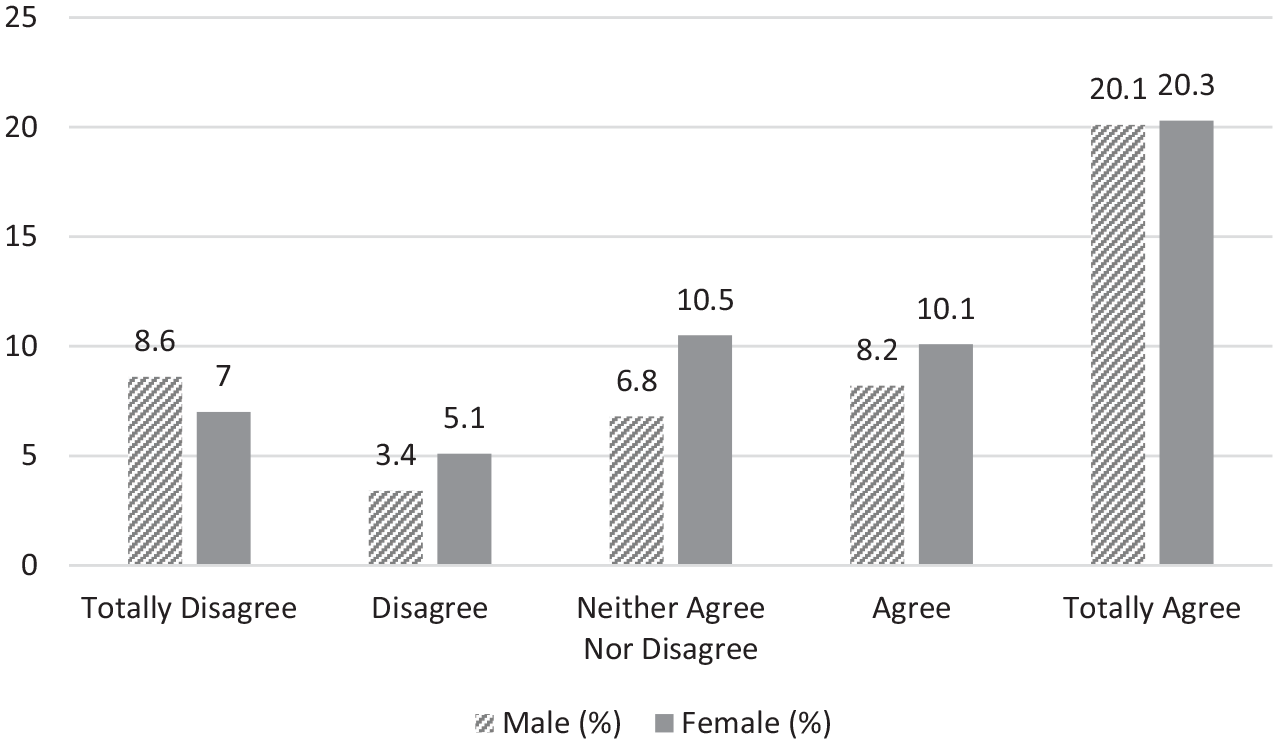
Level of support for votes at 16, by sex (%).
In order to dig deep into the analysis, a factorial two-way ANOVA was conducted to compare the main effects of gender and age group (12–14 and 15–18) as well as their interaction effects on the level of agreement of the participants with the possibility of lowering the voting age to 16. Thus, the results show no significant effects of gender (F(1, 942) = 0.079, p = 0.779, partial η2 = 0.000), nor significant interaction effects between gender and age group (F(1, 942) = 0.861, p = 0.354, partial η2 = 0.001). However, there is a significant effect of age group (F(1, 942) = 5.452, p = 0.020, partial η2 = 0.006), with the younger group (12–14) showing a higher level of agreement with the desirability of being able to vote at 16 (M = 3.68, SD = 1.461) than the older group (15–18) (M = 3.45, SD = 1.469). One interpretation that could be advanced from this result is that the younger people (12–14) are more idealistic about an age they have not yet reached than the older ones (15–18), who are more critical of young people of their age concerning their competency to vote in that moment or in the near future.
Results: Qualitative data
Questionnaires (open-ended question) (N = 961)
As mentioned above, the open-ended question was used to enable participants to justify their rating (five-point) on the item about the possibility of voting at the age of 16 to further deepen the data obtained from the questionnaires. The results are presented in the form of figures, depicting the number of responses coded in each of the main categories identified, as well as in the subcategories that emerged within the main categories. It is worth noting that the number of responses presented in each category and subcategory is the same as the number of participants, that is each response represents, exclusively, one single participant. Thus, despite the large number of ‘Inconclusive and No responses’ (390, 41%), there is a prevalence of ‘In Favour’ responses to voting at 16 (339 responses, 35% of the total) compared to responses ‘Against’ voting at 16 (204 responses, 21% of the total), as can be seen in Figure 2. However, the difference between the two categories is not as relevant as those observed in the other topics of the impact evaluation of the YM project (e.g. electronic vote) (see Ferreira et al., 2018), meaning that there is no broad consensus on the question of voting at the age of 16 among participants.
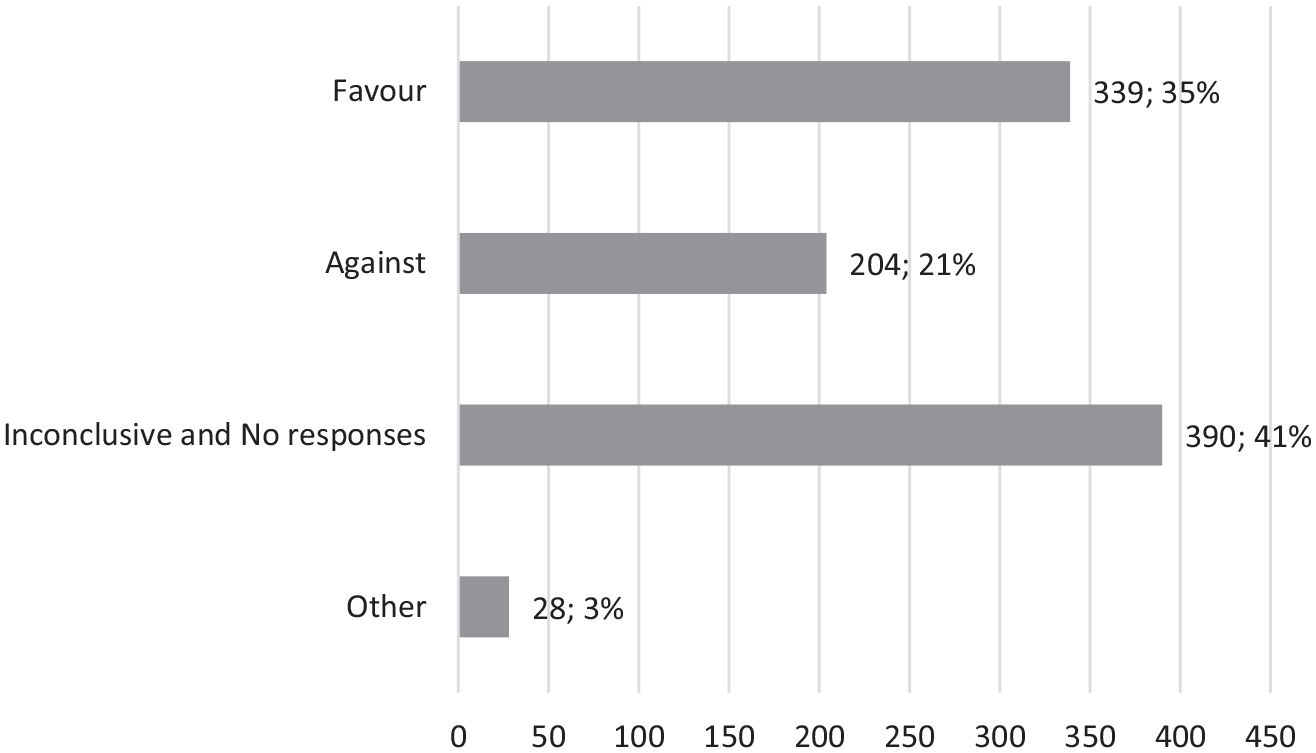
Votes at 16: No. and % of coded responses by categories.
The arguments that young people ‘Already have awareness, responsibility and maturity’ (147 responses, 43% of the total), and that they have the ‘Right to decide about the future’ (89, 26%), are the most mentioned within the category ‘In Favour’ of voting at 16 (see Figure 3). Concerning the category ‘Against’ the vote at 16, the most mentioned argument is ‘Immaturity’ (186 responses, 91% of the total) (see Figure 4).
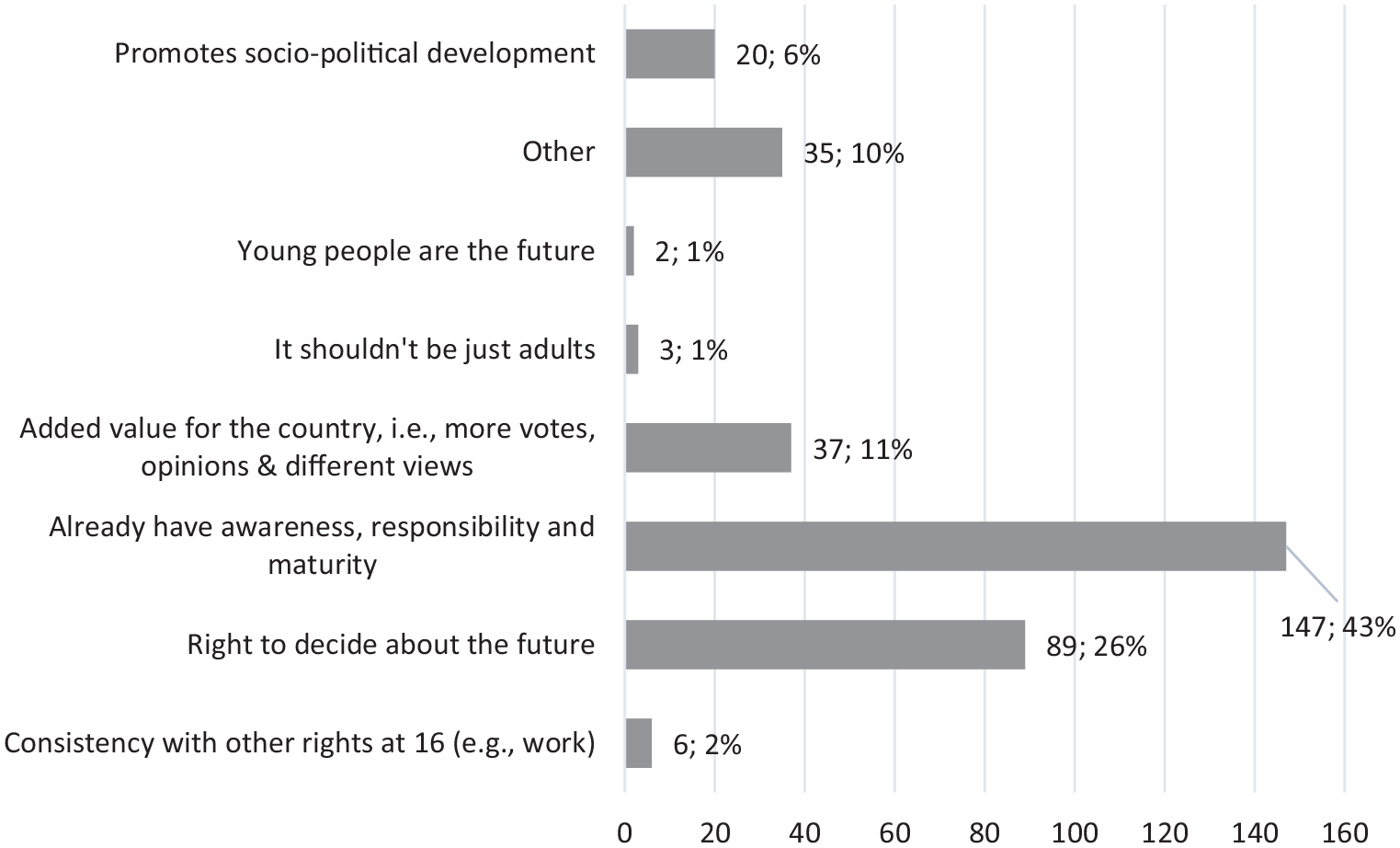
Reasons for supporting votes at 16: No. and % of coded responses by subcategories.
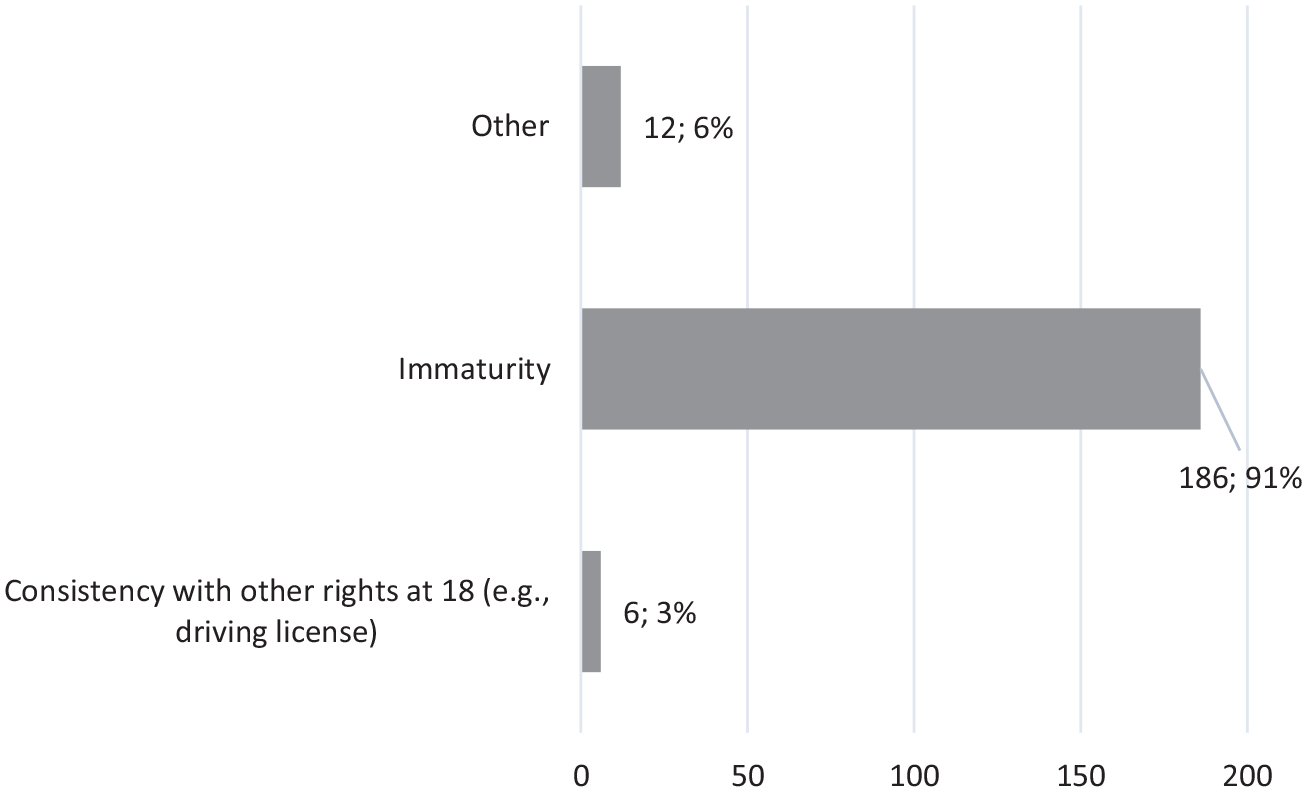
Reasons for opposing votes at 16: No. and % of coded responses by subcategories.
Below are some examples of responses to illustrate the responses of the participants in ‘Favour’ versus ‘Against’ the voting at age 16: I think by the age of 16 people already think for themselves and can contribute to the elections (Boy, 14 years old) I think we, young people, should also have some voting power because we live in this country too (Girl, 14 years old) In my opinion, as a citizen who is interested in politics and with some perception, I think we should be able to vote to defend our interests (Girl, 15 years old)
versus
Their maturity is still weak; practically most of youth aged 16 do not understand anything about politics nor do they have any desire to understand. Even I, at 17, have no interest in politics (Boy, 17 years old) Many young people are not mature enough to vote even at 18, let alone at 16. At 16, many young people do not even care about politics, which is why I disagree with voting rights at 16 (Girl, 14 years old)
Interviews with young mayors elected (N = 3)
The opinion of elected young women regarding the possibility of voting at the age of 16 is homogeneous. There is a consensus around the idea that young people are too immature to vote in an informed and conscious manner; in that sense, they are seen as politically apathetic. In other words, there is a fair degree of agreement among the three interviewees that seems to suggest a certain internalisation of the idea that young people are citizens under construction without the necessary maturity to exercise the political right of voting: We, young people, still have to gain a lot of awareness. It’s not worth it. We can participate in other ways. We can join associations, youth parties, participate in projects like Young Mayor, participate in local activities, local events such as the Medieval Journey [an historical recreation event held annually for several consecutive days in the historical centre of the city of Santa Maria da Feira]. We are contributing to society in that way. I think young people are often not yet aware of how decisions are made. They don’t even get informed about the electoral programmes (Girl, 19 years old) . . .they [adults] will actually read the electoral programmes and try to understand what is right and what is wrong. I do not think that lowering the voting age will bring many advantages because the youngsters are still a bit alienated from politics. The older ones, maybe not so much. To what extent, I have my doubts (Girl, 16 years old) It seems too early to me. At 16 I think what there should be is something that would begin to educate us about what voting is, what we are voting for, what kind of powers the people we elect will have, or what job they will have. I think it would be important at 16 to have some training in this direction, but not voting rights just yet. I still think it’s too early (Girl, 16 years old)
Focus group with young people (N = 15)
When asked about the possibility of voting at age of 16, young people hold a diverse range of opinions. Nonetheless, most young people who took part in the YM team, when discussing votes at 16 in the focus groups we conducted, were against the idea of lowering the voting age: It’s too soon, I think there are still things that young people have yet to realise (Girl, 1st edition, 18 years old) Not even now! Not that I know a lot, but I did not know almost anything about political parties or anything. As I was saying, you don’t learn anything about parties or ideologies. I think at that age it’s a bit premature (Boy, 1st edition, 17 years old) I think we’re too immature. That depends on the person, right? I know some people aged 18 who are not mature enough to vote (Girl, 3rd edition, 16 years old) Oh! We do not even know what it is that we want to do tomorrow, let alone who to vote for! Seriously! I don’t agree! Look, once I gave an interview and they asked me that, and I said that I agreed. We do what they want! [the adults responsible for the coordination of the YM project]. Now, I do not agree. I think we’re still very immature! If they should change it to turn 21, yes, I would be actually for it (Girl, 1st edition, 18 years old)
Although most young people opposed the vote at 16, there are also opinions in favour; as well as opinions that argue for the need of a selection (based on maturity, political awareness, etc.) of the young people who are eligible to vote at 16, in coordination with other youth-targeting policies (e.g. work, housing, health): The process could be a bit more difficult, in order to define who truly wants to participate. Because there are people who, just to rebel, can go there and vote. But if it were a bit more difficult, if it required more effort, they [the youngsters] wouldn’t go. They could make it a bit more difficult, so only the most informed ones would really vote. . . (Boy, 1st edition, 16 years old) There could be a test, almost a test . . . (Boy, 3rd edition, 14 years old) If we lower the voting age to 16, I think there would be other issues that might lead youths to say ‘so why can I vote at 16, but, for example, I can only take my driver’s licence when I’m 18?’ or ‘why can I vote at 16 and can drink alcohol only when I’m 18?’ There would always be an age that allows you to work, to drive, to vote. . . all at the same age (Girl, 2nd edition, 17 years old)
Limitations and future research
This study has some limitations that should be noted and addressed in future research. To begin with, our sample was collected from a single municipality. In addition, it was also carried out on a specific community of young people who had already the experience of participating in a youth politics programme. Given the small sample size, the findings are not generalisable across the country. Notwithstanding, we consider that this study provides a valuable contribution to research on young people’s attitudes to votes at 16 and political education. To do so, future research should collect data from a larger sample size of young people, considering diverse contexts and types of engagement and participation in order to integrate a wide range of backgrounds and opinions which represent the whole country. This will enable more robust inferential analyses of the Portuguese young people’s perceptions of lowering the voting age to 16 to be conducted.
Discussion
One of the aspects which is particularly evident in the results is the clear difference between the perceptions observed in the questionnaires with young students, involving a larger number of participants (N = 961), and the perceptions discursively elaborated within interviews and focus groups with young people involved in the Young Mayor project. In the questionnaires, there is a prevalence of responses in favour of lowering the voting age to 16. On the other hand, all the other data show a contentious and even an opposite understanding, especially those resulting from the interviews with the elected young mayors. These findings are somewhat unexpected, since we anticipated that a more in-depth discussion with adolescents who are already active in a participation project would reveal a more enthusiastic perspective on the possibility of earlier involvement by young people in the formal decision-making process. Further studies are needed to explore the reasons influencing adolescents’ perceptions about lowering the age to vote to 16.
Overall, the lack of (political) maturity is undoubtedly the most often used argument to justify opinions against lowering the voting age to 16. Regarding specifically the opinions presented by the young mayors interviewed, we hypothesise that the unanimous opinion against lowering the voting age may be due to the fact of a more intense participation experience (in the YM project) than most young people usually have, that is this intense participation experience may have influenced a more critical and demanding perspective regarding youth interest and participation in politics. However, we also think that this could be due to their internalisation of a certain adult-centric perception of young people. The plausibility of such analysis is supported by studies showing, for instance, that school principals and teachers tend to be against lowering the voting age to 16 (Ferreira et al., 2018; Hill et al., 2017), a viewpoint which is perhaps underpinned by the idea that young people are still under construction as citizens and are not yet mature enough to exercise the right to vote – for more details on the criticisms that can be pointed to this functionalist perspective of education that defends the idea that young people are citizens-in-the-making (Marshall, 1950), see for instance the following works: Biesta and Lawy (2006) and Ribeiro et al. (2017).
Therefore, taking the results as a whole, we could firmly say that the main conclusion of this study is that there is an ambivalent perception regarding young people’s political maturity to vote at 16. This conclusion is similar to that drawn by Godli (2015) who considered that the existing empirical evidence from Norway – collected in a voting age trial implemented in 2011, involving 21 municipalities and 9456 participants aged 16 and 17 – is not ‘unambiguous’, since some of young people do support lowering the voting age, while others do not. However, these conclusions are strongly contested by other studies showing that the quality of vote choice of the young people under 18 is similar to that of older voters (Stiers et al., 2020; Wagner et al., 2012) ‘so they do cast votes in ways that enable their interests to be represented equally well’ (Wagner et al., 2012: 372). Moreover, Stiers et al. (2020) claim that the only conclusion that can be drawn from their study with regard to correct, well-informed voting, is that ‘16 year olds do not perform any better, or any worse, than their parents do’ (p. 10); this assumption resonates with the study of Shukra (2017) which concluded, by examining the exit poll surveys of the Lewisham (UK) Young Mayor elections in 2013 and 2014, that ‘young electors take their vote seriously and a higher proportion of teenagers vote for a directly elected Young Mayor than adults do for a directly elected Mayor in adult elections elsewhere’ (p. 75).
Despite the ambivalent perception regarding young people’s political maturity to cast a well-informed vote at the age of 16, the idea that young people should be politically mature as soon as possible is supported. Considering this premise, opportunity to act differently in school should not be wasted. In other words, taking the arguments presented by Peto (2018), ‘[i]f factual knowledge about political systems and political affairs really is required for the vote, we ought to provide that knowledge to children via education and allow them to vote rather than deny them that education and prevent them from voting’ (Peto, 2018: 283 – our emphasis). Going even further, the same author points out that young people are ‘already mature, or, to the extent they are immature, this immaturity is a product of a system which excludes them and the immaturity will fade if the voting age is lowered (perhaps when combined with other policies such as increased political education in school)’ (Peto, 2018: 293 – our emphasis).
As Schwarzer and Zeglovits (2009: 333) have shown, there is a positive correlation between the frequency of political discussions with friends in school and the probability of political participation. On the other hand, giving young people genuine political rights will strengthen their democratic commitment and political engagement (Ødegård, 2011). On this matter, Zeglovits and Zandonella (2013), aware that the lack of political interest among adolescents has been used as an argument against lowering the voting age, raised the following question: ‘why should someone be interested in politics if he or she is not eligible to vote?’ (p. 1084). Answering this question, their study points out ‘that political interest of 16- and 17-year-olds was higher after lowering the voting age’ (Zeglovits and Zandonella, 2013). In addition, this also indicates that ‘[t]he impact of schools on political interest among young people emerged after the voting age had been lowered’ (Zeglovits and Zandonella, 2013).
Godli (2015) emphasised that voting habits at an earlier stage ‘increase the likelihood that they will continue to vote at a later stage’ (p. 158), assuming in some way the assertion that voting is a habit-forming (see Dinas, 2012). Moreover, reinforcing previous studies, Zeglovits and Aichholzer (2014: 359) show that their ‘findings contradict the studies that assume low electoral participation of 16- and 17-year-olds because of lack of political interest’ (e.g. Chan and Clayton, 2006), arguing that ‘those who have not yet developed a habit to vote will especially abstain in second order elections’ (Chan and Clayton, 2006).
In this context, the issue of lowering the voting age to 16 should be the subject of a wide, in-depth societal debate, because, as Peto (2018) pointed out, summarising the scientific evidence, when the voting age is lowered in general elections, ‘16- and 17-year-olds have higher turnout rates than other first-time voters [. . .]; they are just as politically interested as older voters [. . .]; they know as much as older voters [. . .]; and they vote just as competently’ (Peto, 2018: 293). Indeed, a study based on focus group discussions with Portuguese young people reveals that the claims for schools to fulfil the role of better equipping youth with political competencies and knowledge, go along with pleas for a youth-friendly political system capable of promoting mechanisms of participatory policy-making (e.g. participatory budgeting) and political participatory measures, such as the lowering of the voting age to 16 years old (Malafaia, 2017). As Wall (2014a) very eloquently argued, ‘like all other disempowered groups, children and youth present democratic life with a profound opportunity for creative new self-critique. What minors really call for is democracy’s more profound democratization’ (pp. 656–657). Besides that, ‘Democracies ought to avoid presuming what is best for entire populations without first hearing from those populations themselves’ (Wall, 2014b: 114), because ‘[i]f democracy is the experiment of including “the people” in governance, then it is undemocratic to exclude the third of the people who happen to be under 18 years of age without significantly more compelling reasons for doing so’ (p. 118).
Recognising that it is an area of research that should be the focus of future studies, Eichhorn and Bergh (2019a) emphasised that ‘[g]ranting voting rights to a new segment of the population is not just about turnout and engagement in democracy, it is also about power’ (p. 241, emphasis in original).In other words, as Barrett and Pachi (2019: 88) pointed out: Allowing 16- and 17-year-olds to vote has the additional benefit of enabling them to seek political representation on matters that can deeply affect their lives. This will not only reinforce their levels of political internal efficacy but will also have an effect on the candidates who are elected, their political priorities and the extent to which the policies that they put forward take into account the concerns and views of youth.
Conclusion
All in all, the results do not reveal a homogenous and emphatic position on lowering the voting age to 16. While on the one hand we have discourses that support the vote at the age of 16, on the other hand, there are also discourses claiming that young people, at these ages, are still immature and cannot exercise the right to vote in an informed and conscientious way. Indeed, the lack of political maturity is the argument most often used to justify opinions against voting at 16. Thus, considering the results as a whole, there is an ambivalent perception concerning young people’s political maturity to vote at 16. Grounded on the research finding that young people should be politically mature as soon as possible, it is argued that adequate political education needs to be provided by schools to enable young people to grow as confident voters, feeling able to make informed choices when voting. Consequently, we propose that governments recognise the importance of this area in the schools’ curriculum, in order to enable young people’s acquisition of knowledge and skills that can sustain their growth as competent voters. This is crucial in legitimising democratic representative systems. Considering these findings, it is important now to develop further studies on youngsters’ perceptions regarding lowering the voting age to 16, but also to analyse the real impact that political education (provided by schools) brings about on the political interest and electoral participation of young people. The analysis developed by Bessant (2020) on the failed attempt in Australia in 2018 to lower the voting age below 18, is of assistance in re-framing the debate as a matter of citizenship, in relation to how minors are misrecognised and misrepresented in a context of democratic crisis. In that sense, we follow the arguments advocated by Bowman (2021) and Loughran et al. (2019, 2021) that the debate over voting at 16 should be accompanied by the concern of producing proposals to promote youth political engagement more effectively, rather than focusing the problem on the simplistic question of the voting age.
Footnotes
Declaration of conflicting interests
The author(s) declared no potential conflicts of interest with respect to the research, authorship, and/or publication of this article.
Funding
The author(s) disclosed receipt of the following financial support for the research, authorship, and/or publication of this article: This work was supported by the municipality of Santa Maria da Feira, under the Young Mayor project; and by national funds, through the Portuguese Foundation for Science and Technology, IP (FCT), under the strategic funding awarded to CIIE (grants nos. UIDB/00167/2020, and UIDP/00167/2020]. N. Ribeiro also acknowledges FCT funding for his contract, established under the Scientific Employment Stimulus Individual Programme (CEECIND/02115/2018).
