



Abstract
In recent years, the concept of global citizenship has been widely incorporated into educational programmes worldwide, ranging from primary schools to higher education. Nevertheless, scholars in the field of political geography have tended to view this concept as less relevant to young people’s political engagement. Based on this foundation, this paper discusses how notions of geographical scale can offer a more comprehensive understanding of global citizenship education. The discussion focuses on identifying descriptive and pragmatic/normative conceptions of global citizenship. The paper concludes by suggesting that research on the political geographies of young people can contribute to a critical approach to global citizenship education by offering an alternative to conventional notions of the geographical scale as a hierarchical organisation of society.
Keywords
Introduction
The web page at which the Royal Geographical Society at the Institute of British Geographers (RGS) provides resources for schools notes that ‘being a global citizen is essential to life in the 21st century’ (Royal Geographical Society, 2021). It then asserts that ‘the fact that we now live in what is termed a Global Village means that students are not only aware of global events, but they are also aware that what happens across the globe affects them too’. This web page further emphasises the importance of global citizenship by referencing Oxfam’s guide to teachers, which states that ‘Global Citizenship gives [students] the knowledge, understanding, skills, and values that they need if they are to participate fully in ensuring their own and others’ wellbeing and to make a positive contribution, both locally and globally’.
This emphasis on global citizenship has been integrated into educational programmes worldwide, ranging from primary schools to higher education programmes, often through the support of various nongovernmental organisations that focus on relevant global issues (Dimpfl and Smith, 2019; Lough and McBride, 2014; Woods and Kong, 2020). Such pervasive interest in global citizenship education has also been reflected in a large body of educational science and citizenship studies that have explored various ways in which educational programmes worldwide socialise young people in what is known as global citizenship (Alejo, 2020; Noh, 2019; Oxley and Morris, 2013; Pashby et al., 2020; Pillay and Karsgaard, 2023). Global citizenship education (GCE) has become a world-wide educational movement with support from scholars with various backgrounds (Bajaj, 2011; Bergen et al., 2020; Bosio, 2023; Ellis, 2021; Kim and Kwon, 2023; Misiaszek, 2020). (Ferguson, 2024) However, the concept of global citizenship has been contested and has sometimes been characterised by contradictory meanings and multifaced practices (Schattle, 2008)
To help navigate the literature on global citizenship in education Pashby et al. (2020) have followed up on the work of de Oliveira Andreotti et al. (2016) and conducted a type of a meta-review known as social cartography to discuss three main typologies of global citizenship that have been referenced in the emerging literature on global citizenship education (for other relevant reviews see: Estellés and Fischman, 2021; Hou, 2020; Yemini et al., 2019). The first such typology of Pashby et al. pertains to the ‘neoliberal approach’, which suggests that human wellbeing can be advanced most effectively by liberating individual entrepreneurial freedoms and skills within an institutional framework characterised by the current capitalist orientation of the global economy. The second typology, that is, the ‘liberal approach’, also focuses on individual freedom; however, it views citizens as accountable to a democratic notion of the nation-state that has been transferred to the global scale. The final typology is known as the ‘critical approach’, and it seeks to interrupt the violent patterns of power and knowledge that are embedded in the colonial nation-state and that express their power on a global scale. Although these categories occasionally compete with one another, they can also be complementary or even overlap in terms of their conceptions of global citizenship education (de Oliveira Andreotti et al., 2016; Pashby et al., 2020).
Notably, however, although this literature review reveals that the concept of global citizenship, in its various meanings, has received significant attention in the contexts of educational research and citizenship education, the concept has largely been overlooked by research on political geography. This oversight is particularly interesting, as political geography is a subfield of geography research that extensively considers the implications of globalisation for education. However, the global dimension of young people’s citizenship has instead been approached from different perspectives, such as cosmopolitanism (Warf, 2015), intracultural understanding (Arrowsmith and Mandla, 2017), transnationalism (Szkornik, 2017) and internationalisation (Hudson and Hinman, 2017; Kenna, 2017; Khan et al., 2014; Theobald, 2008).
Altogether, this situation highlights an apparent contradiction between the notable interest exhibited by education scholars in the articulation of global citizenship in education and the lower level of engagement with this concept exhibited political geographers. Notably, scholars who have investigated the political geography of young people have generally agreed that analyses of citizenship among young people must extend beyond the territoriality of the nation-state (e.g. Cheng and Holton, 2019; Hörschelmann and Refaie, 2014; Kallio et al., 2020; Kastrissianakis et al., 2021). Nevertheless, the concept of global citizenship has largely been overlooked in studies of the political geography of young people and has rarely been viewed as a phenomenon that can be analytically researched and empirically explored (e.g. Baillie Smith and Laurie, 2011; Dimpfl and Smith, 2019; Kastrissianakis et al., 2021; Lorimer, 2010; Reddy, 2019)
This apparent contradiction represents the point of departure for this paper, which aims to explore how the research field of political geography, despite its limited interest in the concept of global citizenship, can contribute to contemporary understandings of young people’s global engagement in the context of global citizenship education. In the following section, we begin by discussing young people’s citizenship from the perspective of geographical scale. On the basis of this discussion, in the following section, we suggest that the concept of global citizenship should be divided by into descriptive and pragmatic/normative approaches to citizenship. We end the paper with some concluding remarks.
Geographical scales of young people’s citizenship
Some years ago, Staeheli (1999), a prominent political geographer, noted that globalisation significantly influences the articulation of citizenship. In response to this new geography of society, a considerable number of geographical studies have investigated on postnational approaches to citizenship (Baillie Smith and Laurie, 2011; Dimpfl and Smith, 2019; Hörschelmann and Refaie, 2014; Jeffrey, 2012; Lough and McBride, 2014; Reddy, 2019). These approaches have recognised that young people engage extensively with political issues such as climate change, inequality, and discrimination at both the local and the global scale. Furthermore, Bowman (2019) argued that young people represent one of the most remarkable and important mass movements of our age, particularly in reference to the massive mobilisations that emerged from the school strikes initiated by Greta Thunberg.
This new geographical reality of young people’s political engagement is explored below by identifying and discussing four possible ways of using geographical scales to understand emerging developments in young people’s citizenship. It starts by discussing an understanding of politics that extends beyond the national level through the upscaling and/or downscaling of citizenship. Thereafter, citizenship is explored by investigating cross-scalar approaches to citizenship (Desforges et al., 2005; Mills and Waite, 2017; Wood and Black, 2018). A final approach discussed is the descaling of citizenship, which involves rejecting the notion of geographical scale as a foundation for understanding young people’s citizenship. This discussion is summarised at the end of the section in Table 1 in terms of how each of these notions of scale has implications for our understanding of the concept of global citizenship.
Identifying geographical scales of young people’s citizenship and their implications for understanding global citizenship.
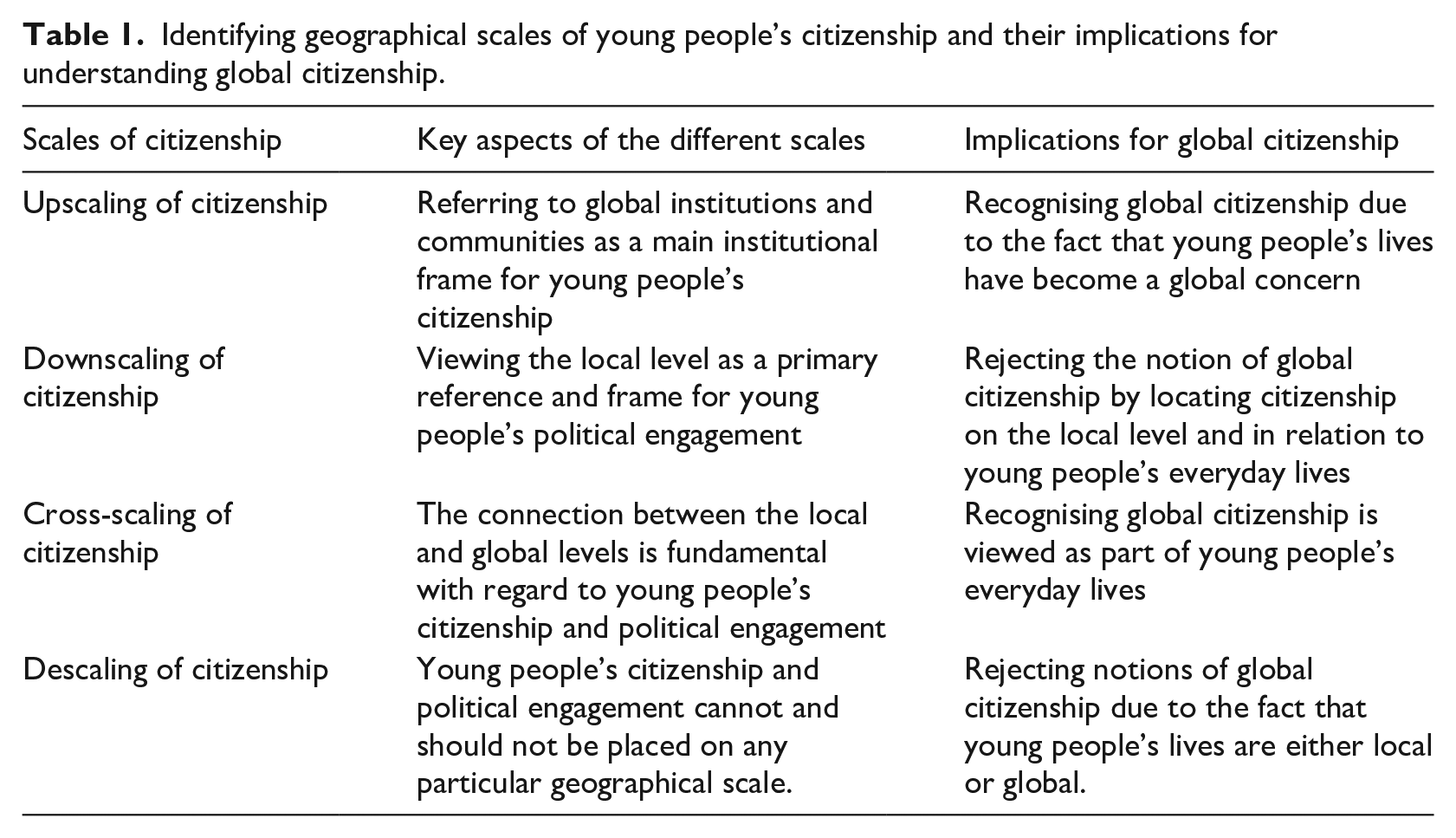
The basic upscaling argument for the inclusion of the ‘global’ in conceptions of citizenship is simple: because politics have become a global issue, notions of citizenship must also consider the recent increases in the interconnectedness of the world (Desforges, 2004; Mills and Waite, 2017). New media has played a crucial role in this development, and contemporary young people are among the most advanced and frequent users of such media (Loos and Ivan, 2024). Young people’s media use connects them with their peers worldwide and provides them with information regarding events in geographically distant places. Rye (2016), for example, explained how senior high school students in Norway took the initiative to use search engines such as Google to access learning sources, including distant sources, for school projects. On the basis of observations of developments in China, Ong (2006) described how the ‘cyberpublic’ has become a transnational space in which people can develop their citizenship in relation to the ruling powers.
However, citizenship formation can also be traced to the global flow of markets, technology and people. For example, Ong (2006, 2022) emphasise that migration based on a market logic establishes a transitional space that has implications for how young people are formed and form themselves as citizens. Kim and Kwon (2023) explained how the steady influx of migrants from various countries such as Vietnam, China, and Uzbekistan has changed South Korea from a homogenous society to a country that is increasingly racially, ethnically, linguistically, and culturally diverse. This new transnational reality, as these authors argued, entails challenges with regard to the ways in which secondary teachers engage in citizenship education. Dyrness (2021) questioned how state-led global citizenship programmes typically work for transnational youth, particularly with regard to nonwestern migrants. Additionally, for younger children, migration entails a transitional environment that has various implications for their development as political subjects and citizens (Ansell, 2009).
As is evident in the RGS definition discussed in the introduction to this paper, the normative implication of such conceptions of global citizenship is that young citizens must be able to act and behave in relation to a global political community, that is, a ‘global village’ of which they are considered to be a part (Royal Geographical Society, 2021). Kim and Kwon (2023) explicated this point by revealing how teachers in South Kora, through global citizenship education, aim to highlight justice as a global issue reflecting the ‘bigger picture’ at the global scale which concerns all people. Similarly, in the context of the UK, Lough and McBride (2014) noted that many geographers have expressed the concern that young adults in the Global North are unprepared to meet the demands of an increasingly globalised society. This issue is related to the fact that a nationalistic and ethnocentric focus among young people is rendering them unable to address and act on global issues such as poverty, human rights, and climate change in a constructive manner. Other scholars have emphasised the fact that a neoliberal system requires young citizens to prepare themselves to participate in a global economy (Baillie Smith and Laurie, 2011; Dimpfl and Smith, 2019; Reddy, 2019).
Howard (2022), Howard and Maxwell (2021), for example, based on a multi-sited global ethnography of elite schools around the world, explore how these institutions prepare students for an increasingly interconnected world characterised by diversity and competition through global citizenship education and what they term cosmopolitan practices. On the other hand, the literature also examines approaches to developing young people as global citizens through education grounded in legal human rights frameworks, which support youth political engagement (Jerome et al., 2021; Jerome and Starkey, 2022). The Rights of the Child is one such institutional framework, discussed in the literature from the perspective of citizenship development.
Overall, these notions of global citizenship reflect tensions between the neoliberal ideal of citizens as autonomous economic agents who participate in a global market economy and the liberal ideal of citizens as responsible agents and defenders of political freedom and human rights on a global scale (Lorimer, 2010; Ong, 2006). Furthermore, the upscaled version of citizenship highlights the tension between an understanding of global citizenship as an elitist and postcolonial project and a conception of global citizenship as a project that focuses on defending marginalised people worldwide (Stein, 2015; Stein and de Andreotti, 2016).
A second way of calling the national approach to citizenship into question has been to downscale citizenship by locating it at a local scale. This downscaling can be viewed as a response to the increased focus on how globalisation has detached politics from young people’s daily lives since young people tend to view this conceptualisation as abstract, distant and out of reach (Ansell, 2009). Thus, downscaling can be viewed as an attempt to repoliticise young people by representing political participation as ‘informal’ and ‘softer’, albeit not as necessarily less important than conventional politics (Hörschelmann and Refaie, 2014; Kallio et al., 2020).
This situation is evident in educational citizenship programmes in schools that focus on the local level, particularly in the context of issues that young people experience directly (Adams, 2005). Consider the example of Lemanski’s (2020) discussion of what she calls everyday citizenship in the context of school programmes in South Africa, which focus on young people’s participation in local planning. Similarly, Ansell (2009) claimed that much of the geography of young people’s political participation is characterised by a preoccupation with the microscale, such as neighbourhoods, playgrounds, shopping malls, and school transportation. A great deal of research on this topic has focussed on children, but in the literature, young people (i.e. those into their early twenties) have also been viewed as citizens in the making, as they are not able to participate fully in politics (Gifford et al., 2014; Skelton, 2010)
However, as noted, such a focus on young people’s local lives does not necessarily imply that global politics are irrelevant to understanding young people as political subjects. A local approach to young people’s political engagement has typically focussed on the direct interactions between the daily lives of young people and the phenomenon that may be termed global politics (Mills and Waite, 2017). This approach involves ensuring that youths can access global politics (and the global world) by localising the subject on a scale that makes it possible for them to express political engagement (Rye, 2013, 2016). In other words, a downscaled version of citizenship may be related to how global relations impact people’s local experiences of politics, and global interconnectedness arguably obtains a more central position when this group of people are conceptualised in this manner.
The preceding discussion situation suggests a cross-scalar approach to citizenship that identifies young people’s political action as embedded in multiple but as related to connected scales. Citizenship is thus located at both the local and global levels. This cross-scaling of citizenship among young people is interesting, as it accounts for a globalised world while simultaneously recognising young people as political subjects who can change their immediate surroundings (Chipato, 2021). However, cross-scaling citizenship is also problematic for several reasons, particularly with respect to a rights-based approach to citizenship. One issue in this context pertains to the fact that this approach implies a basic conception of individuals as possessing universal political rights (and duties) at a level above that of the state; for example, through the Universal Declaration of Human Rights 1948, which has typically been viewed as emblematic of the rights-based approach (Isin and Turner, 2007; Lough and McBride, 2014). While the importance of such declarations is not in doubt, their use as a foundation for the construction of global citizenship may be problematic (Shafir and Brysk, 2006). A core argument in this context identifies such rights as abstract in character and universal in their application and hence as less relevant for citizens’ daily lives (Hutchings, 2002; Kastrissianakis et al., 2021). Everyone has these rights as individuals; that is, they are not earned through practice, and they entail no corresponding formal duties, representing rather merely a notion of potential responsibility that may be experienced as a duty (Isin and Turner, 2007).
Some scholars have claimed that these rights can, at least to some extent, be secured through their incorporation into national legislation (Benhabib, 2013). Nevertheless, this approach raises questions regarding the scales of citizenship. In this context, universal rights are necessarily secured by the institution of the nation-state, which, according to Isin and Turner (2007), has a doubtful interest in securing such rights. On the basis of an investigation of legislation in the US and Europe, Nash (2009) even claimed that such approaches establish conditions in which fundamental human citizens’ rights are violated. A core challenge pertaining to many cross-scalar approaches to citizenship is, accordingly, the fact that individual rights are typically upscaled and embedded in institutions above the level of the nation-state. Nevertheless, agency is typically downscaled to the local level in (young) people’s daily lives (Kallio et al., 2020).
An action-oriented approach to global citizenship may overcome the institutional limitations of a cross-scalar approach to citizenship, as it emphasises young citizens’ ability to make political claims independent of their position outside or inside a given political and territorial community, such as the nation-state (Staeheli et al., 2016). We have already discussed how formal political institutions are not necessarily a precondition for a downscaled version of citizenship; this claim is also applicable to global citizenship. Accordingly, the question that emerges in the action-oriented approach is not what (global) citizenship is in terms of the existence of rights and duties within a formalised political community but rather how global citizenship is performed and constructed through various actions across existing scripts for appropriate political behaviour (Isin, 2009). This situation allows citizenship among young people to be viewed as a multiscaled and cross-scaled phenomenon that is not limited by state borders or territory (Bamber et al., 2018; Staeheli et al., 2013).
This action-oriented approach to citizenship is, however, also problematic, as it typically relies on a notion of young people as bearing global responsibility; in contrast, they actually have few opportunities to act above the national level—that is, at a global scale. Their acts will always be local, although they are believed to have implications at the global level. As Ansell (2009) noted, young people, particularly children, have only a limited capacity to act purposefully beyond the level of their immediate encounters with people and places, although global relationships have implications for their lives. Therefore, it may be appropriate to question how young people’s agency is located at the local level while responsibility is ascribed to them at the global level. Thus, the concept of global citizenship as a cross-scalar version of citizenship entails the risk of burdening young people with the consequences of the failures of previous generations without entrusting them with political agency at the same level in the present context (Rye and Vold, 2019).
Finally, geographers have suggested an interesting alternative to scalar approaches to citizenship based on the notion of descaling citizenship, that is, not locating it at particular scales. This approach is based on recent advances in geographical theory, which have proposed that cross-scalar approaches to space largely fail to overcome the tension between the local and the global (Ash, 2020; Jones et al., 2007; Marston et al., 2005). A main concern in this context is that scales are defined hierarchically, where the local scale is typically viewed as concrete, small, and proximate, whereas the global scale is viewed as abstract, large, and distant. Accordingly, Ansell (2009) suggested that a flattening ontology such as that developed in human geography might highlight ways of addressing the difficulties that children’s geographers have faced in their efforts to advance beyond young people’s immediate environments to address other issues that affect their lives. Other geographers have used a topological notion of space to advance our relational understanding of young people as political subjects (Bartos, 2020; Kallio, 2016; Mitchell and Kallio, 2017).
Common in these relational approaches to young people’s geographical space is an interest in how young people engage as citizens in what is distant—whether distant events, places, or people—in significant relations that constitute what it means to be and act as young political subjects. Similarly, Staeheli et al. (2016) argues, with reference to international conferences for young citizen activists, that the circulation of ideas, values, and bodies is always critical to the ways in which the near and the distant are constituted. As a result, Staeheli et al. (2016) suggest that citizenship should not be located at specific sites or scales; instead, the focus should be on the relationships through which citizenship is constructed, enacted, and given meaning. Hence, political (educational) programmes that seek to establish a foundation for young people’s citizenship should not be limited to being local, national, or global. Instead, such programmes should extend across space and involve transnational relations and multilocal communities that are typically supported by various media and communication technologies (Hörschelmann and Refaie, 2014; Wood and Black, 2018).
This point is also evident in Hörschelmann and Refaie’s (2014: 454) study of young people in the United Kingdom and their engagement with international politics. The students interviewed as part of that research indicated that they ‘felt intimately connected to the plight of those suffering the atrocities of war in Iraq and Afghanistan’. They described this feeling as an immediate concern rather than a distant concern. According to Hörschelmann and Refaie (2014), this view was influenced by both the media’s extensive coverage of the issue at the time and the transnational connections maintained by young people, especially those from migrant families. It was also the result of a sense of responsibility and care emerging from these connections as well as young people’s general feeling of connectedness to others in distant places due to the globalisation of media. Young people analyse international political events by focussing on their own envisioned futures and those of others, and they thereby anticipate broader global repercussions resulting from seemingly isolated current events.
In line with the preceding argumentation, recent efforts in the field of political geography to establish a theoretical position concerning the topology of young people as political subjects have resulted in the emergence of the concept of ‘lived citizenship’ (Kallio et al., 2015, 2020). These works have made sense of young people’s political agency by investigating spatial relations as a part of young people’s everyday lives and the contextual aspects of lived citizenship (Kallio et al., 2020). Notably, the lived citizenship approach is not merely a downscaled version of citizenship as it according to Kallio et al. (2020), rejects a reduction of young people’s agency to local practices. Lived life, these scholars claim, is not entirely about young people’s local practices but also includes relations stretching across space. Thus, other and sometimes distant places become integral components of young people’s local lives. Similarly, in line with the preceding example of young people’s engagement in the wars in Afghanistan and Iraq, Kallio and Häkli (2013) suggested that lived citizenship remains a local articulation despite the fact that these articulations are produced through relations that extend across space; thus, this understanding of lived citizenship differs from most conceptions of global citizenship despite approaches that focus on the merging of transnational connectivity.
Descriptive and normative/pragmatic conceptions of global citizenship
The preceding discussion of global citizenship illuminates how research in the field of political geography has productively engaged in the process of challenging and reformulating young people’s political engagement in response to the increased global interconnectedness that characterises the contemporary world. The following section expands on this insight by outlining and discussing two distinct ways of conceptualising the geographical dimension of global citizenship, namely, a descriptive way and a pragmatic/normative way. This discussion relies on de Oliveira Andreotti et al.’s (2016) typologies of approaches to global citizenship as introduced in the introduction to this paper. The section ends with Table 2, which lists these approaches alongside a descriptive and a pragmatic/normative approach to global citizenship.
Conceptualisation of the geographical dimension of global citizenship.
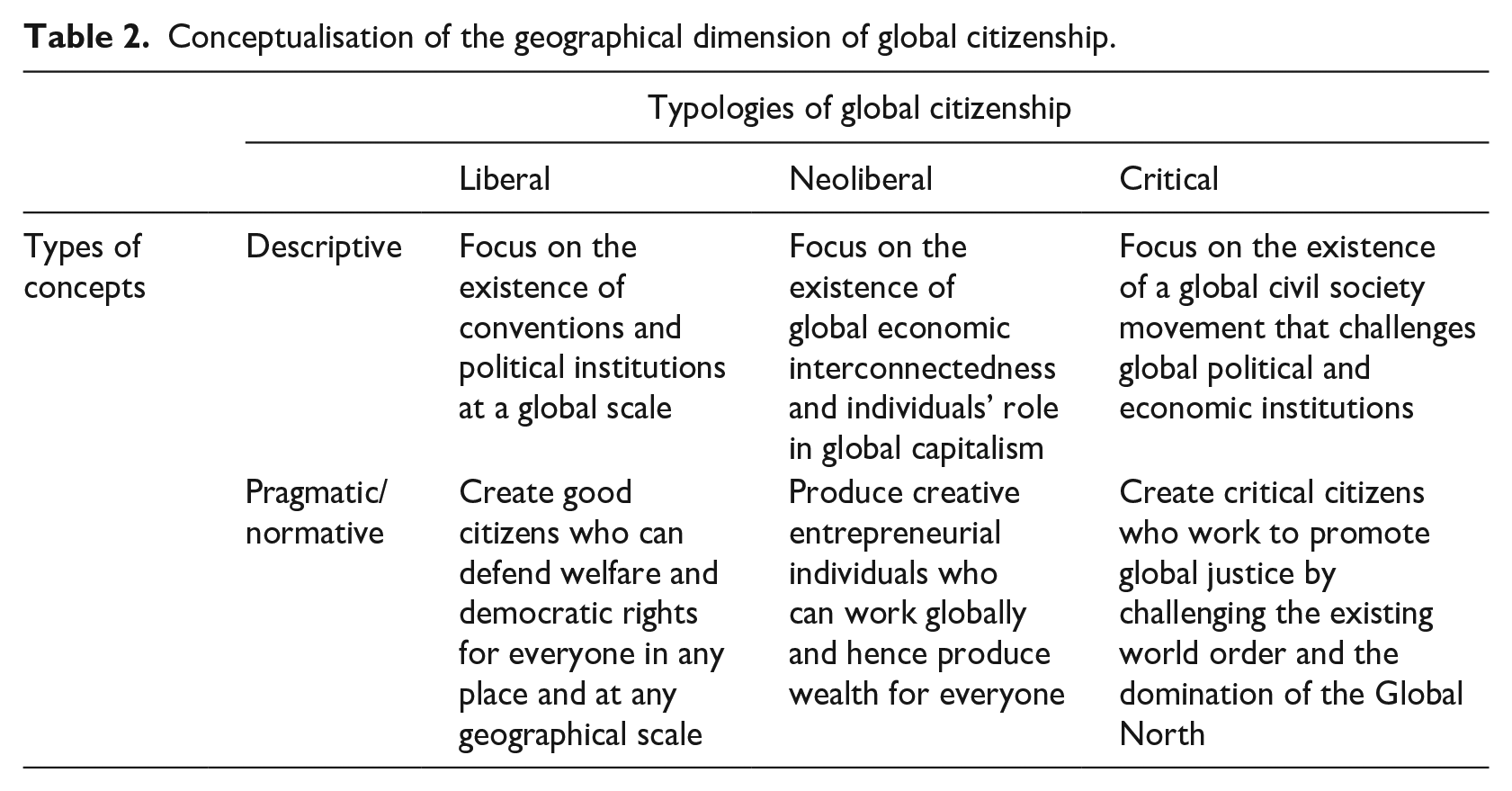
First, global citizenship may appear as a descriptive concept of a particular form of citizenship on the basis of what has been described as a new spatial reconfiguration of society: a globalised world. In educational research, this perspective is evident in the fact that citizenship programmes present both globalisation and global citizenship as facts that schools must consider (Bamber et al., 2018). The presence of advanced media technologies and forms of human mobility that connect different parts of the world is typically essential to descriptions of a globalised world (Wood and Black, 2018). This approach to global citizenship has typically been based on an essentialist notion of globalisation, which views this concept as a force that has transformed the world into a society in which members exhibit a kind of shared destiny and a common ground for addressing politics (Lough and McBride, 2014). This approach also typically includes the existence of institutions and conventions that operate above the national level and facilitate the existence of global citizenship.
According to the liberal approach to citizenship, notions of the existence of global communities and institutions are essential with respect to securing individual rights in matters such as individual wealth and democratic rights (Isin and Turner, 2007). The neoliberal version of citizenship, on the other hand, focuses on global interconnectedness through corporate institutional and production networks (also known as global capitalism) that are viewed as the foundation of global wealth (Ong, 2022). Both approaches view the global as the sum of nation-states, and they view the nation-state as the factor that constitutes the rule and order that characterises the global scale (Bamber et al., 2018) and do accordingly reflect an upscaled version of citizenship as discussed in the previous section.
Approaches to global citizenship based on critical theory also acknowledge the existence of political and economic institutions that operate at the global scale; however, they explain this existence as a result of a colonial history whose primary function is to uphold existing global power relations (Andreotti, 2011; Pashby and Costa, 2021; Stein and de Andreotti, 2016). As a result, the descriptions of globalisation provided by a critical approach to citizenship tend to focus on the existence of a global civil society rather than the origin of institutions in the existence of (pot-colonial) nation-states (Andreotti, 2021). A critical approach to citizenship thus implies a notion of the global arena and a global scale in which people and communities struggle to obtain recognition and promote societal changes (Kim and Kwon, 2023).
Regarding the descriptions of globalisation and global citizenship, prominent citizenship theorists such as Isin and Turner (2007) interestingly question the existence of a global community as a foundation of citizenship. This is done without acknowledging the presence and importance of institutions such as the United Nations and global conventions related to universal human rights. Isin and Turner’s argument implies that even though the globe is highly connected through economic integration and systems for communication and transportation, this connectivity does not necessarily indicate a global political community or any other sense of global belonging (Wood and Black, 2018).
The implication of this perspective is a rejection of the existence of global citizenship in the same way that the existence of true global institutions and communities is rejected. Accordingly, a critical approach to global citizenship in the context of education is also indirectly called into question, as true global institutions and communities based on civil society organisations are viewed as unrealistic and as not presently existing. Another issue regarding global citizenship is whether rights such as human rights are global in the sense of being universal. Indeed, some scholars have suggested that these rights are visions that reflect what people should think and how the world should appear (Kastrissianakis et al., 2021). The latter indicates the next way of understanding the concept of global citizenship.
Second, global citizenship can also be a pragmatic concept with moral and political implications regarding how citizenship is considered to be a component of educational practices. This notion of global citizenship is based on moral or ideological perspectives that seek to encourage young people to engage as active members of society (Baillie Smith and Laurie, 2011; Staeheli, 2011). This approach is in line with Lough and McBride’s (2014) description of global citizenship as a sociopolitical construct that exists independent of whether an institutionalised form of global citizenship actually exists. Similarly, Pashby et al. (2020) and de Oliveira Andreotti et al. (2016) described their previously referred typologies of global citizenship education as ideological positions. This position is also typically found in the emerging literature on global citizenship education (Bajaj, 2011; Bergen et al., 2020; Ellis, 2021; Kim and Kwon, 2023).
The existence of global citizenship in this construct is not contested; rather it is taken for granted, as it exists in the form of rights, duties, and political communities at the global scale. Instead of asking whether global citizenship is real, the essential question is how the notion of global citizenship can serve as a useful means of supporting young people in the process of creating a better world, whether their approach to this task is liberal, neoliberal or critical (Oxley and Morris, 2013). Such a conceptualisation of global citizenship typically establishes a foundation for educational citizenship programmes to be used as political tools with the goal of preparing young people to become agents for change who have responsibility for everyone, rather than merely those who live within the borders of their own countries (Lough and McBride, 2014).
Many of these citizenship programmes in schools employ a liberal approach to citizenship that emphasises the view that young people are indivisibly responsible for securing rights and wealth for everyone without questioning the current global order (Bamber et al., 2018; Kim and Kwon, 2023). This approach is apparent in the RGS example discussed in the introduction of this paper. However, the political expression of global citizenship may also take a neoliberal form by serving as a political tool that can be used to support a neoliberal global production structure; in this context, relevant actors exhibit less concern about democratic development as a collective action (Baillie Smith and Laurie, 2011; Dimpfl and Smith, 2019). Critical approaches to global citizenship education have relied on notions of decolonialism to challenge citizenship programmes that aim to engage young people in existing global structures based on liberal or neoliberal ideas of citizenship (Bamber et al., 2018; Hong, 2018; Hutchings, 2002; Kim and Kwon, 2023). Hence, the critical approach has productively challenged the ways in which citizenship programmes have reproduced power relations and inequalities at different scales.
Interestingly, the core characteristics of the critical citizenship approach are echoed in the literature on young people’s political geography, albeit with no reference to notions of critical global citizenship. A core argument in political geography pertains to how pragmatic and normative notions of global citizenship programmes, including voluntarism, among NGOs are seemingly most apparent in high-income countries such as countries in Europe or the USA, which are also often referred to as the Global North (Baillie Smith and Laurie, 2011; Lorimer, 2010; Lough and McBride, 2014). The literature has further explained that these programmes tend to focus on the need to take societal action to address problems in low- and middle-income countries, which are often known as the Global South.
The problem-solving methods used by the Global North in the Global South are typically implemented first in early education. For example, the previously cited RGS website suggests that ‘global disasters can be used as a vehicle to explore global citizenship’, particularly by citing war and conflicts in the Democratic Republic of the Congo (Royal Geographical Society, 2021). As Bowden (2003, p. 350) suggested, ‘the ideal of global citizenship is inextricably linked to the West’s long and tortuous history of engaging in overzealous civilising-cum-universalising missions in the non-Western world’. Accordingly, a significant problem with liberal and neoliberal notions of global citizenship is that they tend to overlook important power relations in politics across certain distances (Lorimer, 2010), which Massey (1993) conceptualised as ‘power asymmetry’.
The approaches to critical global citizenship that have been outlined by authors such as Andreotti, Pashby Stein and Ahenakew can be viewed as a research agenda and as a political and normative programme aimed at challenging these types of citizenship education practices (see e.g. Andreotti, 2011, 2021; Pashby et al., 2020; Pashby and Costa, 2021; Stein, 2015; Stein and de Andreotti, 2016). A core aim of this research is to challenge the tendency of global citizenship education to reinforce the current global imbalances resulting from colonial history and to prevent global citizenship education from becoming a tool to support an unjust order for the world. However, researchers such as Pais and Costa (2020), who have also relied on critical theory, have suggested that even the critical global citizenship education movement can reinforce existing global power relations by maintaining the neoliberal structure of higher education.
Research in political geography, which is also rooted in critical theory, may offer an alternative to the conception of global citizenship presented in Table 2. This line of research has largely acknowledged the normative programme of critical global citizenship education, by challenging the normative fundament of global political structures (see e.g. Desforges et al., 2005; Hörschelmann and Refaie, 2014; Lorimer, 2010; Lough and McBride, 2014; Mills and Waite, 2017). Moreover, as discussed, critical political geographers have largely rejected the existence of global institutions that support any form of global citizenship (Blakey, 2021; Jones et al., 2007).
A core argument lies in the reaction of geographical scale as it comes with inherent notions reflecting a hierarchical structuring of the world where the local is seen as small, concrete, and powerless. At the same time, the global is perceived as big, abstract, and powerful. Instead, critical political geography tends to view the world as interconnected and relational rather than hierarchically organised through geographical scale (Jones et al., 2007). An acknowledgement of global citizenship as both a descriptive and a pragmatic/normative concept can thus be viewed as an acknowledgement of the current way power is structured. Accordingly, it can be argued that the geography of young people’s political engagement must be considered in the context of relations that extend across space rather than as being constituted by the hierarchical organisation of the world, as is assumed in conventional conceptualisations of geographical scale.
Concluding remarks
This paper has revealed how research on the geography of young people’s political participation highlights the importance of the increased global interconnectedness characterising the contemporary world. Nevertheless, the ability of global institutions to serve as a foundation for young people’s citizenship is called into question in much of this research, particularly among scholars working in the field of political geography. Although political geographers have acknowledged that most contemporary young people are a part of and impacted by global and distant relations, these researchers have tended to avoid locating citizenship at a level above the national level. A core argument in this context pertains to the lack of global institutions or communities that can host any form of global citizenship as an upscaled version of national citizenship. With respect to new conceptualisations of scale, citizenship is instead typically viewed by political geographers as existing on multiple scales or even without scale.
In contrast, education research has acknowledged notions of global citizenship as embedded in global institutions to a greater degree than research on political geography. In particular, proponents of critical global citizenship education have been a significant force in this research. Global citizenship has thus been recognised as a significant strategy for mobilising young people to take political action in pursuit of social justice via the educational system as well as for preparing students to play an active role in shaping society’s future. To a large degree, this research has also acknowledged global institutions such as the Universal Declaration of Human Rights 1948 as a meaningful institutional framework for understanding young people as global citizens. Global citizenship thus actually exists, but it then becomes a normative and political strategy, regardless of the limited ability of global institutions to host institutions related to global citizenship efficiently. In this context, citizenship is defined by action rather than by institutions.
Although these two bodies of research differ significantly, they also exhibit some fundamental similarities, as both emphasise global injustices resulting from the exercise of power by nation-states and global capitalism at the global level. On the basis of this fundamental assumption, both approaches aim to challenge the existing global order and the dominant narrative of the existing organisation of society. Notably, however, political geography avoids the use of the term global citizenship, whereas research embedded in critical global citizenship education focuses its research agenda on the same concept. The main question in this context is thus whether these approaches can still fertilise one another’s research.
The previous discussion suggests that to advance both research and practice on citizenship education for young people, research conducted within the framework of critical global citizenship education should reconsider the notion of geographical scale. Such a reconsideration could facilitate a more critical approach not only to the existing global structuring of power but also to how a hierarchal world order is embedded in notions of geographical scale, including when related to citizenship education. Questioning own conceptions of scale could, as suggested in this paper, facilitate a more fundamental and critical approach to current practices in (critical) global citizenship education. In its own right, political geography could benefit from a more widespread acknowledgement of global citizenship education as a significant movement in the process of defining the geography of young people as political subjects, regardless of whether global citizenship truly exists. Engaging with this research and the corresponding practice more extensively could enhance the impact of novel insights from the field of political geography on the implications of the notion of (young) citizenship.
Footnotes
Declaration of conflicting interests
The author declared no potential conflicts of interest with respect to the research, authorship, and/or publication of this article.
Funding
The author received no financial support for the research, authorship, and/or publication of this article.
